A Metabolomic Study of the Variability of the Chemical Composition of Commonly Consumed Coffee Brews - MDPI
←
→
Page content transcription
If your browser does not render page correctly, please read the page content below
H

      OH
            OH
                 metabolites
Article
A Metabolomic Study of the Variability of the
Chemical Composition of Commonly Consumed
Coffee Brews
Joseph A. Rothwell 1,† , Erikka Loftfield 2,† , Roland Wedekind 1 , Neal Freedman 2 ,
Callie Kambanis 2 , Augustin Scalbert 1, * and Rashmi Sinha 2
 1         International Agency for Research on Cancer (IARC), Nutrition and Metabolism Section, Biomarkers Group,
           150 Cours Albert Thomas, CEDEX 08, F-69372 Lyon, France; RothwellJ@fellows.iarc.fr (J.A.R.);
           WedekindR@students.iarc.fr (R.W.)
 2         National Cancer Institute, 9609 Medical Center Drive, Bethesda, MD 20892, USA;
           erikka.loftfield@nih.gov (E.L.); freedmanne@mail.nih.gov (N.F.); calkam15@terpmail.umd.edu (C.K.);
           sinhar@exchange.nih.gov (R.S.)
 *         Correspondence: scalberta@iarc.fr; Tel.: +33-(0)472-738-095
 †         Authors contributed equally to this manuscript.

 Received: 25 November 2018; Accepted: 16 January 2019; Published: 18 January 2019

 Abstract: Coffee drinking has been associated with a lower risk of certain chronic diseases and overall
 mortality. Its effects on disease risk may vary according to the type of coffee brew consumed and
 its chemical composition. We characterized variations in the chemical profiles of 76 coffee brew
 samples representing different brew methods, roast levels, bean species, and caffeine types, either
 prepared or purchased from outlets in Rockville, Maryland, United States of America. Samples were
 profiled using liquid chromatography coupled with high-resolution mass spectrometry, and the main
 sources of chemical variability identified by the principal component partial R-square multivariable
 regression were found to be brew methods (Rpartial 2 = 36%). A principal component analysis (PCA)
 was run on 18 identified coffee compounds after normalization for total signal intensity. The three
 first principal components were driven by roasting intensity (41% variance), type of coffee beans
 (29%), and caffeine (8%). These variations were mainly explained by hydroxycinnamoyl esters and
 diketopiperazines (roasting), N-caffeoyltryptophan, N-p-coumaroyltryptophan, feruloylquinic acids,
 and theophylline (coffee bean variety) and theobromine (decaffeination). Instant coffees differed
 from all coffee brews by high contents of diketopiperazines, suggesting a higher roast of the extracted
 beans. These variations will be important to consider for understanding the effects of different coffee
 brews on disease risk.

 Keywords: coffee; untargeted metabolomics; chemical composition; brew method; roast; bean variety

1. Introduction
      Coffee drinking has been consistently linked to lower risk of overall mortality [1–4], diabetes [5],
cardiovascular diseases [6], and cancers of the liver [7,8] and endometrium [9,10] in epidemiological
studies. Possible harmful effects have also been examined, but no consistent evidence of harmful
associations with diseases could be found, except for outcomes related to pregnancy and the risk of
fractures in women [11]. The mechanisms underlying these associations are likely mediated by any
of the thousands of specific coffee phytochemicals present in the beans or produced during roasting.
Coffee is prepared in many diverse ways, such as adding water to instant coffee powder, percolation,
or filtering of ground coffee, and preparation of espresso in commercial machines. In addition,
raw coffee beans include both Arabica and Robusta species that are then roasted to different degrees.

Metabolites 2019, 9, 17; doi:10.3390/metabo9010017                               www.mdpi.com/journal/metabolites
Metabolites 2019, 9, 17 2 of 13
All these parameters affect the levels of bioactive compounds in the coffee [12–14] and may influence
the effects of coffee consumption on disease risk.
Epidemiological studies on coffee and disease risk require accurate measurements of coffee
intake. However, food frequency questionnaires (FFQ) commonly used to assess coffee intake
almost always lack information on coffee type and preparation. As such, these factors are rarely
considered in epidemiological studies, and it remains unclear whether they affect associations with
health. Investigating the composition of popular coffee brews and determining which parameters
have the greatest influence on the content of important coffee bioactives should assist in the creation
of a focused coffee FFQ module and food composition table. It will also inform the interpretation of
coffee biomarkers measured in epidemiological studies [15–17].
Some previous studies on coffee composition have analyzed a wide range of brewed coffees,
but they have typically focused on specific components of interest, such as flavor volatiles, caffeine,
or lipids rather than overall profiles [18–21]. The aim of this study was to analyze through an
agnostic untargeted metabolomic approach a wide range of coffee brews in order to identify coffee
characteristics that have the greatest influence on their chemical profile.
2. Results
2.1. Untargeted Constituent Profiles and Variation Due to Different Coffee Parameters
A total of 3670 spectral features were measured across the 76 coffee brews. PC-PR2 analysis
revealed that brew method explained the largest proportion of variability in metabolomic data
(Rpartial 2 = 36%), followed by roast (Rpartial 2 = 16%), bean type (Rpartial 2 = 9%) and caffeine
(Rpartial 2 = 7%). In relation to technical variables, injection plate and order of injection explained
Rpartial 2 = 10% and 3% of the variability, respectively. The total variability explained by all selected
variables (Rmodel 2 ) was 61% (Supplementary Figure S1).
The summed signal intensities from all spectral features measured varied with the brew method
(Supplementary Figure S2). On average, espresso and boiled brews produced significantly greater total
signal intensity than instant coffee brews, which were taken as a reference for brew strength (mean
fold change = 1.62; Student’s t-test p = 0.0007).
2.2. Annotation of Coffee Compounds in Coffee Brew Metabolomic Data
An in-house database on known coffee compounds was built and a targeted list of 64 tentative
annotations was established based on the matching of their accurate masses with those of the known
coffee compounds (Supplementary Table S1). A tentative annotation of 24 compounds was invalidated
on the basis of their mass fragmentation spectra and/or retention time (‘unknowns’). The identity
of an additional 22 peaks could not be confirmed because of the lack of chemical standards or
good quality mass fragmentation spectra (confidence level 4). In contrast, 14 compounds could
be identified with a high level of confidence (levels 1 and 2) by comparison of their retention time
and MS/MS fragmentation spectra with those of the commercially available reference compounds,
or by comparison of their MS/MS spectra with those in public database when standards were not
available (Table 1). Four additional compounds were tentatively identified based on their accurate
masses, known occurrence in coffee brews, and the presence of fragments characteristic of specific
structural residues in the molecule (e.g., coumaroyl group or amino acid group) (confidence level 3).
In total, 18 compounds could be identified or tentatively identified (Table 1). These compounds are
mono- and dicaffeoylquinic acids, and similar esters with ferulic acid and p-coumaric acid (classically
named chlorogenic acids [22]), N-caffeoyltryptophan and N-p-coumaroyltryptophan, in which the
hydroxycinnamic acid is linked to tryptophan through an amide bond, 3 methylxanthines, cafamarine
(a diterpenoid glycoside), 5 diketopiperazines (cyclic dipeptides) and methyl-2-pyrrolecarboxaldehyde.Metabolites 2019, 9, 17 3 of 13
Table 1. Coffee compounds annotated in 76 coffee brews.
Compound Class Formula Observed m/z Ion Mass Difference (Delta ppm) Retention Time (min) Annotation Level 1
3,5-Dicaffeoylquinic acid Phenolic acid ester C25 H24 O12 517.1347 [M + H]+ 0.63 3.85 1
3-Caffeoylquinic acid Phenolic acid ester C16 H18 O9 355.1030 [M + H]+ 0.62 2.94 1
5-Caffeoylquinic acid Phenolic acid ester C16 H18 O9 355.1030 [M + H]+ 0.90 2.46 1
Feruloylquinic acid isomer (i) Phenolic acid ester C17 H20 O9 369.1186 [M + H]+ 1.27 3.47 3
Feruloylquinic acid isomer (ii) Phenolic acid ester C17 H20 O9 369.1186 [M + H]+ 1.27 2.99 3
Coumaroylquinic acid isomer Phenolic acid ester C16 H18 O8 339.1081 [M + H]+ 1.97 3.35 3
N-caffeoyltryptophan Phenolic acid amide C20 H18 N2 O5 367.1295 [M + H]+ 1.99 4.48 2
N-p-Coumaroyltryptophan Phenolic acid amide C20 H18 N2 O4 351.1346 [M + H]+ 2.41 4.71 2
Paraxanthine Methylxanthine C7 H8 N4 O2 181.0726 [M + H]+ 10.41 2.69 1
Theobromine Methylxanthine C7 H8 N4 O2 181.0726 [M + H]+ 3.75 2.37 1
Theophylline Methylxanthine C7 H8 N4 O2 181.0726 [M + H]+ 4.30 2.81 1
Cafamarine Terpene glycoside C26 H36 O10 509.2387 [M + H]+ 0.50 4.05 3
Cyclo(isoleucyl-prolyl) Diketopiperazine C11 H18 N2 O2 211.1447 [M + H]+ 3.67 3.76 2
Cyclo(isophenylalanyl-prolyl) Diketopiperazine C14 H16 N2 O2 245.1291 [M + H]+ 5.01 3.94 2
Cyclo(leucyl-prolyl) Diketopiperazine C11 H18 N2 O2 211.1447 [M + H]+ 3.67 3.87 1
Cyclo(phenylalanyl-prolyl) Diketopiperazine C14 H16 N2 O2 245.1291 [M + H]+ 3.78 4.05 1
Cyclo(prolyl-valyl) Diketopiperazine C10 H16 N2 O2 197.1291 [M + H]+ 3.17 3.08 1
Methyl-2-pyrrolecarboxaldehyde Heteroaromatic compound C6 H7 NO 110.0607 [M + H]+ 4.00 3.62 1
1 Confidence level for identification as defined by [23].Metabolites 2019, 9, 17 4 of 13
2.3. Association of Coffee Compound Profiles with Different Types of Coffee Brews
Intensity profiles of the 18 coffee compounds in the 76 unique coffee samples were analyzed
using principal component analysis (PCA). Data were first normalized over total signal intensities
to correct for differences in coffee brew dilution (Supplementary Figure S2). The first two principal
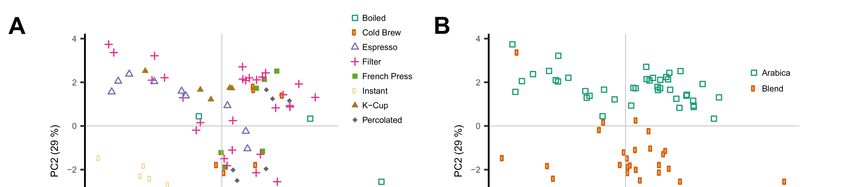
components (PC) accounted for respectively 41% and 29% of the variance in the data. Different brew
methods could be separated on the first two PCs. Instant coffee showed lower scores in both PC1 and
PC2, and espresso and K-cup coffee brews showed lower scores in PC1 when compared to all other
coffee brews (Figure 1A). Loading plots showed that PC1 was largely explained by the high levels
of the six phenolic acid esters and cafamarine, and low levels of the 5 diketopiperazines (Figure 1C).
The same score plot also showed a clear distinction between coffee brews according to the type of
coffee beans used, either Arabica or blends of Arabica and Robusta (Figure 1B). The second PC was
mainly explained by high loadings of the two feruloylquinic acid isomers, the two phenolic acid
amides, and the five diketopiperazines (Figure 1C). Caffeinated and decaffeinated coffee brews could
be differentiated along PC3 (accounting for 7.7% of the variability), a result consistent with the high
loadings of paraxanthine and theobromine on this PC (Supplementary Figure S3).
Figure 1. Principal component analysis (PCA) of constituent profiles of the 18 annotated coffee
compounds measured in 76 coffee brew samples. Data were normalized to the sum of the intensities of
all compounds. Scores and loadings on principle components PC1 and PC2 are shown. (A) Color-coding
according to the type of coffee brew; (B) color-coding according to the type of coffee beans;
(C) loading plots.
2.4. Coffee Compounds Associated with Coffee Brew Characteristics
T-tests were run to identify coffee compounds most strongly associated with roasting, the type of
coffee beans, instant coffee, and bean decaffeination (Supplementary Figure S4), showing significant
differences of the relative levels of several coffee compounds after Bonferroni correction. The three
caffeoyl esters showed lower concentrations and three diketopiperazines showed higher concentrations
in dark roasted brews when compared with medium roasted beans (Figure 2). Light roasted brewsMetabolites 2019, 9 FOR PEER REVIEW 5 of 13
concentrations
Metabolites2019, in dark
2019,9,9 17
FOR PEERroasted
REVIEWbrews when compared with medium roasted beans (Figure 2). Light
5 of 13
Metabolites 5 of 13
roasted brews could not be compared because of a low number of samples. Coffee brews prepared
with Arabica in beans
concentrations showed
dark roasted brewsrelatively high with
when compared concentrations
medium roasted of N-caffeoyltryptophan,
beans (Figure 2). Light
N-p-coumaroyltryptophan,
roasted brews could not be the two
compared feruloylquinic
because of aacid
low isomers,
number and
of
could not be compared because of a low number of samples. Coffee brews prepared theophylline
samples. Coffee when
brewscompared
prepared
with Arabica
with
with coffee
beans showed brews
Arabica prepared
beans
relatively with
showed
high blends of Arabica
relatively
concentrations ofhigh and Robusta beans of
concentrations
N-caffeoyltryptophan, (Figure 3). Instant coffees
N-caffeoyltryptophan,
N-p-coumaroyltryptophan,
were
the twoalso compared to acid
N-p-coumaroyltryptophan,
feruloylquinic all other
the coffee
two
isomers, brew samples.
feruloylquinic
and Theisomers,
acid
theophylline most compared
when discriminatingwithcompounds
and theophylline when
coffee were the
compared
brews prepared
5 diketopiperazines
with coffee brews (Figure
prepared 4). Decaffeinated
with blends of coffees
Arabica showed
and lower
Robusta intensities
beans of
(Figure theobromine
3).
with blends of Arabica and Robusta beans (Figure 3). Instant coffees were also compared to all other Instant and
coffees
cafamarine
coffee brew when
were also compared compared
samples. The most withcoffee
to all other all caffeinated
discriminating coffeeThe
brew samples. brews
compounds (Figure
most 5).
discriminating
were the compounds were the
5 diketopiperazines (Figure 4).
5 diketopiperazines (Figure 4). Decaffeinated coffees showed lower intensities of theobromine and
Decaffeinated coffees showed lower intensities of theobromine and cafamarine when compared with
cafamarine when compared with all caffeinated coffee brews (Figure 5).
all caffeinated coffee brews (Figure 5).
Figure 2. Relative concentrations of the main discriminant metabolites in dark roasted (n = 17) and
Figure 2. roasted
medium Relative(nconcentrations
= 47) coffee brew
ofsamples.
the main discriminant metabolites in dark roasted (n = 17) and
medium roasted (n = 47) coffee brewthe
Figure 2. Relative concentrations of main discriminant metabolites in dark roasted (n = 17) and
samples.
medium roasted (n = 47) coffee brew samples.
Figure 3. Relative concentrations of the main discriminant metabolites in coffee brews prepared with
Metabolites 2019, 9 FOR PEER REVIEW 6 of 13
Arabica beans
Figure 3. (n =concentrations
Relative 41) or blends of
of Arabica
the mainand Robusta beans
discriminant (n = 32).
metabolites in coffee brews prepared with
Arabica beans (n = 41) or blends of Arabica and Robusta beans (n = 32).
Figure 3. Relative concentrations of the main discriminant metabolites in coffee brews prepared with
Arabica beans (n = 41) or blends of Arabica and Robusta beans (n = 32).
Figure 4. Relative concentrations of the main discriminant metabolites in instant coffees (n = 12) and
allFigure
other 4. Relative
coffee brewconcentrations
samples (n = of the main discriminant metabolites in instant coffees (n = 12) and
64).
all other coffee brew samples (n = 64).Figure 4. Relative concentrations of the main discriminant metabolites in instant coffees (n = 12) and
Metabolites 9, 17 brew samples (n = 64).
2019,coffee
all other 6 of 13
Figure 5. Relative concentrations of the main discriminant metabolites in decaffeinated (n = 16) and
Figure 5. Relative
caffeinated concentrations
(n = 60) coffee brews. of the main discriminant metabolites in decaffeinated (n = 16) and
caffeinated (n = 60) coffee brews.
3. Discussion
3. Discussion
Coffee beans contain a wide range of phytochemicals, many of which are potentially bioactive
and Coffee
may explain
beans observed associations
contain a wide range of with health. Thesemany
phytochemicals, consist ofof chemical
which classes as diverse
are potentially bioactiveas
alkaloids,
and amino observed
may explain acids, terpenes, lipids,with
associations phenolic acids,
health. These and manyof
consist small volatiles
chemical thatas
classes contribute
diverse as to
aroma and bitterness [24]. The aim of this study was to explore the chemical profiles
alkaloids, amino acids, terpenes, lipids, phenolic acids, and many small volatiles that contribute to of a wide range of
commonly-consumed
aroma coffee
and bitterness [24]. The brews
aim ofand to study
this determine
was towhich
explorecoffee
thecharacteristics
chemical profilesmostofinfluence these
a wide range
profiles.
of Chemical profiles
commonly-consumed werebrews
coffee acquiredandusing high-resolution
to determine which mass
coffeespectrometry
characteristics and wereinfluence
most found to
vary substantially
these according
profiles. Chemical to the
profiles weretype of coffeeusing
acquired brew,high-resolution
the extent of roasting of beans, theand
mass spectrometry variety
were of
bean, and
found decaffeination.
to vary substantiallyThe data was
according to mined
the type forofknown
coffee coffee
brew, thecomponents. Eighteenofcompounds
extent of roasting beans, the
could be
variety ofannotated,
bean, andand PCA analysisThe
decaffeination. wasdata
run was
aftermined
normalization
for known overcoffee
the total solute concentration
components. Eighteen
to correct forcould
compounds variations in dilution.
be annotated, andMuchPCA of the variations
analysis was runinafterthe composition
normalization of over
thesethe18 total
compounds
solute
were driven by
concentration tothe typefor
correct of coffee brew,inwith
variations instant
dilution. coffee
Much of being clearly different
the variations from all other
in the composition types
of these
of coffee under study (Figure 1A).
18 compounds were driven by the type of coffee brew, with instant coffee being clearly different
Theother
from all analysis
typesofofthe loadings
coffee under on the(Figure
study first two1A).PCs provides clues for how to interpret these
differences. The first
The analysis PC is
of the mainly driven
loadings on the by high
first twolevels
PCs of chlorogenic
provides cluesacids
for (caffeoyl-, feruloyl-,
how to interpret and
these
p-coumaroylquinic
differences. The firstacids)
PC isand low driven
mainly levels of bydiketopiperazines (Figure 1C,
high levels of chlorogenic Figure
acids 2). Diketopiperazines
(caffeoyl-, feruloyl-, and
are cyclodipeptides formed
p-coumaroylquinic acids) by the degradation
and low levelsof of proteins contained in green
diketopiperazines coffee beans
(Figure during heat
1C, Figure 2).
treatment [25,26]. They confer a bitter taste to highly roasted coffee. In
Diketopiperazines are cyclodipeptides formed by the degradation of proteins contained in green contrast, chlorogenic acids are
largelybeans
coffee degraded
during during
heat roasting
treatment[27]. This They
[25,26]. suggests
conferthata coffee
bitter brews
taste towith low roasted
highly scores on the first
coffee. In
PC are more
contrast, highly roasted
chlorogenic acids are than coffee
largely brews with
degraded high
during scores.[27].
roasting Instant
Thiscoffee samples,
suggests whichbrews
that coffee show
particularly
with highon
low scores levels of diketopiperazines
the first PC are more highly (Figure 4), would
roasted then differ
than coffee brewsfrom
withother
high coffee brews
scores. by a
Instant
particularly high degree of roast.
The second PC of the same PCA plot is mainly driven by the variety of coffee beans used to
prepare the coffee brews. Coffee brews prepared from Arabica beans show high scores, whereas those
prepared from blends of Arabica and Robusta beans show low scores (Figure 1B). The compounds
with the highest loadings on the second PC are the two phenolic acid amides (N-caffeoyltryptophan
and N-p-coumaroyltryptophan) and the two feruloylquinic acid isomers (Figure 1C, Figure 3). This is
fully consistent with the known composition of both varieties of beans. The two phenolic acid amides
are characteristic of Robusta beans and are either not found or found at very low concentrations
in Arabica beans [28,29]. Feruloylquinic acids are known to be particularly abundant in Robusta
beans when compared with Arabica beans [29]. The low scores of the instant coffee samples on
PC2 are also consistent with the wide use of Robusta beans in the production of instant coffees
(https://www.britannica.com/topic/coffee).
The third PC was notably explained by the high negative loadings of theobromine and
paraxanthine, two known biosynthetic precursors of caffeine in the coffee plant [30]. T-tests showed inMetabolites 2019, 9, 17 7 of 13
particular relatively low levels of theobromine in decaffeinated coffee samples, as would have been
expected (Figure 5).
The present metabolomic study shows the distinct chemical compositions of the various coffee
brew samples. Several classes of coffee compounds (chlorogenic acids, phenolic acid amides,
methylxanthines, and diketopiperazines) showed large variations in their concentrations, which were
explained by the extent of bean roast, the variety of the coffee bean, and also by decaffeination.
These coffee compounds showing wide variations in their concentrations are not only abundant in
coffee but also have biological properties which contribute to explain the health effects of coffee.
In particular, chlorogenic acids were shown to exhibit a wide range of biological activities, including
indirect antioxidant effects through the induction of phase 2 enzyme activities, inhibition of DNA
methyltransferase, inhibition of platelet activities, and interference with glucose absorption [24,31,32].
Caffeine, besides its effects as a stimulant of the central nervous system, increases metabolic rate and
energy expenditure and has been used as an aid in weight loss, and may contribute to a reduced risk
of metabolic syndrome [33].
In most epidemiological studies, assessment of coffee intake is generally limited to the number
of cups of coffee consumed and sometimes whether the coffee consumed was usually caffeinated or
decaffeinated. It will be important in future epidemiological studies on coffee to accurately record
the type of coffee consumed in order to understand the impact of various types of coffee brews
(brew method, roasting, coffee beans) on disease risk. A previous cross-over study with a dark
roast and a light roast coffee brew suggested that the degree of roast may influence coffee health
effects [34]. The intake of dark roast coffee was shown to elicit stronger antioxidant effects upon human
erythrocytes and to significantly reduce body weight in pre-obese subjects when compared with light
roast coffee, which had no effect.
The use of biomarkers may also help to clarify the role of the different types of coffee brews
in disease risk in future epidemiological studies. Several biomarkers of habitual coffee intake have
been identified in blood [15,35–37]. Ratios of diketopiperazines or catechol sulfate over trigonelline
measured in serum were recently proposed as indicators of roast of coffee brews consumed in four
European countries differing in their coffee drinking habits [17].
The present study also has some limitations. Firstly, the present work is derived from the analysis
of data on 18 compounds that could be successfully annotated and analyzed with the analytical
method used in this study. Some important compounds could not be measured in this work such
as caffeine (saturated signal) or trigonelline (insufficiently retained on the chromatographic column).
A combination of several chromatographic methods would be needed for a more comprehensive
analysis of coffee compounds. Secondly, the number of annotated compounds was limited by the
limited availability of chemical standards or the lack of high-quality mass spectra. Further analytical
work would be needed for more comprehensive coverage of coffee compounds. In future studies,
it will be of particular importance to develop targeted methods of analysis to measure in human
biospecimens the coffee compounds specific to the different types of coffee brews as described here,
but also to measure all major bioactive compounds known in coffee that may explain the effects of
coffee intake on health.
4. Materials and Methods
4.1. Standards and Reagents
UPLC-grade acetonitrile and formic acid were supplied by Sigma-Aldrich (France) and
LCMS grade water was generated from a Milli-Q integral water purification system. Standards
to aid compound identification were obtained as follows: N-methyl-2-pyrrolecarboxaldehyde,
5-caffeoylquinic acid, were purchased from Sigma, France; cyclo(leucyl-prolyl) and cyclo(prolyl-valyl)
were purchased from Bachem, Switzerland; 3-caffeoylquinic acid and 3,5-dicaffeoylquinic acid
were purchased from Extrasynthese, France; and cyclo(phenylalanyl-prolyl) was purchased fromMetabolites 2019, 9, 17 8 of 13
Chem-Impex, Ilinois, US. Standards of theophylline, theobromine, paraxanthine, caffeine, and
guanosine were obtained as part of the Mass Spectrometry Metabolite Library (MSMLS) kit of standards
by IROA Technologies (Bolton, MA, USA).
4.2. Purchase and Brew of Coffee Samples
A total of 76 unique coffee samples representing a diverse range of coffee brews were brewed
or purchased in the Rockville, Maryland area, USA (Supplementary Table S2). We targeted brands
that accounted for a majority of the market share to provide the best coverage of coffee exposure.
For the ground coffees, we brewed all selections using a drip machine since this is the most common
form of preparation in the US. Then, for comparison, we brewed ground beans from the same source
(i.e., the bag) using the French Press, percolator, and cold brew methods, balancing these between
100% Arabica or blend of Arabica and Robusta, light, medium, or dark roast, and caffeinated and
decaffeinated varieties. With limited resources for analysis and countless potential combinations of
coffee types and brew methods, we focused on the most commonly consumed coffee types and brew
methods. We tried to balance the number of samples in the compared groups to prevent factors other
than the one being considered from impacting the results. Coffee brews prepared with Robusta bean
exclusively are not commonly consumed in the US and were therefore not included in this study.
Robusta beans are thus brewed as blends of Arabica and Robusta beans in proportions that are usually
not disclosed by the food manufactures.
Ground coffee samples were brewed with a BUNN®drip coffee maker with a paper filter using
50 g of ground coffee per 1893 mL of tap water (i.e., 5 g ground coffee per 177 mL cup of tap water).
The drip coffee machine heated the water to approximately 200 ◦ F (93 ◦ C). French Press coffees were
brewed using 23 g of ground coffee per 798 mL of tap water. Water was on average 190 ◦ F (88 ◦ C) upon
pouring, and French Press brews were left to steep at room temperature for 3 minutes. Percolated
coffee was brewed using a Presto®Coffee Maker with a paper filter as described by the manufacturer
using 40 g of ground coffee per 1183 mL of tap water. The Presto®coffee maker heated the water
to approximately 200 ◦ F (93 ◦ C). Cold brew coffee concentrates were brewed using 24 g of ground
coffee per 89 mL of tap water and were left in the refrigerator overnight. After 19 h, cold brew coffee
concentrates were filtered using a paper filter and were then diluted using a 1:3 ratio of concentrate to
tap water (i.e., 17 g ground coffee per 177 mL of tap water).
K-cups were brewed using pods made for Keurig®coffee machines, each containing 10 g of coffee
grounds and brewed with 177 mL tap water heated to approximately 192 ◦ F (89 ◦ C). Three types of
espresso were brewed using a Nespresso®machine with pods containing 6 g of ground coffee and
approximately 74 mL of water. Twelve unique types of instant coffee were prepared from single-serving
sachets containing 2 g of powdered coffee and 177 mL tap water heated to approximately 183 ◦ F
(84 ◦ C). Espresso brews were purchased from national chains serving coffee. Turkish and Greek boiled
coffees were brewed per package instructions with 6 g of coffee grounds per 59 mL of tap water, which
was heated to approximately 190 ◦ F (88 ◦ C) prior to pouring.
All coffees were brewed or purchased in triplicate. The triplicate preparations were combined to
make a single pooled sample for each coffee type to limit the total number of analyses. Coffee samples
were cooled and stored in a refrigerator, and two aliquots of each pooled sample were transferred to
a −80 ◦ F freezer within 6 hours of brewing. Two coffee samples were aliquoted 13 times each and
used as blinded QCs for the monitoring of analytical repeatability. QC1 consisted of replicate samples
of a medium roast, decaffeinated, 100% Arabica coffee, and QC2 of replicate samples of a dark roast,
caffeinated, Arabica/Robusta blend coffee.
4.3. Untargeted Chemical Profiling of Coffee Samples Using Liquid Chromatography-Mass Spectrometry
Coffee samples were thawed and agitated, and an aliquot of each was placed in Eppendorf tubes.
Samples were centrifuged at 120× g for 10 min to separate each into a particulate pellet, with the clear
aqueous portion and any fat from the coffee resting on top. Any fatty supernatant (in three instantMetabolites 2019, 9, 17 9 of 13
coffee samples containing powdered milk) was first removed using a micro-spatula and a portion
of the aqueous fraction was then taken, diluted 50-fold in water, and transferred to glass vials for
instrumental analysis in a randomized order. An equal mixture of all coffee samples was also made
and used as a pooled quality control (QC) sample. This QC was placed in the injection sequence after
every 10 study samples, giving a total of 18 replicates. In addition, six aqueous methanol blanks were
placed in the injection sequence after every 20 study samples, giving a total of 6 replicates, and blinded
QC samples (2 × 13 samples) were randomly distributed across the sample batch. With column
conditioning QCs, a total of 200 samples were thus injected into the instrument, requiring three 96-well
injection plates.
Coffee brews were analyzed directly using liquid chromatography coupled to a time-of-flight
mass spectrometer (LC-MS). The instrument used was an Agilent 1290 Binary LC system coupled
to an Agilent 6550 quadrupole time-of-flight (QTOF) mass spectrometer with jet steam electrospray
ionization source. Samples (2 µL) were injected onto a reversed-phase C18 column (ACQUITY UPLC
HSS T3 2.1 × 100 mm, 1.8 µm, Waters) maintained at 45 ◦ C. The mobile phase used was a mixture of
ultrapure water and LC-MS grade methanol. A linear gradient made of ultrapure water (eluant A)
and LC-MS grade methanol (eluant B) was used for elution: 0–100% B from 0–6 min, 100% B from
6–10.5 min, and 5% B for the remainder of the 13-min run. The mass spectrometer was operated in
positive ionization mode and ions were detected across a mass range of 50–1000 daltons. Agilent Mass
Hunter software and a recursive two-stage extraction pass were used to align and extract mass spectral
data. First, all possible molecular features were extracted from every sample, and masses and retention
times aligned according to tolerance windows of 15 ppm and 0.1 min, respectively. The resulting
list was then used as a target for a second recursive extraction, which enabled features closer to the
noise floor to be picked up. The result of this molecular feature extraction was a table of 3670 spectral
features aligned across samples by mass to charge ratio (m/z) and retention time with accompanying
relative intensities (peak areas).
4.4. Mining of Untargeted Metabolomic Data for Known Coffee Compounds
Untargeted profile data acquired by LC-MS were mined for known coffee components. Firstly,
chemical formulae and exact masses of as many known coffee components as possible were collected
from online resources such as the Dictionary of Food Ingredients, Duke’s Phytochemical and
Ethnobotanical database (www.phytochem.nal.usda.gov) and FooDB (www.foodb.ca). Data was
collected for around 500 organic compounds (348 formulae). All formulae were then searched for
directly in the raw data files of pooled QC samples using the Agilent Quantitative Analysis Find by
Formula algorithm. This algorithm sums signals from different ion species to generate a peak for each
formula. Peaks were found corresponding to 115 formulae matching those of the coffee compounds.
In some cases, multiple peaks at different retention times were retained for the same formula.
Subsequently, 88 groups of peaks potentially corresponding to known coffee compounds remained
and were checked for acceptable peak shapes and consistent retention times. An Agilent Personal
Compound Database and Library (PCDL), populated using these masses and retention times, was then
used as the target for further extraction using the Find by Formula algorithm on the 76 coffee
samples. The resulting groups of peaks were carefully screened for inclusion. A total of 24 of
these putative coffee compounds were then excluded due to detector saturation (caffeine only),
large peaks in the injected blanks, missing peaks in >25% samples, or high coefficient of variation
(>30%) in pooled or blinded QCs. For the remaining 64 peaks (Supplementary Table S1; Supplementary
Spreadsheet), mass spectral data were mined to confirm the initial hypotheses or, if disproved, generate
alternative hypotheses. Annotations were thus made taking into account inter-compound correlations
(Supplementary Figure S5), and each attributed a level of confidence for annotation [23]. Level 1
corresponding to confirmed structure, based on comparison of retention time and MS/MS match
with those of an authentic chemical standard. For level 2, no standard was available or analyzed,
and probable identification was based on physicochemical properties, isotope pattern, and MS/MSMetabolites 2019, 9, 17 10 of 13
spectra. For level 3, the tentative structure was based on comparison with a structurally related
compound in the same chemical class and characteristic fragments in MS/MS spectra. For level 4,
the tentative annotation was based on the unequivocal molecular formula. Level 5 correspond to
unknown compounds. When no chemical standard was available, experimental MS/MS spectra were
compared to library spectra in databases such as HMDB [38] and Metlin [39]. If MS/MS data were
not available (for example, where the intensity of the [M + H]+ ion was low), retention time only was
used. If identities could not be confirmed by retention time or MS/MS spectra matching, the assigned
identity was regarded as hypothetical (level 4). Technical reproducibility of the semi-quantitative
measurements of peak areas is shown for annotated compounds in Supplementary Table S3 for the
pooled QC samples and blinded duplicate QC samples.
4.5. Statistical Analysis
The untargeted feature table was first filtered to remove any features present in one or two
samples only. All other features were retained. Multivariate data were log2 transformed and Pareto
scaled, and constituent profiles were explored by performing a principal component analysis (PCA) on
multivariate data for all unique brews (n = 76). The variability in the untargeted profile explained by
each factor was then determined using principal component partial R-square (PC-PR2) multivariable
regression [40]. The covariates included in the models were the brew method, bean type, roast, caffeine
type, injection order, and injection plate.
The effect of the most influential brew parameters on the profiles of 18 annotated compounds was
then investigated using PCA for all 76 brews. Data were first normalized to total intensity (sum of all
detected compounds; Supplementary Figure S2) to remove the effect of differing brew strengths from
the analysis [41] and were log-transformed. Loadings were calculated to determine which compounds
or groups of compounds contributed most to the largest principal components (PC) of variation.
An unpaired Student’s t-test was used to assess differences between different coffee subgroups (dark
vs. medium roast, Arabica beans vs. blend, instant coffee vs other brew methods, regular coffee vs.
decaffeinated coffee) for the 18 identified metabolites. Bonferroni-corrected p-values below 0.05 were
considered significant. The PCA and PC-PR2 models were fit using R open-source statistical software.
All analyses were performed using R software version 3.4.4 [42].
5. Conclusions
There is a high demand for better understanding of the health benefits or risks associated with
the consumption of coffee, one of the most widely consumed beverages in the world. The coffee
composition is highly variable, depending on coffee brew method, bean variety, level of roast
and decaffeination. However, it is still unclear how these parameters affect coffee bioactivity and
associations with disease. The current study is the first to compare the chemical profiles of the main
types of coffee consumed in the USA and to identify factors that contribute to this variation. It is hoped
that the results presented here will contribute to better estimations of coffee intake in epidemiological
studies and to clarify the relationship with disease.
Supplementary Materials: The following are available online at http://www.mdpi.com/2218-1989/9/1/17/s1:
Table S1: Brewed or purchased coffee samples and their characteristics, Table S2: Summary of mass spectral data
supporting peak annotations in coffee brews, Table S3: Coefficients of variation for the coffee compounds identified
or tentatively identified, Figure S1: Heatmap showing correlations between annotated coffee compounds, Figure
S2: Boxplots showing means of sums of total intensities of mass spectrometry signals (n = 3670) for each type of
coffee brews, Figure S3: PC-PR2 analysis of metabolomic data from the coffee brew samples, Figure S4: Principal
component analysis of constituent profiles of the 18 annotated coffee compounds measured in 76 coffee brew
samples, Figure S5: T-tests comparing different groups of coffee brew samples. Dark line indicates the limit for
significant difference after Bonferroni correction.
Author Contributions: Conceptualization, E.L., N.F., A.S. and R.S.; methodology, J.A.R, E.L., N.F. and A.S.; formal
analysis, J.A.R., E.L. and R.W.; investigation, J.A.R., E.L. and C.K.; writing—original draft preparation, J.A.R. and
A.S.; writing—review and editing, E.L., N.F., A.S. and R.S.; visualization, R.W.; supervision, N.F., A.S. and R.S.;
funding acquisition, R.S. All authors read and approved the final manuscript.Metabolites 2019, 9, 17 11 of 13
Funding: This work was supported by the National Cancer Institute, Bethesda, USA.
Conflicts of Interest: All authors declare no conflicts of interest.
Abbreviations
PCA, principal component analysis; PC, principal component; QC, quality control; LC-MS, liquid
chromatography-mass spectrometry.
References
1. Loftfield, E.; Freedman, N.D.; Graubard, B.I.; Guertin, K.A.; Black, A.; Huang, W.-Y.; Shebl, F.M.; Mayne, S.T.;
Sinha, R. Association of Coffee Consumption With Overall and Cause-Specific Mortality in a Large US
Prospective Cohort Study. Am. J. Epidemiol. 2015, 182, 1010–1022. [CrossRef] [PubMed]
2. Je, Y.; Giovannucci, E. Coffee consumption and total mortality: A meta-analysis of twenty prospective cohort
studies. Br. J. Nutr. 2014, 111, 1162–1173. [CrossRef]
3. Gunter, M.J.; Murphy, N.; Cross, A.J.; Dossus, L.; Dartois, L.; Fagherazzi, G.; Kaaks, R.; Kuhn, T.; Boeing, H.;
Aleksandrova, K.; et al. Coffee Drinking and Mortality in 10 European Countries: A Multinational Cohort
Study. Ann. Intern. Med. 2017, 167, 236–247. [CrossRef] [PubMed]
4. Park, S.Y.; Freedman, N.D.; Haiman, C.A.; Le Marchand, L.; Wilkens, L.R.; Setiawan, V.W. Association
of Coffee Consumption With Total and Cause-Specific Mortality Among Nonwhite Populations.
Ann. Intern. Med. 2017, 167, 228–235. [CrossRef] [PubMed]
5. Van Dam, R.M.; Hu, F.B. Coffee consumption and risk of type 2 diabetes—A systematic review. JAMA 2005,
294, 97–104. [CrossRef] [PubMed]
6. Grosso, G.; Micek, A.; Godos, J.; Sciacca, S.; Pajak, A.; Martinez-Gonzalez, M.A.; Giovannucci, E.L.; Galvano, F.
Coffee consumption and risk of all-cause, cardiovascular, and cancer mortality in smokers and non-smokers:
A dose-response meta-analysis. Eur. J. Epidemiol. 2016, 31, 1191–1205. [CrossRef] [PubMed]
7. Sang, L.X.; Chang, B.; Li, X.H.; Jiang, M. Consumption of coffee associated with reduced risk of liver cancer:
A meta-analysis. BMC Gastroenterol. 2013, 13, 34. [CrossRef]
8. Lai, G.Y.; Weinstein, S.J.; Albanes, D.; Taylor, P.R.; McGlynn, K.A.; Virtamo, J.; Sinha, R.; Freedman, N.D.
The association of coffee intake with liver cancer incidence and chronic liver disease mortality in male
smokers. Br. J. Cancer 2013, 109, 1344–1351. [CrossRef]
9. Zhou, Q.; Luo, M.-L.; Li, H.; Li, M.; Zhou, J.-G. Coffee consumption and risk of endometrial cancer:
A dose-response meta-analysis of prospective cohort studies. Sci. Rep. 2015, 5, 13410. [CrossRef]
10. Gunter, M.J.; Schaub, J.A.; Xue, X.N.; Freedman, N.D.; Gaudet, M.M.; Rohan, T.E.; Hollenbeck, A.R.; Sinha, R.
A prospective investigation of coffee drinking and endometrial cancer incidence. Int. J. Cancer 2012, 131,
E530–E536. [CrossRef]
11. Poole, R.; Kennedy, O.J.; Roderick, P.; Fallowfield, J.A.; Hayes, P.C.; Parkes, J. Coffee consumption and health:
Umbrella review of meta-analyses of multiple health outcomes. BMJ 2017, 359, j5024. [CrossRef] [PubMed]
12. Caprioli, G.; Cortese, M.; Sagratini, G.; Vittori, S. The influence of different types of preparation (espresso and
brew) on coffee aroma and main bioactive constituents. Int. J. Food Sci. Nutr. 2015, 66, 505–513. [CrossRef]
[PubMed]
13. Niseteo, T.; Komes, D.; Belscak-Cvitanovic, A.; Horzic, D.; Budec, M. Bioactive composition and antioxidant
potential of different commonly consumed coffee brews affected by their preparation technique and milk
addition. Food Chem. 2012, 134, 1870–1877. [CrossRef] [PubMed]
14. Ciaramelli, C.; Palmioli, A.; Airoldi, C. Coffee variety, origin and extraction procedure: Implications for
coffee beneficial effects on human health. Food Chem. 2019, 278, 47–55. [CrossRef] [PubMed]
15. Rothwell, J.A.; Fillâtre, Y.; Martin, J.-F.; Lyan, B.; Pujos-Guillot, E.; Fezeu, L.; Hercberg, S.; Comte, B.; Galan, P.;
Touvier, M.; et al. New Biomarkers of Coffee Consumption Identified by the Non-Targeted Metabolomic
Profiling of Cohort Study Subjects. PLoS ONE 2014, 9, e93474. [CrossRef] [PubMed]
16. Edmands, W.M.; Ferrari, P.; Rothwell, J.A.; Rinaldi, S.; Slimani, N.; Barupal, D.K.; Biessy, C.; Jenab, M.;
Clavel-Chapelon, F.; Fagherazzi, G.; et al. Polyphenol metabolome in human urine and its association with
intake of polyphenol-rich foods across European countries. Am. J. Clin. Nutr. 2015, 102, 905–913. [CrossRef]
[PubMed]Metabolites 2019, 9, 17 12 of 13
17. Rothwell, J.A.; Keski-Rahkonen, P.; Robinot, N.; Assi, N.; Casagrande, C.; Jenab, M.; Ferrari, P.;
Boutron-Ruault, M.C.; Mahamat-Saleh, Y.; Mancini, F.R.; et al. A metabolomic study of biomarkers of
habitual coffee intake in four European countries. Mol. Nutr. Food Res. 2019. Submitted.
18. Alves, R.C.; Casal, S.; Oliveira, M.B.P.P. Tocopherols in coffee brews: Influence of coffee species, roast degree
and brewing procedure. J. Food Comp. Anal. 2010, 23, 802–808. [CrossRef]
19. Becalski, A.; Halldorson, T.; Hayward, S.; Roscoe, V. Furan, 2-methylfuran and 3-methylfuran in coffee on
the Canadian market. J. Food Comp. Anal. 2016, 47, 113–119. [CrossRef]
20. Fujioka, K.; Shibamoto, T. Chlorogenic acid and caffeine contents in various commercial brewed coffees.
Food Chem. 2008, 106, 217–221. [CrossRef]
21. Marcucci, C.T.; Benassi, M.d.T.; Almeida, M.B.; Nixdorf, S.L. Trigonelline, 5-caffeoylquinic acid, cafeine and
melanoidins levels in commercial Brazilian instant coffees (portuguese). Química Nova 2013, 36, 544–548.
[CrossRef]
22. Clifford, M.N. Chlorogenic acids and other cinnamates—Nature, occurence and dietary burden. J. Sci.
Food. Agric. 1999, 79, 362–372. [CrossRef]
23. Schymanski, E.L.; Jeon, J.; Gulde, R.; Fenner, K.; Ruff, M.; Singer, H.P.; Hollender, J. Identifying Small
Molecules via High Resolution Mass Spectrometry: Communicating Confidence. Environ. Sci. Technol. 2014,
48, 2097–2098. [CrossRef] [PubMed]
24. Ludwig, I.A.; Clifford, M.N.; Lean, M.E.J.; Ashihara, H.; Crozier, A. Coffee: Biochemistry and potential
impact on health. Food Funct. 2014, 5, 1695–1717. [CrossRef] [PubMed]
25. Ginz, M.; Engelhardt, U.H. Identification of Proline-Based Diketopiperazines in Roasted Coffee. J. Agric.
Food Chem. 2000, 48, 3528–3532. [CrossRef]
26. Ginz, M.; Engelhardt, U.H. Identification of new diketopiperazines in roasted coffee. Eur. Food Res. Technol.
2001, 213, 8–11. [CrossRef]
27. Lang, R.; Yagar, E.F.; Wahl, A.; Beusch, A.; Dunkel, A.; Dieminger, N.; Eggers, R.; Bytof, G.; Stiebitz, H.;
Lantz, I.; et al. Quantitative studies on roast kinetics for bioactives in coffee. J. Agric. Food Chem. 2013, 61,
12123–12128. [CrossRef]
28. Okada, H.; Murata, M.; Ohyazu, K.; Homma, S. Distinction between Arabica and Robusta Coffee Beans by
Hydroxycinnamic Acid Derivatives, Especially by p-Coumaroyltryptophan. Food Sci. Technol. Int. Tokyo
1997, 3, 205–209. [CrossRef]
29. Garrett, R.; Vaz, B.G.; Hovell, A.M.C.; Eberlin, M.N.; Rezende, C.M. Arabica and Robusta Coffees:
Identification of Major Polar Compounds and Quantification of Blends by Direct-Infusion Electrospray
Ionization-Mass Spectrometry. J. Agric. Food Chem. 2012, 60, 4253–4258. [CrossRef]
30. Ashihara, H. Metabolism of alkaloids in coffee plants. Braz. J. Plant Physiol. 2006, 18, 1–8. [CrossRef]
31. Palmioli, A.; Ciaramelli, C.; Tisi, R.; Spinelli, M.; De Sanctis, G.; Sacco, E.; Airoldi, C. Natural Compounds in
Cancer Prevention: Effects of Coffee Extracts and Their Main Polyphenolic Component, 5-O-Caffeoylquinic
Acid, on Oncogenic Ras Proteins. Chem. Asian J. 2017, 12, 2457–2466. [CrossRef] [PubMed]
32. Liang, N.; Kitts, D.D. Role of Chlorogenic Acids in Controlling Oxidative and Inflammatory Stress Conditions.
Nutrients 2015, 8, 16. [CrossRef] [PubMed]
33. Heckman, M.A.; Weil, J.; Gonzalez de Mejia, E. Caffeine (1,3,7-trimethylxanthine) in foods: A comprehensive
review on consumption, functionality, safety, and regulatory matters. J. Food Sci. 2010, 75, R77–R87.
[CrossRef] [PubMed]
34. Kotyczka, C.; Boettler, U.; Lang, R.; Stiebitz, H.; Bytof, G.; Lantz, I.; Hofmann, T.; Marko, D.; Somoza, V.
Dark roast coffee is more effective than light roast coffee in reducing body weight, and in restoring red blood
cell vitamin E and glutathione concentrations in healthy volunteers. Mol. Nutr. Food Res. 2011, 55, 1582–1586.
[CrossRef] [PubMed]
35. Guertin, K.A.; Loftfield, E.; Boca, S.M.; Sampson, J.N.; Moore, S.C.; Xiao, Q.; Huang, W.-Y.; Xiong, X.;
Freedman, N.D.; Cross, A.J.; et al. Serum biomarkers of habitual coffee consumption may provide insight
into the mechanism underlying the association between coffee consumption and colorectal cancer. Am. J.
Clin. Nutr. 2015, 101, 1000–1011. [CrossRef] [PubMed]
36. Rothwell, J.; Madrid-Gambin, F.; Garcia-Aloy, M.; Gao, Q.; Andres-Lacueva, C.; Logue, C.; Gallagher, A.M.;
Mack, C.; Kulling, S.; Dragsted, L.; et al. Biomarkers of intake for coffee, tea and sweetened beverages.
Genes Nutr. 2018, 13, 15. [CrossRef] [PubMed]Metabolites 2019, 9, 17 13 of 13
37. Midttun, Ø.; Ulvik, A.; Nygård, O.; Ueland, P.M. Performance of plasma trigonelline as a marker of coffee
consumption in an epidemiologic setting. Am. J. Clin. Nutr. 2018, 107, 941–947. [CrossRef] [PubMed]
38. Wishart, D.S.; Feunang, Y.D.; Marcu, A.; Guo, A.C.; Liang, K.; Vázquez-Fresno, R.; Sajed, T.; Johnson, D.;
Li, C.; Karu, N.; et al. HMDB 4.0: The human metabolome database for 2018. Nucl. Acids Res. 2017.
[CrossRef]
39. Tautenhahn, R.; Böttcher, C.; Neumann, S. Annotation of LC/ESI-MS Mass Signals. Lect. Notes Comput. Sci.
2007, 4414, 371–380.
40. Fages, A.; Ferrari, P.; Monni, S.; Dossus, L.; Floegel, A.; Mode, N.; Johansson, M.; Travis, R.; Bamia, C.;
Sánchez-Pérez, M.-J.; et al. Investigating sources of variability in metabolomic data in the EPIC study:
The Principal Component Partial R-square (PC-PR2) method. Metabolomics 2014, 10, 1074–1083. [CrossRef]
41. Warrack, B.M.; Hnatyshyn, S.; Ott, K.H.; Reily, M.D.; Sanders, M.; Zhang, H.Y.; Drexler, D.M. Normalization
strategies for metabonomic analysis of urine samples. J. Chromatogr. B-Anal. Technol. Biomed. Life Sci. 2009,
877, 547–552. [CrossRef] [PubMed]
42. R_Core_Team. R: A Language and Environment for Statistical Computing; R Foundation for Statistical
Computing: Vienna, Austria, 2018.
© 2019 by the authors. Licensee MDPI, Basel, Switzerland. This article is an open access
article distributed under the terms and conditions of the Creative Commons Attribution
(CC BY) license (http://creativecommons.org/licenses/by/4.0/).You can also read


