Assessing the Readiness of Future Network Cyber Infrastructure in Malaysia- Part-1: Survey Data Analysis
←
→
Page content transcription
If your browser does not render page correctly, please read the page content below
Technical Report TR 2018-04-01
                     Internetworking and Media Communications Research Laboratories
                           Department of Computer Science, Kent State University
                               http://medianet.kent.edu/technicalreports.html

  Assessing the Readiness of Future Network Cyber
   Infrastructure in Malaysia– Part-1: Survey Data
                      Analysis

                                             April 2018
                                              Draft 1.0

                                   Javed I. Khan, Ph.D.
                                  Professor and Director
                       Media Communications & Networking Laboratory
                              Department of Computer Science
                                Kent State University, Ohio

Study Commissioned by Malaysian Communications and Multimedia Commission (MCMC), Government
of Malaysia, and Supported by The Malaysian-American Commission on Education Exchange (MACEE)
   & Fulbright Senior Specialist Program, Fulbright Commission, US Department of State, 2017-2018.
Technical Report TR 2018-04-01
                      Internetworking and Media Communications Research Laboratories
                      Department of Computer Science, Kent State University
                      http://medianet.kent.edu/technicalreports.html

Table of Contents
1.      Background............................................................................................................................................ 3
     1.1.       Scope............................................................................................................................................. 3
     1.2.       Objective ....................................................................................................................................... 3
2.      Study Introduction ................................................................................................................................. 3
     2.1.       Celcom .......................................................................................................................................... 4
     2.2.       Digi Telecommunications ............................................................................................................. 4
     2.3.       Maxis Broadband .......................................................................................................................... 4
     2.4.       Telekom Malaysia......................................................................................................................... 5
     2.5.       U Mobile ....................................................................................................................................... 5
     2.6.       MIMOS......................................................................................................................................... 5
     2.7.       Universiti Putra Malaysia (UPM)/WiPNET ................................................................................. 5
3.      Network ................................................................................................................................................. 6
4.      Level of Sharing in NCI Infrastructure .................................................................................................. 9
     4.1.       Infrastructure Used From Market.................................................................................................. 9
     4.2.       Level of Infrastructure we Contributed to The market.................................................................11
5.      Spectrum Bands ....................................................................................................................................11
     5.1.       Spectrum Bands and Estimated RBS Count and Estimated Traffic TB.......................................12
     5.2.       Equipment Infrastructure Capability............................................................................................15
6.      Network Performance ...........................................................................................................................17
     6.1.       A.9 Network Health within Malaysia ..........................................................................................17
7.      Nature of Data and Growth...................................................................................................................18
     7.1.       Total Data of our customer we carried over backhaul network (ZB/year)...................................18
     7.2.       Total Data of our customer we moved in/out internationally (ZB/year) ......................................18
     7.3.       Data usage per year – total data of our customer we carried........................................................19
     7.4.       Public Data Center Raw Storage..................................................................................................19
     7.5.       Data Center Traffic (EB)..............................................................................................................20
8.      Efforts in Future Network.....................................................................................................................20
     8.1.       Plans and Expected Timeline for Future Network .......................................................................20
     8.2.       To Use 5G Spectrum....................................................................................................................21
     8.3.       To Expand Data Center and engage Public Cloud .......................................................................22
     8.4.       To Deploy/ Enhance NFV/SDN...................................................................................................23
     8.5.       To Support IoT Device ................................................................................................................23
9.      Challenges and Suggestions..................................................................................................................24
     9.1.       To Use 5G Spectrum and Roll Out 5G ........................................................................................24
     9.2.       To Expand Data Center and engage Public Cloud .......................................................................24
     9.3.       To Deploy/ Enhance NFV/SDN...................................................................................................24
     9.4.       To Support IoT Devices ...............................................................................................................24

Malaysia Future Network- Part 1/Survey                                          1
Technical Report TR 2018-04-01
Internetworking and Media Communications Research Laboratories
Department of Computer Science, Kent State University
http://medianet.kent.edu/technicalreports.html
9.5. Collaboration................................................................................................................................25
10. Summary of Findings and Recommendations..................................................................................25
11. References: .......................................................................................................................................25
Malaysia Future Network- Part 1/Survey 2Technical Report TR 2018-04-01
Internetworking and Media Communications Research Laboratories
Department of Computer Science, Kent State University
http://medianet.kent.edu/technicalreports.html
1.BACKGROUND
Good national communication networks infrastructure (NCI) provides Malaysians with the
facilities they need to participate fully in the global digital society and benefit from the digital
economy and opportunities it brings in terms of employment, innovation, creative expression and
social inclusion. From the technological perspective, artificial intelligence (AI), 5G, internet of
things (IoT) and big data are some of the components of future network that will usher Malaysia
towards becoming a smart digital nation. In light of this, the MCMC invited this independent study
to determine the current state of communication and multimedia infrastructure in Malaysia and
review the future network readiness of our country.
1.1. SCOPE
There are 4 main objectives of the project:
Assess readiness – propose methodology(s) that could assess the future readiness of our current
networks platform in supporting the ubiquitous digital and electronics services.
Identify challenges and opportunities – gather information from relevant stakeholders to identify
where are the gaps and challenges and as well as new opportunities, that arises in deploying
emerging technologies for the future network.
Establish future network requirements – determine the necessary elements to make Malaysia
future ready towards becoming a smart digital nation.
Facilitate stakeholders – analyze how MCMC can assist the stakeholders in achieving the
communication and multimedia objectives of the 11th Malaysia Plan as well as our National Policy
Objectives.
1.2. OBJECTIVE
It is envisaged that the project will promote strategic assessment of networks planning,
development and monitoring and enhance MCMC’s Communications and Digital Ecosystem
Sector’s opportunities for engagement and collaboration with key stakeholders to provide greater
impetus for the movement towards developing a national strategy to balance investments in
technology and infrastructure with investments in the skills and knowledge Malaysian need to use
ICTs to improve the quality of their lives, increase productivity throughout the private and public
sectors and develop innovative products and services.
The outcome from the project is intended to form part of the collective body of knowledge
and information resources needed to support the Technology Development Department’ s
advocacy role on emerging and future networks specifically, as well as MCMC’s role in
handling the many complex challenges in regulating and managing the ICT impacts of on society.
2.STUDY INTRODUCTION
The study was commissioned in the summer of 2017. The study benefits from an extensive an
extensive on the ground fact finding effort. A suggested study team was formed with officers from
MCMC’s Technology Development Department and lead by the author. The author also suggested
that fact finding consultation with a national telecommunication focus group. MCMC contacted
the key stakeholders. The proposed focus group included five communication provider
organizations. These providers are deemed by MCMC as the main players in Malaysia’s
telecommunication industry. Together these companies represent 80% of Malaysia’s current
telecommunication industry by revenue and they also manages 80% of commercial radio spectrum.
It was also participated by a national research organizations MIMOS and the University Putra
Malaysia’s (UPM) next generation telecommunication systems research groups. The study team
Malaysia Future Network- Part 1/Survey 3Technical Report TR 2018-04-01
Internetworking and Media Communications Research Laboratories
Department of Computer Science, Kent State University
http://medianet.kent.edu/technicalreports.html
took a three pronged approach. First are the discussion and knowledge. Half day meetings were
conducted with the focus group organizations. The author also met area specialist from MCMC.
More than 50 Malaysia experts- including executives, planners and engineers, from the regulatory
experts, academics, and researchers made presentations, provided both issue specific presentations,
and participated in open format intensive discussion sessions. Each group provided their insight
into the issues through discussion on topics including the a) current state of telecommunication
infrastructure, b) about their vision, plan and activities on 5G, b) services for smart community, c)
Internet of Things (IoT), d) network virtualization, and e) data centers and cloud services.
Secondly, a national seminar on Future Network for Smart Digital Malaysia was conducted. It was
participated by 200 experts from all the stakeholder organizations from industry, academia, and
government. Third a written survey instrument was designed and distributed to the focus group
organizations. This document summarizes the findings of the written survey and also insights
received from the surveys. A second associated document to provide the technical assessment and
recommendations. The authors would like to thank the companies and in particulars their expert
groups for their input. Below is a short profile of the organizations.
2.1. CELCOM
Celcom reported to be Malaysia’s leading data network provider, with the largest mobile
broadband and corporate services provider. With almost 10 million customers, Celcom is part of
the Axiata Group of Companies, one of the world’s largest telecommunications company with close
to 300 million customers across 10 Asian markets.
Celcom’s Head of Network Surveillance Mr. Zaharuddin Aman was the key presenter at the
Knowledge Sharing Session, with other participants including personnel from Network, Corporate
Strategy and Regulatory Divisions. The Future Network Focus Group Team comprises of
personnel from Network, Corporate Strategy and Regulatory Divisions, with Mr. Low Kien Yap
as the team contact.
2.2. DIGI TELECOMMUNICATIONS
Digi Telecommunications is a mobile communication company engaged in the establishment,
maintenance and provision of telecommunication and related services. Digi reported to be the first
telecommunication industry to launch and operate a fully digital cellular network in Malaysia. Digi
has provided a variety of mobile communication services including voice under prepaid and
postpaid plans, SMS, data plans and services, international roaming, international calling card,
WAP services and so on. Digi mission is to provide customer specific solutions to meet individual
needs for communications, connectivity and access to information and security.
Siti Fauziah of Regulatory, Adam Azlam of Sustainability, and Soam Chin Choon of Core
Network Technology were presenters at the knowledge sharing session. The rest of the participants
includes the regulatory team, technology team, and corporate team, with Fami Abdul Hamid,
Regulatory Corporate Affairs, as team contact.
2.3. MAXIS BROADBAND
Maxis reported to have the widest LTE coverage of 88% population coverage nationwide,
fastest LTE speed of average 30 Mbps and best mobile streaming experience which they received
a 4 star rating national wide including Sabah and Sarawak according to a YouTube video checkup.
Maxis reported that its customers enjoy a superior experience when making voice calls and text,
and immerse themselves in an ever expanding universe of connected applications on the most
advanced cellular network, encompassing 3G and 4G LTE technologies.
Malaysia Future Network- Part 1/Survey 4Technical Report TR 2018-04-01
Internetworking and Media Communications Research Laboratories
Department of Computer Science, Kent State University
http://medianet.kent.edu/technicalreports.html
Lam Leong Kien, Senior Specialist, Regulatory, Tan Cheng Peng, Head of Technology,
Strategy and Planning, and Chai Ming Ching, Head of IoT were presenters during the knowledge
sharing session. Other participants included Mohd Edymainoe Mohd Noh, and Siti Noraini Abd
Rahman. The Future Network Focus Group Team consists of Mariappan Chanachayai, Chai Ming
Ching, Mohd Edymainoe Mohd Noh, Lam Leong Kien, and Siti Noraini Abd Rahman as the team
contact.
2.4. TELEKOM MALAYSIA
Telekom Malaysia Berhad (TM) is Malaysia’s reported to be the convergence champion and
number one converged communications services provider, which offers a comprehensive range of
communication services and solutions in broadband, data and fixed-line. TM have 2.36 million
broadband customers, 2.7 million HSBB ports nationwide, and 1 million UniFi customers.
Mr. Mohd Fakruzzaki Hanafi, AGM SDN Development and Integration, Teh Keng Hoe,
Director Solution Planning, Mohd Zafir, Manager RF Planning, and Chu Chin Huei, Manager
Business Analyst were presenters during Knowledge Sharing session. Other participants were
Arief Khalid Supian, and Amiza Zainol Abidin. Telekom Malaysia did not have a Focus Network
Group team.
2.5. U MOBILE
UMobile reported to be one of the newer mobile telecommunications service providers, with its
vision focused on simplifying and improving lives while delivering best in class customer
experience. It is currently operating with frequencies in the 2100 and 2600 bands, providing 3G
and LTE services, and as a result of the spectrum re-farming process, is also progressively
expanding its network on the 1800 and 900 bands. UMobile’s active subscribers grew from 540,000
in 2012 to 5 million in 2017.
Mr. Tai Koon Sun, Khoo Poh Hean, and Mohd Fuad Romelli of UMobile were presenters during
the knowledge sharing session. Other participants were Liew Wai Ming, and Noor Wahida Abu
Bakar.
2.6. MIMOS
MIMOS is a leader in ICT innovations, pioneering new market creations for partners through
patentable technologies for economic growth. With firm government support, MIMOS has been
focusing on market-driven R&D areas to ensure our technologies are commercially available for
sustained growth. To date, they have contributed to the ICT landscape through development of
more than 20 technology prototypes and transfer of 19 technology platforms to 23 technology
recipients.
Dr. Hafizal Mohamad, Senior Staff Researcher is the presenter during knowledge sharing
session, with Dr. Nordin Ramli as the other participant. The Future Network Focus group consists
of Drs. Nordin Ramli, Mohd Ariff Abdullah, Ahmad Zaki Abu Bakar, Azrulmukmin Azmi, and
Hafizal Mohamad as the team contact.
2.7. UNIVERSITI PUTRA MALAYSIA (UPM)/WIPNET
Associate Professor Dr. Shaiful Jahari Hasim, WiPNet member is the presenter at knowledge
sharing session, with Associate Professor Ir Dr. Aduwati Sali, Associate Professor Dr. Raja
Syamsul Azmir Raja Abdullah, Associate Professor Dr. Sharifah Mumtazah, Dr. Makhfudzah
Malaysia Future Network- Part 1/Survey 5Technical Report TR 2018-04-01
Internetworking and Media Communications Research Laboratories
Department of Computer Science, Kent State University
http://medianet.kent.edu/technicalreports.html
Mohktar, and research officer Aziz Md Ali as participants. The Future Network Focus Group
consists of Dr. Mohd Hanif Yaacob, Associate Professor Ir Dr Aduwati Sali, Professor Dr Mohd
Adzir Mahdi, Professor Borhanuddin Mohd Ali, Professor Dr Nor Kamariah Noordin, Associate
Professor Dr Mohd Fadlee A Rasid, Associate Professor Dr Raja Syamsul Azmir Raja Abdullah,
Associate Professor Alyani Ismail, Associate Professor Dr Siti Barirah Ahmad Anas, Associate
Professor Ir Dr Mohd Syamsuri Yaacob, Dr Makhfudzah Mokhtar, Dr Zuraidah Zan, Dr Nurul
Adilah Abdul Latif, and Associate Professor Dr. Shaiful Jahari Hasim. Dr. Mohd Hanif Yaacob is
the team contact.
As part of the research center under Universiti Putra Malaysia Faculty of Engineering, Wireless
and Photonics Network Research Center (WiPNET) was appointed as the National Center of
Excellence for Sensor Technology (NEST) by the Malaysia government. WiPNET focuses on the
end-to-end communication network solutions deployed in critical fields of telecommunications,
agriculture, food analysis, biomedical and environmental monitoring. The group makes significant
scientific findings in functional nanomaterials, optical fiber and wireless devices, broadband
communication networks and satellite systems. WiPNET vision is to be a world class research
center with high impact community contributions in communication technologies.
3.NETWORK
To understand the extent of each provider’s telecommunication network infrastructure we
requested information about the number of managed RBS points deployed nationwide and how
many of those have optical and non-optical backhaul data connection. To estimate the trend we
also requested data for the years 2010 and 2015 data and projected data for the year 2020. Figure 1
provides a snapshot.
Among the respondents, Celcom stands out to be the distinct leader with 8000+ RBS deployed.
It is followed by U-Mobile. The 2020 projection indicates both have aggressive expansion plan.
Telekom Malaysia (TM) did not have data for 2010, but is also projected to have significant growth
based on their 2015 to 2020 projection. UMobile only provided the total managed RBS number,
and have substantial growth between 2010 and 2015, but did not provide their 2020 projection.
Digi and Maxis did not provide RBS data. Overall, it seems that the volume the expansion lead by
Celcom will be felt nationwide. MCMC will gain working closely with Celcom and U-Mobile.
Regarding the quality/capacity of RBS it seems vast majority of the reported RBS does not
currently have optical-backhaul. It seems more that 75% of RBS backhaul-capacity is limited by
non-optical backhaul. Celcom shows that it has plan. It expects to move aggressively bringing about
half of their RBS with optical back-haul by 2020. From reported data (or the lack of reporting)
seems to indicate that there might not be any clear planned investment to improve the back-haul
for the rest and MCMC should probe further.
Malaysia Future Network- Part 1/Survey 6Technical Report TR 2018-04-01
Internetworking and Media Communications Research Laboratories
Department of Computer Science, Kent State University
http://medianet.kent.edu/technicalreports.html
Figure 1. Radio Network
14000
12000
10000
RBS Count
8000
6000
4000
2000
0
-2000
2010 2015 2020
To understand the extent of network infrastructure coverage in Malaysia, we also asked two
types of coverage data - population coverage and geo-graphics coverage. Population coverage from
the providers were requested for the years 2010 and 2015, and a 2020 projection, and is shown in
Figure 2.
Maxis provided coverage data for 2010 and 2015, showing steady numbers with very minimal
increase for 2G and 3G, but a higher % increase for 4G. Celcom’s population coverage showed
steady with some growth. Telekom Malaysia did not have data in 2010, with a minimal coverage
in 2015 but shows significant increase for the year 2020. It will be interesting to investigate the
reasons of the last of the ‘dark pockets’ in population coverage in further depth.
Malaysia Future Network- Part 1/Survey 7Technical Report TR 2018-04-01
Internetworking and Media Communications Research Laboratories
Department of Computer Science, Kent State University
http://medianet.kent.edu/technicalreports.html
Figure 2. Population Coverage %
120%
100%
Population coverage %
80%
60%
40%
20%
0%
Celcom TM Digi No Maxis 2G/3G Maxis 4G Umobile No
-20% Answer Answer
2010 2015 2020
Geographic coverage growth for 2010 and 2015 were requested and a projection for 2020, but
only Digi provided their current Geographic Coverage. Digi’s have less than 50% current
geographic coverage on 3G, 4G, and 4G LTE on the following Malaysia states: Johor, Kedah,
Kelantan, Kuala Lumpur, Melaka, N Sembilan, Pahang, Penang, Perak, Perlis, Sabah, Sarawak,
Selangor and Terengganu. There is certainly much room for geographic coverage improvement.
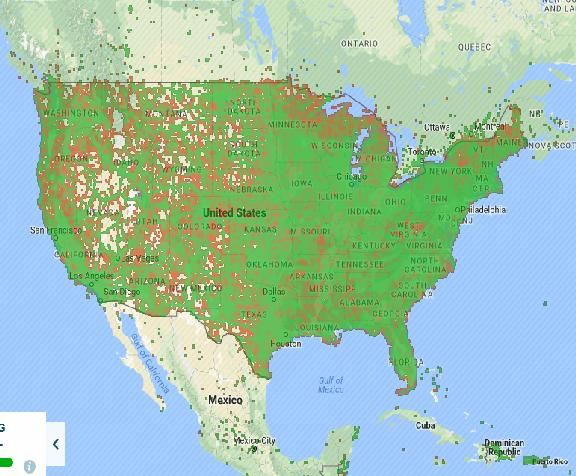
There are large swatch of uncovered areas. For comparison, Figure 3.2 shows geographic coverage
of USA’s Verizon Wireless.
Figure 3.1. Geographic coverage – Digi
Malaysia Future Network- Part 1/Survey 8Technical Report TR 2018-04-01
Internetworking and Media Communications Research Laboratories
Department of Computer Science, Kent State University
http://medianet.kent.edu/technicalreports.html
Figure 3.2. Geographic coverage – Verizon Wireless, USA
4.LEVEL OF SHARING IN NCI INFRASTRUCTURE
4.1. INFRASTRUCTURE USED FROM MARKET
To understand the level of sharing in each infrastructure, the respondents were requested to help
us with data on their fiber and radio related infrastructure sharing. In Fiber Sharing, they were
asked to provide length in km for following sharing models: a) own dark-fiber inside own
duct/conduit, b) own dark fiber but is on a leased duct/conduit, c) leased lambda on fiber, d) and
leased bandwidth on fiber.
Telekom Malaysia reported having the longest owned dark fiber in their own duct with over
149,000 km. However, they do not report having any of their own dark fiber on a leased duct/
conduit, nor leased lambda on fiber. Their leased bandwidth on fiber goes to a distance of up to
240km, and is only used for transmission. This indicates TM backhaul infrastructure mostly built
on fully owned asset. Celcom have over 8,000 km of their own fiber on their own duct, no additional
data was provided. Only Maxis reported having shared infrastructure where 13,000 km is on
combination owned and leased fiber, and no other data was provided. UMobile did not any provide
data. Figure 4 provides a visualization of the data.
Malaysia Future Network- Part 1/Survey 9Technical Report TR 2018-04-01
Internetworking and Media Communications Research Laboratories
Department of Computer Science, Kent State University
http://medianet.kent.edu/technicalreports.html
Figure 4. Fiber Sharing Model
160000
140000
120000
100000
Fiber in KM
80000
60000
40000
20000
0
Celcom TM Digi Maxis Umobile
-20000
Own Dark-Fiber but on Leased duct Own Dark-Fiber and Own Duct
In Radio Network Sharing, the providers were requested to provide data for RBS count on their
own equipment on their own tower, RBS count on their own equipment on a shared tower, and
RBS count on shared equipment on a shared tower.
UMobile have the most numbers of RBS, 1785 with their own equipment in their own tower,
2466 with their own equipment on a shared tower, and 2660 RanShare with Maxis, shared
equipment on a shared tower. Telekom Malaysia have 1347 RBS with their own equipment in their
own tower consisting of mainly private WiMax rooftop and TM orange structures. 1938 RBS in
their own equipment on a shared tower, and 3 RBS shared equipment on a shared tower in TM
CRAN Putrajaya.
Maxis only noted a 3G RAN share on their radio network sharing model, while Celcom did not
provide any data.
Malaysia Future Network- Part 1/Survey 10Technical Report TR 2018-04-01
Internetworking and Media Communications Research Laboratories
Department of Computer Science, Kent State University
http://medianet.kent.edu/technicalreports.html
Figure 5. Radio Network Sharing Model
3000
2500
2000
RBS Count
1500
1000
500
0
Count Count Count Count Count
-500
Celcom TM Digi Maxis Umobile
RBS (own equipment own tower) RBS (own equipment shared tower)
RBS (shared equipment/tower
4.2. LEVEL OF INFRASTRUCTURE WE CONTRIBUTED TO THE MARKET
We also asked question to understand how much of owned asset each company is opening up
for sharing. Reported data apparently shown Telekom Malaysia does not lease dark fiber to others.
Telekom Malaysia does not lease lambda to others. As per survey, it appears Telekom Malaysia
have leased bulk bandwidth over fiber asset up to 240 km for transmission only. This is the only
reporting of asset sharing.
No one else provided data for this.
5.SPECTRUM BANDS
To understand how much Malaysian organizations have invested into various generation of
technology and current usage. The providers were requested to provide bands each are operating
and provide some data about the history of traffic in those bands1.
1
MCMC has the fuller picture of spectrum allocation.
Malaysia Future Network- Part 1/Survey 11Technical Report TR 2018-04-01
Internetworking and Media Communications Research Laboratories
Department of Computer Science, Kent State University
http://medianet.kent.edu/technicalreports.html
Figure 6. Spectrum Band Width and Technology
2G 2G
1995 3G 3G
1996 2G 2G
2004 3G
2008 3G 3G
4G
2013 LTE LTE
2015 LTE
2016 LTE
2G
3G 2G
2017 LTE LTE LTE
NO NO NO
Data Data Data
900 1800 2100 2600 900 1800 2100 2600 900 1800 2100 2600 900 1800 2100 2600
m m m m m m m m m m m m m m m m
Celcom TM Digi Maxis Umobile
Maxis and Digi established 2G and 3G earlier than their counterpart Celcom and Telekom
Malaysia. Digi have direct ownership. Celcom have Spectrum assignment ownership for Bands
900m, 1800, and 2100m and apparatus assignment ownership for 2600m band range. All four
providers reached 4G LTE in the 2600m band range by the year 2016-2017.
5.1. SPECTRUM BANDS AND ESTIMATED RBS COUNT AND ESTIMATED TRAFFIC TB
To understand the rollout status of the technology generations we also requested data on the
amount of estimated RBS in various spectrum-bands and estimated traffic in terabyte per month
for the years 2015, 2016, and 2017.
Malaysia Future Network- Part 1/Survey 12Technical Report TR 2018-04-01
Internetworking and Media Communications Research Laboratories
Department of Computer Science, Kent State University
http://medianet.kent.edu/technicalreports.html
Figure 7. Spectrum Bands and Estimated RBS Count
12000
10000
8000
RBS Count
6000
4000
2000
0
-2000
900 1800 2100 2600
Celcom allocated their 900 and 1800 bands in the 1990s, the 2100 band in 2008 and 2600 band
in 2013 with a consistent drop in RBS count from 2015 to 2017. Digi allocated spectrum band in
1996 with increase RBS from 2015 to 2017. Telekom Malaysia allocated 3 bands within 2015 and
2016, UMobile allocated a 2100 band in 2008, followed by 2600 band in 2013 and later added 900
and 1800 band in 2017. It seems much of RBS (like Celcom) is in 2G/3G, currently the providers
are invested into aggressively rolling out 4G-LTE.
For estimated traffic TM and Umobile provided data. We encourage working with the
companies to obtain more traffic data in future cycles.
Malaysia Future Network- Part 1/Survey 13Technical Report TR 2018-04-01
Internetworking and Media Communications Research Laboratories
Department of Computer Science, Kent State University
http://medianet.kent.edu/technicalreports.html
Figure 8. Estimated TB Traffic/month
25000
20000
15000
TB/month
10000
5000
0
TM 2015 TM 2016 TM 2017 Digi Maxis Umobile Umobile Umobile
-5000 2015 2016 2017
900 1800 2100 2600
Malaysia Future Network- Part 1/Survey 14Technical Report TR 2018-04-01
Internetworking and Media Communications Research Laboratories
Department of Computer Science, Kent State University
http://medianet.kent.edu/technicalreports.html
5.2. EQUIPMENT INFRASTRUCTURE CAPABILITY
Figure 9. Equipment Infrastructure Capability - IoT
Transmission Equipment Data Network Equipment Radio Network Equipment
IoT
Capabilit
y
Level 5
Fully
Ready
Level 4
HW/SW
Capable,
License
needed
Level 3 T T
Maxis
HW M M
Capable,
SW
upgrade T
needed M
Umobile
Level 2
Maxis
Maxis
HW is
not
Umobile
Umobile
capable
Level 1
Instrume
nts have
NB-IoT/
EMTC
Celcom
Celcom
Celcom
No Data
Digi
Digi
Digi
Provided
Almost all respondents demonstrated awareness about the impending Internet-of-Things and
Network Virtualization. We requested to indicate the readiness of their infrastructure to support
rollout IoT services. UMobile reported currently conducting trial, with a target in 2018/2019 for
NFV and 2020 for NFV and SDN. The hardware is 100% capable for transmission equipment,
data network equipment, and radio network equipment. For IoT capability, transmission
equipment hardware is capable but needs software upgrade, and data network equipment and radio
network equipment are also hardware capable. Digi did not want to disclose this information.
Maxis is offering IoT services currently on 2G/3G/4G as these equipment can use their data
capabilities. NB-IoT/eMTC is still at the early stage with few pilot and commercial deployments
worldwide and emerging ecosystem. Their network is NB-IoT/eMTC hardware ready but requires
software upgrade, and they are continually evaluating such technology. The core network of their
Malaysia Future Network- Part 1/Survey 15Technical Report TR 2018-04-01
Internetworking and Media Communications Research Laboratories
Department of Computer Science, Kent State University
http://medianet.kent.edu/technicalreports.html
Data Network Equipment infrastructure is hardware ready. Some Radio network equipment sites
require new and additional base band card.
Figure 10. Equipment Infrastructure Capability – NFV/SDN
Transmission Equipment Data Network Equipment Radio Network Equipment
NFV/
SDN
Capability
Level 4 2020
Fully Ready
Level 3
HW/SW
Capable,
License
needed
Level 2
HW
Capable,
SW upgrade
needed
Maxis
2018
Level 1 T
UMobile
UMobile
UMobile
M
Maxis
Maxis
HW is not T
capable T M
M
Celcome
Celcome
Celcome
No Data
Digi
Digi
Provided
Digi
Telekom Malaysia (TM) is at the testing stage on virtual EPC (NFV). Transmission network
is 70% hardware capable, with on-going upgrade in process and is planned to be HW/SW capable
for new deployment in 2018. TM’s Data Network Equipment is hardware capable, requiring
software upgrade and will be fully ready for vEPC and vCPE in estimated 3 years’ time. Their
radio network equipment are hardware and software capable, needing a license.
Maxis Transmission equipment for NFV/SDN capability is currently at 50% capable, IP core
and microwave, and SDN capable, but require software upgrade. Maxis is planning to deploy NFV
based core network elements in 2017 and moving forward will be extended to other components of
the network. Maxis is also assessing Transport SDN capability which is currently in the tender
stage.
Malaysia Future Network- Part 1/Survey 16Technical Report TR 2018-04-01
Internetworking and Media Communications Research Laboratories
Department of Computer Science, Kent State University
http://medianet.kent.edu/technicalreports.html
6.NETWORK PERFORMANCE
To understand the technical data carriage characteristics at user level we requested a range of
network performance parameters that is experienced by the mobile users from the providers, both
for inter Malaysia between its regions (broken down by inter-state delays) and international -
Malaysia to different parts of the world. The parameters includes average round trip delay,
minimum round trip delay, packet loss experienced by the network.
6.1. A.9 NETWORK HEALTH WITHIN MALAYSIA
No one provided data for delays experienced within Malaysia. A Pinger site delay is available
to provide an alternate estimate of the delays- though it is not reflective of any single provider’s
network. For international network performance, Telekom Malaysia provided partial data on
Average RTT and Minimum RTT, none for Jitter IPDV and TCP. No data for Packet Loss from
Telekom Malaysia. Figure-11 provides a comparison of this data with Pinger data.
Figure 11. Network Health Malaysia-International
500
450
400
350
300
250
ms
200
150
100
50
0
-50
Average RTT Pinger Min RTT Pinger Packet Loss Pinger
Average RTT TM Min RTT TM Packet Loss TM
Average Packet
Min RTT Average Min RTT Packet
RTT Loss
Pinger RTT TM TM Loss TM
Pinger Pinger
Singapore, 19.6 15.16 0.19 277 277 0
Thailand, 62.39 49.55 0.47 70 69 0
Vietnam, 113.58 96.75 0.6 48 48 0
Malaysia 27.21 23.95 0.36 9
Cambodia 32
Philippines, 76.04 68.11 0.28 204 201 0
United Kingdom, 222.49 212.41 0.23 177 177 0
Germany, 244.54 235.91 0.25 279 279 0
United States, 206.42 203.25 0.2 254 249 0
Malaysia Future Network- Part 1/Survey 17Technical Report TR 2018-04-01
Internetworking and Media Communications Research Laboratories
Department of Computer Science, Kent State University
http://medianet.kent.edu/technicalreports.html
Japan, 102.55 99.47 0.18 97 94 0
China, 117.86 97.12 0.35 327 324 0
UAE Dubai 80 80
India, 86 63.84 1.05 254 199 0
South Africa, 430.01 417.72 0.28 346 345 0
Uganda 392.53 0.88 430 425
Morocco 336.73 368.14 0.37 315 314
Mexico 323.98 270 270
Argentina 386.17 376.63 0.35 441 441
7. NATURE OF DATA AND GROWTH
To understand and learn about the provider’s experience and projection on data growth. The
providers were requested to provide net volume traffic that the backhaul network has carried per
data type such as voice, voice or video over data, internet of things, sensor data or machine to
machine data, and other forms of data, reported in zettabytes per year. Observed data for the years
2014-2016 were requested, and projections for the years 2017-202.
Telekom Malaysia stated that they do not monitor data according to data type as requested
above. No one provided any answers to the requested information as shown in the three tables
below.
7.1. TOTAL DATA OF OUR CUSTOMER WE CARRIED OVER BACKHAUL NETWORK (ZB/YEAR)
TOTAL DATA OF OUR CUSTOMER WE CARRIED OVER BACKHAUL NETWORK (ZB/YEAR)
Type 2014 2015 2016 2017 2018 2019 2020
Voice
VVDATA
IOTMD
IOTDATA
Aggregate
7.2. TOTAL DATA OF OUR CUSTOMER WE MOVED IN/OUT INTERNATIONALLY (ZB/YEAR)
TOTAL DATA OF OUR CUSTOMER WE MOVED IN/OUT INTERNATIONALLY (ZB/YEAR)
Type 2014 2015 2016 2017 2018 2019 2020
Voice
VVDATA
IOTMD
IOTDATA
Aggregate
Malaysia Future Network- Part 1/Survey 18Technical Report TR 2018-04-01
Internetworking and Media Communications Research Laboratories
Department of Computer Science, Kent State University
http://medianet.kent.edu/technicalreports.html
7.3. DATA USAGE PER YEAR – TOTAL DATA OF OUR CUSTOMER WE CARRIED
DATA USAGE PER YEAR – TOTAL DATA OF OUR CUSTOMER WE CARRIED
Type 2014 2015 2016 2017 2018 2019 2020
Voice
VVDATA
IOTMD
IOTDATA
Aggregate
7.4. PUBLIC DATA CENTER RAW STORAGE
Data centers and public clouds (DC & PC) are becoming increasingly important part of traffic
contributor on national communication infrastructure. To understand the growth phenomena of the
provider’s established data centers and cloud infrastructure, the following were requested. Data
about storage capacity and traffic volume of the backhaul network has carried for the public data
center and/or cloud. Observed data for the years 2014-2017 were requested, and projection for the
years 2017-2020. Each virtual machine requested is considered as one work load. Workload
density is the ration of workload processed and the number of actual physical core.
Only Telekom Malaysia provided data for this.
Telekom Malaysia
Type 2014 2015 2016 2017 2018 2019 2020
# Data Centers 13 12 11 10 9 NA NA
# Public Data Centers 13 12 11 10 9 NA NA
# Hyper scale DC & PC 0 1 2 2 2 NA NA
Workloads processed 0 NA NA NA NA NA NA
Workload density 0 NA NA NA NA NA NA
Total Storage Capacity 0 130 TB 264 TB 461 TB NA NA NA
Storage Used by tenants 0 40 TB 80 TB 160 TB NA NA NA
Storage used by IAAS 0 NA NA NA NA NA NA
Storage used by PAAS 0 NA NA NA NA NA NA
Storage used by SAAS 0 NA NA NA NA NA NA
The number of data centers and public data centers have decreased through the years, possibly
caused by the increase in the number of hyper scale DC and PC. Storage capacity have increased
in parallel with the increase of data centers. Storage used have also increased parallel with total
storage capacity. There is no other data provided
Malaysia Future Network- Part 1/Survey 19Technical Report TR 2018-04-01
Internetworking and Media Communications Research Laboratories
Department of Computer Science, Kent State University
http://medianet.kent.edu/technicalreports.html
7.5. DATA CENTER TRAFFIC (EB)
Telekom Malaysia
Type 2014 2015 2016 2017 2018 2019 2020
User to Data Center 2.6 Gbps 4.2 Gbps 1.3 Gbps 2.6 Gbps NA NA NA
Data Center to User 2.7 Gbps 2.5 Gbps 2.2 Gbps 3.2 Gbps NA NA NA
DC to DC NA NA NA NA NA NA NA
Figure 12. Data Center Traffic (EB)
5
4
3
2
1
0
Celcom TM 2014 TM 2015 TM 2016 TM 2017 TM 2018 TM 2019 TM 2020 Digi No Maxis No Umobile
-1
No Answer Answer No
-2 Answer Answer
User to Data Center (Gbps) Data Center to User (Gbps) DC to DC
8. EFFORTS IN FUTURE NETWORK
8.1. PLANS AND EXPECTED TIMELINE FOR FUTURE NETWORK
To better understand each provider’s plan for Future Network, the companies were asked to
share their current plans and future projects in preparation for Future Network. They were
requested to share any pioneering experiences in the implementation of the elements of Future
Network in Malaysia. Overview of teams and plans, and description of pilot projects that have
been launched were requested.
Celcom is exploring projects for Smart Community efforts, and is the only one that answered.
Malaysia Future Network- Part 1/Survey 20Technical Report TR 2018-04-01
Internetworking and Media Communications Research Laboratories
Department of Computer Science, Kent State University
http://medianet.kent.edu/technicalreports.html
8.2. TO USE 5G SPECTRUM
Figure 13.1 Efforts in Future Network – 5G
No Data Explorin Actively Laborato Setting Limited Seeking Business System
Provided g Planning ry partnersh scale sustainab viability Operation
Projects Experim ips field ility set al
ent piloting
5G
Celcom
TM
Digi
Maxis
UMobile
The survey found that almost all mobile operators are indeed aware of the development in 5G.
Celcom, Maxis, Telekom Malaysia, and UMobile are all exploring what is 5G in preparations to
use 5G Spectrum for Future Network. Few also reported that initial study on 5G high level
architecture are being considered and potential vendors has been identified, for a possible trial in
2018 or 2019. Given the lack of specificity in 5G’s definitions (which are themselves not well
defined yet internationally until early 2017) the operators are exploring what their vendor’s are
proposing as the 5G architecture. The following diagrams (read left to right progressively) will
provide an understanding of the stage they are in for each element of the FN namely Data Center
integration, NFV and SDN and IoT support. Left means low preparation and right means advanced
stage.
Malaysia Future Network- Part 1/Survey 21Technical Report TR 2018-04-01
Internetworking and Media Communications Research Laboratories
Department of Computer Science, Kent State University
http://medianet.kent.edu/technicalreports.html
8.3. TO EXPAND DATA CENTER AND ENGAGE PUBLIC CLOUD
Figure 13.2 Efforts in Future Network – Data center/Public cloud
No Data Explorin Actively Laborato Setting Limited Seeking Business System
Provided g Planning ry partnersh scale sustainab viability Operation
Projects Experim ips field ility set al
ent piloting
DC
PC
Celcom
TM
Digi
Maxis
UMobile
Maxis offers public cloud for enterprise customers only, and delivers cloud computing solution
via the internet. Celcom plans to expand their Data Center and Public Cloud, while Telekom
Malaysia will depend on overall corporate group strategy on Telco cloud. UMobile have no plans
to expand their Data Center and/or Public Cloud at the moment.
Malaysia Future Network- Part 1/Survey 22Technical Report TR 2018-04-01
Internetworking and Media Communications Research Laboratories
Department of Computer Science, Kent State University
http://medianet.kent.edu/technicalreports.html
8.4. TO DEPLOY/ ENHANCE NFV/SDN
Figure 13.3 Efforts in Future Network – NFV/SDN
No Explorin Actively Laborato Setting Limited Seeking Business System
Data g Planning ry partnersh scale sustainab viability Operation
Projects Experim ips field ility set al
ent piloting
NFV
SDN
Celcom
TM
Digi
Maxis
UMobile
Celcom is working on deploying Network Function Virtualization and Software defined
Networking while Maxis is planning to deploy NFV based core network elements in 2017 and
moving forward will be extended to other components of the network. They are also assessing
Transport SDN capability which is currently under tender stage.
8.5. TO SUPPORT IOT DEVICE
Figure 13.4 Efforts in Future Network – IoT and Low delay communication
No Explorin Actively Laborato Setting Limited Seeking Business System
Data g Planning ry partnersh scale sustainab viability Operation
Projects Experim ips field ility set al
ent piloting
IoT
Celcom
TM
Digi
Maxis Trial
2018
UMobile
Malaysia Future Network- Part 1/Survey 23Technical Report TR 2018-04-01
Internetworking and Media Communications Research Laboratories
Department of Computer Science, Kent State University
http://medianet.kent.edu/technicalreports.html
While Celcom is working on supporting IoT services, Maxis is already offering IoT service
using 2G/3G/4G technologies, and will trial Narrow Band IoT in 2018. Like other matter, Telekom
Malaysia’s plans will depend on overall group strategy on Telco cloud which is currently under
study. mMTC services is one of the main use case of 5G network and to support this is highly
dependent on business case and ecosystem maturity.
9. CHALLENGES AND SUGGESTIONS
To better understand and learn about issues and challenges each provider is facing, the providers
were requested to share candidly in the areas of 5G, Data center/Public cloud, NFV/SDN
deployment and IoT Support services. We also requested them to provide insights on how MCMC
can help alleviate these difficulties.
9.1. TO USE 5G SPECTRUM AND ROLL OUT 5G
Respondents’ noted spectrum availability as one of the biggest challenge. They also noted
sustainability, market readiness, device ecosystem readiness and pricing all affect the use of the 5G
Spectrum. Some of the road blocks for rolling out 5G Spectrum are high regulatory cost of site
acquisition, fiber trenching, fiber leasing, and spectrum acquisition, monopoly by state-backed
company, slow land approval and high approval fees by state authorities. Suggestions are made
for allowing mobile operators to build telecommunications infrastructure and regulate fees and
prices for fiber leasing, eliminate monopoly and anti-competition behaviors. There are also
concerns that about a guideline plan how 5G will be rolled out. In Malaysia 5G spectrums have not
been assigned. Many operators noted following challenges and road blocks for 5G: a) spectrum
availability, insufficient bandwidth (of spectrums??), and high regulatory cost of spectrum
acquisition b) sustainability, market readiness, device ecosystem readiness and pricing; c) high
regulatory cost of site acquisition, d) cost of fiber trenching, fiber leasing, e) monopoly by state-
backed company, f) slow land approval and high approval fees by state authorities.
9.2. TO EXPAND DATA CENTER AND ENGAGE PUBLIC CLOUD
A challenge for Maxis to expand their Data Center and/or Public Cloud is the limited
geographical reach as a domestic player, and competition from other Telco-Over the Top players.
9.3. TO DEPLOY/ ENHANCE NFV/SDN
Besides the high cost of investment to deploy NFV/SDN, maturity and limitation on applications
for NFV/SDN solution from the vendors is also a key challenge. Carrier grade performance is also
a challenge for Maxis in their plans to deploy and/or enhance NFV/SDN. There is however, much
less responses received for network virtualization. Celcom reported working on deploying Network
Function Virtualization and Software defined Networking while Maxis is planning to deploy NFV
based core network elements in 2017 and moving forward will be extended to other components of
the network. They are also assessing Transport SDN capability which is currently under tender
stage. The reported anxieties are: a) the high cost of investment to deploy NFV/SDN; b) maturity
and limitation on applications for NFV/SDN solution from the vendors is also a key challenge; and
c) Carrier grade performance is also a challenge for Maxis in their plans to deploy and/or enhance
NFV/SDN.
9.4. TO SUPPORT IOT DEVICES
Currently, there are no specific guidelines for IoT devices in terms of technology
implementation. There are limited sensors available for testing, interoperability for multi-vendor
Malaysia Future Network- Part 1/Survey 24Technical Report TR 2018-04-01
Internetworking and Media Communications Research Laboratories
Department of Computer Science, Kent State University
http://medianet.kent.edu/technicalreports.html
environment, initial module and licensing costs are high thus making it difficult to justify the
business strategy. Organization readiness to create new skill sets and processes is also a challenge.
9.5. COLLABORATION
The survey also probed collaboration efforts taken by the players both locally and
internationally particularly related to Future network. Telekom Malaysia and Digi did not respond
to this question.
UMobile is in collaboration with other providers such as Maxis being their DR (Disaster
Recovery?) provider. UMobile is exploring the possibility for alliance with universities. Celcom
is in collaboration with government organizations, and Huawei and Ericcson. Maxis reported a
partnership with Vodafone since July 2016, to offer IoT solutions to Malaysia business across
industries. The solution is about connecting devices over the internet, allows objects to be sensed
and controlled remotely across existing data networks, to improve efficiency, enhance customer
experience, create new revenue stream, as well as automate processes. eKelas is another Maxis
collaboration initiative to facilitate technology-enabled teaching, and making remote learning a
reality for these students. It is an engaging after-school supplement, done via highly-interactive
digital content, in line with Malaysian School Syllabus. The eKelas programme at Pusat Internet 1
Malaysia (PI1M) centres are managed by Maxis. As a member to Bridge Alliance of leading Asia
Pacific mobile operators, Maxis expressed their ability to extend their reach and scale in areas such
as M2M/IoT, enterprise mobility, roaming and optimization, drawing on the collective experience
and their high-performance networks to address customer needs. The group has also transformed
the experience of travelers when it comes to roaming by designing innovative offers to drive
adoption and revenue. As part of the group, Maxis expressed confidence to leverage on the
alliance’s scale and scope to negotiate for cost savings.
10.SUMMARY OF FINDINGS AND RECOMMENDATIONS
The MCMC team also conducted other analysis besides the survey. An in-depth analysis of the
status and subsequent recommendation documents is to be into technical documents part-II [1] and
Part-III [3].
Future network is a rapidly evolving technology participated by many diverse players. Unlike
4G where mobile communication and broad-band companies played key roles- the Future Network
ecosystem will see expanded eco-system with major players including CKD (content-knowledge-
and-data) organization, as well as public-entities-as-service-and-infrastructure-providers.
One of the implicit goals of this survey was to raise awareness about the importance of data-
driven policy mechanism for any organization. The current survey can be used as a template. It can
be expanded and stake holders should be encouraged to continue to provide the more baseline data
towards formulation of an effective national policy.
11.REFERENCES:
1. TR2018-12-02: A Roadmap for the Readiness of Future Network Cyber Infrastructure in
Malaysia: Part-3: Recommendations, Javed I Khan, Study Commissioned by Malaysian
Communications and Multimedia Commission (MCMC), Government of Malaysia, and
Supported by Fulbright Senior Specialist Program, Fulbright Commission, US Department
of State, 2017-2018, December 2018.
2. TR2018-12-01: Assessing the Readiness of Future Network Cyber Infrastructure in Malaysia:
Part-2: Challenges, Opportunities and Recommendations, Javed I Khan, Study
Malaysia Future Network- Part 1/Survey 25Technical Report TR 2018-04-01
Internetworking and Media Communications Research Laboratories
Department of Computer Science, Kent State University
http://medianet.kent.edu/technicalreports.html
Commissioned by Malaysian Communications and Multimedia Commission (MCMC),
Government of Malaysia, and Supported by Fulbright Senior Specialist Program, Fulbright
Commission, US Department of State, 2017-2018, December 2018.
Malaysia Future Network- Part 1/Survey 26You can also read


