BUILDING AN AMBITIOUS PUBLIC TRANSPORT SYSTEM IN HO CHI MINH CITY (VIETNAM)
←
→
Page content transcription
If your browser does not render page correctly, please read the page content below
N° 1 - 2014/2015

                  WORKING PAPER
Urban Development Management Support Centre - PADDI

BUILDING AN AMBITIOUS PUBLIC TRANSPORT
SYSTEM IN HO CHI MINH CITY (VIETNAM)

Clément MUSIL, researcher at the IPRAUS (Paris Research Institute of Architecture,
Urban and Social Development) and member of the UKNA Network (Urban Know-
ledge Network in Asia).
Contact: musil.clement@gmail.com

Charles SIMON, project executive at PADDI, Urban Development Management
Support Centre.
Contact : paddi.csimon@gmail.com

                             With the support of AFD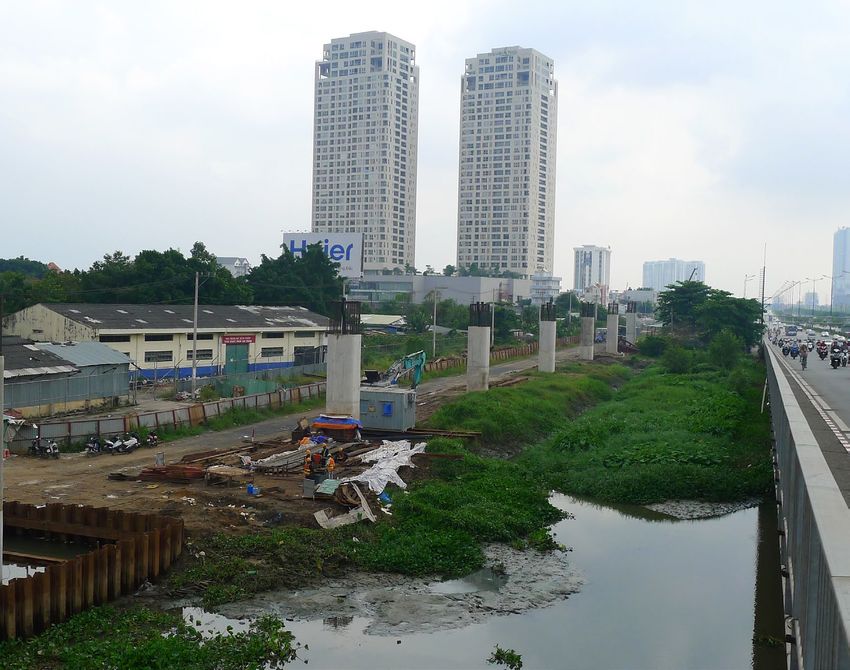
Building an ambitious public transport
                                                                                               system in Ho Chi Minh City (Vietnam)

                                                                                   Ho Chi Minh City plans to build an extensive public transport system which includes among
                                                                                   others metro lines and dedicated bus lanes. Following a statement on the evolution of the muni-
                                                                                   cipal public transport system, this paper examines its development and the constraints faced by
                                                                                   the authorities in its modernization: funding, land acquisition and institutional issues.

                                                                                   1 - The greater metropolitan       Ho Chi Minh City (HCMC), Vietnam’s main              The fast growing number of cars has there-
                                                                                   area includes HCMC and its         economic hub, is currently one of South East         fore prompted the municipal authority to re-
                                                                                   7 surrounding provinces (i.e.
                                                                                   Đồng Nai, Bà Rịa – Vũng Tàu,       Asia’s most dynamic cities. With a GDP ha-           define road lane arrangements, whilst the in-
                                                                                   Bình Dương, Bình Phước, Tây        ving expanded by 10% annually for the past           creased use of cars has worsened the adverse
                                                                                   Ninh, Long An and Tiền Giang).     consecutive ten years and an annual urban            effects caused by motorbikes (i.e. congestion,
                                                                                                                      growth rate of 3%, this city is riding on a fast     noise and air pollution, and lack of road sa-
                                                                                   2 - HCMC’s current public          economic and population growth rate (GSO,            fety). Against this backdrop, public transport
                                                                                   transport system relies on ur-     2014). In 2013, its population was estimated         should be an alternative in HCMC for urban
                                                                                   ban buses, which are capable
                                                                                   of meeting solely 7% of travel     at 8 million; meanwhile the greater urban            mobility in a near future.2 This is what an am-
                                                                                   needs (Mouhot, 2013). Accor-       area’s population is estimated at approxima-         bitious transport plan revised and approved
                                                                                   ding to the administration,        tely 18 million.1                                    in 2013 envisages for 2030.3
                                                                                   public transport includes travel
                                                                                   by urban buses and taxis. Tra-     The city’s robust economic growth, coupled           In an effort to tackle road congestion-related
Disclaimer                                                                         vel by metro and tramway will      with an ever-increasing population, has put          problems, to improve environment quality
                                                                                   be counted in this category
Analysis and conclusions of the document are formulated under the authors’         once available.                    pressure on urban infrastructure, especially         for city residents, and to cope with climate
responsibility. They may not necessarily convey the viewpoint of PADDI                                                its transportation system. Between 2003              change-related adverse effects, the Govern-
(HCMC Urban Development Management Support Centre), nor that of its                3 - Adjustment for the             and 2013, the number of vehicles registered          ment plans on the one hand to modernize the
                                                                                   transportation development         by municipal agencies has increased three-           existing road network, and on the other hand
partner agencies.                                                                  planning of Ho Chi Minh City       folds (DTC, 2014). By now, roughly six mil-          to build up an extensive public transport
                                                                                   in 2020 and beyond (Prime
                                                                                   Minister’s Decision n°568/QD-      lion motorbikes and nearly half a million cars       system which includes metro lines of Mass
PADDI                                                                              TTg dated April 08, 2013).         have been registered in HCMC (ibid, 2014).           Rapid Transit (MRT) and corridors of Bus
Founded in 2006, PADDI is an innovative cooperation project between the                                               Even though the city was recently qualified          Rapid Transit (BRT). Public transport should
Rhône-Alpes Region (France) and the greater Ho Chi Minh City area. Under                                              as a “motorcycle dependent city” (Khuat Viet         thus become a serious alternative to indi-
                                                                                                                      Hung, 2006; Nguyen Thi Cam Van et al., 2013)         vidual transport. According to the plan, the
the HCMC People’s Committee direct supervision, its goal is to assist the city’s
                                                                                                                      and its number of motorbikes continues to            objectives set out in 2013 are that the share
technical agencies in various fields of urban management.                                                             rise, the growing number of cars (resulted           of public transport will represent 25% of city
Website: www.paddi.vn                                                                                                 from economic growth that improved the li-           travel by 2020, 45% by 2030 and eventually
                                                                                                                      ving standards of a part of urban households)        60% after 2030. This newly unveiled plan is
Authors : Clément Musil, Charles Simon                                                                                has surged significantly by 10% annually             certainly ambitious, but there are a number
                                                                                                                      since 2007 (DTC, 2014).                              of constraints hindering its successful imple-
Translators : Trần Thọ Bình
                                                                                                                                                                           mentation.
Copy editors : Fanny Quertamp, Michael Moloney, Zan-Hee Oh

Printing date : 05/2015

                                                                                                                                                       Working Paper of Urban Development Management Support Centre - PADDI   3
LARGE-SCALE TRANSPORT PLAN in 2007.6 Under this document, six MRT lines 4 - Prime Minister’s Decision Hà Noi
n°123/1998/QĐ-TTg dated July
WITH A LIMITED BUDGET were planned as well as three additional lines 10, 1998. Tây Ninh
which would be monorail or tramways, for a and
Cambodian
total network’s length of 109 km. border
The idea of building MRT lines in HCMC be- 5 - For instance between
The urban rail component of the 2007 plan HCMC and Vũng Tàu (a city Củ Chi
gan in 1998 with the approval of the master located 100 km southeast of
was modified with the 2013 adjustment
plan for 2020.4 The plan gives priority to in- HCMC). Thủ Dầu Một
which suggested that by 2030, HCMC would
ter-urban rail lines;5 since at that time only Bình
be equipped with eight MRT lines, one tram- Dương
studies on the construction of urban metro 6 - The “HCMC Transport Biên Hòa
way and two monorail lines, for a total of Development Planning to
were scheduled. The first study was conduc-
216 km (see Figure 2). However, one of the 2020” was prepared by the
ted in 1998 and was funded by a British Ministry of Transport and local
latter plan’s innovations is to complete the An Bình
Official Development Aid (ODA) grant. This consulting companies (TEDI, M2 Thạnh Xuân station Suôi Tiên New Miên Dông
urban rail network with six BRT lines, which TDSI) in 2006 and approved on Tây Ninh
Tân Chánh Hiệp
station/depot Vĩnh Phú bus station
study recommended that to revive the public station/depot station terminus
means an additional 100 km of public trans- January 22, 2007 by the Prime
transport system, which was at that time Minister Decision 101/2007/
Long Bình
port network. Previously, another study fun-
responsible for only 2% of inner city travel, QĐ-TTg.
ded by the World Bank in 2005, and resumed Ngã Tư Ga
M1
the city should reorganizing the bus service Hiêp Binh
by PADDI7 in 2009, stressed the possibility to MR3 terminus
and start to build three MRT lines (MVA et 7 - Through a technical
M4 M3b
M3b
adopt BRT lines in HCMC. However, up until
al., 1998). In 2004, a second study, funded by assistance mission, the Urban
2013, the city authorities did not retain this Development Management
An Sương
Japan, supported the recommendation that
option in their planning agenda. Support Centre conducted a
future public transport in HCMC should focus study on the construction of
Tân Sơn Nhất
airport Bình Triệu
on building an MRT network but composed Regarding the impact on spatial organization a pilot line of BRT in HCMC. A Tham Lương
M4b station
by four lines (Almec et al., 2004). The findings of the city, the completion of the transport feasibility study for building Miên Dông
Saigon
Vĩnh Lộc
plan adjusted in 2013 should strengthen the a BRT pilot network was later Lăng Cha Cả Song Tac
of these two studies were incorporated into a delivered to the HCMC munici-
station Bà Queo bridge
comprehensive transportation plan approved polarization of the historical center (Saigon) pal authority.
M6 Central Thu Thiêm Vũng Tàu
Station station and
Cộng Hòa Long Thành
crossroad airport (planned)
Bên Thành
Vòng xoay Station
Phú Lâm
Miền Tây Chợ Lớn
T1
Station/bus
interchange
Tân Kiên
M3a
MR2
M5
Mỹ Tho
and Cân Tho Cần Giuộc
Tân An
Metro line Railway line
M1 : Bên Thành - Suôi Tiên / extension Existing
M2 : Thu Thiêm - Tây Ninh bus interchange / extension Planned Hiêp Phuoc
port
M3A : Bên Thành - Tân Kiên / extension
Hô Chi Minh City central station
M3B : Công Hoa crossroad - Hiêp Binh Phuoc / extension
Planned station
M4 : Thạnh Xuân- Hiêp Phuoc port / option 2 km
M4b : Gia Đình station - Lăng Cha Cả station Tramway (T), Monorail (MR) and
M5 : Cân Giuoc bus interchange - Saigon bridge Bus Rapid Transit (BRT) line
M6 : Bà Queo - Vòng xoay Phú Lâm Tramway 1 (T1)
Monorail 2 (MR2)
Metro station
Monorail 3 (MR3)
Metro station connection
BRT
Metro depot
Realisation :
Bus station Loïc BOISSEAU / Clément MUSIL / PADDI, 08/2014
Existing station (urban and inter-provincial buses) Main road Sources :
Multimodal transport interchange (planned) Decision 568/QD-TTg - 08/04/2013, adjustment for the
River / Canal
transportation development planning of Ho Chi Minh City in 2020
Figure 1: Metro Line No1-District 1, preparations of ground works to implement the under-
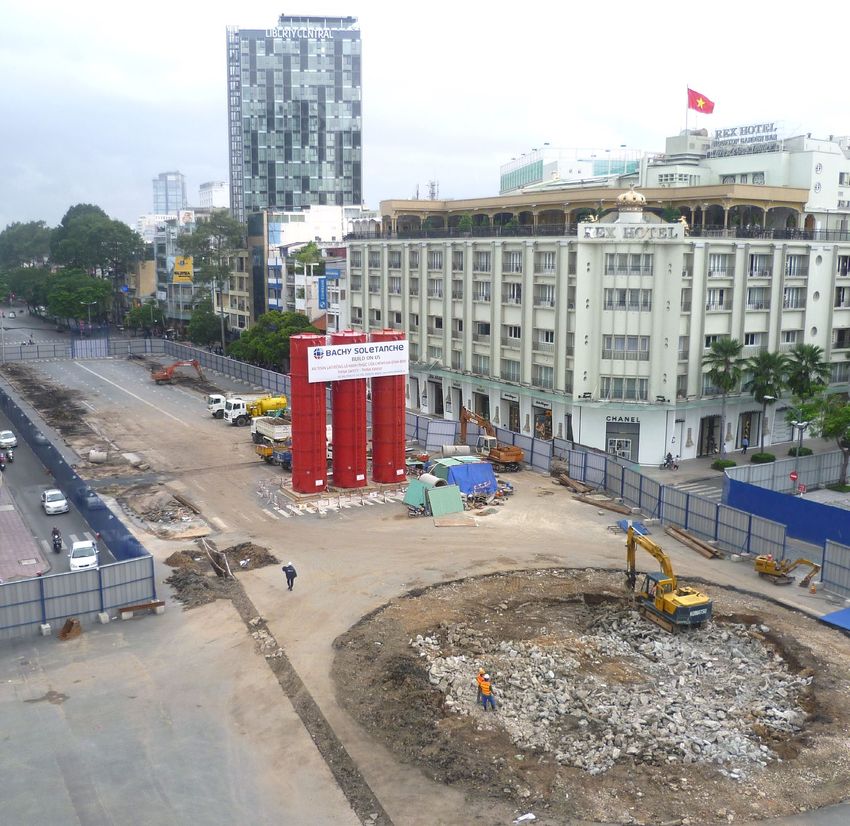
ground part of the line, September 2014, (Ch. Simon) Figure 2: Development of Ho Chi Minh City railway transport network for 2020-2030
4 Working Paper of Urban Development Management Support Centre - PADDI Working Paper of Urban Development Management Support Centre - PADDI 5
since four of the eight MRT lines will connect CONSTRAINTS TO THE DEVELOPMENT 8 - In population censuses
Routes/ Stations Length
Cost
Financing sources
State of progress/
conducted in Vietnam, only
to the Ben Thanh market. This planning calls OF HCMC’S PUBLIC TRANSPORT people with permanent resi-
Estimation Completion
for massive urban fabric rearrangement. It SYSTEM dence permits are counted in 19.7 km
MRT No1
14 stations (3 Construction phase
will come along with large property develop- areas where the census takes Bến Thành -
underground /
(with a 2.6 km US$ 2.49 JICA (US$ 2.2 billion)
started in 2012 /
ment (high rise buildings and underground place. Other people (even if Suối Tiên
11 elevated)
underground billion VN-G (US$ 289 billion)
Put into service in 2020.
they have accommodation for section)
shopping malls, of which some are already Apart from the problem of raising capital to an unspecified period of time) ADB (US$ 450 millions)
under construction); as well as the transfor- build HCMC’s public transport system, frag- are not counted; whilst they Phase 1 11 stations (10
11.3 km
KfW (US$ 313 millions)
mation of a few District 1 areas into walking mentation of funding, land acquisition and are using urban infrastructure Bến Thành - underground /
(with a 9.3 km US$ 2.15
EIB (US$ 195 millions)
Advanced study phase /
networks and services (water, Tham Lương 1 elevated)
underground billion Put into service in 2020
streets for pedestrians. Moreover, the combi- resettlement management, as well as insti- transport, etc.). section) VN-G (US$ 326.5
millions)
MRT No2
nation of various modes of public transport tutional steering of the system during imple- Phase 2
(MRT, BRT and urban bus) will facilitate the mentation and future operation are all chal- Line extension
development of multimodal interchange hubs lenges to the final realization of this planned towards Tây
MRT/BRT Lines
Ninh / Line Under Study 8.7 km Under Study / /
and also new urban projects across the me- system. extension
tropolitan area. towards Thủ
Thiêm
Once completed, the railway transport
Fragmentation of financing sources 8.9 km
ADB (US$ 500 millions)
network of HCMC will be larger than that of Phase 1 8 stations (7
(with a 6.6 km
ESP-G (US$ 200
Study phase /
Saigon bridge - underground / US$ 1.1 billion millions)
Singapore (160 km in 2013) and will become underground Achievement 2018
MRT No5
Bảy Hiền 1 elevated) EIB (US$ 200 millions)
one of the region’s largest MRT networks, By the end of the 1990s, several internatio-
section)
VN-G (US$ 200 millions)
competing with that of Shanghai (538 km nal cooperations with technical assistance Phase 2 13 stations (8
14.5 km
in 2013) and of Beijing (465 km in 2013) agencies were involved in the development of Bảy Hiền - Cần underground /
(with a 8.6 km
US$ 1.8 billion / /
underground
(Nguyen Quoc Hien and Doan Hong Duc, public transport. But the Japanese Internatio- Giuộc 5 elevated)
section)
2013). The goal set by the government to nal Cooperation Agency (JICA) was the first to World Bank (US$ 142
BRT No1
make HCMC a leading global city of South provide funds. In 2004 this agency published US$ 155 millions) Advanced study phase /
An Lạc - Cát Lái 32 stations 23.5 km
East Asia is now clearly stated with its plan of a report on public transport development millions VN-G (US$ 13.6 Put into service in 2018
millions)
a sizeable urban metro system, symbolizing and delivered a feasibility study which was
the emergence of an urban modernism. focused on building an MRT line. JICA then
In spite of this displayed ambition, it is granted a loan to the Vietnamese Government Figure 3: Financing sources for MRT and BRT lines in HCMC
arduous to turn urban planning into reality to build the first metro line in HCMC in 2007. Indication: JICA (Japanese International Cooperation Agency), ADB (Asian Development Bank), KfW (Kreditanstalt für
in Vietnam’s cities. The output of the urban Wiederaufbau-German Development Bank), EIB (European Investment Bank), G-VN (Vietnamese Government, G-ESP
Later on, other foreign partners have been (Spanish Government).
planning, developed from arithmetic ratios involved in funding facilities of this type. The
and factors which are based on poorly esti- German Government, the Asian Development Sources: Report on the progress of metro projects in 2012 and the planning in 2013 by the Management Authority
mated demographic data,8 becomes outda- for Urban Railways (MAUR) on Nov. 5 2013 ; Report of Tuổi Trẻ newspaper on Dec. 9 2013, “€ 850 million pledged
Bank (ADB) and the European Investment for metro line No5 in HCMC” ; Urban – Civil works construction investment management authority of HCMC (UCCI),
ted quickly, mainly due to the constant local Bank (EIB) have teamed up to fund the first Workshop “HCMC Green Transport Project (concept and basic design)” held on Sep. 09 2014 ; Article of Thanh Niên
transformations driven by vibrant econo- stage of MRT line No2. The two multilateral newspaper on Sep. 13 2014, “Metro: cost skyrocketing at horse gallop speed and progress at turtle pace” [Metro vốn
mic activities (Berger and Quertamp, 2012). tăng ‘phi mã’, tiến độ ‘rùa bò’
banks then joined the Spanish Government
Furthermore, it is particularly true in the to fund part of the line No5. More recently,
transport sector that the government’s the World Bank has granted loans to launch
actual financing capacity does not match the 9 - For building of MRT Furthermore, the currently launched metro sely in a situation to offer, but also to compete
the first BRT line (see Figure 3). Although
required investment amount (Huynh The Du, lines, loans proposed by the projects have seen their cost swell conside- against one another. This is explained by the
these projects were mainly foreign-funded, Japanese government, the
2014). the Vietnamese Government also contributed rably. From 2008, the year when investment benefits that each ODA supplier can gain in
“Special Terms for Economic
15% of each project and appears for the MRT for construction of line No1 was approved, granting loans to the Vietnamese Govern-
In the implementation of the HCMC transport Partnership” (STEP), provide
line No2 project as the second investor, just to 2011, the estimated cost of the project has ment. In fact, each donor imposes particular
plan to 2030, construction of public transport a grace period of 10 years,
behind the ADB. refunding period of 40 years more than doubled (from USD 1.09 billion to conditions for the granting of their particular
facilities would cost USD 18 billion. Howe-
and incredibly low interest almost 2.5 billion). Similar cost hikes occur loan. The Japanese assistance, which has the
ver, according to a study on financing urban In spite of these agreed financial efforts, and
rate, less than 1% annually. with line No2 with the cost of the first stage most attractive financial offer,9 is characte-
infrastructure, for the 2011-2015 period, considering the importance of the funds and rising from USD 1.4 billion to 2.1 billion rized by a “tied” financial aid.
the city struggled to cover 9% of investment their technical challenges, the Vietnamese between 2009 and 2013 (Thanh Niên, 2014). This means that the loan is conditioned with
needs in transport infrastructure (both road Government obviously needs to call on more This situation is a concern to the Vietnamese the use of a Japanese-originated technology
and public transport facilities). The city may financing sources. So far, six donors have Government which needs to negotiate with and expertise. From the study on the metro
have USD 866 million, whilst USD 10 billion granted funds but only four projects (three donors for additional budget commitments to rolling stock to the ticketing system and the
are needed (World Bank, 2013). The cost for MRT lines and one BRT line) have been cover the hiked costs while still seeking funds engineering works, all these components
building this planned public transport system financed, and some of the four are only for other lines. These challenges remind us will be provided by Japanese companies or
appears disproportionate compared to the partially funded. that the implementation of any urban mega- Japanese-led international consortiums.
city’s investment capacity. Consequently, the
What about financing of the other lines? project, in any city and any context, would
local government has to diversify its financing At the opposite, for the metro lines No2 and
Although other donors, such as South hardly happen without high risks and addi-
sources, seek international financing (notably No5 in which ADB is involved, the financial
Koreans and British as bilateral cooperation tional costs (Flyvberg, 2007). How can this be
ODA), and involve the private sector. assistance is considered as “untied”. ADB al-
partners (Vietnamplus, 2014) and private different with the case of HCMC?
investors, have expressed certain interest to lows that tender offers are open and that both
If on one hand the Vietnamese Government is foreign and local contractors can submit their
team up in these projects, little discussion in need of international financial assistance,
has been concluded. Until now, uncertainty bids. Moreover, this donor imposes other
on another hand the ODA donors are conver- requirements such as respect for ethical,
remains (See Figure 4).
6 Working Paper of Urban Development Management Support Centre - PADDI Working Paper of Urban Development Management Support Centre - PADDI 712 - It should be noted that in underground sections. For instance, in the In this context, the HCMC Land Development
M1 there is no private land case of the first phase of line No2, more than Centre is in an unfavourable position to esta-
ownership in Vietnam. Accor-
M2 BRT6 ding to the 1992 Constitution, 22 hectares of land located in urban districts blish land reserves and to provide plots for
land belongs to the People and are to be acquired and 400 households will building the expected infrastructures. Moreo-
M3b the State is responsible for its be relocated and compensated, with a total ver, the land located around the future metro
M4 management. Since the land
MR3 BRT4 law promulgated in 1993, land cost estimated at USD 115 million (MVA et al., stations where high land value increasing is
BRT3 users are supposed to have 2010). With such conditions, the Government predicted has already been acquired, notably
a land use right regulated by faces two major challenges to build other by well-informed property developers.
the administration. This right
Tân Sơn Nhất
Airport
M4b can be revoked by authorities public transport infrastructure: the esta- Resettlement procedures related to public
to implement projects which blishment of reserves of land and the mana-
M5 are part of the city’s master transport infrastructures pose another pro-
plan and land users have to be
gement of site clearance and resettlement blem to the authorities. Whilst public trans-
compensated. procedures. port projects are developed in the name of a
M1
M5 T1 M2 Although cities in Vietnam do not have the public interest, most of the land users who
M6 M2
13 - On the land market, one “urban pre-emption right” to establish a land are concerned by the projects are recalci-
BRT5 M3b Legend square meter in the HCMC
M3a bank, HCMC does have a Land Development trant to transfer their rights to the adminis-
Bên Thành Metro/Monorail/Tramway and BRT Main road outskirt costs around USD
Connexion area
Secondary road 500, and in central districts, Centre founded in 2003. This centre is in tration.12 In this kind of case, the land users
Metro/Monorail/Tramway terminus station
BRT terminus station
River / Canal the price reaches USD 4,000 charge to acquire plots and to compensate do not oppose the legitimacy of the operation
BRT1 (Quertamp et al., 2013). But to
Bên Thành station land users. However, it has had little room to but contest the amount of proposed compen-
T1 BRT2 calculate compensations, the
BRT3 Lines Financing Investor administration refers to the operate so far since it has limited financial sation. In fact, land prices are often evaluated
M1 committed* ODA (JICA) official land price framework resources and land use planning is unclear. below their actual value while HCMC periodi-
M2 (phase 1) committed ODA (ADB, EIB, KFW) which is irrelevant and lower cally experiences land fevers.13
M4
M5 (phase1) committed ODA( ADB, Spain, EIB)
than the market price. Over In fact, in Vietnam, transport planning is not
M3a BRT5 M4 (phase 1)
M3a (phase 1)
under discussion
under discussion
Private investor (Thaïland)
ODA (JICA)
recent years however, the gap integrated into the city and province’s urban Furthermore, in the time between the first
between the administrated master plans. As with HCMC, while these land evaluations and that when the govern-
MR2
BRT2 M2 (phase 2), M3a (phase 2), looking for prices and real market prices
M3b,
M4 (phase 2), M5 (phase 2), M6,
looking for
looking for has tended to decrease. two sectorial plans are supposed to respect ment asks for site clearance, which may take
T1, MR2, MR3 looking for
the overall orientation set in city social-eco- several years, land prices have surged, cau-
BRT1 committed ODA (World Bank)
nomic development planning, each agency sing fresh disagreements with disaffected
M5 BRT2, BRT3, BRT4, BRT5, BRT6 looking for
(in charge of the development of a planning households. Moreover, opposition is stronger
Realisation :
Indications:
ODA: Official Development Assistance
JICA: Japanese International Cooperation Agency
* The metro line M1 is the only line which is
under construction in 2014, its construction
started in 2012.
document) has its own manner of work based and more violent with households who do
Loïc BOISSEAU / Clément MUSIL / PADDI, 08/2014
Sources :
Decision 568/QD-TTg - 08/04/2013, adjustment for the
ADB: Asian Development Bank
EIB: European Investment Bank
KFW: Kreditanstalt für Wiederaufbau (Germany)
Completion is scheduled for 2020.
on different references, data and rules. Thus not have regulated land use rights. Indeed,
2 km
transportation development planning of Ho Chi Minh City in 2020
the two sectorial plans are inconsistent and the administration estimates that the latters
inefficient (PADDI, 2012). are only compensated for their lost property
Figure 4 : Development of public transport system of HCMC planned for 2030 - Financing statement for infrastructure of
Metro (M), Tramway (T), Monorail (MR), Bus Rapid Transit (BRT) in 2014
social and environmental rules with regards tructures. Problems in accessing land increase 10 - Within the loan agree-
to the implementation of the project.10 The the projects costs and delay the completion ment between ADB and the
Vietnamese Government, this
conditions for loans by Spain and Germany of the works. Expropriation, compensation one pledge to respect a num-
have similar rules to the Japanese, namely and resettlement procedures are the most ber of conditions imposed by
“conditional” use of the granted credits. difficult stages in the projects’ implementa- the donor like to minimize the
project’s adverse effects on
Diversified financing sources are certainly an tions.11 Unlike road building projects, the first environment and population
studies on MRT and BRT lines in HCMC gave the affected by these infrastruc-
advantage to HCMC, helping it with access to ture projects, particularly
required funds for project implementation. impression to simplify the land issue. This when resettlement is required.
In return however, the authorities are made was the local authorities’ understandings.
to comply with each donor’s conditions. They Indeed, MRT lines are built out of ground, 11 - One of the most signifi-
are then in a situation of being dependent on either underground or elevated, and then cant examples in this area was
foreign techniques and technology which at appear to be less land-consuming. As for BRT the construction of a 1.1 km
long section of the first Hanoi’s
the end may not be totally compatible. Fur- lines, they are integrated in enlarged road ring road, the Kim Liên - Ô Chợ
thermore, diversification of financing sources arteries, like the case of the BRT line No1 on Dừa artery. Launched in 1999
has the effect of partitioning the projects. This Võ Văn Kiệt boulevard, and thus, they do not and achieved in 2005, this
operation had a cost of more
approach could be counterproductive, while directly need land acquisition. than USD 50 million, but the
the goal is that all these public transport faci- However, since work started on building MRT amount of compensation for
lities have to work into a “unified system”. resettlement represented 75%
line No1, along with the study of line No2, of the total project cost (Musil,
land issue has re-emerged as a major concern. 2013).
Whereas the need for land acquisition is li-
Land acquisition, a recurrent issue
mited, resettlement is inevitable, especially
for works on train depots, access to stations,
Access to land is a major obstacle in every roads and other network deviation (i.e. elec-
urban transport projects initiated so far in trical and sanitary sewers networks), instal-
Vietnam, especially for building road infras- lation of ventilation shaft and safety systems
Figure 5 : Metro line No1- engineering civil work stage, September 2014 (Cl. Musil)
8 Working Paper of Urban Development Management Support Centre - PADDI Working Paper of Urban Development Management Support Centre - PADDI 9but not for the land, whilst the compensation port (DOT), one of the People’s Committee 14 - In Vietnam’s organization 17 - In other circumstances The institutional organization, to which require the city to create a Public Transport
amount for the building is often ridiculously line agencies.14 In parallel, to implement of territorial administration, and other cities, because public transport management is attached, Authority (PTA). The establishment of such
the People’s Committee at of the lack of capacity and
low compared to the amount paid for the each transportation projects (e.g. MRT, BRT, the provincial level refers to project complexity, especially has “top-down” logic. On top is the People’s body reaches a consensus amongst partners
land. Hence, the progress of urban transport etc.) the municipality has established dedi- the body in charge to manage underground projects, the Committee. The latter dispatches important of the transport projects (the People’s Com-
projects poses a critical issue of equity of cated Project Management Units (PMU). The the province. In the case of contracting authority would decision to its technical agencies, centralizes mittee, local technical agencies and donors),
HCMC which has the rank of get external and independent
households to administrative procedures and Management Authority for Urban Railways a city-province, the People’s assistance to support it in spe- data, decides on disputes among various pro- but doesn’t appear to be on the municipality
questions the transparency of resettlement (MAUR) is for instance in charge of metro line Committee corresponds to a cific areas (geological study, ject bodies and departments, and coordinates agenda given the urgency to be resolved on
regulations. monitoring. To develop the BRT pilot line the municipal authority and it is digging method, contract, overall operations. This seemingly orderly metro construction sites. Furthermore, as
also an executive body under etc.). Up to now, HCMC MAUR
Urban - Civil Constructions Investment Mana- the Government. does not have such assistance organization proved ineffective when project various donors are involved in the metro pro-
gement Authority of HCMC (UCCI) had been nor a sufficient expertise to bodies need to deal with cross-cutting issues jects, all of them support different PTA mo-
Institutional and technical manage- chosen. By the past, this body used to manage discuss technical solutions (i.e. land acquisition, network deviation), and dels. Then, the missions of such body in terms
15 - To harmonize activities of proposed by the contractor
ment in the learning process urban road projects and is currently monito- ODA practices in Vietnam, the and supported by donors. when working with lower administration of status, financing and planning are unclear.
ring other projects in water and sanitation’s Government and its donors levels, namely the districts. Considering its
established in the early 2000s Institutional adjustments required by the
sector (See Figure 6). a group (Partnership Group on management of regular business, the multi- establishment of a modern public transport
The size of the planned projects, the problems plication of transport projects and their tech-
These project units, which benefit from their Aid Effectiveness-PGAE) to be system will obviously be processed over step
with funding as well as challenges related to in charge of monitoring and nical sophistication, the current HCMC urban
land acquisition, require the administration own legal personality and budget, were ori- analysis of problems affecting by step. However, the authorities’ “wait and
ginally required by foreign donors to ensure disbursement of foreign finan- management is reaching its limits. The gover- see” attitude may affect the progress of the
to perform a tighter overall management of nance required by these complex projects
implementation and effectiveness of the pro- cial aid. In one of the reports current projects as well as do harm to the sys-
current public transport projects. These ope- commissioned by PGAE in challenges not only the city’s institutions
rations are however conducted in a partitio- jects they funded (Braütigam, 2001). Occa- 2007 (Independent monitoring tem’s future efficiency.
sionally, these units are criticized for drawing report on implementation of but also its autonomy vis-à-vis the central
ned framework. Whilst this framework may government. In such conditions, the People’s
the most competent civil servants from the the Hanoi Core Statement,
fulfil the required coordination of current prepared by Marcus Cox,
administration in charge of the works and Committee can barely play its governing role. THE FUTURE OF PUBLIC TRANSPORT
projects, the model has reached its limits and Sam Wangwe, Hisaaki Mitsui
Its decision making process is slowed down
will need an overhaul to ensure a better inte- for creating duplicate administrative jobs.15 and Trần Thị Hạnh), adverse DEPENDS ON MUNICIPALITY PRAGMA-
But actually in the HCMC case, they are a impacts and problems related and adversely affects the project’s progress. TISM
grated management of MRT, BRT and urban to the establishment of ad-hoc
bus lines. major asset and even an innovation in the project structures as part of The administrative organization structure
public transport sector. In this regard, MAUR ODA funded projects have of public transport projects is also beset by
The institutional organization of HCMC pu- responds both to the requirement of donors been underlined. These pro- the difficulties caused by the involvement of Due to the Ho Chi Minh City’s rapid urbaniza-
blic transport is segmented. The existing sys- blems are not specific to Viet- tion, building a modern mass transit system is
because it is an umbrella body of the different nam, other countries which a large number of foreign financial partners.
tem, meaning the urban bus network, is ma- PMUs monitoring metro lines projects, and benefit from ODA policies are PMUs under the MAUR are supposed to func- a priority to ensure a sustainable and livable
naged by the Bus Management Center (BMC) facilitates the coordination of these projects also affected. tion in accordance with bidding procedures development of the metropolis in the coming
which belongs to the Department of Trans- for and under the People’s Committee.16 conditioned by the financial assistance of the decades. To break with current practice of city
16 - The situation found in donors. These procedures are guided by the travel, mainly by motorbikes, the government
HCMC represents a relative methods of concepts and techniques of the has no option but to invent a new way of mo-
administrative consistence as bility based on fast, efficient, and attractive
People’s Committe of HCMV compared to that identified construction projects. These obligations cou-
in Hanoi. In the capital city pled with MAUR’s limited resources (espe- public transport, ensuring that commuting is
some PMUs in charge of metro cially in terms of internal expertise) question viable across the entire metropolitan area.
lines are under the People’s
Committee authority while the body’s capacity to decide and impose its To cope with this challenge, the city does have
others belong to the Ministry choice on innovating operations17, and ques- an ambitious plan. But its capacity is not up to
of Transport. tion its capacity to ensure the metro system’s its ambition. Lacking funding resources and
Management Urban-Civil works
Department of Authority for Construction Investment integration. Without integration, metro lines given the sophistication of future facilities
Transport (DOT) Urban Railways management authority of and other modes of public transport would like the MRT lines, the future of the munici-
(MAUR) Ho Chi Minh City (UCCI) not compete with the current more functio- pal public transport infrastructures depends
nal use of motorbikes. In these respect, the on foreign financial technology and aid. Chal-
system’s economic and commercial success lenges in land acquisition, tardy resettlement
Bus PMU 1: Project PMU 2: Project PMU 5: Project Project could be at risk. procedures, and land disputes, have slowed
Management Management Management Management Management
Center (BMC) Unit – line 1 Unit – line 2 Unit – line 5 Unit of BRT line Following this integration issue, comes the down the completion of works. Issues in go-
operation issue. With regard to metro lines, vernance of such on-going projects have put
the Japanese ODA partner supports the idea the authorities to test. They are now pushed
Operator
to create a company in charge of operation to design a suitable institutional architecture
and maintenance of all lines. This concept is to ensure that facilities’ under construction
also shared and supported by the People’s may function later as a unique “system”.
Committee. The German ODA partner, for its Given these constraints, it is doubtful that the
BUS MRT BRT
part, puts forward training projects for future city public transport system would be built
engineers and technicians who will join the faster than the road network in spite of the
operation and maintenance companies. The pledged construction of the first metro line
Existing public transport Project public transport competition amongst donors affects not only in 2012. Regarding the metropolitan road
system system
the building process, but also how the system network evolution, the authorities have at
will be operated. their disposal local technical know-how
Figure 6 : Institutional organization (simplified) of existing bodies related to public transport without being reliant on foreign technology.
Finally, there will come the time when the fu-
in HCMC They are also able to raise funds through
ture multimodal public transport system will
10 Working Paper of Urban Development Management Support Centre - PADDI Working Paper of Urban Development Management Support Centre - PADDI 11partnerships involving the private sector REFERENCES Khuat Viet Hung, 2006, Traffic Management in Quertamp Fanny, Pandolfi Laurent and Peti-
based on proved and successful mechanisms. Motorcycle Dependent Cities, Doctoral Dis- bon Laura, 2013, Make the city - Cross-refe-
Moreover, a growing slice of the population sertation, Technischen Universität Darms- renced reading of urban planning tools and
Almec Corporation, Japan International tadt, 347 p. methods between France and Vietnam [Faire
which can afford a car will expect the deve-
Cooperation Agency (JICA), Ministry of la ville - Lecture croisée des méthodes et
lopment of road network. The challenge that outils de l’urbanisme en France et au Viêt-
Transport of Socialist Republic of Viet-
the authorities must give more impetus to nam (MOT) et Ho Chi Minh City People’s Mouhot Laure, 2013, Improvement of the Nam], Valorization of the experiences of
the development of public transport system, Committee (HCMC-PC), 2004, The study quality control of the Ho Chi Minh City pu- the Paris Region /Hanoi and Rhône-Alpes
resides not only in financial and technical as- on urban transport master plan and feasi- blic bus network [Amélioration du contrôle Region /Lyon metropolis/Ho Chi Minh City
pects, but also in its capacity to convince the bility study in Ho Chi Minh metropolitan qualité sur le réseau de bus de Hô Chi Minh Decentralized cooperation initiatives, PAD-
citizens that public transport is the future of area (HOUTRANS), Final report, Vol. 1 sum- Ville], Study report, PADDI (Ho Chi Minh DI – IMV, 120 p. (http://www.paddi.vn/
mary, june 2004, 138 p. (http://fr.scribd. City Urban Development Management Sup- IMG/pdf/Faire_la_Ville__PADDI-IMV.pdf )
a modern metropolis.
com/doc/218535655/Vol1-Summary) port Centre), 67 p. 02/09/2014.
03/09/2014.
Musil Clément, 2013, Urban cooperation Thanh Niên, 13/09/2014, Metro: cost
Berger Patrice and Quertamp Fanny, 2012, and official development assistance in Hanoi: increases with the speed of a galloping
How to make urban planning more efficient supporting the city’s development by struc- horse and progress at the pace of the tor-
in Vietnam? The case of Ho Chi Minh City turing the metropolitan transport network toise [Metro vốn tăng ‘phi mã’, tiến độ ‘rùa
[Comment rendre plus effective la planifi- [La coopération urbaine et l’aide publique bò’]. (http://www.thanhnien.com.vn/
cation urbaine au Vietnam ? Le cas de Ho au développement à Hanoi, un appui à la pages/20140912/metro-von-tang-phi-ma-
Chi Minh Ville], PADDI (Ho Chi Minh City fabrication de la ville par la structuration tien-do-rua-bo.aspx) 20/09/2014.
Urban Development Management Support du réseau de transport métropolitain], PhD.
Centre) and Lyon metropolis urban plan- Dissertation, Paris-Est University, 476 p.
ning agency, 24 p. (http://www.paddi.vn/ Vietnamplus, 27/05/2014, Great Britain
IMG/pdf/Plaquette_ADETEF_Planif_Viet- and South Korea want to support the deve-
MVA, Maunsell, Transport Research Labo- lopment of urban rail transport in Ho Chi
nam_8_22_mai_2012.pdf) 03/09/2014. ratory, Transport Development Study Ins- Minh City [Anh và Hàn Quốc muốn hỗ trợ TP.
titute South, 1998, Ho Chi Minh City Trans- HCM phát triển đường sắt đô thị]. (http://
Braütigam Deborah, 2001, Aid Dependence port Study, Draft final report, august 1998. www.vietnamplus.vn/anh-va-han-quoc-
and Governance, Expert Group on Deve- muon-ho-tro-tp-hcm-phat-trien-duong-
lopment Issues, Report prepared for the sat-do-thi/262052.vnp) 02/09/2014.
MVA Asia Limited, Systra, TDSI South, TEDI,
Division for International Development TRICC, Vision Associates, 2010, Socialist
Cooperation, Ministry for Foreign Affairs of Republic of Viet Nam: Preparing the Ho Chi
Sweden, 68 p. World Bank, 2013, Assessment of the finan-
Minh City Metro Rail System Project (Fi- cing framework for municipal infrastructure
nanced by the Japan Special Fund), Asian in Vietnam, Final Report, 242 p.
Department of Transport (DOT) of Ho Chi Development Bank Technical Assistance
Minh City, 2014, Evolution of the motorized Consultant’s Report, ADB TA 4862-VIE, Fe-
vehicles in Ho Chi Minh City (cars and motor- bruary 2010, 169 p.
bikes) between 2001 and 2013 [Evolution
du nombre de véhicules motorisés à Hô Chi Nguyen Thi Cam Van, Boltze Manfred et Vu
Minh Ville (automobiles et motos) entre Anh Tuan, 2013, Urban Accessibility in Mo-
2001 et 2013], internal document. torcycle Dependent Cities - Case study in Ho
Chi Minh City, Vietnam, 13th World Confe-
Flyvberg Bent, 2007, “Policy and planning rence on Transport Research, July 15-18,
for large-infrastructure projects: problems, 2013 - Rio de Janeiro, Brazil, 19 p.
causes, cures”, Environment and Planning B:
Planning and Design, Vol. 34, pp. 578-597. PADDI, 2012, The land bank, measure-
ments and acquisition of land reserves as
General Statistics Office (GSO) of Vietnam, part of urban renewal projects combined
2014, Statistical yearbook of Ho Chi Minh with a transportation component [Le parc
City – 2013, Ho Chi Minh City Statistical foncier, les mesures d’acquisition et de
Office. réserves foncières dans le cadre de pro-
jets de réaménagement urbain à compo-
sante transport], Coll. « Training works-
Huynh The Du, 2014, The transformation hops booklets of the Ho Chi Minh City
of Ho Chi Minh City: challenges in building a Urban Development Management Support
more desirable city, Asia public policy forum Centre – PADDI », n°39, 93 p. (http://www.
2014: urban transport and land use in rapi- paddi.vn/IMG/pdf/TAO_QUY_DAT-FON-
dly growing Asian cities, Conference Pro- CIER_Double_pages_-_14-01-2014.pdf )
ceedings, Ho Chi Minh City June 5-6 2014, 02/09/2014.
pp. 4-24.
12 Working Paper of Urban Development Management Support Centre - PADDI Working Paper of Urban Development Management Support Centre - PADDI 13WORKING PAPER
Urban Development Management Support Centre - PADDI
Trung tâm Dự báo và Nghiên cứu đô thị
Centre de Prospective et d’Etudes Urbaines
Urban Development Management Support CentreYou can also read


