Heterozygous Variants of CLPB are a Cause of Severe Congenital Neutropenia
←
→
Page content transcription
If your browser does not render page correctly, please read the page content below
American Society of Hematology
                          2021 L Street NW, Suite 900,
                          Washington, DC 20036
                          Phone: 202-776-0544 | Fax 202-776-0545
                          editorial@hematology.org

                                                                                                           Downloaded from http://ashpublications.org/blood/article-pdf/doi/10.1182/blood.2021010762/1809413/blood.2021010762.pdf by WASHINGTON UNIVERSITY SCHOOL, Julia Warren on 11 June 2021
Heterozygous Variants of CLPB are a Cause of Severe Congenital Neutropenia
Tracking no: BLD-2021-010762R2

Julia Warren (Washington University, United States) Ryan Cupo (University of Pennsylvania, United
States) Peeradol Wattanasirakul (Washington University, United States) David Spencer (Washington
University School of Medicine, United States) Adam Locke (Regeneron Genetics Center, United States)
Vahagn Makaryan (University of Washington, United States) Audrey Anna Bolyard (University of Washington,
United States) Meredith Kelley (University of Washington, United States) Natalie Kingston (Washington
University, United States) James Shorter (University of Pennsylvia, United States) Christine Bellanné-
Chantelot (Pitié-Salpétrière Hospital, APHP, France) Jean Donadieu (Hopital Trousseau, France) David
Dale (University of Washington School of Medicine, United States) Daniel Link (Washington University
School of Medicine, United States)

Abstract:
Severe congenital neutropenia (SCN) is an inborn disorder of granulopoiesis. Approximately one-third of
cases do not have a known genetic cause. Exome sequencing of 104 persons with congenital neutropenia
identified heterozygous missense variants of CLPB (caseinolytic peptidase B) in 5 SCN cases, with 5 more
cases identified through additional sequencing efforts or clinical sequencing. CLPB encodes an adenosine
triphosphatase (ATPase) implicated in protein folding and mitochondrial function. Prior studies showed
that biallelic mutations of CLPB are associated with a syndrome of 3-methylglutaconic aciduria,
cataracts, neurologic disease, and variable neutropenia. However, 3-methylglutaconic aciduria was not
observed and, other than neutropenia, these clinical features were uncommon in our series. Moreover, the
CLPB variants are distinct, consisting of heterozygous variants that cluster near the ATP-binding
pocket. Both genetic loss of CLPB and expression of CLPB variants results in impaired granulocytic
differentiation of human hematopoietic progenitors and increased apoptosis. These CLPB variants
associate with wildtype CLPB and inhibit its ATPase and disaggregase activity in a dominant-negative
fashion. Finally, expression of CLPB variants is associated with impaired mitochondrial function but
does not render cells more sensitive to endoplasmic reticulum stress. Together, these data show that
heterozygous CLPB variants are a new and relatively common cause of congenital neutropenia and should be
considered in the evaluation of patients with congenital neutropenia.

Conflict of interest: COI declared - see note

COI notes: All authors except JS declare no conflicts of interests. JS is a consultant for Dewpoint
Therapeutics and Maze Therapeutics

Preprint server: No;

Author contributions and disclosures: Author Contributions DDCL and DCD conceived and jointly supervised
the study. JTW, RRC, JS, DCD and DCL designed the experiments; JTW, RRC, PW, and NLK performed the
experiments. DHS and AEL performed sequence alignment and variant annotation; JTW, PW and DCL analyzed
SCNIR exome data and performed filtering. DCD, VM, MLK, and AAB provided patient samples and clinical
information from the SCNIR; CBC and JD provided sequencing and clinical information from the French SCN
Registry. JTW and DCL wrote the manuscript. All authors reviewed and contributed to the final version of
the manuscript.

Non-author contributions and disclosures: No;

Agreement to Share Publication-Related Data and Data Sharing Statement: All data will be made available
by email to the corresponding authors.

Clinical trial registration information (if any):
Title: Heterozygous Variants of CLPB are a Cause of Severe Congenital Neutropenia

Running Title: Heterozygous CLPB ATP-Binding Pocket Variants Cause SCN

                                                                                                   Downloaded from http://ashpublications.org/blood/article-pdf/doi/10.1182/blood.2021010762/1809413/blood.2021010762.pdf by WASHINGTON UNIVERSITY SCHOOL, Julia Warren on 11 June 2021
Julia T. Warren1, Ryan R. Cupo2, Peeradol Wattanasirakul3, David H. Spencer3, Adam E.

Locke3, Vahagn Makaryan4, Audrey A. Bolyard4, Meredith L. Kelley4, Natalie L. Kingston5,

James Shorter2, Christine Bellanné-Chantelot6, Jean Donadieu7, David C. Dale4, and Daniel C.

Link3

1
Division of Hematology-Oncology, Department of Pediatrics, Washington University School of
                                      2
Medicine, Saint Louis, MO, USA.       Department of Biochemistry and Biophysics, Pharmacology
Graduate Group, Perelman School of Medicine at the University of Pennsylvania, Philadelphia,
Pennsylvania, USA. 3Division of Oncology, Department of Medicine, Washington University
School of Medicine, Saint Louis, MO, USA. 4Department of Medicine, University of Washington,
Seattle, WA, USA. 5Medical Scientist Training Program, Washington University School of
Medicine, Saint Louis, MO, USA. 6Département de génétique, Assistance Publique-Hôpitaux de
                                                                                      7
Paris (AP-HP) Hôpital Pitié Salpêtrière, Sorbonne Université, Paris, France.           Sorbonne
Université, Inserm, AP-HP, Registre français des neutropénies chroniques, Centre de référence
des Neutrpénies chroniques, Hôpital Trousseau, Service Hémato oncologie Pédiatrique, F-
75012 Paris, France.

Corresponding Authors:
Daniel C. Link, M.D.                                David C. Dale, M.D.
Department of Medicine                              Department of Medicine
660 South Euclid Avenue, Box 8007                   University of Washington, Box 356422
St. Louis, MO 63110                                 Seattle, WA 98195
Phone: (314) 362-8871                               206-543-7215
E-mail: danielclink@wustl.edu                       dcdale@uw.edu

Word count (text and abstract): Text 4,336; Abstract 215; Figure/table count: 6 Figures /1 Table
Reference count: 39
Scientific category: Granulopoiesis

                                                1
Key Points:
Heterozygous variants in CLPB, clustered around the ATP-binding pocket, are a newly
described and common cause of SCN
ATP-binding pocket CLPB mutants act in a dominant-negative fashion to impair
Downloaded from http://ashpublications.org/blood/article-pdf/doi/10.1182/blood.2021010762/1809413/blood.2021010762.pdf by WASHINGTON UNIVERSITY SCHOOL, Julia Warren on 11 June 2021
mitochondrial function and disrupt granulocytic differentiation
2ABSTRACT
Severe congenital neutropenia (SCN) is an inborn disorder of granulopoiesis. Approximately
one-third of cases do not have a known genetic cause. Exome sequencing of 104 persons with
Downloaded from http://ashpublications.org/blood/article-pdf/doi/10.1182/blood.2021010762/1809413/blood.2021010762.pdf by WASHINGTON UNIVERSITY SCHOOL, Julia Warren on 11 June 2021
congenital neutropenia identified heterozygous missense variants of CLPB (caseinolytic
peptidase B) in 5 SCN cases, with 5 more cases identified through additional sequencing efforts
or clinical sequencing. CLPB encodes an adenosine triphosphatase (ATPase) implicated in
protein folding and mitochondrial function. Prior studies showed that biallelic mutations of
CLPB are associated with a syndrome of 3-methylglutaconic aciduria, cataracts, neurologic
disease, and variable neutropenia. However, 3-methylglutaconic aciduria was not observed and,
other than neutropenia, these clinical features were uncommon in our series. Moreover, the
CLPB variants are distinct, consisting of heterozygous variants that cluster near the ATP-
binding pocket. Both genetic loss of CLPB and expression of CLPB variants results in impaired
granulocytic differentiation of human hematopoietic progenitors and increased apoptosis.
These CLPB variants associate with wildtype CLPB and inhibit its ATPase and disaggregase
activity in a dominant-negative fashion. Finally, expression of CLPB variants is associated with
impaired mitochondrial function but does not render cells more sensitive to endoplasmic
reticulum stress. Together, these data show that heterozygous CLPB variants are a new and
relatively common cause of congenital neutropenia and should be considered in the evaluation
of patients with congenital neutropenia.
3INTRODUCTION
SCN is a rare bone marrow failure syndrome characterized by severe chronic
neutropenia, an arrest of granulocytic differentiation at the promyelocyte or myelocyte stage,
Downloaded from http://ashpublications.org/blood/article-pdf/doi/10.1182/blood.2021010762/1809413/blood.2021010762.pdf by WASHINGTON UNIVERSITY SCHOOL, Julia Warren on 11 June 2021
1
and a marked propensity to develop myeloid malignancies . It has an estimated prevalence of 5
cases per million individuals. SCN demonstrates multiple modes of inheritance including
autosomal recessive, autosomal dominant, X-linked, and sporadic patterns. The most frequently
mutated gene in SCN is ELANE, which accounts for approximately 60% of SCN cases. ELANE
mutations are also found in the majority of cases of cyclic neutropenia, a related disorder of
granulopoiesis characterized by recurrent episodes of neutropenia with a 14-35 day periodicity.
The genetic cause of approximately 30% of cases of SCN remains unknown.
Several groups recently reported that biallelic mutations of CLPB are associated with a
syndrome characterized by 3-methylglutaconic aciduria (3-MGA), cataracts, neurologic disease,
2–5
and neutropenia . Neutrophils counts are variable, ranging from normal to chronic severe
neutropenia. The CLPB mutations are distributed across the entire gene and include frequent
6
nonsense or frameshift mutations , suggesting a loss-of-function mechanism of disease
pathogenesis. CLPB encodes for caseinolytic peptidase B homolog, a member of the Clp/heat
7
shock protein-100 family of ATPases . Prokaryotic ClpB has been shown to catalyze protein
8–10
unfolding and disaggregation in the setting of cellular stress . This function is dependent on
ATP hydrolysis and the formation of a hexameric ring through which substrate proteins are
driven. Though the ATPase and disaggregase function of human CLPB has been confirmed 11,12
and it does appear to form higher order multimers12, the exact structural basis for its function
may differ as vertebrate CLPB only shares homology to the prokaryotic C-terminal ATPase
2,11,13,14
domain and has a unique N-terminal region2. CLPB localizes to mitochondria , and it has
14
been shown to regulate mitochondrial function .
4Here, we report exome sequencing results of a large cohort of persons with congenital
neutropenia. We identified heterozygous variants in CLPB that cluster in the ATP-binding
pocket in 10 unrelated individuals. Expression of CLPB variants results in impaired granulocytic
Downloaded from http://ashpublications.org/blood/article-pdf/doi/10.1182/blood.2021010762/1809413/blood.2021010762.pdf by WASHINGTON UNIVERSITY SCHOOL, Julia Warren on 11 June 2021
differentiation of human hematopoietic stem/progenitor cells (HSPCs) and is associated with
reduced mitochondrial function. These data show that heterozygous ATP-binding pocket
variants in CLPB are a new and relatively common cause of congenital neutropenia.
METHODS
Congenital neutropenia samples
Patients with congenital neutropenia were enrolled in the Severe Chronic Neutropenia
International Registry (SCNIR) or the French chronic neutropenia registry, or identified through
clinical sequencing. A total of 85 patients with congenital neutropenia were selected from the
SCNIR based on prior ELANE genotyping, with the majority (70) having no ELANE mutation.
Exome sequencing for the French registry cohort was performed on trios (proband-parents)
after excluding the genes classically involved in SCN by targeted high throughput
sequencing. All patients gave informed consent for these studies under protocols approved by
local institutional review boards. DNA was extracted from blood, bone marrow or saliva
samples.
Exome sequencing
Library preparation, sequencing, and data analysis details are provided in Supplementary
Methods. Data were aligned to genome build GRCh38, and variants passing quality filters and
15
present in the Exome Aggregation Consortium (ExAC) database at a frequencypotentially pathogenic variants: 1) variants that altered amino acid sequence, including
missense, nonsense, or splice site variants; 2) missense variants predicted to be deleterious
based on a combined annotation dependent depletion (CADD) score ≥ 15; 3) variants with a
Downloaded from http://ashpublications.org/blood/article-pdf/doi/10.1182/blood.2021010762/1809413/blood.2021010762.pdf by WASHINGTON UNIVERSITY SCHOOL, Julia Warren on 11 June 2021
15
frequency of < 0.0025 in the ExAC database ; and 4) variants in genes that are highly
expressed in granulocyte precursors (TPM > 2). Variants of interest were further narrowed to
those that had agreement between in silico predictions algorithms as further outlined in the
17
supplemental methods. Copy number variation (CNV) analysis was performed with cnvkit
using default parameters to generate a reference copy number profile across all samples,
followed by the ‘batch’ command for identification of CNVs in each sample.
Human HSPC Isolation and Culture
Human umbilical cord blood was obtained from the Saint Louis Cord Blood Bank. Mononuclear
cells were enriched using Lymphoprep (StemCell Technologies). CD34+ cells were isolated
using biotin anti-CD34 (Biolegend) antibody followed by enrichment with anti-biotin microbeads
(Miltenyi). CD34+ cells were resuspended in StemSpan SFEMII with 100ng/mL of human stem
cell factor (SCF), human thrombopoietin (TPO), and human Fms-like tyrosine kinase 3-ligand
(FLT3-L) (PeproTech). Granulocytic differentiation was assessed by culturing cells in
StemSpan SFEMII media with 3ng/mL of granulocyte-colony stimulating factor (G-CSF),
10ng/mL of SCF, and 10% fetal calf serum for 10-14 days. Colony forming unit-granulocyte
(CFU-G) assays were performed using Methocult H4230 (StemCell Technologies)
supplemented with G-CSF and SCF.
CRISPR/Cas9 knockout and Lentiviral Overexpression
A lentiviral vector was constructed based on the MND promoter for high expression in human
18,19
hematopoietic cells . Human CLPB encoding isoform 2 (the highest expressed isoform in
6HSPCs and myeloid lineage cells) with a C-terminal hemagglutinin (HA) or c-Myc epitope tag
was followed by an internal ribosomal entry site (IRES) linked to green fluorescent protein
(GFP) or blue fluorescent protein (BFP). Following HSPC enrichment, CD34+ cells were
Downloaded from http://ashpublications.org/blood/article-pdf/doi/10.1182/blood.2021010762/1809413/blood.2021010762.pdf by WASHINGTON UNIVERSITY SCHOOL, Julia Warren on 11 June 2021
transduced with lentivirus at a multiplicity of infection (MOI) of 15. To assess the degree of
CLPB overexpression, RNA was isolated from day 7 cultures using a spin-column purification kit
(Machery-Nagel) and cDNA was prepared using a reverse synthesis kit (Bio-rad). An exon-
spanning probe was used to detect all isoforms of CLPB, and quantitative real-time PCR
reactions was performed using a TaqMan Universal PCR Mastermix kit (Agilent Biosystems).
For generation of knock-out cells using the clustered regularly interspaced short palindromic
repeats (CRISPR)/Cas9 system, single guide RNA (sgRNA) were designed using the Broad
Institute Genetic Pertubation Platform CRISPRko web-based tool
(https://portals.broadinstitute.org/gpp/public/analysis-tools/sgrna-design). sgRNA were ordered
from Synthego with 2’-O-metyl 3’ phosphorothioate modifications in the capping nucleotides for
increased stability. Recombinant Cas9 protein (IDT) was mixed with sgRNA and incubated at
room temperature to generate ribonuclear protein complexes, followed by nucleofection in to
20
HSPCs using the Neon system as previously described . Insertion/deletion status was
assessed by next generation sequencing (NGS) on the Illumina MiSeq platform, and analyzed
21
using Crispresso2 .
Flow cytometry
Cells were collected on the indicated day of culture and resuspended in phosphate-buffered
saline (PBS) containing 0.1% bovine serum albumin (BSA) with human FC-block reagent
(Trustain FcX, Biolegend) followed by incubation with antibodies on ice for 20 minutes. After
washing, cells were resuspended in Sytox green for live/dead discrimination (Invitrogen).
Granulocyte precursors were defined as: CD33+, CD14-, CD11b+/-, CD16-; and mature
7neutrophils (PMN) were defined as: CD33+, CD14-, CD11b+, CD16+. Data was collected on an
Attune NxT flow cytometer and analyzed using FlowJo v10. For apoptosis assays on primary
human HSPCs, cells were placed in serum-free media for 16 hours then stained with neutrophil
Downloaded from http://ashpublications.org/blood/article-pdf/doi/10.1182/blood.2021010762/1809413/blood.2021010762.pdf by WASHINGTON UNIVERSITY SCHOOL, Julia Warren on 11 June 2021
differentiation markers followed by fixation with BD Fix/Perm solution (BD Biosciences). Cells
were stained with anti-cleaved caspase3 antibody (Biolegend). Apoptosis assays in the myeloid
cell line MOLM-13 followed 24 hours of treatment with control dimethylsulfoxide (DMSO) or the
glycosylation inhibiting drug tunicamycin (Sigma, St. Louis, MO) which was resuspended in
DMSO and used at a final concentration of 1 uM. Cells were washed in EDTA-free media and
resuspended in Annexin V-PE label according to the manufacturer’s instructions or were fixed
and stained for cleaved caspase-3 as above. For cell cycle analysis, following fixation cells were
then stained with anti-Ki67 antibody, washed, and resuspended in FxCycle Violet (Invitrogen).
ATPase and Disaggregase Assays
Human CLPB protein containing amino acids 127-707, representing the ankyrin-rich repeat
domains, ATPase domain, and C-terminal domain but lacking the N-terminal mitochondrial
localization sequence and PARL-cleaved regulatory domains, was purified as previously
described11,22. ATPase activity was assessed via detection of inorganic phosphate release using
a malachite green detection assay (Expedeon) measured on a Tecan Infinite M1000 or Safire2
plate reader, as previously described11,23. Values represent background (time zero) subtracted
from end-point colorimetric change. Luciferase disaggregation was performed using urea-
denatured firefly luciferase, as previously described11. Detection of recovered luminescence
was monitored using the above plate readers. For the mixing studies, WT CLPB was mixed
either WT or variant CLPB at equimolar ratios for 10 minutes at 25oC (total protein concentration
4uM).
Confocal Imaging
8Following lentiviral transduction, MOLM-13 cells were cytospun onto glass slides, fixed using
the BD Perm/Fix reagent, permeabilized with 0.5% Triton X-100 (Sigma), and stained with
antibodies to detect the C-terminal HA epitope tag on CLPB (Cell Signaling) or the mitochondrial
Downloaded from http://ashpublications.org/blood/article-pdf/doi/10.1182/blood.2021010762/1809413/blood.2021010762.pdf by WASHINGTON UNIVERSITY SCHOOL, Julia Warren on 11 June 2021
marker TOM-20 (Cell Signaling) followed by incubation with secondary antibody (anti-rabbit
Alexa Fluor 594 or anti-mouse Alexa Flour 647). Nuclei were counterstained with Sytox green,
and slides were mounted in ProLong glass antifade (Thermo Fisher) then imaged on an LSM
700 confocal microscope (Carl Zeiss Microscopy) using a 63X objective. Images were
processed using the Zeiss Zen software.
Mitochondrial Assays
MOLM-13 cells were lentivirally transduced as above using a BFP reporter plasmid, and sorted
on BFP+ cells. The mitochondrial stress test was performed according to manufacturer
instructions and analyzed on a XF96e Seahorse (Agilent). Cells were then stained with Hoescht
live cell nuclear stain (Sigma) and imaged on a Cytation5 analyzer (Biotek). Seahorse data were
normalized to cell number and processed using the Wave software. To estimate mitochondrial
mass, cells were washed with pre-warmed PBS and stained with Mitotracker green (Invitrogen)
for 30 minutes in a 37C incubator. Cells were then seeded on a CelTak coated 96-well black
walled plate and imaged on a Cytation5 analyzer. To estimate mitochondrial membrane
potential, cells were washed with pre-warmed PBS and adhered to a CelTak coated 96-well
black walled plate using centrifugation then stained with the mitochondrial membrane potential
sensitive dye tetramethyl rhodamine methylester (TMRM, Sigma) for 20 minutes in a 37C
incubator. Cells were imaged on a Cytation5 analyzer. Data were processed using the Gen
software (Biotek) to create a cell-size mask, within which mean fluorescence intensity was
calculated.
9Statistical Analysis
Significance was determined using Prism v8.1.2 (GraphPad, San Diego, CA, USA). For single
parameter analysis, unpaired t-test were used to assess statistical significance. For multiple
Downloaded from http://ashpublications.org/blood/article-pdf/doi/10.1182/blood.2021010762/1809413/blood.2021010762.pdf by WASHINGTON UNIVERSITY SCHOOL, Julia Warren on 11 June 2021
parameter data, statistical significance was calculated using one-way or two-way analysis of
variance (ANOVA). P values less than 0.05 were considered significant.
RESULTS
Heterozygous CLPB variants in congenital neutropenia
In an effort to identify novel genetic causes of SCN, we performed exome sequencing on
85 persons with congenital neutropenia recruited through the Severe Chronic Neutropenia
International Registry (SCNIR); prior ELANE genotyping identified variants in 15 of 85 persons
(Table S1). Using our filtering strategy defined in the methods section, we identified all known
cases of ELANE-mutated congenital neutropenia and 8 cases of SCN with variants in
established SCN-associated genes (Fig. 1A). In the remaining 62 cases of congenital
neutropenia with no known genetic cause, we identified four unique heterozygous missense
variants in CLPB in 5 persons with SCN. One additional SCN patient was initially identified
through clinical sequencing and subsequently underwent exome sequencing confirming their
heterozygous CLPB variant and the absence of other known SCN causative gene variants.
Independently, exome sequencing was performed on 19 persons (and their parents) with
chronic neutropenia without a known genetic cause enrolled in the French Chronic Neutropenia
Registry (Fig. 1B). This identified one SCN patient with a de novo heterozygous CLPB variant.
An additional three SCN cases with heterozygous CLPB variants were identified through
targeted sequencing of 355 chronic neutropenia cases (Fig. 1C). Altogether, we identified 6
unique CLPB variants within 10 unrelated SCN patients (Table 1). Most of these variants were
confirmed by Sanger sequencing (Fig. S1). For two of these patients, family studies were
available and indicate de novo inheritance pattern (Fig. 1D). We also identified heterozygous
CLPB variants in 2 cases of cyclic neutropenia in the SCNIR cohort, with a third case identified
10in the French Neutropenia Registry; interestingly, all three cases carried the CLPB R628C
variant (Table S2). No copy number alterations of CLPB were detected. Of note, we identified
two additional CLPB variants that passed our filtering strategy (R327W and R603H); however,
Downloaded from http://ashpublications.org/blood/article-pdf/doi/10.1182/blood.2021010762/1809413/blood.2021010762.pdf by WASHINGTON UNIVERSITY SCHOOL, Julia Warren on 11 June 2021
both were present in an asymptomatic parent, indicating they are likely benign and are therefore
not included in Table 1.
Prior studies showed that biallelic variants of CLPB are associated with a syndrome
(CLPB syndrome) characterized by 3-methylglutaconic aciduria (3-MGA), cataracts, neurologic
2–5
disease, and variable neutropenia . However, the variants seen in CLPB syndrome and
CLPB-SCN are distinct. In patients with CLPB syndrome, the CLPB variants are always biallelic
6
and are found scattered throughout the protein , with half of patients having at least one frame
shift or nonsense variant (Fig. 1E). In contrast, the variants observed in our series are
heterozygous, missense, and the localize to the C-terminal ATP-binding domain. We generated
a structural model of human CLPB by threading the primary amino acid sequence onto that of
24
Thermus thermophilus ClpB . All 6 of the heterozygous CLPB-SCN variants are predicted to
contribute to the ATP-binding pocket (Fig. 1E). Of note, these variants are in evolutionarily
conserved residues and, by homology, most are predicted to be crucial residues for nucleotide
24–26
binding and hydrolysis (Fig. S2).
The clinical characteristics of the 10 patients with SCN carrying ATP-binding pocket
CLPB variants is summarized in Table 1. All of the CLPB-SCN patients were diagnosed under
the age of 5 and most received G-CSF therapy, with a median dose of 5.62 mcg/kg/day (a
typical dose for SCN treatment). All demonstrated a myeloid maturation arrest and most had
documented severe infections prior to G-CSF therapy. One patient developed a myeloid
malignancy and is the only deceased patient from the cohort. In contrast to CLPB syndrome, in
which 3-methylglutaconic aciduria is universal, none of the 5 patients in our series with available
6
urine samples had 3-methylglutaconic aciduria . Likewise, whereas cataracts and neurologic
11abnormalities were present in more than 90% of cases of CLPB syndrome (very often co-
occurring), they were uncommon in our CLPB-SCN cohort (2 non-overlapping patients each
with cataracts or epilepsy, and 1 with developmental concerns). No case had more than one
Downloaded from http://ashpublications.org/blood/article-pdf/doi/10.1182/blood.2021010762/1809413/blood.2021010762.pdf by WASHINGTON UNIVERSITY SCHOOL, Julia Warren on 11 June 2021
non-neutropenia CLPB syndrome feature. Of note, nearly 20% of patients with CLPB syndrome
did not have neutropenia. The different clinical and molecular features of CLPB syndrome and
CLPB-SCN suggest that these are distinct but related disorders with potentially unique
mechanisms of disease pathogenesis.
Loss of CLPB results in impaired granulocytic differentiation
To assess the contribution of CLPB to granulopoiesis, we first used CRISPR-Cas9 gene
editing to generate null mutations in CLPB in human cord blood CD34+ hematopoietic
stem/progenitor cells (HSPCs) (Fig. S3A). We were able to achieve greater than 80% editing
efficiency, with a concordant decrease in protein expression (Fig. S3B-D). The gene-edited
HSPCs were cultured in the presence of G-CSF and stem cell factor (SCF), and differentiation
was assessed on day 14 by flow cytometry or by histomorphometry (Fig. 2A-B). Compared
with HSPCs transduced with control sgRNA, significantly fewer mature neutrophils and an
increase in granulocytic precursors were observed in cells transduced with two independent
sgRNAs targeting CLPB. A significant decrease in CFU-G also was observed (Fig. 2C). Gene
editing with the CRISPR-Cas9 system predominantly generates small insertion/deletions, some
of which are in-frame and may yield functional, intact CLPB protein. Next-generation
sequencing of cells from day 14 cultures showed a significant enrichment for non-targeted and
in-frame CLPB sequences in neutrophils but not granulocytic precursors, consistent with a
selective loss of CLPB-deficient cells during terminal granulocytic differentiation (Fig. 2D).
Impaired granulocytic differentiation was at least in part due to increased apoptosis of early
granulocytic precursors (Fig. 2E), with no change in cell cycle status observed (Fig. 2F and Fig.
S4). Together, these data show that CLPB is required for normal granulocytic differentiation.
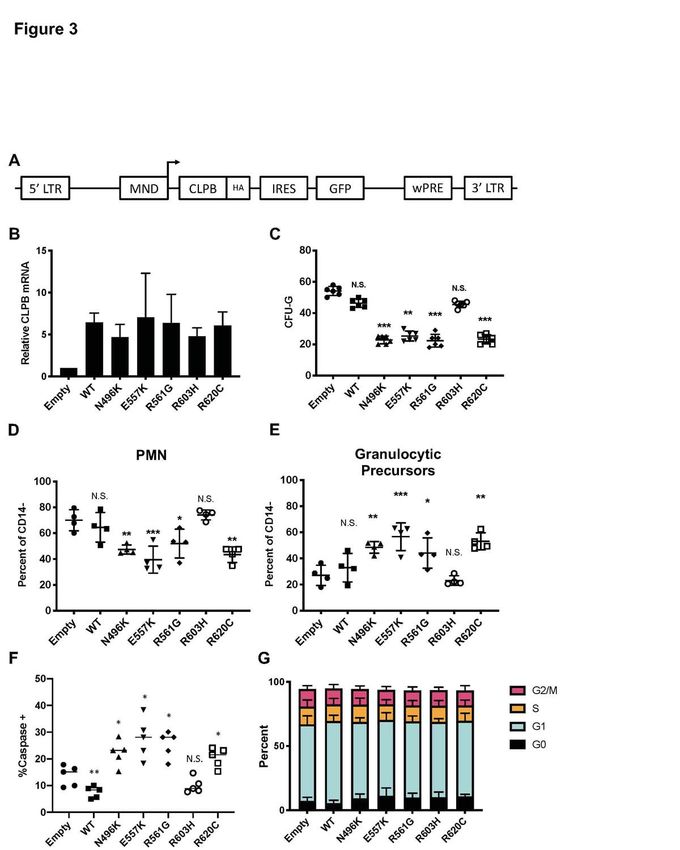
12Expression of ATP-binding pocket CLPB variants results in impaired granulocytic differentiation
To assess the impact of heterozygous CLPB variants on granulopoiesis, we transduced
Downloaded from http://ashpublications.org/blood/article-pdf/doi/10.1182/blood.2021010762/1809413/blood.2021010762.pdf by WASHINGTON UNIVERSITY SCHOOL, Julia Warren on 11 June 2021
cord blood CD34+ cells with lentivirus expressing each of the four CLPB variants from our
SCNIR exome sequencing cohort (Fig. 3A). We included the likely benign, paternally inherited,
non-ATP binding cleft R603H variant as a negative control. Of note, since CLPB expression was
increased 4-10 fold compared to vector-alone controls (Fig. 3B and Fig. S5), we included a
wildtype CLPB lentiviral cohort to control for the effect of CLPB overexpression (Fig. 3B). A
significant decrease in CFU-G was observed for the four CLPB variants that localize to the ATP-
binding pocket (N496K, E557K, R561G, and R620C) but not the R603H variant (Fig. 3C and
1E). Fewer mature neutrophils and an increase in granulocytic precursors was present in
cultures of HSPCs transduced with the ATP-binding pocket CLPB variants but not the R603H
variant (Fig. 3D-E). Expression of ATP-binding pocket variants resulted in an increase in
apoptosis of granulocytic precursors but no change in cell cycle status (Fig. 3F-G). Collectively,
these data show that heterozygous ATP-binding pocket variants of CLPB cause impaired
granulocyte differentiation.
CLPB heterozygous variants have impaired ATPase and disaggregase activity, and exert a
dominant-negative effect on WT CLPB.
Human CLPB is an ATPase with potent disaggregase activity11,12. Biallelic CLPB
variants that impair ATP cleavage also show impaired disaggregase activity, though there also
appear to be ATPase-intact variants with impaired disaggregase activity that occurs through
alternative mechanisms11. The heterozygous nature of our CLPB-SCN variants suggests a
dominant negative effect on wildtype CLPB. To test this hypothesis, we performed mixing
studies with recombinant WT and mutant CLPB proteins. As a control, we included the R408G
CLPB variant that is found in biallelic CLPB syndrome in conjunction with a second CLPB
13variant. Of note, parents with heterozygous R408G CLPB are asymptomatic2,6, even though
purified R408G protein has impaired ATPase activity2. We also included the likely benign
variant, R603H. We show that all of the CLPB variants (except the R603H control) have
Downloaded from http://ashpublications.org/blood/article-pdf/doi/10.1182/blood.2021010762/1809413/blood.2021010762.pdf by WASHINGTON UNIVERSITY SCHOOL, Julia Warren on 11 June 2021
impaired ATPase and disaggregase activity when tested in isolation (Fig. 4A-B). When mixed
with WT CLPB, all of the heterozygous CLPB-SCN variants demonstrate greater than 50%
reduction in both ATPase (reaching significance for E557K and R561G) and disaggregase
activity (reaching significance for all CLPB-SCN variants) (Fig. 4C-D). In contrast, the R408G
variant, while having reduced ATPase and disaggregase activity in isolation (Fig. 4A-B), did not
suppress the activity of WT CLPB (Fig. 4C-D). As expected, the R603H variant had no effect.
Together, these data suggest that heterozygous CLPB-SCN variants act in a dominant-negative
fashion.
Expression of ATP-binding pocket CLPB variants results in impaired mitochondrial function
CLPB contains a mitochondrial localization sequence and has previously been shown to
localize to the mitochondria in a human myeloid progenitor cell line, MOLM-1314, and absence
of CLPB causes impaired mitochondrial protein solubility11. Therefore, we hypothesized that
CLPB-SCN heterozygous variants may affect granulocyte progenitors by impacting
mitochondrial function. To test this hypothesis, we generated MOLM-13 cells expressing
wildtype or mutant CLPB. We initially focused on CLPB N496K and R620C. Both wildtype and
mutant CLPB localize to mitochondria (Fig 5A). CLPB mutant cells had impaired mitochondrial
respiration, with significantly reduced basal and maximal respiratory capacity and a
corresponding decrease in ATP production (Fig. 5B-E). A small but significant decrease in
mitochondrial mass was observed in CLPB-N496K overexpressing cells, with a corresponding
decrease in mitochondrial membrane potential, as measured using TMRM (Fig. 5F-H).
We next expanded our analysis to include other ATP-binding pocket variants from our
heterozygous CLPB-SCN cohort (E557K, R561G, R561Q) and the two parentally inherited likely
14benign variants (R327W and R603H). We also tested the R408G ATP-binding pocket variant,
which is found in CLPB syndrome patients always in combination with nonsense or frameshift
variants. As expected, the additionally tested ATP-binding pocket variants from our
Downloaded from http://ashpublications.org/blood/article-pdf/doi/10.1182/blood.2021010762/1809413/blood.2021010762.pdf by WASHINGTON UNIVERSITY SCHOOL, Julia Warren on 11 June 2021
heterozygous-CLPB SCN cohort also demonstrated impaired mitochondrial function (Fig 5I-K).
In contrast, one of the paternally inherited variants (R327W) did not. The other paternally
inherited variant, R603H, displayed an intermediate phenotype. Interestingly, the R408G variant
from the biallelic CLPB syndrome series did not show impaired mitochondrial function. The
observed differences were not due impaired association of mutant CLPB with WT CLPB, as
both R408G and our heterozygous CLPB-SCN variants were able to co-associate with WT
CLPB (Fig. S6). Together, these data show that expression of ATP-binding pocket CLPB-SCN
variants results in impaired mitochondrial respiration.
Expression of ATP-binding pocket CLPB variants does not render MOLM13 cells more sensitive
to ER stress
During granulocytic differentiation, the massive expression of neutrophil elastase
(encoded by ELANE), and other primary granule proteins, induces ER stress. Indeed, we and
others reported that misfolded neutrophil elastase, through induction of ER stress, contributes to
the pathogenesis of ELANE-mutated SCN27-30. ER stress can induce the unfolded protein
response (UPR), ultimately resulting in apoptosis. Recent studies suggest that UPR-induced
calcium efflux can enhance mitochondrial respiration, resulting in protection from ER-stress
induced apoptosis31,32. Based on these observations, we hypothesized that the impaired
mitochondrial respiration induced by mutant CLPB expression renders granulocytic precursors
more sensitive to ER stress. To test this hypothesis, we induced ER stress in MOLM13 cells
expressing CLPB N496K or R620C by treating with the glycosylation inhibiting drug
tunicamycin. The magnitude of ER stress induced by tunicamycin, as measured by HSPA5
mRNA expression, was similar in control and CLPB mutant cells (Fig. 6A). In control (DMSO-
15treated) cells, expression of N496K and R620C results in a small but significant increase in
apoptosis as measured by cleaved Caspase 3 (Fig. 6B), with a trend to increased Annexin V
cells surface expression (Fig. 6C). Although there was a significant increase in the total
Downloaded from http://ashpublications.org/blood/article-pdf/doi/10.1182/blood.2021010762/1809413/blood.2021010762.pdf by WASHINGTON UNIVERSITY SCHOOL, Julia Warren on 11 June 2021
percentage of apoptotic cells in the N496K and R620C groups, all variants showed an
equivalent fold-change increase in apoptosis relative to DMSO control (Fig. 6D-E). Thus,
mutant CLPB expression does not render cells more sensitive to ER stress-induced apoptosis.
DISCUSSION
We identified 10 unrelated individuals with SCN and heterozygous ATP-binding pocket
variants in CLPB. These patients present with isolated severe neutropenia with few, if any, of
the non-hematopoietic features associated with bi-allelic CLPB loss, including 3-
methylglutaconic aciduria. Expression of these CLPB variants in primary human HSPCs is
sufficient to impair granulocytic differentiation. These observations suggest that heterozygous
variants in CLPB that localize to the ATP-binding pocket are a new and relatively common
cause of severe congenital neutropenia. Indeed, in the North American exome sequencing
cohort, potentially pathogenic heterozygous CLPB mutations were identified in 5 of 70 (7.1%) of
ELANE-wildtype SCN cases, making it the second most common cause of SCN behind ELANE
mutations. We also establish the presence of potentially pathogenic heterozygous CLPB
variants in the European population.
Not all heterozygous mutations in CLPB will be disease causing. Our data support a
model whereby highly conserved mutations located within the ATP-binding pocket are predicted
to be pathogenic. Our combination of sequencing and functional data allows us to classify the
variants in 10 of these individuals as pathogenic or likely pathogenic according to American
College of Medical Genetics criteria33 (Table S3). We also identified two individuals with
heterozygous variants in CLPB (R327W and R603H) that our functional data and inheritance
patterns suggest are benign variants (Table S4). Of note, we also identified three unrelated
16families with cyclic neutropenia carrying the CLPB variant R628C. Although not functionally
validated, these data raise the possibility that this heterozygous CLPB variant may be a rare
cause of cyclic neutropenia. Together, these observations indicate that genetic testing for
Downloaded from http://ashpublications.org/blood/article-pdf/doi/10.1182/blood.2021010762/1809413/blood.2021010762.pdf by WASHINGTON UNIVERSITY SCHOOL, Julia Warren on 11 June 2021
CLPB should be included in the work-up of patients presenting with congenital neutropenia and
importantly that heterozygous mutations in the ATP-binding pocket should be considered
potentially pathogenic.
The mechanisms by which heterozygous ATP-binding pocket CLPB variants impair
granulocytic differentiation are not clear. Genetic and biochemical evidence support a
dominant-negative mechanism. Parents of patients with CLPB syndrome carrying heterozygous
null CLPB mutations are asymptomatic2-6. Additionally, we show that ATP-binding pocket CLPB
mutants co-immunoprecipitate with wildtype CLPB and inhibit the ATPase and disaggregase
activity of wildtype CLPB in mixing studies. On the other hand, a simple dominant-negative
mechanism does not account for all of the phenotypic differences between persons with
heterozygous CLPB mutations and CLPB syndrome. In particular, 3-MGA was not detected in
the urine of all evaluable CLPB-SCN cases (5 out of 10). In Pronicka’s review of 31 patients
with CLPB6, urine 3-MGA was detected in 29 of 29 evaluable cases, whereas it was not
detected in any of the 5 cases of CLPB-SCN where urine was available (P < 0.0001 compared
to 0/5 CLPB-SCN cases, by Fisher’s exact test). These observations suggest the possibility
that, while the ATPase activity of CLPB is needed to maintain mitochondrial functions required
for granulocytic differentiation, an (as yet undefined) ATPase-independent activity of CLPB
helps maintain mitochondrial functions required to suppress 3-methylglutagonic production. In
this model, the biallelic CLPB mutations in CLPB syndrome patients results in a loss (or partial
loss) of all CLPB functions, resulting in both neutropenia, 3-methylglutagonic aciduria, and other
nonhematopoietic phenotypes. In contrast, the heterozygous ATP-binding pocket mutations of
CLPB found in SCN cases only impair the ATPase-dependent functions of CLPB, leading to
severe neutropenia without 3-methylglutaconic aciduria. Further study is needed to test this
17model, including careful examination for extra-hematopoietic phenotypes in all identified
heterozygous CLPB-SCN cases. This will allow for clarification of whether ATP-binding pocket
CLPB mutations define a unique clinical entity or contribute to a wider clinical spectrum of CLPB
Downloaded from http://ashpublications.org/blood/article-pdf/doi/10.1182/blood.2021010762/1809413/blood.2021010762.pdf by WASHINGTON UNIVERSITY SCHOOL, Julia Warren on 11 June 2021
deficiency.
Our data suggest that expression of ATP-binding pocket CLPB mutants results in
14
impaired mitochondrial function, and is similar to the phenotype of CLPB null cells . Of note,
our data show that mitochondrial respiration is significantly reduced in cells expressing mutant
CLPB and this difference is not explained by the small (though significant) decrease in
mitochondrial mass. This may be relevant, since during granulocytic differentiation there is a
34-36
switch in energy metabolism from glycolysis to oxidative phosphorylation . Whether impaired
oxidative phosphorylation contributes to the impaired granulocytic differentiation induced by
mutant CLPB will require further study. Although recent studies have suggested a link between
ER stress and mitochondrial stress, our data suggest that the mitochondrial dysfunction induced
by mutant CLPB expression does not appear to render cells more sensitive to ER stress. CLPB
protein interacts with the mitochondrial proteins Optic Atrophy 1 (OPA1) and HAX111,14 and is
37
required for HAX1 solubility11. Mutations of HAX1 are a rare cause of SCN and OPA1 has
been shown to regulate mitochondrial respiratory capacity through maintenance of
38
mitochondrial cristae . Whether heterozygous ATP-binding pocket mutations of CLPB alter
interactions with OPA1 or HAX1 to disrupt mitochondrial function will require further study.
Interestingly, although neutropenia is observed in some mitochondrial syndromes, such as
39
Barth syndrome, it is not a common feature . Thus, the specific mitochondrial defect may
determine whether granulopoiesis is disrupted.
Establishing the link between SCN and heterozygous ATP-binding pocket mutations in
CLPB will help guide the clinical management of these patients: they should be treated with G-
CSF therapy as indicated and monitored closely for infection and development of myeloid
18malignancy. Our findings also establish an important cell-intrinsic role for CLPB in normal
human granulopoiesis. Future studies will be aimed at understanding the link between
mitochondrial dysfunction and impaired granulocytic differentiation.
Downloaded from http://ashpublications.org/blood/article-pdf/doi/10.1182/blood.2021010762/1809413/blood.2021010762.pdf by WASHINGTON UNIVERSITY SCHOOL, Julia Warren on 11 June 2021
Acknowledgements
We are grateful to the persons who contributed samples and clinical information for this study.
The authors wish to thank the Alvin J. Siteman Cancer Center at Washington University School
of Medicine and Barnes-Jewish Hospital in St. Louis, MO., for the use of the Siteman Flow
Cytometry Core, which provided cell sorting expertise; Jessica Hoisington-Lopez and MariaLynn
Cosby from the DNA Sequencing Innovation Laboratory at the Edison Family center for
Genome Sciences and Systems Biology for expertise with DNA sequencing; Sridhar
Nonavinkere Srivatsan for bioinformatics support; Severine Clauin for sequencing support;
Julien Buratti for bioinformatics analysis support; James Huang for providing comments on the
manuscript; and Paul Coppo, Mohamed Hamidou, and Amelie Servettaz for clinical expertise.
This work was supported by T32 Institutional NRSA Training Program in Developmental
Hematology HD007499-19 and Training of the Pediatric Physician-Scientist HD043010 (JTW),
American Society of Hematology Scholar Award (JTW), Children’s Discovery Institute
Fellowship MC-F-2020-871 (JTW), NIH/NIA F31AG060672 (RRC), NIH/NIGMS T32GM008275
(RRC), Blavatnik Family Foundation Fellowship (RRC), the National Cancer Institute
K08CA190815 (DHS), The G. Harold and Leila Y. Mathers Foundation (JS), NIH/NIGMS
R01GM099836 (JS), Inserm ITMO sante publique, X4 Pharma, Prolong Pharma and Chugai SA
(French SCN Registry), Foundation for Rare Diseases (AO9102LS), 111 Les Arts, the RMHE,
Association Barth France, and the Association Sportive de Saint Quentin Fallavier (CBC and
JD), NIH/NIAID 2R 24 AI 049393-Severe Chronic Neutropenia International Registry (DCD),
Department of Defense grant BM130173 (DCL), and R01HL152632-01 (DCL).
19Author Contributions
DCL and DCD conceived and jointly supervised the study. JTW, RRC, JS, DCD and DCL
designed the experiments; JTW, RRC, PW, and NLK performed the experiments. DHS and AEL
Downloaded from http://ashpublications.org/blood/article-pdf/doi/10.1182/blood.2021010762/1809413/blood.2021010762.pdf by WASHINGTON UNIVERSITY SCHOOL, Julia Warren on 11 June 2021
performed sequence alignment and variant annotation; JTW, PW and DCL analyzed SCNIR
exome data and performed filtering. DCD, VM, MLK, and AAB provided patient samples and
clinical information from the SCNIR; CBC and JD provided sequencing and clinical information
from the French SCN Registry. JTW and DCL wrote the manuscript. All authors reviewed and
contributed to the final version of the manuscript.
Conflict of Interest Disclosures
All authors except JS declare no conflicts of interests. JS is a consultant for Dewpoint
Therapeutics and Maze Therapeutics.
REFERENCES
1. Skokowa J, Dale DC, Touw IP, Zeidler C, Welte K. Severe congenital neutropenias. Nat Rev
Dis Primers. 2017;3(1):nrdp201732.
2. Wortmann SB, Ziętkiewicz S, Kousi M, et al. CLPB mutations cause 3-methylglutaconic
aciduria, progressive brain atrophy, intellectual disability, congenital neutropenia, cataracts,
movement disorder. American journal of human genetics. 2015;96(2):245–257.
3. Saunders C, Smith L, Wibrand F, et al. CLPB variants associated with autosomal-recessive
mitochondrial disorder with cataract, neutropenia, epilepsy, and methylglutaconic aciduria.
American journal of human genetics. 2015;96(2):258–265.
4. Capo-Chichi J-M, Boissel S, Brustein E, et al. Disruption of CLPB is associated with
congenital microcephaly, severe encephalopathy and 3-methylglutaconic aciduria. Journal of
Medical Genetics. 2015;52(5):303–311.
5. Kiykim A, Garncarz W, Karakoc-Aydiner E, et al. Novel CLPB mutation in a patient with 3-
methylglutaconic aciduria causing severe neurological involvement and congenital neutropenia.
Clinical immunology (Orlando, Fla.). 2016;165:1–3.
6. Pronicka E, Ropacka-Lesiak M, Trubicka J, et al. A scoring system predicting the clinical
course of CLPB defect based on the foetal and neonatal presentation of 31 patients. Journal of
inherited metabolic disease. 2017;40(6):853–860.
7. Snider J, Thibault G, Houry WA. The AAA+ superfamily of functionally diverse proteins.
Genome biology. 2008;9(4):216.
208. Haslberger T, Zdanowicz A, Brand I, et al. Protein disaggregation by the AAA+ chaperone
ClpB involves partial threading of looped polypeptide segments. Nature structural & molecular
biology. 2008;15(6):641–650.
9. Deville C, Carroni M, Franke KB, et al. Structural pathway of regulated substrate transfer and
Downloaded from http://ashpublications.org/blood/article-pdf/doi/10.1182/blood.2021010762/1809413/blood.2021010762.pdf by WASHINGTON UNIVERSITY SCHOOL, Julia Warren on 11 June 2021
threading through an Hsp100 disaggregase. Science advances. 2017;3(8):e1701726.
10. Rizo AN, Lin J, Gates SN, et al. Structural basis for substrate gripping and translocation by
the ClpB AAA+ disaggregase. Nature communications. 2019;10(1):2393.
11. Cupo, RR, Shorter, J. Skd3 (human ClpB) is a potent mitochondrial protein disaggregase
that is inactivated by 3-methylglutaconic aciduria-linked mutations. eLife. 2020;9:e55279.
12. Mroz, D, Wyszkowski, H, Szablewski, T, Zawieracz, K, Dutkiewicz, R, Bury, K, Wortmann,
S, Wevers, R, Zietkiewicz, S. CLPB (caseinolytic peptidase B homolog), the first mitochondrial
protein refoldase associated with human disease. Biochem Biophys Acta Gen Subj.
2020;1864(4):129512.
13. Yoshinaka T, Kosako H, Yoshizumi T, et al. Structural basis of mitochondrial scaffolds by
prohibitin complexes: Insight into a role of the coiled-coil region. Iscience. 2019;19:1065–1078.
14. Chen X, Glytsou C, Zhou H, et al. Targeting Mitochondrial Structure Sensitizes Acute
Myeloid Leukemia to Venetoclax Treatment. Cancer Discov. 2019;9(7):890–909.
15. Lek M, Karczewski KJ, Minikel EV, et al. Analysis of protein-coding genetic variation in
60,706 humans. Nature. 2016;536(7616):285–291.
16. Network CGAR, Ley TJ, Miller C, et al. Genomic and epigenomic landscapes of adult de
novo acute myeloid leukemia. The New England journal of medicine. 2013;368(22):2059–2074.
17. Talevich E, Shain AH, Botton T, Bastian BC. CNVkit: Genome-Wide Copy Number
Detection and Visualization from Targeted DNA Sequencing. Plos Comput Biol.
2016;12(4):e1004873.
18. Halene S, Wang L, Cooper RM, et al. Improved Expression in Hematopoietic and Lymphoid
Cells in Mice After Transplantation of Bone Marrow Transduced With a Modified Retroviral
Vector. Blood. 1999;94(10):3349–3357.
19. Robbins PB, Skelton DC, Yu XJ, et al. Consistent, persistent expression from modified
retroviral vectors in murine hematopoietic stem cells. Proceedings of the National Academy of
Sciences of the United States of America. 1998;95(17):10182–10187.
20. Brunetti L, Gundry MC, Kitano A, Nakada D, Goodell MA. Highly Efficient Gene Disruption of
Murine and Human Hematopoietic Progenitor Cells by CRISPR/Cas9. Journal of visualized
experiments : JoVE. 2018;(134):e57278–e57278.
21. Clement K, Rees H, Canver MC, et al. CRISPResso2 provides accurate and rapid genome
editing sequence analysis. Nature biotechnology. 2019;37(3):224–226.
2122. Cupo RR, Shorter J. Expression and Purification of Recombinant Skd3 (Human ClpB)
Protein and Tobacco Etch Virus (TEV) Protease from Escherichia coli. Bio Protoc. 2020;
10(23):e3858.
23. DeSantis ME, Leung EH, Sweeny EA, Jackrel ME, Cushman-Nick M, Neuhaus-Follini A,
Downloaded from http://ashpublications.org/blood/article-pdf/doi/10.1182/blood.2021010762/1809413/blood.2021010762.pdf by WASHINGTON UNIVERSITY SCHOOL, Julia Warren on 11 June 2021
Vashist S, Sochor MA, Knight MN, Shorter J. Operational plasticity enables hsp104 to
disaggregate diverse amyloid and nonamyloid clients. Cell. 2012;141(4):778-793.
24. Lee S, Sowa ME, Watanabe Y, et al. The structure of ClpB: a molecular chaperone that
rescues proteins from an aggregated state. Cell. 2003;115(2):229–240.
25. Zeymer C, Fischer S, Reinstein J. trans-Acting arginine residues in the AAA+ chaperone
ClpB allosterically regulate the activity through inter- and intradomain communication. Journal of
Biological Chemistry. 2014;289(47):32965–32976.
26. Wendler P, Ciniawsky S, Kock M, Kube S. Structure and function of the AAA+ nucleotide
binding pocket. Biochim Biophys Acta. 2011;1823(1):2–14.
27. Grenda, D, Murakami, M, Ghatak, J, Xia, J, Boxer, L, Dale, D, Dinauer, M, Link, D.
Mutations of the ELA2 gene found in patients with severe congenital neutropenia induce the
unfolded protein response and cellular apoptosis. Blood. 2007;110(13): 4179 - 4187.
28. Nustede, R, Klimiankou, M, Klimenkova, O, Kuznetsova, I, Zeidler, C, Welte, K, Skokowa, J
. ELANE mutant-specific activation of different UPR pathways in congenital neutropenia. British
J Haemat. 2016;172(2):219 - 227.
29. Köllner, I, Sodeik, B, Schreek, S, Heyn, H, Neuhoff, N, Germeshausen, M, Zeidler, C,
Krüger, M, Schlegelberger, B, Welte, K, Beger, CMutations in neutrophil elastase causing
congenital neutropenia lead to cytoplasmic protein accumulation and induction of the unfolded
protein response. Blood. 2006;108(2):493 - 500.
30. Nanua, S, Murakami, M, Xia, J, Grenda, D, Woloszynek, J, Strand, M, Link, D. Activation of
the unfolded protein response is associated with impaired granulopoiesis in transgenic mice
expressing mutant Elane. Blood. 2011;117(13):3539 - 3547.
31. Bravo, R, Vicencio, JM, Parra, V, Troncoso, R, Munoz, JP, Bui, M, Quiroga, C, Rodriguez,
AE, Verdejo, HE, Ferreira, J, Iglewski, M, Chiong, M, Simmen, T, Zorzano, A, Hill, JA,
Rothermel, BA, Szabadkai, G, Lavendero, S. Increased ER-mitochondrial coupling promotes
mitochondrial respiration and bioenergetics during early phases of ER stress. J Cell Sci.
2011;124(Pt13):2143-52.
32. Knupp, J, Arvan, P, Chang, A. Increased mitochondrial respiration promotes purvival from
endoplasmic reticulum stress. Cell Death Differ. 2019;26:487-501.
33. Richards, S, Aziz, N, Bale, S, Bick, D, Das, S, Fastier-Foster, J, Grody, W, Hegde, M, Lyon,
E, Spector, E, Voelkerding, K, Rehm, H, on behalf of the ACMG Laboratory Quality Assurance
Committee. Standards and Guidelines for the Interpretation of Sequence Variants: a Joint
Consensus Recommendation of the American College of Medical Genetics and Genomics and
the Association for Molecular Pathology. Genetics in Medicine. 2015;17: 405-423.
2234. Vannini N, Girotra M, Naveiras O, et al. Specification of haematopoietic stem cell fate via
modulation of mitochondrial activity. Nat Commun. 2016;7(1):13125.
35. Six E, Lagresle-Peyrou C, Susini S, et al. AK2 deficiency compromises the mitochondrial
energy metabolism required for differentiation of human neutrophil and lymphoid lineages. Cell
Downloaded from http://ashpublications.org/blood/article-pdf/doi/10.1182/blood.2021010762/1809413/blood.2021010762.pdf by WASHINGTON UNIVERSITY SCHOOL, Julia Warren on 11 June 2021
Death Dis. 2015;6(8):e1856–e1856.
36. Rice CM, Davies LC, Subleski JJ, et al. Tumour-elicited neutrophils engage mitochondrial
metabolism to circumvent nutrient limitations and maintain immune suppression. Nat Commun.
2018;9(1):5099.
37. Klein C, Grudzien M, Appaswamy G, et al. HAX1 deficiency causes autosomal recessive
severe congenital neutropenia (Kostmann disease). Nature genetics. 2007;39(1):86–92.
38. Mishra P, Carelli V, Manfredi G, Chan DC. Proteolytic Cleavage of Opa1 Stimulates
Mitochondrial Inner Membrane Fusion and Couples Fusion to Oxidative Phosphorylation. Cell
Metab. 2014;19(4):630–641.
39. Finsterer J. Hematological manifestations of primary mitochondrial disorders. Acta
haematologica. 2007;118(2):88–98.
23Table 1. Detailed Characteristics of Heterozygous SCN-CLPB Patients
Downloaded from http://ashpublications.org/blood/article-pdf/doi/10.1182/blood.2021010762/1809413/blood.2021010762.pdf by WASHINGTON UNIVERSITY SCHOOL, Julia Warren on 11 June 2021
Pre- Median
Age at Urine
G- G-CSF Bone AML/M
Sampl Protei cDNA VA gnomA Gend Diagno Splenomeg Neurologica Catarac 3-
CSF dose Marrow DS Infections Other
e ID# n p. c. F D er sis aly (Y/N) l ts MGA
AN (mcg/kg/d Biopsy (Y/N)
(Years) **
C ay)
Azoosper
Maturati
Fr- T388 1163C 0.3 mia
0 M 1.5 A 3 neurinoma
arrest
(age 41)
Maturati omphalitis
SCNI N496 1488 0.4
0 F 0.2 0.18 10.45 on Yes Yes at birth, Epilepsy No None N/A
R-19 K T>A 5
arrest otitis
Maturati
SCNI E557 1669 0.3 Developme
0 M 0 0.15 4.41 on No No URI No None N/A
R-73 K G>A 7 ntal delays
arrest
Maturati otitis, skin
SCNI R561 1681 0.2
0 F 1.6 0.00 3.96 on Yes No abscesse Negative No None No
R-2 G C>G 6
arrest s
gangreno
us
SCNI Maturati
R561 1682 appendicit
R- het 0 F 2.1 0.10 4.59 on No No Negative No None N/A
Q G>A is, sepsis;
2698* arrest
perianal
abscess
Maturati IUGR, GH
Fr- R561 1682 0.4 0.45
0 F 0.5 12.61 on No No No Negative No deficiency, No
0038 Q G>A 8 -A 2 A 7 us Difficulties
arrest
otitis,
Maturati cellulitis,
SCNI R620 1858 0.4 0.29
0 F 0.6 3.438 on No No skin Negative No None No
R-12 C C>T 3 2
arrest abscess,
URI
Maturati
SCNI R620 1858 0.4
0 F 0.2 0.00 3.45 on No No None Negative No None No
R-29 C C>T 7
arrest
SCNIR: Cases identified through the SCNIR North America registry; Fr: Cases identified through the French SCN registry
*Identified initially through clinical sequencing
**Urine organic acid testing specifically included quantitation of 3-MGA
URI: upper respiratory infection; UTI: urinary tract infection
IUGR: intrauterine growth restriction; GH: growth hormone; POF: premature ovarian failure
N/A: Not available
24FIGURE LEGENDS
Figure 1. CLPB variants in SCN. Flow diagrams summarizing independent sequencing results
from the SCNIR (A) and French SCN registry (B-C). Cyclic: cyclic neutropenia. The number of
Downloaded from http://ashpublications.org/blood/article-pdf/doi/10.1182/blood.2021010762/1809413/blood.2021010762.pdf by WASHINGTON UNIVERSITY SCHOOL, Julia Warren on 11 June 2021
cases carrying a specific variant is shown in parentheses. *One patient was identified initially
through clinical sequencing, but subsequently enrolled in the SCNIR and underwent exome
sequencing. (D) Mutational spectrum of CLPB as identified in this series (top) vs. previously
reported biallelic variants (bottom). The overall domain architecture of human CLPB is shown
and includes the mitochondrial localization sequence (MLS); ankyrin-rich repeats (ANK);
ATPase domain, and C-terminal domain (CTD). (E) CLPB protein structure model based on
data from the crystal structure of Thermus Thermophilus CLPB (PDB ID: 1qvr). Side chains are
shown for the 5 mutated residues found in 10 patients which cluster around the ATP-binding
pocket. (F) Pedigrees for 2 de novo cases with available family studies. Parental and patient
variant status was confirmed using Sanger sequencing. “WT”: wild-type, indicating that the
relevant CLPB variant was not present. Parentage for cases Fr-0019, Fr-0038 and Fr-1408
were confirmed using short tandem repeat analysis.
Figure 2. CLPB deficient HSPCs have impaired granulocytic differentiation. Human cord
blood CD34+ cells were nucleofected with guide RNA targeting CLPB (CLPB-g1 or CLPB-g3), or
a control guide RNA targeting the intron of AAVS1 (as a gene editing control) complexed
together with recombinant Cas9 protein. Edited CD34+ cells were cultured for 7-14 days in
media containing G-CSF and stem cell factor. (A) Representative flow plots showing gating
strategy to identify CD11b+, CD16+ mature neutrophils (PMN) or CD11b+/- CD16- granulocytic
precursors; data are gated on CD14- cells to remove monocytes. Data are quantified in the right
panel. (B) Representative hematolylin/eosin stained cytospin preparations of cells on day 14 of
culture; original magnification 63X. Data are quantified in the right panel. (C) Shown are the
number of colony-forming units-granulocyte (CFU-G) per 2,000 gene-edited CD34+ cells. (D)
25You can also read


