Local Mart: Online Grocery Application - IJESC
←
→
Page content transcription
If your browser does not render page correctly, please read the page content below
ISSN 2321 3361 © 2021 IJESC

Research Article                                                                                        Volume 11 Issue No.07

                              Local Mart: Online Grocery Application
                       Shahzaib Ahmad1, Rishabh Pathak2, Rishabh Verma3, Sanchit Verma4, Jaspreet Kaur5
                                      Department of Computer Science and Engineering
                                     JSS Academy of Technical Education, Noida, India

Abstract:
This review paper is for a web-based shopping system for an existing business, with the goal of delivering an online grocery
shopping application to an Android platform that is built keeping COVID-19 in mind. If stores offer an internet platform via
which clients can purchase conveniently from anywhere, they will not lose customers to popular online retailers such as Flipkart
or Amazon. The application is instantly accessible and always available because it is available on an Android Smartphone. There
is no need to stand in a queue, nor to carry bags or struggle with trolleys. Customers can buy for groceries from the comfort of
their own homes by viewing photos of various items and adding them to their shopping cart. The Application will have significant
role in this COVID circumstances by limiting social gatherings and time spent in crowded places. At all appropriate levels,
special attention was paid to ensuring that the system ensures data consistency using relevant business rules and validations. The
database connectivity was arranged utilizing the most recent “Database connection” technology provided by Mongo dB.
Authentication and authorization were double-checked at every stage of development.

Keywords: Grocery Shopping, Pandemic, Web-Scrapping, Model–view–view model (MVVM).

I. INTRODUCTION                                                       A. To see how Discerned Factors influence online shoppers'
                                                                      attitudes on online grocery ordering.
Online grocery shopping is the act of purchasing groceries            Customers who are inexperienced with online grocery
from a merchant in real time through the Internet without the         shopping and those who are accustomed with online grocery
need of an intermediary service. It's an instance of electronic       shopping will have differing perceptions of cost. Varied age
commerce. The application's basic principle is to allow users to      groups have different perspectives on risk. Non-Online grocery
shop virtually via the Internet and to purchase the goods they        consumers and online grocery shoppers will assess risk in
want from the store. At the server side, the information about        different ways. Married clients are more likely to detect risk
the items is stored in a Non-Relational DBMS (store).                 than single customers. Males and females perceive costs in
Customers are processed by the Server, and products are               different ways.[2]
dispatched to the addresses provided by them. There are two
primary modules in the system. The first module is for clients        B. To see how Discerned Convenience influences
who want to buy groceries. The second module is for the               consumers' perception on online grocery ordering.
Sellers, who are responsible for maintaining and updating             Customers who are familiar with online grocery shopping and
product and customer information. The end user of this service        those who are not familiar with online grocery shopping will
is a grocery store, and the application is hosted on the web          evaluate convenience in different ways. Customers who are
with the database managed by the administrator. The database          single and married will evaluate convenience in different ways.
of all the things is updated at the end of each transaction by the    Customers who are employed and those who are unemployed
application that is deployed at the customer database, and the        will evaluate convenience in different ways. Convenience will
information of the products is brought forward from the               be seen differently by different age groups. [2]
database for the customer view based on the selection through
the list. Data can be entered into the application through a          C.To see how Discerned Enjoyable affects customers'
variety of panels designed for different levels of clients.           attitudes on online grocery ordering.
Several reports could be generated in accordance with the             Customers who buy for groceries online and those who do not
security when authorised personnel input the required data into       shop for groceries online will have distinct experiences.
the application.                                                      Customers who are experienced with online grocery shopping
                                                                      and customers who are not will have different experiences.
II. RESEARCH METHODOLOGY                                              Males and females have distinct perceptions of what is
                                                                      enjoyable. Customers who are single and married will have
A quantitative methodology is used in the research. The               different perspectives on what is enjoyable. Customers who are
information was gathered by mailing online surveys to the             employed and those who are unemployed will have different
participants and utilising adequate and snowball sampling             perspectives on what is entertaining. [2]
techniques. Within the timeframe, 100 respondents completed
questionnaires, which were then analysed using SPSS                                    Table.1. Age of respondent
software. To uncover significant differences between the
perspectives of subpopulations of Demographic features and
usage behaviour towards online grocery shopping in India, an
independent sample T-test and one way ANOVA were utilised.
The goal of the survey is to find out how Indian customers feel
about online grocery shopping.[1]

IJESC, July 2021                                                     28407                                          http:// ijesc.org/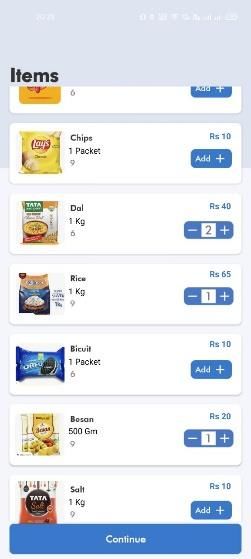
III. RECENT SCENARIO IN E-COMMERCE                                   C. E-commerce: A support system for the present
                                                                     economic downturn.
The purchasing and selling of goods and services through the         The e-commerce market in India has clocked close to
internet, as well as the money and data transfers required to        Rs55,000 cores by the end of 2014, according to First Data
accomplish these transactions, is referred to as e-commerce or       Corporation and ICICI Merchant Services. Even if there are
Electronic Commerce. In India, the e-commerce sector is              only about 10 million internet users in India who are interested
expanding at a breakneck speed.[3] E-continued commerce's            in e-commerce, there are approximately 150 million internet
expansion is altering how individuals think, search, perform,        users in India, or over 75 million households, who are ready to
and generate a yield. Most shoppers are adopting new                 participate in e-commerce.[5] Because entry and operations
purchasing technology, and many of them, being liberal               expenses are lower than in other countries, such as the United
thinkers, seek fast and efficient buying while also taking into      States, the second half of 2011 and the start of the current
account other factors. The majority of businesses in the small,      calendar year saw the introduction of a slew of new e-
medium, and big size sectors have a website to help them grow        commerce sites covering a wide range of industries– Fashion
their business, and they do so by using online marketing and         for women, men, and shoes is followed by accessories, sports,
promotional events, effectively taking a "digital" jump in their     food, home furnishings, toys, jewellery, automobiles,
business cycles. Consumer convenience, needs, wants, and             electronic equipment’s, bicycles and electrical equipment,
solace, as well as their purchasing behaviour and process, are       among others.[11][12]
the basis of E-unstoppable commerce's expansion.
                                                                     IV. PROBLEM IN ONLINE GROCERY SHOPPING
A. India is one of the world's fastest-growing markets, and
the organisation has recognised it as one of its most                Online grocery shopping is a fantastic idea that allows
promising future markets.                                            individuals to purchase from the convenience of their own
According to Muralikrishnan B., country manager for eBay             homes. There will be no more searching various stores for the
India, Electronic devices and books, which are currently the         product, dealing with overly eager salespeople, or waiting in
most popular but have smaller profit margins and are less            long queues at the checkout desk. The rise of electronic
frequent purchases, are preferred by Indian consumers over           commerce has unquestionably improved our shopping habits.
high-margin commodities like clothes and shoes, which are            However, like everything else, internet grocery shopping isn't
popular with eBay users in the West. In a country where              without its drawbacks. Despite the efforts of electronic
Internet usage is rapidly increasing, he depicted India's            commerce organisations to alleviate them, clients still have to
burgeoning e-commerce market, which was largely limited to           deal with a few issues when purchasing online. The following
people purchasing train, flight, and movie tickets until             are a few of these issues. [5]
recently, as being in the midst of a surge as a younger, tech-
savvy middle class gradually takes to shopping online.[4]            A. Delivery and logistics
Techno Park, a consultancy group, predicts a $70-billion             When shopping online, one issue that frequently arises is when
yearly industry by 2020, up from $600 million presently, or          the order will be delivered. While all e-commerce platforms
0.05 percent of worldwide internet buying.                           provide order tracking for their consumers, these systems are
                                                                     not always reliable. Because there is no way to schedule a
B. Due to the modest margins and logistics costs involved,           certain delivery time, delivery staff frequently arrive at our
many firms are difficult to transform into commercial                houses while our customers are at work or elsewhere. When it
endeavours.                                                          comes to returning things, the problem is the same. Another
According to Gaurav Saraf, [4] director of Epiphany Ventures,        issue is that the great majority of Indians who live in rural
the notion of online grocery shopping has the challenge of           areas and Tier-III cities are unable to shop online because not
turning their businesses into viable ventures because the            all e-commerce platforms offer delivery to their locations.[6]
concept is new to the market, resulting in low margins and
significant transportation costs. In addition to these issues,       B. Quality issues
some commodities, such as fruits and vegetables, have a short        The biggest issue with buying things online is that you can't be
shelf life, and if they are not delivered before their shelf life    sure of their quality. Reviews aren't always trustworthy, and no
expires, there will be wastage, which will increase the cost.        amount of research can guarantee a product's quality.
The conclusion drawn from the foregoing is that these                Fraudulent vendors who purposefully mislead buyers in order
businesses operate on a razor-thin profit margin. The research       to maximize sales are the leading cause of faulty products
model is depicted below.                                             being sold online. With the volume of commodities that
                                                                     electronic commerce organisations handle these days,
                                                                     conducting quality checks on each and every product they sell
                                                                     can be tough.[7]
                                                                     C. Additional charges
                                                                     How many times have you seen a terrific offer on a product
                                                                     only to discover an extra shipping charge when you're one
                                                                     click away from purchasing it? When your order amount isn't
                                                                     large enough to qualify for free shipping, this is a typical
                                                                     occurrence on all e-commerce sites. Even when it is, these
                                                                     shipping charges are occasionally tacked on to purchases.[10]
                                                                     V. PROPOSED WORK

                                                                     To overcome these challenges we came up with the idea of
    Figure. 1. Attitude towards online grocery shopping.             “LOCAL MART”:

IJESC, July 2021                                                    28408                                           http:// ijesc.org/
• To overcome with the quality issue we maximized the                shopping experience. It will be a convenient way to shop for
reachability of customer and seller to 1km, by this merchant         groceries. It will be highly beneficial for working people
can't offer a faulty or terminated item to the customer as the       because they will be able to complete all of their shopping at
customer won't be obscure to him and if vender attempts to do        any time and will not have to go to stores. It's also open 24
so it will make a negative impact of the store.                      hours a day, 7 days a week, and is regarded as an innovative
                                                                     and creative way to shop.
• In “LOCAL MART”, since just the nearby stores will be              • Shopping for groceries no longer requires a lot of work and
displayed therefore we have planned a functionality where            time.
there will be no challenge in delivery and logistics. If some        • Get a notification whenever price drops.
store doesn’t provides home delivery the customer will also          • Place your order anytime and anywhere.
have a self-pickup option where seller will keep the product
ready to pick up and the customer can himself pick up the
product and there will be no need of waiting in long queues
and this functionality will play a major role in this COVID
situation by limiting social gathering and time spent in
crowded place.

• Since everyone doesn’t have a digital payment method or
everyone doesn’t trust it especially in provincial zone that’s
why we have a cash on delivery mode on payment also where
customer can pay when product reaches their doorstep and
there is no limit on cash on delivery payment.
                                                                            Figure.3. Static deployment view of the system.

                                                                     VII. RESULTS

                                                                     A. CUSTOMERS:
                                                                     Login/Register: When users initially access the app, they are
                                                                     prompted to register by providing their information. They will
                                                                     be requested to log in if they have already registered.

     Figure.2. Organization and wiring of the physical
                       components.

• Customers will be notified when the price of a product
they've added to their cart decreases, which is a vital feature.
Customers will be able to purchase the product at a lesser cost,
increasing the store's revenues.
                                                                                  Figure. 4. User login information.
• There will be no additional charges on the delivery of the
products and if a customer is ordering an individual product or
products whose cost in less than the minimum order limit then
the customer can choose to self-pickup or the product will be
delivered to him when the seller receives an order from other
customer who lives nearby first customer.

• Vendors can compare the price of a product to that of larger
competitors such as Flipkart and Amazon, which will boost the
likelihood of a client ordering from their store. The application
will also include an analytics functionality that will provide
information to vendors regarding sales. This feature will show
the top selling products and top customers to the seller. The
seller can also change the number of best-selling products and
top customers.

VI. APPLICATION

A. Customers
Local Online Shopping App will allow customers to place their
order online that will save time and money and provide a better
                                                                                       Figure. 5. Sign in Page.

IJESC, July 2021                                                    28409                                          http:// ijesc.org/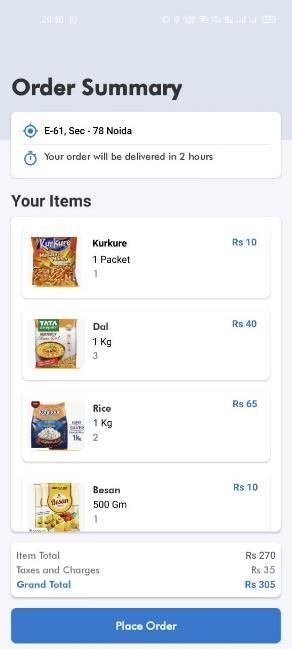
there are thousands of products displayed in the app. In
                                                                    addition to the essential auto-suggest features, our application
                                                                    has the ability to add things to the cart from search results with
                                                                    a single click, eliminating the need to navigate to the product
                                                                    page.

                                                                    Product Page: We gave the option to add any product from
                                                                    the listing to your cart, but this does not reduce the energy of
                                                                    the product page, which presents more information to buyers
                                                                    such as:
                                                                    • Product description
                                                                    • Product price
                                                                    • Product availability in various sizes
                                                                    • Buttons for adding items to cart

                       Figure.6. Sign up Page.

Email Verification: An electronic mail will be sent to the
customer’s email id, for identity verification and on successful
payment. This feature is added keeping security of user in
mind.

                                                                                     Figure. 10. Product Details.

             Figure.7. Verification Email Details.

                    Figure.8. Verification Email.

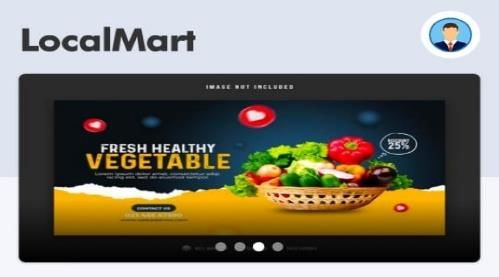
Slider Banner: It provides primary benefits to app users on a
constant basis. With a slider banner displaying your special                         Figure.11. List of Products.
offers, appealing deals, and central message, our application
can nail the bull's eye.

                   Figure. 9. Offers Slider Banner.

 Search Functionality: The main element of an e-commerce
application is product discovery. Search becomes one of the
most significant functions of any online grocery store when                      Figure.12. Adding Products to cart.

IJESC, July 2021                                                   28410                                             http:// ijesc.org/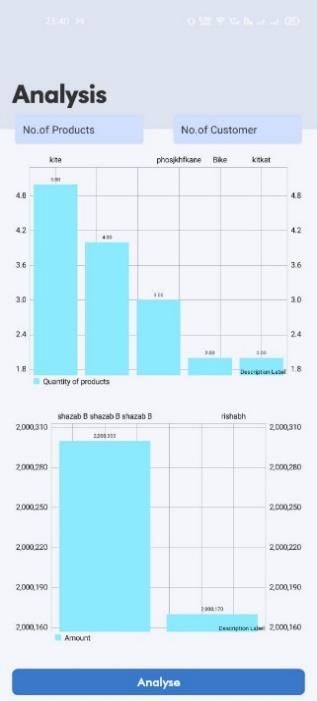
Add to Cart: The ability to add a product to a shopping basket
and subsequently proceed with payment is the core of any e-
commerce platform.

                   Figure.13. Cart items detail.

                                                                              Figure.16. Push Notification Conditions.

                      Figure.14. Cart items.

Push Notification: Customers will be notified when the price
of a product they have added to their cart decreases, which is a
vital feature. Customers will be able to purchase the product at
a lesser cost and reminds them that they have not placed the
order yet.

                                                                           Figure.17. Notification on customer’s Device.

                                                                    Checkout: The checkout page is well-designed, and in order to
                                                                    achieve this, the location for all of the items, quantities, and
                                                                    prices is created ahead of time.
                                                                    • We made it simple to remove products without stress from
                                                                    this page, which is one of our distinctive features.
                                                                    • At the checkout step, the user can also increase the quantity
                                                                    of any individual product. A ‘plus' sign is located near the
                                                                    supply box and can be clicked to enlarge the number.
                                                                    • An important colour is assigned to a ‘Proceed to Pay' button
            Figure.15. Push Notification function                   to indicate the following stage.

IJESC, July 2021                                                   28411                                           http:// ijesc.org/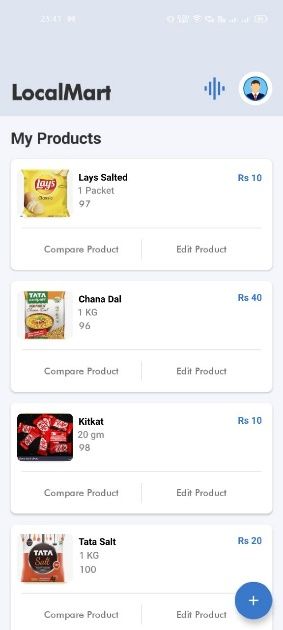
B. VENDOR:
                                                             Login/Register: When seller initially access the app, they are
                                                             prompted to register by providing their information. They will
                                                             be requested to log in if they have already registered.

                   Figure. 18. Order description.

                                                                        Figure.21. Vendor login information.

                   Figure.19. Order Summary.

Payment Options: We support a variety of payment methods,
including:
• Cash on delivery (COD)
• Internet banking
• Credit/debit cards
                                                                               Figure.22. Sign in Page.

          Figure.20. Successful Payment interface.                             Figure.23. Sign up Page.

IJESC, July 2021                                            28412                                          http:// ijesc.org/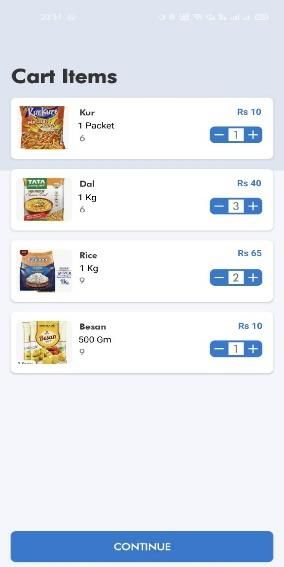
Email Verification: An electronic mail will be sent to the
seller’s email id, for identity verification and on successful
payment. This feature is added keeping security of user in
mind.

            Figure.24. Verification Email Details.

                                                                                Figure.28. Product details entered.

                                                                  Compare Products: After adding a products seller can compare
                                                                  the price of a product to that of larger competitors such as
                                                                  Flipkart and Amazon, which will boost the likelihood of a
                                                                  client ordering from their store. This functionality is achieved
                                                                  by using web-scrapping technique.

                   Figure.25. Verification Email.

Add Product: A simple and easy interface allows the seller to
add any number of products. The seller will just disclose the
product's name, description, price, and quantity available.
In addition, the seller can upload a product image.

                                                                         Figure.29. Compare product using web-scrapping.

     Figure.26. Post request by vendor to add products.

        Figure.27. Add product interface for vendor.                        Figure.30. List of Products added in a store.

IJESC, July 2021                                                 28413                                           http:// ijesc.org/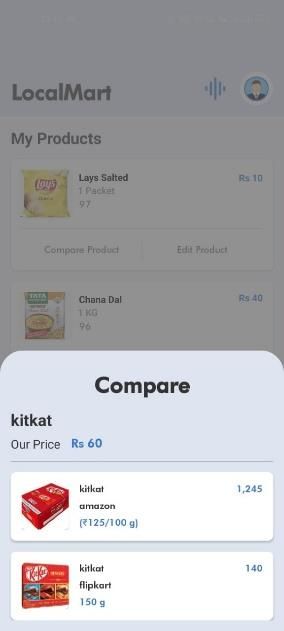
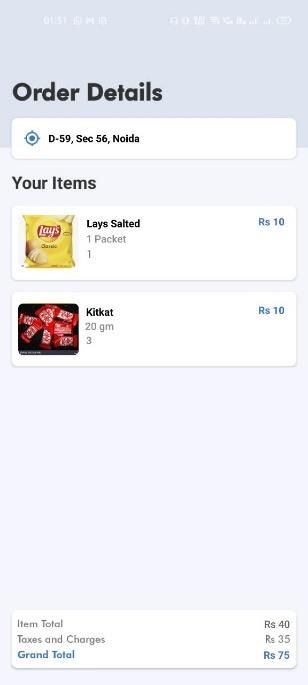
Order Details: The order details screen will provide all of the
                                                                information regarding the order placed by the customer like
                                                                Customer Name, Payment Method, Product Name, Quantity,
                                                                Total Billing Amount, and Delivery Address.

                                                                           Figure.34. Order Details information.
           Figure.31. Compare Products interface.

Sales Analytics: The seller will have access to an analysis
screen where they can review sales data. This feature will
display the most popular items and customers. The vendor can
also alter the amount of best-selling products and top
consumers.

                                                                            Figure. 35. List of Customers order.
         Figure.32. Get Request for Shop Analytics.

                                                                           Figure.36. Vendor’s Order Details UI.

                                                                VII.CONCLUSION

                                                                The Goal of this paper is to present the study done for online
                   Figure.33. Shop Analysis UI.                 shopping and how that can be used for grocery shopping and
                                                                the work done for building an android application for the same.

IJESC, July 2021                                               28414                                          http:// ijesc.org/
Technology has advanced significantly in recent years to               [9]. MasoodH Siddiqui, Shalini N Tripathi, “Grocery Retailing
provide consumers with a better online shopping experience,            in India: Online Mode versus Retail Store Purchase”,
and it will continue to do so in the future. People have               International Business Research; Vol. 9, No. 5; 2016.
predicted that internet shopping will overtake in-store
purchasing due to the rapid rise of products and brands. While         [10]. https://www.business-standard.com/article/news-ani/ in
this is true in some regions, there is still a desire for grocery      dia-s-online-grocery-shopping-forecasted-to-be-among-fastest-
stores in market areas where customers can see and touch the           growing-in-asia-119070800218_1.html
products they are purchasing. The advent of online purchasing,
on the other hand, has resulted in a more knowledgeable                [11]. https://www.businessinsider.in/business/ecommerce/news
customer who can browse around with relative ease and                  /online-grocery-retailers-growth-estimate-in-india/articleshow/
without wasting a lot of time. Online shopping has provided            71885168.cms#:~:text=Online%20grocery%20segment%20wi
opportunities for numerous small businesses. At the end of the         ll%20grow,funding%20in%202019%20so%20far.
day, it was a win-win situation for both the buyer and the
seller. The application will not only help customers and stores        [12].https://retail.economictimes.indiatimes.com/re tales/ india
but will also help stop spreading corona virus. In comparison          n-online-grocery-retailing-will-grow-despite-challenges/1959.
to physical shopping, a thorough analysis of the above findings
reveals that easy accessibility of products on online                  [13].   https://www.crummy.com/software/BeautifulSoup/bs4/
application, as well as flexibility and efficiency of time, are the    doc/
two most important factors that are likely to make consumers
stick with online grocery shopping even after the pandemic             [14]. https://flask.palletsprojects.com/en/1.1.x/quickstart/
ends. For building this application various fields of software
development such as web-scrapping for comparing the price of           [15].http://docs.mongoengine.org/projects/flask-mongoengine/
the product with other competitors were studied and                    en/latest/
implemented accordingly. Various technologies like Android
Studio for building the user interface of the application,             [16]. https://urllib3.readthedocs.io/en/stable/
Retrofit for retrieving and uploading JSON (or other structured
data) via a REST based web service, Mongo dB for storing the           [17]. https://docs.python.org/3/tutorial/index.html
data of customers and stores and approaches like Model-view-
viewModel were used for developing various modules for the
application.

VIII. REFERENCES

[1]. Harjinder Kaur and Rakesh K. Shukla “CONSUMER’S
ATTITUDE FOR ACCEPTANCE OF ONLINE GROCERY
SHOPPING IN INDIA”, International Journal of Current
ResearchVol. 9, Issue, 05, pp.50776-50784, May, 2017.

[2]. Mrs. Panuganti Jayasree “Consumer behavior-Online
grocery shopping in India:an Overview”, International Journal
of Advance Research in Science and Engineering, Vol. No.6,
Special Issue(01),September-2017.

[3]. Shalini Sinha and Md Hasrat Ali, “CONSUMER
BEHAVIOUR FOR E-GROCERY SHOPPING IN INDIA:AN
OVERVIEW”,AGRIALLIS,Volume 2-Issue 6.

[4]. https://scholars.opb.msu.edu/.../the-impact-of-perceived-
channel-utilities-shoppingorientation.

[5]. K.V. Pandya, J. Vallabhaneni and C. Seow, “E-grocery in
India: a comparison with UK”, International Journal of Indian
Culture and Business Management, 5(3), 2012, 233-258.

[6]. K.M. Chatzis, V.F. Panagiotopoulos, and V. Mardiris,
“Factors Affecting Consumer Intention to use Internet for Food
Shopping, Proc. 9th MIBES Int. Conf. 30/5-1/6, 2014, 206-
215.

[7]. M. Punakivi and J. Saranen, “Identifying the success
factors in e-grocery home delivery”, International Journal of
Retail & Distribution Management, 29(4), 2001, 156-163.

[8]. https://www.indianretailer.com/article/whats-hot/ trends/
new-normal-the-rise-of-online-grocery-shopping-its-impact-
on-consumers-wfh.a6625/

IJESC, July 2021                                                      28415                                              http:// ijesc.org/
You can also read


