ROOFING & WALLING INSTALLATION MANUAL - FOR DESIGN AND INSTALLATION PROFESSIONALS 2015-2016 EDITION
←
→
Page content transcription
If your browser does not render page correctly, please read the page content below
ROOFING
& WALLING
INSTALLATION
MANUAL
FOR DESIGN AND INSTALLATION PROFESSIONALS
2015-2016 EDITION

Contents
1.0    Introduction & General Notes               4    PART B: INSTALLATION
PART A: DESIGN                                         7.0    General care, safety and handling                31
2.0    Design Preliminaries                       6    7.1    Safety                                           31
2.1    Product selection                          6    7.2    Care and storage before installation             31
2.2    Materials and finishes                     6    7.3    Handling cladding on site                        31
2.3    Support spacings                           6    7.4    Walking on roofs                                 31
2.4    Maximum lengths of roofing                 6    7.5    Marking out, cutting and drilling                31
2.5    Low roof pitches                           7    7.6    Clean up                                         32
2.6    Wind forces on roofs                       7    7.7    Warn other contractors                           32
2.7    Codes and performance tests                7    7.8    Strippable coatings                              32
2.8    Environmental conditions                   7    7.9    Sealants                                         32
2.9    Metal and timber compatibility             7    7.10   Maintenance                                      33
2.10   Transportation                             8    8.0    Installing pierce-fixed cladding                 34
2.11   Paint and COLORBOND finishes ®
                                                  8    8.1    General installation procedure                   34
2.12   Specifications - roofing                   9    8.2    Side-lapping & positioning pierce-fixed sheets   35
2.13   Specifications - walling                   10   8.3    Pierce-fixing on crests                          35
2.14   Maximum roof lengths for drainage          11   8.4    Pierce-fixing on valleys (for walling only)      36
3.0    Fasteners                                  12   8.5    Pierce-fixing on side-laps                       36
3.1    Materials for screws                       12   9.0    Installing concealed-fixed cladding              37
3.2    Materials for nails                        12   9.1    Installing KLIP-LOK® roofs                       37
3.3    Materials for blind rivets                 12   9.2    Installing KLIP-LOK® walls                       37
3.4    Materials for sealing washers              12   9.3    Installing EASYCLAD®                             44
3.5    Identification of screws                   12   9.4    Installing LONGLINE 305® roofs                   46
3.6    Setting of screws                          13   9.5    Installing LONGLINE 305® walls                   48
3.7    Quantity of fasteners and clips            14   10.0   Ends of sheets                                   49
3.8    Recommended fasteners and locations        14   10.1   Turn-ups                                         49
4.0    Curved, bent & tapered cladding            20   10.2   Turning-down                                     51
4.1    Spring-curved-ridge roof                   20   10.3   Blocking off rib cavities                        51
4.2    Spring-arched roof                         21   10.4   End-lapping                                      52
4.3    Spring-curved concave roofs                22   10.5   Expansion                                        54
4.4    Pre-curved sheets                          22   10.6   Roof overhang with edge stiffener                55
4.5    Capped bent ribbed roofs                   23   11.0   Flashings                                        56
4.6    Tapered roofing                            23   11.1   Materials                                        56
5.0    Insulation & skylights                     24   11.2   Longitudinal flashings                           56
5.1    Heat control                               24   11.3   Transverse flashings                             57
5.2    Condensation                               25   11.4   Flashing at change of pitch                      59
5.3    Noise reduction                            26   11.5   Flashing large roof penetrations                 59
5.4    Insulation materials                       26   11.6   Flashing small roof penetrations                 61
5.5    Insulation thickness                       26   11.7   Flashing walls                                   62
5.6    Skylighting                                27   11.8   Bushfire protection                              64
6.0    Roof drainage                              28   References                                              65
6.1    Introduction                               28   Index		                                                 66
6.2    Design of drainage (eaves-gutter system)   28
                                                                                                                    INSTALLATION MANUAL
                                                                                                                     ROOFING & WALLING
                                                                                                                           3
ROOFING & WALLING
1. Introduction & General Notes
DATE OF ISSUE JULY 2015 GENERAL NOTES TO READ BEFORE YOU USE THIS GUIDE
This Manual is the 2015-2016 edition of the LYSAGHT Roofing
®
This Manual has been prepared for a range of roofing and walling
& Walling Installation Manual, issued July 2015. BlueScope applications including water drainage systems, using products
and LYSAGHT® may make changes to this Manual in their sole manufactured or supplied by LYSAGHT®.
discretion. You should check you are using the most up-to-date
CYCLONIC AREAS
version of the Manual before you start construction. We also have
specific publications for all of our products, and you should use In general, this book refers to non-cyclonic conditions. Design
them in conjunction with this manual. information for cyclonic areas is in our Cyclonic Area Design
Manual. The information in this booklet is suitable for use only in
SCOPE areas where a tropical cyclone is unlikely to occur as defined in
This manual is a guide to the design and installation of steel roofing AS/NZS 1170. 2:2011 Part 2: Structural Actions - Wind Actions (or if
and walling manufactured by LYSAGHT®. We intend that it be used used outside Australia, to the equivalent standard).
by all trades and professions involved with specifying and applying
Information on cyclonic performance may be found in our Cyclonic
the wide range of our products.
Area Design manual which is available on-line at www.lysaght.com.
We refer only to genuine steel roofing and walling manufactured by
All erection and connection details are to be made in accordance
us and marketed under our brand names. Our recommendations
with the relevant standard connection details drawing contained in
should only be used for our products because they are based
this Manual.
on comprehensive testing of our profiles, base metal thicknesses
(BMT) and material finishes. We recommend you get professional advice to ensure your
particular needs are adequately met.
CONDITIONS OF USE
Before you commence construction:
If you use this Manual, you acknowledge and agree that your use
is subject to the terms and conditions in this Manual. LYSAGHT, its a. you should check with your local government authority to see if
agents, officers, employees, sub-contractors or consultants make any form of prior permission or approval is required;
no representations, either expressed or implied, as to the suitability b. if you want to build or construct any attached structure, you
of the information and data in this Manual for your particular should seek advice from a suitably qualified engineer to verify
purposes. It’s your responsibility to ensure the design you use is the capacity of your existing structure to withstand any additional
appropriate for your needs, the products you have purchased, your load arising from the attached structure. You should also check
site and structural limitations and your building and construction with your local government authority to determine any specific
capabilities. requirements for the attachment to existing structures;
USE OF GENUINE MATERIALS c. you should check with your local workplace health and safety
authority to see what safety measures you need to put in place
Structures in this Manual should only be built or constructed using
prior to and during construction. It is the responsibility of the
genuine LYSAGHT® or recommended third party products. Except
installer/erector to ensure all local safe work practices are
as otherwise provided in these terms, any warranties only apply to
adhered to and the safety of the whole site is maintained at all
you (if at all) if you use the recommended genuine LYSAGHT® or times.
third party products and method of construction.
To ensure maximum lifespan of your building, consult your
CHECK DELIVERY nearest LYSAGHT® branch for information regarding maintenance,
It is important that you check all materials delivered to site against handling, storage and any other technical assistance you may
your invoice before you use them in your building or construction require.
to ensure all components have arrived, are of the appropriate
LYSAGHT® Roofing and Walling Installation Manual
quality and are ready for installation.
Previously published as:
WARRANTIES
LYSAGHT® Roofing & Walling Users Guide
For over 150 years we have consistently manufactured the highest
Steel Roofing and Walling: Installation Manual, and
quality building products. The LYSAGHT® brand is synonymous
Using LYSAGHT® Roofing and Walling
with Australian building.
Our continuing confidence in our products is shown in the YOUR SUGGESTIONS
warranties we offer. Please send your suggestions for improvements to this manual to:
The Publications Officer,
INSTALLATION MANUAL
Our products are engineered to perform according to our
ROOFING & WALLING
specifications only if they are used in the appropriate conditions LYSAGHT® Research & Technology,
and installed to the recommendations in this manual and our other 27 Sterling Road, Minchinbury NSW 2770
publications.
FURTHER INFORMATION ON PRODUCTS AND SERVICES
Naturally, the warranties require specifiers and installers to exercise WWW.LYSAGHT.COM
due care in how the products are applied and installed and are
subject to final use and installation. Also, owners need to maintain Your supplier of LYSAGHT® products
the finished work. LYSAGHT® Information Service on 1800 641 417
We invite you to ask about the warranties applicable to your
proposed purchase, at your supplier of LYSAGHT® products.
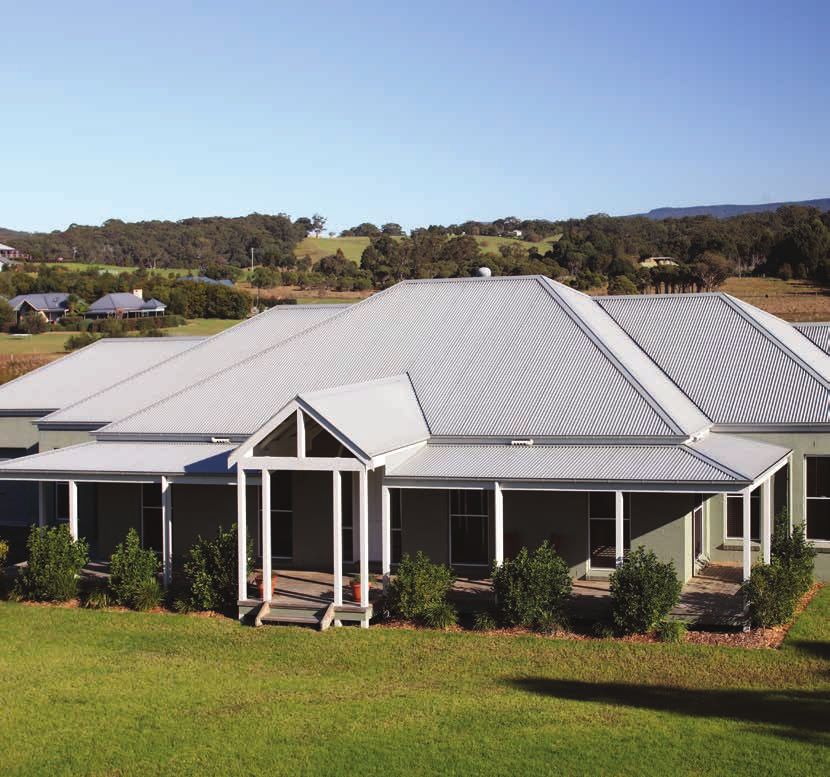
4Contemporary and traditional, residential or commercial: all are accomplished with ease using LYSAGHT® building products.
INSTALLATION MANUAL
ROOFING & WALLING
5PART A: DESIGN
2. Design Preliminaries
2.1 PRODUCT SELECTION of the source). The painting complies with AS/NZS 2728:2013
and the steel base is an aluminium/zinc alloy-coated steel
When you design steel cladding into your building you have a wide
complying with AS 1397:2011. Minimum yield strength is G550
range of profiles from which to choose. Whilst roofing and walling
(550 MPa). Minimum coating mass is AM150 (150g/m2).
obviously have to keep out the weather, they also have significant
effects on the looks, cost and durability of a building. • COLORBOND® Stainless is a pre-painted steel for severe coastal
or industrial environments. The painting complies with AS/NZS
If you are unsure about any product feature, visit www.lysaght.com, 2728:2013 and the steel base is a stainless steel complying with
call our information line or seek advice from the relevant specialists. AISI/ASTM Type 430; UNS No. S43000.
WALLS Check with your local LYSAGHT® office for availability of profiles,
The design of walling from a steel perspective is fairly materials, finishes, colours, accessories; and for suitability of the
straightforward. Once you have made the aesthetic decision of product.
which profile to use, the main considerations are the support Tables 2.12.1 and 2.13.1 list general information for profile selection.
spacings (Section 2.3), fixing details (Chapter 3) and the details of Refer to our publications on specific products for detailed
flashing (Chapter 11). specifications. There are also publications on ZINCALUME® steel
ROOFS and COLORBOND® pre-painted steel from our information line
(Page 1).
There are many factors in designing roofs including:
• t he shape: is the roof to be ‘flat’ or pitched 2.3 SUPPORT SPACINGS
or curved? The maximum recommended support spacings are shown in
• the supporting structure and support spacing; Tables 2.12.1 and 2.13.1. They are based on data in accordance
with AS 1562.1:1992 Design and installation of sheet roof and wall
• the wind forces that the roof must sustain;
cladding: Metal, and AS 4040.1:1992 Methods of testing sheet
• t he pitch which affects the looks, the profile’s ability to efficiently roof and wall cladding—Resistance to concentrated loads.
carry rain to the gutters, and fixing details;
The spacings in the tables are recommended to produce adequate
• thermal expansion of long sheets (Chapter 10); performance of claddings under concentrated loading (incidental
• the attributes of other materials used in the roof design. for maintenance).
This manual doesn’t attempt to cover the structural design details For support spacings in wind conditions, refer to our publications
of supports or aesthetics: there are many other texts and Australian on specific products for wind pressure data.
Standards that cover them. In all cases, cladding is fixed to a support of 1.0mm minimum base
This chapter gives tables of recommended support spacings, metal thickness (BMT) and minimum yield stress of G550. If you
and the maximum roof length for pitch and rainfall intensity for want to use metal battens thinner than 1.0mm, seek advice from our
LYSAGHT® steel roofing products. information line.
The appropriate design will depend on your particular needs and 2.4 MAXIMUM LENGTHS OF ROOFING
circumstances. You should get advice from the relevant specialists
The valleys (or pans) of roofing have to carry water to the gutters.
where required.
If in heavy rain, the valleys overfill, water can flow into the roof
through the side-laps and flashings.
2.2 MATERIALS AND FINISHES
Our most widely used cladding profiles are listed in Tables 2.12.1 Factors affecting waterproof and drainage capacity of the laps of a
and 2.13.1. They are available in COLORBOND® pre-painted steel, profile include:
or in unpainted ZINCALUME® magnesium/aluminium/zinc alloy- • the width and depth of the valleys or pans;
coated steel.
• the pitch of the roof—rain flows faster on a steeper pitch;
MATERIAL SPECIFICATIONS • rainfall intensity for the geographical area;
• Next generation ZINCALUME® aluminium/zinc/magnesium
alloy coated steel complies with AS 1397:2011 G550, AM125 • the length of the roof from ridge to gutter; and
(550 MPa minimum yield stress, 125g/m2 minimum coating • p
enetrations that cause nearby valleys to carry extra rain diverted
mass). from valleys obstructed by the penetration (Figure 2.14.1).
• COLORBOND® is pre-painted steel for exterior roofing and The maximum recommended roof lengths for drainage for each
INSTALLATION MANUAL
ROOFING & WALLING
walling. It is the most widely used. The painting complies with profile are given in Table 2.14.1.
AS/NZS 2728:2013 and the steel base is an aluminium/zinc
alloy-coated steel complying with AS 1397:2011. Minimum yield
strengths are G550 (550 MPa), or G300 (300 MPa) depending
on profile. Minimum coating mass is AM100 (100g/m2).
• COLORBOND® Metallic is pre-painted steel for superior
aesthetic qualities displaying a metallic sheen.
• COLORBOND® Ultra is pre-painted steel for severe coastal or
industrial environments (generally within about 100m - 200m
62.5 LOW ROOF PITCHES 2.9 METAL AND TIMBER COMPATIBILITY
Unless there is adequate positive fall in a roof, there is danger of Contact with (or run-off from) some materials can damage coated
ponding, which can lead to a reduced service life, particularly in steel products. Buildings can also be susceptible to condensation
coastal areas. on inside surfaces.
At low slopes, say around 1 in 50 (1°) slope, all roof supports must The materials include certain metals, treated timbers and chemicals.
be in the one plane because slight variations can result in zero or • D
on’t allow any contact of coated steel products with
negative fall. This may occur even after completion of the building incompatible materials. (Table 2.9.1).
as the result of settlement, timber warping or shrinking, or extra
loadings (like air conditioners). • D
on’t allow discharge of rainwater from incompatible materials
onto coated steel products. (Table 2.9.1).
Minimum recommended roof slopes are listed in Table 2.12.1. As a
guide, wherever possible, you should design for a minimum slope • E
nsure that supporting members are compatible with the
of 1 in 30 (2°). Roof slopes lower than the recommended minimum coated steel products or, alternatively, appropriately coated.
may be available subject to enquiry and will be dependent upon If there are doubts about the compatibility of other products being
the roof application and building details. Lower roof slopes may used, seek advice from our information line.
require additional provisions to be adhered to. Please call your
Incompatible materials include:
nearest service centre for advice.
• lead
2.6 WIND FORCES ON ROOFS • copper
Winds create considerable forces on both the topside and the
• monel metal
underside of roof cladding, and you must consider these forces in
the design and fixing of any roof. The forces are: • bare steel
• i nward forces tending to collapse the roof cladding inwards, • s tainless steel
caused by wind acting directly on the windward side; and (except with COLORBOND® stainless cladding)
utward forces tending to lift the roof cladding from its
• o • carbon (in pencils and some rubbers)
framing, and the entire roof structure from the rest of the
• g
reen or some chemically-treated timber
building. Outward forces can be caused both by uplift from
(like CCA or tanalith treatments)
negative wind pressures, outside the building; and by positive
wind pressure inside the building. • m
aterials subject to cycles of dryness and wetness or
which have excessive moisture content
Generally the greatest wind forces imposed on roofs are due to (such as improperly-seasoned timber)
the outward forces. Because the dead weight of roofing materials
is relatively small, the outward forces must be resisted by the roof • wet and dry concrete
fasteners. • soils
It is very important that the battens and roof framing are adequately • vegetable matter
fixed to the rafters and walls, and that under extreme conditions
• cleaning agents (e.g. brick cleaning)
the wall framing is anchored to the footings. Special anchoring
provisions may apply in cyclonic areas. Specialist advice should be • a ny material which will inhibit normal exposure to
sought in these circumstances. the atmosphere
2.7 CODES AND PERFORMANCE TESTS
AS 1562.1:1992 specifies the design and installation of sheet
metal roof and wall cladding. Our roofing profiles satisfy all the
requirements of this standard, including the ability of the roof
to resist outward forces and concentrated loads. The testing is
performed according to AS 4040.
Metal roofing products must comply with the performance
specifications, and be checked by stringent tests, in accordance
with the standard. Such tests have been carried out on all our
claddings and the results have been used in the preparation of the
fixing and installation recommendations in this manual.
2.8 ENVIRONMENTAL CONDITIONS
Coated steel products can be damaged by some environmental
INSTALLATION MANUAL
conditions including industrial, agricultural, marine, intensive animal
ROOFING & WALLING
farming, swimming pools or other aggressive conditions.
If any of our products are to be used in these conditions, or
unusually corrosive environments, seek advice from our information
line (Page 1).
Keep the product dry and clear of the ground. If stacked or
bundled product becomes wet for extended periods, separate it,
wipe it with a clean cloth and stack it to dry thoroughly.
7Table 2.9.1
Acceptability of drainage from upper surface onto a lower metal surface and direct contact.
COMPATIBILITY OF DIRECT CONTACT BETWEEN METALS OR ALLOYS
ROOF DRAINAGE SYSTEM ACCESSORIES OR FASTENER OR (UPPER SURFACE)
COMPONENTS & ANY ZINCALUME® GALVANISED ZINC COLORBOND®, COLORBOND® STAINLESS ALUMINIUM COPPER & LEAD
CLADDING MATERIAL (ZINC COATED STEEL) COLORBOND® ULTRA, STAINLESS STEEL ALLOYS COPPER
COLORBOND® METALLIC ALLOYS (1)
ZINCALUME® YES YES YES YES NO NO YES NO NO
GALVANISED YES YES YES YES NO NO YES NO NO
(ZINC COATED STEEL)
ZINC YES YES YES YES NO NO YES NO NO
COLORBOND®, YES YES YES YES NO NO YES NO NO
COLORBOND® ULTRA,
COLORBOND® METALLIC
COLORBOND® STAINLESS NO NO NO NO YES YES NO NO NO
STAINLESS STEEL NO NO NO NO YES YES NO NO NO
ALUMINIUM ALLOYS YES YES YES YES NO (3)
NO (3)
YES NO NO
COPPER & COPPER ALLOYS (1) NO NO NO NO NO NO NO YES NO
LEAD NO NO NO NO NO NO NO YES YES
(1)
Monel - copper/nickel alloy.
(2)
For further guidance refer to AS/NZS 3500.3: 2003.
(3)
In benign environments, mixing of stainless steel and aluminium may be acceptable.
ACCEPTABILITY OF DRAINAGE FROM AN UPPER SURFACE TO A LOWER METAL SURFACE
LOWER ROOF ACCESSORIES OR FASTENER OR (UPPER SURFACE)
DRAINAGE SYSTEM ZINCALUME® GALVANISED ZINC COLORBOND®, COLORBOND® STAINLESS ALUMINIUM COPPER & LEAD GLAZED
MATERIAL (ZINC COATED COLORBOND® ULTRA, STAINLESS STEEL ALLOYS COPPER ROOF TILES,
STEEL) COLORBOND® METALLIC ALLOYS (1) GLASS &
PLASTIC
ZINCALUME® YES YES YES YES YES YES YES NO NO YES
GALVANISED NO YES YES NO NO NO NO NO YES NO
(ZINC COATED STEEL)
ZINC NO YES YES NO NO NO NO NO YES NO
COLORBOND®, YES YES YES YES YES YES YES NO NO YES
COLORBOND® ULTRA,
COLORBOND® METALLIC
COLORBOND® STAINLESS YES YES YES YES YES YES YES YES YES YES
STAINLESS STEEL YES YES YES YES YES YES YES YES YES YES
ALUMINIUM ALLOYS YES YES YES YES YES YES YES NO NO YES
COPPER & COPPER YES YES YES YES YES YES YES YES YES YES
ALLOYS (1)
LEAD YES YES YES YES YES YES YES YES YES YES
(1)
Monel - copper/nickel alloy.
(2)
For further guidance refer to AS/NZS 3500.3: 2003.
2.10 TRANSPORTATION 2.11 PAINT AND COLORBOND® FINISHES
Because our roofing and walling is manufactured by continuous COLORBOND® finishes can be damaged by some handling,
processes, sheet lengths can be supplied up to the limits of installation or maintenance activities. If damage occurs to the
transport regulations, which vary from state to state. COLORBOND® pre-painted finish, refer to Technical Bulletin TB-2,
published by BlueScope.
KLIP-LOK 700 HI-STRENGTH® is available in extra long lengths
via an on-site mobile rollformer. This service is available nationally, Replacement of severely damaged COLORBOND® steel should
subject to enquiry. consider that the replacement sheet may not match perfectly due
to the possible long term fading of the installed sheets exposed to
INSTALLATION MANUAL
ROOFING & WALLING
weathering.
You may overpaint whole roofs and paint accessories to match
specific colours. The overpaint guidelines are also discussed in
Technical Bulletin TB-2.
82.12 SPECIFICATIONS - ROOFING
Table 2.12.1
Specifications of roofing & walling profiles.
Maximum recommended spacing supports
BMT Mass (1) Cover Rib Roof Pitch ROOFS Eaves Overhang (3) WALLS
Width Depth Minimum (2) Single End Internal Unstiffened Stiffened Single End Internal Overhang
mm kg/m 2
mm mm Degrees mm mm mm mm mm mm mm mm mm
CUSTOM ORB® 0.42 4.3 762 16 5 (1 in 12) 700 900 1200 200 300 1800 2500 2700 200
0.48 4.9 762 16 5 (1 in 12) 800 1300 1700 250 350 1800 2700 2700 250
CUSTOM BLUE ORB® 0.60 6.1 762 17 5 (1 in 12) 1600 1600 1800 200 300 2400 3000 3300 200
0.80 8.0 762 17 5 (1 in 12) 1800 1800 2600 400 600 2400 3200 3600 400
CUSTOM ORB 0.40 4.4* 762 21 3 (1 in 20) 750 950 1350 150 400 1800 2400 2400 150
ACCENT 21®
0.48 5.2* 762 21 3 (1 in 20) 950 1500 1900 200 450 1800 2700 2700 200
CUSTOM ORB 0.48 5.5* 724 35 2 (1 in 30) 1300 1600 2400 200 600 2100 2700 2700 200
ACCENT 35®
FLATDEK® (5) 0.42 6.0 250 45 2 (1 in 30) 2000 2600 3000 - - - - - -
FLATDEK® II (4) 0.42 5.2 620 45 2 (1 in 30) 2400 2800 3200 - - - - - -
INTEGRITY® 820 0.42 4.6 820 48 2 (1 in 30) 2100 2300 2800 150 300 2600 3400 3600 150
0.48 5.2 820 48 1 (1 in 50) 2500 2550 3050 200 350 2700 3600 3600 200
KLIP-LOK® 406 0.48 5.6 406 41 1 (1 in 50) 1500 1800 2100 200 600 - - - -
KLIP-LOK 700 0.42 4.7 700 43 2 (1 in 30) (6) 1650 1750 2200 150 450 2600 3200 3850 150
HI-STRENGTH®
0.48 5.3 700 43 1 (1 in 50) 2050 2350 2800 200 500 3000 3450 3900 200
0.60 6.6 700 43 1 (1 in 50) 2350 3000 3600 250 550 3300 3600 3900 250
KLIP-LOK CLASSIC® 700 0.42 4.7 700 41 2 (1 in 30) - 1800 2200 200 500 - 2150 3250 300
0.48 5.3 700 41 1 (1 in 50) 1800 2000 2500 150 450 - 2700 2700 450
LONGLINE 305® 0.70 9.7 305 48 1 (1 in 50) 1800 2000 2500 150 450 - 2700 2700 450
(Not Tapered)
SPANDEK® 0.42 4.7 700 24 3 (1 in 50) (5) 1300 1800 2400 300 600 2500 3000 3300 300
0.48 5.3 700 24 3 (1 in 50) (5) 2000 2200 3000 400 700 3000 3000 3300 400
SPANRIB® 0.42 4.6 820 48 2 (1 in 30) 2100 2300 2800 150 300 2600 3400 3600 150
INSTALLATION MANUAL
ROOFING & WALLING
0.48 5.2 820 48 1 (1 in 50) 2500 2550 3050 200 350 2700 3600 3600 200
TRIMDEK® 0.42 436 762 29 2 (1 in 30) 1100 1300 1900 150 300 2400 3000 3000 150
0.48 4.9 762 29 2 (1 in 30) 1600 1850 2600 200 350 2700 3000 3000 200
(1)
Masses are for unpainted ZINCALUME® steel, unless otherwise marked (*). * which are indicative masses only.
(2)
See Section 2.5, LYSAGHT® Roofing & Walling Installation Manual.
(3)
See Section 10.6 for explanation of ‘stiffened’.
(4)
FLATDEK® & FLATDEK® II are Home Improvement profiles.
(5)
Slope of 2˚ (1 in 30) is available subject to enquiry. Please refer to Section 2.5, LYSAGHT® Roofing & Walling Installation Manual.
9
(6)
Slope of 1˚ (1 in 50) is available subject to enquiry. Please refer to Section 2.5, LYSAGHT® Roofing & Walling Installation Manual.2.13 SPECIFICATIONS - WALLING
Table 2.13.1
Specifications of profiles for walling only.
Maximum recommended spacing supports
BMT Mass (1) Cover Width Rib Depth Single End Internal Overhang
mm kg/m2 mm mm mm mm mm mm
EASYCLAD ®
0.42 4.5 300 19 - 1500 1500 100
MINI ORB® 0.42 4.0 820 6 1200 1500 1500 100
0.48 4.5 820 6 1500 1500 1500 125
MULTICLAD® 0.35 3.3 840 12 1400 1800 1800 150
0.42 3.9 840 12 1700 1800 1800 150
PANELRIB® 0.35 3.2 850 4 1100 1200 1200 150
0.42 3.7 850 4 1200 1200 1200 150
TRIMWALL® 0.35 3.6 762 29 2100 2900 3000 150
WALLCLAD® 0.35 3.6 762 16 1800 2400 2400 150
(1)
Masses are for unpainted ZINCALUME® steel.
Roofing & Walling Profiles
p or
s if end la ting
End span ee
joint in sh SS
expansion ES IS IS ES O
Step
ES O
Spacing definitions
ES = End Span
IS = Internal Span
IS
O = Overhang
IS
SS = Single Span
O ES
Walling Profiles Only
ES O
Spacing definitions
ES = End Span
INSTALLATION MANUAL
IS
ROOFING & WALLING
IS = Internal Span
O = Overhang
IS
SS = Single Span
SS
O ES
102.14 MAXIMUM ROOF LENGTHS Peak Roof Slope
FOR DRAINAGE Rainfall
Intensity
1 in 50 1 in 30 1 in 20 1 in 12 1 in 7.5 1 in 6
(1˚) (2˚) (3˚) (5˚) (7.5˚) (10˚)
Table 2.14.1 LONGLINE 100 219 273 320 397 475 546
Maximum roof lengths for drainage measured from ridge to gutter 305® (Not 150 146 182 213 265 317 364
(m) Penetrations alter the flow of water on a roof. Thus, for design, Tapered)
200 110 136 160 199 237 273
you need to use an effective roof length (Figure 2.14.1). 250 88 109 128 159 190 218
300 73 91 107 133 158 182
Peak Roof Slope
Rainfall 400 55 68 80 100 119 136
1 in 50 1 in 30 1 in 20 1 in 12 1 in 7.5 1 in 6
Intensity (1˚) (2˚) (3˚) (5˚) (7.5˚) (10˚) 500 44 55 64 80 95 109
CUSTOM 100 29 34 38 SPANDEK® 100 97 111 133 154 173
ORB®
150 20 23 25 150 65 74 89 103 115
CUSTOM
BLUE ORB® 200 15 17 19 200 49 55 67 77 86
250 12 14 15 250 39 44 53 62 69
300 10 11 13 300 32 37 44 51 58
400 7 8 10 400 24 28 33 39 43
500 6 7 8 500 19 22 27 31 35
CUSTOM ORB 100 41 54 TRIMDEK® 100 220 257 320 382 439
ACCENT® 21
150 27 36 150 146 172 214 255 293
200 20 27 200 110 129 160 191 220
250 16 21 250 88 103 128 153 176
300 13 18 300 73 86 107 127 146
400 10 13 400 55 64 80 96 110
500 500 44 51 64 76 88
CUSTOM ORB 100 90 103 124 143 161 Notes:
ACCENT® 35 • Some lengths in this table may exceed the maximum allowable transport length.
150 60 69 82 95 107
• Data are based on work of CSIRO and LYSAGHT®.
200 45 51 62 72 80 • For peak rainfall intensities in your locality, see Chapter 6 unless noted otherwise.
250 36 41 49 57 64 • FLATDEK® and FLATDEK® II are recommended for home improvement use only
(carports/verandahs) where weathertightness is not of primary importance. Drainage
300 30 34 41 48 54
figures are therefore not supplied.
400 23 26 31 36 40 • SPANDEK® with slope of 2° (1 in 30) is available subject to enquiry. Please refer to
500 18 21 25 29 32 Section 2.5.
• CUSTOM ORB ACCENT® data are based on proprietary design.
INTEGRITY® 100 410 480 598 713 820
820
150 273 320 399 476 547
SPANRIB® Figure 2.14.1
200 205 240 299 357 410
250 164 192 239 285 328 Example of calculating effective roof lengths where penetrations
300 137 160 199 238 273
alter the flow of water on a roof.
400 102 120 150 178 205 Note: A suitably qualified engineer is recommended for
500 82 96 120 143 164 calculating/checking roof design and flow design.
KLIP-LOK® 406 100 375 467 548 682 813 934
Ridge
150 250 311 365 454 542 623
200 188 234 274 341 406 467 5m
250 150 187 219 273 325 374
300 125 156 183 227 271 311
Penetration
400 94 117 137 170 203 234 Flow Flow
A C
500 75 93 110 136 163 187
10m
KLIP-LOK 700 100 344 428 502 624 745 856
HI-STRENGTH®
150 229 285 334 416 496 571 25m
Flow
200 172 214 251 312 372 428 D
250 137 171 201 250 298 342
Penetration
300 115 143 167 208 248 285 Flow Flow
400 86 107 125 156 186 214 B E
10m
500 69 86 100 125 149 171
INSTALLATION MANUAL
ROOFING & WALLING
KLIP-LOK 100 247 308 361 449 3536 616
CLASSIC® 1 2 3 4 5 6
700 150 165 205 241 300 357 411
200 124 154 181 225 268 308 Gutter
250 99 123 144 180 214 246 Valley Effective Length
300 82 103 120 150 179 205 1 25m (Base Length)
2 Base Length + A + B
400 74 93 108 135 161 185 25 + 5 + 10 = 40m
6 Base Length + C + D + E
500 49 62 72 90 107 123 25 + 5 + 15 + 10 = 55m
(Worst case used for design)
113. Fasteners
When you select fasteners, you should consider the design life 3.5 IDENTIFICATION OF SCREWS
of the structure, because the fasteners and the cladding material
The format of the number code is:
should have similar life expectancies.
12 – 14 x 50
FASTENER CHANGE TO METRIC SIZING M6 – 11 x 50
The Australian fastener industry is moving to a change in fastener Screw gauge Thread pitch Overall length
description that will bring it into line with international markets. (Thread outside (threads per inch) of the screw
This is an on-going process as product requirements and design diameter) measured from
under the head to
changes. M refers to the tip of the drill
metric size point (mm)
Traditionally self drilling fasteners have been described in gauge
(outside thread diameter), by tpi (threads per inch) and by length
(mm). The new changes will convert gauge to metric sizing (e.g.
#12 is approx. M5.5). Fasteners must have a coating system to meet AS 3566 Class 3 or
AS 3566 Class 4.
3.1 MATERIALS FOR SCREWS
Ripple Teks®, AutoTeks®, Teks®, Designer Heads® and Zips® are
Screws are available in a variety of materials, finishes and colours
registered trademarks of ITW Buildex and are recommended for
to match COLORBOND® pre-painted steel, and design. You
specific applications. Vortex® is a registered trademark of Bremick
should use screws to AS 3566:2002 Class 3 (or better). Additional
and is recommended for specific applications. Other equivalent
information on fastener finishes is in the technical bulletin TB-16.
quality fasteners which comply to the above standards are also
Table 3.1.1 recommended for use with LYSAGHT® roofing and walling
products.
Product Appropriate Screw Materials
For most external applications not closer than 400m AS 3566 Class 3 Where a screw penetrates roof sheeting (for fixing or stitching), a
from the ocean or sever marine influence: sealing washer is recommended. The sealing washer is to be an
• COLORBOND® or Metallic EPDM non-conductive rubber.
• ZINCALUME® AM125
Where a screw penetrates the rib of the sheeting (as for roofing),
For severe exposure conditions: AS 3566 Class 4 the ‘top thread section’ feature is recommended to maximise
• COLORBOND® (200m to 400m from marine Where the colour match of resistance to water penetration.
environments) fasteners is an overriding
• COLORBOND® Ultra (100m to 200m from marine consideration, powder coates/ Figure 3.5.1
environments) AM150 painted fasteners may be used
TYPICAL ROOFING SCREWS
For very severe exposure conditions: Stainless steel
• COLORBOND® Stainless Head
Stainless steel fasteners are recommended for use only with COLORBOND® Stainless. Sealing Washer
3.2 MATERIALS FOR NAILS Top Threaded Section
Nails should be of galvanised steel. They are only used to fix the Dwell Section
clips of some concealed-fixed cladding to timber supports.
3.3 MATERIALS FOR BLIND RIVETS Shank Protection
Screw Length
Shank
For COLORBOND® Stainless use stainless steel blind rivets with
stainless steel mandrels; for GALVABOND®, ZINCALUME® and
COLORBOND® steels, use aluminium blind rivets. Blind rivets are
used for fixing flashings, accessories and side-laps.
3.4 MATERIALS FOR SEALING WASHERS
Sealing washers used under the heads of screws on
Drill Point
COLORBOND® finishes must be made from materials that don’t
have significant levels of conductive carbon black, particularly in
marine environments. Use EPDM washers, not neoprene.
INSTALLATION MANUAL
ROOFING & WALLING
12Table 3.5.1
TYPICAL FEATURES OF SCREWS
Head Shank Drill Point
Hexagon head with integrated metal washer Hex. head with EPDM seal Top Tread Section Self drilling for metal
Extrudes sheeting towards the seal to maximise resistance RoofZip® Point
to water penetration. Grips the sheeting for a secure
connection. Stops sheeting from moving when walked on.
Hexagon head with integrated metal washer Hex. head with no seal Dwell Section Self drilling for timber
Prevents the sheeting from riding up during fixing and Drill Point. Type 17
minimises distortion of the profile.
Wafer Head Wafer head with no seal Shank Protection Self drilling for metal
Enlarges the hole in the sheeting to minimise damage to Drill Point. Standard Metal
the protective coating on the screw.
Self drilling for metal
Extended Drill Point
Special Self-sealing Head RippleZips® screw head with Self drilling for metal
self-sealing head RippleZip® Point
3.6 SETTING OF SCREWS
Fasteners with sealing washers should be tightened only until the
washer is gripped firmly enough to provide a weathertight seal. The
fasteners should not be over-tightened because this may split the
sealing washer or deform the sheet, either of which could lead to
water penetration. Take particular care when valley fixing because
there is no flexibility with the sheet hard against its support. Take
particular care to ensure the fastener is driven perpendicular to the
sheeting to avoid deformation of the washer.
Figure 3.6.1
It is important that you set screws correctly.
Underdriven Correctly Driven Overdriven
INSTALLATION MANUAL
ROOFING & WALLING
133.7 QUANTITY OF FASTENERS AND CLIPS Number of clips per job =
KLIP-LOK® 406, KLIP-LOK 700 HI-STRENGTH®, KLIP-LOK (Number of supports) x (Number of sheets +1)
CLASSIC® 700 AND LONGLINE 305®
for LONGLINE 305® and KLIP-LOK® 406, or
For number of clips, see equation at right.
(Number of supports) x (Number of sheets)
For KLIP-LOK® 406, there are 2 fasteners per clip.
for KLIP-LOK 700 HI-STRENGTH® and KLIP-LOK CLASSIC® 700
For KLIP-LOK 700 HI-STRENGTH® and KLIP-LOK CLASSIC® 700
there are 3 fasteners per clip.
For LONGLINE 305®, there is 1 fastener per clip. Number of fasteners per job =
LONGLINE 305® = number of clips
PIERCE-FIXED PROFILES
For number of fasteners, see equation at right (n is the number of KLIP-LOK® 406 = number of clips x 2
fasteners per support, as shown in the diagrams for each cladding KLIP-LOK 700 HI-STRENGTH® = number of clips x 3
product.
KLIP-LOK CLASSIC® 700 = number of clips x 3
SIDE-LAPS
Side-lap fasteners are often placed at about 900mm centres.
(See section 8.5). Number of fasteners per job (for pierced fixing) =
n x (Number of sheets) x (Number of supports)
3.8 RECOMMENDED FASTENERS
AND LOCATIONS
The recommended fasteners and minimum specifications for a SIDE-LAP AND ACCESSORY FASTENINGS
cladding are detailed in the individual cladding brochure. The For MINI ORB® and PANELRIB®
location of the fasteners are detailed in the following diagrams for • Use 3.2mm diameter aluminium sealed blind rivets
each cladding product.
For all other products use:
FASTENER LENGTH WITH INSULATION,
BOARDS AND PACKERS • RoofZips® M6 -11 x 25 or
Where insulation (blankets or boards, foam packers or any other • M5-16 x 25 Designer Head® or
packer/board where the cladding screw penetrates through the • Hex Head Metal Teks® with seal: 10-16 x 16; or
support) is installed under cladding, you may need to increase the
length of screws, depending on the density and thickness of the • Sealed blind rivets: 4.8mm diameter aluminium.
insulation, board or packer. When the screw is properly tightened Figure 3.8.1
(Section 3.6):
Setting screws correctly.
• i nto metal: The screw manufacturer’s recommendations for
screw penetration should be complied with. Generally there Shank Protection
should be at least one full thread protruding past the support
you are fixing. If there are three (3) threads visible (even partial Steel Support
threads) then the penetration requirements are met. Where rib Threads Protruding
fixing is done, then the ‘shank protection’ must not reach the
support (Figure 3.8.1);
• i nto timber: the screw must penetrate the timber by the same
amount that the recommended screw would do if there were no
insulation, i.e. same embedment.
• F or deep insulation, board or packer the availability of a suitable
screw, with all the recommended features and minimum
specifications will need to be investigated. It may be necessary
to increase the screw gauge accordingly or seek advice from
the screw manufacturer. Site trial of screw fixing may need to be
conducted to determine the suitability of the selected screw.
FIXING TO STEEL THICKER THAN 3MM
Use appropriate self-drilling screws with an extended drill point; or
pre-drill hole and seek advice from the screw manufacturer on the
appropriate screw specifications.
INSTALLATION MANUAL
ROOFING & WALLING
14Table 3.8
Guide to estimate fasteners and clips required for typical installation.
FASTENER & CLIP REQUIREMENT GUIDE (PER M2)
Cladding Profile No. of fasteners (clips) Sheet Cover Maximum Support Spacings (mm)
per sheet width Width 450* 600* 900 1200 1500 1800
CUSTOM ORB® 3 762 9 7 5 4 3 3
5 762 15 11 8 6 5 4
CUSTOM BLUE ORB ®
3 762 9 7 5 4 3 3
5 762 15 11 8 6 5 4
CUSTOM ORB ACCENT® 21 3 762 9 7 5 4 3 3
CUSTOM ORB ACCENT® 35 3 (6 @ ends) 724 12 9 6 5 4 3
EASYCLAD® 1 300 8 6 4 3 3 2
INTEGRITY® 820 3 820 - - - 3 2 2
KLIP-LOK® 406 2 (1 clip) 406 - - 6 5 4 3
406 - - 3 2 2 1
KLIP-LOK 700 HI-STRENGTH® 3 (1 clip) 700 - - 2 1 1 1
700 - - 5 4 3 3
KLIP-LOK CLASSIC 700
®
3 (1 clip) 700 - - 2 1 1 1
700 - - 4 3 2 2
LONGLINE 305® 1 (1 clip) 305 - - 4 3 2 2
(Not Tapered) 305 - - 4 3 2 2
MINI ORB® 6 820 17 13 9 7 5 5
11 820 30 22 15 11 9 7
MULTICLAD® 4 840 11 8 6 4 4 3
PANELRIB® 4 850 11 8 6 4 4 3
8 850 21 16 10 8 6 5
SPANDEK® 3 700 10 8 5 4 3 3
4 700 13 10 6 5 4 3
SPANRIB® 3 820 - - - 3 2 2
TRIMDEK® 4 762 12 9 6 5 4 3
TRIMWALL® 4 762 12 9 6 5 4 3
WALLCLAD® 3 762 9 7 5 4 3 3
5 762 15 11 8 6 5 4
* Typical residential framing spacings.
INSTALLATION MANUAL
ROOFING & WALLING
15Crest fixing for roof or walls
Pan/Valley fixing for walls only
Table 3.8.1
Don't fix here because
Guide to fastener layout and sheet coverage. underlapped sheet would leak.
Crest: 3 fasteners †
CUSTOM ORB® & CUSTOM BLUE ORB®
Pan/Valley
SHEET fixing for walls only
COVERAGE
Width of Roof (m) 3 4 5 6 7 8 9 10 11 Pan/Valley:
12 13 3 fasteners
14 15 †
16 17 18 19
sidelap 20 30 40 50
Number of Sheets 4 6 7 Don't
8 fix here
10 because
11 12 14 15 16 18 19 20 21 23 24 25 27 40 53 66
underlapped sheet would leak.
Crest: 3 fasteners † Crest: 5 fasteners †
Crest fixing for roof or walls
Pan/Valley: 3 fasteners † Pan/Valley: 5 fasteners †
sidelap sidelap
Crest fixing for roof or walls
Crest: 5COVERED
fasteners †BY ‘X’ NUMBERS OF SHEETS (M) † Fasteners per sheet per support. Most common practice is:
WIDTH Crest fixing
3 fasteners forfor roofspans
internal or walls
and 5 fasteners for single and end spans.
Number of Sheets 3 4 5 6 7 8 9 10 11 12 13 14 15 16 17 18 19 20
Coverage (m) 2.3 3.0 3.8 4.6 5.3 6.1 6.9 7.6 8.4 9.1 9.9 10.7 11.4 12.2 13.0 13.7 14.5 15.2
Pan/Valley: 5 fasteners † Valley fixing for walls only
sidelap
CUSTOM ORB ACCENT® 21 Don't fix here because
† Fasteners per sheet per support. Most common practice is:
Valley
WIDTH fixing
COVERED
3 fasteners for walls
for internal only
BY
spans ‘X’5 fasteners
and NUMBERS OF
for single andSHEETS
end spans. (M) underlapped
Don't fixsheet
herewould leak.
because underlapped
Crest fixing
Number for roof or3walls 4
of Sheets 5 6 7 8 9 Crest:
10 Valley 3 fasteners
11 fixing 13 † only
12 for walls 14 15 16 17 would
sheet 18 leak. 19 20
Coverage (m) 2.3 3.0 Don't fix
3.8 here because
4.6 5.3 6.1 6.9 7.6 8.4 9.1 9.9 10.7 11.4 12.2 cut13.0 13.7 14.5
At end support, out underlap locally. 15.2
underlapped sheet would leak.
Crest: 3 fasteners † Valley: 3 fasteners †
sidelap
Crest: 3 fasteners per sheet for internal supports
Valley: 3 fasteners † Don't fix here † Fasteners per sheet per support.
because underlapped
CUSTOM
sidelapORB ACCENT 35 ®
sheet would leak.
Valley fixing for walls only
SHEET COVERAGE At end support, cut out underlap locally.
Crest: 6 fasteners per sheet for end supports
† Fasteners per sheet per support. (including single spans)
Width of Roof (m) 3 4 5 6 7 8 9 10 11 12 13 14 15 16 17 18 19 20Sheet
30 3 40 50
Sheet 2
Number of Sheets 5 6 7 9 10 11 13 14 15 17 Sheet
18 120 21 22 24 25 26 28 41 55 69
Crest: 3 fasteners per sheet for internal supports
Sheet 3 Valley: 3 fasteners
Direction of laying per sheet for internal and end supports
Prevailing weather
Sheet 2
Sheet 1 sidelap
Crest: 6 fasteners
Direction of layingper sheet for end supportsPrevailing weather
(including single spans) Valley: 6 fasteners per sheet for end supports
(including single spans)
sidelap
Valley: 3 fasteners per sheet for internal and end supports
WIDTH COVERED BY ‘X’ NUMBERS OF SHEETS (M)
sidelap
Number of Sheets 3 4 5 6 7 8 9 10 11 12 13 14 15 16 17 18 19 20
Coverage (m) 2.2 2.9 3.6 4.3 5.1 5.8 6.5 7.2 8.0 8.7 9.4 10.1 10.9 11.6 12.3 13.0 13.8 14.5
Valley: 6 fasteners per sheet for end supports
Sheet 3
(including single spans) Sheet 2
EASYCLAD ® Sheet 1
sidelap
SHEET COVERAGE Direction of laying Prevailing weather
Width of Roof (m) 3 4 5 6 7 8 9 10 11 12 13 14 15 16 17 18 19 20 30 40 50
INSTALLATION MANUAL
ROOFING & WALLING
Number of Sheets 10 14 17 20 24 27 30 34 37 40 44 47 50 54 57 60 64 67 100 134 167
1 fastener †
Sheet 3
Sheet 2
Sheet 1
WIDTH COVERED BY ‘X’ NUMBERS OF SHEETS (M)
Direction of laying Prevailing weather
Number of Sheets 3 4 5 6 7 8 9 10 11 12 13 14 15 16 17 18 19 20
Coverage (m) 0.9 1.2 1.5 1.8 2.1 2.4 2.7 3.0 3.3 3.6 3.9 4.2 4.5 4.8 5.1 5.4 5.7 6.0
† Fasteners per sheet per support.
16INTEGRITY® 820
SHEET COVERAGE
Width of Roof (m) 3 4 5 6 7 8 9 10 11 12 13 14 15 16 17 18 19 20 30 40 50
Number of Sheets 4 5 7 8 9 10 11 13 14 15 16 18 19 20 21 22 24 25 37 49 61
Crest: 3 fasteners †
WIDTH COVERED BY ‘X’ NUMBERS OF SHEETS (M)
Number of Sheets 3 4 5 6 7 8 9 10 11 12 13 14 15 16 17 18 19 20
Coverage (m) 2.5 3.3 4.1 4.9 5.7 6.6 7.4 8.2 9.0 9.8 10.7 11.5 12.3 13.1 13.9 14.8 15.6 16.4
KLIP-LOK 700 HI-STRENGTH® & KLIP-LOK CLASSIC® 700
SHEET COVERAGE
Width of Roof (m) 3 4 5 6 7 8 9 10 11 12 13 14 15 16 17 18 19 20 30 40 50
Number of Sheets 5 6 8 9 10 12 13 15 16 18 19 20 22 23 25 26 28 29 43 58 72
KLIP-LOK 700 HI-STRENGTH® KLIP-LOK CLASSIC® 700
1 clip and 3 fasteners † 1 clip and 3 fasteners †
sheet
clip
clip
WIDTH COVERED BY ‘X’ NUMBERS OF SHEETS (M)
Number of Sheets 3 4 5 6 7 8 9 10 11 12 13 14 15 16 17 18 19 20
Coverage (m) 2.1 2.8 3.5 4.2 4.9 5.6 6.3 7.0 7.7 8.4 9.1 9.8 10.5 11.2 11.9 12.6 13.3 14.0
KLIP-LOK® 406
SHEET COVERAGE
Width of Roof (m) 3 4 5 6 7 8 9 10 11 12 13 14 15 16 17 18 19 20 30 40 50
Number of Sheets 8 10 13 15 18 20 23 25 28 30 33 35 37 40 42 45 47 50 74 99 124
1 clip, 2 fasteners †
clip
clip
WIDTH COVERED BY ‘X’ NUMBERS OF SHEETS (M)
Number of Sheets 3 4 5 6 7 8 9 10 11 12 13 14 15 16 17 18 19 20
Coverage (m) 1.2 1.6 2.0 2.4 2.8 3.2 3.7 4.1 4.5 4.9 5.3 5.7 6.1 6.5 6.9 7.3 7.7 8.1
LONGLINE 305® (NOT TAPERED)
SHEET COVERAGE
Width of Roof (m) 3 4 5 6 7 8 9 10 11 12 13 14 15 16 17 18 19 20 30 40 50
Number of Sheets 10 14 17 20 23 27 30 33 37 40 43 46 50 53 56 60 63 66 99 132 164
1 clip, 1 fastener
INSTALLATION MANUAL
ROOFING & WALLING
clip
clip
WIDTH COVERED BY ‘X’ NUMBERS OF SHEETS (M)
Number of Sheets 3 4 5 6 7 8 9 10 11 12 13 14 15 16 17 18 19 20
Coverage (m) 0.9 1.2 1.5 1.8 2.1 2.4 2.7 3.1 3.4 3.7 4.0 4.3 4.6 4.9 5.2 5.5 5.8 6.1
† Fasteners per sheet per support.
17Table 3.8.1 (continued)
Guide to fastener layout and sheet coverage.
MINI ORB®
SHEET COVERAGE
Pan/Valley: 6 fasteners †
Width of Roof (m) 3 4 5 6 7 8 9 10 11 12 13 14 15 16 17 18 19 20 30 40 50
Number of Sheets 4 5 7 8 9 10 11 13 14 15 16 18 19 20 21 22 24 25 37 49 61
Pan/Valley: 6 fasteners † Pan/Valley: 11 fasteners †
WIDTH COVERED
Pan/Valley: BY ‘X’
11 fasteners † NUMBERS OF SHEETS (M)
Number of Sheets 3 4 5 6 7 8 9 10 11 12 13 14 15 16 17 18 19 20
Coverage (m) 2.5 3.3 4.1 4.9 5.7 6.6 7.4 8.2 9.0 9.8 10.7 11.5 12.3 13.1 13.9 14.8 15.6 16.4
MULTICLAD®
SHEET COVERAGE
Width of Roof (m) 3 4 5 6 7 8 9 10 11 12 13 14 15 16 17 18 19 20 30 40 50
Number of Sheets 4 5 6 8 9 10 11 12 14 15 16 17 18 20 21 22 23 24 36 48 60
Pan/Valley: 4 fasteners †
WIDTH COVERED BY ‘X’ NUMBERS OF SHEETS (M)
Number of Sheets 3 4 5 6 7 8 9 10 11 12 13 14 15 16 17 18 19 20
Coverage (m) 2.5 3.4 4.2 5.0 5.9 6.7 7.6 8.4 9.2 10.1 10.9 11.8 12.6 13.4 14.3 15.1 16.0 16.8
PANELRIB®
SHEET COVERAGE
Pan: 4 fasteners †
Width of Roof (m) 3 4 5 6 7 8 9 10 11 12
sidelap 13 14 15 16 17 18 19 20 30 40 50
Number of Sheets 4 5 6 8 9 10 11 12 13 15 16 17 18 19 20 22 23 24 36 48 59
Pan: 4 fasteners † Pan: 8 fasteners †
sidelap sidelap
WIDTH COVERED
Pan: 8 fasteners † BY ‘X’ NUMBERS OF SHEETS (M)
sidelap
Number of Sheets 3 4 5 6 7 8 9 10 11 12 13 14 15 16 17 18 19 20
Coverage (m) 2.6 3.4 4.3 5.1 6.0 6.8 7.7 8.5 9.4 10.2 11.1 11.9 12.8 13.6 14.5 15.3 16.2 17.0
SPANRIB®
SHEET COVERAGE
Width of Roof (m) 3 4 5 6 7 8 9 10 11 12 13 14 15 16 17 18 19 20 30 40 50
Number of Sheets 4 5 7 8 9 10 11 13 14 15 16 18 19 20 21 22 24 25 37 49 61
Crest: 3 fasteners †
INSTALLATION MANUAL
ROOFING & WALLING
WIDTH COVERED BY ‘X’ NUMBERS OF SHEETS (M)
Number of Sheets 3 4 5 6 7 8 9 10 11 12 13 14 15 16 17 18 19 20
Coverage (m) 2.5 3.3 4.1 4.9 5.7 6.6 7.4 8.2 9.0 9.8 10.7 11.5 12.3 13.1 13.9 14.8 15.6 16.4
† Fasteners per sheet per support.
18Crest: 3 fasteners †
SPANDEK®
SHEET COVERAGE
Width of Roof (m) 3 4 5 6 7 8 9 10 11 Pan/Valley:
12 13 143 fasteners
15 16 † 17 18 19 20 30 40 50
sidelap
Number of Sheets 5 6 8 9 10 12 13 15 16 18 19 20 22 23 25 26 28 29 43 58 72
Crest: 3 fasteners † Crest: 4 fasteners †
Pan/Valley: 3 fasteners † Pan/Valley: 4 fasteners †
sidelap sidelap
Crest: COVERED
WIDTH 4 fasteners †BY ‘X’ NUMBERS OF SHEETS (M)
Number of Sheets 3 4 5 6 7 8 9 10 11 12 13 14 15 16 17 18 19 20
Coverage (m) 2.1 2.8 3.5 4.2 4.9 5.6 6.3 7.0 7.7 8.4 9.1 9.8 10.5 11.2 11.9 12.6 13.3 14.0
Pan/Valley: 4 fasteners †
sidelap
TRIMDEK® & TRIMWALL® - (TRIMWALL® PAN FASTEN ONLY)
Crest fixing for roof or walls
SHEET COVERAGE
Width of Roof (m) 3 4 5 6 7 8 9 10 11 Crest:
12 4 fasteners
13 14 †
15 16 17 18 19 20 30 40 50
Number of Sheets 4 6 7 8 10 11 12 14 15 16 18 19 20 21 23 24 25 27 40 53 66
Crest: 4 fasteners † Pan/Valley: 4 fasteners †
Crest fixing for roof or walls sidelap
Pan/Valley fixing for walls only
Pan/Valley:
WIDTH 4 fasteners
COVERED † NUMBERS OF SHEETS (M)
BY ‘X’
sidelap
Number of Sheets 3 4 5 6 7 8 9 10 11 12 13 14 15 16 17 18 19 20
Don't fix here because
Coverage (m) 2.3 3.0 3.8 4.6 5.3 6.1 6.9 7.6 8.4 9.1 9.9 10.7 11.4 underlapped
12.2 13.0 sheet
13.7would leak.
14.5 15.2
Crest: 3 fasteners †
WALLCLAD ®
Pan/Valley fixing - (VALLEY/PAN
for walls only FASTEN ONLY)
SHEET COVERAGE Pan/Valley: 3 fasteners † sidelap
Width of Roof (m) 3 4 5 Don't
6 fix here
7 because
8 9 10 11 12 13 14 15 16 17 18 19 20 30 40 50
underlapped sheet would leak.
Number of Sheets 4 6 7 8 10 11 12 14 15 16 18 19 20 21 23 24 25 27 40 53 66
Crest: 3 fasteners † Crest: 5 fasteners †
Valley Fixed - All fixing as specified for CUSTOM ORB®
Pan/Valley: 3 fasteners † sidelap
Pan/Valley: 5 fasteners †
sidelap
Crest: 5COVERED
WIDTH fasteners †BY ‘X’ NUMBERS OF SHEETS (M) † Fasteners per sheet per support. Most common practice is:
3 fasteners for internal spans and 5 fasteners for single and end spans.
Number of Sheets 3 4 5 6 7 8 9 10 11 12 13 14 15 16 17 18 19 20
Coverage (m) 5 fasteners
Pan/Valley: 2.3† 3.0 3.8 4.6 5.3 6.1 6.9 7.6 8.4 9.1 9.9 10.7 11.4 12.2 13.0 13.7 14.5 15.2
sidelap
† Fasteners per sheet per support. Most common practice is:
3 fasteners for internal spans and 5 fasteners for single and end spans.
INSTALLATION MANUAL
ROOFING & WALLING
† Fasteners per sheet per support.
194. Curved, bent & tapered cladding
Curved sheets can be used for both roofing and walling Figure 4.1.1
applications. Sheeting can be curved into either concave or convex Spring-curved-ridge roof.
shapes as required.
An excellent method of cladding low-slope gable roofs is
to run continuous lengths of roofing from eave to eave,
across the full width of the roof. This gives a particularly neat and
NS
attractive roof. It is also possible to spring-curve sheets into a NS
concave shape.
NS
With the exception of KLIP-LOK®, the ridge capping is eliminated Spacing from Table 4.1.1
in these roofs, thus avoiding any possibility of leakage along the NS
ridge. KLIP-LOK® can be used similarly, but the ribs are cut at the Spacing definitions
ridge and a metal cap is fitted over the cut. NS = Normal spacing given in Table 2.3.1
4.1 SPRING-CURVED-RIDGE ROOF Table 4.1.1
Sheets in a spring-curved-ridge roof remain straight except for a Minimum spacing of purlins at ridge for spring-curved-ridge roof
curve near the ridge. (mm).
The pans of KLIP-LOK®, INTEGRITY®, LONGLINE 305® and TRIMDEK® BMT 1 in 20 1 in 15 1 in 12 1 in 10 1 in 8
tend to oilcan (minor waviness in the pan) when spring curved. (3˚) (4˚) (5˚) (6˚) (7˚)
Apart from not looking good, an oil canned pan may retain water SPANDEK® 0.42 1400 1500
which could lead to discolouration and/or deterioration of the 0.48 1500 1600 1700
sheet coating and also contributes to thermally induced roof noise. CUSTOM ORB 0.48 1250
If some oil canning in the pans is acceptable, these profiles can ACCENT® 21
be spring-curved up to a maximum slope of 1 in 30 (2°); with the CUSTOM ORB® 0.42 1200
spacing between the purlins at the ridge being slightly less than the 0.48 1300 1400
internal span recommended for the profile in Table 2.12.1. CUSTOM 0.60 1200 1300 1400
BLUE ORB®
Over the supports at the ridge, very slight crease marks may appear
Note: Blank spaces are combinations not recommended.
in the pans or valleys when subjected to foot traffic. They don’t
affect strength and will usually not be seen from the ground.
Only the sheet profiles recommended for spring-curving are shown
in Table 4.1.1.
Each sheet is first fixed to one side of the roof, and then pulled
down to be fixed to the other side. To minimise small laying errors,
lay alternate sheets from opposite sides of the roof.
Side-laps should be sealed with silicone sealant for the length of the curve.
Figure 4.1
Typical curved and bent applications.
Spring-curved-ridge roof
Sheets straight except for a curve
near the ridge.
Spring-arched or convex roof
Sheets curved in a radius from eave
to eave.
Spring-curved concave roof
Sheets curved concavely in a radius.
INSTALLATION MANUAL
ROOFING & WALLING
Pre-curved sheets
Sheets curved by machine before
installation.
Capped bent ribbed roofs
(for example KLIP-LOK®).
204.2 SPRING-ARCHED ROOF Over the supports very slight lip wave or slight crease marks may
appear in the pans or valleys when subjected to foot traffic or at
Sheets in a spring-arched (convex) roof are curved in a radius
minimum radius. They don’t affect strength and will usually not be
from eave to eave. SPANDEK®, LONGLINE 305®, CUSTOM ORB
seen from the ground.
ACCENT®, CUSTOM ORB® and CUSTOM BLUE ORB® can be spring-
curved for an arched roof. Table 4.2.1 shows the acceptable radii. If end-laps are necessary they should not be located at or near the
crest of the arch and each sheet length must span at least three
The top face of all purlins must accurately follow and be tangential
purlin spacings.
to the radius of the arch. The radius of curvature can be calculated
from the formula in Figure 4.2.1. Refer to Section 8.5 for side-lap fixing.
At the crest of an arch the roof is flat, which is obviously below Profiles with wide pans manufactured from high tensile steel (such
the specified minimum roof pitch. Therefore side-laps of shallow as KLIP-LOK, TRIMDEK®, SPANRIB® and INTEGRITY® 820) are
roof profile as such as CUSTOM ORB®, CUSTOM ORB ACCENT®, susceptible to local buckling of the pans and are therefore not
CUSTOM BLUE ORB® and SPANDEK® should be sealed over recommended for spring-arched roofs. These products may be
the crest of the arch until there is sufficient pitch to give adequate made specially from soft steel (G300) to minimise the problem.
drainage (see Table 2.12.1). The length of seal is shown in Figure
4.2.2. Refer to Section 7.9 for sealant application. Table 4.2.1
Recommended radii for convex spring-curving.
Figure 4.2.1 BMT Minimum Purlin Spacing Maximum
Calculation of radius. Radius (m) at minimum radius(1) (m)
radius (m)
SPANDEK® 0.42 20 1200 60
Rise
0.48 20 1400 60
Width CUSTOM ORB 0.40 18 900 40
ACCENT® 21 0.48 15(2) 900 40
Radius
CUSTOM ORB 0.48 50 900*/1200† 60
ACCENT® 35
Radius = Width2 + 4 (Rise)2 CUSTOM ORB® 0.42 12 800 35
8 x Rise 0.48 10 1000 35
CUSTOM BLUE ORB® 0.60 9 900 35
LONGLINE 305® 0.70 26 1600 180
Figure 4.2.2
LONGLINE 300 0.70 20 1200 180
Seal length for side-laps on spring-arched roof. (fluted)
Seal length LONGLINE 0.70 20 1200 180
measured on roof (tapered)
(1)
Maximum radius is to provide sufficient drainage near crest of arch.
(2)
Every 2nd rib at ends must be fixed.
* For end span. † For interior span.
ius
Rad
Seal Length
CUSTOM ORB® and CUSTOM BLUE ORB®
(minimum roof pitch 5°) = 0.175 x radius
CUSTOM ORB ACCENT® 35
(minimum roof pitch 2°) = 0.105 x radius
CUSTOM ORB ACCENT® 21
(minimum roof pitch 3°) = 0.158 x radius
SPANDEK®
(minimum roof pitch 3°) = 0.105 x radius
LONGLINE
(minimum roof pitch 1°) = 0.035 x radius
INSTALLATION MANUAL
ROOFING & WALLING
214.3 SPRING-CURVED CONCAVE ROOFS 4.4 PRE-CURVED SHEETS
Roofing can be spring-curved into concave shapes. Pre-curving of CUSTOM BLUE ORB® and MINI ORB® is available for
Table 4.3.1 shows the acceptable radii. various applications - we don’t recommend pre-curving for other
profiles.
Figure 4.3.1
Pre-curved corrugated roofing is popular for aesthetics (such as a
Spring-curved concave roof. bullnosed verandah roof), or for function (such as a gutterless eave
Roof pitch at the lower end of the sheeting must not be less than design). CUSTOM BLUE ORB® can be curved to a small radius
the minimum shown in Table 2.12.1. (300mm to 400mm - local variations apply).
MINI ORB® can be curved to a radius to as small as 150mm, though
it isn’t recommended for roofing.
Because of the spacing of curving rolls, there is usually a straight
portion at the end of the sheet beyond the curve (often 50 to
110mm for CUSTOM BLUE ORB®, and about 50mm for MINI
ORB®). Allow for this in your design. It can be trimmed off if
necessary.
If a pre-curved section of cladding is to be joined to a straight
section, it is recommended that you order the curved and
straight sheets at the same time, asking for them to be matched
in production to ensure a quality end-lap. End-lap the sheets as
described in Section 10.4 (End-lapping).
Our CUSTOM BLUE ORB® and the MINI ORB® pages of the
LYSAGHT® Walling Products brochure gives more details on
curving.
Table 4.3.1
Radii for spring curved concave roofs.
BMT Minimum Purlin Spacing
Radius (m) (m)
KLIP-LOK® 406 0.48 26 1400
SPANDEK® 0.42 18 1200
0.48 20 1400
TRIMDEK® 0.42 20 1000
0.48 22 1200
CUSTOM ORB® 0.42 10 800
0.48 10 1000
CUSTOM BLUE ORB® 0.60 8 800
CUSTOM ORB ACCENT® 21 0.42 18 900
0.48 18 900
15 1200
CUSTOM ORB ACCENT® 35 0.48 40 900*
1200†
LONGLINE 305® 0.70 26 1600
The purlin spacing may be increased for radii greater than the minimum radii shown,
provided the spacing does not exceed that shown in Table 2.12.1.
For fluted and tapered LONGLINE please contact your local Service Centre for advice.
* For end spans. † For interior spans.
Over the supports very slight lip wave or slight crease marks may
appear in the pans or valleys when subjected to foot traffic or at
minimum radius. They don’t affect strength and will usually not be
INSTALLATION MANUAL
seen from the ground.
ROOFING & WALLING
Refer to Section 8.5 for side-lap fixing.
Each sheet is first fixed to one side of the roof, and then pulled
down to be fixed to the other side. Alternate sheets are laid from
opposite sides of the roof.
224.5 CAPPED BENT RIBBED ROOFS The normal manufacture is “FORWARD” and unless specified the
FORWARD taper will be produced.
Tray cladding can be used in continuous lengths from eave to eave
by cutting the ribs and bending the pans at the ridgeline. The same The orientation of installation of the sheets will govern as to which
process is used on Mansard roofs. Caps are fitted over the cut ribs, end of the roof that laying can commence. On some projects the
which open up when the pans are bent. Fitting the rib caps can be choice of laying direction is important and thus the selection of the
time-consuming and care must be taken with sealing to avoid any correct direction of taper (Forward or Reverse) is vital.
possibility of leakage. Figure 4.6.1
The ribs must be cut squarely, with a metal cutting blade in a power
Tapered LONGLINE 305®.
saw, set to the depth of the rib minus 2mm.
In some states pressed steel caps may be available to suit KLIP-LOK® Spacing from Table 4.1.1
ribs, though the range of angles is limited. Caps can be handmade
to suit any angle from flat sheet.
KLIP-LOK® is most frequently used for capped bent ribbed roofs,
but LONGLINE 305®, TRIMDEK® or even SPANDEK® can be used.
Overlap
For these four profiles the rib caps can be made from pieces of rib
profile cut from a short length of cladding. A neutral-cure silicon
sealant should be used.
Figure 4.5.1
Capped bent ribbed roof. Underlap
Fit cap over cut rib, adjust angle to fit and fasten.
Underlap
Custom made caps may be available for
preset angles.
Reverse Taper
Overlap
Seal generously all around Forward Taper
Fasten on both sides
on rib and on flanges
Standard width
(cover 305mm)
4.6 TAPERED ROOFING
Fluted
LONGLINE PRODUCTS (cover 300mm)
The LONGLINE cladding product is available in cover widths of:
• L ONGLINE 305® - Wide flat pans, with a uniform cover width of Narrow end withdimension
of approx. 265mm
305mm
• F luted LONGLINE – Flat panned profile with subtle “concertina”
type with longitudinal pan stiffeners with a uniform cover width Narrow end with dimension
of 300mm of approx. 235mm
• T apered LONGLINE - “Concertina” type stiffeners running
longitudinally in the pans varying from a subtle definition to Narrow end with dimension
a bold definition. Cover width varying from a wide end of of approx. 155mm
305mm, down to a narrow end of as low as 145mm.
With combinations of fluted and tapered sheets, and/or with spring
curving, striking or special architectural effects can be achieved.
INSTALLATION MANUAL
ROOFING & WALLING
The tapered LONGLINE results in a fan effect on roofs. Alternating
the arrangement of tapered sheets or the combination of tapers/
fluted or standard LONGLINE 305® sheets will result in various
patterns and textures being achieved.
All tapers are linear tapers. The tapers are manufactured in the
standard mode (termed on the production line as FORWARD taper)
or in the non-standard mode (termed on the production line as
REVERSE taper).
23You can also read


