CHATHAM ISLANDS THE CLIMATE AND WEATHER OF THE - 2nd edition P.R. Pearce - NIWA
←
→
Page content transcription
If your browser does not render page correctly, please read the page content below
THE CLIMATE AND WEATHER OF THE

CHATHAM ISLANDS
2nd edition            P.R. Pearce
© 2016. All rights reserved. The copyright for this report, and for the data, maps, figures and other information
(hereafter collectively referred to as “data”) contained in it, is held by NIWA. This copyright extends to all forms
of copying and any storage of material in any kind of information retrieval system.

While NIWA uses all reasonable endeavours to ensure the accuracy of the data, NIWA does not guarantee or
make any representation or warranty (express or implied) regarding the accuracy or completeness of the data,
the use to which the data may be put or the results to be obtained from the use of the data. Accordingly, NIWA
expressly disclaims all legal liability whatsoever arising from, or connected to, the use of, reference to, reliance
on or possession of the data or the existence of errors therein. NIWA recommends that users exercise their own
skill and care with respect to their use of the data and that they obtain independent professional advice relevant
to their particular circumstances.

NIWA SCIENCE AND TECHNOLOGY SERIES
NUMBER 73

ISSN 1173-0382

Note to Second Edition
This publication replaces the first edition of the New Zealand Meteorological Service Miscellaneous Publication
115 (13), written in 1983 by C.S. Thompson. It was considered necessary to update the second edition, incorpo-
rating more recent data and updated methods of climatological variable calculation.
THE CLIMATE AND WEATHER OF
THE CHATHAM ISLANDS
2nd edition           P.R. Pearce
SUMMARY
The weather of the Chatham Islands is marked by
rapid changes of conditions, and typically windy
cloudy conditions.

Rainfall is moderate and reliable with a winter
maximum. Although rain falls on the Chatham
Islands on about 200 days a year, amounts are
generally small. Most rain falls as showers in
southerly airstreams, but occasional heavy rain is
associated with warm northerlies.

The Islands are surrounded by the vast South
Pacific Ocean. Temperature extremes are rare
because of the ever present wind and also due to
the influence of the ocean in modifying passing
airstreams. Fishing plays a large role in the
economic wellbeing of the Islands’ community,
but rough seas and strong winds can curtail this
activity. Gale force winds can blow for several
days on end.

The climate of the Chatham Islands has been
found suitable for sheep farming, and there are
areas where, with suitable shelter, orchards and
vegetable gardens are highly productive.

                                                     Photo: T. Shand
CONTENTS
SUMMARY                                              4

INTRODUCTION                                         7

TYPICAL WEATHER SITUATIONS IN THE CHATHAM ISLANDS    9
   South to south-west airstreams                    9
   West to north-west airstreams                     9
   North to north-east airstreams                   10
   East to south-east airstreams                    10
   Cyclones of tropical origin                      10

CLIMATIC ELEMENTS                                   13
   Wind                                             13
   Rainfall                                         16
     Rainfall distribution                          16
     Rainfall frequency and intensity               18
     Recent extreme events in the Chatham Islands   19
     Periods of low rainfall                        19
  Temperature                                       20
     Sea surface temperature                        20
     Air temperature                                21
     Earth temperatures                             23
     Frosts                                         24
  Sunshine and solar radiation                      25
     Sunshine                                       25
     Solar radiation                                25
  Other elements                                    26
     Fog                                            26
     Thunderstorms                                  26
     Hail                                           26
     Snow                                           26
     Sea swell and waves                            27

DERIVED CLIMATOLOGICAL PARAMETERS                   29
  Vapour pressure and relative humidity             29
     Evapotranspiration                             30
     Degree-day totals                              30

ACKNOWLEDGEMENTS                                    34

REFERENCES                                          34

                                                         5
6
Photo: Marty Flanagan, NIWA
INTRODUCTION
The Chatham Islands (Figure 1) are situated in the                  local resident, Mr A. Shand. An almost continuous
South Pacific Ocean, approximately 750 km east of                   record was kept there until 1994. Since the 1970s and
New Zealand. They are the largest of the outlying                   1980s, a number of climate stations have opened and
groups of islands adjacent to New Zealand. The island               closed, with most recording data for less than ten
group consists of the main island (Rekohu or Chatham                years. As at early 2016, two climate stations are in
Island) and Pitt Island (Rangiauria) as well as several             operation: Chatham Island EWS (operated by NIWA)
tiny outliers.                                                      and Chatham Island Aero AWS (operated by the New
                                                                    Zealand MetService) – these two climate stations are
Chatham Island has an area of 900 km2 and is roughly
                                                                    in the same location, at the Chatham Island airport.
T-shaped. There is a large lagoon (area 186 km2)
                                                                    Note that Chatham I Waitangi, Chatham I Po Radio,
which covers much of the central portion of the island.
                                                                    and Chatham Islands AWS stations were also at the
Northern and central areas are mostly low-lying with
                                                                    same location, but none are currently operating. Figure
several volcanic cones rising to 180 m. In contrast,
                                                                    1 shows the locations from which data were gathered
the southern portion is a much dissected remnant of
                                                                    for this publication.
a plateau area, which rises from sea level near the
lagoon, to a height of nearly 300 m along the southern              Due to limited station data for periods longer than ten
coastline.                                                          years, all available data from NIWA’s National Climate
                                                                    Database have been used to calculate monthly and
Pitt Island has an area of 63 km2. The island’s
                                                                    annual averages from the stations mentioned in the
coastline is bounded in many places by steep cliffs
                                                                    tables and text. Raw data can be found on NIWA’s
rising 70-100 m to a highly dissected plateau which
                                                                    National Climate Database, accessed via
covers most of the island. The highest part of the
                                                                    http://cliflo.niwa.co.nz.
island is an outcrop of volcanic rock rising to 241 m.

The first official Chatham Islands weather records
were made in 1878 from the Waitangi district by a

   Figure 1. Map of the Chatham Islands, with locations of places mentioned in the text, tables, and figures.

                                                                                                                              7
8
Photo:
Photo: ©mychillybin.co.nz/
       Marty Flanagan, NIWA
TYPICAL WEATHER
SITUATIONS IN THE
CHATHAM ISLANDS
A characteristic of the atmospheric circulation in
the New Zealand region is the abundance of semi-
permanent anticyclones. Daily surface weather maps
often show a series of eastward-moving anticyclones
over the Tasman Sea/New Zealand area, separated by
troughs of low pressure or depressions. These large-
scale synoptic features affect the day-to-day weather
of the Chatham Islands and also determine the broad
climatic features of the region. Examples follow of
some common weather patterns and their associated
weather.

South to south-west airstreams
South to south-west airstreams are by far the most
                                                           Figure 2. Southwest airstream over the Chatham Islands. MSL
frequent to cover the Chatham Islands, occurring           analysis for 3 November 1982.
about 35% of the time. When anticyclones are centred
in the Tasman Sea and pressures are low to the east
of the Chatham Islands, south-westerlies flow over
the Islands (Figure 2). However, when an anticyclone
is centred south of New Zealand, the airstream
is southerly (Figure 3). In slow-moving situations,
conditions such as this may last for up to 7 to 10 days,
but 2 to 3 days is more usual.

These situations are associated with cool, showery
weather and cloudy skies. Strong to gale south-
westerly or southerly winds are not uncommon. Hail
sometimes occurs, and precipitation amounts are
generally small.

West to north-west airstreams
West or north-west airstreams flow over the Islands
about 30% of the time. They are, however, more
prevalent during spring and summer than at other
times of the year. Westerly airstreams cover the
region when a belt of high pressure lies to the north
of New Zealand, together with low pressures to the
south. Embedded in these airstreams are frequent
                                                           Figure 3. Southerly airstream over the Chatham Islands. MSL
and rapidly moving cold fronts which bring showers         analysis for 15 March 1982.
to the Chatham Islands (Figure 4). If, on the other
hand, frontal systems are spaced well apart (Figure
5) fine sunny, yet windy conditions are likely, due to
the anticyclonic curvature of the isobars between the
fronts.

                                                                                                                         9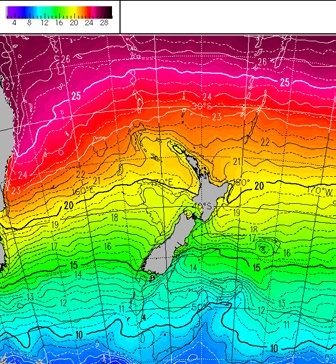
North to north-east airstreams
     North or north-east airstreams flow over the Chatham
     Islands about 15% of the time (Figures 6 and 7).
     They are characterised by a relatively mild and humid
     airstream which flows between a large anticyclone to
     the east of the Chatham Islands and a low pressure
     area to the west. These situations may be slow-moving
     when the anticyclone blocks the movement of the
     depression. Heavy falls of rain are a frequent feature
     of these situations, both in the flow ahead of the front,
     and also with the front.

     On 15 June 1981 (Figure 7) there were strong north-
                                                                 Figure 4. Northwest airstream at the Chatham Islands. MSL
     easterly winds, and rain began to fall over the Chatham
                                                                 analysis for 14 August 1980.
     Islands from about 7 pm. Rain continued during the
     following two days, with some heavy falls recorded
     at Waitangi as the front approached late on 17 June
     1981. The front crossed the Chatham Islands during
     the mid-afternoon of 18 June 1981 and was followed by
     westerly winds and clearing conditions.

     East to south-east airstreams
     East to south-east airstreams affect the Chatham
     Islands about 15% of the time. Figure 8 is an example
     of an easterly airstream flowing over the Chatham
     Islands. Although cloudy, drizzly conditions are usual,
     fine weather normally prevails so long as the centre of
     the anticyclone is west of the Chatham Islands.

     An example of a south-easterly airflow over the
     Chatham Islands is shown in Figure 9. South-easterly
     conditions are typically associated with depressions        Figure 5. Northerly airstream at the Chatham Islands. MSL
                                                                 analysis for 1 February 1982.
     which pass to the north or east. In most cases, these
     airstreams persist for no more than one or two days at
     a time but bring strong or gale force winds and periods
     of rain.

     Cyclones of tropical origin
     The tropical cyclone season in the Southwest Pacific
     lasts from November to April. Originating in low
     latitudes within the cloud masses of the South Pacific
     Convergence Zone, tropical cyclones reaching the
     Chatham Islands and still retaining true cyclonic
     characteristics, such as a warm core, are extremely
     rare. They are nevertheless accompanied by heavy
     rain and strong winds. Ex-tropical cyclones mostly
     approach the Chatham Islands from the north-west,
     and sometimes affect the island group. Tracks of
     tropical cyclones which have passed within 500 km
     of the Chatham Islands between 1970 and 2010 are
                                                                 Figure 6. Northerly airstream over the Chatham Islands. MSL
     shown in Figures 10-14.                                     analysis from 16 November 1981.

10
Figure 7. North-easterly airstream over the Chatham Islands. Figure 10. Tropical cyclones which passed within 500 km of the
MSL analysis for 15 June 1981. Chatham Islands during December, 1970–2010. The Chatham
Islands are the small yellow dot to the east of New Zealand’s
South Island. Source: Southwest Pacific Enhanced Archive of
Tropical Cyclones (SPEArTC; Diamond et al., 2012).
Figure 8. Easterly airstream affecting the Chatham Islands. Figure 11. Tropical cyclones which passed within 500 km of the
MSL analysis for 26 March 1982. Chatham Islands during January, 1970–2010. Source: Southwest
Pacific Enhanced Archive of Tropical Cyclones (SPEArTC;
Diamond et al., 2012).
Figure 9. South-easterly airstream over the Chatham Islands. Figure 12. Tropical cyclones which passed within 500 km of
MSL analysis for 12 April 1982. the Chatham Islands during February, 1970–2010. Source:
Southwest Pacific Enhanced Archive of Tropical Cyclones
(SPEArTC; Diamond et al., 2012).
11Figure 13. Tropical cyclones which passed within 500 km of the Figure 14. Tropical cyclones which passed within 500 km of the
Chatham Islands during March, 1970–2010. Source: Southwest Chatham Islands during April, 1970–2010. Source: Southwest
Pacific Enhanced Archive of Tropical Cyclones (SPEArTC; Pacific Enhanced Archive of Tropical Cyclones (SPEArTC;
Diamond et al., 2012). Diamond et al., 2012).
Photo: Marty Flanagan, NIWACLIMATIC ELEMENTS
Wind
Wind direction over New Zealand in the
zone directly above the earth’s surface
may be interpreted from a mean sea
level pressure (MSLP) map, following the
general principle that, in the Southern
Hemisphere, air flows in a clockwise
direction around a depression (“low”), and
in an anticlockwise direction around an
anticyclone (“high”). As such, MSLP maps
can be used to indicate the general wind
direction at the earth’s surface. However,
actual wind direction at a particular locality
is modified by the influence of friction and
Figure 15. Mean annual wind frequencies (%) of surface wind directions
topography. Wind speeds are also subject from hourly observations at Chatham Island EWS station. The plot shows the
to topographical influence. The prevailing directions from which the wind blows, e.g. the dominant wind directions are
from the southwest and northwest.
wind direction over the southern oceans
of the world in the zone above the Earth’s
of gale were observed in a single year (‘days of gale’ information
boundary layer is westerly.
is available in NIWA’s National Climate Database, for Chatham
At the surface, the main wind directions on Island Waitangi station, between 1956 and 1993). Gales generally
the Chatham Islands are from the south- blow from the south-west, and have a tendency to develop when
westerly quarter (from west to south on cyclogenesis (i.e. the formation of a low pressure centre) occurs
the compass), with a secondary maximum southeast of the Islands. Under these conditions it is not unusual
from the north-west (Figure 15). for strong to gale force winds to blow for up to 7 days at a time.
Wind on the islands is a marked feature of Because south-westerly conditions cover a large area of ocean
the climate; calm conditions are rare. The to the south of the Islands, prolonged periods of high winds from
mean wind speed is about 24 km/hr, and the southwest allow a sufficient time for heavy seas and swell to
calm periods (wind speed less than be generated. Petre Bay on the western side of Chatham Island is
2 km/hr) occur only about 0.2% of the time. totally exposed to the sea in such conditions.
Strong winds (over 39 km/hr) blow nearly The south-western parts of Chatham Island are most affected by
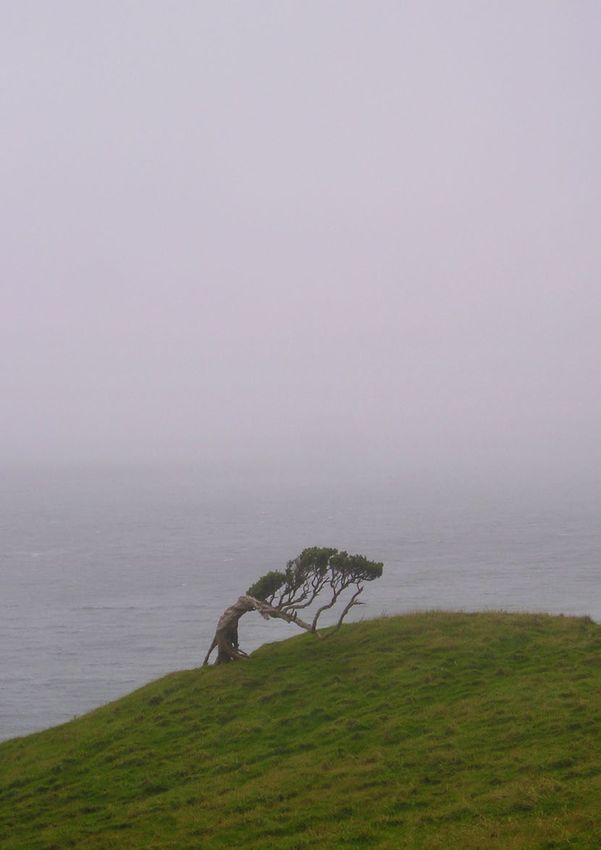
10% of the time, and autumn and winter cold south-westerly airstreams. Many trees along the southern
have the highest frequencies of strong and western coasts and in other exposed positions on the island
winds. Comparing the “windiness” at the are misshapen and lean north-eastwards (see photo page 8). The
Chatham Islands with some South Island, winds in these areas and in Pitt Strait are at times anecdotally
New Zealand sites of similar latitude, reported as being stronger than those observed in Waitangi.
the mean wind speeds at Christchurch,
Mean wind speed data (average wind speeds are taken over the
Timaru, Dunedin, and Invercargill are
10 minute period preceding each hour) are available for two sites
14 km/hr, 9 km/hr, 14 km/hr, and 17 km/hr
in the Chatham Islands (Table 1 and Figure 16). Both sites have
respectively.
relatively similar wind patterns throughout the year, with the
Gale force wind days (beaufort wind scale AWS site being slightly windier in winter and slightly less windy in
8 or more) are encountered on an average summer compared with the EWS site. This is likely due to the AWS
of 14 days each year, mostly during the site position near the west coast, compared to the EWS site which
months of May to September. Forty- is further inland.
nine days of gale were reported in 1988,
and there were a further five occasions
between 1956 and 1993 when over 25 days
13Table 1. Mean monthly/annual wind speeds (km/hr) for Chatham Islands sites, from all available data.
Location Jan Feb Mar Apr May Jun Jul Aug Sep Oct Nov Dec Ann
Chatham Island EWS 24.8 23.5 23.0 23.0 22.2 24.2 22.2 23.5 24.9 26.2 25.7 24.5 24.0
Chatham Islands AWS 22.6 21.7 23.2 23.5 22.8 26.9 23.5 24.5 26.0 26.8 25.9 23.4 24.2
Spring is generally the windiest season throughout
the region, and the least strong winds are observed Chatham Island Ews Chatham Islands Aws
30
in autumn. Table 2 gives the seasonal proportion of
Mean wind speed (km/hr)
25
strong and light winds as a percentage of the annual
20
total. For example, of all strong winds recorded at
15
Chatham Island EWS, 26% occurred in summer,
20% in autumn, 22% in winter and 32% in spring. In 10
compiling this table a strong wind was defined as 5
having an hourly mean wind speed of at least 31 km/hr, 0
Jan Feb Mar Apr May Jun Jul Aug Sep Oct Nov Dec
and light winds were less than 31 km/hr. Month
Figure 16. Mean monthly wind speed (km/hr) at Chatham
Islands sites, from all available data.
Table 2. Seasonal percentages of strong or light winds (%) for Chatham Islands
sites, from all available data.
Location Summer Autumn Winter Spring
Chatham Island EWS Strong 26 20 22 32
Light 25 26 26 23
Strong 19 23 27 31
Chatham Islands AWS
Light 27 26 24 23
Diurnal variation in wind speed is relatively well-
marked, with greatest wind speeds occurring in the Chatham Island EWS Chatham Islands AWS
30
middle of the day. This is because at that time of
25
Wind speed (km/hr)
day heating of the land surface is most intense and
20
stronger winds aloft are brought down to ground level
by turbulent mixing. Cooling at night generally restores 15
a lighter wind regime. Table 3 gives average wind 10
speeds at three-hourly intervals for selected stations, 5
whilst Figure 17 visually highlights the typical diurnal 0
0 3 6 9 12 15 18 21
variation of wind speed observed in the Chatham Hour of day
Islands. Figure 17. Hourly mean wind speed (km/hr) at Chatham Islands
stations, from all available data.
Table 3. Average wind speed (km/hr) for selected hours at Chatham Islands
stations, from all available data.
Location 0000 0300 0600 0900 1200 1500 1800 2100
Chatham Island EWS 22 22 22 25 28 27 24 22
Chatham Islands AWS 23 23 23 25 28 27 24 22
14Gusty winds are quite frequent in the Chatham Islands Table 4. Average number of days per year with gusts exceeding
due to the exposed location. Gusts of at least 63 km/ 63 km/hr and 96 km/hr for selected Chatham Islands stations,
from all available data.
hr are recorded at the exposed site of Chatham Islands
AWS (situated on the west coast of Chatham Island) on Days with Days with
Location Gusts >63 Gusts >96
an average of 117 days each year, and gusts over km/hr km/hr
96 km/hr occur on average 9 days each year (Table 4). Chatham Island EWS 99 5
In comparison, the more sheltered site further inland Chatham Islands AWS 117 9
at Chatham Island EWS records 99 days per year with
gusts over 63 km/hr, and 5 days each year with gusts
over 96 km/hr. The inland site is still very windy, and
this reflects the windy nature of the Chatham Islands
as a whole.
Although gale force winds can occur in any month,
they are most frequent in winter. The highest gust
recorded (according to NIWA’s National Climate
Database) on land in the Islands was 156 km/hr at
Chatham Islands AWS on 29 May 1993. Maximum
gusts recorded at different stations on Chatham Island
are listed in Table 5.
Table 5. Highest recorded gusts at selected Chatham Islands
stations, from all available data.
Location Gust (km/hr) Direction Date
Chatham Islands AWS 156 WSW 31/01/1993
Chatham I Waitangi 124 SSW 29/05/1993
Chatham Island EWS 117 SW 14/03/2007
Chatham Island EWS 117 SW 3/06/2005
Chatham Island EWS 117 SW 2/11/2005
Photo: Ville Miettinen from Helsinki, Finland - View from our cottage, CC BY 2.0, https://commons.
wikimedia.org/w/index.php?curid=3214115
15Rainfall
Rainfall distribution
In the Chatham Islands, the mean annual rainfall total The variability of seasonal and annual rainfall over the
varies with elevation. The lowland areas of Chatham Chatham Islands is similar to that of western areas of
Island (north of the southern highlands) experience New Zealand and is markedly less than many NZ east
between 800 and 1000 mm of rainfall per year (Figure coast districts. This is due to exposure of the Chatham
18). In contrast, the southern highlands experience Islands to the prevailing westerly and south-westerly
up to double this amount of rainfall in parts, up to winds and the islands geographical location. Table 6
2000 mm. Pitt Island experiences between 800 and lists monthly rainfall averages (calculated using all
1400 mm of annual rainfall. available data) and percentage of annual total, for
selected stations. The proportion of annual rainfall
In the Chatham Islands, there is a maximum of rainfall
that is recorded in the winter months from June to
in late autumn and early winter, and a summertime
August is fairly consistent across Chatham Island at
minimum (Figure 19). May is usually the wettest month
an average of 29% (ranging from 27% to 30%), and the
and November or December the driest. Much of the
proportion of rainfall recorded in the summer months
rain that falls over the Chatham Islands is associated
from December to February ranges from 19% at
with fronts or depressions, or showers in southerly
Waitangi to 23% at the Chatham Island EWS station.
airstreams. Nearly half of the rainfall occurs when the
wind is from the south-westerly quadrant although the
more intense falls are usually with north-westerly and
northerly winds.
Figure 18. Mean annual rainfall at the Chatham Islands, from all available data.
16Table 6. Monthly and annual rainfall normal (a; mm), and monthly distribution of annual rainfall (b; %) at selected Chatham Islands
stations from all available data.
Location Jan Feb Mar Apr May Jun Jul Aug Sep Oct Nov Dec Ann
a 54.6 53.4 61.3 69.5 109.5 78.9 90.3 58.7 64.6 58.5 54.0 50.6 804.0
Chatham I Owenga
b 6.8 6.6 7.6 8.6 13.6 9.8 11.2 7.3 8.0 7.3 6.7 6.3
a 69.7 67.3 75.3 78.6 104.4 99.5 91.7 88.3 64.5 55.9 64.0 63.6 922.9
Chatham I Po Radio
b 7.6 7.3 8.2 8.5 11.3 10.8 9.9 9.6 7.0 6.1 6.9 6.9
a 53.3 58.1 78.2 78.2 103.2 97.3 87.1 81.7 66.7 59.7 59.6 59.7 883.0
Chatham I Waitangi
b 6.0 6.6 8.9 8.9 11.7 11.0 9.9 9.3 7.6 6.8 6.7 6.8
a 56.3 68.9 72.1 72.1 87.5 89.9 60.2 71.0 60.3 58.1 48.4 61.7 806.6
Chatham Island EWS
b 7.0 8.5 8.9 8.9 10.8 11.1 7.5 8.8 7.5 7.2 6.0 7.7
Chatham Islands a 63.0 66.4 84.4 81.7 95.6 112.9 80.4 85.3 71.3 64.2 66.7 69.7 941.5
AWS b 6.7 7.1 9.0 8.7 10.2 12.0 8.5 9.1 7.6 6.8 7.1 7.4
Data years: Chatham I Owenga: 1971–1986; Chatham I Po Radio: 1878–1963; Chatham I Waitangi: 1951–1994; Chatham Island EWS:
1999–2015; Chatham Islands AWS: 1991–2012.
The distribution of monthly rainfall is shown in
Figure 19. The 10th percentile, 90th percentile, and
mean rainfall values for each month are shown along
with maximum and minimum recorded values for
several stations.
Chatham I Po Radio Chatham I Waitangi
100 200 300 400
100 200 300 400
Rainfall (mm)
Rainfall (mm)
Highest Monthly Total
90 Percentile Value
0
0
J F M A M J J A S O N D J F M A M J J A S O N D
Chatham Island EWS Chatham Islands AWS Mean
100 200 300 400
100 200 300 400
Rainfall (mm)
Rainfall (mm)
10 Percentile Value
Lowest Monthly Total
0
0
J F M A M J J A S O N D J F M A M J J A S O N D
Figure 19. Monthly variation in rainfall for selected Chatham Island stations. Note that these stations have different periods of
record: Chatham I Po Radio (1878–1963), Chatham I Waitangi (1951–1994), Chatham Island EWS (1999–2015), and Chatham Islands
AWS (1991–2012), so comparisons between stations should be made with caution.
Rainfall variability is often depicted by rainfall deciles, than one month beginning with the month stated. For
as given in Table 7. The 10th percentile values show example, using the table for Chatham Islands AWS, it
the accumulated rainfalls that will normally be can be seen that in the three month period beginning
exceeded in nine out of ten years, while the 90th in April, 243 mm or more of rainfall can be expected in
percentile values indicate the accumulated falls that nine years in ten, while a total of 363 mm or more will
will normally be exceeded in only one year in ten. occur in only one year in ten, on average.
The table includes periods from one month to twelve
months (annual), with each time period that is longer
17Table 7. Rainfall deciles for consecutive months for selected Chatham Islands stations, from all available data.
Jan Feb Mar Apr May Jun Jul Aug Sep Oct Nov Dec
Chatham Islands AWS
1 month
10th 25 24 23 36 57 86 42 43 30 29 28 27
90th 113 115 147 129 129 161 126 146 120 93 126 145
3 months
10th 150 156 180 243 206 187 159 148 123 128 138 133
90th 284 308 345 363 383 360 306 291 283 259 265 294
6 months
10th 424 416 449 421 392 386 303 344 336 298 339 377
90th 602 655 661 619 605 600 547 582 476 499 550 573
Annual
10th 762 762 770 747 734 775 807 804 801 798 788 790
90th 1075 1083 1079 1055 1085 1094 1116 1138 1123 1122 1145 1109
Chatham Island EWS
1 month
10th 17 23 33 30 37 42 34 22 21 33 23 26
90th 115 164 128 109 138 139 85 132 107 93 76 123
3 months
10th 127 144 171 185 163 131 128 132 113 113 106 93
90th 293 283 330 325 325 328 259 268 227 250 259 307
6 months
10th 382 363 319 328 337 296 263 275 223 305 297 340
90th 538 545 541 568 563 529 495 507 497 470 472 502
Annual
10th 683 670 645 653 654 676 684 662 676 691 712 689
90th 1048 1049 955 965 981 945 978 988 1018 994 1022 1023
Rainfall frequency and intensity
The number of rain days (days with at least 0.1 mm the same geographic variability, with an average of 131
of rain) on the Chatham Islands is considerable days across all stations, but a minimum of 113 days
when compared with many places in mainland New at Chatham Island EWS to a maximum of 144 days at
Zealand. At Waitangi, it rains on average 211 days Chatham Islands AWS and Chatham Island Po Radio.
each year, while at Auckland there are usually 183 Rainfall intensities are influenced by the surrounding
days, Wellington 155 days, and Christchurch 128 days topography and normally increase with altitude.
of rain. Wet days (days with 1.0 mm or more of rain) Higher rainfall intensities may therefore be expected
occur at Waitangi on 134 days per year on average. on the southern highlands of Chatham Island and
Rain falls mostly as light showers or as drizzle, is of on the high country of Pitt Island. High intensity
short duration and occurs frequently. The number of rainfall, particularly at sub-hourly periods, is typically
rain days and wet days each season is given in Table associated with thunderstorm activity. In Table 9,
8. The frequency of rain days in the Chatham Islands maximum short period rainfalls for periods of 10
is greatest during winter months (about 32% of the minutes to 72 hours are given for one station in the
annual total) and least in summer (about 18% of the Chatham Islands (there is only one station with short
annual total). period rainfall data available) and some mainland New
The annual number of rain days over the Chatham Zealand sites for comparison.
Islands as a whole is about 200, but varies from 176
days at Chatham Island EWS to 217 at Chatham
Islands AWS. The annual number of wet days exhibits
18Table 8. Average monthly rain days and wet days for Chatham Islands stations; a: 0.1 mm rain day, b: 1 mm wet day.
Location Jan Feb Mar Apr May Jun Jul Aug Sep Oct Nov Dec Ann
a 10 11 12 16 22 21 24 16 15 14 14 11 185
Chatham I Owenga
b 7 7 8 9 16 13 15 10 10 10 9 7 120
a 12 11 14 16 20 22 21 20 16 14 14 14 194
Chatham I Po Radio
b 10 8 10 12 15 17 16 15 11 10 11 10 144
a 13 12 16 17 23 23 23 22 18 16 15 14 211
Chatham I Waitangi
b 8 7 10 11 15 15 15 13 12 10 9 8 134
a 10 11 12 15 18 20 18 18 14 15 12 13 176
Chatham Island EWS
b 6 7 8 9 12 13 11 10 10 10 8 9 113
a 13 13 17 18 22 24 23 22 19 17 15 14 217
Chatham Islands AWS
b 9 8 11 12 14 17 15 15 12 12 11 10 144
Table 9. Maximum recorded short period rainfalls from Chatham Islands AWS and New Zealand main centres for comparison.
Location 10min 20min 30min 1hr 2hrs 6hrs 12hrs 24hrs 48hrs 72hrs
Chatham Islands AWS 13 18 21 28 33 61 77 96 138 155
Auckland 14 27 38 53 61 127 153 168 181 181
Wellington 12 20 24 25 35 54 98 141 159 172
Christchurch 16 20 22 27 51 81 108 118 121 138
Recent extreme events in the Chatham Islands
The Chatham Islands are regularly affected by storms recent dry spell between two key sites on the Chatham
such as ex-tropical cyclones (see page 10), but damage Islands (Chatham Islands AWS and Chatham Island
is often not reported in New Zealand’s mainstream EWS) was 33 days recorded at Chatham Island EWS,
media. As such, only two events where civil defence from 16 November to 18 December 2007. During this
emergencies were declared are listed here. dry spell, 14 consecutive days were without any rain.
The longest recent dry spell at Chatham Islands AWS
17-18 March 1980: Ex-tropical cyclone Sina caused
was 27 days, from 16 August to 11 September 2005
a civil defence emergency to be declared on the
(8 consecutive days without any rain). Most dry spells
Chatham Islands due to high winds. During this storm,
occur during the months November to March. This
18 people were evacuated from their homes.
corresponds to the time when rainfall variability is
15-18 March 2015: Ex-tropical cyclone Pam caused greatest and total amounts least, due to a frequent
a civil defence emergency to be declared on the ridge of high pressure over northern New Zealand.
Chatham Islands. The storm caused high winds, heavy Cold fronts passing over the Chatham Islands in this
rain, and large swells (>7 m swells). Impacts included season are subsequently weak as they impinge into the
power outages to many residents caused by trees southern limits of the high pressure zone.
falling on power lines and damage to wharves from
heavy seas at Kaingaroa and Pitt Island. Schools were
closed as a precaution due to the weather.
Periods of low rainfall
Periods of fifteen days or longer with less than 1 mm
of rain on any day are referred to as ‘dry spells’. Dry
spells are not particularly common in the Chatham
Islands due to its location in the path of moisture-
laden winds. There is an average of 1.25 dry spells
each year in the Chatham Islands. The average
duration of a dry spell is about 19 days. The longest
19Temperature
Sea surface temperature
Monthly mean sea surface temperatures near 18
SST (°C)
Air temp Chatham Island EWS
the Chatham Islands are compared with mean air 16 Air temp Chatham Island AWS
14
temperature for Chatham Island EWS and Chatham
Temperature (°C)
12
Islands AWS in Figure 20. There is a lag in the increase 10
of sea surface temperatures when compared to air 8
6
temperatures from July to August/September. This 4
is attributed to the greater heat capacity of the sea 2
compared to land, which results in the sea surface 0
Jan Feb Mar Apr May Jun Jul Aug Sep Oct Nov Dec
temperatures taking longer to increase and decrease Month
in response to changing seasons compared to land-
based areas. Throughout most of the year, mean Figure 20. Mean monthly land (Chatham Islands AWS
and Chatham Island EWS) and sea surface temperatures
air temperatures are cooler than mean sea surface (surrounding the Chatham Islands).
temperatures, although air temperature at Chatham
Island EWS rises slightly above the sea surface
temperature during the summer months. Figure 21
shows the mean sea surface temperatures for the New
Zealand region for February and August, which are
the warmest and coolest months with respect to sea
surface temperatures.
A) MEAN FEBRUARY SST (°C) B) MEAN AUGUST SST (°C)
Figure 21. Monthly mean sea surface temperatures (°C) for: a) February; b) August. Source: NIWA SST Archive, Uddstrom and
Oien (1999).
Icebergs have been sighted only once near the
Chatham Islands, in October 1892. One stranded
on Chatham Island and others were seen in Pitt
Strait, Petre and Hanson Bays (Shand, 1892). Other
independent observations of icebergs were reported
between the islands and New Zealand. At that time no
living person on Chatham Island had heard of such an
occurrence previously.
20Air temperature
The temperature regimes of small
islands are strongly influenced by the
prevailing wind flows with their associated
airmass characteristics, and hence by the
surrounding sea surface temperatures.
Since the Chatham Islands are situated
in a zone of strong and rather persistent
westerlies, the daily and annual
temperature variations are small.
Mean annual temperatures for most of
the land area on the Chatham Islands is
between 11 and 12°C, with the southern
highlands on Chatham Island slightly
Figure 22. Mean annual temperature at the Chatham Islands, based on all
cooler with a mean annual temperature available data.
of between 10 and 11°C (Figure 22). Table
10 shows the mean monthly and annual
temperature for various stations in the
Chatham Islands, and Table 11 shows
mean maximum (afternoon) and mean
minimum (morning) temperatures for
these stations.
Table 10. Mean monthly and annual temperatures for selected Chatham Islands stations, from all available data.
Location Jan Feb Mar Apr May Jun Jul Aug Sep Oct Nov Dec Ann
Chatham I Po Radio 14.2 14.4 13.6 12.0 10.2 8.2 7.5 7.8 9.0 10.3 11.5 13.1 11.0
Chatham I Waitangi 14.7 15.1 14.3 12.4 10.3 8.7 7.9 8.4 9.2 10.4 11.7 13.6 11.4
Chatham Island EWS 15.8 15.8 14.9 13.0 11.1 9.2 8.3 9.1 10.2 11.2 12.4 14.6 12.1
Chatham Islands AWS 14.9 15.2 14.3 12.4 10.8 9.1 8.2 8.7 9.5 10.5 11.5 13.5 11.6
Table 11. Mean maximum and mean minimum temperatures for selected Chatham Islands stations, from all available data.
Location Jan Feb Mar Apr May Jun Jul Aug Sep Oct Nov Dec Ann
Max 17.4 17.6 16.6 14.8 12.8 10.7 10.1 10.5 11.8 13.1 14.5 16.3 13.8
Chatham I Po Radio
Min 10.9 11.3 10.7 9.1 7.6 5.7 4.9 5.2 6.2 7.4 8.4 10.0 8.1
Max 17.8 18.0 17.1 15.0 12.8 11.1 10.3 10.8 11.7 13.0 14.5 16.5 14.0
Chatham I Waitangi
Min 11.6 12.1 11.4 9.8 7.8 6.4 5.5 6.0 6.7 7.8 8.9 10.8 8.7
Max 19.4 19.2 18.0 15.9 14.0 11.9 11.2 12.0 13.5 14.7 16.1 18.1 15.3
Chatham Island Ews
Min 12.3 12.3 11.7 10.0 8.2 6.5 5.5 6.2 6.9 7.6 8.8 11.1 8.9
Max 17.8 18.1 17.0 14.9 13.2 11.3 10.6 11.1 12.0 13.1 14.2 16.3 14.1
Chatham Islands Aws
Min 11.9 12.2 11.6 10.0 8.4 6.9 5.9 6.3 7.1 7.9 8.7 10.6 9.0
21Figure 23 gives the monthly temperature regime
(highest recorded, mean monthly maximum, mean
daily maximum, mean, mean daily minimum, mean
monthly minimum, and lowest recorded) for selected
sites in the Chatham Islands.
Chatham I Po Radio Chatham I Waitangi
Temperature (oC)
Temperature (oC)
30
30
20
20
Highest Recorded
10
10
Mean Monthly Maximum
0
0
Mean Daily Maximum
J F M A M J J A S O N D J F M A M J J A S O N D Mean
Mean Daily Minimum
Chatham Island EWS Chatham Islands AWS
Temperature (oC)
Temperature (oC)
Mean Monthly Minimum
30
30
Lowest Recorded
20
20
10
10
0
0
J F M A M J J A S O N D J F M A M J J A S O N D
Figure 23. Monthly variation in air temperatures for selected Chatham Islands stations, from all available data.
Daily temperature ranges in the Chatham Islands are January July
smaller than those in mainland New Zealand, due to 20.0
18.0
the small land mass of the islands and the moderating 16.0
influence of winds and the sea. Table 12 shows the 14.0
Temperature (°C)
12.0
average daily temperature range at different Chatham 10.0
Islands sites. Table 13 shows the mean hourly 8.0
6.0
temperatures at Chatham Island EWS, and Figure 4.0
2.0
24 shows these data in a graph, to illustrate how 0.0
temperature changes over the course of an average
10:00
11:00
12:00
13:00
14:00
15:00
16:00
17:00
18:00
19:00
20:00
21:00
22:00
23:00
0:00
1:00
2:00
3:00
4:00
5:00
6:00
7:00
8:00
9:00
day in January and July. Time
Figure 24. Mean hourly temperatures at Chatham Island EWS
for January and July.
Table 12. Average daily temperature range (Tmax – Tmin, °C) for Chatham Islands sites.
Location Jan Feb Mar Apr May Jun Jul Aug Sep Oct Nov Dec Ann
Chatham I Po Radio 6.5 6.2 5.9 5.7 5.2 5.0 5.2 5.3 5.5 5.8 6.1 6.3 5.7
Chatham I Waitangi 6.2 6.0 5.7 5.2 5.0 4.7 4.8 4.8 5.0 5.2 5.5 5.7 5.3
Chatham Island EWS 7.1 6.9 6.3 5.9 5.8 5.5 5.7 5.9 6.6 7.0 7.2 7.0 6.4
Chatham Islands AWS 5.9 5.9 5.4 5.0 4.7 4.5 4.6 4.8 4.9 5.2 5.4 5.7 5.2
Table 13. Mean hourly mean air temperatures at Chatham Island EWS for January and July.
00 01 02 03 04 05 06 07 08 09 10 11
January 13.5 13.5 13.5 13.5 13.4 13.7 14.6 15.5 16.2 16.9 17.3 17.7
July 7.5 7.4 7.4 7.4 7.3 7.3 7.4 7.4 7.8 8.8 9.6 10.0
12 13 14 15 16 17 18 19 20 21 22 23
January 17.9 18.0 17.9 17.6 17.2 16.5 15.8 15.0 14.3 14.1 13.9 13.8
July 10.2 10.3 10.0 9.6 9.0 8.2 7.9 7.8 7.7 7.6 7.5 7.4
22The Chatham Islands do not experience extreme
temperatures to the same extent as most mainland
New Zealand region. The Chatham Islands have
about 4 days per year when the temperature falls
below 0°C, and the temperature very seldom reaches
above 25°C (only three occurrences between 2000
and 2016 were recorded at Chatham Island EWS). In
summer, maximum temperatures exceeding 20°C can
be expected on about 14 days each year. The highest
maximum temperature measured on the islands in
NIWA’s National Climate Database is 29.6°C, recorded
at Chatham Island EWS on 30 January 2013. The
extreme minimum temperature of -3.3°C was also
recorded at Chatham Island EWS on 21 July 2007.
These extreme temperatures compare to New Zealand
national extremes of 42.4°C and -25.6°C.
Earth temperatures
Recent measurements of earth (soil) temperatures
from the Chatham Islands are not recorded in NIWA’s
National Climate Database. From 1956 to 1993, 18.0
10 cm 20 cm 30 cm 100 cm Air temp
however, earth temperatures were measured once 16.0
daily at 9 am at the Waitangi site and these data are 14.0
Earth temperature (°C)
12.0
presented here. 10.0
8.0
Earth temperatures are measured at varying depths 6.0
and are important, amongst other things, for 4.0
determining the growth and development of plants. 2.0
0.0
Different plants have different rooting depths and as Jan Feb Mar Apr May Jun Jul Aug Sep Oct Nov Dec
such, earth temperatures are routinely monitored at Month
10, 20, 30, and 100 cm depths. Table 14 lists mean Figure 25. Average monthly 9 am earth temperatures for
monthly earth temperatures for a number of standard different depths from the ground surface and mean 9 am air
temperature at Chatham Island Waitangi.
depths.
Figure 25 shows how earth temperatures change
throughout the year at Waitangi, compared with air
temperature. The temperature cycle for 100 cm depth
is more damped and lagged than at shallower depths.
Table 14. Monthly and annual mean 9 am earth temperatures (°C) at varying depths from the ground surface at Chatham I Waitangi
site (height above sea level: 44 m).
Jan Feb Mar Apr May Jun Jul Aug Sep Oct Nov Dec Ann
10 cm 15.7 15.5 14.2 11.8 9.4 7.6 6.6 7.2 8.4 10.4 12.4 14.7 11.2
20 cm 16.5 16.5 15.1 12.8 10.4 8.5 7.4 8.0 9.1 10.9 13.0 15.3 12.0
50 cm 16.7 16.8 15.6 13.4 11.0 9.1 8.0 8.4 9.5 11.2 13.3 15.4 12.4
100 cm 15.1 15.7 15.5 14.3 12.7 11.1 9.7 9.4 9.8 10.8 12.2 13.7 12.5
23Frosts
Frost is a local phenomenon and its frequency of
occurrence can vary widely over very small areas.
Frosts occur most frequently in winter during periods
of anticyclonic conditions, primarily for two reasons.
Firstly, clear skies associated with anticyclones
enhance the rate of radiative cooling during the night.
Secondly, anticyclones are associated with light winds,
which reduces the amount of turbulent mixing of air.
Cold air is relatively dense, so when there is a lack
of turbulent mixing it tends to sink towards the earth
surface. Therefore, areas most likely to experience
frost are flat areas, where relatively cold air is not
able to drain away on calm nights, and in valleys,
where relatively cold air pools after descending from
higher elevation areas nearby. Under such conditions,
temperature inversions (where the air temperature
increases with elevation) are common.
There are two types of frost recorded. Air frosts occur
when air temperature measured in a screen by a
thermometer 1.3 m above the ground falls below 0°C.
Ground frosts are recorded when the air temperature
2.5 cm above a closely cut grass surface falls to -1.0°C
or lower. Both types of frost are relatively uncommon
in the Chatham Islands, with ground frosts being
recorded 4 times a year in Waitangi and 10 times a year
at Chatham Island EWS, and air frosts only recorded
about once in two years at Waitangi and about four
times a year at Chatham Island EWS. Table 15 lists
for these two sites the mean daily grass minimum
and extreme grass minimum temperatures and the
average number of days each month with ground
and air frosts. Data on air temperatures (mean daily,
monthly minima, and extreme minima) can be obtained
from Figure 23.
Table 15. Occurrences of frosts and grass minimum temperatures in the Chatham Islands, from all available data.
Location Jan Feb Mar Apr May Jun Jul Aug Sep Oct Nov Dec Ann
Chatham I Waitangi a 10.0 10.6 9.8 8.1 6.1 4.8 3.7 4.3 5.1 6.3 7.3 9.1 7.1
b 0.4 -0.5 0.1 0.2 -2.2 -2.7 -3.0 -3.0 -2.9 -2.1 -2.1 -2.5
c 0.0 0.0 0.0 0.0 0.1 0.7 1.3 0.9 0.8 0.3 0.1 0.1 4.2
d 0.0 0.0 0.0 0.0 0.0 0.1 0.0 0.2 0.1 0.0 0.0 0.0 0.4
Chatham Island EWS a 11.5 11.5 10.9 9.1 7.1 5.3 4.3 5.0 6.0 6.8 8.0 10.3 8.0
b 0.4 1.9 -0.4 -0.8 -2.5 -5.1 -5.5 -4.4 -3.8 -3.8 -2.9 -1.1
c 0.0 0.0 0.0 0.0 0.7 1.3 3.6 1.9 1.5 0.7 0.4 0.1 10.1
d 0.0 0.0 0.0 0.0 0.1 0.3 1.4 0.7 0.7 0.3 0.0 0.0 3.5
a: mean daily grass minimum (°C)
b: lowest grass minimum recorded (°C)
c: average number of ground frosts per month
d: average number of air frosts per month
24Sunshine and solar radiation
Sunshine
The Chatham Islands are frequently cloud-covered,
and as such, receive only about 1400 hours of bright
sunshine per year (compared to over 2000 hours
observed in Auckland, Wellington, and Christchurch).
Table 16 shows the monthly and annual averages for
Waitangi and for other New Zealand sites. There are
about 50 days each year when no bright sunshine is
recorded. Waitangi has an average of 10 days with
no bright sunshine in summer, 17 days in winter, 11
days in spring and 13 in autumn. Figure 26 shows the
monthly mean, maximum, and minimum recorded
bright sunshine hours for the Waitangi site in the
Chatham Islands.
Table 16. Average monthly and annual bright sunshine hours for Chatham Island Waitangi station, from all available data. Other sites
from New Zealand are provided as a comparison.
Location Jan Feb Mar Apr May Jun Jul Aug Sep Oct Nov Dec Ann
Chatham I Waitangi 186 143 124 100 82 63 77 96 109 137 155 161 1433
Auckland 243 204 184 160 141 111 134 145 151 186 200 235 2093
Wellington 247 211 205 161 133 99 119 147 163 193 209 223 2110
Christchurch 238 195 191 163 140 117 127 154 170 204 224 220 2141
Chatham I Waitangi
300
Highest Recorded
Bright Sunshine (hours)
200
Mean
100
Lowest Recorded
0
J F M A M J J A S O N D
Figure 26. Mean, highest, and lowest recorded monthly bright
sunshine hours for Chatham Island Waitangi.
Solar radiation
Solar radiation data is available for two sites on the
Chatham Islands. Insolation is at a maximum in
December and January and a minimum in June. Table
17 shows mean daily solar radiation (global) for each
month for these two sites.
Table 17. Mean daily global solar radiation (MJ/m2/day) for Chatham Islands sites, from all available data.
Location Jan Feb Mar Apr May Jun Jul Aug Sep Oct Nov Dec Ann
Chatham Island EWS 21.5 18.1 13.3 8.8 5.6 4.4 5.1 7.8 11.8 16.1 20.6 21.4 12.9
Chatham Islands AWS 20.2 17.2 13.0 8.5 5.3 4.1 4.8 7.4 11.2 15.3 19.3 20.5 12.2
25Other elements
Fog
Fog on the Chatham Islands is reported on about 19
days each year (Table 18). It is mostly advection (or
sea) fog and very occasionally frontal fog. Both types
can occur at any time of the day and are fairly evenly
distributed throughout the year. Sea fog will form when
a warm humid northerly air mass is cooled to below its
dew point by a colder sea. Sea fog over the islands can
be persistent but will normally lift to low stratus during
daylight hours.
Figure 27. A situation when fog was observed at the Chatham
On occasions in moist north-westerly or northerly
Islands. MSL analysis for 15 November 1981.
airstreams, fog or stratus cloud may be present on the
north-eastern side of the Chatham Island and on the
southern highlands when there is no indication of this Table 18. Average number of days each year with thunder, fog,
and hail, at Chatham Island Waitangi station, from all available
at Waitangi. A meteorological situation when fog was data.
reported most of the day at Waitangi is shown in Figure Phenomenon Days of occurrence
27, during a northerly flow system. The fog band lay
Thunder 5
within the warm sector of the frontal system.
Fog 19
Hail 17
Thunderstorms
Lightning 6
On average there are five days of thunder each year at
the Chatham Islands (Table 18), and 10 days of thunder
in a year are likely once every 50 years. Although Snow
fairly evenly distributed throughout the year, there is a Snowfall is uncommon at the Chatham Islands
tendency for thunderstorms to occur more frequently especially on the lower levels of the Islands. It is
from April to June and especially during the night. reported one or two times per year and is confined to
Meteorological situations associated with thunderstorms the colder months.
usually occur with cold unstable showery south-
Snowfall occurs in cold south to southwest airstreams
westerlies, or cold fronts crossing the islands. Due to
which flow around deep depressions situated east of
the localised nature of thunderstorm occurrence, it is
the islands. An intense anticyclone normally lies over
possible that not all thunderstorms are detected.
the Tasman Sea or New Zealand. A meteorological
The heavy rain, lightning, hail, and wind squalls which situation when snow and hail fell over the islands is
can occur with thunderstorms will sometimes cause given in Figure 28.
severe local flooding, disruption of electrical and
electronic equipment, and damage vegetation and
buildings.
Hail
Hailstorms are reported on about 17 days each
year (Table 18). There is a pronounced maximum of
occurrence from May to August in which nearly 60%
of all hail falls. Cold unstable south to southwest
airstreams as displayed in Figure 28 often bring
hail to the islands. On 13 July 1980 (Figure 28), both
hail and snow fell on the Chatham Islands. As with
thunderstorms, an unknown number of hail falls will
Figure 28. A meteorological situation when snow and hail fell at
escape detection. the Chatham Islands. MSL analysis for 13 July 1980.
26Sea swell and waves Table 19. Generated wave heights associated with specific wind
speeds. Assumes a fetch length of 500 km with unlimited wind
Exploration of the ocean’s resources frequently
duration.
requires sea conditions which are not too rough. Since
Wind speed (km/hr) Associated wave
the wind is ever present at and around the Chatham height (m)
Islands, so too are there locally-generated sea waves, 10 0.5
and swell which originates from outside the area. 20 1
Predominant wave directions are from the south or 30 2
south-west and also from the north. Most swells 40 3
arriving in the Chatham Islands area originate in the 50 4
strong westerly wind zone to the south and south- 75 7
west of New Zealand, as well as in south-westerly 100 11
airstreams which frequently blow between New 125 13+
Zealand and the Islands.
There is a known relationship between steady wind
speed and wave heights over the open sea. The most
probable wave heights for a given wind speed over a
typical fetch length in New Zealand/Chatham Islands
coastal waters of about 500 km are given in Table 19.
Photo: Vk2cz - Own work, CC BY 3.0, https://commons.wikimedia.org/w/index.php?curid=4051609
2728
Photo: Photo:
RichardT.O’Driscoll,
Shand NIWADERIVED CLIMATOLOGICAL
PARAMETERS
Apart from elements such as temperature and rainfall polar-derived air masses. Vapour pressure can be
which can be measured directly, it has been found important in determining the physiological response of
that parameters computed from several elements organisms to the environment (very dry air, especially
have some important uses, especially in industry. if there is a pre-existing soil moisture deficit, can
Parameters which define the overall suitability of the cause or increase wilting in plants). Average 9 am
climate for agriculture, horticulture, architectural and vapour pressures for several stations in the Chatham
structural designs, and contracting, etc., are vapour Islands are given in Table 20, which shows that vapour
pressure, relative humidity, evapotranspiration (leading pressures are lowest in the winter months.
to soil water balance), degree-days (thermal time),
Relative humidity relates the amount of water present
and rainfall extremes. Some of these and their uses
in the atmosphere to the amount of water necessary
are discussed in the following paragraphs. Short-term
to saturate the atmosphere. Unlike vapour pressure,
high intensity rainfalls have been covered previously.
relative humidity is dependent on the air temperature.
This is because as air temperature increases,
Vapour pressure and relative humidity
the capacity of the atmosphere to hold water also
Vapour pressure and relative humidity are the two
increases. Therefore, relative humidity often displays
parameters most frequently used to indicate moisture
large diurnal variation. Due to the marine environment
levels in the atmosphere. Both are calculated from
of the Chatham Islands, relative humidity remains
simultaneous dry and wet bulb thermometer readings,
high all year round (Table 21). The daily variation is
although a hygrograph may be used to obtain
small when compared with other locations in New
continuous humidity readings.
Zealand. At Chatham Island EWS, there is a mean
Vapour pressure is the part of total air pressure diurnal variation of 15% in January and 9% in July. In
that results from the presence of water vapour in comparison, Auckland has a mean diurnal variation of
the atmosphere. It varies greatly with air masses 22% in January and 16% in July, and Christchurch has
from different sources, being greatest in warm air values of 28% in January and 24% in July.
masses that have tropical origins and lowest in cold,
Table 20. Mean monthly/annual 9 am vapour pressure (hPa) for selected Chatham Island sites, from all available data.
Location Jan Feb Mar Apr May Jun Jul Aug Sep Oct Nov Dec Ann
Chatham I Waitangi 14.2 14.6 14.1 12.7 11.4 10.0 9.5 9.9 10.3 11.0 11.8 13.4 11.9
Chatham Island EWS 15.6 15.7 15.2 13.5 12.3 10.8 10.2 10.6 11.0 11.4 12.3 14.5 12.7
Chatham Islands AWS 14.0 14.5 13.8 12.5 11.6 10.1 9.5 9.9 10.4 11.0 11.3 13.0 11.8
Table 21. Mean monthly/annual 9 am relative humidity (%) for selected Chatham Islands sites.
Location Jan Feb Mar Apr May Jun Jul Aug Sep Oct Nov Dec Ann
Chatham I Waitangi 81.6 82.8 83.1 84.0 86.0 86.1 86.7 86.3 84.0 83.5 82.2 82.6 84.1
Chatham Island EWS 83.5 85.5 87.2 85.3 87.6 88.2 89.0 86.8 81.8 81.7 80.6 83.3 85.0
Chatham Islands AWS 80.4 82.2 82.1 81.9 85.5 84.6 84.9 84.4 82.5 83.4 80.5 81.0 82.8
29Evapotranspiration
Evapotranspiration is the process where water held The departure of mean daily temperature above a
in the soil is gradually released to the atmosphere base temperature which has been found to be critical
through a combination of direct evaporation and to the growth or development of a particular plant
transpiration from plants. A water balance can be is a measure of the plant’s development on that day.
calculated by using daily rainfalls and by assuming that The sum of these departures then relates to the
the soil can hold a fixed amount of water with actual maturity or harvestable state of the crop. Thus, as
evapotranspiration continuing at the maximum rate the plant grows, updated estimates of harvest time
until total moisture depletion of the soil occurs. The can be made. These estimates have been found to
calculation of water balance begins after a long dry be very valuable for a variety of crops with different
spell when it is known that all available soil moisture base temperatures. Degree-day totals indicate the
is depleted or after a period of very heavy rainfall when overall effects of temperature for a specified period,
the soil is completely saturated. Daily calculations are and can be applied to agricultural and horticultural
then made of moisture lost through evapotranspiration production. Growing degree-days express the sum of
or replaced through precipitation. If the available daily temperatures above a selected base temperature
soil water becomes insufficient to maintain that represent a threshold of plant growth.
evapotranspiration then a soil moisture deficit occurs
Table 23 lists the monthly totals of growing degree-
and irrigation becomes necessary to maintain plant
day totals above base temperatures of 5°C and 10°C
growth. Runoff occurs when the rainfall exceeds the
for sites in the Chatham Islands. For example for
soil moisture capacity (assumed to be 150 mm for
a successful harvest of peas, between 650 and 800
most New Zealand soils). No soil moisture calculations
growing degree-days are required above a threshold
for the Chatham Islands are held in NIWA’s National
of 5°C during the August to February period. Peas can
Climate Database.
be grown quite successfully on the Chatham Islands
Potential evapotranspiration (PET) has been calculated as there are over 1400 growing degree-days between
for two Chatham Island sites using the Penman August and February. The difference in growing degree
method (Penman, 1948). The monthly mean, minimum, days is likely due to the difference in exposure between
and maximum PET values are listed in Table 22. the two sites (Chatham Islands AWS is on the coast,
whereas Chatham Island EWS is further inland).
Degree-day totals
The Chatham Islands are suitable for certain types of
agricultural and horticultural activities. With suitable
protection from the wind (such as shelter belts which
set up their own microclimate) many fruits and
vegetables are grown. The suitability of the climate for
a particular crop to grow successfully can be assessed
from the concept of “degree-days”.
Table 22. Penman calculated maximum, mean, and minimum monthly potential evapotranspiration (mm), as well as total
mean annual PET (mm) for selected Chatham Islands sites, from all available data.
Location Jan Feb Mar Apr May Jun Jul Aug Sep Oct Nov Dec Ann
Chatham Island EWS Max 156 109 83 53 30 20 26 39 69 105 137 151
Mean 128 96 72 40 18 11 12 27 54 85 109 123 775
Min 112 78 58 29 7 3 3 15 37 62 87 101
Chatham Islands AWS Max 145 109 93 58 44 32 32 44 66 91 120 147
Mean 123 95 77 45 25 20 21 32 53 79 104 119 795
Min 105 77 70 36 14 10 10 24 44 65 84 95
30Table 23. Average growing degree-day totals above base 5°C and 10°C for selected Chatham Islands sites, from all available data.
Location Jan Feb Mar Apr May Jun Jul Aug Sep Oct Nov Dec Ann
Chatham Island EWS 5°C 335 304 306 240 188 126 104 127 157 191 223 297 2598
10°C 180 162 151 92 48 17 7 13 30 47 78 143 969
Chatham Islands AWS 5°C 306 288 288 222 178 123 101 115 136 171 194 262 2385
10°C 151 146 133 77 39 15 7 9 19 33 52 109 789
Cooling and heating degree days are measurements
that reflect the amount of energy that is required
to cool or heat buildings to a comfortable base
temperature, which in this case is 18°C. Table 24
shows that the number of cooling degree days reach a
peak in summer in the Chatham Islands, where there
is a higher demand for energy to cool building interiors
to 18°C. However, due to the Chathams’ relatively cool
climate, there is only a small number of cooling degree
days in any year. Conversely, heating degree days reach
a peak in winter, where the demand for energy to heat
buildings to 18°C is highest. As with growing degree
days, the difference between the two sites is likely due
to exposure differences.
Table 24. Average cooling (CDD) and heating (HDD) degree-day totals with base 18°C for selected Chatham Islands sites, from all
available data.
Location Jan Feb Mar Apr May Jun Jul Aug Sep Oct Nov Dec Ann
Chatham Island EWS CDD 5 4 2 0 0 0 0 0 0 0 0 2 13
HDD 73 68 99 151 215 264 300 276 234 212 167 108 2165
Chatham Islands AWS CDD 2 2 1 0 0 0 0 0 0 0 0 0 5
HDD 99 82 116 168 225 267 302 288 254 232 196 141 2370
Photo: Marty Flanagan, NIWA
3132
33
Photo: T. Shand
ACKNOWLEDGEMENTS
     The following people from NIWA are
     acknowledged for their assistance in preparing
     this publication: Dr Andrew Tait, Vijay Paul,
     Dr Nicolas Fauchereau, Dr Elizabeth
     Somervell, Dr Michael Uddstrom, Erika
     Mackay, and Hisako Shiona.

     REFERENCES
     NIWA databases used:
     The National Climate Database cliflo.niwa.co.nz
     NIWA Sea Surface Temperature Database

     References:
     DIAMOND, H. J., LORREY, A. M., KNAPP, K. R. & LEVINSON,
        D. 2012. Development of an enhanced tropical
        cyclone track database for the southwest Pacific from
        1840–2010. International Journal of Climatology, 32,
        2240–2250.
     PENMAN, H. L. 1948. Natural evaporation from open water,
       bare soil, and grass. Proceedings of the Royal Society of
       London A, 193, 120–145.
     SHAND, A. 1892. Notes regarding icebergs at the Chatham
       Islands. Transactions and Proceedings of the Royal
       Society of New Zealand, 25, 516.
     UDDSTROM, M. J. & OIEN, N. A. 1999. On the use of high
       resolution satellite data to describe the spatial and
       temporal variability of sea surface temperatures in the
       New Zealand Region. Journal of Geophysical Research
       (Oceans), 104, 20729–20751.

34
You can also read


