CONNECTED & AUTONOMOUS MARITIME - Satellite ...
←
→
Page content transcription
If your browser does not render page correctly, please read the page content below
Catapult Open

       CONNECTED &
       AUTONOMOUS
       MARITIME
           Solent Maritime Enterprise Zone
           Strategic Spark Session Output Report
           V2 FEB 2021

           SATELLITE APPLICATIONS CATAPULT

                                                                                                                Supported By:

Report complied by Joel Freedman - Regional Innovation & Design Lead, Satellite Applications Catapult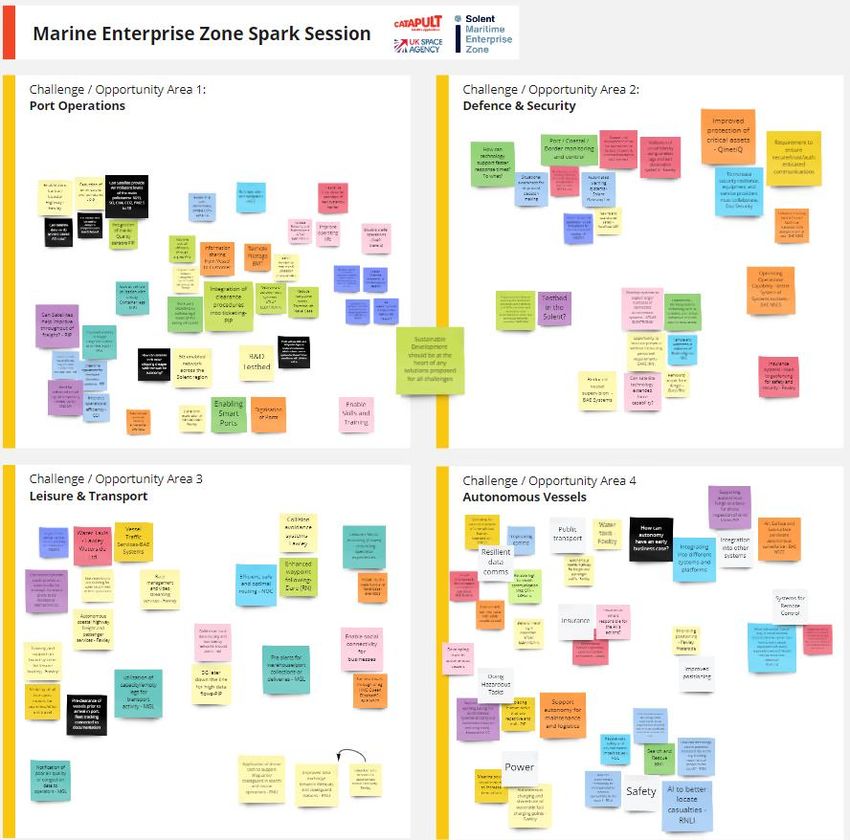
Catapult Open

Contents
Executive Summary                    3
Introduction                         4-5
Overview                             6-9
Thematic Opportunities               10-18
Ideas Developed                      19-27
Relevant Ongoing Activities          29-30
Recommendations                      31-33
Annex 1 – Organisations Attended     34
Annex 2 – Research Document          35-39
Annex 3 – All Ideas Developed        40-45
Annex 4 – Miro Virtual Whiteboards   46

                                                             2
Catapult Open
Executive Summary
On December 15th 2020 a Spark Session was carried out by the Satellite The session was attended by over 50 organisations from a wide range of cross-
Applications Catapult in partnership with the Solent Maritime Enterprise Zone sector organisations including representatives from the Royal Navy, Solent LEP,
and South Coast Centre of Excellence supported by the UK Space Agency. Industry, Small and Medium Enterprises, academia, local government, not for
profit/ charities and a range of space technologists.
This workshop explored opportunities for satellite technology to address
connectivity and autonomy challenges in areas highlighted by the maritime The list of participating organisations can be found at Annex 1.
community as being of strategic importance. These areas were:
Participants brainstormed multiple ideas for new opportunities before
Port Operations choosing six high impact ideas to develop in more detail. These ideas were:
• Smart sensors to monitor cargo condition and flow
• Secure communications network around a dockyard/ port
Defence & Security • Sat nav / sensors to reduce cargo congestion around ports
• Satellite & 5G to enhance ship to ship comms for situational awareness
• Autonomous vessel patrols in high-risk areas
Transport & Leisure • Structured trial zone for testing of autonomous systems
Autonomous Vessels
3
Catapult Open

Introduction                                                                                      Identify                 Outline

The Spark Programme                                                                              Challenges              Capabilities

The Satellite Applications Catapult (SAC) is a part government funded not-for-
profit technology and innovation organisation, created to grow the UK space
sector. As part of a programme of work funded by the UK Space Agency, SAC                                      Brainstorm
is conducting a series of Spark Sessions across the UK. These sessions are                                    Opportunities
designed to identify high value opportunities for space technology in areas of
strategic regional importance.

Sectors and groups of regional priority have been identified through SAC’s
Regional Centres of Excellence in Satellite Applications, and key stakeholders
from these groups have been brought together in order to plan and deliver
each spark session.
                                                                                                                Prioritise

Before a Spark Session takes place, research is conducted within areas of
interest to identify and validate topics that are of most interest. Based on this
research the SAC team prepares a series of examples of relevant satellite
capability which is presented on the day. Following that presentation, the                                    Develop Ideas
Spark Session encourages participants to generate ideas for how satellite
technology can address key challenges. These ideas are then prioritised, and
those that emerge as being of most interest are developed in more detail in
order to outline a plan of action to make them happen.
                                                                                                               Create Plan
The value of Spark Sessions comes not only from the ideas taken forward on
the day, but in the awareness raising of communities around the value that
satellite technology can bring, and in building momentum toward a larger
programme of future collaboration and long-term innovative solution
development.                                                                                                                            4
Catapult Open

Introduction
The Solent Maritime Enterprise Zone
The Solent Maritime Enterprise Zone (MEZ) consortium was established in                           This Connected and Autonomous Maritime initiative aims to generate activity
December 2019 and is founded on industry, SME, government, academia and                           within the region and connected regions to provide a sharp focus on the
the Royal Navy, partnering and collaborating to tackle regional and national                      enabling capabilities required to tackle the key challenges across the maritime
maritime issues in order to address the needs of the future maritime                              sector- Digitisation, Decarbonisation, People. Digitalisation and connectivity,
generation and deliver solutions of mutual benefit. Working in unison with                        data management, use of automation and autonomous vessels, new and
the Solent LEP, Maritime UK Solent and other partnerships, the Solent MEZ is                      emergent technologies around the Smart and Net Zero ports and ships, and a
an umbrella organisation which provides the energy and leadership to position                     skilled workforce able to increase productivity through embracing these
the Solent as the centre of excellence for maritime research, innovation,                         advances will all be considered through a series of use cases. Collaboration,
education, skills and training.                                                                   R&D, and optimising the use of space and other technologies will be at the
                                                                                                  centre of this initiative.
The Solent MEZ INSPIRED* agenda is cross-cutting and directly supports the
delivery priorities of the Solent 2050 and Maritime 2050 strategies, permitting
the consortium to drive forward an enterprise approach addressing key
themes such as maritime skills, autonomy, and sustainability through the
‘Clean Maritime Plan’, while placing emphasis on green technology and
unmanned systems.

Connect. Collaborate. Deliver.
Increasing in influence, the Solent MEZ consortium connects networks
regionally and nationally, collaborates on key maritime initiatives, and delivers
to support the maritime sector in its broadest sense. It will partner with other
regions, maritime clusters, and cross-sectors to benefit Solent maritime
businesses and institutions.

 *INSPIRED – Innovation & Technology; Skills, Careers and Apprenticeships; Prosperity & Growth, Infrastructure Development; Research and Academia; Enterprise Approach; and Development
 of the Coastal Estate and Renaissance of Coastal Communities.
                                                                                                                                                                                          5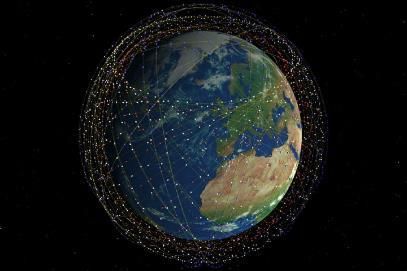
Catapult Open

Overview
Research Approach
Following a series of discussions with key stakeholders within the Solent MEZ,             Autonomous:
the areas where satellites were seen to have the highest potential to bring                • Uncrewed vessels.
cross cutting value to the region were defined broadly as Connected and                    • Continuous capability.
Autonomous Maritime.                                                                       • Data can be gathered in a more carbon neutral, cost effective way.
                                                                                           • Networks of multiple Maritime Autonomous Systems (USVs, UUVs & UAVs)
In order to better understand the opportunities within this topic and validate               operating together to provide a coherent tactical picture and to extend
its interest, a survey was designed and delivered to key MEZ stakeholders. The               force projection of the UK armed forces.
response highlighted the different topics, priorities and technologies that the            • Autonomous systems are also being explored to provide improved
various stakeholders considered to fall under connectivity and autonomy. As                  protection of critical assets – for instance ports or critical infrastructure.
an example, responses to the question “What does Connected and                             • The concentration of autonomous systems companies in the region
Autonomous Maritime mean to your business?” responses can be summarised                      supports our activity to attract foreign direct investment and provides
as follows:                                                                                  opportunities for economic growth.

Connected:                                                                                 The top answers to the question “What top three problems could ‘Connected
• Geographically, digitally and socially.                                                  and Autonomous Maritime’ help you solve?” were:
• Readily available, live data that provides full situational awareness of                 1. Improving safety/reducing risk to personnel
  shipping, factors such as weather, cargoes, pilot and tug availability, security         2. Improving efficiency and extending capability
  warnings and updates to enable more efficient management of                              3. Reductions in carbon emissions (2050 net zero carbon)
  operations/logistics, enhanced capability and improved safety.
• Increases the potential for the sharing of information, technology and skills.           These survey responses were analysed and synthesised in order to highlight
• Enhanced interoperability between systems.                                               challenges that could be used to identify relevant technological capabilities
• Seamless transfer of large volumes of sensitive data from/to deployed                    and applications of satellites. The thematic areas of interest that emerged
  maritime platforms (allowing evidence-based decision making to deliver                   from this research then enabled distinct categories to be created into which
  the mission).                                                                            participants could be split for idea generation.
• Connected socially - support local initiatives and enjoy close working
  relationships with whole maritime sector.                                                A full copy of research can be found in Annex 2.                                6
Catapult Open

Overview
Thematic Areas
                                                                                           In order to achieve even higher engagement and further verify the challenges
The thematic areas that emerged through synthesising the research were as
                                                                                           within the thematic areas, a virtual whiteboard was created and shared which
follows:
                                                                                           invited participants to add their own challenge areas to the themes outlined.
                                                                                           This approach enabled a greater number of responses and helped to gain a
Port Operations
                                                                                           better understanding of high priority and cross cutting challenge areas.
• Improving operational efficiency and increasing throughput of freight (e.g.
  vessel movement forecasts)
• Reduction of emissions and pollutants (e.g. improving air quality)
• More efficient logistics supply chain management (e.g. smart and
  connected ports)

Defence and Security
• Improved situational awareness for enhanced decision making
• Reduction of human interventions for improved human safety
• Enhancing capabilities and resilience of existing platforms

Leisure and Transport
• Connectivity and management of private vessels at sea and in harbour
• Enabling public transportation services (e.g. autonomous water taxis)
• Connectivity in public spaces (e.g. esplanades)

Autonomy
• Better positioning
• Better comms systems
• Integrating platforms due to different providers                                                                                                      Screenshot from
                                                                                                                                                        virtual Challenge
                                                                                                                                                        Capture Board
                                                                                                                                                                            7
Catapult Open
Overview
Technological Context
The maritime sector is poised to take advantage of these technological
The satellite sector is undergoing transformational changes, leading to a
developments, however the key to successful technology development is early
greater amount of accessible data, higher spatial resolutions, lower latency
identification of the challenges it helps us address.
communications, automated analytics and diversified business models.
Whilst the Satellite Applications Catapult is working at the forefront of these
technologies, it is the end user communities who will drive innovation.
Huge investment by satellite operators in communication systems are seeing
the growth of new satellite mega-constellations promising high bandwidth,
It is in the context of this new ubiquitous connectivity landscape that we
low latency, secure communications that will rival current fibre options and
explore opportunities for Connected and Autonomous Maritime.
disrupt the communications market. The UK Government has recently
acquired OneWeb, which promises to deliver a UK sovereign communication
and navigation capability expected to begin supporting service delivery within
the next five years.
As 5G rolls out across the UK, developments are being made on the hardware
and software with the capability to seamlessly switch between modes of
communication, from cellular, to satellite, to low power wide area networks
such as those used for the Internet of Things.
Source: RR and VTT Future Bridge
Meanwhile developments in AI and Machine Learning are enabling data
processing and analysis on unprecedented scales and speeds, leading to fast
evolving capabilities of autonomous systems to make quick decisions in place
of human operators. This provides an opportunity for reduced risk, reduced
cost, increased efficiency in operations across numerous sectors.
As the cost of new hardware goes down and available coverage goes up, we
find ourselves entering a new era of ubiquitous connectivity, enabling new
autonomous, connected, and smart systems never-before possible. 8Catapult Open
Overview
Structure of the Day
In order to further develop prioritised ideas, groups were asked to answer the
The Spark Session was conducted fully virtually using a combination of Zoom
following questions:
and Miro. Miro is an online collaborative whiteboard tool that enables
multiple users to contribute to shared virtual space.
1. Describe the current context (what is happening right now and why is this
a problem?)
The day was structured in order to remind participants about the aims and
2. Describe the opportunity (what would you like to happen? What value
objectives, review the challenges that had been identified, present satellite
would this bring?)
capabilities, and then develop ideas for new opportunities.
3. Outline the technical solution (what is required and how might it be
used?)
The approach taken has ben developed and delivered by SAC over several
4. How do we go from today to a solution? (what steps are required and
years to enable and encourage a collaborative approach to innovation across
who needs to be involved?)
wide groups of stakeholders. Participants are split into groups based on
5. How might this be funded? (are there any ongoing initiatives that this
shared areas of interest, given an opportunity to brainstorm individually based
could link into?)
on the capability presentation they will have just seen, and then encouraged
6. What are the next steps? (who should take them?
to discuss and cluster their ideas into groups and themes. Once discussed,
these ideas are then voted on based on agreed prioritisation criteria, such as:
The session conducted on the 15th of Dec had roughly 50 attendees and was
• Highest value
conducted from 9:30-15:30.
• Biggest impact
• Quick wins
What follows in the report is a summary of the ideas that were developed as
• Links to ongoing initiatives
part of the brainstorming, and a write-up of the ideas that were developed in
more detail.
Once ideas have been prioritised, groups will then focus their attention on
refining the top one or two ideas in order to better understand the
Annex 3 of this document contains a list of all ideas developed, and Annex 4
opportunity, the requirements, and develop high level actions as next steps.
contains screenshots of the Miro boards created on the day
Co-creating strategies for idea development can build commitment between
participants and a shared sense of ownership which can be a driver for
implementation. 9Catapult Open
Port Operations
Opportunity Summary
Improving
Enhanced vessel
Air quality Operational
information & Smart Port
measurement & efficiency and
clearance Development
carbon reduction improving freight
procedures
throughput
Enhanced flexible resilient
Increasing
situational Increasing reliability communication
Autonomy
awareness Networks
10Catapult Open
Port Operations
Top Ideas Summary
Satellite navigation Use satellite air Using sat-comms
Using smart sensors
and communication quality and 5G for seamless
to monitor
to track cargo flow measurements to handover of ship,
condition and
to reduce verify reported port crew, and
position of cargo
congestion emissions passenger comms
Top Voted Ideas Top Voted Ideas
Create secure and
Automated change Realtime ship-ship Use sat-comms and resilient comms
detection for port & ship-shore route 5G to prevent network across a
operations for 24/7 exchange for communication dockyard for
alerts & awareness optimised routing black spots reliable
communications
Top Voted Ideas
11Catapult Open
Defence & Security
Opportunity Summary
Autonomy to
Enhanced Improved resilience Optimising
increase presence
Situational and protection of operational
whilst decreasing
Awareness assets capability
risk to lives
12Catapult Open
Defence & Security
Top Ideas Summary
Solutions to allow Satellite connected
Satellites to support
seamless switching AI to monitor Satellites to provide
maintenance
of autonomous shipping low latency comms
platforms for on-
vessel to transit movements to for tactical
demand information
between comms detect anomalous operations
access
modes behaviour
Top Voted Ideas Top Voted Ideas
Satellite comms to
Satellites to Review of standards Satellite monitoring
support operation
enhance the trust to encourage to improve
and integration of
and assurance in innovation to meet identification of
medium / large
autonomous emerging emissions to meet
autonomous vessels
systems requirements targets
into fleet activities
13Catapult Open
Transport & Leisure
Opportunity Summary
Traffic management
Autonomous Public 5g networks and
& operational
Transport local data routing
efficiency
Improved safety Route mapping and
systems collision avoidance
14Catapult Open
Transport & Leisure
Top Ideas Summary
Monitoring cargo
Satellites & 5G to Automated vessel
from source to port Use of sat-comms
enhance personal reporting enabled
across all transport to improve links
communication by sat-comms to
modes to reduce between different
capability whilst reduce
paperwork modes of transport
travelling miscommunications
requirements
Top Voted Idea
Sat-comms and IoT Installing GNSS
to enable reference station to
autonomous improve location-
vessels operating based service
24-hour passenger performance in
and freight services Solent area
15Catapult Open
Autonomous Vessels
Opportunity Summary:
Resilient data Vessels and systems Improved Systems for remote
communication for hazardous tasks positioning control
Integration into Exploring insurance
Public transport Safety services
other systems and responsibilities
16Catapult Open
Autonomous Vessels
Top Ideas Summary:
High bandwidth low
Use sat-comms &5G Autonomous Autonomous
latency comms to
to share intel vessels to conduct vessels to patrol
control vessels to
between ships to fishery protection high risk safety
conduct remote
enhance safety patrols areas
inspections
Top Voted Ideas
Trial zone for AI to analyse data
Sat-comms and R&D to assess
autonomous from multiple
earth observation capabilities of
systems to develop sources to assess
for enhanced autonomous
technology and disasters for
situational systems to perform
operating improved rescue
awareness rescue operations
frameworks outcomes
Top Voted Ideas
17Catapult Open
Summary of Top Ideas
Create secure and resilient
Satellite navigation and Using smart sensors to Use of sat-comms to improve
comms network across a
communication to track cargo monitor condition and links between different
dockyard for reliable
flow to reduce congestion position of cargo modes of transport
communications
N.B. Though top voted, this idea was not
evolved further during the afternoon session
Solutions to allow seamless Satellite connected AI to Trial zone for autonomous
switching of autonomous monitor shipping movements Autonomous vessels to patrol systems to develop
vessel to transit between to detect anomalous high risk safety areas technology and operating
comms modes behaviour frameworks
N.B. This idea evolved into Satellite and 5G N.B. Though top voted, this idea was not
to enhance ship to ship communications evolved further during the afternoon session
Top Voted Ideas
18Catapult Open
Idea Development
Congestion reduction using smart sensors
The Challenges
• Congestion can be caused by several reasons: • This may also create potential to redirect assets to a less busy port to
• Limited berth capacity enable faster throughput.
• Limitations of physical port capacity, reliant on road and rail network • Robust tracking systems would ensure provenance of cargo and provide
• Anchorage due to changing weather conditions tampering monitoring. A digital passport could provide accurate
• Berth scheduling software/booking system do not account for any information on perishables and interference.
disruptions, data integration is limited, lack of transparency for users.
• There is a lack of real-time accurate data including environmental The solution
conditions • Smart port framework with integration aligned to smart infrastructure
• Robust and resilient communication is needed to share positions of assets utilising multisensory networks and a central user platform.
(vessels, lorries, trains). • Create an integrated port/traffic management system similar with parallels
• There is a heavy reliance on manual processes if late/early disruptions to air traffic control. This would provide positioning information for every
occur. inbound truck and ship as required, allowing redirection of assets to other
ports if necessary. Combine with AI for accurate predictions on arrival times
The opportunity combining data related to VBS, weather, traffic, ship arrival, etc.
• Integrating and fusing data from current systems and technology to create a • Use mobile network application for hauliers to access and share position.
system that supports enhanced insights/efficiency and optimisation across The central system knows vehicle location and can create predictive insights
all ports. (use AIS data).
• Enabling the capture of accurate position data for all port traffic in the • Devise digital passports for cargo linked to IoT sensors for accurate tracking
supply chain (vessels, lorries, trains, etc) inc. dynamic routing for road and speedier throughput. Use to overcome customs checks and support
hauliers to reduce costs (freight delays on M27 costs more than £40m p.a. surveillance monitoring.
TfSE report on Freight Logistics) • Share and aggregate data to encourage efficiency.
• Automating systems to influence Port Traffic Management Systems and
manage/minimise damage and accidents within ports as well as costs (cont. on next slide)
associated with container use and rental.
19Catapult Open
Idea Development
Congestion reduction using smart sensors (cont.)
Roadmap How might this be funded:
• Create working group around topic • MarRI-UK Smart Ship Land Operations call
• Define use case(s) of most interest • Part of a larger SiP Wave 3 bid
• Conduct further research to understand scope of challenge • ESA Business Applications (open call if no appropriate themed call available)
• Create map of processes and timings of port operations to identify – more suitable for small feasibility elements
intervention points. • Innovate UK Smart grants
• Lobby for multi-stakeholder buy-in (e.g. land-owners (e.g. APP/PCC), • £160M for modernising ports – OSW
terminal operators, ports, hauliers, shipping lines/owners, etc) • DfT Clean Maritime demo (£20M) reduction of CO2
• Identify low-hanging fruit (e.g. data integration more immediately • Sell data to port/logistics users for recurring revenue stream
achievable than large network of IoT?) • CSR to in inc. port SH
• Identify who paying customers would be - would port users would pay for • Environmental-focused funding sources
data to improve their own operations? • Part of an extended bid process to support a grand plan funded by
• Review existing innovation projects underway/planned to see how they government.
align with this proposal
• Develop a business case for government investment similar to that of other
sectors
• Need to approach TfSE and look at potential for proposal to fit within their
projects/studies
• Need to approach DfT and Highways England as interested parties
• Need to approach Road Hauliers association/rail freight association, British UNDERPINNING TECHNOLOGY
Ports Association as potential partners. • Galileo Open Signal GNSS
• Need to identify appropriate solution providers e.g. BT, data/software • Low bit rate (LBR) terrestrial comms solution e.g. 4/5G
suppliers • LBR satcom for remote operations
• Need an MNO provider on board for app development and implementation • AI-based predictive analytics
20Catapult Open
Idea Development
Smart sensors to track sensitive cargo
The Challenge Roadmap
• Currently cargo which is susceptible to conditions of transport cannot be In order to develop this idea further research is required in order to build a
identified as fit for purpose until it has arrived at its destination. comprehensive list of use cases along with associated users. Research groups
• Where delays or diversions occur, this can have a critical impact on can be formed to start capturing end user insights, and part of the analysis
perishable goods. could be conducted by academic partners.
• Currently delays and diversions of any cargo can’t easily be tracked.
Once fundamental evidence has been captured this can be presented to key
The Opportunity stakeholders in order to set up trials with major users (such as supermarket
Creating a system that can monitor both location and condition of cargo would chain shipping in perishables, car manufacturer shipping in parts that should
within ISO containers to enable an improved line of communication along avoid vibrations). These trials will validate concept and prove value of solution
supply chains would support better planning to ensure goods are fit for
purpose and available on time at point of use. Next Steps:
• Contact KTN to explore funding opportunities
The Solution • Carry out stakeholder analysis to identify those that could be brought
Creating a system that utilises devices that can be attached to goods which together into a working group
require monitoring. Such a solution could utilise a low power network to • Re-engage Waterguard team at DE&S to provide Defence perspective.
connect multiple sensors with a single point of transmission. Sensors could be • Create working group with private sector to conduct further research and
deployed to monitor temperature, CO2 levels, humidity, vibrations and explore industry funded opportunities
location. They could detect when a container is delayed, dockside, dropped, or • Open channel of communication with KTN and professional organisation.
having its doors opened repeatedly. It is important that sensors are
monitoring continuously, though transmission of data does not need to be
continuous – it could happen upon the passing of certain gates.
UNDERPINNING TECHNOLOGY
Such a solution would enable monitoring of whole supply chain and logistics • Sensors
• Galileo Open Signal GNSS
movement in and around a port. Potential uses could also extend to insurance
• Low bit rate(LBR) terrestrial comms solution e.g. 4/5G
companies, as well logistics companies for planning and restitution.
21Catapult Open
Idea Development
Secure comms network around dockyard
The Challenge Roadmap
• Dockyards have numerous communication blackspots The first step is the creation of a working group to explore use case in more
• Next generation technology is required to support operations but limited by detail. This group would utilise a user centred approach to focus on the
site constraints identifying key issues that need to be solved and the associated data
• Existing infrastructure often prevents additional cables being types/volumes. Once done suitable technology can be identified for trialling
installed based on understood user requirements. Business case should be explored as
• Legacy systems are often incompatible with next gen tech but part of research to quantify the value that a system might bring.
perform critical functions which hinders tech refresh
• Moving objects change the structure of the environment on a This activity could align with existing ABP partnerships or ongoing dockyard
regular basis upgrade programmes.
• New builds and upgrades to existing buildings place loading on ICT
infrastructure. Next Steps:
• Key stakeholders to be brought together around opportunity
The Opportunity • Catapult to share location of 5G test beds to demonstrate current and
Design a system that utilises a combination of technologies to create a future capability.
resilient and secure communication zone within dockyards and ports. • Contact Naval base to carry out discussions about supporting/hosting trials
Wireless technologies would reduce the need for expensive fibre roll-outs. of new technology being developed.
• Invite industry to showcase capability once requirements have been
The Solution defined.
A flexible solution where various communication modes are assigned to
different types of data. These can range from open internet to secure
systems, utilising low power wide area networks where possible, whilst having
satellite backhaul in case of outage. UNDERPINNING TECHNOLOGY
• Resilient terrestrial comms solution e.g. PMR or 4/5G
• Broadband satcom backhaul for remote operations
22Catapult Open
Idea Development
Satellites & 5g to enhance ship-ship situational awareness
The Challenge Integrating AIS, radar, vision, and identification systems will allow faster than
• Poor communications from vessels to vessels and vessels to shore result in via human intervention or react suitably to allow human intervention.
lack of real-time integrated awareness of situation, environment and
enduring capabilities Roadmap
• This creates a number of safety challenges such as collision prevention • Conduct research to map all those that use the sea. eg. reaching out to
• Poor verbal communications - need auto-translation / sub-titling of even networks such as chamber of shipping, P&I clubs, leisure vessel clubs, ports,
verbal comms defence etc.
• Situational awareness essential for un-crewed or lightly crewed vessels • To deep dive into problem exploration to identify opportunity in more
essential for safety, collision avoidance, and safe automated mooring and detail.
transfer • Create framework for collaboration with multiple maritime industry/users
• For task groups it is about sustainability (endurance and shared resources) of the sea
and better situational awareness for decision making and strategy. • Explore cyber security context.
• Currently there is not enough connection /bandwidth at sea to do this as
effectively as could be. Next Steps:
• Conduct market research to identify existing solutions
The Opportunity: • Establish the commercial appetite for these developments (UK or
Utilising a combination of satellite and 5G to enhance the capability of ships to offshore?)
communicate data in order to improve situational awareness. • Speak to all shipping company’s groups (containers, leisure etc..)
Lessons learned from other industries (such as automotive) could be • Work with regulators (MCA) to enable testing and implementation of new
transferred to this area. technologies
• Talk to driverless car industry to identify transferable technology
The Solution:
A flexible and secure solution that utilises a combination of communication UNDERPINNING TECHNOLOGY
mediums to ensure that the minimum amount of data is always available, but • COTS solutions exist to switch between satcom and
with the ability to scale up to higher volumes where necessary. terrestrial networks
• Data sources exist such as radar, AIS & S-AIS. S-SAR may
be of use but delay of 8-24 hrs 23Catapult Open
Idea Development
Autonomous vessel patrols in high-risk areas
The Challenge The Solution
Regular risk analysis informs resource allocation in order to reduce response • Surface vessels - able to apply an effect, e.g. provide equipment and
time to incidents. The RNLI community of volunteers are often fixed to a communications (possible real-time medical advice, etc). Ability to
specific location and respond to low-level incidents. The nature of this transport a higher mass load that air assets.
response introduces risk to the personnel which may cause delays to • Air vessels - possible wider areas of coverage, lower payload capability,
responses to more crucial incidents. lower endurance, faster response
• Possibility of sub-surface vessels to be explored
The opportunity • Data capture, analysis, and relay required, along with sat comms links for
Responding to high-risk situations using autonomous vessels may reduce the operational resilience.
need to put human lives in danger. Utilising such autonomous systems • Use of AI and ML to identify risks, incidents to be flagged to operators
combined with communication relays may also enable faster alerting and • Distribution of data via open and accessible channels becomes the input
response to critical situations. into a remote-operations centre.
• Develop a high spec remote operating centre capable of managing multiple
By building up a clearer picture of activities through multiple data sources, a operations.
remote operation centre could be sharing information quickly to the relevant
services and deploy autonomous vessels where appropriate. This capability Roadmap
would extend the line of site beyond view and support faster response to time
critical situations. • Identifying opportunities to utilise existing solutions and capabilities
• Explore capability of machine learning to detect incidents - a survivor at
This high impact idea can support modernisation of RNLI/Coastguard activities sea, fuel spill etc.
and support integration of additional technologies into their future operating • Determine framework for collaborating across industry
model. • Bring together key stakeholders to identify appetite to participate and fund
• Build a Remote Operations Centre (MASS) – national 3rd party service
(cont. on next slide)
24Catapult Open
Idea Development
Autonomous vessel patrols in high-risk areas (cont.)
Next Steps:
• Establish focussed working groups – develop a Use Case and Business Case
• Refine and priorities key strands, to better align with key stakeholders (topic
is very board in current state)
• SAR
• Disaster Relief
• Policing
• Fishery Protection
• Decompose into elements, data capture, processing and identification, &
subsequent reactions
• Identify if there are any other similar emergency service
research/innovation being developed
• Identify technological capability and possible funding opportunities
• Identify key stakeholders for Service vs Technology options
Possible funding streams:
• Innovate UK • RNLI
• MarRI-UK • Industry links to existing
• Smart Maritime Land operations complimentary products. UNDERPINNING TECHNOLOGY
(MarRI-UK Call) • Defra, Border Force - Home Office, • Resilient GNSS
• DfT - link with MCA? JSARC, MoD? • Resilient L-band satcoms command & control
• Coastguard • Private investment. • Broadband satcoms for sensors e.g. video
• Corporate investment.
25Catapult Open
Idea Development
Trial zone for testing of autonomous systems
The Challenge • Include controllable/adjustable capability in BVLOS communications, PNT
• Trust and confidence in autonomous systems needs to be increased. and other infrastructure in order to allow different scenarios to be
Require multiple means to increase and prove concepts. experimented with and really inform the standards and regulations.
• Regulatory frameworks are not adequately identified/mature in order to • The ability to host tests on multiple sized vessels with multiple mission
support autonomous vessels and their development/adoption. expectations.
• Different standards being utilised - no uniform approach to design, build for • More resilience in PNT solution - multiple solutions (Earth Observation, PNT
autonomous vessels over comms networks, terrestrial networks)
• Review and assess current standards and protocols - lots of work
undertaken, but no default standard. Roadmap
• MARLab work being undertaken to operate autonomous vessels in UK • Engage with the funding countries/bodies in MASS
waters. • Identify potential match funding path from DFT
• MASRWG Publishing codes of conduct • Identify participating bodies in the Solent to establish facility and trade path
(with co-operating country)
The Opportunity • Potential funding routes:
• Creation of an area in the Solent to allow testing and trials of different • MASS initiative but this would require UK GOV/DFT match fund element
specific use cases as a sovereign capability. • European Defence Mechanism - development in defence and safety could
• Inform the future regulatory frameworks provide access to funding
• Identify partnering port abroad to operate autonomous vessels between, • Commercial entity funding for testing/showcasing capabilities
for instance in Canada, that would allow/prove/support the unlocking of
the commercial potential of autonomy. Next Steps:
• Solent MEZ to engage and identify the partners.
Outline the technical solution: • Clarify the commercial benefit of engagement and creation of the living lab
• Autonomy living lab based in the Solent - excite the commercial entities
• Engage with Katrina Kemp
• Research the IMO Framework - Southampton law lecturer - Robert Veal.
26Catapult Open
Technology Summary
Underpinning Technology Providers
Technology Potential providers
Galileo Open Signal GNSS Widely available/multiple vendors
Resilient GNSS Proprietary overlay to Open Signal GNSS needed
Low bit rate (LBR) terrestrial comms solution e.g. 4/5G Widely available/multiple vendors
Resilient terrestrial comms solution e.g. PMR or 4/5G Widely available/multiple vendors
LBR satcom for remote operations Multiple vendors such as Iridium, Inmarsat, Orbcom, some
LEO/IoT smallsat solutions
Broadband satcom backhaul for remote operations Multiple vendors such as Iridium, Inmarsat, OneWeb or HTS
VSAT for fixed installations
COTS least-cost comms switching solutions KVH, Global Marine Networks, Xact Technology
Voice satcoms Inmarsat, Iridium
Resilient L-band satcoms command & control Inmarsat, Iridium
AI to predict multi-modal transport movements CGI
27Catapult Open
Relevant Regional Activities
Connected Solent
AQL & Cowes Week Ltd & 1851 Trust ABP Southampton
Cowes Week Ltd, AQL and the 1851 Trust are creating a 5G ‘Connected Solent’. Installation of secure high-speed connectivity infrastructure to support usage
The high capacity connectivity will allow, amongst other things, the ability to of our Terminal Operating System (TOS) increasing our connected locations
make a crews-view of the racing accessible to the public in real-time 360 and facilitating the required management of goods across the port reducing
degrees Virtual Reality (VR). reliance of offline data and providing real time information to stakeholders.
There is a large educational potential with this concept hence the involvement Implementation of a direct integration between the TOS and Inventory Linking
of the 1851 Trust at Portsmouth who have a very successful STEMS systems making the existing process significantly more efficient; allowing real
programme. This can also be a “learn to race” platform which the e-sailing time information to be shared between all parties involved in the movement
community will likely want to get involved with. Cowes Week 2021 would be of goods; and importantly comply with the new legislation requirements for
used as the pathfinder for this project, but it would be made available for inventory linking.
other boating events in the Solent.
Smart sensors to track sensitive cargo
The infrastructure would create a 5G enabled maritime environment for the
Solent which would also enable the trialling and testing of 5G enabled
applications. With the University of Southampton, Southampton Solent National Oceanography Centre
University’s Warsash Maritime Training Centre and Marine Simulation Centre, With regard to a trial zone for testing of autonomous systems NOC have been
the National Oceanography Centre, Portsmouth University and others, and looking at ideas for an unmanned geotechnical test site as a niche but
many maritime organisations there is a real opportunity to promote important subset.
innovation in 5G for the marine industry.
Trial zone for testing of autonomous systems
The 5G modems could also be installed on the Hampshire to Isle of Wight
ferries and other operators, providing around 300Mb/s onto their vessels.
5g networks and local data routing
28Catapult Open
Relevant Regional Activities
Connected Solent
MSE UK and Connected Places Catapult Solent University
SpacePort project - SBRI Grant Funded - using geospatial data to fund Mari-UK Research - Project IGNITE (Intelligent Ship Centre) will provide a
transport challenges. It will develop advanced information services to unique MASS (Maritime Autonomous Surface Ships) testing and training
streamline supply chain logistics from the port to the city and to the facility. Solent University is the only institution worldwide with both advanced
hinterland, offering increased customer value-add whilst minimising manned model and simulation capability through the associated Class A Full
congestion and air pollution. It will align closely with existing maritime and mission simulation centre. The IGNITE project will innovatively link the
other information systems, such as ship and lorry tracking, but introduce manned model and simulation centres providing training and testing for MASS
additional tracking and geo-fixed data gathering (and associated data system. The project will enable complex simulation of real traffic interactions
analytics) to create a more integrated capability. and high-risk manoeuvring in a safe and controlled environment.
Use of sat-comms to improve links This research study will identify the needs for navigators’ education and
between different modes of transport training regarding future Remotely Controlled (RC) MASS for berth-to-berth
voyages in a combined manned and unmanned maritime environment. The
experiment/test results from Simulator/Lake (Scenario Runs) will be the key
Congestion reduction using smart sensors source to explore training/learning needs, for example practitioners’
behavioural changes in new environment, knowledge gap linked to technology,
and practical approaches to ensure continuing professional development
• KTN – Decarbonising Ports and Harbours Innovation Network (advisory (CPD) for an operator.
group, briefing note and Innovation Exchange challenges).
• MarRI-UK Flagship Programme – Zero Carbon Coastal Highway and Smart Trial zone for testing of autonomous systems
Maritime Land Operations (SMLO) Call
• Innovate UK Regional Event in March
29Catapult Open
Relevant Catapult Activities
Transport: Transitioning to Smart Ports
Seamlessly Connected Cross Catapult projects Maritime 2050
The Satellite Applications Catapult is working closely with the Connected Places We have been working in
Catapult and DfT Maritime to identify the key requirements necessary as we collaboration with strategy
Transitioning to Smart Ports to deliver an industry validated definition and policy makers to develop
and blueprint for the UK Ports of the Future. a 2050 vision focused on
smart ports specifically.
As an island nation, ports are critical for the UK to remain competitive in global
trade. Ports are essential multi-modal transport hubs, vital to the effectiveness
and resiliency of our national logistics networks and supply chains, and to the This vision explores ports being digitalised via integrated services across the wider
success of the industries on which they rely. Approximately 95% of UK international supply chain and logistics system; making use of a wide range of technologies to
trade is transported through ports. As such, the efficiency and resilience of port deliver safety and efficiency improvements across the system and delivering regional
processes is of paramount importance to the national interest. benefits such as boosting productivity and growth. Our ongoing collaboration seeks
to extend our initial report, building on this vision, focussing on specific opportunities
based on validated challenges.
Our collaboration aims to:
• Develop a realistic blueprint
that takes current and
future challenges
into account
• Identify solutions that are fit
for purpose, aligned with
challenges faced
by the UK industry
30Catapult Open
Relevant Catapult Activities
Westcott & 5G
The Westcott 5G system is a fully operational private 5G & 4G network that runs on • Support for edge computing M2M applications
an open architecture which consists of • Massive device emulator
• eUICC network support
5G SDN Core • addressing the connectivity of a multitude of devices.
Software-Defined Networking (SDN) is promising to provide the technology that
provides flexible Quality of Service and very low latency. By modifying the 4G LTE Hybrid Connex project
architecture and integrating OpenFlow (SDN protocol) towards the 5G architecture, This will kick off in April and involves Westcott, Excelerate Technologies, Livewire
this new architecture promises to fulfil the requirements and to achieve better Digital and Vodafone. For this project we will be getting a fully operational Vodafone
performances while participating to the network functions virtualization. 4/5G base station and testing data transmission from an ambulance (but could be any
mode of transport) via satellite and 5G with seamless switch over between both.
The SDN Core is a practical implementation of advanced features based on the
following specifications and functionalities: OneWeb projects
• ETSI NFV MANO aligned Orchestrator integrated with OpenStack enabling the The Catapult is working closely with OneWeb to develop their PNT (Positioning
dynamic deployment and run-time management of virtual network functions Navigation and Timing) solution. It will bring 10cm accuracy positioning (GPS is 3m)
• ONF OpenFlow 1.4 aligned Switch and Controller extended to support telecom augmented with very high data through put. Ideal for automated vehicles, but also as
specific features a resilient PNT for Government , Critical National Infrastructure and Commercial
• A set of virtual network functions and their afferent adaptors based on SDN companies. Will be launched in 2022-23.
components, Open5GCore and OpenIMSCore.
The Catapult is also working with OneWeb on a study on 5G backhaul over fibre. This
MTC will allow base stations in more remote places and eliminate the need to connect a
The 5GMTC software toolkit addresses the needs of M2M communication services base station to a fibre network – quite an advantage in your neck of the woods.
within highly heterogeneous and dynamic environments. It provides the extension of
the 5G networks towards securely connecting many IoT devices. OneWeb and LEO constellations in general are going to bring very low cost and huge
• Connectivity control and subscription management data throughput that will out-perform fibre broadband and possibly even compete
• Secure ownership bootstrapping with 5G.
• Support for secure network islands
31Catapult Open
Recommendations
The ideas outlined in detail represent one part of the broader opportunity • Conduct deeper dive study to understand key requirements for idea and
highlighted in the workshop to utilise advanced connectivity and autonomy to map technology landscape in order to create clear use cases.
make high impact improvements and optimisations across the range of • Use cases should have
maritime focus areas. • Real-world scenarios of use with an understanding of how key
stakeholders currently operate
That they were voted on by workshop participants to be explored in more • Identification and understanding of challenges faced by current
detail indicates a willingness from the community to pursue and engage in approaches
next steps. While each concept has its own set of specific next steps to follow, • Information on impact of challenges (economic, environmental, or
there are some cross cutting approaches to continued engagement that this social)
report recommends. • Proposed service journey of how technological solutions could
address key challenges
• Primarily this report should be fed back to participants in order to capture • Assessment of impact of proposed interventions.
any further feedback or input. • Utilise use cases to run cost benefit analysis on ideas
• Participants should be asked explicitly which ideas they would be interested • Secondary prioritisation can then be based one:
in being involved with, as well as any other stakeholders who should be • Outputs of the cost benefit analysis
included in the creation of primary working groups. • Resource availability
• Working group meetings should then be set in order to capture further • Continued stakeholder engagement
detail on how ideas outlined link to ongoing initiatives and determine • Utilise research to create a proposal that can be shared with academic
development routes. institutions and industry in order to find delivery partners for project
• Technology demonstrations supported by the SAC should occur across opportunities and unlock funding (either industry or grant funded).
working groups based on underpinning capabilities outlined in this report. • In parallel with this work, a review should be carried out of the broad list of
• Initial opportunity prioritisation based on: ideas generated to identify opportunities for development that aligns with
• Stakeholder engagement other ongoing initiatives and activities.
• Funding landscape / opportunities
• Perceived impact
32Catapult Open
Recommendations
Key Contact Details
Below are specific Catapult / MEZ / CoE team members specialising in technology and
market areas relevant to those outlined in this report.
Solent MEZ
Allan Youp Captain RN | Head of the Solent Maritime Enterprise Zone
Allan.Youp149@mod.gov.uk
South Coast Centre of Excellence in Satellite Applications
Louise Butt, Business Development Manager
Louise.butt@port.ac.uk
Satellite Applications Catapult
Joel Freedman, Regional Innovation & Design Lead
Joel.freedman@sa.catapult.org.uk
Gemma Ball, Transport Lead Business Manager
Gemma.Ball@sa.catapult.org.uk
Gary Wade, Satellite Solutions Architect (Sat Comms focus)
Gary.wade@sa.catapult.org.uk
33Catapult Open
Annex 1: Attendee List
Organisations Registered
ABP Southampton Maritime Digital Hub
Airbus Maritime UK
AQL MarRI-UK
Atlas Elektonik UK Meachers Global Logistics
AutoNaut USV MSE UK
BAE Systems NLA Ltd
CGI National Oceanography Centre
DP World Southampton Ocean Infinity
DSTL Portsmouth City Council
Eazi Security Portsmouth International Port
Portsmouth University
Fawley Waterside
QinetiQ
Griffon Hoverworks
Red Funnel
Hampshire County Council
RNLI
Hawkrose
Rosacom
High Q Systems
Royal Navy (DARE, Navy X and Digital - Project Nelson)
HMNB Plymouth
Satellite Applications Catapult
HMNB Portsmouth Seabot XR
IBM UK Serco Marine Services
Inmarsat Solent LEP
KBR Wyle Solent MEZ HQ
KTN Solent University
L3 Harris University of Portsmouth
Lloyds Register University of Southampton
Lockheed Martin UK University of Southampton
34Catapult Open
Annex 2: Research Document
Stakeholder Engagement
35Catapult Open
Annex 2: Research Document
Stakeholder Engagement
36Catapult Open
Annex 2: Research Document
Stakeholder Engagement
37Catapult Open
Annex 2: Research Document
Stakeholder Engagement
38Catapult Open
Annex 2: Research Document
Stakeholder Engagement
39Catapult Open
Annex 3: All Ideas Developed
From Breakout groups
PORT OPERATIONS
Ideas Votes
Use technology to better understand cargo flow so that a port knows exactly when a truck or train will be dropping off/collecting a container and the exact position it needs to be
delivered to, so that port efficiency can be maximised 3
Improved visibility of freight congestion either at or near a port 1
Use Satellite Nav to look at vehicle utilization with empty Container legs, to reduce port side congestion improve air quality and reduce operational cost 2
Use AI/ML/DL to establish ‘what good looks like’ in some aspect of port operations so that operational manpower can be reduced, or efficiency improved
Use a system to account for and locate personnel on ship to reduce risk to life 1
Use satcom and on-board 5G to affect a seamless handover of ship, crew and passenger comms on arrival at a port so that user experience can be maximised 2
Use satcom to provide resilience to critical port operations so that comms are always guaranteed
Use smart sensors to monitor conditions of cargo and track through journey to ensure cargo sensitive to environment is fit for purpose on arrival 6
Use Satellite AQ data to verify reported port emissions so that there is a level competitive playing field. 1
Use of alt mediums (IoT, 5G etc) to provide secure communications & data bearer(s) across a disparate site -
Use of satellite tech to create a network across a dockyard to provide robust, secure and reliable communications - 4
help to increase generation capability of ships / vessels
Use satellite communications and geolocated data to make informed realworld decisions so that ports can measure and monitor more accurately. 2
measurement of cargo (stored / recorded more accurately)
Bringing in all data sets to successfully run a port is currently a tricky task. Port integrated Planning Landside and Marine integration.
How do we develop Cheap/Viable, detailed Satellite data enabling automatic change detection for port operations. Alerting 247 us to changes, security risks, product movements
& many more. 3
Autonomous, speedy and regular capture and upload of geospatial data (sat/drone) to enable the remote running of day to day port operations.
Drones are being used well now across industry for a lot of purposes (asset inspection are well proven). Can satellite provide a valid alternative.
Use Sat Comms Terminals to create a mesh network on a ship so that freight can be monitored at all times -
Use Sat Comms and position data to optimise and synchronise Port Calls to that ships steam more efficienlty (Decarbonisation) -
Use Sat Comms for real-time ship-to-ship and ship-to-shore route exchange so that routening can be optimised 1
Use reliable Sat Comms to enable remote piloatge so that pilot reosurces can be utilsied more efficiently - Lars
Use sat comms and other available arguably more 'off the shelf 4g/5g solutions' to prevent black spots around the port and port infrastructure 2
40Catapult Open
Annex 3: All Ideas Developed
From Breakout groups
DEFENCE & SECURITY
Idea Votes
Situational Awareness 2
Use: overhead imagery, To: monitor port and local maritime activity, So that safety, security and situational awareness can be managed - 2
Use data fusion to add value to EO data with vessel data, so that vessel monitoring is improved.
Use Satellite SAR in conjunction with other data sources eg AIS to improve PORT SA and security. 1
Use satellite connected platforms and AI to monitor shipping movements so that anomalous behaviour can be identified and autonomous systems can be tasked
to improve SA and response. – 5
Use platforms of opportunity to deploy sensors so that situational awareness is imporved -
Support the battlefield 1
Use sat based surveillance to support naval battlespace picture provision so that a greater fidelity of information & data can be provided to operators - 1
Use Sats to support tactical operations, so that low latency data can be provided to operators 1
Use Sat data/comms to support operations of Medium & large autonomous vessels so that such vessels are closely connected to the wider battlespace provisions
- Nick Young 1
Use space navigation and localisation to develop autonomous (above or below water) platforms for RN re-supply Tony Dawe 1
Environmental
Use low latency communications to integrate ships sensors and PORT SA and PORT operations Models to optimise ship and materiel movement to meet NZ
targets.
Use renewables (solar and wind) in ports to generate alternative fuels (hydrogen and ammonia) for maritime - (move from diesel to ammonia).
Use Space monitoring to improve identification emissions to enable ports to meet NZ targets 1
Maintenance and Safety
Use satellite monitoring of traffic to aid colregs compliance of USVs so they can be operated safely in the Solent area - 1
Use satellite assets to support autonomous resupply to reduce crewed vessels and improve safety
Use satellites to assist with information acquisition in relation to SOLAS incidents. Track personnel in water/imagery of incidents
Use sats to support platform maintenance activities so that material states can be maintained live for operators - Nick Young 2
41You can also read


