Control-Based 4D Printing: Adaptive 4D-Printed Systems
←
→
Page content transcription
If your browser does not render page correctly, please read the page content below
applied
           sciences
Review
Control-Based 4D Printing: Adaptive
4D-Printed Systems
Ali Zolfagharian 1, * , Akif Kaynak 1 , Mahdi Bodaghi 2 , Abbas Z. Kouzani 1 , Saleh Gharaie 1
and Saeid Nahavandi 3
 1    School of Engineering, Deakin University, Geelong 3216, Australia; akaynak@deakin.edu.au (A.K.);
      abbas.kouzani@deakin.edu.au (A.Z.K.); s.gharaie@deakin.edu.au (S.G.)
 2    Department of Engineering, School of Science and Technology, Nottingham Trent University,
      Nottingham NG11 8NS, UK; mahdi.bodaghi@ntu.ac.uk
 3    Institute for Intelligent Systems Research and Innovation (IISRI), Deakin University,
      Geelong 3216, Australia; saeid.nahavandi@deakin.edu.au
 *    Correspondence: a.zolfagharian@deakin.edu.au

 Received: 7 April 2020; Accepted: 22 April 2020; Published: 26 April 2020

 Abstract: Building on the recent progress of four-dimensional (4D) printing to produce dynamic
 structures, this study aimed to bring this technology to the next level by introducing control-based 4D
 printing to develop adaptive 4D-printed systems with highly versatile multi-disciplinary applications,
 including medicine, in the form of assisted soft robots, smart textiles as wearable electronics and
 other industries such as agriculture and microfluidics. This study introduced and analysed adaptive
 4D-printed systems with an advanced manufacturing approach for developing stimuli-responsive
 constructs that organically adapted to environmental dynamic situations and uncertainties as nature
 does. The adaptive 4D-printed systems incorporated synergic integration of three-dimensional
 (3D)-printed sensors into 4D-printing and control units, which could be assembled and programmed
 to transform their shapes based on the assigned tasks and environmental stimuli. This paper
 demonstrates the adaptivity of these systems via a combination of proprioceptive sensory feedback,
 modeling and controllers, as well as the challenges and future opportunities they present.

 Keywords: control-based; 4D-printing; adaptive; 4D-printed systems

1. Introduction
     The market share of additive manufacturing (AM) in the global industry continues to grow,
reaching $7 billion USD in 2017 and estimated to hit $33 billion USD by 2023 [1]. Three-dimensional
(3D) printing technology has introduced new pathways to create objects with complex geometries one
layer at a time. This method has several advantages over traditional manufacturing processes such as
faster production, unrestricted design, ability to incorporate multiple materials into a single item in a
single step fabrication process with a reduced cost and waste [2]. However, 3D printing is yet to evolve
to produce intricate dynamic structures with controllable dimensions. Assembling stimuli-responsive
materials, including polymers, hydrogels, alloys, ceramics and composites, and incorporating their
functions inside a single printed construct has recently emerged under the label of four-dimensional
(4D) printing. The fourth dimension refers to the dynamic response of the 3D-printed structure in
response to a controlled stimuli such as ohmic parameters (current and voltage), water (absorption),
heat (pre-strain), electromagnetic radiations (infrared), magnetic field and pH. The 4D printing can
biomimic natural processes in self-constructing structures in automotive and aerospace industries,
drug delivery and medical devices, soft robotics and other engineering applications [3–10].

Appl. Sci. 2020, 10, 3020; doi:10.3390/app10093020                               www.mdpi.com/journal/applsci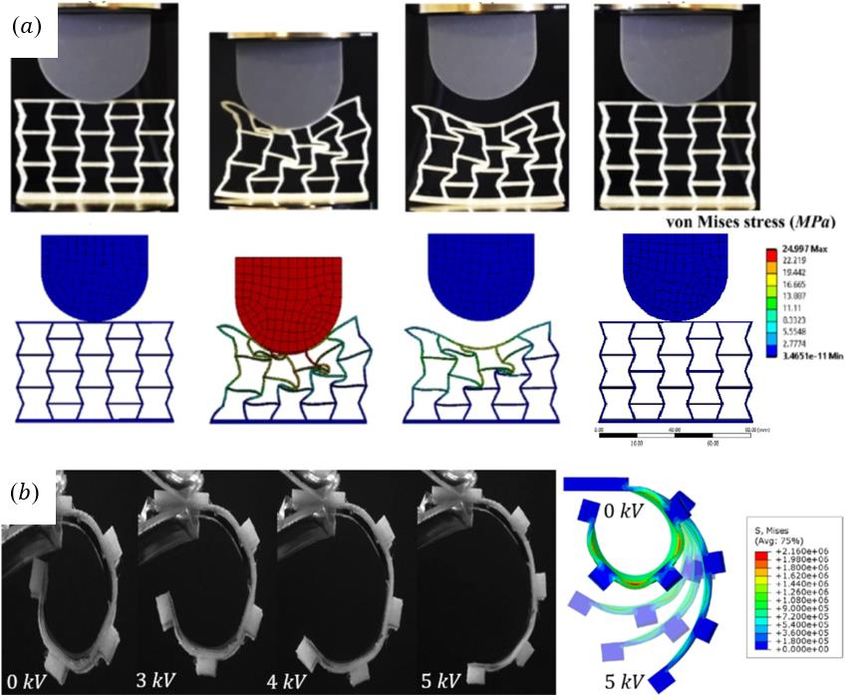
Appl. Sci. 2020, 10, 3020                                                                                              2 of 19

      Almost all of the current 4D-printed constructs solely respond to external stimuli with little
adaptability to dynamic changes and uncertainties [11]. However, control-based 4D printing
enables adaptive time-dependent spatio-temporal regulation in response to external stimuli while
the 4D-printed systems interacts with uncertain environments [12–14]. Schematic diagrams of
control-based 4D printing in adaptive 4D-printed systems are presented and discussed here with
diverse applications as shown in Figure 1. These systems were developed by adding 3D-printed
sensors into 4D printing, monitored by a controller. In other words, the adaptive 4D-printed systems
consist of three components, namely, 3D-printed funcational layers, including embedded sensors and
actuators and a controller. Indeed, there are modules required as peripheral and interfaces such as
stretchable electronic networks boards [15–17] and 3D-printed batteries [17–20] that have already been
broadly investigated and reported [6,17,21].
      Controllable shape-changing 4D-printed systems have potential applications in tissue engineering
to improve the functionality of the generated tissue [22–24]. Currently, an external mechanical stimuli,
e.g., strain, is applied to the cells’ seeded scaffold in a bioreactor. However, this could be achieved
by 4D printing the scaffold, made from shape-memory polymers with intrinisically mechanical
stimulus [22–24]. In chemotrapy, there is a high risk of inefficient treatment and a high risk of side
effects when the drug is released in unintended organs and sites of the body [25]. Adaptive 4D-printed
systems could be utilized in such scenarios to control the drug release to reach the intended site based on
specific environmental circumstances [24]. Bandgapping a certain frequency region [26] and absorbing
the energy of metastructures are also prospective applications of adaptive 4D-printed structures via
control-based 4D printing [27]. Soft robotics is another interesting application where the adaptability
of 4D printing can be utilized to print and control constructs for grasping, sorting and handling frail
objects. Such systems could be used in regulating the fluids in microfluidics, as 4D-printed valves
and pumps [28].
           Appl. Sci. 2020, 10, x FOR PEER REVIEW                                                            3 of 19

           Figure
      Figure      1. Some
              1. Some       applicationsofofthe
                         applications        theadaptive
                                                 adaptive four-dimensional
                                                          four-dimensional (4D)-printed systems.
                                                                             (4D)-printed        The images
                                                                                            systems.        from from
                                                                                                     The images
           top right  to  bottom  are reproduced     from  [29] with the permission  of the  MDPI, [30] with
      top right to bottom are reproduced from [29] with the permission of the MDPI, [30] with the permission  the
           permission of the RMIT University Research Repository; Reproduced with permission from [31],
      of the RMIT University Research Repository; Reproduced with permission from [31], Copyright Elsevier,
           Copyright Elsevier, 2015; [32] with the permission of the MDPI.
      2015; [32] with the permission of the MDPI.
     2. Controllable 4D-Printed Systems
          One of the early representations of controllable 4D-printed systems was brought about by
     embedding off-the-shelf flexible sensors into 3D-printed fluidic actuators [7]. Subsequently,
     conductive hydrogel inks were developed as tactile and force sensors to measure the external load
     on a 4D-printed pneumatic actuator [33]. The flexible sensors were designed based on the resistive
     principle and were utilized to measure and control the bending angle of a 4D-printed pneumatic
     actuator [34]. Ionic polymer–metal composites (IPMCs) have also been utilized as both sensors and
     actuators in 4D-printed systems [35–37]. A controllable 4D-printed paper was recently fabricated by
     a composite polylactic acid (PLA)–graphene filament. The system used a resistive heating element as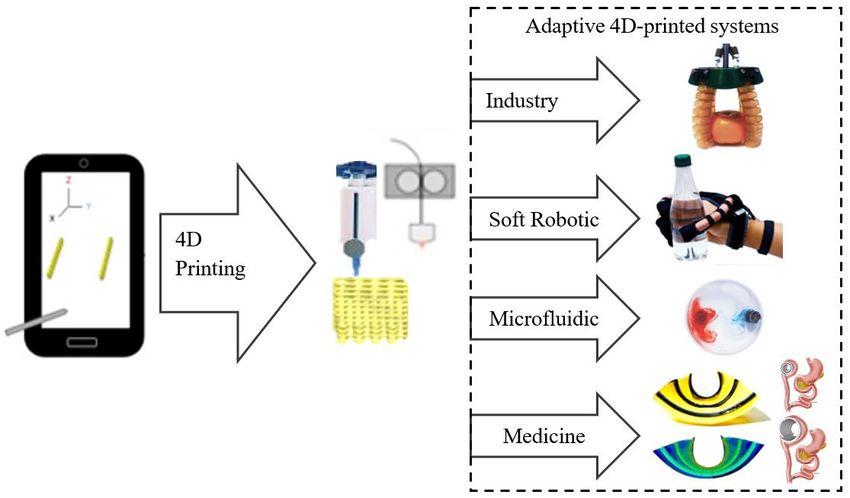
Appl. Sci. 2020, 10, 3020                                                                            3 of 19

     This paper consists of four sections as follows: the introduction of adaptive 4D-printed systems
and the various methods to incorporate control strategies into 4D printing is described in Section 2. It is
followed by analysing the integration of 3D-printed sensors into 4D printing in Section 3. This section
explores different types of sensors that could be used in control-based 4D printing to provide the
proprioceptive and environmental feedback information. In Section 4, the adaptive 4D-printed systems
design is explained. Section 5 concludes the paper by presenting the challenges and future opportunities
of these systems.

2. Controllable 4D-Printed Systems
      One of the early representations of controllable 4D-printed systems was brought about by
embedding off-the-shelf flexible sensors into 3D-printed fluidic actuators [7]. Subsequently, conductive
hydrogel inks were developed as tactile and force sensors to measure the external load on a 4D-printed
pneumatic actuator [33]. The flexible sensors were designed based on the resistive principle and
were utilized to measure and control the bending angle of a 4D-printed pneumatic actuator [34].
Ionic polymer–metal composites (IPMCs) have also been utilized as both sensors and actuators in
4D-printed systems [35–37]. A controllable 4D-printed paper was recently fabricated by a composite
polylactic acid (PLA)–graphene filament. The system used a resistive heating element as an actuator
and electric potential as a sensor [38].
      There have been some advances in the application of controllable 4D-printed systems in the
biomedical sector. A 4D-printed system was developed to measure real-time blood pressure and the
release of a drug in a controlled manner [39]. A 4D-printed artificial skin was made of thermo-responsive
ionic hydrogel which used the capacitive principle for sensing and fiber enlargement as actuation [40].
A combination of poly (D-lactide) (PDLA) and polycaprolactone (PCL) was used to 4D print a
biodegradable and biocompatible smart stent [41]. The PCL was used to fabricate an airway stent
using the melt streolithograpy (SLA) technique. The stent shape was designed according to a patient’s
tracheobronchial track and delivered in its temporary state. An educated approach for the PCL
molecule weight selection was used to control the shape-memory behavior of PCL including the strain
fixity rate and the strain recovery rate. Once it was implanted the stent was thermally actuated and
recovered to its original shape (set shape memory) providing structural support and preventing the
trachea from collapsing.
      In tissue engineering, the mechanical stimulus of cell-seeded scaffolds plays a key role in cell
proliferation and differation processes [42], in which a biroreactor is required to apply the mechanical
forces. However, by the 4D printing of shape-memory polymers (SMPs) based scaffold, the mechanical
forces are applied by the time-controlled deformation of SMPs due to an external stimulus such as
thermal radiation. The effectiveness of this concept was investigated using shape-memory polyurethane
to fabricate 3D scaffolds [22]. It was shown that such a technique has a clear effect on cell alignment
and could be a robust alternative to bioreactors in tissue engineering.
      The controllable 4D-printed system found a novel application in soft robotics manufacturing
through an embedded 3D-printed sensor [43]: a liquid conductor printed as tactile sensor channels
to measure the amplitude and location of external forces. Machine-learning (ML)-based control
algorithms were developed and applied to enhance the autonomy of 4D-printed soft robots in the
assigned tasks [44]. A fusion of different sensors was co-printed in a single step to enable 4D-printed
systems with the adaptation to external stimuli. To achieve this, a composite of thermoplastic
polyurethane and carbon black was printed by the fused deposition modeling (FDM) as pressure and
position sensors operated based on a piezo-resistive principle in a 4D-printed pneumatic actuator [44].
      Not all the 4D-printed systems developed thus far have relied on sensory feedback information
to function. There have been recent developments of 4D-printed compliant mechanisms, including
bi-stable and multi-stable designs, utilizing passive sensing instead of integrated sensors [12,45–47].
These prototypes use stimuli-responsive materials, including liquid crystalline elastomers, conductive
polymers and hydrogels and shape-memory polymers (SMPs), [3,6,48–55] to react to environmental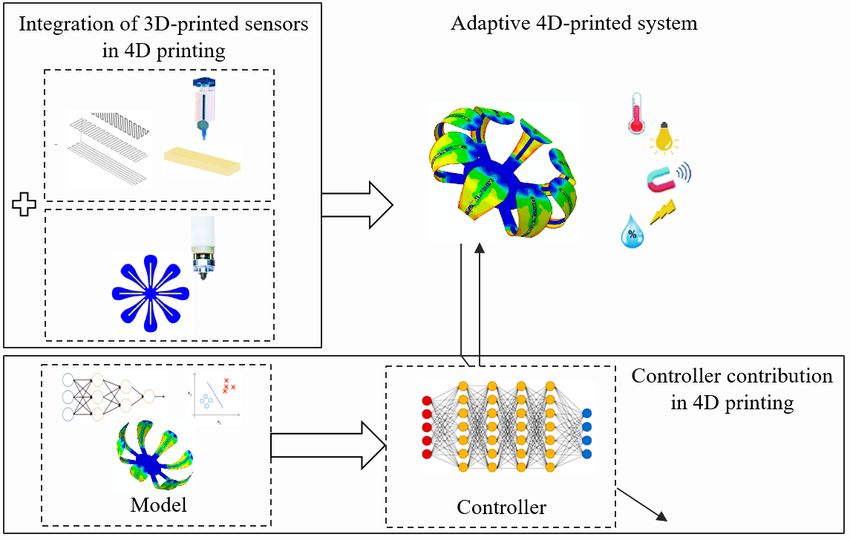
Appl. Sci. 2020, 10, 3020                                                                               4 of 19

stimuli changes with a higher sensitivity and response time compared to the integrated sensor
systems [34,56,57]. The sensitivity of the snap-through energy of these mechanisms could be controlled
by specific features of 3D printing [27,34,58]. In addition to these printed tunable parameters,
a bistable shape-memory strip was also developed exhibiting thermally sensitive volume changes
to the surrounding. Various configurations of these constructs resulted in multi-trigger multi-state
mechanisms [59]. A programmable, reversible and rapid buckling-induced 4D-printed active skin was
developed, that could be controllably actuated in response to uniaxial tensile loading [60].
      Variable stiffness is another recently developed technique for controlling the compliance of
4D-printed systems by heterogeneous SMPs. In other words, the adjustable stiffness of these structures
introduces passive sensing that regulates the stiffness of the body according to environmental variations,
e.g., humidity and temperature. A sweating actuator was 4D-printed by poly-N-isopropylacrylamide
(PNIPAm) and covered with a microporous polyacrylamide (PAAm) dorsal layer. This system operates
based on thermoregulation, that is, below the glass transition (Tg ) temperature the pores are sealed
and the actuator is rigid, while above Tg, the dilation of the pores causes the sudden decrease in
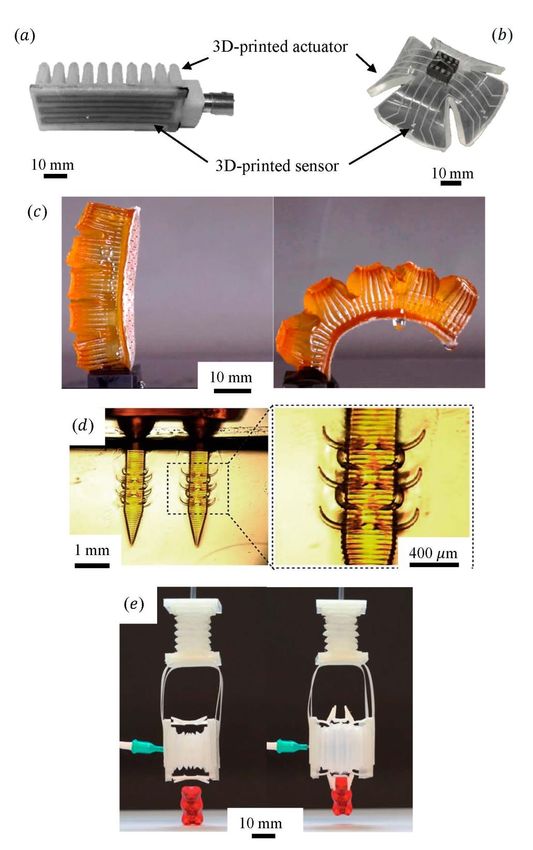
stiffness to soften the stiffness of the fluidic elastomeric actuator [61] (Figure 2c). Bioinspire microneedle
arrays with backward barbs were 4D-printed to provide the more sustained use of minimally invasive
microneedles for drug delivery and biosensing applications [62]. The 4D-printed system is privileged
for the light sensitive barbs that adjust their stiffness based on the environmental changes, for pain-free
and ease-of-use functions.
      The autonomous adjustment of materials’ stiffness could be implemented through various
techniques, including thermal stiffness control, acoustic-based control, jamming-based control
either in pneumatic or fluidic medium, and electrically or magnetically viscosity-based control [63].
These techniques have shown a great compliance control in enabling the manipulation and grasping of
fragile objects [64]. A finger-like soft actuator was 4D-printed using a dielectric elastomer (DE) with an
FDM-based 3D printer. The system was modeled via the finite element model (FEM) and used as a soft
         Appl. Sci. 2020, 10, x FOR PEER REVIEW                                                         5 of 19
robotics gripper [65].

                                               Figure 2. Cont.
Appl. Sci. 2020, 10, 3020 5 of 19
Figure2.2.Controllable
Figure Controllable4D-printed
4D-printed systems (a) A
systems (a) Acombined
combinedsensor
sensorand
and3D-printed
3D-printed pneumatic
pneumatic muscle
muscle
(reproduced
(reproducedfromfrom[66]
[66]with
withthe
the permission
permission ofof Frontier
Frontierunder
underCreative
Creative Commons
Commons CC-BY
CC-BY licence);
licence); (b) (b)
AnAnembedded
embeddedpiezoelectric
piezoelectric sensor
sensor in the hydrogel
in the hydrogelactuator
actuator(reproduced
(reproduced [67]
[67] with
with thethe permission
permission of of
SPIE);
SPIE);(c)
(c)AAsweating 4D-printedsystem
sweating 4D-printed system with
with thermoregulation
thermoregulation pores
pores (reproduced
(reproduced fromwith
from [61] [61]the
with
the permission
permission of of
TheThe American
American Association
Association forfor
thethe Advancement
Advancement of of Science);
Science); (d)(d)
TheThe 4D-printed
4D-printed
bioinspired
bioinspired microneedles
microneedleswithwithstiffness
stiffnesscontrol (reproduced
control (reproduced from [62]
from with
[62] thethe
with permission
permission of John Wiley
of John
and Sons);
Wiley and(e)Sons);
A buckling-induced 4D-printed
(e) A buckling-induced active skinactive
4D-printed (reproduced from [60] with
skin (reproduced fromthe[60]permission
with the of
permission
the of the Nature
Nature Publishing Publishing Group).
Group).
3. Integration of 3D-printed Sensors into 4D Printing
The key to developing adaptive 4D-printed systems is to add 3D-printed sensors into 4D printing,
which require feedback information, including mechanical motions and deformations and other
environmental measurements to realize their environmental interactions. Thus, the 4D-printed system
should be equipped for various physical and mechanical properties measurements such as stress,
strain, deformation and acceleration to send the required proprioceptive feedback information to the
controller unit upon environmental changes. However, the main challenge is to preserve the balance
between the conformity of the system and the accuracy of the sensros. The recent progress in the
development of functional materials and 3D-printing technology offered accessability to a broad range
of sensors with high flexibility and customisation to be integrated into 4D-printed systems for specific
uses. In this section, the different types of sensors and sensing principles, which could be employed
for prospective applications in adaptive 4D-printed systems, is discussed.
3.1. Mechanical Motion and Deformation Measurements
Various thermoplastic materials, such as thermoplastic polyurethane (TPU) and polylactic acid
(PLA), have been utilized in mixed form with conductive fillers and liquid metals, such as carbon
black (CB) [68] and eutectic gallium−indium (EGaIn) [34], to develop strain sensors. These strain
gauge sensors were 3D-printed based on the piezo-resistive or capacitive principles. The pressure
variation resulting from geometrical changes generates signals indicating measures such as mechanicalAppl. Sci. 2020, 10, 3020 6 of 19
deformations including compression, extension, bending and twisting [69,70]. The 3D-printing sensor
industry has utilized the electrical conductivity enhancement through the introduction of conductive
fillers such as graphene, but such sensors may suffer from degradation or stress–strain hysteresis
issues related to conductive materials. This led to a new field of investigations in 3D-printed fibre
optic sensors with a direct application in 4D-printed systems because of being lightweight, transparent
and inexpensive [71]. Three-dimensional-printed displacement sensors, based on the Hall effect and
Eddy-current principles, were fabricated to remotely identify mechanical motions [72]. The higher
switching rate, more design flexibility and the wider range of material access are prominent advantages
of this type of sensors against its capacitive and resistive counterparts. An inductance sensor was
also 3D-printed incorporating ferrofluidic and magnetic materials into the 4D-printed system at
room temperature [73,74]. The prototype demonstrated an acceptable success to measure bending as
well as axial and lateral strains. The color-based proprioception method was used for the real-time
interaction of soft actuators in an uncertain dynamics environment. A color-based sensing approach
was developed to instantly translate the dimensional change of the soft structure into changes in color
to reflect local deformations [75].
Piezoelectric sensors have also been 3D-printed with a prospect application in 4D-printed systems.
Poly(vinylidene fluoride) (PVDF) was studied as a pressure sensor with a piezo-resistive property
that could be 3D printed using electric poling-assisted additive manufacturing (EPAM) [76–80]. A
3D-printed graphite/polydimethylsiloxane (PDMS) sensor was also developed with a capability of
detecting small forces in the range 3.5–7.5 mN [81]. Fibre Bragg grating (FBG) was attached to a
3D-printed acrylonitrile butadiene styrene substrate to develop a pressure sensor [82]. Another study
demonstrated that the variable impedance properties commonly found in ionic hydrogels could be
used for pressure-sensing at a broad range of payloads [67].
Tactile sensors were integrated into 4D-printing to mimic artificial skin by sensing the stimuli
resulting from external interactions. These stimuli can be stresses and strains resulting from the
mechanical interactions or temperature of the object encountered. Recently, tactile sensors were
made from FDM 3D-printing of conductive PLA filament. [83,84]. A multiaxial force sensor was
FDM-3D-printed as a composite of TPU and carbon nanotube (CNT) with a piezo resistive surface.
Despite some hysteresis, the sensor demonstrated sensitivity to small deflections [68]. A composite of
Ecoflex and carbon nanotube (CNT) was developed via 3D printing as a flexible capacitive sensor for
tactile and electrochemical sensing [85,86]. Stretchable multi-material, functional tactile sensors were
3D-printed onto freeform surfaces [87]. A tactile proximity sensor made of a EGaIn liquid metal alloy
was 3D-printed onto a prosthetic hand for electromyography (EMG) purposes [34].
3.2. Environmental Measurements
Temperature and humidity are two essential properties to measure in 4D-printed systems
interacting with the external environment. Functional polymers, due to their variable mechanical
and electrical response to external stimuli such as humidity, temperature, pH and stress, are often
used in 4D printing. In an adaptive 4D-printed system, sensing can be done in spatial layers using
integrated sensors [88]. Electrically conductive extrudates, which contain conductive nano particles,
have frequently been used in capacitive-based sensor 3D printing for measuring humidity and
temperature [89].
Chemical sensors operating in polyelectrolyte solutions were 3D-printed, which demonstrated
reversible bending through the polarity changes of the electrode [48]. Three-dimensional printing
enabled the calibration through the monitoring of electrolyte ion concentrations. There are also some
studies on FDM-printed graphene-based PLA electrodes for electrochemical sensing purposes [90,91].
A conductive composite of PVDF and the multi-walled carbon nanotube (MWCNT) was prepared
as the filament feed for the 3D printing of a chemoresistive sensor responsive to volatile organic
compounds [92]. The 3D-printed sensor could have applications in adaptive 4D-printed systems in
rescue and mine missions. A biological tissue-compatible pH sensor was 3D-printed for wet medium softAppl. Sci. 2020, 10, 3020 7 of 19
robotics applications. The sensor was demonstrated as operational under cyclic torsional and bending
stresses and was made from hydrophilic polyurethane and poly(3,4-ethylene dioxythiophene) [93].
Biocompatible hydrogel sensors were also successfully 3D-printed for drug release and medical
diagnostic applications [94–97]. The material properties, geometry and dimensions of the print played
a significant role in the performance of the sensors in the adaptive 4D-printed systems to produce a
detectable response (Table 1). Each approach of embedding sensors has advantages and disadvantages.
These are discussed in detail in earlier papers [4,98].
Table 1. Sensors integration into 4D printing.
Proprioceptive
Sensors Type Mechanisms 3D Printers Materials Applications
Feedback
Capacitive [99] Extrusion Ionic gel
Stress Optical FBG [82] FDM ABS
Piezoelectric [80] EPAM PVDF
Capacitive [100] Extrusion Silicone Grasping
Mechanical
Strain Optical waveguide [101] FDM OrmoClear Tracking
Motions and
Resistive [102] FDM TPU Holding
Deformations
Measurements Eddy current [103–105] FDM ABS/Copper Manipulation
Displacement Hall effect [72] FDM ABS/Magnetite
Optical waveguide [106] Inkjet InkEpo/InOrmo
Piezo-resistive [68] FDM TPU/CNT
Tactile
Capacitive [107] FDM TPU
Bioluminescent [94] FDM ABS/PLA
Bio Electrochemical [108] SLA PEGDA
Vibratory [109] DLP Bisphenol
Detection
Environmental Chemoresistive [92] FDM PVDF/MWCNT Classification
Measurements Chemical Electrochemical [91] FDM PLA/Graphene Adaptation
Optical waveguide [110] SLA Accura® 60
Humidity Solvatochromic [88] Extrusion Cu(II)–Thymine
Temperature Capacitive [111] DLW Nanocrystals
4. Adaptive 4D-Printed Systems Design
The synergic integration of the main components to develop adaptive 4D-printed systems are
explained in this section (Figure 3). In addition to the incorporation of 3D-printed sensors and 4D
printing, controller units are required to command the necessary input to the 4D-printed system based
on the acquired information. The 4D-printed systems developed so far are mainly reliant on the
morphology of soft materials rather than the sophisticated control methods. However, considering
the potential exposure to a wide range of dynamic environments, 4D-printed systems demand more
robust controllers, particularly in highly sensitive tasks.
A closed-loop controller for the 4D-printed soft robots was recently introduced in order to
improve the performance of the soft robots [112]. The active control of 4D prints was achieved
by combining the 3D-printed shape-memory polymer composites with a controller that regulated
power input to the composite in order to manipulate the material’s heating behavior, considering the
variations in resistance caused by the changes in strain or temperature [113]. However, the dynamic
modeling of such systems was not simply due to their non-linear behavior, infinite degrees of freedom,
hyperelasticity, heterogeneous materials properties and hysteresis [114]. In other words, predicting
the motion of the actuators based on the input-stimuli could not readily be calculated via the inverse
kinematics equations used in the rigid bodies such as the Cosserat rod theory [115] beam theory [116]
and constant curvature model [117] methods, because of the computational expenses and steady state
assumptions [118]. Therefore, machine-learning methods could be an appropriate choice to realise
adaptive 4D-printed systems [119].The synergic integration of the main components to develop adaptive 4D-printed systems are
explained in this section (Figure 3). In addition to the incorporation of 3D-printed sensors and 4D
printing, controller units are required to command the necessary input to the 4D-printed system
based on the acquired information. The 4D-printed systems developed so far are mainly reliant on
the morphology of soft materials rather than the sophisticated control methods. However,
Appl. Sci. 2020, 10, 3020 8 of 19
considering the potential exposure to a wide range of dynamic environments, 4D-printed systems
demand more robust controllers, particularly in highly sensitive tasks.
Figure 3.
Figure 3. Adaptive
Adaptive 4D-printed
4D-printedsystems
systemscomposition.
composition.
ToAequip
closed-loop controllersystems
the 4D-printed for the with
4D-printed
adaptivesoftcontrollability
robots was recently
required introduced in order
for real-world to
dynamic
improve the performance of the soft robots [112]. The active control of 4D prints was
variations, ML algorithms are suitable solutions due to recent advancements in nonlinear systems achieved by
combining
modeling the 3D-printed
[120–122]. The shape-memory
finite element polymer composites
model (FEM) with a controller
is employed to trainthat
theregulated power to
ML algorithm
input to the composite in order to manipulate the material’s heating behavior, considering
effectively calculate volumetric properties such as spatially heterogeneous mechanical strengths, the
variations in resistance caused by the changes in strain or temperature [113]. However,
variable stiffness and the targeted anisotropy during the 4D-printing process. Further, the controlthe dynamic
modeling of such systems was not simply due to their non-linear behavior, infinite degrees of
algorithms will be developed and incorporated into the 4D-printing platform to compute the precise
freedom, hyperelasticity, heterogeneous materials properties and hysteresis [114]. In other words,
actuation signal to adapt to the uncertain and dynamic environments [123–126]. However, closed-loop
predicting the motion of the actuators based on the input-stimuli could not readily be calculated via
controllers are preferred here to make the most of the integrated 3D-printed sensors in handling
the inverse kinematics equations used in the rigid bodies such as the Cosserat rod theory [115] beam
uncertainties for wide frequency bandwidths [122,127–130]. Indeed, in order to increase the efficiency
theory [116] and constant curvature model [117] methods, because of the computational expenses
ofand
control strategies
steady in terms of[118].
state assumptions time and computational
Therefore, costs, model-based
machine-learning methods could MLbe[131] in conjunction
an appropriate
with self-learning controllers [132,133] are preferred
choice to realise adaptive 4D-printed systems [119]. compared to the model-free controllers to deal
with the complexity involved in diverse scenarios [66,129,134–136]. A forward dynamics model using
recurrent or convolutional neural networks could be employed to implement a model-based feedback
controller for an adaptive 4D-printed system [137]. Then, a policy-based reinforcement-learning
feedback controller can be used to learn the nonlinear model of a 4D-printed soft robot through
experiments and simulation data to compensate for the uncertainties. The self-learning algorithms play
a significant role in adaptive 4D-printed systems to optimise the controller commands based on the
information acquired from the interaction with the environment via the 3D-printed sensors [138–142].
Model-based ML algorithms, however, require a large pool of data containing different scenarios
of environmental changes to be trained to represent the 4D-printed system model with time-variable
properties and multi-dimensional control states [143,144]. The training process could be repetitious
and expensive if it merely relies on experimental tests, therefore, the FEM (Figure 4) can be used in
the offline loop for constructing a comprehensive and reliable model exploring the various possible
scenarios [143–149].Appl. Sci. 2020, 10, 3020 9 of 19
Appl. Sci. 2020, 10, x FOR PEER REVIEW 10 of 19
Figure 4.
Figure 4. Finite
Finite element
element model
model (FEM)
(FEM) of
of 4D-printed
4D-printed systems
systems (a)
(a) A reversible energy
A reversible energy absorbing
absorbing
metastructure (reproduced from [27] with the permission of Elsevier); (b) A dielectric elastomer (DE)
metastructure (reproduced from [27] with the permission of Elsevier); (b) A dielectric elastomer (DE)
soft gripper
soft gripper (reproduced
(reproduced from
from [65]
[65] with
with the
the permission
permission of
of Elsevier).
Elsevier).
Recent advancements Table 2. Studies toward
in control-based 4Dadaptive
printing4D-printed systems. the sensors, ML models
with integrating
trained by FEM results and controlling the entire 4D-printed systems are gathered in Table 2. To the best
Refs. 4D Printing Equipped with Sensors Controller FEM
of the knowledge of the authors, there has yet to be an entirely adaptive 4D-printed system, as defined
[34] ✓ ✓
in this paper. However, there are some promising studies in integrated 3D-printed sensors in 4D
[66] ✓ ✓
printing [7,16,38–40,67,150], the application of the FEM [151] and ML-based controllers in 4D-printed
[75] ✓ ✓
systems [34,66,135]. These relevant research results support the possibility of realizing the proposed
[135] ✓ ✓
adaptive 4D-printed systems.
[56] ✓ ✓
[57] ✓ ✓
[61] ✓ ✓
[63] ✓ ✓
[65] ✓ ✓
[152] ✓ ✓
[153] ✓ ✓
[7] ✓
[16] ✓
[38] ✓
[39] ✓
[40] ✓
[67] ✓
[150] ✓Appl. Sci. 2020, 10, 3020 10 of 19
Table 2. Studies toward adaptive 4D-printed systems.
Refs. 4D Printing Equipped with Sensors Controller FEM
[34] X X
[66] X X
[75] X X
[135] X X
[56] X X
[57] X X
[61] X X
[63] X X
[65] X X
[152] X X
[153] X X
[7] X
[16] X
[38] X
[39] X
[40] X
[67] X
[150] X
Additionally, there have been several studies on the design and fabrication of 4D-printed
compliant mechanisms promoting controlled self-management and self-actuation without needing
sensors [34,56,63,152–154]. Further investigations on equipping such mechanisms with controllers to
provide more flexibility and adaptability are envisaged, allowing for their wider ranges of autonomous
operations. It is interesting to note that, there have been only a few studies on the use of the FEM to
design and optimize controllers in 4D-printed systems. This will certainly increase the robustness and
repeatability of 4D-printed systems in diverse applications with variable unstructured environments.
5. Discussions and Future Perspectives
The three-dimensional printing of sensors and actuators have provided a new platform for
developing mass-customized systems with autonomous capabilities owing to recent advancements
of ML-based control algorithms. This paper has proposed and discussed the new technology of
adaptive 4D-printed systems which are printed systems that incorporate 3D-printed sensors and
control algorithms and programmed to handle delicate tasks in dynamic environments.
It was emphasized that the synthesis and processing of stimuli-responsive materials played a
key role for the development of entirely adaptive 4D-printed systems. The recent advancements
of 3D-printed sensors for measuring feedback including mechanical motions and deformations as
well as physical and chemical proprioceptive information and their specific applications to adaptive
4D-printed systems were discussed. ML-based control algorithms were suggested and reviewed to
compensate for the uncertainties pertaining to 4D-printed systems, which originated from non-linear
mechanical characteristics and the viscoelastic nature of soft polymeric materials. Although there are
materials available to achieve adaptive 4D-printed systems, there is a scope for further investigations
on 3D-printable mechanochromic materials that exhibit variable mechano-responsive properties
in different environmental conditions. Moreover, promoting the further applications of adaptive
4D-printed systems in key industries, such as automotive, agriculture and aerospace, demands
stimuli-responsive and printable materials with a high thermal and chemical stability to function
in corrosive, high-temperature and high-pressure, harsh environmental conditions. Piezoresistive
and piezoelectric materials, such as PVDF, have exhibited suitable characteristics for integrated
sensors and actuators. However, further investigations are required to enhance their printability and
piezoelectric performances.Appl. Sci. 2020, 10, 3020 11 of 19
Four-dimensional printing provides a situation for using a random and/or free source of energy
in nature to make non-random structures [155]. Studies have shown that energy consumption in
4D printing is the least of all manufacturing processes [14]. Four-dimensional printing could utilize
abundant biodegradable materials in nature, for example, chitin from fisheries and cellulose from plants
as the most abundant and broadly distributed natural materials in the ecosystem [48]. The current
4D-printed systems do not possess adaptability and longevity and hence are not environmentally
friendly. However, the proposed adaptive 4D-printed systems aim to produce systems with a good
stability and repeated use, benefiting from the recyclability and low carbon footprint of bio and organic
stimuli-responsive polymers.
There is still more demand for developing the multiphysics simulation and control platforms for 4D
printing to accelerate and support the practical applications of adaptive 4D-printed systems in diverse
environmental interactions [156–158]. The reversible multi-stable compliant mechanisms should be
incorporated into 4D printing as sensorless adaptive 4D-printed systems [159]. Four-dimensional
printing is often accompanied by considerable bending that may lead to the rupture of particularly soft
materials. Therefore, the development of self-healing and shape-changing materials can be one of the
future directions of development. The amphibian 4D-printed systems with the adaptability to operate
in various ambiances is another direction of future research [160].
They are still unsolved problems in practical applications of 4D-printed systems, particularly
in the high-frequency bandwidth in terms of control complexities. Hence, embedding the controller
in the volumetric pixel (voxel) performing as the controller unit with zero-lag feedback based on
the morphological properties could be promising approach for faster and intuitive control. Another
approach could be the optimal placement of sensors and actuators via 3D printing as voxel arrays to
significantly impact controller performance.
The 4D-printed systems scalability is another focus of the research due to the challenges associated
with making microscale features, like channels and voids [161]. Miniaturizing 4D-printed systems to
include millimetre-sized features with an adaptability to dynamic environments open new applications
of these products in microfluidics and cells manipulations. This requires further study on the materials
aspect of 4D printing, for enhancing the controlled morphological performance of stimuli-responsive
polymers as both sensor and actuator units [103,162,163], whilst considering the current resolution
limits and technology of 3D printers.
6. Conclusions
Current additive manufacturing is not about producing a fully controllable dynamic product,
but mainly about intricately designed static structures. Four-dimensional (4D) printing was recently
introduced as dynamic interactive systems with limited applications. This paper introduced the
control-based 4D printing that is adaptive 4D-printed systems with the synergic incorporation of
3D-printed sensors and machine learning (ML)-based controllers into 4D printing, leading to the
harnessing of more useful applications for 4D printing in dynamic and uncertain environments.
Different types of 4D-printed systems were presented and reviewed. The integration of
three-dimensional (3D)-printed sensors into 4D printing and its applications and benefits were
discussed. The need for the development of adaptive 4D-printed systems and the techniques for
the modeling and control of them were explained. The role of the finite element model (FEM) in
developing models and designing the ML-based controllers were described. The studies towards
control-based 4D printing for realizing adaptive 4D-printed systems and their current challenges
were outlined. The necessity of adaptive 4D-printed systems and their versatile applications require
further improvements of 3D-printable stimuli-responsive materials in terms of sensitivity, strength and
stability, as well as more a precise FEM, and faster voxelized controllers based on the morphological
properties. Developing such systems will open possibilities for innovative applications in medical,
manufacturing and agricultural fields.Appl. Sci. 2020, 10, 3020 12 of 19
Author Contributions: Conceptualization, A.Z.; methodology, A.Z., M.B..; investigation, A.Z., M.B., S.G., A.K.
and A.Z.K.; resources, S.N.; writing—original draft preparation, A.Z., A.K., M.B. and S.G.; writing—review and
editing, A.K., A.Z.K., M.B., S.G. and A.Z.; supervision, A.K and S.N.; project administration, A.Z. All authors have
read and agreed to the published version of the manuscript.
Funding: This research received no external funding.
Conflicts of Interest: The authors declare no conflict of interest.
References
1. Roach, D.J.; Hamel, C.M.; Dunn, C.K.; Johnson, M.V.; Kuang, X.; Qi, H.J.J.A.M. The m4 3D printer:
A multi-material multi-method additive manufacturing platform for future 3D printed structures.
Addit. Manuf. 2019, 29, 100819. [CrossRef]
2. Zolfagharian, A.; Denk, M.; Kouzani, A.Z.; Bodaghi, M.; Nahavandi, S.; Kaynak, A. Effects of Topology
Optimization in Multimaterial 3D Bioprinting of Soft Actuators. Int. J. Bioprint. 2020, 6, 1–11. [CrossRef]
3. Zolfagharian, A.; Kouzani, A.Z.; Khoo, S.Y.; Gibson, I.; Kaynak, A. 3D printed hydrogel soft actuators.
In Proceedings of the 2016 IEEE Region 10 Conference (TENCON), Singapore, 22–25 November 2016;
pp. 2272–2277.
4. Gul, J.Z.; Sajid, M.; Rehman, M.M.; Siddiqui, G.U.; Shah, I.; Kim, K.H.; Lee, J.W.; Choi, K.H. 3D printing for
soft robotics–a review. Sci. Tech. Adv. Mater. 2018, 19, 243–262. [CrossRef]
5. Miriyev, A.; Stack, K.; Lipson, H. Soft material for soft actuators. Nature Commun. 2017, 8, 596. [CrossRef]
6. Zolfagharian, A.; Kouzani, A.Z.; Khoo, S.Y.; Moghadam, A.A.A.; Gibson, I.; Kaynak, A. Evolution of 3D
printed soft actuators. Sens. Actuators A Phys. 2016, 250, 258–272. [CrossRef]
7. Truby, R.L.; Wehner, M.; Grosskopf, A.K.; Vogt, D.M.; Uzel, S.G.; Wood, R.J.; Lewis, J.A. Soft somatosensitive
actuators via embedded 3D printing. Adv. Mater. 2018, 30, 1706383. [CrossRef]
8. Banerjee, H.; Pusalkar, N.; Ren, H. Single-motor controlled tendon-driven peristaltic soft origami robot.
J. Mech. Robot. 2018, 10, 064501. [CrossRef]
9. Cianchetti, M.; Ranzani, T.; Gerboni, G.; Nanayakkara, T.; Althoefer, K.; Dasgupta, P.; Menciassi, A. Soft
robotics technologies to address shortcomings in today's minimally invasive surgery: The STIFF-FLOP
approach. Soft Robot. 2014, 1, 122–131. [CrossRef]
10. Atalay, O.; Atalay, A.; Gafford, J.; Walsh, C. A Highly Sensitive Capacitive-Based Soft Pressure Sensor Based
on a Conductive Fabric and a Microporous Dielectric Layer. Adv. Mater. Technol. 2018, 3, 1700237. [CrossRef]
11. Bhagat, S.; Banerjee, H.; Tse, Z.T.H.; Ren, H. Deep Reinforcement Learning for Soft, Flexible Robots: Brief
Review with Impending Challenges. Robotics 2019, 8, 4. [CrossRef]
12. Tibbits, S. 4D printing: Multi-material shape change. Arch. Des. 2014, 84, 116–121. [CrossRef]
13. Momeni, F.; Sabzpoushan, S.; Valizadeh, R.; Morad, M.R.; Liu, X.; Ni, J. Plant leaf-mimetic smart wind
turbine blades by 4D printing. (in English). Renew. Energ. 2019, 130, 329–351. [CrossRef]
14. Momeni, F.; Liu, X.; Ni, J. A review of 4D printing. Mater. Des. 2017, 122, 42–79. [CrossRef]
15. Ota, H.; Emaminejad, S.; Gao, Y.; Zhao, A.; Wu, E.; Challa, S.; Chen, K.; Fahad, H.M.; Jha, A.K.; Kiriya, D.;
et al. Application of 3D printing for smart objects with embedded electronic sensors and systems. Adv. Mater.
Technol. 2016, 1, 1600013. [CrossRef]
16. Lopes, A.; Paisana, H.; de Almeida, A.T.; Majidi, C.; Tavakoli, M. Hydroprinted Electronics: Ultrathin
Stretchable Ag–In–Ga E-Skin for Bioelectronics and Human–Machine Interaction. ACS Appl. Mater.Interfaces
2018, 10, 38760–38768. [CrossRef]
17. Espera, A.H.; Dizon, J.R.C.; Chen, Q.; Advincula, R.C. 3D-printing and advanced manufacturing for
electronics. Prog. Addit. Manuf. 2019, 4, 245–267. [CrossRef]
18. Yang, H.; Leow, W.R.; Chen, X. 3D printing of flexible electronic devices. Small Method. 2018, 2, 1700259.
[CrossRef]
19. Gao, X.; Sun, Q.; Yang, X.; Liang, J.; Koo, A.; Li, W.; Liang, J.; Wang, J.; Li, R.; Holness, F.B.; et al. Toward a
remarkable Li-S battery via 3D printing. Nano Energy 2019, 56, 595–603. [CrossRef]
20. McOwen, D.W.; Xu, S.; Gong, Y.; Wen, Y.; Godbey, G.L.; Gritton, J.E.; Hamann, T.R.; Dai, J.; Hitz, G.T.; Hu, L.;
et al. 3D-Printing Electrolytes for Solid-State Batteries. Adv. Mater. 2018, 30, 1707132. [CrossRef]Appl. Sci. 2020, 10, 3020 13 of 19
21. Gao, X.; Yang, X.; Wang, S.; Sun, Q.; Zhao, C.; Li, X.; Liang, J.; Zheng, M.; Zhao, Y.; Wang, J.; et al. A 3D-printed
ultra-high Se loading cathode for high energy density quasi-solid-state Li–Se batteries. J. Mater. Chem. A
2020, 8, 278–286. [CrossRef]
22. Hendrikson, W.J.; Rouwkema, J.; Clementi, F.; van Blitterswijk, C.A.; Farè, S.; Moroni, L. Towards 4D printed
scaffolds for tissue engineering: Exploiting 3D shape memory polymers to deliver time-controlled stimulus
on cultured cells. Biofabrication 2017, 9, 031001. [CrossRef] [PubMed]
23. Miao, S.; Cui, H.; Nowicki, M.; Lee, S.J.; Almeida, J.; Zhou, X.; Zhu, W.; Yao, X.; Masood, F.; Plesniak, M.W.;
et al. Photolithographic-stereolithographic-tandem fabrication of 4D smart scaffolds for improved stem cell
cardiomyogenic differentiation. Biofabrication 2018, 10, 035007. [CrossRef] [PubMed]
24. Apsite, I.; Biswas, A.; Li, Y.; Ionov, L. Microfabrication Using Shape-Transforming Soft Materials. Adv. Funct.
Mater. 2020, 1908028. [CrossRef]
25. Li, J.; Mooney, D.J. Designing hydrogels for controlled drug delivery. Nature Rev. Mater. 2016, 1, 1–17.
[CrossRef]
26. Noroozi, R.; Bodaghi, M.; Jafari, H.; Zolfagharian, A.; Fotouhi, M. Shape-adaptive metastructures with
variable bandgap regions by 4D printing. Polymers 2020, 12, 519. [CrossRef]
27. Bodaghi, M.; Serjouei, A.; Zolfagharian, A.; Fotouhi, M.; Hafizur, R.; Durand, D. Reversible Energy Absorbing
Meta-Sandwiches by FDM 4D Printing. Int. J. Mech. Sci. 2020, 173, 105451. [CrossRef]
28. d'Eramo, L.; Chollet, B.; Leman, M.; Martwong, E.; Li, M.; Geisler, H.; Dupire, J.; Kerdraon, M.; Vergne, C.;
Monti, F.; et al. Microfluidic actuators based on temperature-responsive hydrogels. Microsyst. Nanoeng. 2018,
4, 1–7. [CrossRef]
29. Shie, M.Y.; Shen, Y.F.; Astuti, S.D.; Lee, A.K.X.; Lin, S.H.; Dwijaksara, N.L.B.; Chen, Y.W. Review of Polymeric
Materials in 4D Printing Biomedical Applications. Polymers 2019, 11, 1864. [CrossRef]
30. Thurgood, P. Self-sufficient microfluidic systems using highly porous elastomeric sponges. Ph.D. Thesis,
RMIT University, Melbourne, Australia, 2017.
31. Polygerinos, P.; Wang, Z.; Galloway, K.C.; Wood, R.J.; Walsh, C.J. Soft robotic glove for combined assistance
and at-home rehabilitation. Robot. Auton. Syst. 2015, 73, 135–143. [CrossRef]
32. Bodaghi, M.; Noroozi, R.; Zolfagharian, A.; Fotouhi, M.; Norouzi, S. 4D printing self-morphing structures.
Materials 2019, 12, 1353. [CrossRef]
33. Robinson, S.S.; O’Brien, K.W.; Zhao, H.; Peele, B.N.; Larson, C.M.; Mac Murray, B.C.; Van Meerbeek, I.M.;
Dunham, S.N.; Shepherd, R.F. Integrated soft sensors and elastomeric actuators for tactile machines with
kinesthetic sense. Extreme Mech. Lett. 2015, 5, 47–53. [CrossRef]
34. Thuruthel, T.G.; Abidi, S.H.; Cianchetti, M.; Laschi, C.; Falotico, E. A bistable soft gripper with mechanically
embedded sensing and actuation for fast closed-loop grasping. arXiv 2019, arXiv:1902.04896.
35. Carrico, J.D.; Traeden, N.W.; Aureli, M.; Leang, K.K. Fused filament 3D printing of ionic polymer-metal
composites (IPMCs). Smart Mater. Struct. 2015, 24, 125021. [CrossRef]
36. Nakshatharan, S.S.; Martinez, J.G.; Punning, A.; Aabloo, A.; Jager, E.W. Soft parallel manipulator fabricated
by additive manufacturing. Sens. Actuators B Chem. 2020, 305, 127355. [CrossRef]
37. Carrico, J.D.; Leang, K.K. Fused filament 3D printing of ionic polymer-metal composites for soft robotics.
In Electroactive Polymer Actuators and Devices (EAPAD) 2017; International Society for Optics and Photonics:
Bellingham, WA, USA, 2017; Volume 10163, p. 101630I.
38. Wang, G.; Cheng, T.; Do, Y.; Yang, H.; Tao, Y.; Gu, J.; An, B.; Yao, L. Printed Paper Actuator: A Low-cost
Reversible Actuation and Sensing Method for Shape Changing Interfaces. In Proceedings of the 2018 CHI
Conference on Human Factors in Computing Systems, Montreal, QC, Canada, 21–26 April 2018; pp. 1–12.
39. Park, J.; Kim, J.-K.; Park, S.A.; Lee, D.-W. Biodegradable polymer material based smart stent: Wireless
pressure sensor and 3D printed stent. Microelectron. Eng. 2019, 206, 1–5. [CrossRef]
40. Lei, Z.; Wang, Q.; Wu, P. A multifunctional skin-like sensor based on a 3D printed thermo-responsive
hydrogel. Mater. Horiz. 2017, 4, 694–700. [CrossRef]
41. Zarek, M.; Mansour, N.; Shapira, S.; Cohn, D. 4D printing of shape memory-based personalized endoluminal
medical devices. Macromol. Rapid Commun. 2017, 38, 1600628. [CrossRef]
42. Gaut, C.; Sugaya, K. Critical review on the physical and mechanical factors involved in tissue engineering of
cartilage. Regen. Med. 2015, 10, 665–679. [CrossRef]
43. Kim, T.; Yoon, S.J.; Park, Y.-L. Soft Inflatable Sensing Modules for Safe and Interactive Robots. IEEE Robot.
Auto. Lett. 2018, 3, 3216–3223. [CrossRef]Appl. Sci. 2020, 10, 3020 14 of 19
44. Han, S.; Kim, T.; Kim, D.; Park, Y.-L.; Jo, S. Use of deep learning for characterization of microfluidic soft
sensors. IEEE Robot. Auto. Lett. 2018, 3, 873–880. [CrossRef]
45. Choi, J.; Kwon, O.-C.; Jo, W.; Lee, H.J.; Moon, M.-W. 4D printing technology: A review. 3D Print. Addit.
Manuf. 2015, 2, 159–167. [CrossRef]
46. de Marco, C.; Pané, S.; Nelson, B.J. 4D printing and robotics. Sci. Robot. 2018, 3, eaau0449. [CrossRef]
47. López-Valdeolivas, M.; Liu, D.; Broer, D.J.; Sánchez-Somolinos, C. 4D printed actuators with soft-robotic
functions. Macromol. Rapid Commun. 2018, 39, 1700710. [CrossRef]
48. Zolfagharian, A.; Kaynak, A.; Khoo, S.Y.; Kouzani, A.Z. Polyelectrolyte soft actuators: 3D printed chitosan
and cast gelatin. 3D Print. Addit. Manuf. 2018, 5, 138–150. [CrossRef]
49. Saed, M.O.; Ambulo, C.P.; Kim, H.; De, R.; Raval, V.; Searles, K.; Siddiqui, D.A.; Cue, J.M.O.; Stefan, M.C.;
Shankar, M.R.; et al. Molecularly-Engineered, 4D-Printed Liquid Crystal Elastomer Actuators. Adv. Funct.
Mater. 2018, 29, 1806412. [CrossRef]
50. Rastogi, P.; Kandasubramanian, B. Breakthrough in the printing tactics for stimuli-responsive materials:
4D printing. Chem. Eng. J. 2019, 366, 264–304. [CrossRef]
51. Sakhaei, A.H.; Kaijima, S.; Lee, T.L.; Tan, Y.Y.; Dunn, M.L. Design and investigation of a multi-material
compliant ratchet-like mechanism. Mech. Mach.Theory 2018, 121, 184–197. [CrossRef]
52. Rothemund, P.; Ainla, A.; Belding, L.; Preston, D.J.; Kurihara, S.; Suo, Z.; Whitesides, G.M. A soft, bistable
valve for autonomous control of soft actuators. Sci. Robot. 2018, 3, eaar7986. [CrossRef]
53. Chen, T.; Bilal, O.R.; Shea, K.; Daraio, C. Harnessing bistability for directional propulsion of untethered, soft
robots. Proc. Natl. Acad. Sci. USA 2017, 115, 5698–5702. [CrossRef]
54. Zolfagharian, A.; Kaynak, A.; Khoo, S.Y.; Kouzani, A. Pattern-driven 4D printing. Sens. Actuators A Phys.
2018, 274, 231–243. [CrossRef]
55. Bodaghi, M.; Damanpack, A.R.; Liao, W.H. Triple shape memory polymers by 4D printing. Smart Mater.
Struct. 2018, 27, 065010. [CrossRef]
56. Zhang, X.; Wang, G.; Xu, Q. Design, Analysis and Testing of a New Compliant Compound Constant-Force
Mechanism. Actuators 2018, 7, 65. [CrossRef]
57. Jeong, H.Y.; Lee, E.; Ha, S.; Kim, N.; Jun, Y.C. Multistable Thermal Actuators Via Multimaterial 4D Printing.
Adv. Mater. Tech. 2018, 4, 1800495. [CrossRef]
58. Bodaghi, M.; Damanpack, A.-R.; Liao, W.-H. Adaptive Metamaterials by Functionally Graded 4D Printing.
Mater. Des. 2017, 135, 26–36. [CrossRef]
59. Chen, T.; Shea, K. An Autonomous Programmable Actuator and Shape Reconfigurable Structures using
Bistability and Shape Memory Polymers. 3D Print. Addit. Manuf. 2018, 5, 91–101. [CrossRef]
60. Park, Y.; Vella, G.; Loh, K.J. Bio-inspired Active Skins for Surface Morphing. Sci. Rep. 2019, 9, 1–10. [CrossRef]
61. Mishra, A.K.; Wallin, T.J.; Pan, W.; Xu, P.; Wang, K.; Giannelis, E.P.; Mazzolai, B.; Shepherd, R.F. Autonomic
perspiration in 3D-printed hydrogel actuators. Sci. Robot. 2020, 38, eaaz3918. [CrossRef]
62. Han, D.; Morde, R.S.; Mariani, S.; La Mattina, A.A.; Vignali, E.; Yang, C.; Barillaro, G.; Lee, H. 4D Printing of
a Bioinspired Microneedle Array with Backward-Facing Barbs for Enhanced Tissue Adhesion. Adv. Funct.
Mater. 2020. [CrossRef]
63. Taghavi, M.; Helps, T.; Huang, B.; Rossiter, J. 3D-printed ready-to-use variable-stiffness structures. IEEE Robot.
Auto. Lett. 2018, 3, 2402–2407. [CrossRef]
64. Yang, Y.; Chen, Y. Innovative design of embedded pressure and position sensors for soft actuators. IEEE Robot.
Auto. Lett. 2018, 3, 656–663. [CrossRef]
65. Zhou, F.; Zhang, M.; Cao, X.; Zhang, Z.; Chen, X.; Xiao, Y.; Liang, Y.; Wong, T.W.; Li, T.; Xu, Z. Fabrication
and modeling of dielectric elastomer soft actuator with 3D printed thermoplastic frame. Sens. Actuators
A Phys. 2019, 292, 112–120. [CrossRef]
66. Elgeneidy, K.; Neumann, G.; Jackson, M.; Lohse, N. Directly Printable Flexible Strain Sensors for Bending
and Contact Feedback of Soft Actuators. Front. Robot. AI Commun. 2018, 5, 2. [CrossRef]
67. Yoshida, K.; Takishima, Y.; Hara, Y.; Kawakami, M.; Furukawa, H. 3D printing for gel robotics. In Nano-, Bio-,
Info-Tech Sensors, and 3D Systems II; International Society for Optics and Photonics: Bellingham, WA, USA,
2018; p. 1059717.
68. Kim, K.; Park, J.; Suh, J.-h.; Kim, M.; Jeong, Y.; Park, I. 3D printing of multiaxial force sensors using carbon
nanotube (CNT)/thermoplastic polyurethane (TPU) filaments. Sens. Actuators A Phys. 2017, 263, 493–500.
[CrossRef]Appl. Sci. 2020, 10, 3020 15 of 19
69. Khosravani, M.R.; Reinicke, T. Applications of additive manufacturing in fabrication of sensors—A review.
Sens. Actuators A Phys. 2020, 111916. [CrossRef]
70. Huang, P.; Xia, Z.; Cui, S. 3D printing of carbon fiber-filled conductive silicon rubber. Mater. Des. 2018, 142,
11–21. [CrossRef]
71. Patel, D.K.; Cohen, B.-E.; Etgar, L.; Magdassi, S. Fully 2D and 3D printed anisotropic mechanoluminescent
objects and their application for energy harvesting in the dark. Mater. Horiz. 2018, 5, 708–714. [CrossRef]
72. van Tiem, J.; Groenesteijn, J.; Sanders, R.; Krijnen, G. 3D printed bio-inspired angular acceleration sensor.
In Proceedings of the 2015 IEEE SENSORS, Busan, Korea, 1–4 November 2015; pp. 1–4.
73. He, Y.; Zhou, L.; Zhan, J.; Gao, Q.; Fu, J.; Xie, C.; Zhao, H.; Liu, Y. Three-Dimensional Coprinting of Liquid
Metals for Directly Fabricating Stretchable Electronics. 3D Print. Addit. Manuf. 2018, 5, 195–203. [CrossRef]
74. Lazarus, N.; Bedair, S.S.; Smith, G.L. Creating 3D printed magnetic devices with ferrofluids and liquid metals.
Addit. Manuf. 2019, 26, 15–21. [CrossRef]
75. Scharff, R.B.; Doornbusch, R.M.; Doubrovski, E.L.; Wu, J.; Geraedts, J.M.; Wang, C.C. Color-Based
Proprioception of Soft Actuators Interacting With Objects. IEEE/ASME Trans. Mechatron. 2019, 24,
1964–1973. [CrossRef]
76. Rajala, S.N.K.; Mettänen, M.; Tuukkanen, S. Structural and electrical characterization of solution-processed
electrodes for piezoelectric polymer film sensors. IEEE Sens. J. 2015, 16, 1692–1699. [CrossRef]
77. Kirkpatrick, M.B.; Tarbutton, J.A.; Le, T.; Lee, C. Characterization of 3D printed piezoelectric sensors:
Determiniation of d 33 piezoelectric coefficient for 3D printed polyvinylidene fluoride sensors. In Proceedings
of the IEEE SENSORS 2016, Orlando, FL, USA, 30 October–3 November 2016; pp. 1–3.
78. Liu, W.; Yan, C. Direct Printing of Stretchable Elastomers for Highly Sensitive Capillary Pressure Sensors.
Sensors 2018, 18, 1001. [CrossRef] [PubMed]
79. Tseng, T.-L.B.; Akundi, A.; Kim, H. 4-D Printing of Pressure Sensors and Energy Harvesting Devices for
Engineering Education. In Proceedings of the 2018 ASEE Annual Conference & Exposition, Tampa, FL, USA,
23 June 2018.
80. Kim, H.; Torres, F.; Villagran, D.; Stewart, C.; Lin, Y.; Tseng, T.L.B. 3D printing of BaTiO3/PVDF composites
with electric in situ poling for pressure sensor applications. Macromol. Mater. Eng. 2017, 302, 1700229.
[CrossRef]
81. Nag, A.; Feng, S.; Mukhopadhyay, S.; Kosel, J.; Inglis, D. 3D printed mould-based graphite/PDMS sensor for
low-force applications. Sens.Actuators A Phys. 2018, 280, 525–534. [CrossRef]
82. Lin, Y.-K.; Hsieh, T.-S.; Tsai, L.; Wang, S.-H.; Chiang, C.-C. Using three-dimensional printing technology to
produce a novel optical fiber bragg grating pressure sensor. Sens. Mater. Corros. 2016, 28, 389–394.
83. Singh, D.; Tawk, C.; Mutlu, R.; Sariyildiz, E.; Alici, G. A 3D Printed Soft Robotic Monolithic Unit for Haptic
Feedback Devices. In Proceedings of the 2019 IEEE/ASME International Conference on Advanced Intelligent
Mechatronics (AIM), Hong Kong, China, 8–12 July 2019; pp. 388–393.
84. Shemelya, C.; Cedillos, F.; Aguilera, E.; Maestas, E.; Ramos, J.; Espalin, D.; Muse, D.; Wicker, R.; MacDonald, E.
3D printed capacitive sensors. In Proceedings of the IEEE SENSORS, Baltimore, MD, USA, 4–6 November
2013; pp. 1–4.
85. Li, K.; Wei, H.; Liu, W.; Meng, H.; Zhang, P.; Yan, C. 3D printed stretchable capacitive sensors for highly
sensitive tactile and electrochemical sensing. Nanotechnology 2018, 29, 185501. [CrossRef]
86. Mousavi, S.; Howard, D.; Wu, S.; Wang, C. An Ultrasensitive 3D Printed Tactile Sensor for Soft Robotics.
arXiv 2018, arXiv:1810.09236.
87. Guo, S.Z.; Qiu, K.; Meng, F.; Park, S.H.; McAlpine, M.C. 3D printed stretchable tactile sensors. Adv. Mater.
2017, 29, 1701218. [CrossRef]
88. Maldonado, N.; Vegas, V.G.; Halevi, O.; Martínez, J.I.; Lee, P.S.; Magdassi, S.; Wharmby, M.T.;
Platero-Prats, A.E.; Moreno, C.; Zamora, F.; et al. 3D Printing of a Thermo-and Solvatochromic Composite
Material Based on a Cu (II)–Thymine Coordination Polymer with Moisture Sensing Capabilities. Adv. Funct.
Mater. 2019, 29, 1808424. [CrossRef]
89. Marasso, S.L.; Cocuzza, M.; Bertana, V.; Perrucci, F.; Tommasi, A.; Ferrero, S.; Scaltrito, L.; Pirri, C.F. PLA
conductive filament for 3D printed smart sensing applications. Rapid Prototyp. J. 2018, 24, 739–743. [CrossRef]
90. Palenzuela, C.L.M.; Novotný, F.; Krupička, P.; Sofer, Z.K.; Pumera, M. 3D-printed graphene/polylactic acid
electrodes promise high sensitivity in electroanalysis. Anal. Chem. 2018, 90, 5753–5757. [CrossRef]You can also read


