Endemic and endangered Short-crested Coquette (Lophornis brachylophus): floral resources and interactions - Avian Conservation and Ecology
←
→
Page content transcription
If your browser does not render page correctly, please read the page content below
VOLUME 16, ISSUE 1, ARTICLE 13
Arizmendi, M., L. Nuñez-Rosas, H. Berlanga, M. Quiroga Rodríguez, J. Soberanes González, C. Macias Caballero, R. Vidal Rodriguez, and G.
López-Segoviano. 2021. Endemic and endangered Short-crested Coquette (Lophornis brachylophus): floral resources and interactions. Avian
Conservation and Ecology 16(1):13. https://doi.org/10.5751/ACE-01834-160113
Copyright © 2021 by the author(s). Published here under license by the Resilience Alliance.

Research Paper

Endemic and endangered Short-crested Coquette (Lophornis
brachylophus): floral resources and interactions
María del Coro Arizmendi 1     , Laura E. Nuñez-Rosas 1     , Humberto Berlanga 2, Mónica A. M. Quiroga Rodríguez 1, José Manuel
Soberanes González 1, Claudia Macias Caballero 3, Rosa María Vidal Rodriguez 3 and Gabriel López-Segoviano 4
1
  Facultad de Estudios Superiores Iztacala, Universidad Nacional Autónoma de México, 2Comisión Nacional para el Conocimiento
y Uso de la Biodiversidad (CONABIO), 3Pronatura Sur A. C., 4Escuela Nacional de Estudios Superiores Campus Morelia

ABSTRACT. The Short-crested Coquette (Lophornis brachylophus) is an endangered species endemic to Mexico. Currently, its
distribution area is estimated at 53 km². Little to no information exists on its natural history, abundance, and distribution. The purpose
of the present study is to describe its food resources, behavior, and interactions with plants and other hummingbirds in addition to its
abundance and distribution along an altitudinal gradient. We found that the Short-crested Coquette is sparsely distributed and ranges
from tropical sub-deciduous forest to cloud forest. It can also occupy cultivated lands and forests with shade coffee plantations. It
moves along an altitudinal gradient following the blooming of its floral resources, similar to other hummingbird species in the study
region. It is a generalist, subordinate species that shares its distribution with 14 other hummingbird species. It interacts with some of
these hummingbirds and plants in a nested network of interactions with low levels of connectance, visiting 8 of the 23 plant species
commonly used by hummingbirds in the area. More in-depth studies on its reproduction and interaction with different plants and
important crops in the area are required. The results of the present study can be used to propose programs for the management,
conservation, or recovery of the habitats inhabited by the Short-crested Coquette and other hummingbirds.

Coquette du Guerrero (Lophornis brachylophus), espèce endémique et en voie de disparition :
ressources florales et interactions
RÉSUMÉ. La Coquette du Guerrero (Lophornis brachylophus) est une espèce en voie de disparition, endémique du Mexique. Son aire
de répartition actuelle est évaluée à 53 km². On n'en connait peu, voire pas du tout, sur ses traits comportementaux, son abondance et
sa répartition. L'objectif de la présente étude était de décrire ses ressources alimentaires, son comportement et ses interactions avec les
plantes et les autres colibris, ainsi que son abondance et sa répartition le long d'un gradient altitudinal. Nous avons constaté que la
répartition de la Coquette du Guerrero est clairsemée et s'étend de la forêt tropicale sub-décidue à la forêt brumeuse. La coquette
fréquente également les terres cultivées et les forêts comportant des plantations de café d'ombre. Elle se déplace le long d'un gradient
altitudinal en suivant la floraison de ses ressources florales, comme le font les autres espèces de colibris de la région d'étude. Il s'agit
d'une espèce généraliste et subordonnée, qui partage sa répartition avec 14 autres espèces de colibris. Elle interagit avec certains de ces
colibris et plantes dans un réseau imbriqué d'interactions à faibles niveaux de connectivité, visitant 8 des 23 espèces végétales
communément utilisées par les colibris dans la région. Il serait nécessaire de mener des études plus approfondies sur sa reproduction
et ses interactions avec différentes plantes et cultures importantes dans la région. Nos résultats peuvent servir à proposer des programmes
de gestion, de conservation ou de restauration des habitats fréquentés par la Coquette du Guerrero et d'autres colibris.
Key Words: conservation; food resources; interactions; Short-crested Coquette

INTRODUCTION                                                             Short-crested Coquette is critically endangered according to the
The genus Lophornis (10 species) belongs to the Coquettes                International Union for Conservation of Nature (IUCN) and is
phylogenetic clade (McGuire et al 2009, 2014). It is distributed         classified as endangered according to Mexican law (NOM-
principally in lowland habitats from Mexico to Central America           ECOL-059: SEMARNAT 2010). It is only known to inhabit a
and South America (Colombia, Ecuador, Peru, Bolivia, Brazil,             strip of about 25 km long between Atoyac, Paradise, and Puerto
and Argentina; Freymann and Schuchmann 2005), where the                  Gallo (Guerrero, Mexico). Birdlife International (2011) estimated
Short-crested Coquette (Lophornis brachylophus) and Black-               that its population is between 250 and 999 individuals over a range
crested Coquette (L. helenae) represent the northernmost species         of 53 km², with densities between 3.6 and 18 individuals per square
in Mexico (Schuchmann 1999).                                             kilometer and a population decline between 10% and 19% mainly
                                                                         due to habitat loss.
The Short-crested Coquette is an endemic Mexican species, and
according to McGuire et al. (2014) is considered monotypic. The          Several factors affect hummingbird species and their populations;
                                                                         however, habitat loss is one of the main problems (Lindberg and

Address of Correspondent: María del Coro Arizmendi, Facultad de Estudios Superiores Iztacala, Universidad Nacional Autónoma de México.,
Laboratorio de Ecología, UBIPRO, Av. De los Barrios 1, Los Reyes Iztacala, Tlanepantla Edo. De México, CP 54090, coro@unam.mx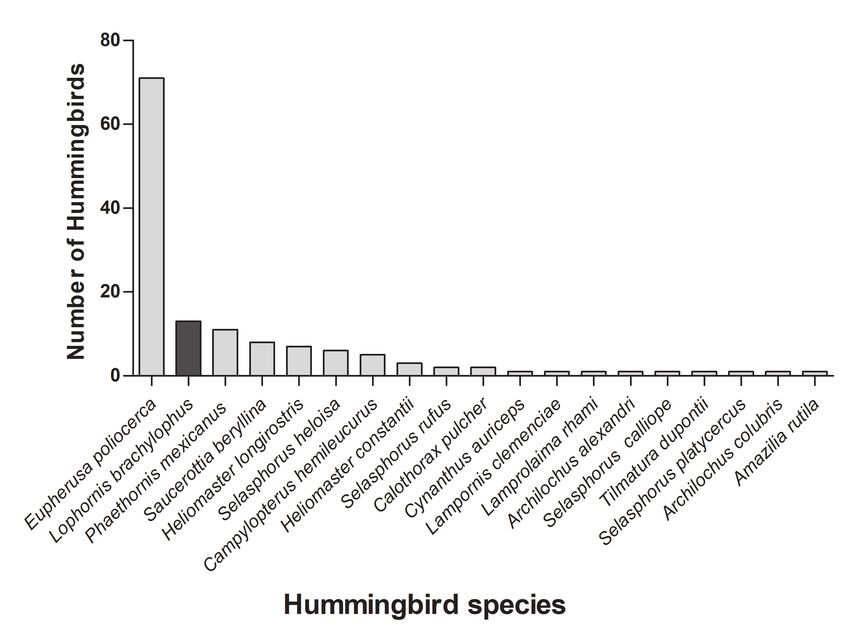
Avian Conservation and Ecology 16(1): 13
                                                                                                     http://www.ace-eco.org/vol16/iss1/art13/

Olesen 2001, Estades et al. 2007, Anderson et al. 2010, Freile et      cloud forest, cloud forest between 1400-2000 m asl, pine-oak
al. 2011, Rodrigues and Rodrigues 2011). For species restricted        forest between 2000-2600 m asl, pine forest above 2600 m asl, and
to particular areas with a low number of individuals, such as the      Abies forest above 3100 m asl (Navarro 1992).
Short-crested Coquette, the effect of habitat loss can be even more
                                                                       The study was conducted in 2011 (March, June to October) in
critical. Using potential distribution models, Sierra-Morales et
                                                                       three sites representing different habitats: Paraiso (17° 19' 57.62
al. (2016) estimated that the Short-crested Coquette has lost
                                                                       " N and 100° 10' 17.99" W) between 1000-1200 m asl with tropical
approximately 1422 km² of its potential range due to habitat loss
                                                                       deciduous forest and coffee plantations, Nueva Delhi (17° 25' 9.24
as a result of anthropogenic activities. More recently, 52% of the
                                                                       " N and 100° 11' 33.88" W) between 1200-1500 m asl with cloud
vegetation along the gradient has been lost.
                                                                       forest and coffee plantations, and El Molote (17° 25' 11.49" N and
The Short-crested Coquette is found in the Atoyac cloud forest,        100° 10' 14.01" W) between 1600-1800 m asl with cloud forest,
between semi-deciduous tropical forest and pine-oak forest. The        oak-pine forest and coffee plantations (see Appendix Table 1).
Mexican cloud forests occupy less than 1% of the territory and         Due to accessibility, climatic conditions, and social conflicts, only
host high biodiversity (CONABIO 2019, Navarro-Sigüenza et al.          six visits to each of the habitats were possible.
2014), and are the most threatened terrestrial ecosystems
nationwide (CONABIO 2019, Ornelas et al. 2013). Mexican cloud          Hummingbird surveys and distribution
forests are the most used environment for shade-coffee plantations     To determine the abundance of the Short-crested Coquette in the
(CONABIO 2019), and this is also the main economic activity at         different habitats, 52 point counts were conducted along the
the Sierra de Atoyac (González-González and Hernández-                 altitudinal gradient. Twenty point counts each in the vicinity of
Santana 2016).                                                         El Molote and Nueva Delhi's towns, and 12 points near Paraiso,
                                                                       all were separated by at least 250 m. The point counts were
The region where this species is distributed has been characterized
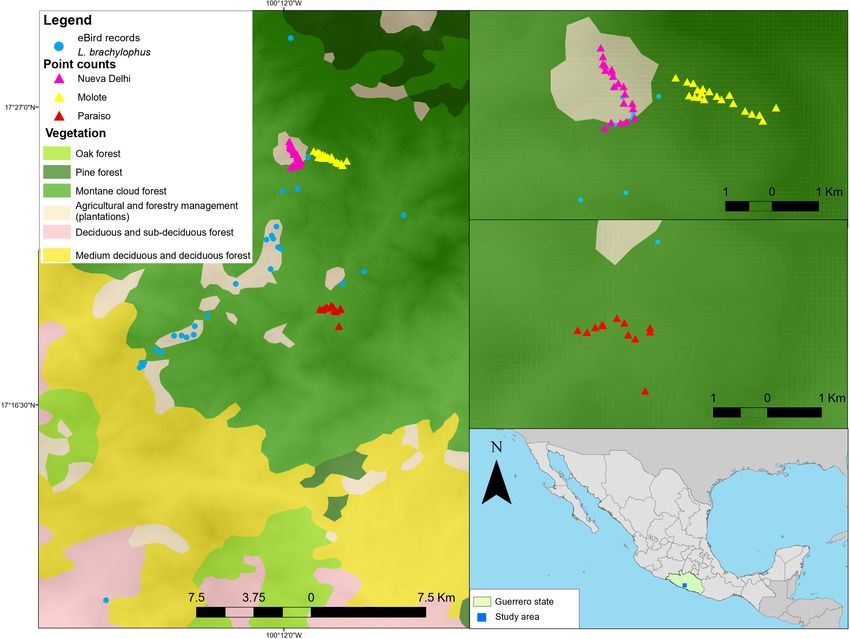
                                                                       distributed to represent the heterogeneity of each study site (Fig.
by presenting social conflicts (Argüello Cabrera 2019). People are
                                                                       1). Each point count had a fixed radius of 20 m and was monitored
poor and the primary sources of income are coffee farming and,
                                                                       for 10 min, during which all hummingbirds were recorded.
for a long time, the planting of poppies (González-González and
                                                                       Between the arrival at the point and the start of sampling, one
Hernández-Santana 2016, Argüello-Cabrera 2018, 2019).
                                                                       minute of standing time was left to lessen the effect of the
Therefore, studies of the birds of the region are scarce despite its
                                                                       observer’s presence. Following Bustamante-Castillo et al. (2020),
great biological importance.
                                                                       in each plot we recorded the hummingbird species that visited
Despite the high importance of the Sierra de Atoyac for                flowers and plant species that were visited.
conserving biodiversity, there are no protected natural areas
(Navarro 1992, Arizmendi et al. 2016). The region hosts many           Fig. 1. Map of observations of Lophornis brachylophus
hummingbird species (Arizmendi et al. 2016), including two of          recorded in eBird and study sites.
the most critically endangered hummingbird species with
restricted distributional ranges (L. brachylophus and Eupherusa
poliocerca; Berlanga et al. 2008). Accordingly, the purpose of the
present study was to describe the abundance, floral resources, and
interactions of the Short-crested Coquette in order to propose
more effective conservation measures. To do this we first, 1)
estimated the spatial distribution model of the Short-crested
Coquette; then, 2) evaluated the abundance of Short-crested
Coquette and of the other hummingbird species and their floral
resources; 3) determined the plant species visited by Short-crested
Coquette and the role of this hummingbird within ecological
networks; and finally (4) evaluated the feeding behavior of Short-
crested Coquette.

METHODS
Study area and data collection
Sierra de Atoyac is located in the southwestern Sierra Madre del
Sur, Mexico. It extends from western Guerrero to the south-
central part of Oaxaca (Navarro 1992). It is located between 17°       To better document the distribution of Short-crested Coquette,
15'-17° 45' N and 100° 10'-100° 20' W along an altitudinal gradient    all existing records from the literature and observational
between 300 and 2450 m asl (Vargas-Fernández et al. 1992).             databases were compiled (aVerAves/ebird; CONABIO 2016).
Lopez-Ramos (1983) placed the area within the geologic
provinces of the Sierra Madre del Sur and Oaxacan Highlands.           Flower resources
Rzedowski (1978) placed it in the floristic province of the southern   The availability of the flowers used by the Short-crested Coquette
mountains. It contains semi-deciduous tropical forest with             was recorded in phenological plots distributed in the three sites.
disturbed coffee-growing areas found in the lowlands (300-820 m        The observations were carried out between 7:00 and 11:00 hours
asl) along with an ecotone between tropical deciduous forest and       for four consecutive days in 2011 (in March, and in each month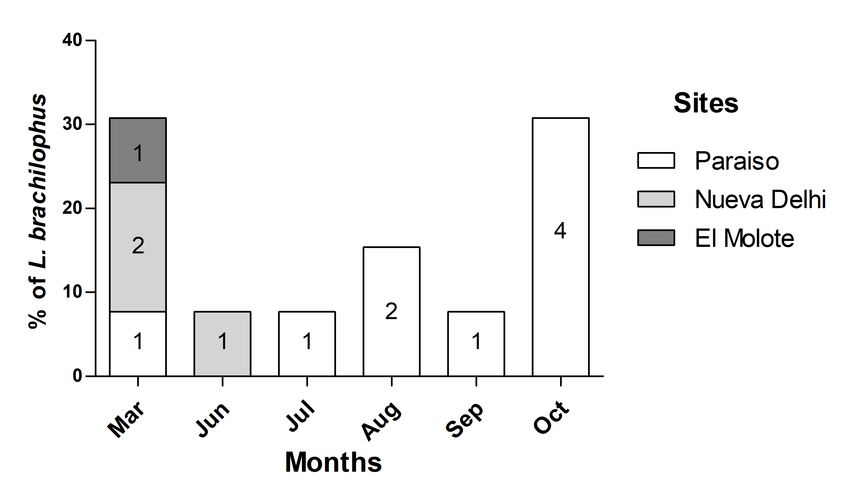
Avian Conservation and Ecology 16(1): 13
                                                                                                         http://www.ace-eco.org/vol16/iss1/art13/

      Table 1. Species-level network indices (degree, species strength, specialization d’, betweenness and closeness centrality)
      and core-periphery. Core species name bold.

                                              Core-     Degree        Species     Specialization d’,      Betweenness       Closeness
                                            periphery                strength
      Archilochus alexandri                  -0.714        1           0.25             0.604                   0             0.052
      Archilochus colubris                   -0.317        3          0.179             0.133                   0             0.070
      Campylopterus hemileucurus             -0.317        3          0.250             0.184                0.0175           0.073
      Cynanthus auriceps                     -0.516        2           0.75             0.695                   0             0.057
      Eupherusa poliocerca                    3.254       21         13.242             0.378                 0.151           0.080
      Heliomaster longirostris                0.278        6          1.605             0.435                 0.018           0.073
      Heliomaster constantii                 -0.516        2          0.127             0.181                 0.018           0.073
      Lophornis brachylophus                  0.675        8          3.807             0.763                 0.601           0.083
      Phaethornis mexicanus                  -0.119        4          1.616             0.509                   0             0.061
      Saucerottia beryllina                   0.278        6          1.298             0.352                 0.151           0.080
      Selasphorus platycercus                 0.079        5          1.929             0.516                   0             0.070
      Selasphorus heloisa                    -0.714        1           0.25             0.604                   0             0.052
      Selasphorus rufus                      -0.714        1          0.333             0.686                   0             0.048
      Selasphorus calliope                   -0.714        1           0.25             0.604                   0             0.052
      Tilmatura dupontii                      0.079        5          1.115             0.353                 0.045           0.076

from June to October). The plant species visited by each                et al. 2009). To calculate network-level specialization, we used the
hummingbird species were also recorded. In each plot, the number        specialization index H2’, which is defined as the diversity of species
of flowers of plant species with ornithophilic syndrome (tubular        interactions within the network considering the minimum
corolla, bright colors, and presence of nectar as a reward) and         (H2min) and maximum (H2max) number of possible interactions
other flowers reported as used by hummingbirds were registered.         (Bluthgen et al. 2006, Dormann et al. 2009). We calculated the
The plant species were identified in the laboratory using               connectance (C) as the fraction of interactions recorded to the
herbarium specimens, guidebooks, and photographic records and           total possible at the community level (Dormann et al. 2009); more
by consulting with specialists.                                         interconnected communities tend to be more stable (Dunne et al.
                                                                        2002). Connectance values range from 0 to 1; if each animal visited
Short-crested Coquette behavior                                         each plant species, the connectance would be equal to 1 (Dormann
To establish which floral resources were used by the Short-crested      et al. 2009). To calculate the modularity (Q), we used the
Coquette and to understand how individuals of this species              QuanBiMo algorithm that computes modules in weighted,
interact with those of other hummingbird species, behavioral            bipartite networks, based on a hierarchical representation of
observations were made for one day at each study site. All              species link weights and optimal allocation to modules (Dormann
observed hummingbird species and plants visited by them were            and Strauss, 2014). We started with the number of Markov chain
registered; when possible, hummingbird sex and age were noted.          Monte Carlo (MCMC) moves to the point with no improvement
Each phenological plot was observed for 60 minutes, and all             in yield before the algorithm stops set to 107 steps (Dormann and
individual visits to flowers were registered. Also, all aggressive      Strauss 2014). The modularity (Q) measures aggregated sets of
interactions involving Short-crested Coquettes were recorded            interacting species within the network, ranging from 0 to 1
(Cotton 1998).                                                          (Dormann and Strauss 2014). The higher the Q value indicates
                                                                        that the data support the division of a network into modules.
Network analysis                                                        Following Maruyama et al. (2014), we performed 50 independent
We built quantitative networks of the interactions between plant        runs and retained the module conformation with the highest Q
and hummingbird species, with focal observations and point              value because the algorithm is stochastic, the module
counts observations. We counted one visit (with or without              arrangement can vary between each run. We evaluated whether
making contact with reproductive structures of flowers) when a          the Q value of each network is different from expected by chance,
hummingbird fed on at least one flower and considered the               performing a null model (“null model 2”) for Q values with 100
number of visits as a measure of interaction strength (Maruyama         network replicates generated randomly, considering the observed
et al., 2019). We recorded rij=1 if plant i was visited by              species richness and heterogeneity of the interaction. Also, we
hummingbird j and rij=0 if no interaction occurred. We used the         evaluated whether the network metrics (NODF, H2', and C) are
R Bipartite package to build the quantitative networks (Dormann         different from expected by chance, performing a null model
et al. 2008, R Development Core Team 2019) and calculated the           (r2dtable) for values with 1000 network replicates generated
following metrics: nestedness (NODF), specialization (H2'),             randomly, considering the matrix sum and row/column sums as
connectance (C), and modularity (Q). Nestedness is a topological        constant (Bascompte et al. 2003).
pattern that measures the separation of species' systematic
arrangement by niche width (Dormann et al. 2009, Guimarães              To calculate species level (degree, species strength, betweenness,
and Guimarães 2006). If the NODF value is close to 0, there is          closeness, and specialization) of hummingbird species within the
no evidence of aggregation in the matrix; as it approached 100,         interaction networks, we used the function “specieslevel” in the
the interactions can be considered increasingly nested (Dormann         bipartite package (Blüthgen et al. 2006, Dormann et al. 2008).
                                                                        We also calculated network core (Gc) as: Gc = (ki/kmean) / σk,
Avian Conservation and Ecology 16(1): 13
                                                                                                     http://www.ace-eco.org/vol16/iss1/art13/

where ki is the mean number of links for a given hummingbird            A total of 19 hummingbird species were detected in the study area
or plant species, kmean is the mean number of links between all         (Fig. 3). The Short-crested Coquette represented 9% of all records
hummingbird or plant species in the network, and σk is the              (13 individuals observed). The most abundant species was the
standard deviation of the mean number of links between all              White-tailed Hummingbird (Eupherusa poliocerca), representing
hummingbird or plant species (Dáttilo et al. 2013). A Gc value          52% of records. The following hummingbirds were also found in
greater than one indicates species with a higher number of              decreasing order of abundance: the Mexican Hermit (Phaethornis
interactions related to other species of the same trophic level;        mexicanus), Berylline Hummingbird (Saucerottia beryllina),
these can be considered the generalist nucleus (Dáttilo et al. 2013).   Long-billed Starthroat (Heliomaster longirostris), Violet
                                                                        Sabrewing (Campylopterus hemileucurus), and Bumblebee
To simulate node extinctions and robustness calculations for            Hummingbird (Selasphorus heloisa; Fig. 3).
different scenarios, we used the bipartite package (Dormann et
al. 2008). We simulated three extinction scenarios of species: in       Fig. 2. Observed individuals of Lophornis brachylophus at each
the first scenario, species were randomly removed (plant and            site during the sampling months. The number indicates the
hummingbird species); in the second scenario, species were              registers of Lophornis brachylophus in each site and month.
removed from the most to the least linked or more to the less
degree within the network (plant and hummingbird species), and
in the third scenario, hummingbird species were removed from
most endangered to least endangered (only hummingbird
species). First, we considered endangered species (NOM-059
SEMARNAT), second the endemic species, and last, the
distribution range for the third extinction. Each simulated node-
removal scenario was running 100 times and robustness was
calculated. The robustness is the proportion of species in a trophic
level that remains in a bipartite network after sequential
extirpation of species in the other trophic level and calculated as
the area below the Attack Tolerance Curve (Vizentin‐Bugoni et
al. 2020).

Statistical analysis
For the statistical analysis, we used generalized linear models
(GLMs) with a Poisson distribution. We considered the number
of hummingbird species and number of Short-crested Coquette             Fig. 3. Relative abundance of hummingbird species at Sierra de
individuals as dependent variables and the number of plant              Atoyac.
species with flowers and number of flowers as independent
variables. We made all figures in R Program ver. 3.6.1 (R
Development Core Team 2019), and we used the bipartite
(Dorman et al. 2016) and vegan (Oksanen et al. 2014) packages
for network analysis, the lme4 package (Bates et al. 2015) for the
GLMs, and the ggplot2 package (Wickham 2016) for generating
graphics.

RESULTS
Distribution
The Short-crested Coquette's distribution is highly restricted to
pine-oak forest, pine, deciduous forest, and cloud forest in the
Sierra de Atoyac in Guerrero. In the eBird database, we found 88
observations of the Short-crested Coquette (corresponding to 136
individuals observed). Most observations were recorded in cloud
forest (86.48%; see Fig. 1) and the remaining in coffee-growing
areas (13.52%).

Hummingbird surveys
The Short-crested Coquette was recorded throughout the year             Floral resources
along the studied altitudinal gradient. From March to October,          The Short-crested Coquette moved along the altitudinal gradient
it was detected at the lower part of the gradient around Paraiso.       following the flowering of the plants on which it feeds. In March
During the beginning and end of winter, it moved to higher              2011, it was widely distributed along the gradient and was
altitudes following the distribution of visited flowers (see Fig 2).    associated with the presence of flowers. During summer,
                                                                        flowering plants were restricted to the lower areas of the gradient,
Avian Conservation and Ecology 16(1): 13
http://www.ace-eco.org/vol16/iss1/art13/
and hummingbirds were detected in those areas. The number of
detected hummingbirds and number of flowers was positively and Fig. 4. Hummingbird-plant visitation networks in the Atoyac,
significantly related (Z = 2.758, P = 0.005). At El Molote, at the Guerrero. Hummingbird and plant species are indicated by
top of the gradient, the Short-crested Coquette was only detected boxes at the top and bottom, respectively. Box height represent
once when flowers were found. The number of plant species was the proportion of visits corresponding with each species in the
significantly related to the number of flowers and Short-crested network, and the thickness of each link indicates the frequency
Coquette individuals (Z = 3.401, p < 0.001), yet the number of of each pairwise interaction. Blue boxes and lines indicate
flowers was not related to the number of Short-crested Coquette Lophornis brachylophus and their links. Red boxes indicate core
individuals (Z = 1.610, p = 0.107). species and black boxes indicate periphery species (Dáttilo et al.
2013).
Hummingbird-plant network
The Hummingbird-plant data set comprised a total of 179
interactions between 27 plant species belonging to 17 families and
15 hummingbird species. The Short-crested Coquette fed on eight
plant species out of the 27 species visited by hummingbirds in the
study area (Fig. 4). Network specialization (H2’= 0.463) and
modularity (Q = 0.484) were significantly different from null
models; network connectance (0.170), and nestedness (NODF =
43.075) were not different from null models (Z test, P-values >
0.05).
The endemic and endangered White-tailed Hummingbird visited
21 plant species, was a core species, and had the highest level of
degree, species strength, betweenness, and closeness (Table 1).
Short-crested Coquettes visited eight plant species and had the
higher species strength, core-periphery, betweenness, and
closeness (Table 1). Core plant species were Psittacanthus
ramiflorus (visited by nine hummingbird species) and Musa sp.
(visited by six hummingbird species) (Fig. 4). The Short-crested
Coquette had a higher specialization level (Table 1).
In plant species' extinction scenarios, robustness of random-
extinction scenarios (R = 0.742) was higher than the most-to-
least-linked scenarios (R = 0.434). When robustness was
compared at the three scenarios of hummingbird species loss, we
found that random-extinction scenarios had higher robustness (R
= 0.615) than most-to-least-linked scenarios (more to less degree)
(R = 0.293) and vulnerability status (R = 0.348). It is important
to highlight that the vulnerability-status scenario had a similar
robustness to the most-to-least-linked scenario (Fig. A2.1).
Feeding behavior
The Short-crested Coquette is clearly a subordinated
hummingbird. During focal observations we registered 46
females, 8 males, and 3 juveniles (only registered in Paraiso). Both
males and females behaved similarly, following foraging routes
and occasionally entering into the territories of dominant species.
We observed a few interactions with other individuals, but the
most agonistic interactions were with the White-tailed
Hummingbird when visiting Clusia salvinii, where the Short-
Crested Coquette lost all of the encounters (Fig. A2.2).
DISCUSSION
Our data indicated that the Short-crested Coquette is a species
that moves along a small altitudinal gradient following the
flowering of its preferred floral resources. It is subordinate and
co-exists with at least 14 hummingbird species, some of which are
territorial and dominant. Nonetheless, it is an important, range-
restricted, and specialist hummingbird species in the interaction
network at the Bird Area Sierra de Atoyac.Avian Conservation and Ecology 16(1): 13
http://www.ace-eco.org/vol16/iss1/art13/
Distribution Hummingbird-plant network
The Short-crested Coquette is reportedly distributed between 900 The hummingbird-plant network specialization was low
and 1800 m asl (Schuchmann 1999). González-González and compared to the specialization reported by Maglianesi et al.
Hernández-Santana (2016) stated that the low mountain areas (2014) but was similar to a previous meta-analysis study (H2’ =
between 1100 to 1500 m asl are the best places for coffee cultivation 0.43; Schleuning et al. 2012). Sonne et al. (2016) found that
at the Sierra de Atoyac. We found that the Short-crested Coquette hummingbird communities with high proportions of smaller
was more abundant in the transition between cloud forest and ranged species also have a high ecological specialization degree.
semideciduous tropical forest around 1000 m asl (at Paraiso). This study registered five endemic hummingbird species: White-
Cloud forest is one of the most threatened ecosystems in Mexico tailed Hummingbird, Short-crested Coquette, Golden-crowned
and the world, mainly due to deforestation as a result of human Emerald, Mexican Hermit, and Bumblebee Hummingbird. The
activities and global warming (Toledo-Aceves et al. 2011, Ponce- first two have restricted distributional ranges in Mexico. The
Reyes et al. 2012, Gual-Díaz and Rendón-Correa 2017). In the hummingbird communities with higher proportions of smaller-
study region, the cloud forest below 1800 m asl is almost ranged, specialized species may be vulnerable to disturbance and
completely used for understory coffee cultivation; undisturbed climate changes because communities composed of specialized
forest only exists on steep slopes. Meanwhile, semideciduous species less prone to switching their interactions are at higher risk
tropical forest is rapidly being cleared for the cultivation of corn, of secondary extinctions (Sonne et al. 2016)
fruits, and coffee (Navarro 1992).
In comparison to other studies from Mexico, the specialization
Notably, coffee plantations are one of the main sources of income we found was similar to Díaz-Infante et al. (2020) who worked in
in the study region. More than 48% of the crops produced in the tropical dry forest of Jalisco. Our measures of network
Atoyac de Alvarez correspond to coffee plantations (Moguel and components (connectance, nestedness, and modularity) which
Toledo 1999). According to González-González and Hernández- support network stability, were lower than in some other systems,
Santana (2015), 21753.2 ha are currently used for coffee for example, Díaz-Infante et al. (2020) and Maglianesi et al.
production in Atoyac de Álvarez (13.95% of the total area of the (2014). However, they were similar to those reported by Ramírez-
municipality). Given that the Short-crested Coquette feeds on the Burbano et al. (2017) who studied other endemic and endangered
flowers of coffee plants, it is important to evaluate the energy hummingbirds such as the Colorful Puffleg (Eriocnemis mirabilis)
supply of exotic plants such as coffee, in addition to the role of in Colombian Andes. Araujo et al. (2018) suggested that climate
hummingbird species such as the Short-crested Coquette as and spatial filters are determinants for the modularity in
pollinators of coffee plants; but it is also important to know the hummingbird-plant networks and also affect the cross-biome
energy contribution of its main resource, Clusia salvinni. network structure. However, due to multiple factors, this
Therefore, Short-crested Coquette conservation is closely linked network's temporary sampling effort is not complete; sampling
to the practices of coffee cultivation and the conservation of the effort can influence our understanding of interaction patterns but
few pristine areas of cloud forest in the region. has a minor influence on identifying processes structuring a single
ecological subnetwork (Vizentin-Bugoni et al. 2016).
Hummingbird surveys and floral resources
Generalist core species are abundant and visit many plant species
Our findings confirmed that the conservation of the Short-crested
(Simmons et al. 2019). We found that the endangered and more
Coquette depends on the preservation of the entire altitudinal
abundant White-tailed Hummingbird was a generalist core
gradient. Paraiso at the bottom of the gradient seems to be a very
species that visited 21 of 27 plant species, and the Short-crested
important site for the Short-crested Coquette, but it also appears
Coquette has a high core-periphery (Gc = 0.675) and visited eight
that the upper parts are important during winter (as observed for
plants species. As an example, the critically endangered Colorful
other altitudinal hummingbirds in other areas of Mexico [Lyon
Puffleg was observed visiting 15 of 27 plant species and 4 of 19
1976, Arizmendi 2001, López-Segoviano et al. 2017]). Rappole
plant species of the hummingbird-plant networks from
and Schuchmann (2003) estimated that 87 out of the 328 known
Munchique Natural National Park and its buffer zone in
hummingbird species (26.52%) make altitudinal migrations,
Colombia (Ramírez-Burbano et al. 2017). In the Munchique
moving up or down foothills following the blooming of their
Natural National Park, the Colorful Puffleg was one of the most
preferred plant species (Des Ganges 1979, Arizmendi and Ornelas
important hummingbird species (Ramírez-Burbano et al. 2017).
1990, Hobson et al. 2003, Tinoco et al. 2009, Fraser et al. 2010).
Similarly, the critically endangered Short-crested Coquette was
The main factor that influences the altitudinal migration of
one of the most important hummingbird species within our
hummingbirds is the seasonal fluctuation of food resources (food-
visitation network.
limitation hypotheses; Levey and Stiles 1992, Des Ganges 1979,
López-Segoviano et al. 2017, Hsiung et al. 2018); the cost and Our results showed that the robustness of the vulnerability-status
intensity of competition for those resources are also important scenario (according to the species' risk status and their
factors (Wolf et al. 1976, Des Ganges 1979). However, other distribution) was lower than the random-extinctions scenario and
factors can explain altitudinal migrations, such as weather higher than the most-to-least-linked scenario. When we removed
variation (i.e., changes in temperature, tropical storms) or the most-linked species of pollinators, the number of plant species
predation risk. Skutch (1985) and Martin (2015) mentioned that decays faster than in random-extinction scenarios, the same was
if predation risk differs along an elevational gradient, animals found by Memmott et al. (2014). The vulnerability-status
can make altitudinal migrations to breed in sites with low scenario's robustness was similar to most-to-least-linked because
predation risk (Hsiung et al. 2018) but information about the endangered and endemic hummingbird species have many links.
breeding of the Short-crested Coquette is not still available. For example, the vulnerability-status scenario first eliminatedAvian Conservation and Ecology 16(1): 13
http://www.ace-eco.org/vol16/iss1/art13/
critical endangered Short-crested Coquette which had eight links, Moreno-González et al. 2018). Additionally, Bishop et al. (2018)
and then eliminated endangered White-tailed Hummingbird found pesticide compounds in cloacal fluids and fecal pellets of
which was a generalist core species and had 21 links. Solé and hummingbirds, although they did not comment on the potential
Montoya (2001) mentioned that extinctions of core species have effects of exposure. Therefore, it is necessary that future work
huge consequences on network dynamics. Vizentin‐-Bugoni et al. evaluates the effect of coffee crop cultivation and management
(2020) stated that vertebrate pollinator-plant tropical networks on the Short-crested Coquette, and hummingbirds in general, in
are more susceptible to the loss of generalist than specialist the study region.
species. According to Hadley et al. (2018) the absence of
Morrison and Mendenhall (2020) found changes in diversity,
specialized hummingbird implies more generalized interaction
composition, and interaction specialization in hummingbird-
networks. Our network has two generalist species as core species
plant interactions in response to deforestation for coffee
(White-tailed Hummingbird and Short-crested Coquette), this
plantations and other agriculture; and according to Kattan et al.
may have implications on the stability of the network because
(1994) the fragmentation of an altitudinal gradient can lead to
both species are listed with some degree of threat (SEMARNAT
mass extinctions by disrupting altitudinal migrations. Likewise,
2010). The extinction of the most connected species causes the
the Short-crested Coquette is a core species, and its conservation
network to collapse.
is important because its presence in the community helps maintain
the permanence of other hummingbirds and other plants (Kattan
Feeding behavior
1992). More studies and a conservation plan are needed to outline
The Short-crested Coquette feeds on the flowers of eight plant
suitable economic activities and practices for the conservation of
species. Most flowers used by the Short-crested Coquette cannot
the most endangered, restricted, and endemic hummingbird
be classified as ornithophilic flowers. Maruyama et al. (2013)
species in Mexico.
found in a Brazilian Cerrado that non-ornithophilous floral
resources are as important for hummingbirds as ornithophilous
plants. Also, they established that flowers with bumblebee or bat/ Responses to this article can be read online at:
hawkmoth syndrome are commonly visited by hummingbirds and https://www.ace-eco.org/issues/responses.php/1834
contribute greatly to the total availability of energy in their
habitats (Dalsgaard et al. 2009, Maruyama et al. 2013). It is
important to understand the feeding ecology of the Short-crested
Coquette in order to guide future restoration initiatives and Acknowledgments:
propagation techniques (Guevara et al. 2017), especially
The present work was supported by PAPIIT IN216617, IN221920
considering that one of the main proposals for the conservation
and IV200418 (MCA). Pronatura Chiapas collaborated in the
of at-risk hummingbirds is the conservation and restoration of
initial part of the work with financial aid from BirdLife
their habitats (Anderson et al. 2010, Guevara et al. 2017).
International and the American Bird Conservancy. L. E. Nuñez-
However, it is possible that other hummingbirds with aggressive Rosas and G. López-Segoviano are grateful for the postdoctoral
behavior are displacing the Short-crested Coquette, causing them grant awarded by the Dirección General de Asuntos del Personal
to visit non-ornithophilic flowers (i.e., Clusia salvinii, Coffea Académico (DGAPA) of the Universidad Nacional Autónoma de
arabica, and Sommera grandis). Small species such as the Short- Mexico for their research carried out at the Facultad de Estudios
crested Coquette act as subordinates of larger species. In fact, less Superiores Iztacala (L. E. Nuñez-Rosas) and Escuela Nacional de
dominant hummingbird species may appear to prefer areas of Estudios Superiores Campus Morelia (G. López-Segoviano).
poorer resource quality simply because they are forced out of
more favorable habitat (Stiles 1976, Sandlin 2000, Muchhala et
al. 2014, López-Segoviano et al. 2017). However, smaller-sized LITERATURE CITED
hummingbird species also require smaller quantities of nectar, Anderson, D. L., P. House, R. E. Hyman, R. Steiner, H. R.
rendering smaller species more efficient in the exploitation of less Hawkins, S. Thorn, M. J. Rey, M. R. Espinal, and L. E. Marineros.
calorie-rich resources than larger hummingbirds (Wolf 1978). The 2010. Rediscovery of the Honduran Emerald Amazilia luciae in
nutritional quality of the floral resources used by hummingbirds western Honduras: insights on the distribution, ecology, and
in the study area has not yet been determined but would be conservation of a 'Critically Endangered' hummingbird. Bird
important to investigate in the near future in order to better Conservation International 20:255-262. https://doi.org/10.1017/
understand this phenomenon. S0959270910000389
Conservation Araujo, A. C., A. M. Martín González, B. Sandel, et al. 2018.
The Short-crested Coquette is distributed across relics of cloud Spatial distance and climate determine modularity in a cross‐
forest and coffee plantations. Coffee growers alter the habitat as biomes plant-hummingbird interaction network in Brazil. Journal
they maintain trees as shade for coffee crops, manage the of Biogeography 45:1846-1858. https://doi.org/10.1111/jbi.13367
vegetation, and constantly cut the undergrowth. Also, pesticides Argüello Cabrera, L. 2018. Violencia crónica y memoria pública.
are commonly used and represent a threat for hummingbirds and Entre rebeldes y víctimas, a propósito de Lucio Cabañas en
other pollinators that consume nectar from coffee flowers. Several Atoyac de Álvarez, Guerrero (2002-2018). Interdisciplina
authors have documented the presence of insecticide residues 8:87-112. https://doi.org/10.22201/ceiich.24485705e.2020.22.76420
(neonicotinoid insecticides) on the nectar and pollen of crops and
have mentioned that these could affect pollinators (Dively and Argüello Cabrera, L. 2019. Homicidios, cotidianidad y la ‘Guerra
Kamel 2012, Thompson et al. 2014, Bartlewicz et al. 2016, contra el Narcotráfico’. Atoyac de Álvarez, GuerreroAvian Conservation and Ecology 16(1): 13
http://www.ace-eco.org/vol16/iss1/art13/
(2007-2014). Iztapalapa. Revista de ciencias sociales y gradients associated with environment and hummingbird size.
humanidades 40:175-203. https://doi.org/10.28928/ri/872019/ Oecologia 159:757-766. https://doi.org/10.1007/s00442-008-1255-
aot2/arguellocabreral z
Arizmendi, M. C., H. Berlanga, C. Rodríguez-Flores, V. Vargas- Dáttilo, W., P. R. Guimarães Jr., and T. J. Izzo. 2013. Spatial
Canales, L. Montes-Leyva, and R. Lira. 2016. Hummingbird structure of ant-plant mutualistic networks. Oikos 122:1643-1648.
Conservation in Mexico: The Natural Protected Areas System. doi: 10.1111/j.1600-0706.2013.00562.x.
Natural Areas Journal 36:366-376. https://doi.org/10.3375/043.036.0404
Dively, G. P., and A. Kamel. 2012. Insecticide residues in pollen
and nectar of a cucurbit crop and their potential exposure to
Arizmendi, M. C. 2001. Multiple ecological interactions: nectar
pollinators. Journal of agricultural and food chemistry
robbers and hummingbirds in a highland forest in Mexico.
60:4449-4456. https://doi.org/10.1021/jf205393x
Canadian Journal of Zoology 76:997-1006. https://doi.
org/10.1139/z01-066 Dormann, C. F., and R. Strauss. 2014. A method for detecting
modules in quantitative bipartite networks. Methods in Ecology
Banks, R. C. 1990. Taxonomic status of the coquette
and Evolution 5:90-98. https://doi.org/10.1111/2041-210X.12139
hummingbird of Guerrero, Mexico. Auk 107:19 l-192.
Dormann, C., J. Fründ, N. Blüthgen, and B. Gruber. 2009.
Bartlewicz, J., M. I. Pozo, O. Honnay, B. Lievens, and H.
Indices, Graphs and Null Models: Analyzing Bipartite Ecological
Jacquemyn. 2016. Effects of agricultural fungicides on
Networks. The Open Ecology Journal 2. https://doi.
microorganisms associated with floral nectar: susceptibility
org/10.2174/1874213000902010007
assays and field experiments. Environmental Science and Pollution
Research 23:19776-19786. https://doi.org/10.1007/s11356-016-7181-4 Dormann, C., B. Gruber, and J. Fründ. 2008. Introducing the
bipartite Package: Analysing Ecological Networks. R News
Bascompte, J., P. Jordano, C. Melian, and J. Olesen. 2003. The 8:8-11.
nested assembly of plant-animal mutualistic networks.
Dunne, J. A., R. J. Williams, and N. D. Martinez. 2002. Food-
Proceedings of the National Academy of Sciences of the United
Web Structure and Network Theory: The Role of Connectance
States of America 100:9383-9387. https://doi.org/10.1073/
and Size. Proceedings of the National Academy of Sciences of the
pnas.1633576100
United States of America 99:12917-12922. https://doi.
Bates, D., M. Maechler, B. Bolker, and S. Walker. 2015. Fitting org/10.1073/pnas.192407699
linear mixed-effects models using lme4. Journal od Statistical
eBird. 2020. eBird Basic Dataset. Cornell Lab of Ornithology,
Software 67:1-48. http://doi.org/10.18637/jss.v067.i01
Ithaca, New York
Beattie, A. J. 1971. A technique for the study of insect-borne
Estades, C. F., J. Aguirre, M. A. Escobar, J. A. Tomasevic, M. A.
pollen. Pan-Pacific Entomologist 47:82.
Vukasovic, and C. Tala. 2007. Conservation status of the Chilean
Berlanga, H., V. Rodríguez-Contreras, A. O. de Ita, M. Escobar, Woodstar Eulidia yarrellii. Bird Conservation International
L. Rodríguez, J. Vieyra, and V. Vargas. 2008. Red de conocimientos 17:163-175. https://doi.org/10.1017/S0959270907000676
sobre las aves de México (AVESMX). Comisión Nacional para
Freile, J.F., P. Piedrahita, G. Buitron-Jurado, C. A. Rodriguez, O.
el Uso y Conocimiento de la Biodiversidad. http://avesmx.
Jadan, and E. Bonaccorso. 2011. Observations on the natural
conabio.gob.mx/index.html
history of the Royal Sunangel (Heliangelus regalis) in the
Bishop, C. A., A. J. Moran, M. C. Toshack, E. Elle, F. Nangaritza Valley, Ecuador. Wilson Journal of Ornithology
Maisonneuve, and J. E. Elliott. 2018. Hummingbirds and bumble 123:85-92. https://doi.org/10.1676/10-054.1
bees exposed to neonicotinoid and organophosphate insecticides
Freymann, B. and Schuchmann, K. L. 2005. Collecting history
in the Fraser Valley, British Columbia, Canada. Environmental
of the hummingbird genera Chaetocercus Gray, 1855 and
toxicology and chemistry 37:2143-2152. https://doi.org/10.1002/
Lophornis Lesson, 1829. Journal of Ornithology 146: 61-64.
etc.4174
https://doi.org/10.1007/s10336-004-0056-3
Buckland, S. T., D. R. Anderson, K. P. Burnham, and J. L. Laake.
González-González, H. A., and J. R. Hernández-Santana. 2016.
1993. Distance sampling: estimating abundance of biological
Zonificación agroecológica del Coffea arabica en el municipio
populations. Chapman and Hall, London, UK.
Atoyac de Álvarez, Guerrero, México. Investigaciones
Blüthgen, N., F. Menzel, and N. Blüthgen. 2006. Measuring Geográficas, Boletín del Instituto de Geografía 90:105-118. https://
specialization in species interaction networks. BMC Ecology 6:9. doi.org/10.14350/rig.49329
https://doi.org/10.1186/1472-6785-6-9
Gotelli, N. J., and G. R. Graves. 1996. Null models in Ecology.
CONABIO. 2016. aVerAves. Base de datos SNIB-CONABIO. Smithsonian Institution Press, Washington D.C., USA.
Noviembre, 2020. México.
Gual-Díaz, M,. and A. Rendón-Correa. 2017. Los bosques
CONABIO. 2019. Bosques nublados. https://www.biodiversidad. mesófilos de montaña de México. Agroproductividad 10:3-9.
gob.mx/ecosistemas/bosqueNublado.
Guevara, E. A., R. Hipo, C. Poveda, B. Rojas, C. H. Graham,
Dalsgaard, B., A. González, J. M. Olesen, J. Ollerton, A. and G. T. Santander. 2017. Plant and habitat use by Black‐
Timmermann, L. H. Andersen, and A. G. Tossas. 2009. Plant- breasted Pufflegs (Eriocnemis nigrivestis), a critically endangered
hummingbird interactions in the West Indies: floral specialization hummingbird. Journal of Field Ornithology 88:229-235. https://
doi.org/10.1111/jofo.12208Avian Conservation and Ecology 16(1): 13
http://www.ace-eco.org/vol16/iss1/art13/
Guimarães, P. R., and P. Guimarães. 2006. Improving the analyses Maruyama, P. K., C. Bonizário, A. P. Marcon, G. D’Angelo, M.
of nestedness for large sets of matrices. Environmental Modelling M. da Silva, E. N. da Silva Neto, P. E. Oliveira, I. Sazima, M.
& Software 21:1512-1513. https://doi.org/10.1016/j.envsoft.2006.04.002. Sazima, J. Vizentin-Bugoni, L. dos Anjos, A. M. Rui, and O.
Marçal Júnior. 2019. Plant-hummingbird interaction networks in
Hadley, A. S., S. J. K. Frey, W. D. Robinson, and M. G. Betts. urban areas: Generalization and the importance of trees with
2018. Forest fragmentation and loss reduce richness, availability, specialized flowers as a nectar resource for pollinator
and specialization in tropical hummingbird communities. conservation. Biological Conservation 230:187-194. https://doi.
Biotropica 50:74-83. https://doi.org/10.1111/btp.12487 org/10.1016/j.biocon.2018.12.012
Hernández-Baños, B. E., A. T. Peterson, A. G. Navarro-Sigüenza, Maruyama, P.K., G. M. Oliveira, C. Ferreira, B. Dalsgaard and
and B. P. Escalante-Pliego. 1995. Bird faunas of the humid P. E. Oliveira. 2013. Pollination syndromes ignored: importance
montane forests of Mesoamerica: biogeographic patterns and of non-ornithophilous flowers to Neotropical savanna
priorities for conservation. Bird Conservation International hummingbirds. Naturwissenschaften 100:1061-1068. https://doi.
5:251-277. https://doi.org/10.1017/S0959270900001039 org/10.1007/s00114-013-1111-9
Howell, S. N. G., and S. Webb. 1995. A guide to the birds of Maruyama, P. K., J. Vizentin-Bugoni, G. M. Oliveira, P. E.
Mexico and Northern Central America. Oxford University Press, Oliveira, and B. Dalsgaard. 2014. Morphological and Spatio-
New York, USA. Temporal Mismatches Shape a Neotropical Savanna Plant-
Hummingbird Network. Biotropica 46:740-747. https://doi.
Hsiung, A. C., A. W. Boyle, R. J. Cooper, and R. B. Chandler.
org/10.1111/btp.12170
2018. Altitudinal migration: ecological drivers, knowledge gaps,
and conservation implications. Biological Reviews 93:2049-2070. Memmott, J., and N. M. Waser. 2002. Integration of alien plants
https://doi.org/10.1111/brv.12435 into a native flower - pollinator visitation web. Proceedings of the
Royal Society of London Series B: Biological Sciences
Hutto, R. L., S. M. Pletschet, and P. Hendricks. 1986. A fixed-
269:2395-2399. https://doi.org/10.1098/rspb.2002.2174
radius point count method for nonbreeding and breeding season
use. Auk 103:593-602. https://doi.org/10.1093/auk/103.3.593 McGuire, J. A., C. C. Witt, J. V. Remsen Jr, R. Dudley, and D. L.
Altshuler. 2009. A higher-level taxonomy for hummingbirds.
Johnsgard, P. A. 1997. The hummingbirds of North America.
Journal of Ornithology 150:155-165. https://doi.org/10.1007/
Smithsonian Institution Press, Washington D.C., USA.
s10336-008-0330-x
Kattan, G. H. 1992. Rarity and vulnerability: the birds of the
McGuire, J. A., C. C. Witt, J. V. Remsen Jr, A. Corl, D. L. Rabosky,
Cordillera Central of Colombia. Conservation Biology 6:64-70.
D. L. Altshuler, and R. Dudley. 2014. Molecular phylogenetics
https://doi.org/10.1046/j.1523-1739.1992.610064.x
and the diversification of hummingbirds. Current Biology
Kattan, G. H., H. Alvarez‐López, and M. Giraldo. 1994. Forest 24:910-916. https://doi.org/10.1016/j.cub.2014.03.016
fragmentation and bird extinctions: San Antonio eighty years
Moreno-González, D., J. Alcántara-Durán, B. Gilbert-López, M.
later. Conservation Biology 8:138-146. https://doi.org/10.1046/
Beneito-Cambra, V. M. Cutillas, Ł. Rajski, A. Molina-Díaz, and
j.1523-1739.1994.08010138.x
J. F. García-Reyes. 2018. Sensitive detection of neonicotinoid
Kearns, C. A. and D. W. Inouye. 1993. Techniques for Pollination insecticides and other selected pesticides in pollen and nectar
Biologist. University Press of Colorado, USA. using nanoflow liquid chromatography orbitrap tandem mass
spectrometry. Journal of AOAC International 101:367-373.
Lindberg, A. B. and J. M. Olesen. 2001. The fragility of extreme
https://doi.org/10.5740/jaoacint.17-0412
specialization: Passiflora mixta and its pollinating hummingbird
Ensifera ensifera. Journal of Tropical Ecology 17: 323-329. https:// Memmott, J., N. M. Waser, and M. V. Price. 2004. Tolerance of
doi.org/10.1017/S0266467401001213 pollination networks to species extinctions. Proceedings of the
Royal Society 271:2605-2611. https://doi.org/10.1098/rspb.2004.2909
López-Segoviano, G., R. Bribiesca and M. C. Arizmendi. 2017.
The role of size and dominance in the feeding behavior of
Moguel, P., and V. M. Toledo. 1999. Biodiversity conservation in
coexisting hummingbirds. Ibis 160:283-292. https://doi.
traditional coffee systems of Mexico. Conservation Biology
org/10.1111/ibi.12543
13:11-21. https://doi.org/10.1046/j.1523-1739.1999.97153.x
Lyon, D. L. 1976. A montane hummingbird territorial system in
Morrison, B. M. and C. D. Mendenhall. 2020. Hummingbird-
Oaxaca, Mexico. Wilson Bulletin 88:280-298. https://www.jstor.
Plant Interactions Are More Specialized in Forest Compared to
org/stable/4160743.
Coffee Plantations. Diversity 12:126. https://doi.org/10.3390/
Martin, T. E. 2015. Age‐related mortality explains life history d12040126
strategies of tropical and temperate songbirds. Science 349:
Muchhala, N., S. Johnsen, and S. D. Smith. 2014. Competition
966-970. https://doi.org/10.1126/science.aad1173
for hummingbird pollination shapes flower color variation in
Maglianesi, M. A., Blüthgen, N., Böhning-Gaese, K., & Andean Solanaceae. Evolution 68:2275-2286. https://doi.
Schleuning, M. (2014). Morphological traits determine org/10.1111/evo.12441
specialization and resource use in plant-hummingbird networks
Navarro, S. A. 1998, Distribución geográfica y ecológica de la
in the neotropics. Ecology, 95(12), 3325-3334. https://doi.
avifauna del Estado de Guerrero, México. PhD Thesis,
org/10.1890/13-2261.1
Universidad Nacional Autónoma de México.Avian Conservation and Ecology 16(1): 13
http://www.ace-eco.org/vol16/iss1/art13/
Navarro S. A. G. 1992. Altitudinal distribution of birds in the Maglianesi, R. Ortiz-pulido, M. A. Rocca, L. C. Rodrigues, B. A.
Sierra Madre del Sur, Guerrero, Mexico. Condor 94:29-39. https:// Tinoco, M. F. Vasconcelos, M. Sazima, A. M. M. González, J.
doi.org/10.2307/1368793 Sonne, C. Rahbek, L. V Dicks, B. Dalsgaard, and W. J. Sutherland.
2019. Abundance drives broad patterns of generalisation in plant-
Navarro-Sigüenza, A., H. Silva, M. Gual, L. Sánchez-González,
hummingbird pollination networks. Oikos:1287-1295. https://doi.
and M. Pérez-Villafaña. 2014. La importancia de las aves del
org/10.1111/oik.06104
Bosque Mesófilo de Montaña de México. Pages 279-304
Skutch, A. F. 1985. Clutch size, nesting success, and predation on
Ornelas, J. F. 1987. Rediscovery of the Rufous-crested Coquette
nests of Neotropical birds, reviewed. Ornithological Monographs
(Lophornis delattrei brachylopha) in Guerrero, Mexico. Wilson
36:575-594. https://doi.org/10.2307/40168306
Bulletin 99:719-721. https://www.jstor.org/stable/4162485
Solé, R. V,. and J. M. Montoya. 2001. Complexity and fragility
Ornelas, J. F., V. Sosa, D. E. Soltis, J. M. Daza, C. González, P. S.
in ecological networks. Proceeding of Royal Society B
Soltis, C. Gutiérrez-Rodríguez, A. E. de los Monteros, T. A.
268:2039-2045. https://doi.org/10.1098/rspb.2001.1767
Castoe, C. Bell, and E. Ruiz-Sanchez. 2013. Comparative
Phylogeographic Analyses Illustrate the Complex Evolutionary Sonne, J., A. M. Martín González, P. K. Maruyama, B. Sandel,
History of Threatened Cloud Forests of Northern Mesoamerica. S. Abrahamczyk, R. Alarcón, A. C. Araujo, F. P. Araujo, S.
PLOS ONE 8:e56283. https://doi.org/10.1371/journal.pone.0056283 Mendes de Azevedo Jr, A. C. Baquero, D. Nogués-Bravo, P. A.
Cotton, T. T. Ingversen, G. Kohler, C. Lara, F. M. Guedes Las-
Ornelas, J. F. 1996. Origen y evolución de los colibríes. Ciencias Casas, A. O. Machado, C. G. Machado, M. A. Maglianesi, A.
42:38-47. Cerqueira Moura, G. M. Oliveira, P. E. Oliveira, J. F. Ornelas, L.
da Cruz Rodrigues, L. Rosero-Lasprilla, A. M. Rui, M. Sazima,
Ponce-Reyes, R., V. H. Reynoso-Rosales, J. E. Watson, J.
M. Schleuning, A. Timmermann, I. Galarda Varassin, J. Vizentin-
VanDerWal, R. A. Fuller, R. L. Pressey, and H. P. Possingham.
Bugoni, Z. Wang, S. Watts, J. Fjeldså, J-C. Svenning, C. Rahbek,
2012. Vulnerability of cloud forest reserves in Mexico to climate
and B. Dalsgaard. 2016. High proportion of smaller-ranged
change. Nature Climate Change 2:448-452. https://doi.
hummingbird species coincides with ecological specialization
org/10.1038/nclimate1453
across the Americas. Proceedings of the Royal Society B
R Development Core Team. 2019. A language and environment 283:20152512. https://doi.org/10.1098/rspb.2015.2512
for statistical computing. R Foundation for Statistical
Stiles, F. G. 1981. Geographical aspects of bird-flower
Computing, Vienna. [online] http://www.R- project.org/
coevolution, with particular reference to Central America. Annals
Ramírez‐Burbano, M. B., F. G. Stiles, C. González, F. W, Amorim, of the Missouri Botanical Garden 68:323-351. https://www.jstor.
B. Dalsgaard, and P. K. Maruyama. 2017. The role of the endemic org/stable/2398801 https://doi.org/10.2307/2398801
and critically endangered Colorful Puffleg Eriocnemis mirabilis
Stiles, F.G., 1976. Taste preferences, color preferences, and flower
in plant‐hummingbird networks of the Colombian Andes.
choice in hummingbirds. Condor 78:10-26. https://www.jstor.org/
Biotropica 49:555-564. https://doi.org/10.1111/btp.12442
stable/1366912 https://doi.org/10.2307/1366912
Sandlin, E.A. 2000. Cue use affects resource subdivision among
Thompson, H. M., S. Wilkins, S. Harkin, S. Milner, and K. F.
three coexisting hummingbird species. Behavioral Ecology
Walters. 2015. Neonicotinoids and bumblebees (Bombus
11:550-559. https://doi.org/10.1093/beheco/11.5.550
terrestris): effects on nectar consumption in individual workers.
Schuchmann, K. L. 1999. Family Trochilidae (Hummingbirds). Pest management science 71:946-950. https://doi.org/10.1002/
Pp. 468-680 in J. del Hoyo, A. Elliot and J. Sargatal, editors. ps.3868
Handbook of the birds of the world. Volume 5: Barn-owls to
Toledo-Aceves, T., J. A. Meave, M. Gonzalez-Espinosa, and N.
hummingbirds. Lynx Editions, Barcelona, Spain. https://doi.org/
Ramirez-Marcial. 2011. Tropical montane cloud forests: current
doi.org/10.2307/4089742
threats and opportunities for their conservation and sustainable
SEMARNAT. 2010. Norma Oficial Mexicana NOM-23759- management in Mexico. Journal of environmental management
SEMARNAT-22371237, Protección ambiental-Especies nativas 92:974-981. https://doi.org/10.1016/j.jenvman.2010.11.007
de México de flora y fauna silvestres-Categorías de riesgo y
Torres-Chavez, M. G. and A. G. Navarro. 2000. Los Colibríes de
especificaciones para su inclusión, exclusión o cambio-Lista de
México, brillo de la biodiversidad. Biodiversitas 28:2-6.
especies en riesgo. Diario Oficial de la Federación, jueves 30 de
diciembre de 2010. Gobierno de los Estados Unidos Mexicanos, Vizentin-Bugoni, J., V. J. Debastiani, V. A. G. Bastazini, P. K.
Mexico D.F.http://www.profepa.gob.mx/innovaportal/file/435/1/ Maruyama, and J. H. Sperry. 2020. Including rewiring in the
NOM_059_SEMARNAT_2010.pdf estimation of the robustness of mutualistic networks. Methods in
Ecology and Evolution 11:106-116. https://doi.org/10.1111/2041
Sierra-Morales, P., R. C. Almazán-Núñez, E. Beltrán-Sánchez,
-210X.13306.
C. A. Ríos-Muñoz, and M. C. Arizmendi. 2016. Distribución
geográfica y hábitat de la familia Trochilidae (Aves) en el estado Vizentin-Bugoni, J., P. K. Maruyama, V. J. Debastiani, L. da S.
de Guerrero, México. Revista de Biología Tropical 64:363-376. Duarte, B. Dalsgaard, and M. Sazima. 2016. Influences of
https://doi.org/10.15517/rbt.v64i1.18003 sampling effort on detected patterns and structuring processes of
a Neotropical plant-hummingbird network. Journal of Animal
Simmons, B. I., J. Vizentin-bugoni, P. K. Maruyama, P. A. Cotton,
Ecology 85:262-272. https://doi.org/10.1111/1365-2656.12459.
O. H. Marín-gómez, C. Lara, L. Rosero-lasprilla, M. A.You can also read


