EUROPEAN JOURNAL OF ENTOMOLOGY - Biotaxa
←
→
Page content transcription
If your browser does not render page correctly, please read the page content below
EUROPEAN JOURNAL OF ENTOMOLOGY
                        ISSN (online): 1802-8829                                                                       Eur. J. Entomol. 118: 31–45, 2021
                        http://www.eje.cz                                                                                      doi: 10.14411/eje.2021.004
                                                                                                                                   ORIGINAL ARTICLE

Ecological niche modelling of species of the rose gall wasp Diplolepis
(Hymenoptera: Cynipidae) on the Iberian Peninsula
SARA SARDÓN-GUTIÉRREZ 1, DIEGO GIL-TAPETADO 1, 2, JOSÉ F. GÓMEZ 1 and JOSÉ L. NIEVES-ALDREY 2

1
 Departamento de Biodiversidad, Ecología y Evolución, Facultad de Ciencias Biológicas, Universidad Complutense de Madrid,
28040 Madrid, Spain; e-mails: sarasard@ucm.es; diego.gil@ucm.es; jf.gomez@bio.ucm.es
2
 Museo Nacional de Ciencias Naturales (CSIC), José Gutiérrez Abascal 2, 28006 Madrid, Spain;
e-mail: mcnna38@mncn.csic.es

Key words. Hymenoptera, Cynipidae, Diplolepis, species distribution modelling, gall-inducing wasps, Spain, Rosaceae, habitat
complementarity

Abstract. Diplolepis (Hymenoptera: Cynipidae) are gall wasps that induce conspicuous galls on Rosa spp. (Rosaceae). These
species are distributed globally and in Europe some are especially common and are founder organisms of biological communi-
ties composed of different insects. However, the ecological niches of these species have not been studied in detail. We modelled
the potential distributions of these species using the locations of the galls of the four most abundant species of Diplolepis on the
Iberian Peninsula (Diplolepis mayri, Diplolepis rosae, Diplolepis eglanteriae and Diplolepis nervosa, the galls of latter two are in-
distinguishable) using four different algorithms and identified the resulting consensus for the species. We compared the potential
distributions of these species, considering their spatial complementarity and the distributions of their host plants. We found that
D. mayri and D. eglanteriae/nervosa have complementary distributions on the Iberian Peninsula. The former species is found in
the Mediterranean region, while D. eglanteriae and D. nervosa are distributed mainly in the Eurosiberian region. Diplolepis rosae
has the widest distribution on the Iberian Peninsula. Our models constitute the first effort to identify suitable areas for species
of Diplolepis species on the Iberian Peninsula and could be useful for understanding the evolutionary ecology of these species
throughout their distribution in the western Palearctic.

INTRODUCTION
                                                                                  Nearctic (Burks, 1979; Csóka et al., 2005). Six species of
   The Cynipidae family comprises approximately 1,500                             Diplolepis are common and widely distributed in Europe,
species worldwide, mainly distributed in temperate areas                          but only five species are recorded on the Iberian Penin-
in the Northern Hemisphere (Ronquist, 1999; Csoka et                              sula (Nieves-Aldrey, 2001a) (Fig. 1): Diplolepis eglan-
al., 2005; Melika, 2006). On the Iberian Peninsula and                            teriae (Hartig, 1840), Diplolepis nervosa (Curtis, 1838),
Balearic Islands there are 29 genera and 147 species of                           Diplolepis rosae (Linnaeus, 1758), Diplolepis mayri
Cynipidae (Nieves-Aldrey, 2001a; Nieves-Aldrey et al.,                            (Schlechtendal, 1877) and Diplolepis spinosissimae (Gi-
2006, 2012, unpubl.). Most of the cynipids (86%) are as-                          raud, 1859). In addition to the western European species,
sociated with oak trees (Fagaceae), 7% induce galls on the                        there is an additional Diplolepis species, Diplolepis fructu-
genus Rosa L., and the remaining 7% are associated with                           um (Rübsaamen, 1896), which is distributed from Ukraine
different camephytic and herbaceous plants of the families                        to the Anatolian Peninsula and in the neighbouring regions
Rosaceae, Asteraceae, Lamiaceae, Papaveraceae, Valeri-                            of the Caucasus and Kazakhstan (Nieves-Aldrey, 2001a;
anaceae and Aceraceae (Folliot, 1964; Shorthouse, 1973;                           Lotfalizadeh et al., 2006; Güçlü et al., 2008; Katılmış &
Nieves-Aldrey, 1981, 2001a). The Diplolepidini tribe is                           Kıyak, 2010; Todorov et al., 2012). The second member
strictly associated with Rosaceae and includes two genera,                        of the Diplolepidini tribe, the predominantly Asian genus
Diplolepis Geoffroy, 1762 and Liebelia Kieffer, 1903, the                         Liebelia, has only one species in Europe, Liebelia cavarai
species of which induce galls only on plants of the genus                         (Kieffer, 1895), which is restricted to the island of Sardinia
Rosa, but are not highly host-specific within this genus                          (Vyrzhikovskaja, 1963).
(Pujade-Villar, 1993). Among these genera, the most di-                             Galls of the European Diplolepis may be categorized
verse and widespread is Diplolepis. A total of fifteen spe-                       into two morphological groups according to the plant or-
cies of this genus are recorded in the Palearctic (Belizin,                       gans they attack and the shape and structure of the galls
1957; Pujade-Villar, 1993; Nieves-Aldrey, 2001a; Abe et                           they induce, which correspond with different extant phy-
al., 2007; Pujade-Villar et al., 2020) and thirty-one in the                      logenetic lineages (Zhang et al., 2019). D. eglanteriae, D.

    Final formatted article © Institute of Entomology, Biology Centre, Czech Academy of Sciences, České Budějovice.
    An Open Access article distributed under the Creative Commons (CC-BY) license (http://creativecommons.org/licenses/by/4.0/).

                                                                                                                                                      31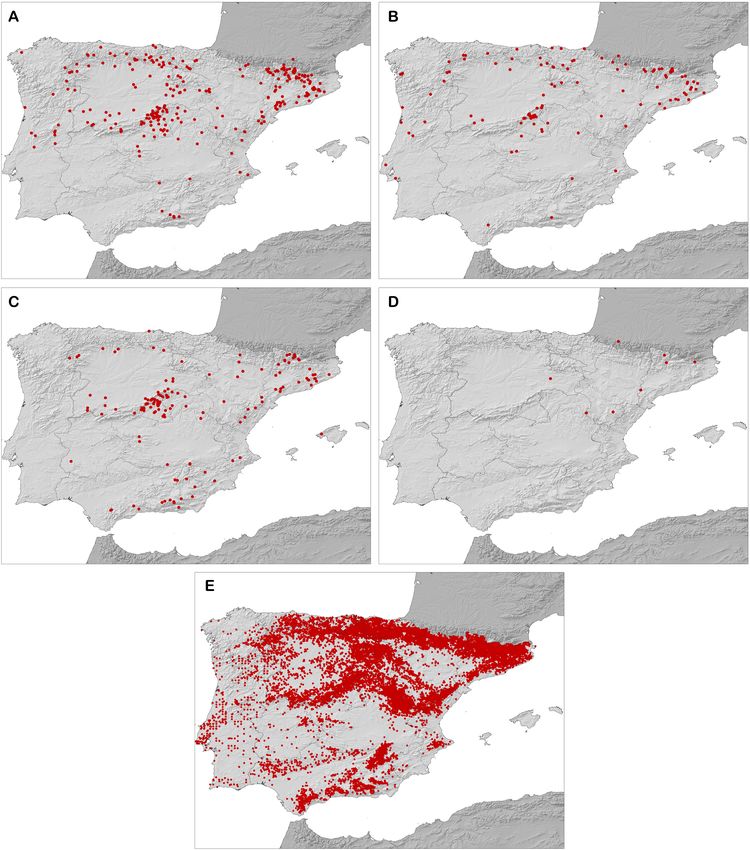
Sardón-Gutiérrez et al., Eur. J. Entomol. 118: 31–45, 2021                                               doi: 10.14411/eje.2021.004

nervosa and D. spinosissimae induce mainly small spheri-          are probably the main contributors to species niche delimi-
cal and unilocular galls on leaves, and D. rosae, D. mayri        tation at a large scale (Barbet-Massin et al., 2013).
and D. fructuum cause larger, multilocular galls on stems,           Currently, there are a few cynipid ecological models,
leaves or hips.                                                   all of them related to Fagaceae hosts (Rodríguez et al.,
   D. eglanteriae and D. nervosa form a complex of cryptic        2015; Gil-Tapetado et al., 2018). This paper presents, for
galls that are morphologically indistinguishable, potential-      the first time, an accurately niche suitability modelling of
ly leading to misidentification. Both species are univoltine      Diplolepis communities on Rosaceae hosts.
and bisexual. On the other hand, the galls of D. spinosis-           The main aim of this study is to determine potentially
simae are produced on the leaves, the fruits and sometimes        favourable areas for gall-inducing cynipids associated with
the stems of different species of the genus Rosa, mainly          shrubs of the family Rosaceae on the Iberian Peninsula.
shrubs of Rosa pimpinellifolia L.                                 This objective is achieved by comparing different eco-
   The species D. rosae and D. mayri induce conspicuous           logical models incorporating predictive climatic and en-
and striking galls and are thus the most collected and re-        vironmental variables, Diplolepis records and a suitability
corded within the genus. The galls of both species develop        model of host plants, which is used to limit the distribu-
on buds or twigs, but sometimes on leaflets or fruits. The        tion. These favourability models are used to analyse the
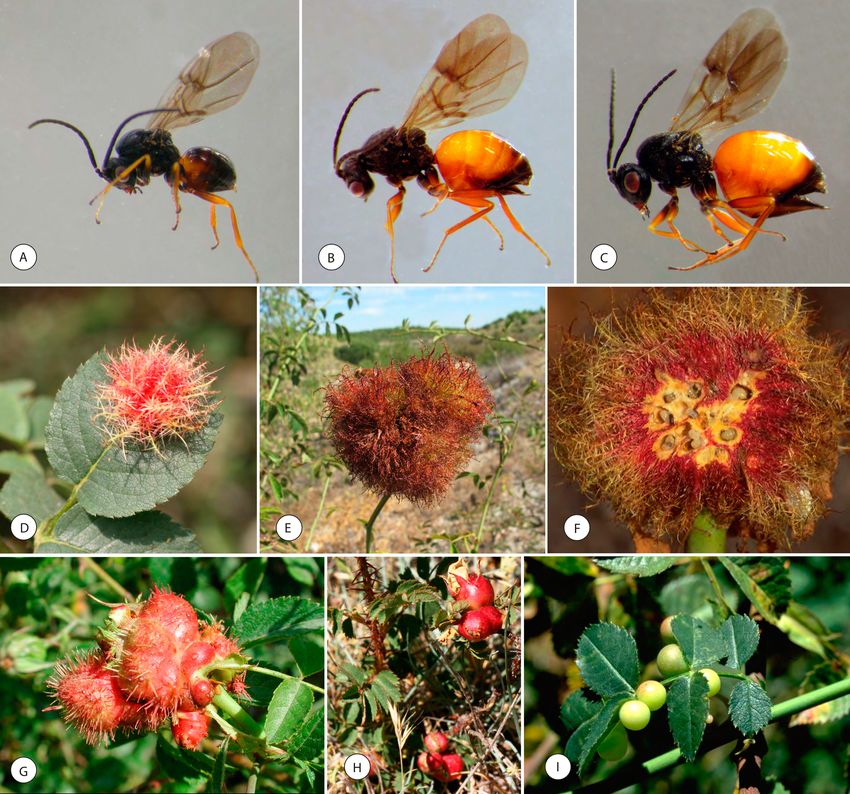
galls of D. mayri (Fig. 1G) have a sparse coating of stiff        association of species of Diplolepis with biotic and abiotic
spines instead of the filamentous appendix of the so-called       variables and draw conclusions about their distribution on
‘rose bedeguar’ galls of D. rosae (Fig. 1D–F). The life cycle     the Iberian Peninsula.
of both species is univoltine, but their modes of reproduc-
tion vary with their geographical range, particularly on the      MATERIALS AND METHODS
Iberian Peninsula. While males of D. rosae are very scarce        Selection of presence data
or virtually absent in most areas on the Iberian Peninsula,          To create the niche models, we compiled a dataset of the pres-
the sex ratio of this species is closer to 1 : 1 in the rest of   ence of five species of Diplolepis recorded in southern Europe:
Europe. In fact, some studies in other areas have linked          D. eglanteriae/nervosa, D. spinosissimae, D. rosae and D. mayri
latitude with the relative presence/abundance of males of         (Fig. 1). This was compiled using the published and georefer-
D. rosae (Askew, 1960; Stille, 1984, 1985). Males of D.           enced records of each species. All records for synonymous spe-
                                                                  cies names were also considered acceptable and included in the
mayri (Fig. 1A) are not abundant in non-Iberian Europe,
                                                                  data matrix (Nieves-Aldrey, 2001a). This data was compiled from
but other authors have discovered differences in the repro-       different sources up to 2017 (Table 1, Fig. 2A–D, Table S1). As
ductive biology of this species on the Iberian Peninsula,         species of Diplolepis are dependent on Rosa species, we used the
where it does not undergo thelytokous parthenogenesis as          modelled distribution of the host plant to define the limits of the
it does in other countries. Instead, the Iberian D. mayri has     cynipid distributions. Records of Rosa, consisting of 17,943 pres-
a bisexual generation and a sex ratio close to 1 : 1 (Pujade-     ences (Fig. 2E), were compiled from GBIF (Global Biodiversity
Villar, 1983; Nieves-Aldrey, 1989; Nieves-Aldrey, 2001a).         Information Facility) datasets (GBIF Data Portal, 2016) and used
   From the biogeographical and macroecological point             in niche models. Both cynipid and host plant records were cleaned
of view, determining the potential distribution of organ-         by eliminating geographically redundant (we included only one
                                                                  presence record per km2) and low accuracy georeferenced data.
isms is an important tool for the ecological and biological
conservation of animals (Guisan & Zimmermann, 2000;               Selection of variables
Guisan et al., 2006; Peterson, 2006). Using mathematical             Bioclimatic and environmental variables can be used to predict
algorithms to model the potential distribution of species         the presence of each species of gall wasp. In the present study, dif-
has allowed the determination of those areas where there is       ferent variables were used to model cynipid-gall and host Rosa,
a greater probability of finding them. Niche models, suit-        because it is important to distinguish those variables that have a
ability models or predictive habitat distribution models are      direct effect on cynipid biology and those that influence the wasp
                                                                  through its host plant (Rodriguez et al., 2015; Gil-Tapetado et
empirical or mathematical approximations of the ecologi-
                                                                  al., 2018).
cal niche of a species constructed from their presence and/          The WorldClim version 1.4 (Hijmans et al., 2005) variables
or absence records and variables that limit and define this       at a resolution of 30 arc seconds were used in the niche models
niche (Araújo & Guisan, 2006; Austin, 2007; Peterson et           of Diplolepis. As they emerge from their galls in spring (March,
al., 2011).                                                       April, and May), only the spring variables Bio04 (temperature
   It is important that these niche models are based on envi-     seasonality), Bio08 (mean temperature in wettest quarter), Bio13
ronmental conditions in the regions studied and that the po-      (precipitation in wettest month), Bio15 (precipitation seasonal-
tential distribution models provide a distribution of habitat     ity) and Bio16 (precipitation in wettest quarter) were used in
suitability for each species (Franklin, 2009; Zimmermann          these analyses, because they directly affect adult Diplolepis.
                                                                  Galls isolate the wasps from external environmental conditions,
et al., 2010). The variable selection procedure is quite im-
                                                                  although some variables, such as snow cover, glycerol concentra-
portant since these variables are going to limit and define       tion or mild winter temperatures, affect the survival of those that
the habitat of a species. In addition, selecting appropriate      overwinter in galls (Somme, 1964; Shorthouse, 1980; Williams
predictor variables will decide if the model is essential for     et al., 2003). The free-living stage (i.e., adult cynipid), howev-
predicting species distributions (Guisan & Zimmermann,            er, is affected directly by bioclimatic conditions (Shorthouse &
2000; Jiménez-Valverde et al., 2011). Climatic variables          Rohfrisch, 1992).

32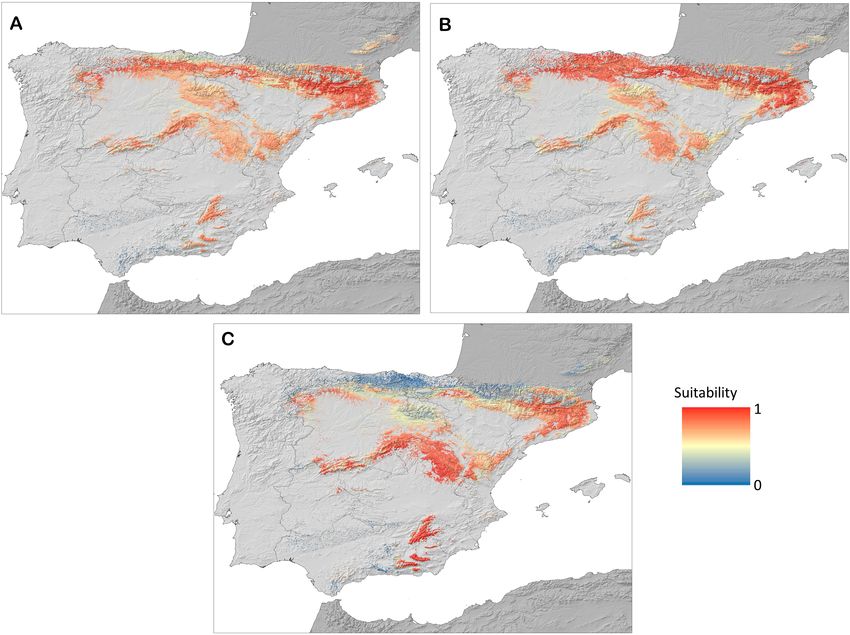
Sardón-Gutiérrez et al., Eur. J. Entomol. 118: 31–45, 2021                                                     doi: 10.14411/eje.2021.004

Fig. 1. Adults and galls of species of Diplolepis. A – adult male Diplolepis mayri; B – adult female D. mayri; C – adult female D. rosae; D–F
– galls of D. rosae and a section of a gall; G – D. mayri gall; H – D. spinosissimae gall; I – galls of D. eglanteriae/nervosa.

   We used cluster dendrogram analysis of correlation distances         lated with other factors, thereby indicating that it was appropriate
to identify possible correlation biases between the variables.          to eliminate them from the analysis (Kutner et al., 2004; O’Brien,
First, we chose all the variables that exceeded a value of 0.3 (or      2007; Lin et al., 2011). All the variables in the dendrogram satis-
less than 70% correlation). Second, we selected all the uncorrelat-     fied the threshold value condition (VIF > 5) and no variable was
ed variables (those variables that did not form a cluster); finally,    excluded from the analysis.
we chose the variable with the greatest biological significance            The selection of environmental variables for the construction
for Diplolepis from the clusters of correlated variables. In cases      of the Rosa model was difficult because these plants are widely
in which a variable did not have a clear biological meaning, the        distributed and it is a group with many species (Zhang & Gande-
most derived variable was chosen (i.e., the variable that refers        lin, 2003; Yan et al., 2005; Koopman et al., 2008). The ecological
to a specific period of the year). Bio16 was excluded from the          and edaphic conditions selected are general, which makes it diffi-
modelling of Diplolepis due to its high correlation with the rest of    cult to determine those conditions that are most likely to influence
the variables (Fig. 3A). In addition, we applied a forward elimina-     its presence (Castroviejo et al., 1998). We used the modelling
tion process, variance inflation factor (VIF), to the variables. VIF    methods previously mentioned and selected the most general cli-
measures how much the variance in a regression coefficient in-          matic variables from WorldClim (Bio01 (annual mean tempera-
creases when predictors are correlated. We computed the VIF of          ture), Bio02 (mean diurnal range), Bio03 (isothermality), Bio07
the variables using R version v 3.3.1 (R Development Core Team,         (temperature annual range) and Bio12 (annual precipitation)) and
2008) and RStudio 0.99.903 (RStudio Team, 2016) in the pack-            other non-climatic variables (available water capacity (ESDB,
age HH 3.1–32 (Heiberger & Holland, 2015). The threshold value          2004), percentage of clay (ESDB, 2004), lithology (IGME,
of 5 was used to determine which variables were strongly corre-         2020), proximity to water masses (rivers, lakes, reservoirs and

                                                                                                                                          33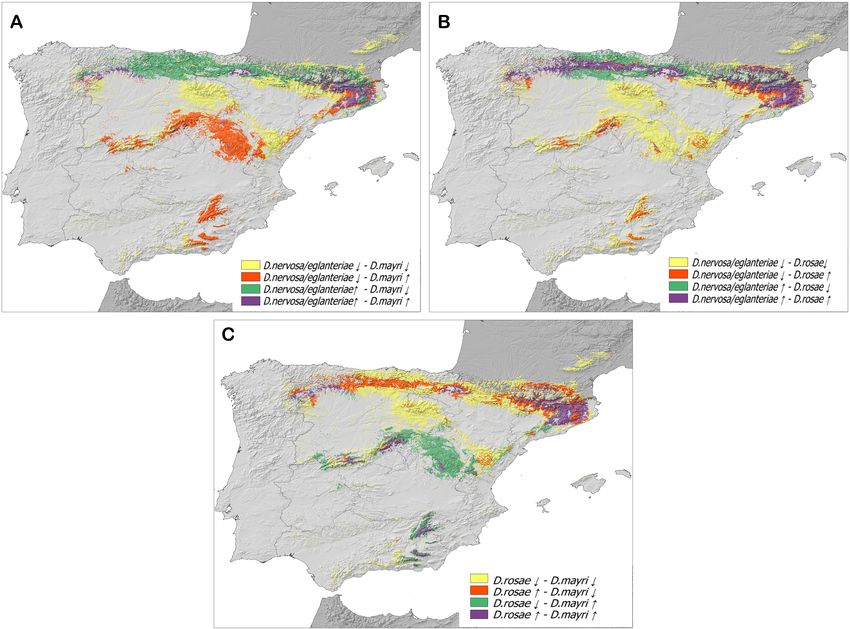
Sardón-Gutiérrez et al., Eur. J. Entomol. 118: 31–45, 2021                                                  doi: 10.14411/eje.2021.004

Table 1. Record of presence of different species of Diplolepis on the Iberian Peninsula and the sources of the information (Source) from
which they were compiled. N indicates the number of records per source.
Species                                                         Source                                            N      Presence data
                                                 Nieves-Aldrey (1986, pers. comm.)                                 5
Diplolepis spinosissimae                                                                                                        8
                                                  Pujade-Villar (1991, 1993, 1996)                                 3
                                                           Cogolludo (1921)                                        4
                                        Nieves-Aldrey (1984, 1989, 1995, 2001b, pers. comm.)                      36
Diplolepis eglanteriae
                                                  Pujade-Villar (1991, 1993, 1996)                                12
and                                                                                                                            115
                                                          Tavares (1931a, b)                                      13
Diplolepis nervosa
                                                    Vilarrúbia & Vilarrúbia (1933)                                 3
                                                       BiodiversidadVirtual.org                                   47
                                                          Cogolludo (1921)                                         5
                                                       Lázaro e Ibiza (1917)                                       1
                                    Nieves-Aldrey (1984, 1986, 1989, 1995, 2001b, pers. comm.)                    55
Diplolepis mayri                           Pujade-Villar (1983, 1987, 1991, 1993, 1996)                           22           147
                                                         Tavares (1931a, b)                                        1
                                                      Vilarrúbia (1933, 1936)                                      2
                                                      BiodiversidadVirtual.org                                    61
                                                            Codina (1920)                                          1
                                                           Cogolludo (1921)                                        7
                                                      Fernández de Gata (1901)                                     1
                                                        Lázaro e Ibiza (1917)                                      1
                                           Nieves-Aldrey (1981, 1985, 1986, 1989, 2001b)                          76
Diplolepis rosae                            Pujade-Villar (1983, 1987, 1991, 1993, 1996)                          40           282
                                                          Tavares (1931a, b)                                      16
                                                            Ventalló (1905)                                        1
                                           Vilarrúbia & Vilarrúbia (1933); Vilarrúbia (1936)                       2
                                                       BiodiversidadVirtual.org                                  129
                                                                 GBIF                                              8

other continental water bodies) (modified from EEA, 2009) and            We evaluated these models using area under the curve (AUC)
land uses from CORINE Land Cover 2006 (EEA, 2012) resized             statistics. Finally, we selected models that had a maximum suit-
to 1 km2). Bio2 and available water capacity were not included in     ability value of at least 0.80 to obtain an improved estimation
the final set of variables (Fig. 3B).                                 of the potential geographic distribution of a species. The models
                                                                      selected for each species were joined to create an average con-
Modelling the distributions of species
                                                                      sensus map.
   We used the following algorithms: generalized linear models           ArcGIS 10.1 software (ESRI, 2011) was used to transform
(GLMs) (McCullagh & Nelder, 1989), generalized additive mod-          highly suitable areas (i.e., areas with a suitability greater than
els (GAMs) (Hastie & Tibshirani, 1990, Yee & Mitchell, 1991),         or equal to 0.70) indicated by the host plant consensus models
random forest (RF) (Breiman, 2001) and MaxEnt (Phillips et            into buffer zones of high suitability – i.e., zones with a radius of
al., 2006). The first three were created using R version 3.3.1 (R     one kilometre around the presence data for Rosa, which consti-
Development Core Team, 2008) and RStudio version 0.99.903             tute possible action areas for the species. Presence data for the
(RStudio Team, 2016) in the packages dismo 1.1-1 (Hijmans et          genus Rosa were also included, and corresponding buffers with a
al., 2015), mgcv 1.8-12 (Wood, 2016) and randomForest 4.6-12          one-kilometre radius were generated around the presence points.
(Breiman et al., 2015), with 3,000 trees and a node number of 3.      We overlapped this mask layer with each consensus model of
We used MaxEnt version 3.4.1 (Phillips & Dudik, 2008) with the        Diplolepis species to obtain the final models. These results reflect
default configuration, including a regularization parameter of 1      the high and low probabilities of the presence of each cynipid
and 10 replicates.                                                    within their host plant areas on the Iberian Peninsula.
   For both the Rosa and Diplolepis models, we performed back-           The complementary maps of the Diplolepis species were devel-
ground point generation tests following and improving upon the        oped in ArcGIS 10.1 (ESRI, 2011) based on the most favourable
methodology of Gil-Tapetado et al. (2018), using the maximum          areas (areas with values greater than 0.70). Finally, these maps
and minimum values of the predictor variables as parameters of        were combined by twos. In addition, the possible associations of
habitability for each species. The sum of the resulting areas be-     environmental variables Bio04 (temperature seasonality), Bio15
tween the maximum and minimum values of each predictive vari-         (precipitation seasonality) and Bio16 (precipitation in wettest
able was classified as habitable area in which to generate random     quarter) from WorldClim version 1.4 (Hijmans et al., 2005) with
background points; the excluded areas were classified as non-         the potential distribution areas of the Diplolepis species were
habitable zones in which to generate the pseudo-absences.             checked using boxplots in the ggplot2 package in RStudio.
   Four individual models (GLM, GAM, MaxEnt and RF) were
developed for the host plant taxa (genus Rosa), D. rosa and D.        RESULTS
mayri, and the group formed by D. eglanteriae and D. nervosa,
the galls of which are not externally morphologically distinguish-      The results from the RF, GLM and GAM algorithms
able. We could not develop models for D. spinosissimae (Fig. 1H)      were selected for the species D. eglanteriae/nervosa and
because of the few records for this species from the Iberian Pen-     D. rosae because they had a maximum suitability of more
insula (Fig. 2D, Table 1). With respect to host plant taxa, models    than 0.80. In the case of D. mayri, only the results of the RF
were made including different species of the genus Rosa.              and GAM met this requirement. In all these cases, Max-
                                                                      Ent did not exceed a maximum suitability of 0.80 and we

34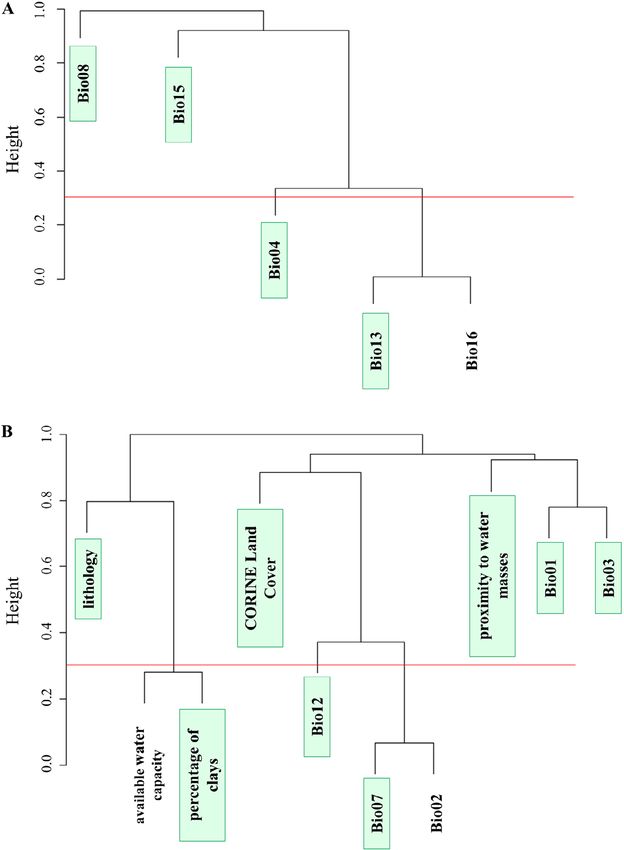
Sardón-Gutiérrez et al., Eur. J. Entomol. 118: 31–45, 2021                                                 doi: 10.14411/eje.2021.004

Fig. 2. Maps of the Iberian Peninsula showing the presence points for the species. A – Diplolepis rosae; B – Diplolepis eglanteriae/ner-
vosa; C – Diplolepis mayri; D – Diplolepis spinosissimae; E – Rosa.

did not use this algorithm in the average consensus mod-              Below, are the detailed results for each of the species of
els. RF, GLM and GAM were selected to produce the final               Diplolepis.
model for Rosa (Table 2).                                               Diplolepis rosae (Figs 1C–F, 4A) is the most common
  The models indicate that southern areas of the Iberian              species of this genus on the Iberian Peninsula. According
Peninsula are more suitable for D. mayri (Fig. 4C) and                to the presence points and areas of maximum suitability,
northern areas more suitable for D. eglanteriae/nervosa               this species occurs in areas with a mean annual tempera-
(Fig. 4B), while D. rosae is a generalist, with highly suit-          ture of approximately 11°C and annual precipitation of
able areas throughout the Iberian Peninsula (Fig. 4A).                700–800 mm and at an average altitude of approximately
                                                                      900–1000 m a.s.l. In the areas in which D. rosae occurs, in

                                                                                                                                     35
Sardón-Gutiérrez et al., Eur. J. Entomol. 118: 31–45, 2021 doi: 10.14411/eje.2021.004
Table 2. Results of (AUC) area under the curve and the maximum
suitability values of the four models used to develop each consen-
sus model.
Maximum
Species Model AUC
suitability value
GAM 0.757 0.88
RF 0.890 0.91
Rosa
GLM 0.734 0.85
Maxent 0.623 0.59
GAM 0.715 0.91
Diplolepis eglanteriae/ GLM 0.721 0.84
nervosa RF 0.931 0.88
Maxent 0.768 0.69
GAM 0.794 0.85
GLM 0.796 0.81
Diplolepis rosae
RF 0.905 0.85
Maxent 0.764 0.69
GAM 0.814 0.86
RF 0.911 0.93
Diplolepis mayri
GLM 0.561 0.76
Maxent 0.787 0.70
the warmest quarter, the mean temperature was 19°C and
there was approximately 160 mm of precipitation, while
in the coldest quarter, the mean temperature was 4°C and
there was approximately 190 mm of precipitation (Table
3). The presence areas for D. rosae are diverse, with suit-
ability percentages of > 0.70 in all areas. The areas with
the most suitable ecological conditions are concentrated in
the region of the Catalonian Pyrenees (north eastern Ibe-
Fig. 3. Cluster dendrogram analysis based on the correlation coef- rian Peninsula) and Montes de León (north western Iberian
ficient distance for the following datasets. A – cynipid-related varia- Peninsula) (Fig. 4A).
bles: Bio04 (temperature seasonality), Bio08 (mean temperature of The most favourable areas for D. eglanteriae and D. ner-
wettest quarter), Bio13 (precipitation of wettest month), Bio15 (pre-
cipitation seasonality) and Bio16 (precipitation of wettest quarter);
vosa (Fig. 1I, Fig. 4B) are in mountain ranges. The results
B – host plant-related variables: Bio01 (annual mean temperature), indicate that areas in the Cantabrian Mountains and Pyr-
Bio02 (mean diurnal range), Bio03 (isothermality), Bio07 (tempera- enees (in the north of Iberian Peninsula), both the Central
ture annual range), Bio12 (annual precipitation), available water and Iberian Mountain Ranges (central Iberian Peninsula),
capacity, percentage of clays, lithology, proximity to water masses
and CORINE Land Cover (derived from land uses in the CORINE
and part of the Baetic System (in the south of Iberian Pen-
Land Cover 2006). insula) are the most suitable areas (with suitability percent-
Table 3. Different measurements of climatic variables Worldclim and altitude in the points of presence and of high suitability for the
Diplolepis rosae, with the average value (AV), standard deviation (SD) and minimum (MIN) and maximum (MAX) values for each.
PRESENCE DATA HIGH SUITABILITY
Variable Code
AV SD MIN MAX AV SD MIN MAX
Altitude Alt 942 409 26 2172 1009 397 24 2281
Annual mean temperature Bio01 10.93 2.53 3.40 16.00 10.15 2.11 3.70 16.00
Mean diurnal range
Bio02 9.60 1.38 5.90 12.30 9.17 1.37 6.90 12.50
[Mean of monthly (max temp – min temp)]
Isothermality [(Bio2/Bio7) × 100] Bio03 3.63 0.24 3.00 4.50 3.61 0.29 2.90 4.30
Temperature seasonality (standard deviation × 100) Bio04 576.52 59.51 330.80 689.30 555.38 46.12 456.10 682.00
Max temperature of warmest month Bio05 25.83 3.40 16.20 34.10 24.37 2.35 16.60 30.90
Min temperature of coldest month Bio06 –0.25 2.43 –7.40 6.90 –0.64 2.27 –6.40 5.80
Temperature annual range (Bio5–Bio6) Bio07 26.08 3.02 15.70 32.80 25.01 2.54 20.20 32.90
Mean temperature of wettest quarter Bio08 9.98 3.63 2.90 20.30 9.41 4.12 3.00 20.70
Mean temperature of driest quarter Bio09 14.01 7.72 –2.40 24.20 11.37 7.15 –2.00 22.90
Mean temperature of warmest quarter Bio10 18.62 2.73 10.60 24.20 17.54 2.16 11.10 23.00
Mean temperature of coldest quarter Bio11 3.98 2.46 –3.10 10.10 3.45 2.11 –2.50 9.50
Annual precipitation Bio12 716.61 225.09 373.00 1280.00 829.35 152.00 432.00 1260.00
Precipitation of wettest month Bio13 85.36 26.18 44.00 178.00 96.86 15.12 53.00 139.00
Precipitation of driest month Bio14 32.28 19.15 6.00 85.00 42.66 14.72 11.00 82.00
Precipitation seasonality (coefficient of variation) Bio15 27.42 9.39 13.00 56.00 23.23 6.25 13.00 45.00
Precipitation of wettest quarter Bio16 229.99 73.57 121.00 481.00 259.32 42.51 146.00 368.00
Precipitation of driest quarter Bio17 121.39 57.80 34.00 291.00 153.23 44.44 50.00 283.00
Precipitation of warmest quarter Bio18 139.24 70.75 34.00 294.00 175.51 55.36 50.00 298.00
Precipitation of coldest quarter Bio19 180.88 74.33 73.00 477.00 201.13 52.50 101.00 362.00
36Sardón-Gutiérrez et al., Eur. J. Entomol. 118: 31–45, 2021 doi: 10.14411/eje.2021.004
Table 4. Different measurements of climatic variables Worldclim and altitude in the points of presence and of high suitability for the
Diplolepis eglanteriae/nervosa gall complex, with the average value (AV), standard deviation (SD) and minimum (MIN) and maximum
(MAX) values for each.
PRESENCE DATA HIGH SUITABILITY
Variable Code
AV SD MIN MAX AV SD MIN MAX
Altitude Alt 869 485 3 1951 939 432 –3 2292
Annual mean temperature Bio01 11.13 2.82 3.50 17.10 9.97 2.44 2.50 16.40
Mean diurnal range
Bio02 9.29 1.51 5.90 12.10 8.74 1.18 5.80 12.20
[Mean of monthly (max temp – min temp)]
Isothermality [(Bio2/Bio7) × 100] Bio03 3.67 0.29 3.10 4.50 3.66 0.29 2.90 4.50
Temperature seasonality (standard deviation × 100) Bio04 552.51 76.27 332.20 687.60 520.12 46.75 332.40 674.70
Max temperature of warmest month Bio05 25.37 3.23 16.30 33.40 23.26 2.22 15.10 29.50
Min temperature of coldest month Bio06 0.35 3.23 –6.70 8.40 –0.26 2.78 –7.60 7.70
Temperature annual range (Bio5–Bio6) Bio07 25.02 3.60 15.80 32.50 23.52 2.23 15.60 32.50
Mean temperature of wettest quarter Bio08 9.72 3.72 2.00 19.00 8.49 3.74 1.70 19.20
Mean temperature of driest quarter Bio09 14.01 7.44 –0.90 23.60 12.56 6.79 –2.40 23.10
Mean temperature of warmest quarter Bio10 18.48 2.72 10.60 23.60 16.86 2.26 9.60 23.30
Mean temperature of coldest quarter Bio11 4.45 3.08 –2.80 12.00 3.65 2.64 –3.70 10.20
Annual precipitation Bio12 787.10 255.02 389.00 1484.00 908.00 155.44 508.00 1407.00
Precipitation of wettest month Bio13 95.48 34.10 44.00 234.00 104.69 16.84 58.00 202.00
Precipitation of driest month Bio14 34.07 19.98 3.00 81.00 48.22 13.48 12.00 88.00
Precipitation seasonality (coefficient of variation) Bio15 28.48 11.78 13.00 66.00 21.17 5.14 13.00 51.00
Precipitation of wettest quarter Bio16 258.12 93.85 127.00 597.00 282.09 45.54 159.00 564.00
Precipitation of driest quarter Bio17 127.95 60.86 25.00 269.00 172.95 40.87 58.00 299.00
Precipitation of warmest quarter Bio18 145.77 72.40 29.00 280.00 188.97 46.69 59.00 299.00
Precipitation of coldest quarter Bio19 212.58 101.85 75.00 580.00 232.32 56.84 102.00 564.00
Table 5. Different measurements of climatic variables Worldclim and altitude in the points of presence and of high suitability for Diplolepis
mayri, with the average value (AV), standard deviation (SD) and minimum (MIN) and maximum (MAX) values for each.
PRESENCE DATA HIGH SUITABILITY
Variable Code
AV SD MIN MAX AV SD MIN MAX
Altitude Alt 956 406 21 2198 1110 370 10 2313
Annual mean temperature Bio01 11.54 2.19 5.00 16.00 10.53 1.86 5.10 16.90
Mean diurnal range
Bio02 10.13 1.38 6.10 12.30 10.22 1.56 6.90 12.50
[Mean of monthly (max temp – min temp)]
Isothermality [(Bio2/Bio7) × 100] Bio03 3.61 0.21 3.00 4.00 3.62 0.23 2.90 4.20
Temperature seasonality (standard deviation × 100) Bio04 606.60 48.93 367.00 689.30 607.78 40.56 495.30 678.80
Max temperature of warmest month Bio05 27.40 2.75 18.20 33.50 26.42 2.37 18.60 33.20
Min temperature of coldest month Bio06 –0.16 2.28 –5.10 6.60 –1.27 2.18 –6.00 5.60
Temperature annual range (Bio5–Bio6) Bio07 27.57 2.86 16.20 32.80 27.69 2.89 21.80 32.80
Mean temperature of wettest quarter Bio08 10.16 3.69 2.50 20.30 10.41 3.49 1.90 20.70
Mean temperature of driest quarter Bio09 16.32 6.85 –0.80 23.90 13.87 7.34 –1.10 24.10
Mean temperature of warmest quarter Bio10 19.68 2.22 12.50 24.00 18.69 1.83 12.40 24.30
Mean temperature of coldest quarter Bio11 4.27 2.23 –1.30 9.60 3.27 1.94 –1.50 10.80
Annual precipitation Bio12 602.94 169.22 351.00 1174.00 646.88 162.74 390.00 1139.00
Precipitation of wettest month Bio13 73.64 19.34 47.00 129.00 79.30 16.81 47.00 137.00
Precipitation of driest month Bio14 23.35 15.06 2.00 78.00 29.47 14.00 6.00 76.00
Precipitation seasonality (coefficient of variation) Bio15 30.84 9.29 14.00 68.00 27.32 6.23 15.00 46.00
Precipitation of wettest quarter Bio16 197.29 55.09 116.00 361.00 207.65 46.81 126.00 362.00
Precipitation of driest quarter Bio17 92.82 45.93 20.00 258.00 111.28 42.62 35.00 248.00
Precipitation of warmest quarter Bio18 107.20 62.47 24.00 278.00 129.49 56.94 35.00 291.00
Precipitation of coldest quarter Bio19 153.56 50.28 80.00 349.00 151.89 45.18 77.00 349.00
ages > 0.70) for this species complex on the peninsula. The suitable. These areas are the parts of the Iberian Peninsula
most suitable areas are characterized by an average mean with a Mediterranean climate.
annual temperature of 9.97°C and an annual precipitation Regarding the bioclimatic variables in the highly suit-
of 908 mm (Table 4). The models indicate that the most able areas for each species of Diplolepis (Tables 3, 4 and
suitable areas for these species are coastal areas in Galicia, 5), D. mayri is the species which can occur at higher alti-
Asturias, Cantabria, Basque Country and Catalonia and the tudes (956 m a.s.l. on average) and D. eglanteriae/nervosa
mainland in Navarre and Aragon (northern Spain; Fig. 4B). in areas with the highest rainfall (787.1 mm on average).
Diplolepis mayri (Figs 1A, B and G, 4C), like D. rosae, Moreover, combining the potential distribution maps re-
is common on the Iberian Peninsula. The mountainous vealed suitable areas for all of the species of Diplolepis.
areas in the central and south eastern parts of the peninsula There is a clear separation in the highly suitable areas for
are highly suitable for D. mayri (Table 5), with the Cata- D. eglanteriae/nervosa and D. mayri (Fig. 5A), with those
lonian Pyrenees (north eastern Iberian Peninsula) the most of the former mainly in the northern parts and the latter
37Sardón-Gutiérrez et al., Eur. J. Entomol. 118: 31–45, 2021 doi: 10.14411/eje.2021.004
Fig. 4. Map of the suitable areas on the Iberian Peninsula for the species studied. A – Diplolepis rosae; B – Diplolepis eglanteriae/nervosa;
C – Diplolepis mayri.
in of the central and southern parts of the Iberian Penin- because cynipids have been sampled less in southern
sula. The central mountain ranges are of low suitability for Spain than in central and northern Spain (Nieves-Aldrey,
D. eglanteriae/nervosa and D. rosae, whereas the moun- 2001a). However, more recent samples collected from
tainous areas in the northern part of the Iberian Peninsula 2017 to 2019 by Nieves-Aldrey (unpubl. data) confirm that
are the most favourable for them (Fig. 5B). The species D. rosae is absent or less abundant in the southern part of
D. rosae and D. mayri share the same potential distribu- the Iberian Peninsula. In addition, it is noteworthy that the
tion, with a small area in northern Catalonia region (north records obtained from the citizen science platform Biodi-
eastern Iberian Peninsula) with highest suitability for both versidad Virtual (BVdb, 2016), which were collected by
species (Fig. 5C). many observers and make up ~ 50% of the total records for
The distributions of species of Diplolepis seem to be species of Diplolepis (Table 1), few of these records are
associated with particular climatic variables (Fig. 6). The for the southern Iberian Peninsula. Moreover, many galls
boxplots provide a visual approximation of the predic- are striking structures that are specific to the inducer wasp,
tions of the models: areas highly suitable for D. mayri are which makes them easily identifiable and photographic ev-
in areas with higher temperatures and lower rainfall than idence of their presence at a particular place. Such georef-
those highly suitable for the other species of Diplolepis. erenced data can be used along with previously published
It is also noted that D. eglanteriae/nervosa has the highest records in biogeographical studies of the Iberian Peninsula
tolerance range for rainfall and D. rosae is the most gener- (Goula et al., 2013; Jiménez-Valverde et al., 2019). Based
alist of the species (Fig. 6). on this information and that D. rosae is the most common
species on the Iberian Peninsula, it is possible that the data
DISCUSSION truly reflect a latitudinal gradient in the abundance of these
Suitability models for the different species species on this Peninsula.
of Diplolepis On the other hand, an important aspect of these models
The presence data indicate a greater occurrence of all is the environmental conditions selected and their effects
the species of Diplolepis studied in the northern than in on the distribution of the species analysed. The insects
the southern part of the peninsula (Fig. 2). This may be studied are obligatorily dependent on their Rosa hosts, on
38Sardón-Gutiérrez et al., Eur. J. Entomol. 118: 31–45, 2021 doi: 10.14411/eje.2021.004
Fig. 5. Maps of the potential distributions of low (↓) and high (↑) suitable areas in the region studied for: A – the Diplolepis eglanteriae/
nervosa complex and Diplolepis mayri; B – Diplolepis eglanteriae/nervosa and Diplolepis rosae; C – Diplolepis rosae and Diplolepis mayri.
which they induce galls (Nieves-Aldrey, 2001a). Thus, the has little or no effect on the species richness of Diplolepis
limiting variable is the distribution of their host plant. The (Looney & Eigenbrode, 2010) and that the homogenization
suitability models developed for Rosa were constructed of the landscape provides a perfect habitat for gall inducers
using all the data for wild rose plants, without considering and their community members (László et al., 2018). On the
host specificity or preference of each species of Diplolepis. other hand, microtopographic conditions can mask temper-
Although there is currently no evidence of species of ature differences along altitudinal or latitudinal gradients
Diplolepis being host specific (Stille, 1984; Kohnen et al., over small scales. The interaction between microtopogra-
2011), except in the case of D. spinosissimae for R. pimp- phy, plant cover and solar radiation result in microhabitat
inellifolia, it is possible that the distributions of specific conditions that are not represented by climatic variables
species of Rosa may be a factor affecting the distributions (Scherrer & Körner, 2010, 2011; Scherrer et al., 2011).
of these cynipids. There are 27 species of the genus Rosa Diplolepis rosae has a wider potential distribution than
on the Iberian Peninsula, which are highly polymorphic the rest of the species. For this reason, this species is found
and hybrids are also present, making their identification in most rose bushes on the Iberian Peninsula (Fig. 4A).
by non-specialists difficult (Castroviejo, 1998; Cueto & Most of the D. rosae data used in the present article do not
Giménez, 2009; Calvo & Ross-Nadié, 2016; Tomljenović specify the sex of the galler or the composition and abun-
& Pejić, 2018). For this reason, and in addition to the fact dance of its parasitoid communities. However, in the sum-
that there are no reliable data on the distributions of spe- mer of 2017, Nieves-Aldrey (unpubl. data) found a single
cies of Rosa, all the plant data used were at the genus rather male specimen of D. rosae in the Aracena Mountains in
than the species level. south western Iberian Peninsula (Nieves-Aldrey, 2001a).
Other variables not considered were the effects of habitat This observation matches those of other authors, which in-
fragmentation due to natural and anthropogenic causes and dicate the possibility of a latitudinal gradient (from south to
the microhabitat or microtopographic conditions. Increas- north) in the sex ratio of this species. For example, Askew
ing land use intensity and habitat fragmentation are impor- (1960) and Hoffmeyer (1925) suggest that there is a higher
tant threats to global biodiversity, especially in agricultural abundance of male D. rosae in the northern parts of the
landscapes. Some studies report that landscape diversity peninsula. However, some authors (Rizzo & Massa, 2006;
39Sardón-Gutiérrez et al., Eur. J. Entomol. 118: 31–45, 2021 doi: 10.14411/eje.2021.004
Fig. 6. Boxplots showing the associations between highly suitable areas (> 0.70) for the species of Diplolepis and three bioclimatic vari-
ables: precipitation seasonality (Bio15), temperature seasonality (Bio04) and precipitation in the wettest quarter (Bio16).
László & Tóthmèrèsz, 2011; Todorov et al., 2012) report cies of Diplolepis has not been determined due to the taxo-
the lack of a latitudinal gradient and that the presence of nomic difficulties of identifying each species of wild rose,
D. rosae males depends on more complicated factors, and among other reasons.
also that the endosymbiotic bacteria Wolbachia affect the Diplolepis mayri occurs in the western Palearctic in
sex ratio of this species (Schilthuizen & Stouthamer, 1998; areas of north Africa and Asia Minor (Nieves-Aldrey,
Rizzo & Massa, 2006). The record of a male of D. rosae 2001a). The distribution model for this species (Fig. 4C)
on the Iberian Peninsula indicates the presence of males in revealed that the areas with the highest suitability were
southern Europe, although at a low abundance. However, mainly in mountainous regions in the Mediterranean area
to determine the actual sex ratio of D. rosae, more inten- of the Iberian Peninsula. Unlike D. rosae and D. eglanteri-
sive sampling is needed in southern Europe. ae/nervosa, there is an area of high suitability for D. mayri
The D. eglanteriae/nervosa model (Fig. 4B) reveals that in the southern third of the Iberian Peninsula. This species
the presence data and the maximum suitability for these is distributed in areas with relatively more precipitation
two species occur in mountain forest areas and they avoid seasonality and temperature seasonality, and relatively less
river-valleys (Table 4). In addition, D. eglanteriae and D. rain (Fig. 6, Table 5). This might indicate that D. mayri
nervosa are also abundant in areas near the northern coast is adapted to the Mediterranean climatic conditions in the
of the Iberian Peninsula. It is possible that in mountain- southern Iberian Peninsula, unlike the rest of the species of
ous areas, species of Rosa have local characteristics, e. g. Diplolepis studied.
separation of vegetation patches, shrub size, or distance to
Habitat complementarity
the soil, that are lacking in riverbanks, and that these condi-
tions are favourable for both cynipid species. An example A comparison of the potential distributions of D. eglan-
is provided by Mifsud (2016), who reports that in moun- teriae/nervosa and D. mayri revealed that they occur in
tainous areas, where wild roses grow in the shade of coni- complementary areas, e.g., areas on Iberian Peninsula with
fer trees, they do not flower and galls are not recorded. On highly suitable environmental conditions for D. eglanteriae
the other hand, mountainous areas, particularly mountain and D. nervosa are of low suitability for D. mayri and vice
forests, are favourable in many other ways; for example, versa (Fig. 5A). This phenomenon occurs between species
the spatial configuration of trees favours optimal radiation, in other genera, such as Copris hispanus (Linnaeus, 1758)
temperature and precipitation conditions. The conditions and Copris lunaris (Linnaeus, 1758) (Coleoptera: Scara-
found in mountainous areas, together with being isolated baeidae) (Chefaoui et al., 2004), different species of the
from other areas, may have resulted in there being more or red-striped oil beetle of the genus Berberomeloe Bologna,
different species of Rosa, which could be specific or more 1989 (Coleoptera: Meloidae) (Sánchez-Vialas et al., 2020)
suitable hosts for D. eglanteriae and D. nervosa, than at and among species that compete for resources (De Smedt
lower altitudes. However, the host preference of these spe- et al., 2016).
40Sardón-Gutiérrez et al., Eur. J. Entomol. 118: 31–45, 2021 doi: 10.14411/eje.2021.004
It is possible that the species of Diplolepis studied are overlap the suitable habitat for D. eglanteriae/nervosa, as
allopatric. The areas of high suitability for D. eglanteriae mentioned above.
and D. nervosa occur in the north of the Iberian Penin-
An overview of the distribution of Diplolepis
sula (Euro Siberian areas) and those for D. mayri in central in Europe
and southern parts of the Iberian Peninsula (Mediterranean
areas). These zones are separated by the northern plateau Focusing on the western Palearctic, the glaciation events
of the Iberian Peninsula where host plants are either absent in the Quaternary/Pleistocene are considered to be a key
or scarce. Studies on the structure and genetic diversity of determinant of the distribution of plants and therefore that
these species are likely to reveal significant genetic differ- of cynipids (Taberlet et al., 1998; Hewitt 1999; Rokas et al.,
entiation between them, possibly due to this physical bar- 2003; Stone et al., 2001; Güçlü et al., 2008). Like the Ibe-
rier. The molecular characteristics of the cytochrome b and rian Peninsula, the Anatolian Peninsula was also a glacial
12S genes and different character states (‘number of larval refugium during the European glaciations and have a rich
chambers per gall’, ‘organ bearing the gall’ and ‘surface fauna, including cynipids of the genus Diplolepis. There-
area of the gall’) of species of the Diplolepis reveals that fore, a comparative study of these two peninsulas, with ei-
the species included in our study form two species groups: ther similar or parallel scenarios, can be used to define the
the D. eglanteriae group (including D. eglanteriae and D. evolutionary history of this group in the western Palearctic.
nervosa) and the D. rosae group (including D. rosae, D. In addition, the Anatolian Peninsula is the transition point
fructuum, D. mayri and D. spinosissimae) (Plantard et al., between the continents of Europe, Asia and Africa, and has
1997). Recently, Zhang et al. (2019) published a phylogeny a great variety of natural habitats, ranging from Mediter-
of Diplolepis and Periclisttus based on COI (cytochrome c ranean, Aegean and Black Sea beaches to towering coastal
oxidase subunit I) that divides the genus Diplolepis into and interior mountains, including deeply incised valleys,
two major monophyletic clades, the ‘flanged femur’ clade expansive steppes and fertile alluvial plains along with
and ‘leaf galler’ clade, the latter of which includes three arid, rocky slopes. Ronquist & Liljeblad (2001) report that
subclades: the Nearctic leaf galler subclade, the Palearctic many of the ancestral cynipid relationships occur in the
multichambered subclade and a mixed leaf gall subclade. eastern Mediterranean and Turano-Eremial region, indicat-
The Palearctic multichambered subclade includes the D. ing that this area was possibly the centre of speciation for
rosae group (D. fructuum, D. mayri and D. rosae), D. spi- cynipid gallers (Mete & Demirsoy, 2012).
nosissimae and two undescribed species. Finally, the rest The absence of D. fructuum from the Iberian Peninsula
of the species included in our study are classified in the (the only other species of western Palearctic Diplolepis
mixed leaf gall subclade, which distinguishes between the missing in this territory) and the presence of all the Euro-
D. eglanteriae Palearctic group (D. japonica and D. eg- pean species of this genus on the Anatolian Peninsula seem
lanteriae) and the D. eglanteriae Nearctic group and D. to indicate an east-west gradient in the richness of species
nervosa. The different lineages of the subclades that con- of cynipids. In the past, D. fructuum was considered a geo-
tain D. mayri and D. rosae (Palaearctic multichambered graphic race of D. mayri, but molecular techniques confirm
subclade) and D. eglanteriae and D. nervosa (mixed leaf they are different species (Plantard et al., 1997; Güçlü et
gall subclade) could partially explain the observed habi- al., 2008; Zhang et al., 2019). It is possible that Diplolepis
tat complementarity between D. mayri and D. eglanteriae/ spread from eastern Europe to the west; in this case, the
nervosa. Iberian Peninsula is the western limit to the distribution of
There is an overlap in the most suitable areas for this genus, with greater species richness in the Nearctic and
Diplolepis eglanteriae/nervosa and D. rosae in the north- eastern Palearctic regions.
ern mountain ranges (Fig. 5B); therefore, there could po- In the case of the suitable areas for D. eglanteriae and D.
tentialy be interspecific competition between these species nervosa there are similarities between the Anatolian and
in this area. However, D. rosae and D. eglanteriae/nervosa Iberian peninsulas. The most suitable areas on the Iberian
exploit their host plants in different ways. Diplolepis eg- Peninsula for Diplolepis eglanteriae/nervosa are around
lanteriae/nervosa induce galls on the petioles or under- high-altitude large mountain ranges. This is also the case
sides of leaves and D. rosae on the buds of the stems, leaf- on the Anatolian Peninsula, where D. eglanteriae and D.
lets or fruits (Nieves-Aldrey, 2001a). It is possible that if nervosa occur in provinces enclosed by mountain ranges at
two different species have overlapping distributions, they altitudes greater than 2,000 m (Güçlü et al., 2008; Katılmıs
might use different parts of the same resource or develop & Kıyak, 2010; Mete & Demirsoy, 2012). This supports
strategies that allow them to exploit the same resource the hypothesis that both the Iberian and Anatolian Penin-
without competing. For example, the distributions of other sulas were Pleistocene glacial refugia of these species. In
Hymenoptera [Apis mellifera (Linnaeus, 1758) and Bom- addition, D. eglanteriae and D. nervosa spread from west-
bus terrestris (Linnaeus, 1758)] also largely overlap with ern Asia into Europe along major mountain ranges, such
respect to the plants they pollinate; however, their pollina- as the Carpathians in Romania, Serbia and the Ukraine
tion activities have different schedules (Perez, 2013). For (Melika, 2006; Marković, 2015; Prázsmári et al., 2017),
the two species with most records (D. rosae and D. mayri), Malta (Mifsud, 2016) and the Scandinavian Mountains at
the most suitable areas occur in the north eastern and cen- their northern latitudinal limit (Bergqvist, 2010). Based on
tral parts of the Iberian Peninsula (Fig. 5C) where they these facts and our distribution models, which indicate that
D. eglanteriae and D. nervosa occur in the Eurosiberian
41Sardón-Gutiérrez et al., Eur. J. Entomol. 118: 31–45, 2021 doi: 10.14411/eje.2021.004
region, it is likely that glaciation events may have limited assessment using GIS tools: a case study of Iberian Copris spe-
the distributions of these species, which were able to adapt cies. — Biol. Conserv. 122: 327–338.
to cold and high-altitude conditions (Fig. 6, Table 4). On CODINA A. 1920: Recull de zoocecidies catalanes. — Butl. Inst.
the other hand, D. rosae seems to have been able to spread Catalana Hist. Nat. 20: 178–187 [in Catalan].
COGOLLUDO J. 1921: Contribución al conocimiento de las zooce-
and adapt to different temperate conditions (Table 3), al-
cidias de España. — Trab. Mus. Nac. Cienc. Nat. (Ser. Bot.)
though the scarcity of this species in the southern parts 16: 1–117.
of the Iberian Peninsula seems to indicate it has a Euro CSÓKA G., STONE G.N. & MELIKA G. 2005: The biology, ecology
Siberian distribution. Diplolepis mayri seems to have an and evolution of gall wasps. In Raman A., Schaefer C.W. &
affinity for Mediterranean conditions as the highly suitable Withers T.M. (eds): Biology, Ecology and Evolution of Gall-
areas for this species are on the southern plateau of the Ibe- Inducing Arthropods. Science Publisher, Enfield, New Hamp-
rian Peninsula and complementary to those of D. rosae and shire, pp. 573–642.
Diplolepis eglanteriae/nervosa. CUETO M. & GIMÉNEZ E. 2009: Family Rosaceae. In Blanca G.,
Cabezudo B., Cueto M., Fernández López C. & Morales Torres
ACKNOWLEDGEMENTS. We would like to thank MNCN-CSIC, C. (eds): Flora Vascular de Andalucía Oriental. Universidades
Biodiversidad Virtual and the Department of Biodiversity, Ecol- de Almería, Jaén y Málaga, Granada, pp. 869–904.
ogy and Evolution of Complutense University for their collabora- DE SMEDT P., WUYTS K., BAETEN L., DE SCHRIJVER A., PROESMANS
tion in the collection of presence data for species of Diplolepis W., DE FRENNE P., AMPOORTER E., REMY E., GIJBELS M., HERMY
and all the information they provided us on these cynipids. M. ET AL. 2016: Complementary distribution patterns of arthro-
pod detritivores (woodlice and millipedes) along forest edge-
REFERENCES to-interior gradients. — Insect Conserv. Divers. 9: 456–469.
EEA (EUROPEAN ENVIRONMENT AGENCY) 2009: WISE Large Rivers
ABE Y., MELIKA G. & STONE G.N. 2007: The diversity and phylo-
and Lakes Raster Data. URL: https://www.eea.europa.eu/data-
geography of cynipid gallwasps (Hymenoptera: Cynipidae) of
and-maps/data/wise-large-rivers-and-large-lakes (last accessed
the oriental and eastern Palearctic regions, and their associated
Jan. 2018).
communities. — Orient. Insects 41: 169–212.
EEA (EUROPEAN ENVIRONMENT AGENCY) 2012: Corine Land Cover
ARAÚJO M.B. & GUISAN A. 2006: Five (or so) challenges for spe-
2006 Raster Data. URL: https://www.eea.europa.eu/data-and-
cies distribution modelling. — J. Biogeogr. 33: 1677–1688.
maps/data/clc-2006-raster (last accessed Jan. 2018).
ASKEW R.R. 1960: Some observations on Diplolepis rosae (L.)
ESDB (EUROPEAN SOIL DATABASE) 2004: The European Soil Da-
(Hym. Cynipidae) and its parasites. — Entomol. Mon. Mag.
tabase Distribution Ver. 2.0. URL: https://esdac.jrc.ec.europa.
95: 191–192.
eu/content/european-soil-database-v20-vector-and-attribute-
AUSTIN M.P. 2007: Species distribution models and ecological
data#tabs-0-description=0 (last accessed Jan. 2018).
theory: a critical assessment and some possible new approach-
ESRI (ENVIRONMENTAL SYSTEMS RESEARCH INSTITUTE) 2011: Arc-
es. — Ecol. Model. 200: 1–19.
Gis 10.1 Geographical Information System. URL: https://
BARBET-MASSIN M., ROME Q., MULLER F., PERRARD A., VILLEMANT
www.esri.com/es-es/home (last accessed Jan. 2018).
C. & JIGUET F. 2013: Climate change increases the risk of inva-
FERNÁNDEZ DE GATA M. 1901: Nuevos estudios sobre las agallas.
sion by the yellow-legged hornet. — Biol. Conserv. 157: 4–10.
— Bol. R. Soc. Esp. Hist. Nat. 1: 194–199, 231–331, 345–353,
BELIZIN V.I. 1957: Gall wasps (Hymenoptera: Cynipidae) in the
385–402.
USSR fauna developed on roses. — Entomol. Obozr. 36: 925–
FOLLIOT R. 1964: Contribution à l’étude de la biologie des cynipi-
934.
des gallicoles (Hymenoptères, Cynipoidea). — Ann. Sci. Nat.
BERGQVIST E. 2010: Sawflies and Wasps Attacking Roses. First
(Zool. Sér. 12) 6: 402–564.
cycle, G1E. Department of Plant Protection Biology, Swedish
FRANKLIN J. 2009: Mapping Species Distributions: Spatial Infer-
University of Agricultural Sciences, Alnarp, 42 pp. [in Swed-
ence and Prediction. Cambridge University Press, Cambridge,
ish].
UK, 320 pp.
BVDB (BIODIVERSIDAD VIRTUAL DATABASE) 2016: Insectarium Vir-
GBIF DATA PORTAL 2016: Genus Diplolepis. URL: https://www.
tual. Genus Diplolepis. URL: http://www.biodiversidadvirtual.
gbif.org/ (last accessed 20 Sep. 2016).
org/insectarium (last accessed 20 Sep. 2016).
GIL-TAPETADO D., GÓMEZ J.F., CABRERO-SAÑUDO F.J. & NIEVES-
BREIMAN L. 2001: Random forests. — Machi. Learn. 45: 5–32.
ALDREY J.L. 2018: Distribution and dispersal of the invasive
BREIMAN L., CUTLER A., LIAW A. & WIENER M. 2015: Breiman
Asian chestnut gall wasp, Dryocosmus kuriphilus (Hymeno-
and Cutler’s Random Forests for Classification and Regression
ptera: Cynipidae), across the heterogeneous landscape of the
(R Package Ver. 4.6–12). URL: https://cran.r-project.org/web/
Iberian Peninsula. — Eur. J. Entomol. 115: 575–586.
packages/randomForest/.
GOULA M., SESMA J.M. & VIVAS L. 2013: Photosharing websites
BURKS B.D. 1979: Superfamily Cynipoidea. In Krombein K.V.,
may improve Hemiptera biodiversity knowledge and conserva-
Hurd P.D., Smith Jr. D.R. & Burks B.D. (eds): Catalog of Hy-
tion. — ZooKeys 319: 93–105.
menoptera in America North of Mexico, Vol. 1. Smithsonian
GUISAN A. & ZIMMERMANN N.E. 2000: Predictive habitat distribu-
Institution Press, Washington, pp. 1045–1107.
tion models in ecology. — Ecol. Model. 135: 147–186.
CALVO J. & ROSS-NADIÉ E. 2016: Rosas silvestres ibéricas. Guía
GUISAN A., LEHMANN A., FERRIER S., AUSTIN M., OVERTON J.M.C.,
de identificación. Consejo Superior de Investigaciones Cientí-
ASPINALL R. & HASTIE T. 2006: Making better biogeographi-
ficas, Madrid, 70 pp.
cal predictions of species’ distributions. — J. Appl. Ecol. 43:
CASTROVIEJO S., MUÑOZ GARMENDIA F. & NAVARRO C. 1998: Flora
386–392.
Ibérica: Plantas vasculares de la Península Ibérica e Islas
GÜÇLÜ S., HAYAT R., SHORTHOUSE J.D. & TOZLU G. 2008: Gall-
Baleares. Vol. VI. Rosaceae. Real Jardín Botánico, CSIC, Ma-
inducing wasps of the genus Diplolepis (Hymenoptera: Cyn-
drid, 592 pp.
ipidae) on shrub roses of Turkey. — Proc. Entomol. Soc. Wash.
CHEFAOUI R.M., HORTAL J. & LOBO J.M. 2004: Potential distribu-
110: 204–217.
tion modelling, niche characterization and conservation status
42Sardón-Gutiérrez et al., Eur. J. Entomol. 118: 31–45, 2021 doi: 10.14411/eje.2021.004
HASTIE T.J. & TIBSHIRANI R.J. 1990: Generalized Additive Models. MCCULLAGH P. & NELDER J.A. 1989: Generalized Linear Models.
Chapman & Hall, London, 335 pp. Chapman & Hall, London, 532 pp.
HEIBERGER R.M. & HOLLAND B. 2015: Statistical Analysis and MELIKA G. 2006: Gall wasps of Ukraine. Cynipidae. — Vestn.
Data Display: An Intermediate Course with Examples in R (1st Zool. 21: 301–644.
and 2nd ed.). Springer Text in statistics. URL: https://cran.r- METE Ö & DEMIRSOY A. 2012: A preliminary study on the gall-
project.org/web/packages/HH/index.html wasp fauna of Kemaliye (Erzincan, Turkey) and a new record
HEWITT G.M. 1999: Post-glacial re-colonization of European for Turkey. — Hacettepe J. Biol. Chem. (Suppl.) 2012: 351–
biota. — Biol. J. Linn. Soc. 68: 87–112. 363.
HIJMANS R.J., CAMERON S.E., PARRA J.L., JONES P.G. & JARVIS A. MIFSUD S. 2016: Rediscovery of a rare gall on Rosa sempervirens
2005: Very high resolution interpolated climate surfaces for induced by Diplolepis eglanteriae (Hartig, 1840) (Hymeno-
global land areas. — Int. J. Climatol. 25: 1965–1978. ptera, Cynipidae) in Malta. — Bull. Entomol. Soc. Malta 8:
HIJMANS R.J., PHILLIPS S., LEATHWICK J. & ELITH J. 2015: Dismo. 39–45.
Species Distribution Modeling. (R Package Ver. 1.1-1). URL: NIEVES-ALDREY J.L. 1981: Datos sobre Diplolepis rosae (L.)
https://CRAN.R-project.org/package=dismo. (Hym., Cynipidae) y su fauna de himenópteros parásitos en
HOFFMEYER E.B. 1925: Remarks on Danish gall wasps. — Ento- Salamanca. — Boln. Asoc. Esp. Entomol. 4: 107–113.
mol. Medd. 16: 1–8 [in Danish]. NIEVES-ALDREY J.L. 1984: Contribución al conocimiento de la
IGME (INSTITUTO GEOGRÁFICO Y MINERO ESPAÑOL) 2020: Lithol- fauna de himenópteros inquilinos y parásitos en las agallas
ogy Layer. URL: http://info.igme.es/catalogo/catalog.aspx?po de Diplolepis mayri (Schlechtendal) y Diplolepis eglanteriae
rtal=1&catalog=3&ctt=1&lang=spa&dlang=eng&llt=dropdo (Hartig) (Hym., Cynipidae). — Graellsia 39: 93–102.
wn&master=infoigme&shdt=false&shfo=false&types=3 (last NIEVES-ALDREY J.L. 1985: Notas sobre los Aylaxini (Hym., Cyn-
accessed 6 June 2020). ipidae, Cynipinae) de la Península Ibérica, con descripción de
JIMÉNEZ-VALVERDE A., PETERSON A.T., SOBERÓN J., OVERTON J.M., una nueva especie de Isocolus. — Eos 60: 235–250.
ARAGÓN P. & LOBO J.M. 2011: Use of niche models in invasive NIEVES-ALDREY J.L. 1986: La colección de cinípidos gallícolas
species risk assessments. — Biol. Invas. 13: 2785–2797. (Hym., Cynipidae, Cynipinae) del Instituto Español de Ento-
JIMÉNEZ-VALVERDE A., PEÑA-AGUILERA P., BARVE V. & BURGUILLO- mología. — Graellsia 41: 113–124.
MADRID L. 2019: Photo-sharing platforms key for character- NIEVES-ALDREY J.L. 1989: Los cinípidos gallícolas e inquilinos
ising niche and distribution in poorly studied taxa. — Insect de la Sierra de Guadarrama y zonas adyacentes (Hym., Cynipi-
Conserv. Divers. 12: 389–403. dae). — Eos 64: 125–163.
KATILMIS Y. & KIYAK S. 2010: Distribution, phenology and ef- NIEVES-ALDREY J.L. 1995: Abundancia, diversidad y dinámica
fects of Diplolepis spp. (Hymenoptera: Cynipidae) on Rosa temporal de cinípidos en dos hábitats del centro de España
canina in the Inland Western Anatolian. — J. Entomol. Res. (Hymenoptera, Cynipidae). In Avances en Entomología Ibé-
Soc. 12(2): 31–36. rica: VI Congreso Ibérico de Entomología. Museo Nacional de
KOHNEN A., WISSEMANN V. & BRANDL R. 2011: No host associ- Ciencias Naturales (CSIC), Universidad Autónoma de Madrid,
ated differentiation in the gall wasp Diplolepis rosae (Hyme- Madrid, pp. 113–136.
noptera: Cynipidae) on three dog rose species. — Biol. J. Linn. NIEVES-ALDREY J.L. 2001a: Fauna Ibérica, Vol. 16, Hymeno-
Soc. 102: 369–377. ptera: Cynipidae. Consejo Superior de Investigaciones Cientí-
KOOPMAN W.J.M., WISSEMANN V., DE COCK K., VAN HUYLENBROE- ficas (CSIC), Madrid, 636 pp.
CK J., DE RIEK J., SABATINO G.J.H., VISSER D., VOSMAN B., RITZ NIEVES-ALDREY J.L. 2001b: Nuevos datos faunísticos, corológi-
C.M., MAES B. ET AL. 2008: AFLP markers as a tool to recon- cos y biológicos sobre los cinípidos del ámbito íbero-balear
struct complex relationships: a case study in Rosa (Rosaceae). (Hymenoptera, Cynipidae). — Graellsia 57: 39–72.
— Am. J. Bot. 95: 353–366. NIEVES-ALDREY J.L. 2012: Two new herb gall wasps from Spain,
KUTNER M.H., NACHTSHEIM C., NETER J. & LI W. 2004: Applied including the description of a new species of Aulacidea Ash-
Linear Regression Models. McGraw Hill, New York, 1396 pp. mead, 1897 (Hymenoptera, Cynipidae, “Aylacini”) inducing
LÁSZLÓ Z. & TÓTHMÉRÉSZ B. 2011: Parasitism, phenology and galls on Serratula nudicaulis L. DC (Asteraceae). — Graellsia
sex ratio in galls of Diplolepis rosae in the Eastern Carpathian 68: 325–339.
Basin. — Entomol. Romanica 16: 33–38. NIEVES-ALDREY J.L., GÓMEZ J.F., HERNÁNDEZ NIEVES M. & LOBO
LÁSZLÓ Z., RÁKOSY L. & TÓTHMÉRÉSZ B. 2018: The simpler the J.M. 2006: Los Cynipidae (Hymenoptera) de la Comunidad de
better: when decreasing landscape complexity increases com- Madrid: lista anotada, mapas de distribución, riqueza y estatus
munity stability. — Ecol. Indic. 84: 828–836. de conservación. — Graellsia 62: 371–403.
LÁZARO E IBIZA B. 1917: Noticias de algunas agallas de España. O’BRIEN R.M. 2007: A caution regarding rules of thumb for vari-
In Asociación Española para el Progreso de las Ciencias, Con- ance inflation factors. — Qual. Quant. 41: 673–690.
greso de Valladolid, Sección 4, Ciencias Naturales. Imprenta PÉREZ V. 2013: Bombus (Bombus) terrestris (Linnaeus, 1758)
de Fortanet, Madrid, pp. 5–55. (Hymenoptera: Apidae) introduction in the Magellan region:
LIN D., FOSTER D.P. & UNGAR L.H. 2011: VIF-Regression: A fast potential risk for the native bees. — An. Inst. Patagon. 41:
regression algorithm for large data. — J. Am. Stat. Assoc. 493: 147–152.
232–247. PETERSON A.T. 2006: Uses and requirements of ecological niche
LOONEY C. & EIGENBRODE S.D. 2010: Landscape-level effects of models and related distributional models. — Biodiv. Informat-
cynipid component communities of “orphaned” native shrubs. ics 3: 59–72.
— J. Insect Conserv. 15: 695–706. PETERSON A.T., SOBERÓN J., PEARSON R.G., ANDERSON R.P., MAR-
LOTFALIZADEH H., RASPLUS J.Y. & DELVARE G. 2006: Rose gall TÍNEZ-MEYER E., NAKAMURA M. & ARAÚJO M.B. 2011: Ecologi-
wasps and their associated fauna (Hymenoptera) in Iran. — cal Niches and Geographical Distributions: A Modeling Per-
Redia 89: 73–85. spective. Princeton University Press, Princeton, 328 pp.
MARKOVIĆ Č. 2015: Contribution to knowledge of the cynipid gall PHILLIPS S.J. & DUDIK M. 2008: Modeling of species distributions
wasp (Hymenoptera: Cynipidae) fauna of Mt. Rtanj (Serbia). with Maxent: new extensions and a comprehensive evaluation.
— Acta Entomol. Serb. 20: 137–143. — Ecography 31: 161–175.
43You can also read


