Evaluation of Nanofiltration Membranes for Pure Lactic Acid Permeability
←
→
Page content transcription
If your browser does not render page correctly, please read the page content below
membranes

Article
Evaluation of Nanofiltration Membranes for Pure Lactic Acid
Permeability
Mayuki Cabrera-González * , Amal Ahmed * , Khaled Maamo, Mohammad Salem, Christian Jordan
and Michael Harasek *

                                          Institute of Chemical, Environmental & Bioscience Engineering E166, Technische Universität Wien,
                                          1060 Vienna, Austria; e11811857@student.tuwien.ac.at (K.M.); e11728321@student.tuwien.ac.at (M.S.);
                                          christian.jordan@tuwien.ac.at (C.J.)
                                          * Correspondence: mayuki.cabrera@tuwien.ac.at (M.C.-G.); amal.ahmed@tuwien.ac.at (A.A.);
                                            michael.harasek@tuwien.ac.at (M.H.)

                                          Abstract: Lactic acid (LA) is an organic acid produced by fermentation or chemical synthesis. It plays
                                          a crucial role in the pharmaceutical, food and plastic industries. In the fermentation of, for example,
                                          grass silage, LA and different compounds are produced. To purify lactic acid, researchers have tried
                                          to investigate membrane technology to achieve a high yield of lactic acid permeance. This study
                                          tested four commercially available nanofiltration membranes (NF270, MPF-36, Toray NF, and Alfa
                                          Laval NF). Nanofiltration experiments were performed to investigate the rejection levels of lactic acid
                                          from a binary solution by using distinct molecular weight cut off membranes. All of the experiments
                                          were conducted with a lab-scale cross-flow membrane unit. Different operating conditions (pH,
                                          temperature) were studied for each membrane; the optimal process condition was found at 25 ◦ C and
                                          pH 2.8. With higher temperatures and pH, an increase in LA rejection was observed. The MPF-36

                                   membrane shows the lowest lactic acid rejection yield of 7%, while NF270 has the highest rejection
Citation: Cabrera-González, M.;           yield of 71% at 25 ◦ C and pH 2.8. These results will be helpful in the future to understand both the
Ahmed, A.; Maamo, K.; Salem, M.;          interaction of lactic acid permeance through nanofiltration membranes and process scale-up.
Jordan, C.; Harasek, M. Evaluation of
Nanofiltration Membranes for Pure         Keywords: lactic acid; nanofiltration; membranes
Lactic Acid Permeability. Membranes
2022, 12, 302. https://doi.org/
10.3390/membranes12030302

Academic Editors: Sotiris I. Patsios,     1. Introduction
Konstantinos V. Plakas and Dimitris            Lactic acid (LA) is an essential chemical compound used as a flavour, acidifier, and
C. Sioutopoulos                           preservative in the food industry. The pharmaceutical, cosmetic and polymers industries
Received: 15 December 2021
                                          use lactic acid as a raw material to develop commercial products [1]. Lactic acid is produced
Accepted: 6 March 2022
                                          in two ways: fermentation (biotechnological process) and chemical synthesis. Different
Published: 8 March 2022
                                          feedstocks have been utilised for lactic acid production to replace the oil-based material.
                                          For example, green biomass, like grass or seaweed, can be fermented to obtain lactic acid [2].
Publisher’s Note: MDPI stays neutral
                                          The fermentation process for lactic acid production is performed by lactic acid bacteria
with regard to jurisdictional claims in
                                          (LAB) through metabolic pathways. LAB, such as Lactobacillus delbrueckii [3] or Bacillus
published maps and institutional affil-
                                          coagulants strains A20, A369, A107, and A59 [4], can convert sugars like fructose, glucose,
iations.
                                          arabinose, etc., into lactic acid, ethanol, butyric, propionic, acetic, and caproic acid, and
                                          other organic acids [5]. Although fermentation has many advantages, the production of
                                          other chemical compounds besides lactic acid is not desirable in the industries mentioned
Copyright: © 2022 by the authors.
                                          above, since they require a pure form of this compound (LA) [6]. Therefore, LA without
Licensee MDPI, Basel, Switzerland.        impurities or in a highly refined form is mandatory for industrial application [7].
This article is an open access article         Even though the molecular compounds generated in the fermentation are potentially
distributed under the terms and           valuable products, downstream processing steps are necessary to purify and recover lactic
conditions of the Creative Commons        acid and to remove the undesired compounds.
Attribution (CC BY) license (https://          Downstream processing (DP) is a series of unit operations that remove most of the
creativecommons.org/licenses/by/          impurities from a complex solution to obtain a set of pure chemical compounds in different
4.0/).                                    stages of the entire process. All of the required steps in DP establish an expensive process

Membranes 2022, 12, 302. https://doi.org/10.3390/membranes12030302                                       https://www.mdpi.com/journal/membranes
Membranes 2022, 12, 302 2 of 14
to recover lactic acid from any feedstock, and it can cost between 50% [8] and 80% of the
total production [9]. A conventional route for lactic acid recovery goes from fermentation
to extraction, then distillation, after that adsorption to go through membrane filtration,
to evaporation and to end with a crystallisation [10]. Therefore, the typical route can be
replaced with selective membranes to recover lactic acid. Membrane technologies are used
in the downstream processing of chemical and biological industries [11]. The advantages
of membranes are that they are highly selective, have high levels of purification, can
be integrated into conventional fermenters and reactors, and are flexible in the scale of
production [12]
Nanofiltration (NF) is a membrane separation technique situated between ultrafil-
tration and reverse osmosis. The nominal molecular weight cut-off (MWCO) of NF is in
the range of 200 to 1000 g mol−1 [13]. NF is ideal for purifying lactic acid as there is no
need to use additional chemicals [14]. According to the cost–benefit and selectivity, the
nanofiltration separation process is more competitive than conventional separation. In
addition, the high rejection of small organic molecules and multivalent inorganic salts at
modest applied pressures are some of the essential advantages of NF [15].
The importance of nanofiltration membranes technology has increased in many indus-
tries, specifically biotechnology, in the last decade. NF membranes are used in downstream
processing because they separate proteins, nutrients, cells, unconverted carbon sources,
and salts [16] from the fermented broth.
Several authors have addressed the separation of lactic acid from complex solutions
(acid whey, sugar bread, and crust bread, among others.) [6,17–19]. However, there is
no extensive research for nanofiltration on a binary solution of lactic acid. The study of
the binary solution of lactic acid in the membrane process will allow to understand the
transport phenomena of this molecular compound through nanofiltration [20].
One of the critical parameters in transport phenomena is mass transfer. This nonequi-
librium process involves driving forces: electrical potential, temperature, concentration and
pressure, selective sorption, mechanical sieving, and diffusion through the membranes [21].
Diffusion plays a vital role in chemical processes, such as porous catalysis, across
phase interfaces and porous membranes, within fluids and gels. The diffusion coefficient is
a key parameter to design mass transfer and membrane performance evaluation [22].
The Equation of Maxwell–Stefan describes the mixture transport of a binary or multi-
compound solution to predict the separation performances through membranes based on
the solution-diffusion model [23]. Therefore, experimental work needs to be conducted to
use and support this model for simulation purposes.
This research aims to study the specific permeance of lactic acid as a binary solution in
four different commercially available membranes. In addition, the effect of pH, temperature,
and membrane pore size in the permeance of lactic acid were investigated. This is a
preliminary experimental investigation of the retention of lactic acid in NF. The obtained
data will be helpful to understand the interactions between LA and membrane properties
at different pH and temperatures. In addition, to gain an overview to help choose the best
membrane performance for lactic acid permeability for future downstream processing.
2. Materials and Methods
2.1. Preparation of the Lactic Acid Solution
Lactic acid (C3 H6 O3 ; ≥85%, Sigma-Aldrich, Wien, Austria) was used as a raw material
to prepare the binary solution in this work. First, 50 g of LA were dissolved in 2 L of
deionised water, at room temperature in an air atmosphere. The final concentration for
C3 H6 O3 was 0.277 mol L−1 . This concentration is based on green silage juice [24]. The pH
of the initial solution was 2.8, and then it was adjusted to 3.9 and 6.0 by adding 7 and 14 g
of NaOH, respectively. The pH was adjusted to approach the pH of grass silage (Zhao et al.,
2021). The physicochemical properties of lactic acid are presented in Table 1.Membranes 2022, 11, x FOR PEER REVIEW 3 of 14
of the initial solution was 2.8, and then it was adjusted to 3.9 and 6.0 by adding 7 and 14
g of NaOH, respectively. The pH was adjusted to approach the pH of grass silage (Zhao
of the initial solution was 2.8, and then it was adjusted to 3.9 and 6.0 by adding 7 and 14
Membranes 2022, 12, 302
et al., 2021). The physicochemical properties of lactic acid are presented in Table 1. 3 of 14
g of NaOH, respectively. The pH was adjusted to approach the pH of grass silage (Zhao
etTable
al., 2021). The physicochemical
1. Physicochemical propertiesproperties
of the lacticof lactic acid are presented in Table 1.
acid.
Table Property
Table1.1.Physicochemical
Physicochemicalproperties
propertiesofofthe
thelactic
lacticacid.
acid. Value
Property
Property Value
Value
Molecular structure
Molecular
Molecular structure
structure
Molecular formula C3H6O3
Molecular weight
Molecular formula
formula g mol −1 90.08
C33H
H O
Molecular C 66O33
Dissociation
Molecular constant
weight g(pKa)mol −1at 25 °C
− 1 3.86
90.08
Molecular weight g mol ◦ 90.08
Dissociation constant
Dissociation constant (pKa) at 25
(pKa) C °C
at 40 3.86
3.67
Dissociation
Dissociation constant
constant (pKa)atat4025◦ C°C
(pKa) 3.86
3.67
Diffusion coefficient at 30 °C [25] 11.2 × 10 −10 m2 s−1
Dissociation constant (pKa)
Diffusion coefficient at 30 ◦ C
at[25]
40 °C 11.2 × 10 −10 m2 s−1
3.67
Diffusion coefficient at 30 °C [25] 11.2 × 10⁻¹⁰ m2 s−1
2.2. Experimental Set-Up and Nanofiltration Membranes
2.2. Experimental Set-Up and Nanofiltration Membranes
The separation
2.2. Experimental Set-Up performance of NF270,
and Nanofiltration MPF-36, Toray NF, and Alfa Laval NF com-
Membranes
The separation
mercially available flatperformance of NF270,
sheet membranes MPF-36,
were evaluatedToray NF, and Alfa
separately in theLaval NF com-
nanofiltration
The
mercially separation
available performance
flat sheet of NF270, MPF-36, Toray NF, and Alfa Laval NF com-of
of the lactic acid solution. A membranes were evaluated
lab-scale cross-flow filtrationseparately
membrane in unit,
the nanofiltration
model OS-MC-
mercially
the available
lactic acid flat sheet membranes were evaluated separately in the nanofiltration
01 (Figure 1), solution.
was usedAtolab-scale
carry outcross-flow filtrationThe
the experiments. membrane unit, model
unit is equipped with OS-MC-01
a 2 L ca-
of(Figure
the lactic
1), acid used
was solution.
to A lab-scale
carry out the cross-flow
experiments. filtration
The unitmembrane
is equipped unit, model
with a 2 LOS-MC-
capacity
pacity stainless steel jacketed feed tank. The feed solution is pumped to the rectangular
01stainless
(Figuresteel
1), was used feed
jacketed to carry
tank.out
The the experiments.
feed The unit to
solutionmembrane
is pumped is the
equipped with cross-flow
a 2 L ca-
cross-flow membrane module, with an effective area ofrectangular
2 (0.04 m
0.008 m2 (0.04 m × 0.2
pacity
membranestainless steel with
module, jacketedan feed tank.
effective The feedarea
membrane solution
of is m
0.008 pumped to×the
0.2rectangular
m), through
m), through a CAT-high pressure piston pump model 231, with a maximum flow capacity
cross-flow
aofCAT-high membrane
pressure module,
−1 and apiston pumpwith an effective membrane area of 0.008 m2 of
(0.04
3.7 m × 0.2−1
3.7 L min pressure upmodel
to 60 231,
bar. with
All of a maximum flow
the experiments capacity
were conducted L minin a
m),
and through
a a CAT-high
pressure up to 60 pressure
bar. All piston
of the pump model
experiments were231, with a maximum
conducted in a batchflow capacity
concentration
batch concentration mode; the retentate was recycled back to the feed tank, and the per-
ofmode;
3.7 L the
minretentate
−1 and a waspressure up back
recycled to 60tobar.
theAll
feedoftank,
the experiments
and the permeate werewas conducted in a
continuously
meate was continuously exiting the system.
batch
exitingconcentration
the system. mode; the retentate was recycled back to the feed tank, and the per-
meate was continuously exiting the system.
Figure 1. Schema of membrane test cell (model OS-MC-01).
Figure 1. Schema of membrane test cell (model OS-MC-01).
The four nanofiltration membranes (Table 2) were chosen according to the different
Figure The
1. Schema nanofiltration
of membrane test cell (model (Table
OS-MC-01).
molecularfour membranes
weight cut-off (MWCO). 2) were
To determine the chosenofaccording
permeance to performance
LA and the the different
molecular
of weight cut-off
each membrane, samples(MWCO). To determine
of the permeate and thethe permeance
retentate of LAatand
were taken the the
endperfor-
of the
The four nanofiltration membranes (Table 2) were chosen according to the different
mance of each membrane,
nanofiltration process. samples of the permeate and the retentate were taken at the
molecular weight cut-off (MWCO). To determine the permeance of LA and the perfor-
end of
Thethe nanofiltrationprocess
nanofiltration process.finished when there was 1400 g in the permeate, the re-
mance of each membrane, samples of the permeate and the retentate were taken at the
The 30%
maining nanofiltration process
of the solution wasfinished
left in when there
the feed was
tank to 1,400 g inretentate
take the the permeate,
samplesthefor
re-
end of the nanofiltration process.
concentration
maining 30% analysis and to avoid
of the solution was leftthein
dry run
the of the
feed tankpump. The
to take permeance
the retentate of the LAfor
samples is
The nanofiltration process finished when there was 1,400 g in the permeate, the re-
directly relatedanalysis
concentration to the rejection
and to of LA. The
avoid concentration
the dry run of the of LA inThe
pump. the permeance
permeate and of retentate
the LA is
maining 30% of
was detected bythe solution was left in the feed tank to take the retentate samples for
HPLC.
concentration analysis and to avoid the dry run of the pump. The permeance of the LA isMembranes 2022, 12, 302 4 of 14
Table 2. Characteristics of the nanofiltration membranes.
SelRO® Alfa Laval
Parameter NF270 Toray NF
MPF-36 NF
Manufacture FilmTec™ Koch Toray Alfa Laval
Material Polypiperazine Polysulfone Polypiperazineamide Polyamide
MWCO (g mol−1 ) 200 1000 200 300
Maximum operating
45 60 50 50
temperature (◦ C)
Operating pH range 3–10 3–10 3.5–10.5 3–10
Max operating pressure (bar) 41 35 55.2 55
Isoelectric point (pH) 3.6 [26] 5–6.5 [27] 4.0 4.0
Before the experiment, all the membranes were hydrated by being inserted in deionised
water for 20 min before use. Then, the membranes were compacted in the module for
20 min more under pressure at 32 bar and a 3.6 L min−1 cross-flow rate.
2.3. Operating Conditions
The experiments were carried out using the solution mentioned in Section 2.1. The
nanofiltration process evaluated two independent variables (pH and temperature) to
determine their effect on lactic acid permeance and concentration. Table 3 presents the
operating conditions which were applied for each membrane. The following parameters
were calculated for each membrane: water flux at the beginning and the end of every
experiment, the retention coefficients of lactic acid, and permeate flux. A VWR thermo-bath
controlled the temperature during the experiments. Conductivity, permeate flux, and pH
were measured every 10 min until 70% of the model solution was collected. A total of
16 experiments were carried out.
Table 3. Experimental conditions for lactic acid permeability.
Pressure Temperature Lactic Acid
Experiment pH
(bar) (◦ C) (g L−1 )
1 32 25 2.8 25
2 32 40 2.8 25
3 32 25 3.9 25
4 32 25 6.0 25
The osmotic pressure of the feed in the binary solution containing the lactic acid
was 7 bar. During the batch mode, the concentration in the feed tank increases with time
due to the solvent removal, which leads to the increased osmotic pressure of the solution;
therefore, the applicable constant driving force at high pressure was 32 bar to avoid flux
reduction. The membranes used in this study are permeable for water at high pressure. The
temperature of nanofiltration was chosen according to the biomass fermentation at 40 ◦ C
for lactic acid production [28]. Regarding 25 ◦ C, the temperature was used to compare the
rejection of lactic acid at room temperature.
2.4. Lactic Acid Quantification
The concentration of LA in the feed, permeate, and retentate was quantified by High-
Performance Liquid Chromatography (HPLC). All the samples were diluted to 1:8 to match
the HPLC detection range. The method used in the HPLC is shown in Table 4.Membranes 2022, 12, 302 5 of 14
Table 4. The method used in the HPLC.
Experiment Value
Equipment Shimadzu UFLC
Flow (mL min−1 ) 0.6
Injection volume (µL) 10
Mobile phase of H2 SO4 (mM) 5
Gradient Isocratic
Oven temperature (◦ C) 50
Refractive index detector RID-10A
column Shodex SH1011 (8 × 300 mm)
Guard column SH-G Sugar
The rejection of lactic acid was calculated from Equation (1) to determine the perfor-
mance of the nanofiltration membrane. Cp and Cf are the concentrations in the permeate
and the feed, respectively.
CP
R= 1− × 100% (1)
Cf
3. Results and Discussion
3.1. Water Flux and Flux Reduction
Pure water flux is one of the parameters used to describe membrane characteristics [29].
In the separation process, the feed solution affects the performance of the membranes in
terms of flux. The particles or colloids interact physically with the membrane, which
causes a pore or surface layer blocking [30]. Organic substances can produce flux reduction
because they can be attached via adsorption in the membrane. On the other hand, inorganic
compounds can also form membrane blocks because they can precipitate dissolved compo-
nents due to oxidation or pH variation [30]. Figure 2 presents the pure water flux obtained
from the four nanofiltration membranes at different experimental conditions (Table 3). The
following Equation (2) calculates the flux reduction:
PWFb − PWFa
FRPWF (%) = × 100% (2)
PWFb
FRPWF is the flux reduction in the pure water flux%, PWFa is the pure water flux after
the LA filtration in Kg m−2 h−1 , and PWFb is the pure water flux before the LA filtration in
Kg m−2 h−1 [31].
The highest water flux was for NF270, MPF-36, Toray NF, and Alfa Laval NF at 40 ◦ C,
which exhibited a flux of 520, 372, 292, and 320 Kg m−2 h−1 , respectively, before the
filtration of the binary solution.
After the nanofiltration of a lactic acid binary solution, no flux reduction occurred
when Toray NF was used in experiment 1 (Figure 2a) and experiment 4 (Figure 2d), as well
as in Alfa Laval in experiment 2 (Figure 2b), because the FRPWF is 0%. In this case, it can be
assumed that there is no effect on the surface of the membrane from the filtration of the
LA solution. The most affected membrane with the highest flux reduction was NF270 in
experiment 3 (Figure 2c) and experiment 4 (Figure 2d), with a FRPWF of 15% on average.
In addition, no flux reduction was observed for MPF-36 for pH 6.0. On the other hand,
the membrane NF270 had a decreasing flux at pH 3.9 and 6.0; in both cases, the water
flux diminished by 15% regarding the FRPWF for this membrane. Even though the NF270
presented the highest water flux compared to the other membranes used in this study,
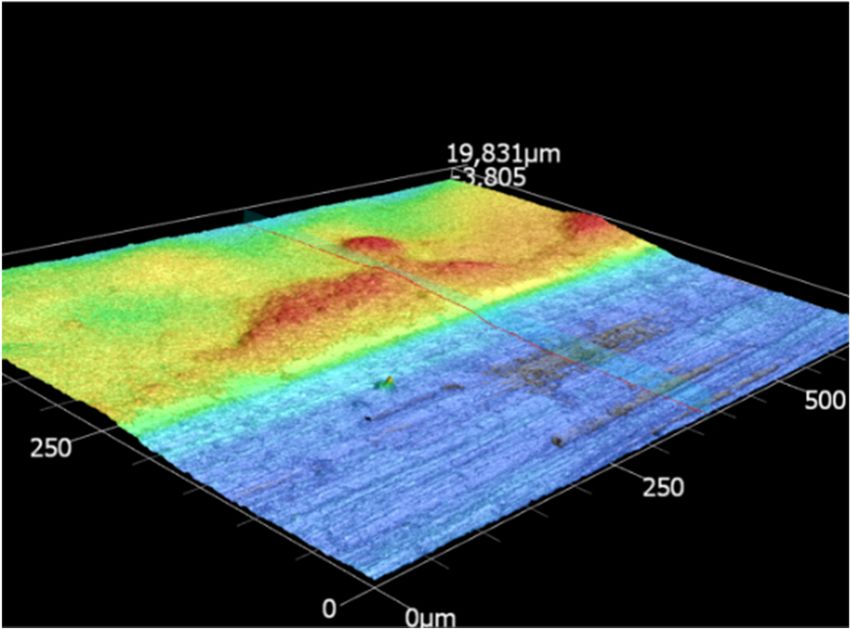
this membrane experienced the most flux reduction. Figure 3 represents a 3D image of
NF270 after being tested for LA permeability, measured by a 3D laser-scanning microscope
(Keyence VK-X3000 Series) to observe the change in the structure of the membrane. This
finding is concordant with [32], who found the same decline in flux for NF270 compared to
this study.11, x FOR PEER REVIEW 6 of 14
Membranes 2022, 12, 302 6 of 14
(a) (b)
(c) (d)
Figure 2. Water fluxFigure
before2.and
Waterafter the
flux experiment
before and afterwith lactic acid with
the experiment for NF270, MPF-36,
lactic acid Toray
for NF270, NF, Toray NF,
MPF-36,
and ◦ C at ◦ C and 32 bar.
Membranes 2022, 11,Alfa Laval
x FOR PEERNF membranes.
and Alfa Laval
REVIEW (a)NFat membranes.
pH 2.8, T: 25(a)°Catand 32 bar.
pH 2.8, T: 25(b) andpH322.8,
bar.T:
(b)40at°C
pHand
2.8, 32 bar.
T: 40 7
(c) at pH 3.9, T: 25 °C(c)and 32 3.9,
at pH bar.T:(d)
25 at
◦ CpH
and6.0, T: 25
32 bar. (d)°C
at and 32 T:
pH 6.0, bar.
25 ◦ C and 32 bar.
The highest water flux was for NF270, MPF-36, Toray NF, and Alfa Laval NF at 40
°C, which exhibited a flux of 520, 372, 292, and 320 Kg m−2 h−1, respectively, before the
filtration of the binary solution.
16.96 µm
After the nanofiltration of a lactic acid binary solution, no flux reduction occurred
when Toray NF was used in experiment 1 (Figure 2a) and experiment 4 (Figure 2d), as
well as in Alfa Laval in experiment 2 (Figure 2b), because the FRPWF is 0%. In this12case, it
can be assumed that there is no effect on the surface of the membrane from the filtration
of the LA solution. The most affected membrane with the highest flux reduction 8
was
NF270 in experiment 3 (Figure 2c) and experiment 4 (Figure 2d), with a FRPWF of 15% on
average.
In addition, no flux reduction was observed for MPF-36 for pH 6.0. On the 4 other
hand, the membrane NF270 had a decreasing flux at pH 3.9 and 6.0; in both cases, the
water flux diminished by 15% regarding the FRPWF for this membrane. Even though 0 the
NF270 presented the highest water flux compared to the other membranes used in this
−1.856 µm
study, this membrane experienced the most flux reduction. Figure 3 represents a 3D image
of NF270 after being tested
Figure
Figure 3.3. for LA
NF270
NF270 permeability,
3D 3D image.
image. 20× 20× measured
measured
measured by3D
by 3Dby a 3D laser-scanning
laser-scanning
laser-scanning micro-
microscope.
microscope.
scope (Keyence VK-X3000 Series) to observe the change in the structure of the membrane.
This finding is concordant Thewith [32],
water who
flux found the
is higher andsame decline
quick wheninthe flux for NF270iscom-
membrane thin. In contrast, wh
pared to this study.membrane is thick, the water flux is lower and slow due to the nanochannels being la
[33]. The thickness of the membrane for NF270 is 7 to 14 nm [34]. For that reason, the wThe water flux is higher and quick when the membrane is thin. In contrast, when a
membrane is thick, the water flux is lower and slow due to the nanochannels being larger
[33]. The
Membranes 2022,thickness
12, 302 of the membrane for NF270 is 7 to 14 nm [34]. For that reason, the water
7 of 14
flux is high due to the NF270 being a thin membrane.
The water flux is higher and quick when the membrane is thin. In contrast, when
3.2. Conductivity a membrane is thick, the water flux is lower and slow due to the nanochannels being
The conductivity larger
was measured in theofpermeate
[33]. The thickness and
the membrane forthe retentate
NF270 is 7 to 14vs.
nm time, tothat
[34]. For evalu-
reason,
the water flux is high due to the NF270 being a thin membrane.
ate the performance for lactic acid permeability in each membrane. The conductivity helps
as a quick test to determine if there is a migration of ions from the feed tank to the perme-
3.2. Conductivity
ate through the membrane. TheThe conductivity
conductivity wasinmeasured
was measured the permeatewith a retentate
and the WTW TetraCon 925
vs. time, to evaluate
the performance for lactic acid permeability in each membrane. The conductivity helps as
conductivity probe coupled to a WTW Multi 3430. Samples from the retentate and the
a quick test to determine if there is a migration of ions from the feed tank to the permeate
permeate were taken every
through10 themin. The measurements
membrane. The conductivityof the
was conductivity
measured are shown
with a WTW TetraConin 925
Figure 4, where the curves with the
conductivity shapes
probe coupledfilled in black
to a WTW Multi represent
3430. Samples thefrom
retentate, andand
the retentate thethe
permeate were taken every 10 min. The measurements of the conductivity are shown in
unfilled shapes represent the permeate.
Figure 4, where the curves with the shapes filled in black represent the retentate, and the
unfilled shapes represent the permeate.
EER REVIEW 8 of 14
(a) (b)
(c) (d)
Figure 4. The conductivity of the
Figure lactic
4. The acid solution
conductivity thought
of the lactic different
acid solution membranes:
thought (a) NF270,
different membranes: (b)
(a) NF270,
(b) SelRO ® MPF-36, (c) Toray NF, and (d) Alfa Laval NF. P1 and R1, P2 and R2, P3 and R3, and P4
SelRO MPF-36, (c) Toray NF, and (d) Alfa Laval NF. P1 and R1, P2 and R2, P3 and R3, and P4 and
®
and R4 belong to experiments 1, 2, 3, and 4 listed in Table 3. P is permeate and R is retentate.
R4 belong to experiments 1, 2, 3, and 4 listed in Table 3. P is permeate and R is retentate.
The pH adjustment influenced the conductivity of the retentate directly in all of the
tested membranes. The conductivity in the retentate increased by 21, 24, 85, and 91% com-
pared to the feed (initial measurement) for experiments 1, 2, 3, and 4, respectively, usingMembranes 2022, 12, 302 8 of 14
The pH adjustment influenced the conductivity of the retentate directly in all of
the tested membranes. The conductivity in the retentate increased by 21, 24, 85, and 91%
compared to the feed (initial measurement) for experiments 1, 2, 3, and 4, respectively, using
the membrane NF270 (Figure 4a). Experiment 4 for NF270 had a substantial increase in the
conductivity of the retentate, from 10,370 to 19,300 µS/cm. This result can be attributed to
the high pH adjusted by NaOH, which increases the presence of ions in the solution and
increases the lactic acid dissociation. Moreover, the conductivity in the retentate for the
SelRO® MPF-36 membrane increased by 4, 22, 33, and 34% for experiments 1, 2, 3, and 4,
respectively, compared to the initial feed which is represented in Figure 4b. The slightly
increasing retentate conductivity regarding experiments 3 and 4 in MPF-36 is due to the
MWCO of 1000 g mol−1 ; therefore, this characteristic allows NaOH and lactic acid to pass
through the membrane. There was only a 1% difference in the conductivity between pH 3.9
and 6.0, and the lowest increment was in experiment 1. Regarding Toray NF (Figure 4c),
the conductivity in the retentate increased by 26, 26, 74, and 91% for experiments 1, 2, 3,
and 4, respectively, compared to the feed. This means that when Toray NF is used, the
conductivity in the retentate at 25 ◦ C and 40 ◦ C increases in the same percentage at pH 2.8.
Concerning the Alfa Laval membrane (Figure 4d), the conductivity in the retentate also
increased compared to the feed solution by 21, 29, 100, and 86% for experiments 1, 2, 3, and
4, respectively. The Alfa Laval NF membrane showed a considerably high difference in
experiment 3 in terms of the conductivity of the retentate being a double value compared to
the initial feed, from 5000 to 10,000 µS/cm. In the four tested membranes, the conductivity
in the permeate side was lower than in the retentate at pH 2.8. It suggests that lactic acid
does not pass entirely to the permeate side.
The conductivity in the permeate and the retentate depends on the MWCO of the
membrane and the charge. With a higher MWCO, the conductivity in the retentate stream
is lower compared to the lowest MWCO of the membranes. This behaviour can be related
to the sieving effect in the MPF-36 membrane regarding the pore size. In addition, the
increase in pH is directly related to the conductivity increment because LA dissociates at a
higher pH above 3.86.
3.3. pH Variation in the Permeate and Retentate
pH is a key factor that strongly influences the membrane and the electrolyte solution,
specifically in weak acids [35], e.g., lactic acid. pH also affects the charge of the active and
selective layers of membranes. The pH is measured with a WTW SenTix H pH electrode
coupled to a WTW Multi 3430 pH meter, calibrated against standard buffers at pH 4.00,
7.00, and 10.00. Samples were taken every 10 min. The results of the measurements are
presented in Figure 5. The curves with the shapes filled in black represent the retentate,
and the curves with the unfilled shapes show the permeate.
After the membrane filtration of the lactic acid solution at pH 2.8, 3.9, and 6.0, the
pH of the resulting retentate was 2.8, 4.1, and 6.1, respectively, for NF270 (Figure 5a). For
the SelRO® MPF-36 membrane (Figure 5b), the initial pH was 2.8, 3.9, and 6.0, and the
obtained pH of the retentate after the filtration process was 2.6, 3.8, and 6.0, respectively.
For the MPF-36 membrane, the pH of the retentate was slightly lower than the initial pH
at 2.8 and 3.9. For the Toray NF membrane (Figure 5c), the pH variation occurred for 2.8,
which decreased by 7% in the retentate compared to the feed, for the pH 3.9 in the feed, the
retentate increased by 6%, with a final pH of 4.1; it shows the same behaviour as NF270.
The tight membrane with a MWCO of around 200–300 g mol−1 has a similar tendency in
pH variation over time (Figure 5d). However, a loose membrane, such as MPF-36, with a
MWCO of 1000 g mol−1 , shows no differences in the pH variation of both the permeate
and the retentate over time.Membranes 2022, 11, x FOR PEER REVIEW 9 of 14
7.00, and 10.00. Samples were taken every 10 min. The results of the measurements are
Membranes 2022, 12, 302 9 of 14
presented in Figure 5. The curves with the shapes filled in black represent the retentate,
and the curves with the unfilled shapes show the permeate.
(a) (b)
(c) (d)
Figure 5. pH variation of the binary solution of lactic acid over time using different membranes: (a)
Figure 5. pH variation of the binary solution of lactic acid over time using different membranes:
NF270, (b) SelRO® MPF-36, (c) Toray NF, and (d) Alfa Laval NF. P is the permeate, R is the retentate,
® MPF-36, (c) Toray NF, and (d) Alfa Laval NF. P is the permeate, R is the
andNF270,
(a) (b) SelRO
the numbers indicate the experiments listed in Table 3.
retentate, and the numbers indicate the experiments listed in Table 3.
After Acid
3.4. Lactic the membrane filtration of the lactic acid solution at pH 2.8, 3.9, and 6.0, the pH
Permeability
of the resulting retentate was 2.8, 4.1, and 6.1, respectively, for NF270 (Figure 5a). For the
The term permeability in this work refers to the accumulated amount of lactic acid in
SelRO® MPF-36 membrane (Figure 5b), the initial pH was 2.8, 3.9, and 6.0, and the ob-
the permeate. The objective of the nanofiltration was to have low lactic acid rejection. This
tained pH of the retentate after the filtration process was 2.6, 3.8, and 6.0, respectively. For
means lactic acid concentration must be low in the retentate, and the concentration of this
the MPF-36 membrane, the pH of the retentate was slightly lower than the initial pH at
compound should be high in the permeate.
2.8 and 3.9. For the Toray NF membrane (Figure 5c), the pH variation occurred for 2.8,
which decreased
3.4.1. Effect of theby
pH7% in the retentate compared to the feed, for the pH 3.9 in the feed,
the retentate increased by 6%, with a final pH of 4.1; it shows the same behaviour as
The pH of the solution strongly influenced lactic acid permeability (Figure 6). The
retention of LA increased with the pH increasing. At pH 3.9, the retention of LA was 73%
for NF270, 24% for MPF-36, 80% for Toray NF, and 80% for Alfa Laval NF.The pH of the solution strongly influenced lactic acid permeability (Figure 6). The
retention of LA increased with the pH increasing. At pH 3.9, the retention of LA was 73%
for NF270, 24% for MPF-36, 80% for Toray NF, and 80% for Alfa Laval NF.
The
Membranes 2022, 12, 302lowest rejection of lactic acid was at pH 2.8. For NF270 this was 71%; for MPF-36 10 of 14
it was 7%, for Toray NF it was 32%, and for Alfa Laval NF it was 40%.
100 300
NF270 MPF-36
90 Toray NF Alfa Laval NF
Flux [Kg/m2h]
250
80
Lactic Acid Rejection [%]
70
200
Flux [Kg/m2h]
60
50 150
40
100
30
20
50
10
0 0
pH 2.8 pH 3.9 pH 6.0
Figure 6. Rejection ofFigure
lactic6.acid at different
Rejection of lactic pH.
acid at different pH.
The lowest rejection Theoflowest
lacticrejection of lactic acid
acid contained in was
the at pH 2.8.
binary For NF270
solution wasthisfor
was
the71%;
MPF- for MPF-36
it was 7%, for Toray NF it was 32%, and for Alfa Laval NF
36 membrane at pH 2.8 and 25 °C reaching a 7%, Figure 6. Therefore, the permeability of it was 40%.
The lowest rejection of lactic acid contained in the binary solution was for the MPF-36
LA was 93% in themembrane
permeate.at pH 2.8 and 25 ◦ C reaching a 7%, Figure 6. Therefore, the permeability of LA
At a high pH was
(above
93%3.86),
in the LA is dissociated in lactate (C3H5O3-) and proton (H+) due
permeate.
to the pKa of the lactic acid. On the
At a high pH other
(abovehand,
3.86), nanofiltration
LA is dissociated membranes
in lactate (Chave
3 H5 Onegatively
-
3 ) and proton (H )
+
or positively charged
duesurfaces
to the pKa depending onacid.
of the lactic the pH On[36]. A membrane
the other charged negatively
hand, nanofiltration membranes have
negatively
will reject most lactate due to or electrostatic
positively charged surfaceswhereas
repulsion, dependinga on the pH [36].
positively A membrane
charged mem-charged
negatively will reject most lactate due to electrostatic repulsion, whereas a positively
brane will pass most lactate due to electrostatic attraction. The electrostatic interaction is
charged membrane will pass most lactate due to electrostatic attraction. The electrostatic
produced in all commercial membranes due to an isoelectric point. The isoelectric point is
interaction is produced in all commercial membranes due to an isoelectric point. The
the neutral charge isoelectric
of the membrane
point is theat neutral
a specific pH.ofThe
charge the pH range for
membrane at a the isoelectric
specific pH. Thepoint
pH range for
among all the membranes varies
the isoelectric depending
point among all onthethe composition.
membranes varies depending on the composition.
Regarding the
Regarding the relationship relationship
between between nanofiltration
nanofiltration membranes membranes
and pH,and if pH,
the ifsolu-
the solution
pH isthe
tion pH is lower than lower than the point
isoelectric isoelectric
(IP),point (IP), the membrane
the membrane will bewill be positively
positively charged, and
charged,
membranes will be negatively charged if the pH is higher than the IP. This modification of
charges leads to changes in porosity and the membrane surface conformation. As a result,
there is a reduction in the permeate flux.
In the case of experiments at pH 3.9 and 6.0, these are over the isoelectric point of each
membrane; therefore, in every investigation, the membrane is negatively charged except
for MPF-36, which was only negative at pH 6.0. It avoids lactate transport through the
membranes, as lactic acid at a pH over 3.86 is dissociated, resulting in a high rejection of
lactic acid. In addition, the increase in the pH of the LA solution leads to an increase in
viscosity [14].
The dissociation constant of any compound is calculated by the Equation of Henderson–
Hasselbalch [36]. The dissociation degree of lactic acid depends on the pH. The high yield
could be obtained by changing the pH. pH 3.8 and 6.0 lead to more dissociated LA than
lactate [24]. However, LA remains undissociated for the lower pH 2.8; therefore, theyield could be obtained by changing the pH. pH 3.8 and 6.0 lead to more dissociated LA
than lactate [24]. However, LA remains undissociated for the lower pH 2.8; therefore, the
permeability is higher. The dissociation of lactic acid at pH 2.7 is 6.47, at pH 3.9 is 48.14,
and at pH 6.0 is 99.28%, respectively [37].
Membranes 2022, 12, 302 11 of 14
At a higher pH above 3.8, the dissociation of lactic acid increases and leads to in-
creased rejection. Therefore, it is concluded by our experimental work that pH plays a role
in the transport of lactic acid
permeability through
is higher. Thenanofiltration membranes.
dissociation of lactic acid at pH 2.7 Kumar
is 6.47, et al.,3.9
at pH 2020,
is 48.14,
achieved 37% lactic andacid
at pHrejection at pH
6.0 is 99.28%, 2.5 through
respectively [37]. partitioning methods [6]. These re-
At a higher
sults agree with our research; atpH above
lower 3.8,the
pH, the dissociation
permeability of lactic
of LAacidisincreases
higher.and The leads
pHtoofincreased
the
rejection. Therefore, it is concluded by our experimental work that pH plays a role in the
permeate and the retentate of lactic acid transport through membranes is required to val-
transport of lactic acid through nanofiltration membranes. Kumar et al., 2020, achieved
idate any mathematical simulation
37% lactic model.
acid rejection at pH 2.5 through partitioning methods [6]. These results agree
On the other with
hand, the flux of the
our research; at lower binary
pH, thesolution of lactic
permeability of LA acid decreased
is higher. The pH of markedly
the permeate
for NF270, Toray NF, and the
andretentate of lactic
Alfa Laval acid transport
when through membranes
the pH increased. For NF270, is required
MPF-36, to validate
Toray any
mathematical simulation model.
NF, and Alfa Laval at pH 2.8 compared to pH 6.0, the flux decreased in all the experiments
On the other hand, the flux of the binary solution of lactic acid decreased markedly for
by 53%, 8%, 26%, and NF270,33%, respectively.
Toray NF, and Alfa In addition,
Laval when thethere is a correlation
pH increased. For NF270, between
MPF-36,rejec-
Toray NF,
tion and flux. At aandhigh rejection
Alfa Laval at of
pHlactic acid, the
2.8 compared flux6.0,
to pH wasthe lower; therefore,
flux decreased in all the pH plays by
the experiments
an important role 53%,
with8%,both parameters.
26%, and 33%, respectively. In addition, there is a correlation between rejection
and flux. At a high rejection of lactic acid, the flux was lower; therefore, the pH plays an
important role with both parameters.
3.4.2. Effect of Temperature
3.4.2. Effect LA
At high temperatures, of Temperature
is dissociated in the solution [37], and the membranes al-
lows sorption through them. The rejectionLA
At high temperatures, of islactic
dissociated
acid isinaffected
the solution [37], and the
by increasing membranes
the tem-
perature for the Toray NF and Alfa Laval NF membranes due to the Donnan effect, while the
allows sorption through them. The rejection of lactic acid is affected by increasing
temperature for the Toray NF and Alfa Laval NF membranes due to the Donnan effect,
for MPF-36, the Donnan
while forand the sieving
MPF-36, effect
the Donnan and(Figure 7). effect
the sieving In contrast, the
(Figure 7). In rejection ofrejection
contrast, the lactic of
acid decreases at higher temperatures
lactic acid due to
decreases at higher sorption for
temperatures dueNF270.
to sorption for NF270.
100 400
NF270 MPF-36
90
Toray NF Alfa Laval NF 350
80 Flux [Kg/m2h]
Lactic Acid Rejection [%]
300
70
Flux [Kg/m2h]
60 250
50 200
40
150
30
100
20
10 50
0 0
25 °C 40 °C
Figure
Figure 7. Rejection of Rejection
lactic7. acid of lactic acid
at different at different temperatures
temperatures and flux variation.
and flux variation.
The rejection of LA on the NF270 membrane decreased by 10% at 40 ◦ C compared to
25 ◦ C. On the other hand, lactic acid retention increased by 88, 51, and 21% for MPF-36,
Toray NF, and Alfa Laval NF, respectively.
Temperature is one important operating parameter that improves the flux and affects the
rejection of LA. LA retention increased by 88% for MPF-36, and the lowest rejection increase
was 21% for Alfa Laval NF when the temperature was 40 ◦ C in comparison with 25 ◦ C.
However, for NF270, the rejection of lactic acid decreased when the temperature increased.
The highest permeability yield (93%) for lactic acid was obtained when MPF-36 was
used at 25 ◦ C and pH 2.8. This yield is close to Novalin and Zweckmair, 2009 [38], with
89% of LA permeability.Membranes 2022, 12, 302 12 of 14
Regarding the flux in the nanofiltration of the lactic acid binary solution, it increases
when the temperature increases as well as the rejection. The flux increased by 34, 28,
35 and 50% for NF270, MPF-36, Toray NF, and Alfa Laval NF, respectively, when the
temperature rises from 25 to 40 ◦ C. The most affected membrane regarding the flux when
the temperature increased was Alfa Laval due it reaches 50% of a higher flux.
4. Conclusions
Lactic acid is one of the leading products from grass silage juice; it has important
uses in numerous industrial applications. The permeability of LA is an essential consid-
eration in purifying LA when using the adequate membrane for downstream processing.
Nanofiltration is used to study the transport of binary solutions (lactic acid and water).
The experiment showed that nanofiltration is useful for lactic acid separation but
depends strongly on the characteristics of the membrane regarding the selective layer
charge, the pore size, and the composition. MPF-36 presented the best performance for
lactic acid permeance at 25 ◦ C and pH 2.8, with a 93% yield; as MPF-36 is a loose membrane,
the permeance is mainly due to its pore size characteristic. However, a poor performance
was given by NF270 with an LA rejection of 71% at the same operating conditions. The
optimal operating parameter for lactic acid transport was found at pH 2.8 and 25 ◦ C in all
four tested membranes.
On the other hand, when the pH increases, the flux decreases for the binary solution
of lactic acid; in contrast, the flux increases as well when the temperature increases.
The pH variation of the feed directly influences the charge of the membrane due
to the isoelectric point. Therefore, this parameter must be considered to recover certain
compounds and their dissociation grades from obtaining a high permeability of lactic acid.
The experimental data of the pH and the conductivity in both the permeate and the
retentate of the process will help select the optimal lactic acid permeability performance for
further downstream processing and process scale-up.
Author Contributions: Conceptualization, M.C.-G. and A.A.; methodology, M.C.-G. and A.A.; val-
idation, M.C.-G., A.A., K.M., M.S., C.J. and M.H.; formal analysis, M.C.-G., A.A., K.M. and M.S.;
investigation, M.C.-G. and A.A.; resources, M.H.; data curation, A.A. and M.C.-G.; writing—original
draft preparation, M.C.-G. and A.A.; writing—review and editing, M.C.-G., A.A. and C.J.; visualisa-
tion, A.A. and M.C.-G.; supervision, M.H.; project administration, M.H.; funding acquisition, M.H.
All authors have read and agreed to the published version of the manuscript.
Funding: This project has received funding from the European Union’s Horizon 2020 research and
innovation programme under grant agreement No 860477–AgRefine–H2020-MSCA-ITN-2019.
Institutional Review Board Statement: Not applicable.
Informed Consent Statement: Not applicable.
Data Availability Statement: Not applicable.
Acknowledgments: Thomas Jung for the chemical analysis.
Conflicts of Interest: The authors declare no conflict of interest.
References
1. Camesasca, L.; de Mattos, J.A.; Vila, E.; Cebreiros, F.; Lareo, C. Lactic acid production by Carnobacterium sp. isolated from a
maritime Antarctic lake using eucalyptus enzymatic hydrolysate. Biotechnol. Rep. 2021, 31, e00643. [CrossRef] [PubMed]
2. Agrefine. AgRefine Project: European Union’s Horizon 2020 Research and Innovation Programme under the Marie Skłodowska-
Curie Grant Agreement No 860477. Available online: https://agrefine.eu/about-the-project/ (accessed on 26 January 2022).
3. Karnaouri, A.; Asimakopoulou, G.; Kalogiannis, K.G.; Lappas, A.; Topakas, E. Efficient d-lactic acid production by Lactobacillus
delbrueckii subsp. bulgaricus through conversion of organosolv pretreated lignocellulosic biomass. Biomass Bioenergy 2020, 140,
105672. [CrossRef]
4. Alexandri, M.; Schneider, R.; Venus, J. Membrane Technologies for Lactic Acid Separation from Fermentation Broths Derived
from Renewable Resources. Membranes 2018, 8, 94. [CrossRef] [PubMed]Membranes 2022, 12, 302 13 of 14
5. Viesser, J.A.; de Melo Pereira, G.V.; de Carvalho Neto, D.P.; Rogez, H.; Góes-Neto, A.; Azevedo, V.; Brenig, B.; Aburjaile, F.; Soccol,
C.R. Co-culturing fructophilic lactic acid bacteria and yeast enhanced sugar metabolism and aroma formation during cocoa beans
fermentation. Int. J. Food Microbiol. 2021, 339, 109015. [CrossRef]
6. Kumar, S.; Yadav, N.; Nain, L.; Khare, S.K. A simple downstream processing protocol for the recovery of lactic acid from the
fermentation broth. Bioresour. Technol. 2020, 318, 124260. [CrossRef]
7. Joglekar, H.G.; Rahman, I.; Babu, S.; Kulkarni, B.D.; Joshi, A. Comparative assessment of downstream processing options for
lactic acid. Sep. Purif. Technol. 2006, 52, 1–17. [CrossRef]
8. Komesu, A.; Wolf Maciel, M.R.; Filho, M. Separation and purifications technologies for lactic acid—A Brief Review. BioResources
2017, 12, 6885–6901. [CrossRef]
9. Taleghani, H.G.; Ghoreyshi, A.A.; Najafpour, G.D. Thin film composite nanofiltration membrane for lactic acid production in
membrane bioreactor. Biochem. Eng. J. 2018, 132, 152–160. [CrossRef]
10. Phanthumchinda, N.; Thitiprasert, S.; Tanasupawat, S.; Assabumrungrat, S.; Thongchul, N. Process and cost modeling of lactic
acid recovery from fermentation broths by membrane-based process. Process Biochem. 2018, 68, 205–213. [CrossRef]
11. Desiriani, R.; Kresnowati, M.T.A.P.; Wenten, I.G. Membrane-Based Downstream Processing of Microbial Xylitol Production. Int. J.
Technol. 2017, 8, 1393–1401. [CrossRef]
12. Komesu, A.; Wolf Maciel, M.R.; Rocha de Oliveira, J.A.; Da Silva Martins, L.H.; Maciel Filho, R. Purification of Lactic Acid
Produced by Fermentation: Focus on Non-traditional Distillation Processes. Sep. Purif. Rev. 2017, 46, 241–254. [CrossRef]
13. Sabaté, J.; Pujolà, M.; Labanda, J.; Llorens, J. Influence of pH and operation variables on biogenic amines nanofiltration. Sep. Purif.
Technol. 2008, 58, 424–428. [CrossRef]
14. Chandrapala, J.; Chen, G.Q.; Kezia, K.; Bowman, E.G.; Vasiljevic, T.; Kentish, S.E. Removal of lactate from acid whey using
nanofiltration. J. Food Eng. 2016, 177, 59–64. [CrossRef]
15. Oatley-Radcliffe, D.L.; Walters, M.; Ainscough, T.J.; Williams, P.M.; Mohammad, A.W.; Hilal, N. Nanofiltration membranes and
processes: A review of research trends over the past decade. J. Water Process Eng. 2017, 19, 164–171. [CrossRef]
16. Pal, P.; Sikder, J.; Roy, S.; Giorno, L. Process intensification in lactic acid production: A review of membrane based processes.
Chem. Eng. Process. Process Intensif. 2009, 48, 1549–1559. [CrossRef]
17. Oberherr, R.; Tassinary, R.F.; Vognach, L.; Stulp, S. Application of ultrafiltration and electrodialysis techniques in lactic acid
removal from whey solutions. Eclet. Quim. J. 2019, 44, 39–45. [CrossRef]
18. Lech, M.; Trusek, A. Batch Electrodialysis of Lactic Acid Obtained from Lab Fermentation. Pol. J. Chem. Technol. 2018, 20, 81–86.
[CrossRef]
19. Dey, P.; Linnanen, L.; Pal, P. Separation of lactic acid from fermentation broth by cross flow nanofiltration: Membrane characteri-
zation and transport modelling. Desalination 2012, 288, 47–57. [CrossRef]
20. Diaz, P.A.B.; Araujo Kronemberger, F.; Habert, A.C. Predictive study of succinic acid transport via nanofiltration membranes
using a Maxwell–Stefan approach. J. Chem. Technol. Biotechnol. 2021, 96, 785–800. [CrossRef]
21. Khanlari, S.; Tofighy, M.A.; Mohammadi, T. Transport phenomena through nanocomposite membranes. In Nanocomposite
Membranes for Water and Gas Separation; Elsevier: Amsterdam, The Netherlands, 2020; pp. 91–112. ISBN 9780128167106.
22. Cao, X.; Zhou, M.; Jia, S.; Yuan, X.; Yu, K.-T. Maxwell–Stefan diffusion coefficient model derived from entropy generation
minimization principle for binary liquid mixtures. Chem. Eng. Sci. 2019, 207, 30–38. [CrossRef]
23. Ebneyamini, A.; Azimi, H.; Thibault, J.; Tezel, F.H. Description of butanol aqueous solution transport through commercial PDMS
pervaporation membrane using extended Maxwell–Stefan model. Sep. Sci. Technol. 2018, 53, 1611–1627. [CrossRef]
24. Ecker, J.; Raab, T.; Harasek, M. Nanofiltration as key technology for the separation of LA and AA. J. Membr. Sci. 2012, 389, 389–398.
[CrossRef]
25. Ribeiro, A.C.F.; Lobo, V.M.M.; Leaist, D.G.; Natividade, J.J.S.; Veríssimo, L.P.; Barros, M.C.F.; Cabral, A.M.T.D.P.V. Binary Diffusion
Coefficients for Aqueous Solutions of Lactic Acid. J. Solut. Chem. 2005, 34, 1009–1016. [CrossRef]
26. 2Semião, A.J.; Schäfer, A.I. Estrogenic micropollutant adsorption dynamics onto nanofiltration membranes. J. Membr. Sci. 2011,
381, 132–141. [CrossRef]
27. Thamaraiselvan, C.; Michael, N.; Yoram, O. Selective Separation of Dyes and Brine Recovery from Textile Wastewater by
Nanofiltration Membranes. Chem. Eng. Technol. 2018, 2, 285–293. [CrossRef]
28. Ahmad, A.; Banat, F.; Taher, H. A review on the lactic acid fermentation from low-cost renewable materials: Recent developments
and challenges. Environ. Technol. Innov. 2020, 20, 101138. [CrossRef]
29. Zhou, F.; Wang, C.; Wei, J. Separation of acetic acid from monosaccharides by NF and RO membranes: Performance comparison.
J. Membr. Sci. 2013, 429, 243–251. [CrossRef]
30. Merino-Garcia, I.; Velizarov, S. New insights into the definition of membrane cleaning strategies to diminish the fouling impact in
ion exchange membrane separation processes. Sep. Purif. Technol. 2021, 277, 119445. [CrossRef]
31. Mänttäri, M.; Pekuri, T.; Nyström, M. NF270, a new membrane having promising characteristics and being suitable for treatment
of dilute effluents from the paper industry. J. Membr. Sci. 2004, 242, 107–116. [CrossRef]
32. Liikanen, R.; Kiuru, H.; Tuhkanen, T.; Nyström, M. Nanofiltration membrane fouling by conventionally treated surface water.
Water Sci. Technol. Water Supply 2003, 3, 183–190. [CrossRef]
33. Ding, J.; Zhao, H.; Xu, B.; Yu, H. Biomimetic Sustainable Graphene Ultrafast-Selective Nanofiltration Membranes. ACS Sustain.
Chem. Eng. 2020, 8, 8986–8993. [CrossRef]Membranes 2022, 12, 302 14 of 14
34. Ortiz-Albo, P.; Ibañez, R.; Urtiaga, A.; Ortiz, I. Phenomenological prediction of desalination brines nanofiltration through the
indirect determination of zeta potential. Sep. Purif. Technol. 2019, 210, 746–753. [CrossRef]
35. Zhang, L.; Hamelers, H.; Biesheuvel, P.M. Modeling permeate pH in RO membranes by the extended Donnan steric partitioning
pore model. J. Membr. Sci. 2020, 613, 118511. [CrossRef]
36. Ang, M.B.M.Y.; Tang, C.-L.; de Guzman, M.R.; Maganto, H.L.C.; Caparanga, A.R.; Huang, S.-H.; Tsai, H.-A.; Hu, C.-C.; Lee, K.-R.;
Lai, J.-Y. Improved performance of thin-film nanofiltration membranes fabricated with the intervention of surfactants having
different structures for water treatment. Desalination 2020, 481, 114352. [CrossRef]
37. González, M.I.; Alvarez, S.; Riera, F.A.; Álvarez, R. Lactic acid recovery from whey ultrafiltrate fermentation broths and artificial
solutions by nanofiltration. Desalination 2008, 228, 84–96. [CrossRef]
38. Novalin, S.; Zweckmair, T. Renewable resources-green biorefinery: Separation of valuable substances from fluid-fractions by
means of membrane technology. Biofuels Bioprod. Bioref. 2009, 3, 20–27. [CrossRef]You can also read


