Forum UN & Australia SUSTAINABLE PARTNERSHIPS
←
→
Page content transcription
If your browser does not render page correctly, please read the page content below
UN & Australia
SUSTAINABLE
PARTNERSHIPS
       Forum

                    DISCUSSIONS
                 AND RESOURCES
                 UN & AUSTRALIA SUSTAINABLE
                        PARTNERSHIPS FORUM
                       20 and 21 April 2021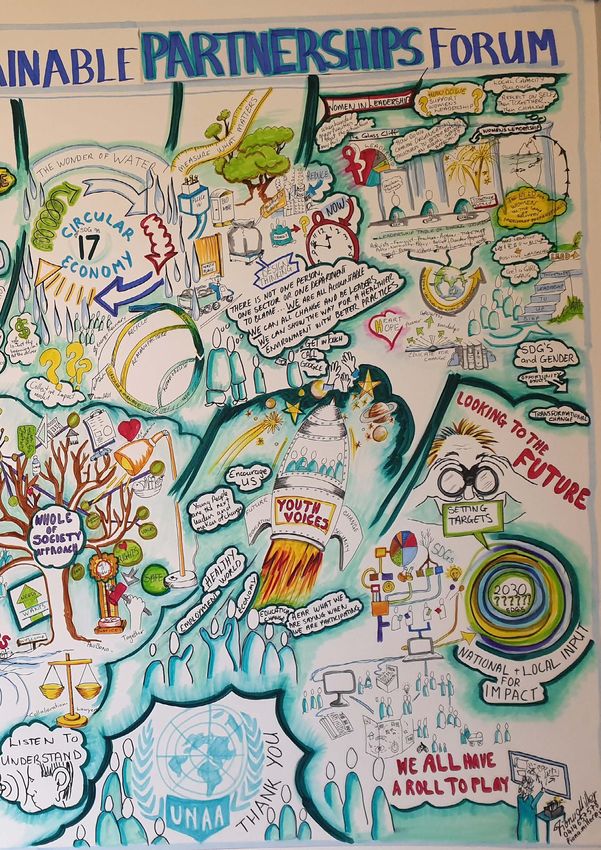
ABOUT UNAA
The United Nations Association of Australia (UNAA) works to increase awareness of the
UN and its work and to engage Australians in key UN programs such as the Sustainable
Development Goals (SDGs). UNAA state divisions run events and programs to raise
awareness of the SDGs, in partnership with government, business and civil society.

UNAA, which has UN Economic and Social Council (ECOSOC) Consultative Status - is
seeking to progress achievement of the SDGs through collaborative partnerships that
inspire interest, mobilise resources, encourage dialogues and guarantee positive impact.

www.unaa.org.au

ABOUT THE FORUM
The UN & Australia Sustainable Partnerships Forum was originally scheduled to take place
face to face in April 2020 but was postponed due to the COVID-19 pandemic. In late 2020,
UNAA decided to deliver the Forum virtually as an opportunity to bring in a wider range of
national and international speakers and an international audience.

The Forum was ultimately delivered virtually on 20 and 21 April, with an audience of 350
from across Australia, Asia, South Pacific, Europe and the US. Participants took park in
Plenary sessions around partnering and Breakout sessions under four UN themes: Climate
and Planet, Gender Equality, Human Rights and Justice and Poverty and Inequality.
Attendees listened to and interacted with some 54 Speakers and 22 Session Hosts.

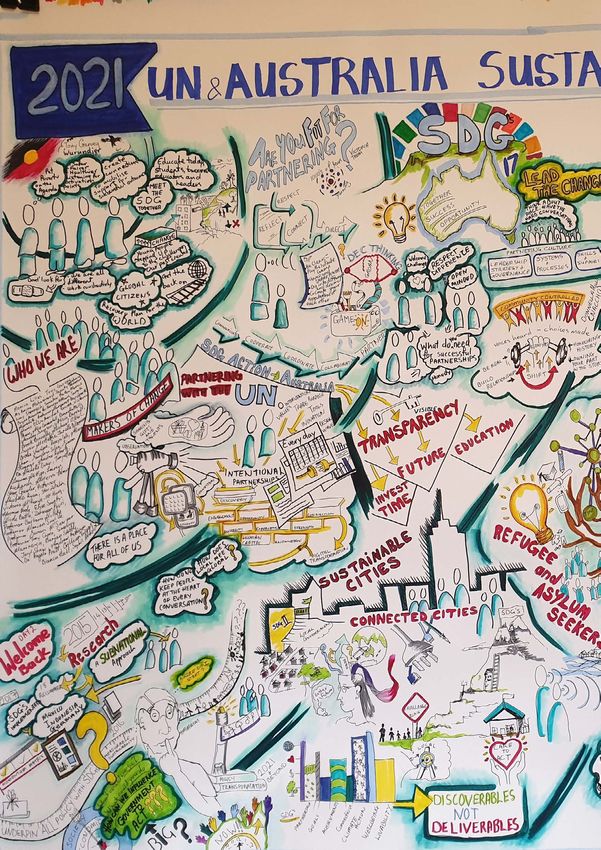
Participants were also able to view a curated exhibition of art previously shown at the
UN in Geneva and watch graphic harvester Fiona Miller work as she captured session
discussions creatively.

Start-ups, government departments, community organisations and companies
demonstrated their work to progress the SDGs in the Digital SDGs Showcase, and
facilitated networking opportunities were provided on both days.

UNAA Victoria provided the Forum Secretariat, which was managed by Sophie Arnold,
Executive Manager, with the assistance of Sally Northfield, Global Education Program
Manager, and Katie Reyers, Global Education Program Officer. Forum Working Groups
were made up of UNAAV Board members Michael Henry, Carlisle Richardson and Warwick
Peel; former UNAA Executive Director Lachlan Hunter, UNAAV Young Professionals
Partnerships Lead, Laiza Garcia, and Partnerships Coordinator, Fran Grossi. Volunteer
support is acknowledged on P.49.

The Forum was delivered in partnership with JT Production Management
- https://www.jtproductionmanagement.com/

If you have any queries relating to the Forum, please contact
Sophie Arnold at office@unaavictoria.org.au

2   UN & AUSTRALIA SUSTAINABLE PARTNERSHIPS FORUM
CONTENTS
Introduction		                                            4
Partners                                                  5
Resources and Showcase                                   10

Special Features: Conversations with UN Leaders          11
Special Features: Discussion Harvest                     12
Special Features: Conversations with UN Leadres		        13

Plenary Wrap-Up: Forum Opening                           14
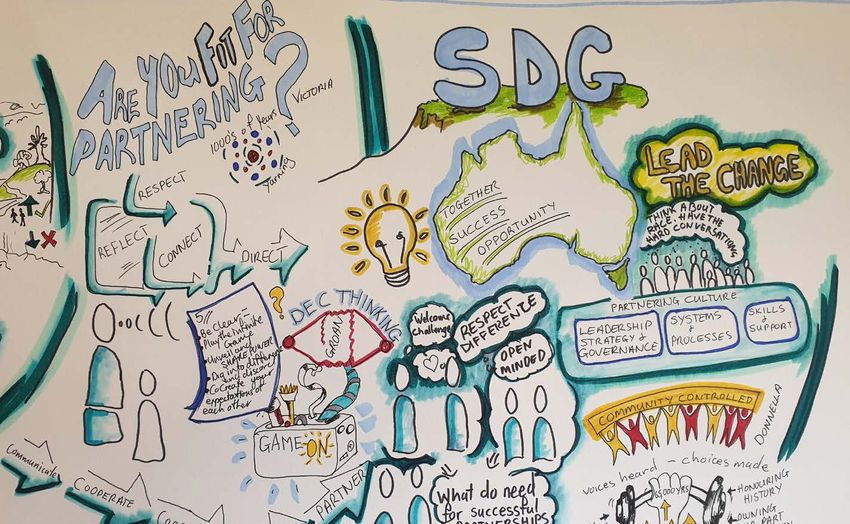
Plenary Wrap-Up: Are you fit for partnering?             16
Plenary Wrap-Up: Partnering at the international level   17
Plenary Wrap-Up: Partnering at the national level        19
Plenary Wrap-Up: Cities leading the SDGs:
partnering at the subnational level			                   21
Plenary Wrap-Up: Partnering with young people            22
Plenary Wrap-Up: Looking to the Future                   23

Breakout Review – Climate and Planet                     28
Breakout Review – Gender Equality                        30
Breakout Review – Poverty and Inequality                 32
Breakout Review – Justice and Human Rights               35

Special Features: Australian Art at the UN               38

APPENDICES:                                              39
Forum Program                                            40
Resource list                                            45
Showcase Participants                                    50
Participant Organisations                                51
INTRODUCTION
While we did not meet face to face as originally planned, the virtually
delivered UN and Australia Sustainable Partnerships Forum allowed us to
ultimately present a two-day event on 20 and 21 April 2021 which provided
participants from Australia, the Asia-Pacific region, Europe and the US with
access to an inspiring, diverse and challenging line-up of speakers.

Participants were united by a driving desire to work in partnership to progress the Sustainable
Development Goals (SDGs), particularly in the aftermath of the global COVID-19 pandemic. Recognition of
the SDGs as the blueprint for positive worldwide recovery resonated across the Forum sessions.

During the Forum, we discussed partnering at the international, national and city level and the importance
of ensuring that young people are truly included as partners in decision-making. Climate and Planet,
Gender Equality, Poverty and Inequality and Justice and Human Rights provided the thematic frameworks
for our breakout discussions.

Our Forum would not have been possible without the ongoing support of our Forum partners, who have remained
with us for some 18 months. Thank you also to our Forum Speakers and Session Hosts whose expertise inspired
delegates to think creatively about how to partner and who to partner with to progress the SDGs.

Thank you to all participants for joining us. We hope that the work we did together during the Forum will build
a foundation for working together over the next decade to achieve the Sustainable Development Goals.

And finally thank you to the Forum Secretariat, Sophie Arnold, Sally Northfield and Katie Reyers, who
committed to delivering an event at the MCG in April last year and then successfully moved – with the
support of all the Forum partners – to delivery of an effective and interactive online event.

This report provides a recap of the UN & Australia Sustainable Partnerships Forum and its many highlights.
We hope it inspires readers to remain engaged with us as we move forward with a shared purpose.

Mario D’Elia
President
UN Association of Australia (UNAA)

4   UN & AUSTRALIA SUSTAINABLE PARTNERSHIPS FORUM
United           UN & Australia
         Nations
         Association      SUSTAINABLE
                          PARTNERSHIPS
         of Australia
                                 Forum
PARTNERS
FORUM PARTNERS

SESSION PARTNERS

FUTURE LEADERS PARTNERS              CONNECTING PARTNER

SUPPORTING PARTNERS

                                   UN & AUSTRALIA SUSTAINABLE PARTNERSHIPS FORUM   5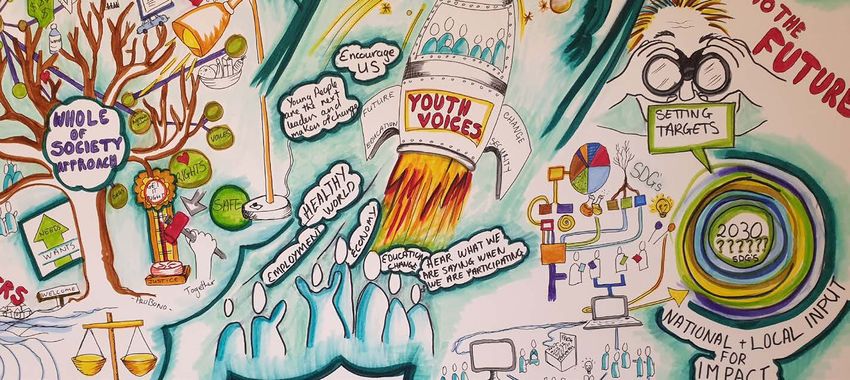
A MESSAGE FROM OUR
THREE FORUM PARTNERS

MONASH UNIVERSITY
Monash University was a proud partner of the 2021 UN and Australia Sustainable Partnerships Forum.

In 2016, Monash made a landmark commitment to the Sustainable Development Goals (SDGs), and is the first
Australian university to commit to an energy reduction target through an initiative to achieve net zero emissions by
2030.

In 2021, Monash reached 18th in the world on the Times Higher Education Impact Rankings, which measure
university action against the SDGs. The University is also home to the Monash Sustainable Development Institute
(MSDI), one of the leading interdisciplinary research and education institutes for sustainable development. SDG
leadership is a core focus of MSDI.

Monash University hosts many cross-disciplinary programs that combine our sustainable development expertise
with governments, businesses, and communities to deliver real-world impact. Working closely with industry,
government and other research organisations, Monash develops and tests world-leading emission-reduction
technologies and market mechanisms.

We invite you to explore Monash’s comprehensive activities on sustainability, sustainable development and the
SDGs through the Monash Sustainable Development webpage www.monash.edu/msdi You can also connect with
Monash on LinkedIn, Twitter or Instagram.

6   UN & AUSTRALIA SUSTAINABLE PARTNERSHIPS FORUM
THE UNIVERSITY OF MELBOURNE
The University of Melbourne has a strong and enduring commitment to sustainability, contributing to the
Sustainable Development Goals through academic expertise, University operations and partnerships.
Released in 2020, the Advancing Melbourne strategy (https://about.unimelb.edu.au/strategy/advancing-
melbourne) defines the university’s purpose to “benefit society through the transformative impact of education
and research”. The University’s Sustainability Plan to 2020 enabled delivery of significant achievements,
including the establishment of a sustainability fellowships program to integrate sustainability into core curriculum,
and development of the ‘Wattle Fellowship’ co-curricular program for students to foster leadership on global
sustainability.

Our academic mission is also reflected in the approach to operating our campuses, with a long-term commitment
to energy reduction on campus and wind farm power purchase agreements now in place. These achievements
deliver the target of zero net emissions electricity and progress towards our commitment of Carbon Neutrality
before 2030. A new Sustainability Plan is now under development to elevate sustainability endeavour and
outcomes across all University activities to 2025 and beyond.

The University is committed to developing real world solutions for a safer climate future. The Melbourne Climate
Futures initiative launched in March 2021 builds on decades of University research in a diverse range of areas
- from climate change impacts in the Pacific to environmental politics on the global stage, energy futures and
bushfire resilience to better global health outcomes. The establishment of Melbourne Climate Futures enables the
University to strive for further ambitious climate actions as a focus of activities under the next Sustainability Plan.

The Connected Cities Lab provides leadership for the urban dimensions of the Sustainable Development Goals,
bringing interdisciplinary teams of researchers and practitioners together with industry and government. The
UNAA Forum showcased the SDGs Cities Challenge, which supports participating cities to localise urban SDG
targets and indicators to inform city projects. Building on this engagement, CCL has worked in partnership
with City of Melbourne to integrate the SDGs as part of a strategic prioritisation framework, and work towards a
Melbourne Voluntary Local Review.

UoM signed the University commitment to the SDGs (https://ap-unsdsn.org/regional-initiatives/universities-
sdgs/university-commitment/) in August 2016. The SDGs are incorporated across curriculum and research - this
webpage - https://sustainablecampus.unimelb.edu.au/sustainable-research - showcases some of the UoM
research integrating the SDGs.

                                                                UN & AUSTRALIA SUSTAINABLE PARTNERSHIPS FORUM             7
PWC
The UN Sustainable Development Goals (SDGs) outline a set of goals to address global issues relating to cli-
mate, planet, poverty, inequality, justice and human rights. A concerted effort to realise the goals will not only
address environmental and social challenges - it will also be a driver of future economic growth.

PwC supports the SDGs and is committed to working closely with government, businesses, academia, social
enterprise and communities to drive meaningful change to advance the global goals. As a firm, we continue to
support the SDGs through our operations, client engagements and involvement in public policy discussion.

For example:
> In our operations: We have undertaken an internal SDG mapping exercise to understand our firm’s impact on
   each of the goals and have prioritised the goals which are most material to our operations. We’re embedding
   a focus on SDGs in our corporate strategy, and we’re committed to reporting our contribution towards the
   goals on an ongoing basis, both as a firm and also through PwC’s Foundation Trust.
> Supporting our clients: We support our clients to map, measure, monitor and report their own contributions
   to the SDGs in a strategic and coherent way. PwC has developed market-leading tools to support clients
   along this journey.
> Participating in public policy discussion: We contribute to public discussion on the SDGs through involve-
   ment in government submissions and development of thought leadership. In 2018, PwC was the only
   professional services firm to make a submission to the Australian Parliamentary Inquiry to the SDGs - see
   Submission 30. Many of PwC’s recommendations to the Senate have been highlighted in the Inquiry report
   published by the Government as critical recommendations and next steps.

For more information, please contact Rosalie Wilkie, leader of Social Impact at PwC, via rosalie.wilkie@pwc.com

8   UN & AUSTRALIA SUSTAINABLE PARTNERSHIPS FORUM
UN & AUSTRALIA SUSTAINABLE PARTNERSHIPS FORUM 9

KEY FORUM RESOURCES
The Forum was planned around these key resources listed below.
A full Resources List is included in the Appendices.

              THE SDG PARTNERSHIP GUIDEBOOK
              This is the flagship publication of the SDG Partnership Accelerator, a collaboration involving
              The Partnering Initiative and the UN Department of Economic and Social Affairs, UN Office of
              Partnerships, UN Global Compact, and UN Development Coordination Office.
              https://thepartneringinitiative.org/publications/toolbook-series/the-sdg-partnerships-guidebook/

              TRANSFORMING AUSTRALIA: SDG PROGRESS REPORT
              Prepared in partnership with the National Sustainable Development Council and the Monash
              Sustainable Development Institute, this report - updated in 2020 - provides a comprehensive,
              independent and data-driven assessment of Australia’s progress towards meeting the SDGs.
              https://www.sdgtransformingaustralia.com/

              NO ONE LEFT BEHIND: IMPLEMENTING THE SUSTAINABLE
              DEVELOPMENT GOALS IN AUSTRALIA
              This Whitlam Institute report analyses SDGs best practice around the world and offers tools for the
              Australian Government to take charge of SDG implementation across Australia.
              https://www.whitlam.org/publications/2020/6/17/no-one-left-behind-implementing-the-sustainable-
              development-goals-in-australia

              If you haven’t already done so, please take this opportunity to watch NATIONS      UNITED:
              URGENT SOLUTIONS FOR URGENT TIMES.

      SDGs DIGITAL SHOWCASE
      During the Forum, businesses, government agencies, universities, start-ups and non-
      profit organisations showcased their work to progress the SDGs.

      Delegates were able to click on each Showcase and watch video presentations
      before chatting live to the Showcasers on Day 2.

      A full list of the participating organisations is included in the Appendices.

10   UN & AUSTRALIA SUSTAINABLE PARTNERSHIPS FORUM
SPECIAL FEATURES:
CONVERSATIONS
WITH UN LEADERS
UN Deputy Secretary-General Amina J. Mohammed
in conversation with 2021 Australian Youth
Representative to the UN Lucy Stronach.
This was a fantastic way to kick off the Forum, with Lucy and DSG
Mohammed engaging in a wide ranging conversation around the SDGs, post-
pandemic recovery and the importance of young people and gender equality
to the world’s future.
When asked by Lucy how organisations can provide opportunities for young
people to shape decisions, DSG Mohammed said established leaders have to
see that this is not about giving up their own authority.
“When I yield the chair to the youngest person around the table, I’m not
yielding my job. I’m yielding my chair in the discussion to give a young person
the experience of looking across the table and thinking oh crumbs these are
my bosses, these are my colleagues, this is the person who is leading this
particular area.”
When asked what more is needed to ensure gender equality around the world,
DSG Mohammed said it is “not for want of knowing what we need to do, it is
finding the way to do it and not to do it as a cookie cutter”.
“Half of humanity is female and has value to add and no-one is going to fly a
plane on one wing. We are bringing value to the game and there should be no
tokenism around that conversation, “she said.
UN & AUSTRALIA SUSTAINABLE PARTNERSHIPS FORUM 11SPECIAL FEATURES:
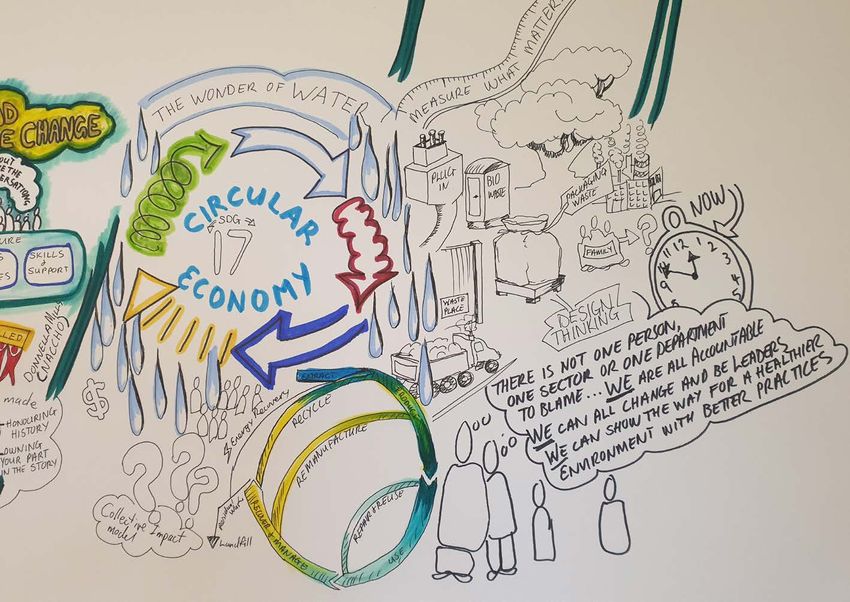
A CREATIVE HARVEST
OF OUR DISCUSSIONS
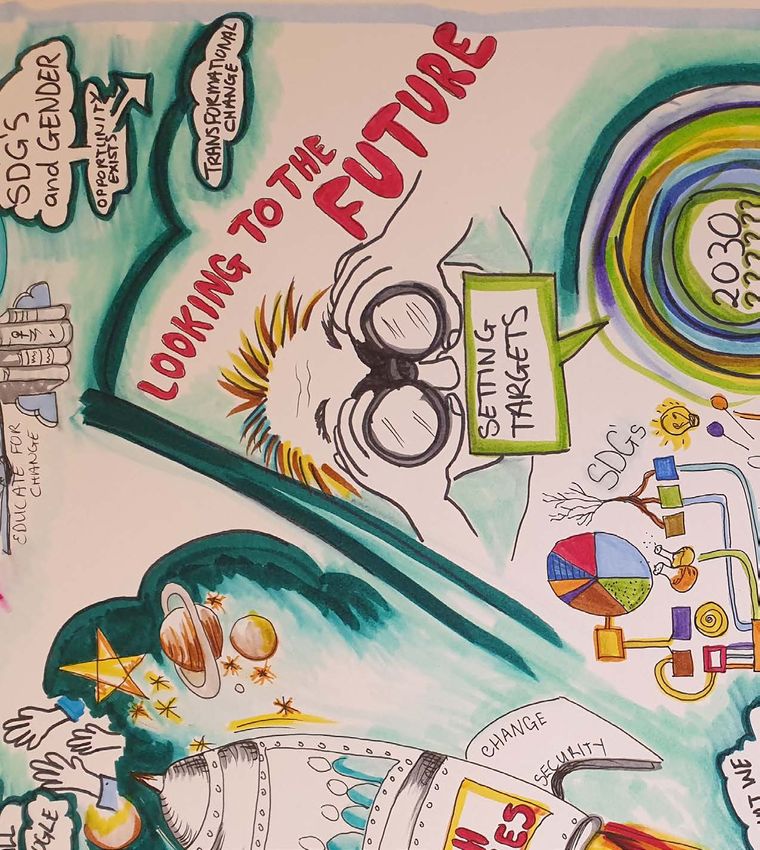
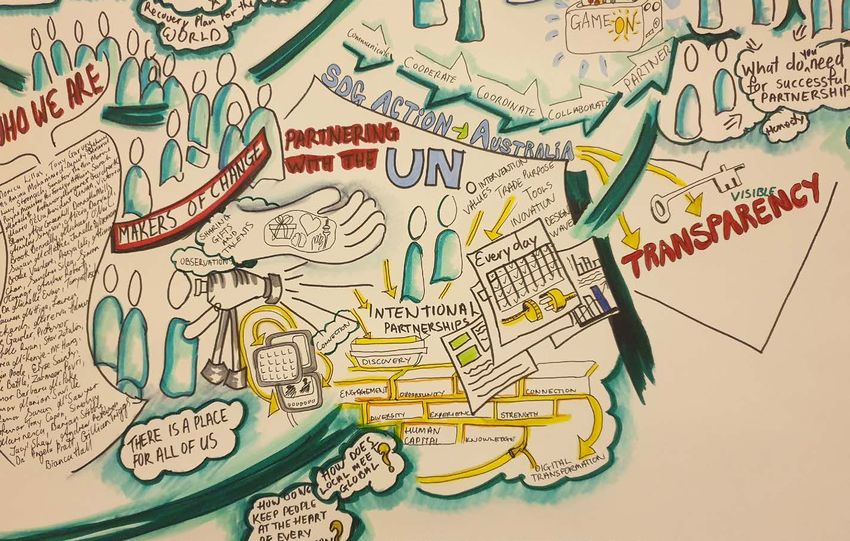
Throughout the Forum, the amazing Fiona Miller captured all the
conversations graphically in a process known as Harvesting. The
results of Fiona’s work can be seen throughout this report.
Fiona is creative and innovative and if there is a box, you won’t find her in it! Maybe decorating it or
even embellishing it, but never in it. With a passion for seeing people and communities explore and
collaborate on all things local, getting people to the same table and share skills and knowledge is a
priority. Conversations matter and by connecting conversations amazing things happen.
Asset Based Community Development underpins all that she does and believes in and it’s all done
with a smile. Graphic Harvesting, facilitating, community consultation and contributing to designing
community projects with communities and their partners are amongst her favourite things.
12 UN & AUSTRALIA SUSTAINABLE PARTNERSHIPS FORUMSPECIAL FEATURES:
CONVERSATIONS
WITH UN LEADERS
AN EVENING WITH
GILLIAN TRIGGS
In this special session from Geneva, Gillian Triggs, UN Assistant Secretary-General
and Assistant High Commissioner for Protection, UNHCR, talked with Bianca Hall,
Senior Journalist, The Age, about the impact of the global pandemic on refugees,
asylum seekers and displaced people, the need for a new global social contract
to ensure the world recovers better from the pandemic and the urgent need for
gender equality around the world.
The conversation led to an article in The Age on 19 April 2021, which can be read
here: https://www.smh.com.au/national/a-great-disappointment-triggs-issues-
rallying-cry-over-treatment-of-women-20210416-p57jv9.html
UN & AUSTRALIA SUSTAINABLE PARTNERSHIPS FORUM 13PLENARY WRAP-UP
PLENARY
1
FORUM OPENING
OPENING ADDRESS:
MS AMINA J. LUCY
MOHAMMED STRONACH
Deputy Secretary, 2021 Australian
United Nations Youth Representative
to the UN
SPEAKERS:
SENATOR THE SARAH
HON MARISE MEREDITH PROFESSOR
PAYNE Australian Country MARGARET
Minister for Director, Global GARDNER AC
Foreign Affairs Citizen President and
Vice Chancellor,
Monash University
“Partnerships are critical. Today, it is beyond the capacities of any
government to deliver on this agenda. It is huge, the challenges
are very complex. And so, partnerships with civil society, with different
groups in business, with academia, with science, there is a multiplicity
of partnerships that are necessary now so that we get the depth and
the breadth of the ambition of the SDGs”
- UN Deputy Secretary-General Ms Amina J. Mohammed, 20 April 2021
14 UN & AUSTRALIA SUSTAINABLE PARTNERSHIPS FORUMSpeaking in conversation with 2021 Australian Youth Representative to the UN, Lucy Stronach, Deputy Secretary-
General Mohammed restated the centrality of the SDGS as the world emerges from the COVID-19 pandemic.
“The SDGs with their universal scope, their interlinked nature and a focus on leaving no-one behind, which is the
most important decision that we came to, have never been more essential. They can serve as a roadmap to guide
COVID-19 responses to not only provide immediate assistance but as an opportunity to recover not only better
but different.”
DSG Mohammed outlined her working breakdown of the SDGs: “The first six goals are the unfinished business
of the MDGs (Millennium Development Goals), SDGs 7-15 are where the real investments need to be made to
transform our economies and become more inclusive. Goal 16 is about the governance and the institutions that
this has to sit on to deliver the scale and 17 is the partnerships - and partnerships are critical”.
Sarah Meredith took up the partnership theme when explaining its primacy to the work Global Citizen is doing
globally to eliminate extreme poverty. “Everything we do around our mission is around our partnership model. We
partner with artist ambassadors, we partner with corporates, we partner with governments and high net worth
individuals all with the goal of ending extreme poverty.”
Sarah took delegates through Global Citizen’s five-point Recovery Plan for the World (https://www.globalcitizen.
org/en/info/2021/) and said it is the “time for us to take action. This is the moment that all of us need to stand
up and say that we have the opportunity to see the global goals realised. We have the opportunity to protect the
planet and we need our governments, corporates and the world’s wealthiest people to stand up”.
In outlining the commitments made by Monash University to integrate the SDGs into research, student education
and campus operations, President and Vice-Chancellor Professor Margaret Gardner AC said today’s “major
challenges are global rather than local and universities can play a significant role in addressing these challenges.
We have the capacities, we have the people, we have the reach, and we have the aspiration to provide solutions
which will have a positive impact on communities around the world”.
Minister for Foreign Affairs Senator Marise Payne told delegates that the Forum was an “invaluable opportunity to
reflect on how positive and constructive connections between governments, multilateral institutions, humanitarian
agencies and civil organisations are pivotal in ensuring we continue to work towards a more just, fair and secure
world”.
UN & AUSTRALIA SUSTAINABLE PARTNERSHIPS FORUM 15PLENARY ARE YOU FIT FOR
2 PARTNERING?
SPEAKERS:
VICTORIA
THOM
Founder &
Principal,
Reimagine Action
The Forum’s focus on sustainable partnerships began with an interactive workshop led by Victoria Thom, a social
impact strategist and partnership broker with more than 20 years’ experience working with not-for-profits, multi-
national corporations, governments and international organisations. After breaking into small groups during the
workshop, participants developed a Manifesto for Partnering for the SDGs (https://partnershipsforum.unaa.org.
au/wp-content/uploads/2021/04/2021-UNAA_Manifesto-for-Partnering-for-SDGs.pdf) which was then used as a
reference underpinning the remainder of the Forum’s breakout and plenary sessions.
Victoria outlined her belief to delegates that partnering is about bringing the best of humanity for the good of
humanity, with the SDGs providing a “huge space for more effective and transformative partnerships” that can
move organisations from symbolic to substantive change.
“Partnering is an essential capability and approach for us to individually manage risk and add value to address the
wicked problems of our time: climate change, poverty, gender inequality, systemic racism, global pandemics and
more. And it even has its own SDG.” However, the potential value will not be achieved unless organisations invest
in strengthening their capacity to partner effectively.
Victoria shared with delegates the five steps which need to be taken to effectively partner – be clear about why
you are seeking to partner; play the infinite game; unveil and share power; dig into difference and discord and
co-create your expectations of each other – and discussed the way that partnering can provide the capability and
methodology to achieve stakeholder and sustainable outcomes.
Victoria then discussed the ways in which organisations can become partners of choice by using examples of
organisations she has worked with which best illustrate the importance of:
> Leadership, Strategy and Governance: The Thriving Communities Partnership - https://thriving.org.au/
> Systems and Processes: The BHP Foundation:
https://www.bhp.com/sustainability/community/bhp-foundation
> Skills and Capability: Pearl Consulting: https://pearlconsult.com/
> Partnering Culture: To discuss the characteristics of partnering culture, which include awareness of self and
others; flexibility to adapt and change and lead that change and clarity and commitment of purpose, Victoria
brought into the conversation Donnella Mills, Chair of the National Aboriginal Community Controlled Health
Organisation (https://www.naccho.org.au).
Donnella discussed the necessary steps organisations must take if they want to partner effectively with First
Nations organisations, including recognising Aboriginal and Torres Strait history, expertise and resilience and
being willing to dedicate sufficient time to “sit with us and learn from us”.
Donnella said it is also vital to understand the role of culture. “Culture is key to us. Culture is a determinant that
increases our protection to be able to navigate in the systems that are designed not with us but for us”, she said.
Organisations wanting to work with a First Nations community also need to be willing to put the community “front
and centre” and build relationships “not just with the CEO but with everyone in the community”. Building genuine
and respectful relationships will be key to shifting from tokenism to tangible change in reconciliation and equity.
16 UN & AUSTRALIA SUSTAINABLE PARTNERSHIPS FORUMPLENARY PARTNERING
3 WITH THE UN
Caption: Top L-R Darian Stibbe, Executive Director, The Partnering Initiative; Dr Angela Pratt, Director, WHO Western Pacific; Andrew Peterson,
CEO, Business Council Sustainable Development Australia (BCSDA). Bottom L-R Simona Marinescu, UN Resident Coordinator, Samoa Multi-
Country Office and Jacyl Shaw, Global Director, GHD Digital D-Lab.
Darian Stibbe, whose organisation assists the UN to set up and support partnerships for the SDGs through
the Partnership Accelerator (https://thepartneringinitiative.org/global-impact/the-partnership-accelerator/), told
delegates that the SDGs have placed partnerships at the forefront of the development agenda.
Darian attributes this to the universality of the SDGs as an agenda which provides genuine roles for all sectors and
actors, including governments, businesses, universities and community organisations, and requires everyone to
work together to achieve the scale required.
The UN, he said, has a critical role to play both as a partner which is implementing new programs all the time and
as a convenor or a neutral broker able to bring people together.
Simona Marinescu explained the vital role that partnerships play in enabling small Pacific Islands with limited
resources and government capacity to develop and meet the needs of their populations. She said this had been
particularly critical during the pandemic and the Measles outbreak which affected several Pacific Island nations
prior to COVID-19.
Working in partnership with civil society and governments, the UN, she said, can develop programs with a broader
reach and longer-term impact. Working within these communities, Simona said the UN’s Samoa and Fiji-based
teams can also provide partners with information about prevailing cultures and needs and help to ensure that
there is local buy-in.
Simona called on participants to make contact with the UN in the Pacific if they are seeking to establish new
partnerships, particularly in areas such as health, energy transition, digital transformation and waste management.
Without local partners, nothing will be
translated into action”.
UN & AUSTRALIA SUSTAINABLE PARTNERSHIPS FORUM 17Partnerships outside the health sector are vital to the work of the World Health Organisation, Dr Angela Pratt explained to delegates, “because the health challenges that our region and our world face today can’t be solved by the health sector alone”. Dr Pratt said the WHO is partnering with Facebook to counter misinformation about COVID-19 and vaccines and with logistics company DHL to ensure that medical equipment can be delivered to the most remote areas of the Pacific. Dr Pratt said the first question she asks when partnerships are suggested is for what purpose. “The most impactful partnerships, the ones that really make a difference… are the partnerships that have a very clear purpose, where there are genuinely shared interests and where each partner brings their unique comparative or strategic advantages”. Dr Pratt advised anyone seeking to partner with the WHO or other UN agencies to take the time to understand the work being done by the agency in different countries and where and how they can add value. Andrew Peterson said that the business sector is becoming increasingly aware that the SDGs require transformational change to be achieved and that the partnerships they enter into need to be able to “transform not just their own business operations and not just their own supply chains but, critically, entire sectors and, ultimately, value chains”. Andrew said the Business Council for Sustainable Development Australia (BCSDA) looks to assist its members to engage with different categories of partners ranging from collaboration partners which might be able to affect systems change such as the Investor Group on Climate Change, to outreach partners such as media organisations and policy partners such as government agencies. Andrew said a truly transformational partnership does not have to know how it is going to reach its outcome, but it does need to know that it won’t reach that outcome without partners. Jacyl Shaw said digital technology and innovation can play enormous roles in effective partnerships but it is vital that humans are at the centre. “We often don’t fund into projects or spend enough time in projects up front with our leaders in our communities to help them understand really what the challenge is and opportunity at stake and we don’t spend enough time in the human to human, bringing people along the journey”. Jacyl said it was also important to understand that digital technology doesn’t have to always be the most advanced available, but it needs to be inclusive, with decisions made early about how it can best be used to deliver and tell the story of what the partnership is trying to achieve. 18 UN & AUSTRALIA SUSTAINABLE PARTNERSHIPS FORUM
PLENARY              PARTNERING AT THE
       4                NATIONAL LEVEL

SPEAKERS:
                LEANNE                               DR CLAIRE                             KYLIE
                SMITH                                BROLAN                                PORTER
                Executive                            Research Fellow,                      Executive Director,
                Director, Whitlam                    University of                         Global Compact
                Institute                            Queensland                            Network Australia

                 CASSANDRA
                 GOLDIE
                 CEO, ACOSS

Leanne Smith and Claire Brolan began this session with a recap of the Whitlam institute commissioned
research - No-one left behind: Implementing the SDGs in Australia – https://www.whitlam.org/
publications/2020/6/17/no-one-left-behind-implementing-the-sustainable-development-goals-in-australia.
In addition to analysing the 164 submissions made to the Federal Parliamentary inquiry into the SDGs
(https://www.aph.gov.au/Parliamentary_Business/Committees/Senate/Foreign_Affairs_Defence_and_Trade/
SDGs/Submissions), this research looked at the policies and practices of Germany, Indonesia and Mexico -
three countries identified by many of the submissions as those from which Australia can learn.

They then moved to a discussion with the speakers about the importance of national leadership on the
SDGs and the impacts if such leadership is not present.

Leanne Smith said that at the national level “on both sides of politics, the SDGs continue to be treated
as a foreign policy and an international development issue. Something Australia should support in other
countries, but not a responsibility for domestic law and policy making”.

Leanne said the Australian Government released its voluntary national review in 2019 -
https://www.sdgdata.gov.au/sites/default/files/voluntary_national_review.pdf - but has not, in the period
since, introduced any sort of national plan of action, policy or accountability mechanisms, or Budgetary
connection to the SDGs.

Claire said an SDG Momentum Matrix, included on P.32 of the No-One Left Behind report, provides clear
guidance for integrating international best practice into national actions, but the Government has not yet
taken up the challenge presented by the SDGs to “stop working in silos” and discuss how best to work in
government and across government to implement the agenda.

                                                         UN & AUSTRALIA SUSTAINABLE PARTNERSHIPS FORUM       19
Cassandra Goldie said the SDGs provide governments, community organisations, universities, and
businesses with a “very clear framework of what we want”.
“If we agreed that these were the targets and goals that we are here collectively to deliver upon, then it
would help to foster a much stronger collaborative culture about the how we get there. Because we are not
debating what we want anymore”.
She said, however, that because the Government has not agreed to measure its own policies and programs
against the goals, “it undercuts the collaborative efforts of others”.
Kylie Porter said that achieving the SDGs requires multi-stakeholder partnerships and collaboration
that can mobilise the shared knowledge, expertise, technology, and financial resources that will achieve
inclusive and transformative economic growth.
She said it is now estimated that the SDGs drive US$12 trillion in opportunities predominantly in the
energy, cities, food, agriculture, health and wellbeing sectors “which is a really huge opportunity to drive
progress at scale”.
Kylie said the 2021-2023 Global Compact Network Strategy released earlier this year -
https://unglobalcompact.org/library/5869?subject= - outlines how businesses can particularly lead and
shape SDGs 5 Gender Equality, 8 Decent Work and Economic Growth, 13 Climate Action, 16 Peace,
Justice and Strong Institutions and 17 Partnerships for the Goals, with private public partnerships having
already shown their capacity to drive systemic change.
“Sustainable development in the 21st century is
not something which happens to somebody else,
somewhere else. We all have a stake in it – and every
country has work to do to progress towards it.”
– HELEN CLARKE, FORMER NZ PRIMER MINISTER, 2015
UNAA Goodwill Ambassador
for Refugees
20 UN & AUSTRALIA SUSTAINABLE PARTNERSHIPS FORUMPLENARY CITIES LEADING THE SDGS:
5 PARTNERING AT THE
SUBNATIONAL LEVEL
With cities on track to house two-thirds of the global population by 2050 and the recognition that some 65% of
the UN’s 2030 agenda will not be achieved without the active participation of local centres, this panel discussion
provided a great opportunity to hear more about what cities are doing to integrate the SDGs into their planning
and programs.
Dr Cathy Oke, Research Fellow, Connected Cities Lab, University of Melbourne, said the SDGs provide cities with
an opportunity to not only engage at the local level but also on a global scale.
Amelia Leavesley, Research Fellow, Urban Sustainability, Connected Cities Lab began the session with a presen-
tation around the ways in which cities can be agents for transformative change and drivers for such global frame-
works as the UN Convention on Biodiversity and the UN Framework on Climate Change - https://partnershipsfo-
rum.unaa.org.au/wp-content/uploads/2021/05/Cities-and-the-SDGs-UNAAV-21-April-2021.pdf
Being well networked, more flexible politically than national governments and closest to the communities they
serve, SDGs provide cities with an “enormous opportunity to step up and lead on sustainability”. Amelia also
discussed how cities can assess and report progress against the SDGs through Voluntary Local Reviews -
https://sdgs.un.org/topics/voluntary-local-reviews
Dr Alexei Trundle, Research Fellow, Connected Cities Lab then brought representatives of three cities into the con-
versation – all of which had been part of the 2020 SDGs Cities Challenge –
https://sites.research.unimelb.edu.au/connected-cities/projects/sdgs-cities-challenge
Sabareesh Suresh, Consultant for the City of Dehradun (India), told delegates that the centrality of cities to
achievement of the SDGs means that cities cannot just be SDGs implementers, they also need to be co-creators
of policies and programs needed to achieve the SDGs.
Candace Jordan, Climate Change Adaptation Officer, City of Melbourne said the common language provided by
the SDGs assists in working internally and externally and the SDGs provide ways for Councils to align investments
for the benefit of their communities and opportunities to benchmark against other local authorities.
Emily Davies O’Sullivan, City Activation Officer, City of Newcastle said with cities having both the biggest impact
on global economies and on consumption, cities have a responsibility to take “tangible action”. The SDGs, she
said, were great drivers for innovation and collaboration and offer opportunities for cities to learn from each other
and from the private sector.
Cathy Oke concluded the session by announcing that the 2021 SDGs Cities Challenge will be carried out in
collaboration with ICLEI USA, ICLEI Oceania, the Brookings Institute, University of Texas and UNAA Victoria and
will include six US cities – Maui County, San Antonio, Atlanta, Orange County, New Haven and Dallas – along with
Australian cities soon to be finalised.
UN & AUSTRALIA SUSTAINABLE PARTNERSHIPS FORUM 21PLENARY PARTNERING WITH
6 YOUNG PEOPLE
SPEAKERS:
IMOGEN WAIT LUCY
Creative STRONACH
Producer, UN 2021 UN Youth
Youth Australia Representative to
the UN
TIM LO SURDO MANISHA AND
Adviser to the VISHAL
UN Secretary- Child Rights
General’s Envoy Advocates, India
on Youth
“I think we need to be more creative, more welcoming
of young people so that they are in discussions not just
as a token, but to be heard”
UN Deputy Secretary-General Amina J. Mohammed, 20 April, 2021
UN Youth Australia Creative Producer, Imogen Wait, hosted this session which focused on the very real benefits
that come from organisations partnering with young people if this collaboration is genuine, resourced and focused
on the world’s most critical issues.
After speaking to DSG Mohammed during the Forum’s opening session, Lucy Stronach talked to delegates
about the need for companies and organisations to include young people in all levels of decision-making “not
because they demand it but because they deserve it. Young people are incredibly innovative, knowledgeable and
open-minded”. Lucy said solutions young people put forward are community based and evidence informed, and
they have the skills and the sustained passion to ensure social justice and change.
22 UN & AUSTRALIA SUSTAINABLE PARTNERSHIPS FORUMLucy said consulting young people must be given sufficient time for real conversations and solutions to emerge
within a safe and inclusive environment. Young people should be paid for their time, she said, and not shut down if
their views challenge existing thinking and practices.
Tim Lo Surdo said young people will be attracted to partner with organisations which can demonstrate they
recognise the scale of the world’s current crises and are genuinely committed to fixing root causes, not just
proposing band-aid solutions.
Manisha and Vishal, Children’s Rights Advocates and alumni of the Indian Children’s Parliament system, said
while there should be an SDG dedicated to the needs and rights of children and young people, the goals
provide opportunities for young advocates to engage with and represent young people and keep governments
accountable. A Children’s Manifesto linked to the SDGs was recently used as a campaign tool in the lead up to
Indian elections, they said.
https://resourcecentre.savethechildren.net/library/india-its-children-childrens-manifesto-2019
All speakers said that engaging with young people at a tokenistic level was guaranteed to end in failure, with
accountability needed to ensure that the contribution of young people is reflected in outcomes and final decisions.
“Box ticking” is instantly obvious, Lucy said, while Tim said that young people would not be interested in
organisations seeking their involvement or views “only because they feel socially obliged to do so”.
Two-way, intergenerational mentoring was a concept supported by all the speakers, with Lucy saying there is a
lot of evidence to show the success of such mentoring in workplaces. Tim said it was incumbent on people with
privilege and power to pass power on to young people.
When asked by Lucy Stronach on Day 1, what advice she would give young people wanting to be heard, DSG
Mohammed said:
“Sometimes young people become very polite in the midst of a
lot of older people who have been there a long time and that’s
okay, we don’t want you to say something that will get you fired. But
what we are saying is have the courage of what you know, your lived
experience, the skill set you bring to offer something on the table.
Challenge that uneasy environment that is not quite sure what you will
say if they give you the floor. And if you are not given the opportunity to
take the floor, you need to find a way to demand it.”
UN & AUSTRALIA SUSTAINABLE PARTNERSHIPS FORUM 23PLENARY LOOKING TO THE FUTURE
7
SPEAKERS:
PROFESSOR JOHN
THWAITES AM
Co-Chair, Leadership
Council, UN Sustainable
Development Solutions
Network (SDSN)
DR GILLIAN ANDREW DR SHIRIN
SPARKES GRAY MALEKPOUR
Commssioner for Director ESG Senior Lecturer,
Environmental and Governance, Monash Sustainable
Sustainability, AustralianSuper Development
Victoria Institute
John Thwaites began this discussion with a presentation of key findings of the Transforming Australia 2020
Update (https://partnershipsforum.unaa.org.au/wp-content/uploads/2021/05/042121-UNAA.pdf) which shows
where Australia stands in relation to the SDGs. This data clearly shows, John said, that a business-as-usual
approach is not going to be enough to achieve the SDGs by 2030, particularly in the wake of the global pandemic.
“Australia’s effective response to the global pandemic has demonstrated the importance of evidence and
following evidence and good data. Unfortunately, we haven’t been doing that across a lot of the Sustainable
Development Goals. But it also demonstrates the need to have clear targets and I would hope we can start a
national conversation now around our targets for 2030 across all the Sustainable Development Goals. And we
need to do that with business, the non-government sector, government and science”.
Dr Gillian Sparkes told delegates that the SDGs “provide an enormous opportunity to bring together a whole of
systems approach”, which is why they are now being embraced in Victorian State of the Environment reporting
(see how here: https://www.ces.vic.gov.au/reports/framework-victorian-state-environment-soe-2023-report.)
Dr Sparkes also talked about the importance of localising the SDGs in partnership with stakeholders. She said
her team are now focusing on co-designing local targets and activities in collaboration with stakeholders which
fill knowledge gaps, take advantage of new ways of monitoring and align policy and action. Engagement with
stakeholders will always be strongest, she said, when working on local areas and issues they know and are
interested in.
Andrew Gray said the SDGs are increasingly being seen by investors like Super funds as a “great framework or
even a great business plan for a long-term sustainable economy” which is essential to deliver the best results for
members. He said, in this context, the risk of not achieving the SDGs can now be seen as an investment risk.
The SDGs, he said, can also help meet increasing member and stakeholder demands for funds to measure and
report on the impacts of their investment programs. Andrew outlined the creation of the Sustainable Development
Investments Asset Ownership Platform (https://www.sdi-aop.org/) as a way to develop a global standard for
investing in the SDGs by assessing some 10,000 companies’ contributions to the SDGs.
24 UN & AUSTRALIA SUSTAINABLE PARTNERSHIPS FORUMAndrew also reported to delegates that as more and more investors and companies become aware of the
significant overlap between environmental, social and governance (ESG) focus areas and the SDGs, there is
increasing momentum to embrace the SDGs as a “very useful framework to measure impact” in such areas as
climate change, modern slavery, diversity and circular economy.
Dr Shirin Malekpour, one of only 15 scientists - and the only one from the Asia-Pacific region - invited by
UN Secretary-General Antonio Guterres to develop the 2023 Global Sustainable Development Report
(https://sustainabledevelopment.un.org/globalsdreport/), outlined her desire to engage Australian stakeholders in
preparation of the report.
Dr Malekpour said that while the previous report identified governance, business and finance, individual and
collective action and science and technology as the four key levers for change, this report will focus on how best
to put these levers in practice.
She said she will be keen to share Australian success stories in the report but also “really understand why we are
not seeing the progress we want in some areas”. Having an Australian representative involved in the process, she
said, will also provide an opportunity for Australia to influence the “global debates and agendas that will follow the
SDGs” after 2030.
UN & AUSTRALIA SUSTAINABLE PARTNERSHIPS FORUM 258.6% BREAKOUT REVIEW
of the global
economy is
CLIMATE AND PLANET
circular: https://
www.circularity- CIRCULAR ECONOMY Ainsley Simpson, CEO Infrastructure
Sustainability Council Australia (ISCA),
gap.world/2020 AND CLIMATE explained that ISCA is accelerating
Presented with the support of the sustainability in infrastructure through
Department of Environment, Land, Water collaboration and is currently supporting the
and Planning (DELWP), this session – infrastructure sector to make progress in 15
hosted by Susan McHattie, Norton Crumlin of the 17 SDGs.
& Associates, - clearly demonstrated the Michael O’Neill, Senior Manager, DELWP
necessity for partnerships if transformation said that the Victorian Government is now
to a circular economy is to be achieved. working to embed the Recycling Victoria
Brooke Donnelly, CEO, Australian (https://www.vic.gov.au/ sites/default/
Packaging Covenant Organisation (APCO), files/2020-02/Recycling%20 Victoria%20
70% said that SDG 17 Partnerships for the Goals
guides much of APCO’s work - “we clearly
recognise that the work of the circular
A%20new%20economy.pdf) circular
economy framework into different sectors
through partnerships with industry,
of global carbon governments, academia, non-government
emissions come economy does not happen by a single
organisation, government or individual”. organisations and communities. This is
from cities: https:// what will make the biggest impact, he said.
www.un.org/ Entire supply chains, she said, need to take
sustainable a holistic and systemic view of the issues Michael said the water sector is particularly
development/cities/ around a circular economy so that they well set up to work in partnership to
understand the interdependencies and can achieve a circular economy because
“build shared capability and capacity with the water cycle is not only a pointer to
all stakeholders”. a successful circular model, but it also
crosses over most sectors including
Brooke said that when this happens, waste, energy, food, infrastructure, natural
“essentially what you create is a collective regeneration, and health.
movement towards change that is far
greater, has this unstoppable momentum
and is much more powerful than any
SUSTAINABLE CITIES
28%
government, organisation or individual”.
Alicia Darvall, Director, Sustainability Victoria,
AND COMMUNITIES
of all species face outlined how the Circular Economy Business Presented in partnership with Melbourne
extinction: Innovation Centre (https://www.cebic.vic.gov.au/) Water and RMIT and through the lens of SDG
https://www. is working collaboratively across sectors 11: Sustainable Cities and Communities,
iucnredlist.org/ to develop best practice and eliminate this discussion – hosted by Mirerva Holmes,
green tape and other barriers to businesses National Trust Australia, focused on the role
moving to a circular economy. Long-term of cities as a focal point for so many current
collaborations, she said, are the “only way challenges, including population growth,
we are ultimately going to make change”. densification, transport and social inclusion,
28 UN & AUSTRALIA SUSTAINABLE PARTNERSHIPS FORUMand the effect that the global pandemic has had on what
people now want from their cities and communities.
BIODIVERSITY SPOTLIGHT:
HUMAN SOLUTIONS FOR
Lauren Mittiga, Manager, Melbourne Water discussed TACKLING BIODIVERSITY
the centrality of good water management to a
sustainable city and the pressures being brought to
LOSS
bear on planning and management of cities by both This session, presented in partnership with Zoos
climate change and urbanisation. Water authorities, Victoria and hosted by Graham Hunter, looked at the
she said, are now working through an integrated water opportunities created by the events of 2020 for humans
management model which involves all stakeholders to establish a “new deal” with nature.
having input into decisions around what is possible and
necessary in their local areas. Discussing the need to ensure that people
feel that there is still time and the tools to correct
In developing a new greenfield corridor on Melbourne’s loss of biodiversity and species extinction, Dr Sally
fringe which is predicted to double its population in the Sherwen, Director, Zoos Victoria said the recently
next 20 years and experience water shortfalls by 2032, released UN Report Making Peace with Nature
Lauren said Melbourne Water is working with its partners (https://www.unep.org/resources/making-peace-nature)
to divert additional stormwater away before it negatively provides a welcome summary of the scientific evidence
impacts on the area’s waterways and find new ways to but is also a “guidebook for what we can all do”.
reuse this water to decrease reliance on drinking water.
Another project close to the CBD which includes land The 2020 bushfires, Sally said, provided a very visible
subject to flooding but dry for long periods of time is example of the benefits of partnerships in helping
now being discussed with community stakeholders to nature to recover. “It was without a doubt the most
determine if sporting facilities and passive recreation collaborative conservation action with everyone
could be available on the land when it is dry. swooping into action with their areas of expertise and
the role they could play”.
Steve Gawler, Regional Director, ICLEI Oceania said
urban councils are grappling with how they can create WWF Australia Chief Conservation Officer, Rachel
the village settings within cities, which are being sought Lowry, said she hopes that the 2020 bushfires prove
by many people moving to rural areas in the wake of to be a watershed moment for Australia, with people
the pandemic. Councils, he said, will need to act on understanding that everyone can and needs to take action.
what people are saying they now want from their local
“If we believe that it is human behaviour that is driving
communities, which includes recognition of the urgency
this cycle of loss around biodiversity, deforestation
of climate action.
and species loss, we can actually take hope from that.
He said while the SDGs have been seen by some Because if humans can drive these losses, we can turn
local authorities as a global agenda that is not directly it around and humans can drive the gains. We’ve seen it
relevant, there are now more cities seeing the benefits happen a number of times,” she said.
of localising the Goals. He said ICLEI Oceania has
Rachel said that there are currently political barriers
been working with the Honiara Council to build greater
to dealing with the effects of climate change and
resilience into their planning and service delivery for
biodiversity loss, but these also provide opportunities
when natural disasters strike, with ward councillors now
for people to keep a spotlight on the issues and, most
working with their own communities to develop even
importantly, the solutions needed. “We have more
more localised plans.
solutions at our disposal than we have ever had before.
RMIT Professor Lauren Rickards said while It’s on us to make sure those solutions are amplified,
partnerships are vital in planning and managing and those win-wins are too hard to ignore”.
sustainable cities, it is equally important that these
Rachel said that the current review of Australia’s nature
involve partners “standing side by side with each other
laws provides a very timely opportunity for people to
looking out together at a shared pathway”.
take action, with information available through the Places
“We also need to ensure that the partnerships we You love Alliance: http://www.placesyoulove.org/
create are porous and flexible so that they don’t just
PHORIA Co-Founder, Trent Clews de Castella, told
reinforce exclusion and injustices”.
delegates that developing technologies such as virtual
Lauren said there were already many good and augmented reality are providing opportunities to
examples of such partnerships, including Greenhouse educate people about current conservation threats in
Alliances (www.victoriangreenhousealliances.org/), ways that make them feel encouraged to take action
networks of Councils working to create zero carbon rather than disheartened.
societies protected from the impact of climate change
He said PHORIA, WWF Australia and Zoos Victoria
and the Climate Change Exchange
are partnering to bring nature to people in ways which
(www.climatechangeexchange.org.au/) – a not for
empowers them to “connect and partner up to tackle
profit, multi-sector network of practitioners and
these challenges”.
researchers collaborating on how best to transition to a
sustainable and just future.
UN & AUSTRALIA SUSTAINABLE PARTNERSHIPS FORUM 2923% BREAKOUT REVIEW
global gender pay
gap: https://www.
unwomen.org/en/
what-we-do/economic-
empowerment/facts-
GENDER EQUALITY
and-figures
ECONOMIC Preeya said the Markets for Change
(https://unwomen.org.au/markets-for-
EMPOWERMENT OF change/) program in Fiji, Vanuatu, the
WOMEN AND GIRLS Solomon Islands and Samoa, is proving
effective in elevating the economic resilience
This session, hosted by UN Women Australia of women in informal economic sectors.
Executive Director Janelle Weissman, Financial and business management training
discussed the importance of partnering by has assisted women to establish resilient
showcasing two key UN Women partnerships businesses and encouraged them to take
which are having real impact in empowering
25% women and girls.
Janelle said these partnerships have shown her
up leadership positions in market vendor
associations, which have then introduced
practical reforms which have made
of national MPs
the importance of partners feeling comfortable marketplaces safer and more accessible for
internationally are
women: https://www. enough to take risks in seeking solutions, but women vendors, particularly those from rural
unwomen.org/en/what- also confident that they will be able to share areas.
we-do/leadership-and- along the way what works and what does not.
political-participation/ Brodie Vansleve, Program Director,
facts-and-figures “If we want to tackle some of the world’s most BHP Foundation said the Second
wicked problems like half a billion women being Chance Education and Vocational
illiterate and develop innovative solutions so that Learning Programme (https://www.bhp.
women have access to education, to learn, to com/-/media/documents/community/
develop knowledge, to be leaders, to be income bhpfoundation/190704_bhp-foundation_
earners, we have to take risks”, she said. second-chance-education-and-vocational-
learning-programme.pdf?la=en), run through
Preeya leli, Specialist, UN Women Fiji, spoke a partnership involving UN Women and
about how COVID 19 and climate change in the BHP Foundation, focusses on illiterate
the Pacific have underscored the importance women who are outside traditional learning
98% of women’s economic empowerment and that
it is now essential that governments, donors,
and partners prioritise women’s economic
systems.
Brodie told delegates that the project is
of Wiyi Yani U founded on research which clearly shows
Thangani participants
empowerment.
the multiplier effect of education, with
said experience
would make a positive
The overrepresentation of women in sectors women likely to invest 85% of their income
personal difference: and jobs that have been most impacted by back into their family and community and
https://humanrights. the economic effects of the pandemic, such children four times more likely to go to
gov.au/our-work/ as tourism, retail, and hospitality, she said, has school if their mother is educated. Since
aboriginal-and-torres- shown how vulnerable women in the informal the program commenced, some 60,000
strait-islander-social-
justice/publications/
employment sector are to events such as people have participated in Chile, Mexico,
wiyi-yani-u-thangani-0 pandemics, cyclones, and climate change. India, Jordan, Cameroon, and Australia.
30 UN & AUSTRALIA SUSTAINABLE PARTNERSHIPS FORUMYou can also read


