Open Networks 2022 Programme Initiation Document - January 2022 Version 1.0
←
→
Page content transcription
If your browser does not render page correctly, please read the page content below
Open Networks
2022 Programme Initiation
Document
January 2022 │Version 1.0
Open Networks programme
2022 Programme Initiation Document
January 2022

     Executive Summary           4

     Energy Networks Association 6

     Open Networks programme         6
        Programme Objectives ___________________________________________________________________ 7
        Key drivers for 2022 _____________________________________________________________________ 8
        Stakeholder Engagement and Collaboration __________________________________________________ 8
        Programme Delivery _____________________________________________________________________ 9
        Public Consultations ____________________________________________________________________ 10

     Workstream 1A – Flexibility Services 11
        Introduction ___________________________________________________________________________ 11
        Workstream Remit _____________________________________________________________________ 11
        WS1A Scope for 2022 __________________________________________________________________ 12
        WS1A Products Details _________________________________________________________________ 15
        WS1A Workstream Activities _____________________________________________________________ 31

     Workstream 1B – Whole Electricity System Planning & T-D Data Exchange 32
        Introduction ___________________________________________________________________________ 32
        Workstream Remit _____________________________________________________________________ 32
        WS1B Scope for 2022 __________________________________________________________________ 33
        WS1B Products Details _________________________________________________________________ 34
        WS1B Workstream Activities _____________________________________________________________ 42

     Workstream 2 – Customer Information Provision & Connections    43
        Introduction ___________________________________________________________________________ 43
        Workstream Remit _____________________________________________________________________ 43
        WS2 Scope for 2022____________________________________________________________________ 44
        WS2 Product Details____________________________________________________________________ 46

     Workstream 3 – DSO Transition       51
        Introduction ___________________________________________________________________________ 51
        Workstream Remit _____________________________________________________________________ 51
        WS3 Scope for 2022____________________________________________________________________ 51
        WS3 Product Details____________________________________________________________________ 52
        WS3 Workstream Activities ______________________________________________________________ 55

                                                                                        Classified as Public │ 2
Open Networks programme
2022 Programme Initiation Document
January 2022

     Workstream 4 – Whole Energy Systems         56
        Introduction ___________________________________________________________________________ 56
        Workstream Remit _____________________________________________________________________ 56
        WS4 Scope for 2022____________________________________________________________________ 57
        WS4 Product Details____________________________________________________________________ 58

     Workstream 5 – Communications and Stakeholder Management           63
        Workstream objectives __________________________________________________________________ 63

     Appendix A – Mapping of Smart Systems and Flexibility Plan Actions      66

     Appendix B – Other key strategic ENA initiatives & Areas of Work   68

     Appendix C – Governance         72
        ENA Board ___________________________________________________________________________ 72
        Electricity Networks Futures Group (ENFG)__________________________________________________ 72
        Whole System Strategy Board (WSSB) _____________________________________________________ 72
        Open Networks (ON) Steering Group_______________________________________________________ 73
        Gas Goes Green (GGG) Steering Group ____________________________________________________ 73
        Open Networks Challenge Group__________________________________________________________ 74
        Dissemination Forum ___________________________________________________________________ 74
        Ofgem & BEIS ________________________________________________________________________ 74
        Open Networks Programme Team _________________________________________________________ 74
        Workstream Working Groups & Resources __________________________________________________ 75
        Reporting ____________________________________________________________________________ 75
        Stakeholder Management________________________________________________________________ 76

     Appendix D – Programme Delivery Approach and Planning 77
        Introduction & Approach _________________________________________________________________ 77
        Product Internal and External Dependencies _________________________________________________ 77
        Programme Closure ____________________________________________________________________ 77
        Change Control ________________________________________________________________________ 78

     Appendix E – Summary of Products and Deliverables          78

                                                                                          Classified as Public │ 3
Open Networks programme
2022 Programme Initiation Document
January 2022
Executive Summary
Through its work over the past five years the Open Networks programme has introduced real
momentum into the transition to a smart and flexible energy system, and has set out a clear, least
regrets delivery pathway. With over 3GW of flexibility available for tender in Great Britain in 2021, the
programme’s work has helped the UK to establish world leading local flexibility markets.
Whilst good progress was made in 2021, there is more to do and 2022 will be another important year
for the programme as it ramps up its efforts to enable Net Zero. The recent Ofgem and BEIS Smart
Systems and Flexibility Plan1 reiterates these challenges and has given Open Networks the mandate
to deliver a common framework for flexibility by 2023. The Smart Systems and Flexibility Plan coupled
with stakeholder feedback provided through a public consultation undertaken in Q4 20212, have been
key inputs into the scope development process and have guided prioritisation to inform the scope set
out in this document.
Flexibility remains one of our largest and most important areas of work for 2022. This Programme
Initiation Document (PID) builds on the High-Level Scope document and consultation to set out the
work plan for 2022. Similar to previous years, the programme will continue to take an adaptable
approach to delivery to ensure that latest industry developments and practical learnings are taken into
account. The Open Networks programme continues to have the commitment of the Business Leaders
within network companies to resource and deliver this work plan.
Open Networks has engaged closely with stakeholders over the years and, whilst this has generally
worked well, we believe that more will be needed this year. We have revised our governance to enable
us to work more collaboratively with industry in developing our flexibility proposals. We have set up a
Challenge Group to give stakeholders a greater voice in the programme with a focus on challenging
and shaping the work of the Open Network programme. A Dissemination Forum, for engagement on
broader topics, has also been introduced this year for anyone to join. Additionally, we will continue to
offer stakeholders the option to join focus groups and work more closely in shaping the outcomes of
some key products.
Below is a summary of the workstreams and scope set out for 2022 with more information available in
later sections of this document:
• Flexibility Services (WS1A) will deliver a common framework for flexibility services to increase
alignment across DNOs and the ESO. This will include further development of the Common
Evaluation Methodology, alignment of processes (including pre-qualification) and timescales,
standard agreement for procurement of flexibility, primacy rules for service conflicts, defining new
products and refining existing ones, and improving ANM curtailment information. WS1A will also
undertake work to develop a carbon reporting methodology and will commence work to review
dispatch interoperability and settlement processes.
1
https://www.gov.uk/government/publications/transitioning-to-a-net-zero-energy-system-smart-systems-and-flexibility-plan-2021
2
Consultation summary and next steps
Classified as Public │ 4Open Networks programme
2022 Programme Initiation Document
January 2022
• Whole Electricity System Planning & T-D Data Exchange (WS1B) will continue to improve
interaction and co-ordination between electricity transmission and distribution networks,
progressing functions fundamental to flexibility such as network operations, planning, and
forecasting. WS1B will deliver more alignment across forecasting and Future Energy Scenario
processes, further improve operational planning through enhanced DER visibility and greater
sharing of operational data, and continue to support the development of reporting against new
licence conditions including Network Development Plans and whole electricity system
coordination.
• Customer Information Provision & Connections (WS2) will continue to focus on improving
both the visibility of data and the connection process. WS2 will work with the ENA Data and
Digitalisation Steering Group to deliver the Embedded Capacity Register as an end-to-end
database solution. WS2 will continue to monitor the implementation of queue management and
interactivity processes.
• DSO Transition (WS3) will continue to provide an overarching role to monitor and steer
Distribution System Operation developments. It will continue to provide visibility of progress being
made by the networks through the DSO Implementation plan and work with the industry to identify
potential conflicts of interest and unintended consequences in the transition.
• Whole Energy System (WS4) will continue to be managed as a joint workstream with ENA’s Gas
Goes Green project to improve interactions between electricity and gas networks. WS4 will further
develop the Whole System CBA framework, proposals for a whole system optioneering service
for local authorities and monitor trials of coordinated approaches to sharing of regional data.
Additionally, WS4 will have a key role in shaping local area energy planning frameworks and
develop best practice and guidance for local authorities that are looking to introduce plans for
decarbonisation.
• Communications and Stakeholder Engagement (WS5) will continue to promote stakeholder
engagement and support the development and delivery of the programme’s communication plan.
The areas of focus and priorities within the programme remain the same as that set out in the 2021
High-Level Scope consultation as stakeholders broadly agree and support them. Stakeholders
provided specific feedback on these focus areas and what these should be looking at as part of their
scope. We believe that we have addressed this feedback in the consultation summary slides and in
this PID document.
Classified as Public │ 5Open Networks programme
2022 Programme Initiation Document
January 2022
Energy Networks Association
Energy Networks Association (ENA) represents the owners and operators of licences for the
transmission and/or distribution of energy in the UK and Ireland. Our members control and maintain
the critical national infrastructure that delivers these vital services into customers’ homes and
businesses.
ENA’s overriding goals are to promote UK and Ireland energy networks ensuring our networks are the
safest, most reliable, most efficient and sustainable in the world. We influence decision-makers on
issues that are important to our members. These include:
• Regulation and the wider representation in UK, Ireland and the rest of Europe
• Cost-efficient engineering services and related businesses for the benefit of members
• Safety, health and environment across the gas and electricity industries
• The development and deployment of smart technology
• Innovation strategy, reporting and collaboration in GB
As the voice of the energy networks sector, ENA acts as a strategic focus and channel of
communication for the industry. We promote interests and good standing of the industry and provide a
forum of discussion among company members.
ENA’s Open Networks programme is one of the strategic initiatives that we lead on behalf of our
members to enable the transition to a smart and flexible energy system to enable Net Zero.
Open Networks programme
Launched in January 2017, ENA’s Open Networks programme is laying the foundations of a smart,
flexible energy system in UK. In recent years, the programme has introduced real momentum into the
transition to Distribution System Operation and has set out a clear, least regrets, pathway with the
necessary actions to deliver. With over 3GW of flexibility available for tender in Great Britain in 2021,
the programme’s work has helped the UK to establish world leading local flexibility markets which are
fundamental to DSO.
Open Networks continues to play a pivotal role in supporting the move towards Net Zero by enabling
local flexibility markets and implementing the processes required to support them. We continue to build
on existing successes and drive forward change that will improve transparency, boost new flexibility
markets, and secure the supply of clean, low-carbon energy.
Open Networks is a strategic and longer-term programme of work. Through this and future phases of
the programme, we will continue to further develop and implement the change required to enable Net
zero.
Open Networks is working in collaboration with the industry and other ENA initiatives and working
groups that are addressing key aspects of the transition such as digitalisation, uptake of Low Carbon
Classified as Public │ 6Open Networks programme
2022 Programme Initiation Document
January 2022
Technologies, charging, resilience, and cyber security. See Appendix B for further information on these
initiatives and working groups.
Programme Objectives
Our vision is to ensure networks are at the forefront of the UK’s transition to net zero, working
proactively with the Government, Ofgem, and industry to identify, drive and deliver the changes
required for networks to become smart, flexible and Net Zero ready efficiently whilst maximising
customer benefits.
The overarching objectives for the Open Networks programme to help deliver the transition to
Distribution System Operation, in line with Government and Ofgem policy are as follows:
• Enable networks to deliver open, transparent, accessible, and efficient markets for local
flexibility, in coordination with the ESO and accounting for impacts across transmission and
distribution systems (as per the Ofgem and BEIS Smart Systems and Flexibility Plan).
• Improve and optimise existing network functions to achieve efficient coordination across
transmission and distribution boundaries, including through coordination in planning,
forecasting, network and flexibility operations, and data sharing.
• Apply a whole system approach to work across gas and electricity networks to deliver greater
coordination across existing functions and to work with the industry, Government, and Ofgem
to address key strategic industry challenges in the move to Net Zero.
These overarching objectives are delivered through six workstreams across the programme with each
workstream having key areas of focus as described above.
Classified as Public │ 7Open Networks programme
2022 Programme Initiation Document
January 2022
Key drivers for 2022
The recent Ofgem and BEIS Smart Systems and Flexibility Plan recognises the role of Open Networks
and our work to date and has given us a clear mandate to deliver a common framework for flexibility
by 2023. This means that work on standardising and co-ordinating network approaches to flexibility will
remain a high priority in 2022 with a focus on delivering tangible change in the near-term. Enabling
local flexibility markets that are accessible and efficient requires co-ordinated effort across a number of
existing network functions, including planning, forecasting, and connections. It is increasingly important
that these functions are co-ordinated and optimised to support the needs of flexibility markets. Open
Networks will continue to focus on improving these functions.
The Smart Systems Plan also sets out a number of actions for the Open Networks programme to deliver
against and these have directly informed our priorities and scope, as set out in this document. See
Appendix A for further information on how the Open Networks programme is progressing these Smart
Systems Plan actions.
Open Networks will continue to focus on informing and implementing key policy on Distribution System
Operation. Similar to previous years, we will continue to progress least regrets actions that enable us
to deliver stronger co-ordination across transmission and distribution whilst recognising the potential
for changes to future roles and responsibilities to deliver the key functions most effectively.
Following the introduction of the Challenge Group into our governance process (see following section)
this year, we remain committed to working with industry to deliver change at pace, drive convergence
and standardisation in key areas, and to provide better visibility of data to build an energy system that
leaves nobody behind. Open Networks will continue to maintain a transparent approach by making all
the outputs from the programme available and retaining an implementation focus to deliver change.
Stakeholder Engagement and Collaboration
Acting on stakeholder feedback, Open Networks launched an earlier public consultation (in comparison
to previous years) in Q4 2021 on its best view of the high-level scope for 2022 to give the industry the
opportunity to provide earlier input. This has also enabled the programme to set out the work plan much
earlier in the year in January as compared to previous years when the finalised PID would be launched
around May.
Stakeholder engagement and collaboration with the wider industry has always been at the heart of the
Open Networks programme. We have continued to build on this by further opening up our governance
to enable greater collaboration across the industry this year. As a result in 2022 the Advisory Group
from previous years has been superseded by a Challenge Group and a Dissemination Forum. Whilst
the Advisory Group worked well over the years, we believe that having the two groups will enable better
participation and collaboration as well as enabling stakeholders to choose their level of involvement
with the programme.
Classified as Public │ 8Open Networks programme
2022 Programme Initiation Document
January 2022
Challenge Group & Dissemination Forum
Previous feedback from stakeholders has told us that there is an appetite for greater collaboration,
particularly for developing flexibility proposals, and so we have set up a Challenge Group for this year
to shape the direction of the programme, its priorities, and the outcomes that it delivers by providing a
more formal challenge function on behalf of the wider industry. The Challenge Group will also provide
challenge on progress to ensure that the programme remains ambitious in its delivery and
implementation of key proposals.
Given the programme’s mandate to deliver a common framework for flexibility by 2023 we anticipate
that the interest and focus of this group will be on topics that relate to flexibility however we will welcome
and consider other topics. The Challenge Group has an independent chair that will represent the
group’s recommendations to the Steering Group.
This group is supplemented by a Dissemination Forum3 for stakeholders wishing to engage more
broadly with the programme. This forum will meet quarterly and will be open for anyone to join to enable
us to share information as broadly as possible. ENA will facilitate updates across both groups to ensure
that they have visibility of key discussions.
The diagram below sets out how these stakeholder engagement groups fit within and interact with the
Open Networks’ governance structure. Further details on the Programme’s governance can be found
in Appendix C.
Open Networks Challenge Challenge, review & Open Networks Steering Group
shape proposals
Group
Updates
Workstreams
Broader
Dissemination Forum engagement
Product Teams Product Teams
Programme Delivery
In 2022, the programme will be delivered through 24 products that are spread across its six
workstreams (shown below). The programme objectives are funnelled down to targeted objectives for
each workstream. We have included the detailed programme delivery approach in Appendix E which
is consistent with previous years.
3
Interested stakeholders can join the Dissemination Forum by signing up here:
Classified as Public │ 9Open Networks programme
2022 Programme Initiation Document
January 2022
DSO Transition (WS3)
Flexibility Services (WS1A) Whole Energy Systems (WS4)
T-D Coordination (WS1B) Connections (WS2)
Comms & Stakeholder Engagement (WS5)
The following sections of the PID outline what the workstreams/products will deliver in 2022, how it will
be delivered and when.
A summary of all of the programme deliverables is captured in a table in Appendix E.
Public Consultations
We are conscious of not overloading stakeholders with too many consultations from Open Networks
amongst many other industry developments and are proposing the following consultations:
Description Launch
Timing
Overall Programme
2023 High-Level Scope Consultation Q3-22
Workstreams
Consultation on Common Evaluation Methodology Feb-22
WS1A Consultation on all Flexibility outputs up to Jul-22 Jul-22
Classified as Public │ 10Open Networks programme
2022 Programme Initiation Document
January 2022
Workstream 1A – Flexibility Services
Introduction
Since the Flexibility workstream (WS1A) was first launched in 2019, we have made significant progress
and contributed to the development of local flexibility markets in the UK that are world leading. Around
3GW of flexibility was tendered in 2021 across all DNOs in Great Britain and over half of it was
contracted by July 2021, indicating a 45% improvement in uptake from the previous year. 4
WS1A is playing a key role in helping electricity networks to prioritise flexibility and deliver against their
flexibility commitment. Key deliverables from previous years such as the common definition of services,
development of a baselining methodology and a Standard Agreement for procurement of flexibility have
simplified participation for potential providers whilst providing more transparency in this process.
Whilst this reflects good progress, there is more to do in the coming years and a clear expectation for
the programme to deliver a step up in standardisation across local and national flexibility markets and
to deliver a common framework for flexibility by 2023. Note that majority of these actions sit within
WS1A across the products that we have set out below.
Workstream Remit
The focus of this workstream is on facilitating the development of local flexibility markets through more
standardisation (across DNOs and with the ESO), simplification, and transparency in decision-making.
This workstream will deliver a common framework for flexibility by 2023 and additionally, will consider
and progress medium term developments (such as real time procurement, interoperability across
platforms etc.) to bring future maturity to these markets in ED2 and beyond.
The following are the key objectives of this workstream for 2022:
• As per action 3.2 of the Smart Systems Plan, deliver a standardised approach across
distribution networks to procure flexibility by 2023, through commonly defined flexibility
services, common approaches to valuing flexibility, baselining methodologies, pre-qualification,
dispatch and settlement, and monitoring requirements.
• As per action 3.3 of the Smart Systems Plan, deliver a common framework for flexibility by
2023 that delivers a step up in alignment and standardisation across distribution flexibility
services, and ESO balancing and ancillary services. This common framework should include
contract terms, service requirements, frequency of procurement, procurement timetables and
processes, as well as interfaces for the provision of flexibility services to the ESO or network
operators.
• As per action 3.3 of the Smart Systems Plan, develop and implement a set of primacy rules to
resolve service conflicts between ESO and DNO procured flexibility by 2023, in line with
implementation plan set out in 2021.
4
See ENA flexibility figures for more information
Classified as Public │ 11Open Networks programme
2022 Programme Initiation Document
January 2022
• Enable greater participation of Active Network Management (ANM) enabled Flexible
Connections through improved provision of curtailment information.
Note that Ofgem’s work on the Access and Forward-Looking Charging SCR is ongoing and
following the publication of key decisions on Access and DUoS, appropriate working groups will be
formed to progress BaU implementation as required. Therefore, we are not proposing to undertake
further work on apportionment of curtailment risk (Caps and Collars approach) and on exit
strategies for legacy ANM Flexible Connections.
In addition, in 2022 this workstream will also support:
• The proliferation of new market services (outside the direct procurement of services by DSOs)
by extrapolating learning from innovation trials to help customers realise more value from
flexibility and allow more effective use of network capacity.
• Key strategic initiatives and their outcomes, such as Ofgem’s work on Full Chain Flexibility,
Access and Forward-Looking Charges SCR, and BEIS’ work on the development of a
framework for monitoring flexibility.
This workstream will continue to take a technology neutral approach and will not undertake
development of technology specific processes to address issues for technologies such as EVs, heat
pumps, or storage as this work is undertaken within other forums at ENA and we will continue to engage
with them as needed to ensure two-way sharing of information. See Appendix B for further information.
WS1A Scope for 2022
Similar to last year, we have started with a large body of potential areas of work for WS1A and have
prioritised based on the keys asks of the Smart Systems and Flexibility Plan. We have ensured we set
out a realistic and deliverable work plan, with the resources that are available to us, and this document
sets out our view of this.
Summary of WS1A products for 2022
Fully resourced Products
P1 CEM
Enhancements to the Common Evaluation Methodology (CEM) (and tool) used to
evaluate flexibility and traditional intervention options.
P2 Procurement Process
Alignment of Flexibility services procurement processes across DNOs and ESO,
including pre-qualification and planning move to real time procurement.
P3 Dispatch interoperability & Settlement
Review of interoperability of systems across DSO and ESO. Review approach to
settlement across DSO services.
P4 Standard Agreement
Improvement to existing Standard agreement for procuring Flexibility services across
DSO and ESO.
Classified as Public │ 12Open Networks programme
2022 Programme Initiation Document
January 2022
P5 Primacy Rules for service conflicts
Defining and implementing ‘Primacy Rules’ for the ESO and the DNOs to manage
service conflicts.
P6 Flexibility Products
Review of existing and new Flexibility products and undertaking further analysis on
stackability to address barriers.
P7 Carbon Reporting
Support Ofgem’s/BEIS’ initiative to achieve common methodologies for carbon reporting
and monitoring across DNOs.
P8 ANM Curtailment Information
Improved provision and accessibility of curtailment information for ANM enabled
Flexible Connections.
Light touch products (Not resource intensive)
P0 Overarching common framework for flexibility services
Integrate the various aspects of flexibility into a coherent framework. Additionally, set
out a clear strategic view of further development required to mature processes across
key aspects of flexibility (e.g., real time procurement, interoperability across platforms,
residential flexibility etc.).
Will be led by ENA with support from product leads and/or appropriate representatives
as required.
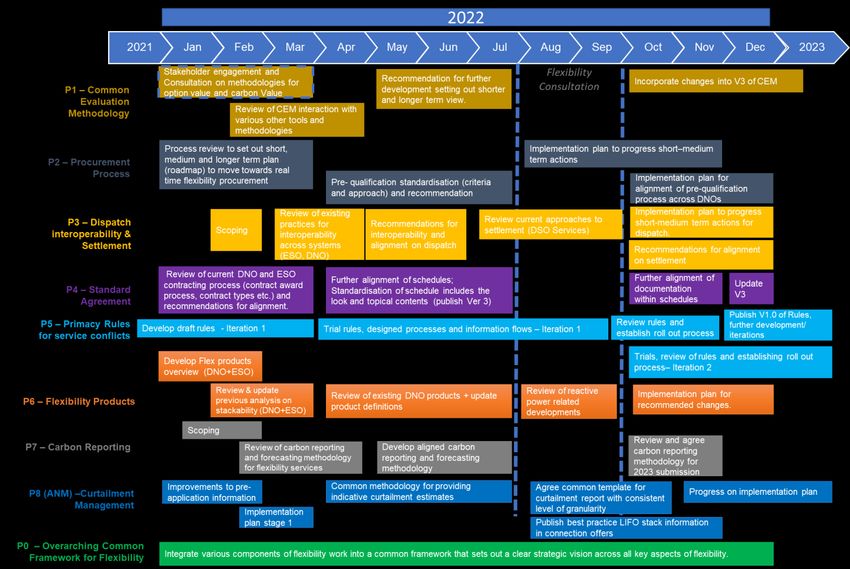
A timeline view of these products and their associated activities is set out below:
Classified as Public │ 13Open Networks programme
2022 Programme Initiation Document
January 2022
Classified as Public │ 14Open Networks programme
2022 Programme Initiation Document
January 2022
WS1A Products Details
P1 Common Evaluation Methodology
Public consultation: Yes Focus Group: Yes Consultancy support: Yes
Background
V1 of the Common Evaluation Methodology (CEM) and Tool developed by the Open Networks programme in
2020 went live on 1 April 2021 to be used by all DNOs to evaluate flex and traditional intervention options for
an identified network need.
Stakeholder feedback from the Advisory Group and consultation responses suggested the V1 was a good start
but did not go far enough in option value and carbon impact assessment. The CEM was developed further in
2021, with external consultancy support, to incorporate carbon value (V2) and to identify methodologies for
implementing option value. This product initiated engagement with stakeholders in Dec 2021.
Activity for 2022
In Q1 2022, this product will continue the stakeholder engagement and then consult on the methodologies for
incorporating option value into the CEM, the changes to carbon valuation included in CEM V2. Additionally,
through this consultation, further views will be sought on the methodology and functionality to include in the
CEM in later versions.
The product will also clarify the CEM interaction with various other tools and methodologies (including the WS4
Whole System CBA framework) and how these fit into existing processes for network options assessment
across the ESO and DNOs with a view to identify alignment opportunities in the short term, medium and longer
term.
Note: In 2020, this product clarified the use of the CEM tool for ANM (Active Network Management) enabled
Flexible Connections. The current scope does not include any further work on this, however following
stakeholder feedback, we will further discuss and review the best approach to considering wider costs and
impacts through the work under 2022 WS4 P1 Whole System CBA Methodology and will seek to work closely
with stakeholders through the Focus Group to understand how we best address this.
Deliverables for 2022
Ref Product Element Deliverables Scope/description Expected
Completion
A Stakeholder Collated Summary of the input received from Jan-22
engagement inputs/feedback Expert + Critical friends engagement (not
from engagement for separate publication as this will feed
(report/slide deck) into the development of the wider
consultation document.
B CEM Consultation Consultation Overview of the work undertaken by the Feb-22
document and product group in 2021, including
associated consolidation of all relevant product
deliverables outputs and key questions for
consultation.
Stakeholder Month long consultation on 2021 CEM Mar-22
consultation development work as outlined by the
above consultation document.
Classified as Public │ 15Open Networks programme
2022 Programme Initiation Document
January 2022
C CEM interactions CEM interactions This paper will seek to clarify the CEM Apr-22
report and interaction with various other tools and
opportunities for methodologies (including the WS4 Whole
alignment System CBA framework) and how these
fit into the overall Network Options
Assessment processes; with a view to
identify alignment opportunities in the
short term, medium, and longer term.
Note: This will be a joint activity with 2022
WS4 P1 and will include stakeholder
engagement to further understand how
consideration of wider cost and impact
can be incorporated into the Whole
System CBA.
D Recommendation Recommendation This will consider stakeholder feedback July-22
for further for further from the CEM consultation in Q1 as well
development development as previous feedback from other sources
to consider the required changes. As part
of this, prioritisation may be required to
fast track the more important changes.
This deliverable will clearly articulate any
prioritisation and stakeholder views will be
sought on this as part of the Flexibility
Consultation in Jul.
E Further Ver 3 of CEM Take on-board stakeholder feedback and Dec-22 and
Development of initiate the further developments beyond
CEM identified. This will likely require
consultancy support.
Note: The delivery timescale for V3 will
depend on the scope and scale of
changes identified and is likely to go into
early 2023.
P2 Procurement Processes
Public consultation: Yes Focus Group: No (engagement via Consultancy support: Yes
other existing channels)
Background
Previously, this product has delivered alignment across DNOs on activities relating to procurement of flexibility
services including definition of common flexibility services, alignment across DNOs on procurement activities
including how and when tenders are assessed by DNOs and coordinated DNO - ESO (Electricity System
Operator) procurement windows.
In 2021, the product focused on investigating the potential for further alignment of procurement timescales
between the DNOs and the ESO (including consideration of the Capacity Market). Detailed reviews were
undertaken to identify and assess the range of options, and the product concluded that it may not be of value
Classified as Public │ 16Open Networks programme
2022 Programme Initiation Document
January 2022
to create concurrent DNO and ESO procurement timelines at this juncture. The product has consulted on both
the options analysis and this conclusion. Stakeholders have broadly agreed with this conclusion and would like
to see alignment across other process areas (pre-qualification, technical specifications etc.) and to see further
consideration of real time flexibility procurement.
Activity for 2022
As identified in our response to the 2021 Flexibility Consultation, this product will focus on improving aspects
of the procurement process such as pre-qualification and will progress thinking on the move to real time
markets, mapping out steps that are required in the short, medium, and longer term to achieve this.
As part of the work on real time procurement, the product will build on the 2021 WS1A P4 Evolution Report to
further develop the technical, legal, and regulatory service requirements identified in the report as required for
a common procurement framework across DSO and ESO.
As part of work on pre-qualification, this product will develop a standard pre-qualification criteria and approach
including the convergence of timescales such that they are accommodative even of smaller flexibility service
providers. To this product will build on the preliminary work undertaken as part of 2019 WS1A P2 Procurement
Processes which delivered a gap analysis to establish a view on the criteria that can be standardised. This
product will also review current approaches to pre-qualification employed across DNOs and the ESO to
understand the pros and cons of the various approaches, with a view to align where possible.
Note that we are staggering work on real time flexibility and pre-qualification across the year to evenly spread
the workload for the product team.
Additionally, this product will work with stakeholders to further identify any improvements within the
procurement process and remove any barriers to help make local flexibility markets more accessible.
Deliverables for 2022
Ref Product Element Deliverables Scope/description Expected
Completion
A Real time Recommended Following a review of current network Mar-22
procurement steps to move to processes and development plans, this
real time deliverable will clearly set out a best view of
procurement steps required in the short, medium and
longer term to move towards real time
flexibility procurement.
This will be included in the consultation in
Jul.
This will feed into WS1A P0 that will be
setting out a broader roadmap across key
aspects of flexibility.
Detailed Develop a clear and detailed action plan that Nov-22
implementation sets out how the steps identified above will
plan to progress be delivered by network companies and by
short-medium when. Where barriers have been identified,
term actions for appropriate actions should be identified and
real time flexibility included in this plan to address them.
Classified as Public │ 17Open Networks programme
2022 Programme Initiation Document
January 2022
Whilst work will commence in Aug to stagger
some of the product activities, this plan will
take on board any stakeholder feedback that
comes through the consultation.
Following the publication of this,
implementation will commence as per the
plan.
B Alignment of pre- Pre-qualification This report will include a review of existing Jul-22
qualification standardisation approaches to pre-qualification employed
recommendation across DNOs and ESO, capturing the pros
and cons of the different methods. The
report will utilise some of the inputs from the
gap analysis undertaken by WS1A P4 to
develop a view of which criteria can be
standardised whilst identifying the product
specific pre-qualifications. Learnings from
the roll out of ESO single market platform will
also be noted.
This report will include recommendations for
the alignment of criteria and approach to
pre-qualification across DNOs, seeking to
align with the ESO where possible.
This will be included in the consultation in
Jul.
Detailed Taking on board stakeholder feedback, Dec-22
implementation update the recommendations as required
plan to align pre- and set out a clear implementation plan that
qualification outlines how and when these
recommendations will be taken forward.
Following the publication of this,
implementation will commence as per the
plan.
Classified as Public │ 18Open Networks programme
2022 Programme Initiation Document
January 2022
P3 Dispatch Interoperability and Settlement
Public consultation: Yes Focus Group: No (engagement via Consultancy support: No
other existing channels)
Background
This product will build on the 2019 WS1A Product 3 Dispatch and Settlement activity. Previously, this work
concluded that due to the DNOs having varying levels of experience operating flexibility services and settlement
processes, this activity should be recommenced at a later date when more knowledge and experience of these
activities are available.
In light of the Smart Systems and Flexibility Plan, we will convene this product in 2022 to specifically look at
standardisation of dispatch and settlement processes. With regards to dispatch of services, this product will
consider interoperability across the various systems (DNO, ESO, and third-party platforms).
Activity for 2022
This product will commence with an exercise to set out the landscape of expectations for dispatch and
settlement to be covered. This will include mapping out interactions between different systems to identify areas
for convergence.
The product will revisit the 2019 work and identify an action plan to deliver interoperability across systems (incl.
ESO, DSO, and third-party platforms) in the short, medium, and longer-term. Considerations may include the
development of common systems, processes, standards, and APIs.
The product will also develop a similar plan for settlement to map out short, medium, and long-term actions.
This product will take relevant learnings from innovation trials and set out a plan towards standardisation.
Although work on dispatch and settlement requires resources with different skill set the two topics are included
in one product as the learning from the interoperability/dispatch exercise could feed into convergence of DNO
settlement processes. The product team will be resourced to ensure key experts are available for the relevant
tasks.
Deliverables for 2022
Ref Product Element Deliverables Scope/description Expected
Completion
A Scope definition Scope document This will be a short document that will Feb-22
outline a common view and definition of
dispatch interoperability in the context of
this product and will set out the scope for
delivery of this product, across both,
dispatch and settlement.
B Dispatch Review of existing A report summarising existing practices for Apr-22
practices and gap each network company and plans for
analysis further development as part of ED2 plans.
Building on this, this report will include a
gap analysis on this to identify
commonalities/best practices and elements
that hinder interoperability from the collated
pool.
Classified as Public │ 19Open Networks programme
2022 Programme Initiation Document
January 2022
Recommendations This will set out the recommendations in Jun-22
for alignment the short, medium, and longer term to
achieve interoperability (across DNO-DNO,
(Appended to DNO-TO, and DNO-ESO) and a
report above) standardised approach to dispatch.
As part of this, where prioritisation has
been applied, it should be clearly noted
along with the justification.
This will be included in the flexibility
consultation in Jul.
This will feed into P0 that will be setting out
a broader roadmap across key aspects of
flexibility.
Note: It is envisioned that the
recommendation will seek to standardise
parts of process, systems and interactions.
However, it will not include a technical
specification.
Implementation Taking on board stakeholder feedback from Dec-22
plan to progress the consultation, this will include any
short-medium term updates to the recommendations that sets
actions. out how these will be delivered by networks
and by when. Any barriers identified will be
clearly noted along with a set of appropriate
actions to address them.
C Settlement Review of existing This will deliver a gap analysis, in the form Sep-22
practices and gap of a spreadsheet, on existing approaches to
analysis settlement per product per DNO.
This report will capture alignment and
differences from the gap analysis. This will
also describe the existing mechanics of
payment including calculation that are
applied, penalties delivery quality etc.
Recommendations The recommendation will identify possible Dec-22
for alignment area of alignment, clearly describing the
areas that cannot be aligned along with a
(Appended to justification. These recommendations will
report above) cover short, medium and long-term steps
that are required for alignment on
settlement processes.
This will feed into P0 that will be setting out
a broader roadmap across key aspects of
flexibility.
Classified as Public │ 20Open Networks programme
2022 Programme Initiation Document
January 2022
As part of this, the product will work closely
with WS1A P6 to ensure that any updated
definitions of products are factored in.
P4 Standard Agreement - Alignment of Contract for DNO/ESO services
Public consultation: Yes Focus Group: No (engagement via Consultancy support: Yes
other existing channels)
Background
The Standard Agreement is a key deliverable from Open Networks that has helped to standardise and simplify
the flexibility procurement process. The Standard Agreement for flexibility services was first implemented in
April 2020 by all DNOs and further iterations have delivered additional improvements over the years. This
product has also set out a view on the evolution of this Agreement and the move towards a framework
approach.
In March 2021, the product delivered Version 1.2 to address stakeholder feedback on liability, indemnity, and
insurance (L, I, & I) elements of the Agreement. Version 2.0 of the Agreement was subsequently released for
consultation in Jul 2021 and is the first version to be utilised by both the DNOs and the ESO. This version
brought the Agreement another step closer to a framework approach and delivered further simplification, similar
to the ESO’s suite of services. The introduction of a framework approach allows contracts to be
awarded, ranging from day ahead (auction-style) agreements to bilateral contracts. A framework approach
essentially enables providers to respond to multiple tenders across a defined period without needing to sign
specific contracts each time.
Activity for 2022
The product will provide further iterations and improvements to the Agreement and deliver Version 3. This will
include further alignment of format of schedules and documentation. Working closely with ongoing
development in the Regional Development Programmes (RDPs), it will also consider the need for tripartite
agreements. The product will also seek to expand the product specific schedules across other ESO and DSO
products.
Additionally, the product will engage with a couple of the respondents to the 2022 scope consultation to further
understand and discuss contract specific feedback based on their experiences. The product will also review
the outputs of WS1A P5-Primacy rules and identify changes (if any) to the standard agreement that need to be
incorporated to ensure applicability of the rules. Any changes identified as part of this will be considered for V3
of the contract.
This product will collaborate with WS1A P2 Procurement Process to help develop some of the technical, legal,
and regulatory areas identified in the 2021 WS1A P4 Evolution Report.
Deliverables for 2022
Ref Product Element Deliverables Scope/description Expected
Completion
Classified as Public │ 21Open Networks programme
2022 Programme Initiation Document
January 2022
A Contracting Gap analysis and Gap analysis that captures similarities and Mar-22
processes recommendations differences in the journeys of network
for alignment on companies (DNO and ESO) in contracting
contracting including contract award process, and
processes contract types (tripartite, bilateral,
framework) etc.
Recommendations for alignment across the
various aspects of contracting and/or the
Standard Agreement, noting future ambitions
to move to real time operations.
B Format of Recommendation This will deliver further standardisation of the Jul-22
schedules to standardise format of Standard Agreement schedules.
format of contract This will include the look of and high-level
schedules content of the agreement. The detailed
schedule content will be product specific and
therefore different.
As part of this, a common set of schedule
structures will also be defined that will be
used for all existing and future products to
help bring consistency. These will specify the
order in which the schedule should be
drafted (e.g. 1: Service terms, 2: glossary, 3:
Annex etc.).
C Format of Recommendations Following the standardisation of the Nov-22
documentation for standardising schedules format, this will identify
format of recommendations for alignment of
supporting documentation within the schedules (e.g.
documentation order of server terms, clauses 1,2 etc).
D Development of Version 3 of Take on board stakeholder feedback Dec-22 and
V3 Standard (including from 2022 scope consultation), beyond
Agreement (to be review of WS1A P5 outputs and initiate the
continued to 2023) further developments identified earlier in the
recommendation for alignment (Product
Element A).
P5 Primacy Rules for Service Conflicts
Public consultation: Yes Focus Group: Yes Consultancy support: No
Background
Network co-ordination and co-optimisation issues can arise when both the DNO and the ESO are seeking to
procure flexibility from the same Flexibility Service Provider (FSP) and/or managing issues in the same parts
of the network or, in some cases, where localised actions may affect the ability to balance the overall system
on a national basis. There is a need for both the DNOs and the ESO to have a set of clear principles and
primacy rules for addressing flexibility service conflicts between the transmission and distribution networks for
a range of scenarios.
It is likely that a series of Primacy Rule releases will be required as the system needs, products, and services,
evolve over time. In 2021, the product has identified and agreed a range of likely scenarios; prioritised by value
Classified as Public │ 22Open Networks programme
2022 Programme Initiation Document
January 2022
to networks and FSPs, and the likely needs timeframe and deliverability. The product will establish a Primacy
focus group consisting of users with relevant experience and / or currently navigating both DNO and ESO
service provision, to review and challenge the use cases/scenarios, their value and timings.
Activity for 2022
This product is a continuation of 2021 product with the detailed plan here. In 2022, the product scope covers
the delivery, testing, and initial implementation of the first version of Primacy Rules for flexibility providers,
networks, stakeholders, market platform designers etc. for the limited use cases identified for the first iteration.
Trials are typically funded and led by industry and the product will need to comply with the relevant processes.
Open Networks will provide a scope/design document and will continue to monitor, provide input and take
learnings from the trials.
The product will employ an iterative approach with a push for delivering tangible outputs, consolidating over
future iterations in the following year. The product will continue ongoing engagement with the focus group
throughout this process. Subsequent physical implementation of a full suite of Primacy Rules at scale in the
network planning and operational processes is likely to be a major undertaking in early ED2 (subject to funding)
and excluded here.
Deliverables for 2022
Ref Product Element Deliverables Scope/description Expected
Completion
A Develop draft "Draft Primacy Using the 2021 principles, this will deliver a Mar-22 for
Primacy Rules & Rules" Report – draft set of Primacy Rules for the chosen use iteration 1
the processes Iteration 1 cases and will set out the processes and
and information information sharing that is required to
sharing needed to support them.
support them
"Draft Primacy As part of this work, there will be a need to
Rules" Report – understand the required changes to ESO, Sep-23 for
Iteration 2 DNO, and FSP processes to accommodate iteration 2
the draft rules for the relevant use case.
This report will set out the high-level impacts
on networks, FSPs and platform providers.
This work will also consider testing and
deployment of these Primacy Rules through
trials and will document the success criteria
that will be used to assess the outcomes of
these trials.
B Implement N/A, initiate Implement the required processes to allow Jun-22 for
designed discussions as testing of the Primacy rules. This will iteration 1
processes and required leverage existing testbeds such as RDP,
information flows TEF, or other projects.
Dec-23 for
Note: There is a dependency on external iteration 2
initiatives and the timing represented here is
our best view at this stage.
C Test the rules N/A, initiate Run the rules and identify any issues against Sep-22 for
discussions as the earlier defined success criteria. iteration 1
required
Classified as Public │ 23Open Networks programme
2022 Programme Initiation Document
January 2022
Mar-23 for
iteration 2
D Review the rules Report setting out Review the rules, identify any changes Nov-22 for
and processes trial learnings, needed. Sign off a roll out programme to iteration 1
and establish roll outcomes and roll accommodate the Primacy Rules.
out process out process –
Iteration 1
Report setting out
trial learnings, May-23 for
outcomes and roll iteration 2
out process –
Iteration 2
E Publish Primacy V1.0 of Primacy Following iteration 1, accommodate the trial Jan-23,
Rules, proposed Rules based on learnings into a V1.0 of Primacy Rules. This following
review periods iteration 1 will also include proposed review periods iteration 1
and target date and target roll out dates for roll-out at scale.
for roll-out at V1.1 of Primacy Jul-23,
scale Rules based on Further review these Rules after iteration 2 following
iteration 2 and publish V1.1 to reflect learnings. iteration 2
Consider the need for further review and
improvement of the proposed rules at both T
and D.
F Governance Primacy Rules This will determine a short term means of Mar-23
governance governing the rules as well as a route
approach towards an enduring governance framework.
G Implementation N/A Roll out the rule across the relevant use Mar-23 for
cases. This may or may not include all DNOs use cases
depending on the use case need. involved in
iteration 1
Oct-23 for
use cases
involved in
iteration 2.
Classified as Public │ 24Open Networks programme
2022 Programme Initiation Document
January 2022
P6 Flexibility Products
Public consultation: Yes Focus Group: No (engagement via Consultancy support: No
other existing channels)
Background
Open Networks has previously developed common definitions and common parameters for 4 active power
services that are being procured by DNOs. This product will take ownership of these products to review, update
and create new products as required based on latest market developments and stakeholder feedback
(including through the SLC31E consultation process). This product will also review stackability of products,
building on 2019 WS1A P5 Co-ordination and co-optimisation of services and progress actions to remove
barriers to it.
Activity for 2022
The product will review and update previous analysis on stackability, taking into account stakeholder inputs
and feedback, including through ESO channels. This will include the development of a flexibility product
catalogue that will consolidate a list of all flexibility products (across DSO and ESO market) and their existing
technical characteristics. The product team will engage and collaborate with ongoing work in 2022 WS1A P5
Primacy Rules which will generate a similar list/catalogue albeit specific to the primacy work. The aim of this
work is to enable an analysis of opportunities for stacking of services that offers a stakeholder a clear view of
the flexibility product portfolio across DSO and ESO. Where barriers to stackability have been identified, this
product will help to address them.
The product will review how flexibility services have been used to date and develop recommendations for any
updates that may be required. Stakeholders will be consulted on the recommendations identified. The product
will also review developments in the area of reactive power flexibility product (e.g. Power Potential and the
SPEN Reactive tender) and consider scoping the definition of technical specification for DSO Reactive Power
services in 2023.
Deliverables for 2022
Ref Product Element Deliverables Scope/description Expected
Completion
A Flexibility product Flexibility product Consolidate a list of all flexibility products Feb-22
catalogue catalogue across DSO and ESO market and their
existing technical characteristics.
B Stackability Stackability report Analysis of opportunities for stacking of Mar-22
review services that offers a stakeholder a clear
view of the flexibility product portfolio across
DSO and ESO.
Classified as Public │ 25Open Networks programme
2022 Programme Initiation Document
January 2022
Principles of assessing Stackability i.e.
considerations such as technical,
commercial, contractual etc. will also be
developed by the product.
C Review of active Active power This will capture the experience and key Jul-22
power products products review learnings from deploying the 4 active power
and updates report (DSO) products. This will identify:
- Areas of divergence
- Identification of factors that are barriers to
markets development
- Factors that improve stackability threshold
for products
- Other relevant factors identified by the
product team
Updated active Recommendations for refinement/alignment
power product of technical specifications of
definitions - Existing DSO flex products (if applicable)
- Learnings from developments in the area of
reactive power flexibility product
This will be included in the Jul flexibility
consultation.
D Review of Review summary A summary of the outcomes and learnings Sep-22
reactive power (slides) from innovation/pilot projects that explores
and other reactive power and other related
developments developments that may substantiate the
need for the definition of further flexibility
products and services.
Implementation Recommendations for technical Dec-22
plan specifications of new DSO products (if
applicable).
Set out a roadmap, including timelines on
how each DNO will roll out the
recommended changes. The
recommendations will ensure that the
migration is consistent whilst managing
contracts/tenders that use old definitions.
P7 Carbon Reporting
Public consultation: Yes Focus Group: No (engagement via Consultancy support: No
other existing channels)
Background
This is a new area of work for Open Networks and has been introduced based on action 3.6 in the Smart
Systems and Flexibility Plan that requires networks to develop common methodologies for carbon reporting
and monitoring of flexibility markets by 2023.
Classified as Public │ 26You can also read


