Re-evaluating 14C dating accuracy in deep-sea sediment archives - GChron
←
→
Page content transcription
If your browser does not render page correctly, please read the page content below
Geochronology, 2, 17–31, 2020
https://doi.org/10.5194/gchron-2-17-2020
© Author(s) 2020. This work is distributed under
the Creative Commons Attribution 4.0 License.

Re-evaluating 14 C dating accuracy in
deep-sea sediment archives
Bryan C. Lougheed1 , Philippa Ascough2 , Andrew M. Dolman3 , Ludvig Löwemark4 , and Brett Metcalfe5,6
1 Department of Earth Sciences, Uppsala University, Uppsala, Sweden
2 ScottishUniversities Environmental Research Centre, Glasgow, Scotland, UK
3 Alfred Wegener Institute, Helmholtz Centre for Polar and Marine Research, Potsdam, Germany
4 Department of Geosciences, National Taiwan University, Taipei, Taiwan
5 Department of Earth Sciences, Vrije Universiteit Amsterdam, Amsterdam, the Netherlands
6 LSCE-IPSL, CEA-CNRS-UVSQ, Université Paris-Saclay, Gif-sur-Yvette, France

Correspondence: Bryan C. Lougheed (bryan.lougheed@geo.uu.se)

Received: 2 September 2019 – Discussion started: 16 September 2019
Revised: 9 March 2020 – Accepted: 20 March 2020 – Published: 6 April 2020

Abstract. The current geochronological state of the art for         14 C activity can be incorporated into single discrete-depth
applying the radiocarbon   (14 C)method to deep-sea sediment        sediment intervals. For certain lower-SAR scenarios, we
archives lacks key information on sediment bioturbation.            find that downcore discrete-depth true median age can
Here, we apply a sediment accumulation model that sim-              systematically fall outside the calibrated age range predicted
ulates the sedimentation and bioturbation of millions of            by the 14 C measurement and calibration processes, thus
foraminifera, whereby realistic 14 C activities (i.e. from a 14 C   leading to systematically inaccurate age estimations. In
calibration curve) are assigned to each single foraminifera         short, our findings suggest the possibility of 14 C-derived
based on its simulation time step. We find that the                 age–depth artefacts in the literature. Furthermore, since such
normal distribution of 14 C age typically used to represent         age–depth artefacts are likely to coincide with large-scale
discrete-depth sediment intervals (based on the reported            changes in global 114 C, which themselves can coincide
laboratory 14 C age and measurement error) is unlikely to be        with large-scale changes in global climate (such as the
a faithful reflection of the actual 14 C age distribution for a     last deglaciation), 14 C-derived age–depth artefacts may have
specific depth interval. We also find that this deviation from      been previously incorrectly attributed to changes in SAR
the actual 14 C age distribution is greatly amplified during        coinciding with global climate. Our study highlights the need
the calibration process. Specifically, we find a systematic         for the development of improved deep-sea sediment 14 C
underestimation of total geochronological error in many             calibration techniques that include an a priori representation
cases (by up to thousands of years), as well as the generation      of bioturbation for multi-specimen samples.
of age–depth artefacts in downcore calibrated median age.
Even in the case of “perfect” simulated sediment archive
scenarios, whereby sediment accumulation rate (SAR),                1      Introduction
bioturbation depth, reservoir age and species abundance
are all kept constant, the 14 C measurement and calibration         1.1     Background and rationale
processes generate temporally dynamic median age–depth
                                                                    For over half a century, radiocarbon (14 C) dating has been
artefacts on the order of hundreds of years – whereby even
                                                                    applied to deep-sea sediment archives. The material that
high SAR scenarios (40 and 60 cm kyr−1 ) are susceptible.
                                                                    is typically analysed from these archives consists of the
Such age–depth artefacts can be especially pronounced
                                                                    calcareous tests of foraminifera. The minimum amount of
during periods corresponding to dynamic changes in the
                                                                    material required for viable 14 C analysis has meant that
Earth’s 114 C history, when single foraminifera of varying
                                                                    researchers have had to pick tens to hundreds of individual

Published by Copernicus Publications on behalf of the European Geosciences Union.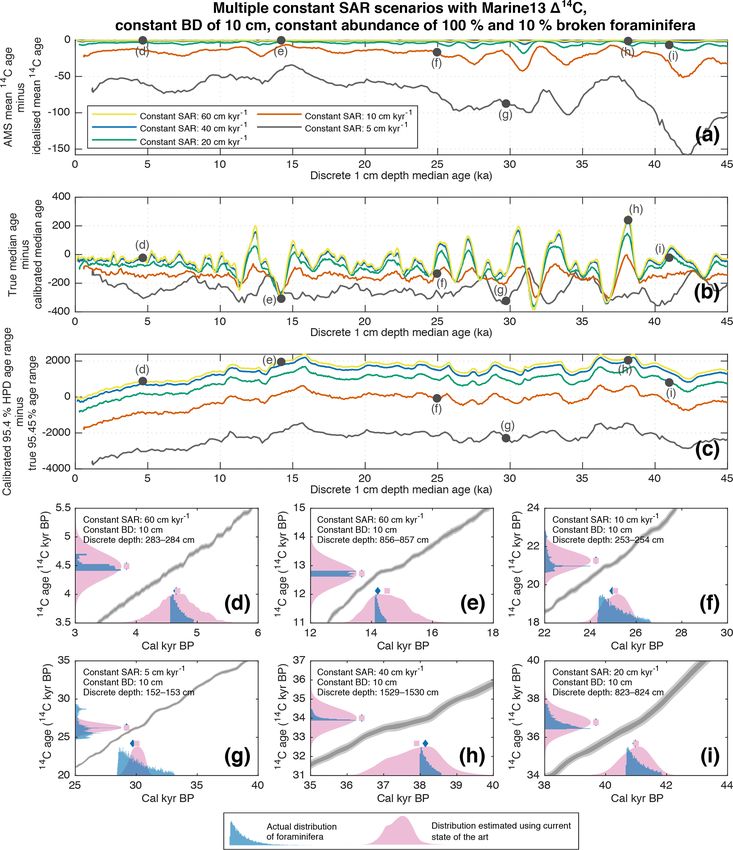
18                               B. C. Lougheed et al.: Re-evaluating 14 C dating accuracy in deep-sea sediment archives

foraminifera specimens (depending on specimen size) from         smoothing of which can change downcore in tandem with
a single discrete-depth core interval (typically 1 cm of core    foraminiferal abundance changes (Ruddiman et al., 1980;
depth) and combine these into a single sample for analysis.      Peng and Broecker, 1984; Paull et al., 1991; Löwemark
Such multi-specimen samples are likely to be heterogeneous       et al., 2008). If SAR, BD and the 114 C history of the
in 14 C activity (i.e. combine individual specimens of           planet were all to be temporally constant, then the idealised
varying true age). The 14 C laboratory measurement (and          14 C activity PDF of each discrete depth (expressed as, for

reported machine error) applied to such an amalgamated           example, the 14 C/12 C ratio or normalised as fraction modern
multi-specimen sample will simply represent the mean 14 C        [F14 C]) would, therefore, exhibit the combination of two
activity of the total carbon of all individual specimens.        exponential functions (the exponential PDF of true age plus
Consequently, the true intra-sample 14 C age heterogeneity       the exponential PDF of 14 C activity vs. time predicted by the
of a sample is concealed from the researcher. Failure to         half-life of 14 C). However, the distribution of the 14 C activity
consider the actual 14 C age heterogeneity of multi-specimen     PDF is further complicated by the fact that 14 C activity vs.
samples can lead to downcore 14 C age artefacts when             time is not always the exact exponential function that would
post-depositional processes mix foraminifera with differing      be predicted by the radioactive half-life of 14 C, seeing as the
14 C activities, which is especially pronounced during periods   Earth’s carbon reservoirs exhibit a dynamic 114 C history,
of dynamic 114 C. Furthermore, one must also take into           as demonstrated by temporal changes in atmospheric 14 C
consideration that younger specimens within a sample             activity (Suess, 1955, 1965; de Vries, 1958; Reimer et al.,
contribute exponentially more to the sample’s mean 14 C          2013). These changes are brought about by changes in 14 C
activity than older specimens do, a process referred to as the   production in the atmosphere in combination with climatic
isotope mass balance effect (Erlenkeuser, 1980; Keigwin and      and oceanic influence upon the carbon cycle (Craig, 1957;
Guilderson, 2009), due to 14 C being a radioactive isotope       Damon et al., 1978; Siegenthaler et al., 1980). Furthermore,
(specimen 14 C activity decreases exponentially with the         non-uniform mixing of the oceans can contribute to temporal
passing of time).                                                changes in local water 14 C activity at a given coring site,
   Systematic bioturbation has long been recognised as an        further affecting the idealised PDF shape.
inherent feature of deep-sea sediment archives (Bramlette           When applying the 14 C method to sediment core material,
and Bradley, 1942; Arrhenius, 1961; Olausson, 1961).             researchers represent the 14 C activity of a discrete-depth
Long-established mathematical models of bioturbation in          interval using a normal (Gaussian) distribution, based on
deep-sea sediment archives consider the uppermost ∼ 10 cm        the conventional mean 14 C age (a reporting convention for
of a sediment archive to be uniformly mixed due to active        14 C activity) and measurement error reported by the 14 C

bioturbation – the bioturbation depth (BD) (Berger and           laboratory (Stuiver and Polach, 1977). In some cases, this
Heath, 1968; Berger and Johnson, 1978; Berger and Killing-       14 C age normal distribution is widened by researchers to

ley, 1982). The presence of such a BD has been supported         also incorporate a reservoir age uncertainty, but it remains
by the detection of a uniform mean age in the uppermost          a normal distribution. This normal distribution of 14 C age
intervals of sediment archives (Peng et al., 1979; Trauth et     is subsequently calibrated using a suitable reference record
al., 1997; Boudreau, 1998; Teal et al., 2008) and suggested      of past 114 C (e.g. those produced by the IntCal group),
by the 14 C analysis of single foraminifera (Lougheed et al.,    allowing researchers to arrive at an estimation of the discrete-
2018). The total range of single-specimen ages mixed within      depth interval’s true (i.e. calendar) age. Such an approach
the BD is dependent upon two main factors: the depth of          inherently excludes the effects of bioturbation, because one
the BD itself and the sediment accumulation rate (SAR),          would not expect a normal 14 C age distribution to be
both of which can exhibit spatio-temporal variation due          representative of a discrete-depth interval for the reasons
to environmental and biological factors (Müller and Suess,       described in the previous paragraph. Currently, systematic
1979; Trauth et al., 1997). The presence of uniform mixing       investigation is lacking into whether neglecting to include
within the BD throughout the sedimentation history of a          the effects of bioturbation has significant impact upon the
deep-sea sediment archive ultimately results, in the case of     interpretative accuracy of 14 C dating as it is currently
temporally constant SAR and BD, in the single-specimen           applied in palaeoceanography, i.e. if it may ultimately lead
population of discrete sediment intervals being characterised    to spurious geochronological interpretations.
by an exponential probability density function (PDF) for true
age, with a maximum probability for younger ages and a long      1.2   Experimental design
tail towards older ages. The existence of such a distribution
has been supported by the post-depositional mixing of            Here, we take advantage of computer modelling to construct
tephra layers (Bramlette and Bradley, 1942; Nayudu, 1964;        an ideal experimental design whereby we can evaluate how
Ruddiman and Glover, 1972; Abbott et al., 2018) and the          the current 14 C state of the art within palaeoceanography
smoothing out of the downcore mean signal (Guinasso              would work in the case of best-case sediment conditions.
and Schink, 1975; Pisias, 1983; Schiffelbein, 1984; Bard         Such best-case conditions do not exist in the field, meaning
et al., 1987; Löwemark et al., 2008; Trauth, 2013), the          that a computer modelling environment can uniquely be

Geochronology, 2, 17–31, 2020                                                             www.geochronology.net/2/17/2020/
B. C. Lougheed et al.: Re-evaluating 14 C dating accuracy in deep-sea sediment archives                                         19

used to create such a best-case scenario, which is ideal          individual very old foraminifera contained within a sample
for testing the current state of the art. We use the 114 C-       will contribute a 14 C signal equivalent to the analytical blank.
enabled, single-specimen SEdiment AccuMUlation Simu-              Here, we choose to set the simulation’s analytical blank
lator (SEAMUS) (Lougheed, 2020). This model uses the              value to 46 806 14 C BP (more precisely the F14 C equivalent
long-established understanding of bioturbation as included        thereof), which corresponds to the lowest activity level in the
in existing bioturbation models (Trauth, 2013; Dolman and         Marine13 calibration curve. The analytical blank activity in
Laepple, 2018), but it differs in that it explicitly simulates    most laboratories is somewhat lower (e.g. > 50 000 14 C BP),
the accumulation and bioturbation of single foraminifera,         but we have no way of accurately applying an activity to
each with individually assigned 14 C activities, to create a      single foraminifera older than the oldest value contained
synthetic sediment archive history. Subsequently, current         within Marine13. Rather than infer a 114 C history beyond
palaeoceanographic subsampling and 14 C dating practices          the limit of Marine13, we simply set the analytical blank in
are virtually applied to the 1 cm discrete-depth sediment         our simulation to 46 806 14 C BP. In some scenarios we wish
intervals of the model’s outputted synthetic archive, resulting   to investigate parameters within an experimental construct
in discrete-depth 14 C ages and calibrated ages that are          with temporally constant 114 C, and in such scenarios
representative of the existing palaeoceanographic state of        we assign 14 C activity (as F14 C) as follows: F14 C(t) =
                                                                      +
the art. These results are subsequently compared to the           e([t R(t)]/−8267) , where t is the single foraminifera age in
actual discrete-depth true age distributions within the model,    years before 1950 CE, and R(t) is the reservoir age for age t.
allowing us to quantitatively evaluate contemporary palaeo-          After the creation of all new single foraminifera within
ceanographic 14 C measurement and calibration techniques.         the synthetic core for a specific time step, bioturbation
By keeping multiple model input parameters constant, we           is simulated. Specifically, for each time step the depth
can construct an experimental environment whereby we have         values corresponding to all simulated foraminifera within
full control over the degrees of freedom. This modelling          the contemporaneous BD are each assigned a new depth
approach allows us to test, at a most fundamental level, the      by way of uniform random sampling of the BD interval.
accuracy of the current 14 C dating state of the art as applied   In this way, uniform mixing of foraminifera within the
to deep-sea sediments.                                            BD is simulated by following the established understanding
                                                                  of bioturbation (Berger and Heath, 1968; Trauth, 2013).
                                                                  All of the aforementioned processes are repeated for every
2     Methods
                                                                  simulation time step until such point that the end of the
2.1    The synthetic core simulation
                                                                  age–depth input (i.e. the final core top) is reached. All
                                                                  simulations are initiated at 70 ka (in true age) in order
The SEAMUS model (Lougheed, 2020) synthesises n single            to confidently exclude the influence of model spin-up
foraminifera raining down from the water column per               effects upon our period of interest (0–45 ka), given the
simulation time step, whereby n is the capacity of the            possibility of a given centimetre of sediment to have a
synthetic sediment archive being simulated (analogous to          long tail of older foraminifera specimens. While SEAMUS
sediment core radius) scaled to the SAR of the time step as       can in principle be run on a local machine, to save time
predicted by an inputted age–depth relationship (Lougheed,        multiple simulations were run in parallel on a computing
2020). To provide good statistics, all simulations use a time     cluster provided by the Swedish National Infrastructure for
step of 5 years and 104 synthetic foraminifera per centimetre     Computing (SNIC) at the Uppsala Multidisciplinary Center
of core depth. An abundance of 104 specimens per centimetre       for Advanced Computational Science (UPPMAX).
is also similar to a best-case scenario value for a particular
sample in the field (Broecker et al., 1992).                      2.2   Virtual discrete-depth analysis
   In each time step, all newly created single foraminifera are
assigned an age (corresponding to the time step), a sediment      After the completion of the synthetic core simulation,
depth (according to the age–depth input), and a 14 C age          synthetic foraminifera (and corresponding values for true
(in 14 C BP) and normalised 14 C activity (in F14 C) based on     age, F14 C and 14 C age) are picked from each discrete
Marine13 (Reimer et al., 2013) after the application of a         1 cm interval of the sediment core. In this study, we
prescribed reservoir age for the time step. For older sections    assume best-case scenarios where it is possible to pick all
of the Marine13 calibration curve, where only 10-year time        whole foraminifera contained within the sediment intervals.
steps are available, linear interpolation is used to provide a    Subsequently, each of these picked 1 cm samples also
5-year 14 C activity time step resolution. Within SEAMUS,         undergoes a synthetic 14 C determination analogous to a
all single foraminifera older than the oldest available age       perfect accelerator mass spectrometry (AMS) measurement,
within the chosen calibration curve (in this case Marine13)       whereby it is assumed that the AMS determination perfectly
are assigned the same 14 C activity: that of the analytical       reproduces the mean 14 C activity (in F14 C) of the sample.
blank, which must be set in the simulation. In this way, the      Within the discrete-depth subsampling simulation, this mean
model incorporates the principles of 14 C dating, whereby         14 C activity is calculated by taking the mean of all F14 C

www.geochronology.net/2/17/2020/                                                               Geochronology, 2, 17–31, 2020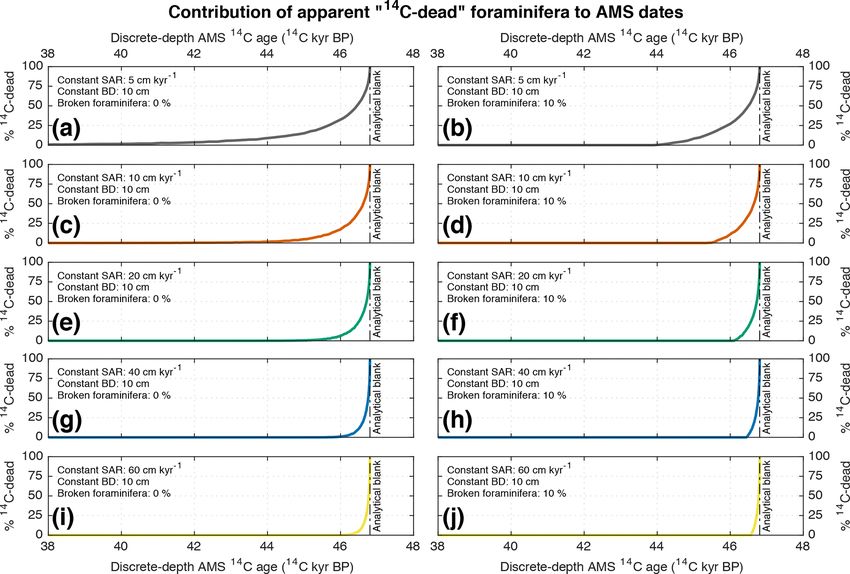
20                                B. C. Lougheed et al.: Re-evaluating 14 C dating accuracy in deep-sea sediment archives

values of all the single foraminifera contained within the        size. A total of five best-case scenarios are carried out, with
picked sample. As mentioned in Sect. 2.1, the analytical          five different SAR scenarios (5, 10, 20, 40 and 60 cm kyr−1 ).
blank is already included when assigning 14 C to single           The BD is set to 10 cm in all cases, following established
foraminifera, meaning that the influence of the analytical        understanding of global BD (Trauth et al., 1997; Boudreau,
blank upon sample AMS measurements is incorporated.               1998). In this scenario, we also assume perfection in
   Using the Libby half-life, a sample’s mean F14 C value         subsampling, i.e. the possibility to exhaustively sample all
is also reported as a conventional 14 C age determination         foraminifera material from each 1 cm discrete-depth interval
(in 14 C yr). All such synthetic determinations are assigned      when picking for multi-specimen samples, thus excluding
a synthetic 1σ measurement error analogous to a best-case         noise due to small sample sizes. The results of these
scenario laboratory counting error for a large sample.            five scenarios are visualised in Figs. 1 and S1–S5 in the
The prescribed synthetic measurement error ranges from            Supplement.
30 14 C yr in the case of near-modern samples to 500 14 C yr         A second set of best-case scenarios takes into account
in the case of samples nearing the blank value. Specif-           that relatively older foraminifera contained within a given
ically, when assigning measurement errors to synthetic            discrete depth of core sediment will have accumulated a
AMS determinations, a 14 C determination of 1.0 F14 C is          longer residence time in the active bioturbation depth. Due
assumed to have a measurement error of 30 14 C yr, and a          to their longer residence time in the active bioturbation
determination with the F14 C value e(blank value−1)/−8033 (i.e.   depth, these foraminifera are more likely to be broken and/or
one 14 C yr younger than the blank value) is assumed to have      partially dissolved (Rubin and Suess, 1955; Ericson et al.,
a measurement error of 500 14 C yr. Errors (in 14 C yr) for       1956; Emiliani and Milliman, 1966; Barker et al., 2007), and
intermediate dates are linearly interpolated to F14 C.            they are thus less likely to be picked by palaeoceanogra-
   The synthetic laboratory 14 C determinations and associ-       phers, who preferentially pick whole, unbroken foraminifera
ated measurement uncertainties for each 1 cm discrete-depth       specimens for analysis. In this way, palaeoceanographers
sample are subsequently converted to calibrated years             exclude the oldest, least well preserved fraction of the
within SEAMUS using the embedded MatCal (v 2.6) 14 C              sediment. An indication of the BD residence time of single
calibration software (Lougheed and Obrochta, 2016), the           specimens for a given 1 cm discrete depth is shown in
Marine13 calibration curve (Reimer et al., 2013) and a            Fig. 2 for all five simulated SAR scenarios, along with the
prescribed reservoir age (according to the scenario – see         median and 90th percentile residence time. The percentage
following sections) to produce a calibrated age probability       of broken specimens within the sediment archive is chiefly
density function (PDF) and 95.4 % highest posterior density       governed by the aforementioned BD residence time, bottom
(HPD) credible interval(s) for every centimetre core depth,       water chemistry (Bramlette, 1961; Berger, 1970; Parker
i.e. analogous to what would be typically produced using          and Berger, 1971), and the susceptibility of a particular
contemporary palaeoceanography methods in the case of             foraminifera species to dissolution or breakage (Ruddiman
every discrete centimetre of core depth being exhaustively        and Heezen, 1967; Boltovskoy, 1991; Boltovskoy and Totah,
14 C dated. The MatCal software calibrates ages in F14 C          1992). Previous studies have indicated that the percentage of
space, resulting in an accurate calibration, especially in the    foraminifera exhibiting test breakage for typically analysed
case of older samples or samples with large uncertainty.          species at locations above the lysocline can hover around
                                                                  10 % (Le and Shackleton, 1992). In the second set of
                                                                  best-case scenarios we, therefore, exclude from the picking
3    Best-case scenario simulations                               process for each 1 cm discrete depth all foraminifera with
                                                                  a number of bioturbation cycles greater than the 90th
In order to investigate the baseline accuracy when applying       percentile for that particular discrete depth. This broken
14 C dating to deep-sea sediment cores, the first simulations     foraminifera percentage of 10 % is applied to all five SAR
in this study consider a number of best-case scenarios.           scenarios (5, 10, 20, 40 and 60 cm kyr−1 ) in a second set
Essentially, we seek to test how well the current application     of best-case scenarios (shown in Figs. 3 and S6–S10). One
of 14 C within palaeoceanography would function in the case       should be aware, however, that BD residence time likely
of such a best-case scenario, thus testing the current state of   varies with SAR itself: when sediment accumulation is
the art at a most fundamental level. In such simulations, we      slower, single specimens remain in the BD for relatively
assume that Marine13 constitutes a perfect reconstruction         longer than in the case of faster SAR (Bramlette, 1961).
of past surface-water 14 C activity at the synthetic core site,
and we therefore employ a temporally constant reservoir           3.1 14 C age artefacts
age (1R = 0 14 C yr). Furthermore, we assume a scenario
involving synthetic sediment cores with temporally constant       Radiocarbon analysis focuses on determining the mean
SAR and BD, and we also assume that the synthetic core            14 C activity of a particular sample, which is reported

is made up of a single planktonic foraminiferal species with      together with an associated analytical error. This mean
a temporally constant abundance (104 cm−1 ) and specimen          activity of samples is often considered in the literature

Geochronology, 2, 17–31, 2020                                                             www.geochronology.net/2/17/2020/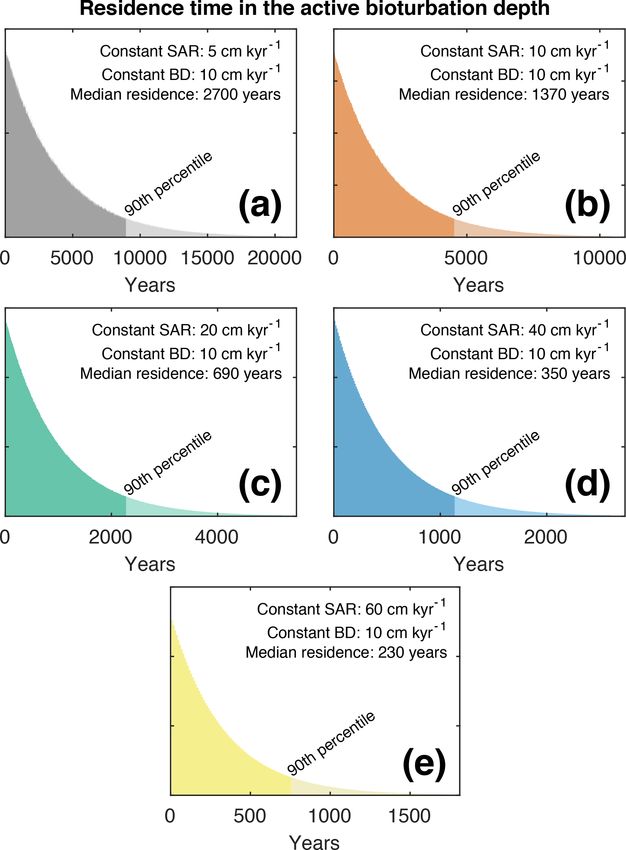
B. C. Lougheed et al.: Re-evaluating 14 C dating accuracy in deep-sea sediment archives                                                       21

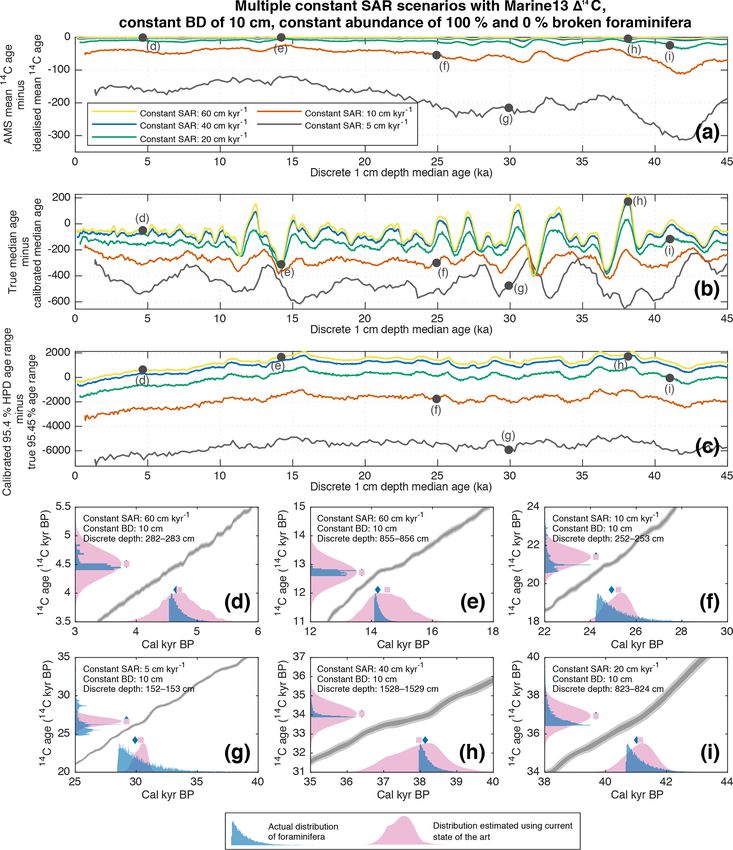
Figure 1. Overview of results of simulations using Marine13 114 C involving multiple constant SAR scenarios (5, 10, 20, 40 and
60 cm kyr−1 ) with constant BD of 10 cm, constant species abundance of 100 % and 0 % broken foraminifera. All discrete-depth results
are plotted against their true median age on the x axes. (a) The discrete-depth offset between mean AMS (i.e. laboratory) conventional 14 C
age and the idealised mean 14 C age. (b) The discrete-depth offset between the true median age and the calibrated median age (i.e. that derived
from the 14 C measurement and calibration process). (c) The discrete-depth difference between the calibrated highest posterior density (HPD)
95.4 % age range (i.e. that derived from the 14 C measurement and calibration process) and the true 95.4 % age range of the sediment. (d, e,
f, g, h, i) A visualisation of 14 C calibration skill for select discrete-depth samples from various scenarios indicated on the figure panels. The
blue histograms represent the actual single-foraminifera simulation output: on the x axis the true age distribution of the single foraminifera
(with the blue diamond corresponding to the median true age) and on the y axis the corresponding true 14 C age distribution of the single
foraminifera (with the blue diamond corresponding to the mean 14 C age of all individual foraminifera). All histograms are shown using
30-year or 30 14 C yr bin widths. The pink distributions represent the current state of the art in 14 C dating. The pink normal distribution
on the y axis represents an AMS 14 C determination carried out on the single specimens, where the pink square corresponds to its mean.
The pink probability distribution on the x axis represents the calibrated age PDF arising from the calibration of the aforementioned AMS
14 C determination using Marine13 (Reimer et al., 2013) and MatCal (Lougheed and Obrochta, 2016), where the pink square represents the
median calibrated age. Also shown, for reference, are the Marine13 calibration curve 1σ (dark grey) and 2σ (light grey) confidence intervals.

www.geochronology.net/2/17/2020/                                                                           Geochronology, 2, 17–31, 2020
22                                  B. C. Lougheed et al.: Re-evaluating 14 C dating accuracy in deep-sea sediment archives

                                                                     14 C  activity (what the measurement process is actually
                                                                     analysing) than older foraminifera do. This bias towards
                                                                     younger foraminifera is most apparent in cases with large
                                                                     intra-sample heterogeneity, such as in scenarios with lower
                                                                     SAR (Fig. 1a), and it is also reduced somewhat in the
                                                                     case of more broken foraminifera (Fig. 3a), due to lesser
                                                                     older foraminifera being picked, thus reducing the age
                                                                     heterogeneity. In the case of the highest SAR scenarios
                                                                     (> 40 cm kyr−1 ) the aforementioned bias is insignificant in
                                                                     a practical sense in that it falls within the typical 14 C
                                                                     measurement error. For all scenarios, superimposed upon
                                                                     the general bias are artefacts of the Earth’s dynamic 114 C
                                                                     history, caused by foraminifera from times of markedly
                                                                     differing 114 C to be mixed together into a single sample,
                                                                     thus altering a sample’s 14 C activity distribution and causing
                                                                     downcore dynamic offsets between AMS mean 14 C age
                                                                     and idealised mean 14 C age. The most pronounced example
                                                                     of these artefacts can be seen during known periods of
                                                                     dynamic 114 C, such as during the Laschamp geomagnetic
                                                                     event (ca. 40–41 ka) (Guillou et al., 2004; Laj et al., 2014),
                                                                     when a large spike in atmospheric 14 C production occurred
                                                                     (Muscheler et al., 2014). We note that our simulations
                                                                     assign single foraminifera 14 C activity using the Marine13
                                                                     calibration curve, while newer records of 114 C (Cheng et al.,
                                                                     2018) suggest that the Laschamp 114 C excursion may have
                                                                     been of greater magnitude than was previously thought. A
                                                                     larger excursion would generate even more pronounced 14 C
                                                                     artefacts in the downcore, multi-specimen, discrete-depth
Figure 2. An overview of residence time of single foraminifera       record. Furthermore, there may exist as yet undiscovered
within the active BD for the various simulation scenarios detailed   short-lived excursions in 114 C (Miyake et al., 2012, 2017;
in Fig. 1, i.e. with a constant BD of 10 cm and a SAR of (a) 5,      Mekhaldi et al., 2015).
(b) 10, (c) 20, (d) 40 and (e) 60 cm kyr−1 .                            We can also visualise how well a sample’s 14 C activity
                                                                     probability distribution function (PDF) is represented by a
                                                                     distribution based on its mean AMS-measured 14 C activity
as conventional 14 C age in 14 C BP. Conventional 14 C               and 1σ measurement error. This visualisation is shown on the
age, a unit of convenience, is linear vs. time, whereas              vertical axes of Figs. 1d–i and 2d–i for a number of simulated
14 C activity is actually exponential vs. time, due to 14 C          discrete depths for the different SAR scenarios with a BD
being a radioactive isotope. Therefore, with increasing age          of 10 cm. It can be clearly seen that the normal distribution
heterogeneity of a sample, we can expect an increased                derived from a sample’s AMS mean measurement and
offset between the AMS conventional 14 C age of a sample             associated uncertainty is a poor representation of a sample’s
(the mean measured activity of the homogenised sample                actual 14 C activity distribution.
reported as conventional age) and the idealised mean of the
conventional 14 C ages of all single foraminifera within the         3.2    Calibration amplifies 14 C age distribution
sample. In Fig. 1, we compare the simulated AMS mean                        mischaracterisation
conventional 14 C age calculated for each discrete depth
to the idealised mean 14 C age (based on the mean value              When estimating a true age distribution for a particular
of all single foraminifera conventional 14 C ages contained          sample, researchers calibrate a normal distribution of 14 C age
within a sample). The resulting offset can help shed light           using suitable calibration curve (in this case Marine13). As
upon how the measurement of age-heterogenous material                discussed in the previous section, the aforementioned normal
is inherently biased towards younger (higher 14 C activity)          distribution of 14 C activity derived from the measurement
specimens contained within the sample. We find that the              mean and machine error is not a faithful representation of the
AMS mean 14 C age is generally younger than the idealised            actual 14 C activity distribution for a particular discrete depth.
mean 14 C age in all cases. This effect can be attributed to         Such a misrepresentation has the potential to be further
the fact that younger foraminifera within a heterogeneous            amplified during the calibration process itself, potentially
sample contribute exponentially more to a sample’s mean              resulting in a poor estimation of a discrete depth’s 95.4 % age

Geochronology, 2, 17–31, 2020                                                                 www.geochronology.net/2/17/2020/
B. C. Lougheed et al.: Re-evaluating 14 C dating accuracy in deep-sea sediment archives 23 Figure 3. Overview of results of simulations using Marine13 114 C involving multiple constant SAR scenarios (5, 10, 20, 40 and 60 cm kyr−1 ) with constant BD of 10 cm, constant species abundance of 100 % and 10 % broken foraminifera. All discrete-depth results are plotted against their true median age on the x axes. (a) The discrete-depth offset between mean AMS (i.e. laboratory) conventional 14 C age and the idealised mean 14 C age. (b) The discrete-depth offset between the true median age and the calibrated median age (i.e. that derived from the 14 C measurement and calibration process). (c) The discrete-depth difference between the calibrated highest posterior density (HPD) 95.4 % age range (i.e. that derived from the 14 C measurement and calibration process) and the true 95.4 % age range of the sediment. (d, e, f, g, h, i) A visualisation of 14 C calibration skill for select discrete-depth samples from various scenarios indicated on the figure panels. The blue histograms represent the actual single-foraminifera simulation output: on the x axis the true age distribution of the single foraminifera (with the blue diamond corresponding to the median true age) and on the y axis the corresponding true 14 C age distribution of the single foraminifera (with the blue diamond corresponding to the mean 14 C age of all individual foraminifera). All histograms are shown using 30-year or 30 14 C yr bin widths. The pink distributions represent the current state of the art in 14 C dating. The pink normal distribution on the y axis represents an AMS 14 C determination carried out on the single specimens, where the pink square corresponds to its mean. The pink probability distribution on the x axis represents the calibrated age PDF arising from the calibration of the aforementioned AMS 14 C determination using Marine13 (Reimer et al., 2013) and MatCal (Lougheed and Obrochta, 2016), where the pink square represents the median calibrated age. Also shown, for reference, are the Marine13 calibration curve 1σ (dark grey) and 2σ (light grey) confidence intervals. www.geochronology.net/2/17/2020/ Geochronology, 2, 17–31, 2020
24                                  B. C. Lougheed et al.: Re-evaluating 14 C dating accuracy in deep-sea sediment archives

range and/or median age, the latter of which is often used           3.3   The influence of the analytical blank
to calculate, for example, sedimentation rates or represents
the region of highest probability which will steer age–depth         A general consequence of bioturbation and the subsequent
modelling routines. In Fig. 1b (0 % broken foraminifera)             mixing of single foraminifera specimens is that older
and Fig. 3b (10 % broken foraminifera), we show the offset           foraminifera become systematically mixed upwards through-
between each discrete depth’s true median age, and the               out the sedimentation history of a sediment archive. This
corresponding median age derived from the 14 C calibration           general mixing can have a particular consequence near the
process. We find large offsets for all constant SAR scenarios,       analytical limit of the 14 C method in that foraminifera
ranging from ∼ 200 years in the case of the 60 cm kyr−1              with a 14 C activity that is lower than a laboratory-based
scenario up to ∼ 700 years in the case of the 5 cm kyr−1             analytical sensitivity can become mixed into samples.
scenario. In certain low-SAR scenarios that coincide with            Samples with a 14 C age that is equal to or older than the
intervals of the calibration curve that are highly resolved (e.g.    established 14 C blank value (i.e. the samples 14 C activity
the late Holocene), the discrete-depth true median age can           falls below the detection limit of the analytical process) are
consistently fall outside the 68.2 % age range predicted by          commonly referred to as “14 C-dead”. Within older intervals
the 14 C measurement and calibration processes. A 68.2 %             of heterogeneous deep-sea sediment archives, it is possible
certainty suggests that, statistically, the true median will fall    that a sample with an apparent measured 14 C age younger
outside of the 68.2 % calibrated age range in only 31.8 % of         than the 14 C blank value can already contain a significant
cases, but, in the case of the 5 cm kyr−1 scenario (Fig. S1),        proportion of 14 C-dead foraminifera. The presence of these
the true median falls outside of the 68.2 % calibrated age           14 C-dead specimens within a sample will bias the sample’s

range for 84 % of the discrete depths spanning the 5 to 0 ka         apparent measured 14 C age towards a value that is too young,
period. In the case of 10 % broken foraminifera, this effect is      because they will contribute a 14 C activity to the sample
reduced.                                                             that is equivalent to the laboratory’s analytical blank. Such
   All offsets for all scenarios vary dynamically downcore,          artefactually young 14 C ages could ultimately erroneously
meaning that they can potentially cause spurious interpreta-         be interpreted as age–depth features. In Table 1, the very
tions of changes in SAR. Furthermore, as these offsets occur         first downcore occurrence of at least one simulated 14 C-dead
during periods of dynamic 114 C, which can be caused by              foraminifer is detailed for each of the aforementioned
large-scale changes in the carbon cycle caused by climate            constant SAR scenarios introduced in Sect. 3. In the case of
shifts (such as during the last deglaciation), it is possible that   low-SAR scenarios with 0 % broken foraminifera, 14 C-dead
some apparent changes in SAR in the palaeoceanographic               foraminifera are already present in discrete-depth samples
literature may have been erroneously attributed to climate           with apparent AMS ages that would normally be considered
processes, when they may be (partially) an artefact of the           well above the 14 C blank value, e.g. an apparent AMS age of
current application of 14 C measurement and calibration              22 647 14 C BP in the case of 5 cm kyr−1 , and 33 747 14 C BP
within palaeoceanography.                                            in the case of 10 cm kyr−1 . However, the contribution of 14 C-
   Using the simulation output, it is also possible to quanti-       dead foraminifera at these levels may still be insignificant.
tatively estimate how well the current 14 C measurement and          The exact percentage contribution of 14 C-dead foraminifera
calibration state of the art applied within palaeoceanography        to discrete-depth AMS determinations is, therefore, detailed
estimates the true age range contained within discrete-depth         in Fig. 4a, c, e, g and i. From this analysis, it transpires that
sediment intervals. The offset between the calibrated 95.4 %         the first occurrence of at least 1 % contribution of 14 C-dead
age range and the true 95.4 % age range for each discrete            foraminifera to discrete-depth AMS determinations occurs
depth for all SAR scenarios is shown in Fig. 1c (0 % broken          in the case of AMS ages of 39 158 and 43 601 14 C BP,
foraminifera) and Fig. 3c (10 % broken foraminifera), and it         respectively, for the 5 and 10 cm kyr−1 scenarios. The
is further visualised for all scenarios in Figs. S1–S10. For the     percentage increases quickly further downcore. In the case
lower SAR scenarios, the current application of 14 C dating          of scenarios involving 10 % broken foraminifera, older
within palaeoceanography significantly underestimates the            foraminifera within discrete-depth sediment intervals are no
total age range contained within each discrete depth by many         longer whole, and therefore they are not picked for samples
thousands of years. The underestimation is less in the case          by a palaeoceanographer preferring whole specimens. The
of the scenario with 10 % broken foraminifera. In the case of        consequence of this effect is that the first occurrence of
higher-SAR scenarios, the discrete-depth 95.4 % age range            picked 14 C-dead whole foraminifera occurs much further
predicted by the 14 C calibration process is similar to that of      downcore (Table 1, Fig. 4b, d, f, h and j). This finding further
the discrete-depth 95.4 % age range of the sediment itself. In       underlines the importance of understanding foraminifera
some cases with very high SAR, the 14 C calibration process          preservation conditions for particular species and/or water
actually overestimates the 95.4 % age range (e.g. Figs. 1e, 3e,      chemistry, and the associated consequences for 14 C dating.
S5 and S10).                                                            As motivated in the methods section, for practical reasons
                                                                     we have set the 14 C analytical blank value to 46 806 14 C BP
                                                                     within our model simulations. The laboratory blank value

Geochronology, 2, 17–31, 2020                                                                 www.geochronology.net/2/17/2020/
B. C. Lougheed et al.: Re-evaluating 14 C dating accuracy in deep-sea sediment archives 25
Table 1. The first downcore discrete-depth where “14 C-dead” whole foraminifera occur (i.e. ndead ≥ 1) for the various constant SAR and
broken foraminifera scenarios discussed in Sect. 3 of this study. Also shown are the simulated median true ages, AMS 14 C ages and median
14 C calibrated ages corresponding to the discrete depth. The simulation analytical blank value is set to 46 806 14 C BP (see Sect. 2.1), thus
any single foraminifera with a 14 C age older than that blank value are assumed “14 C-dead”.
First downcore occurrence of “14 C-dead” foraminifera
0 % broken foraminifera scenario 10 % broken foraminifera scenario
Discrete Median true AMS 14 C age Median 14 C calibrated Discrete Median true AMS 14 C age Median 14 C calibrated
depth (cm) age (yr) (14 C BP) age (cal BP) depth (cm) age (yr) (14 C BP) age (cal BP)
SAR 5 cm kyr−1 133–134 26 110 22 647 26 493 237–238 46 690 44 096 46 833
BD 10 cm
SAR 10 cm kyr−1 375–376 37 250 33 747 37 654 486–487 48 260 45 422 48 396
BD 10 cm
SAR 20 cm kyr−1 900–901 44 855 41 973 45 002 986–987 49 125 46 090 49 186
BD 10 cm
SAR 40 cm kyr−1 1894–1895 47 285 44 582 47 383 1987–1988 49 585 46 455 49 544
BD 10 cm
SAR 60 cm kyr−1 2866–2867 47 725 44 912 47 775 2986–2987 49 710 46 556 49 621
BD 10 cm
Figure 4. An estimation of the contribution of “14 C-dead” (i.e. activity below the analytical blank value) foraminifera to discrete-depth
sample activity plotted against the apparent AMS 14 C mean age of the discrete-depth sample. Based on the simulation scenarios detailed in
Figs. 1 and 3 with a constant BD of 10 cm and (a) SAR of 5 cm kyr−1 and 0 % broken foraminifera, (b) SAR of 5 cm kyr−1 and 10 % broken
foraminifera, (c) SAR of 10 cm kyr−1 and 0 % broken foraminifera, (d) SAR of 10 cm kyr−1 and 10 % broken foraminifera, (e) SAR of
20 cm kyr−1 and 0 % broken foraminifera, (f) SAR of 20 cm kyr−1 and 10 % broken foraminifera, (g) SAR of 40 cm kyr−1 and 0 % broken
foraminifera, (h) SAR of 40 cm kyr−1 and 10 % broken foraminifera, (i) SAR of 60 cm kyr−1 and 0 % broken foraminifera, and (j) SAR of
60 cm kyr−1 and 10 % broken foraminifera.
www.geochronology.net/2/17/2020/ Geochronology, 2, 17–31, 202026 B. C. Lougheed et al.: Re-evaluating 14 C dating accuracy in deep-sea sediment archives
in most laboratories is around ∼ 50 000 14 C BP, or even mation of the true 95.4 % age range of the sample by
greater, depending on sample size, preparation conditions the calibration process, artefacts which are superimposed
and measurement capability. For such greater blank values, upon a long-term change in the underestimation of the true
essentially the same curves as shown in Fig. 4 would apply age range of the sample caused by a long-term change
(i.e. assuming there are no, as of yet undiscovered, large in the confidence intervals in the calibration curve (Fig
114 C excursions around the period of the blank age) but 5g). Specifically regarding 1R, the current method for
shifted further to the right on the x axis. In other words, correcting for reservoir age during calibration, which we
researchers interested in interpreting Fig. 4 in the case of apply in this simulation, involves subtracting the 1R from
an analytical blank of 50 000 14 C BP should simply shift the the AMS date just prior to calibration. This method poses
curves to the right such that the 100 % 14 C-dead contribution a particular challenge for periods near temporal changes in
exactly coincides with 50 000 14 C BP on the x axis. 1R, where multi-specimen samples will incorporate single
foraminifera with varying individual 1R values. The blanket
application of a single 1R correction to the entire sample
4 Dynamic sediment core scenarios fails to adequately represent the 1R heterogeneity of the
foraminifera population.
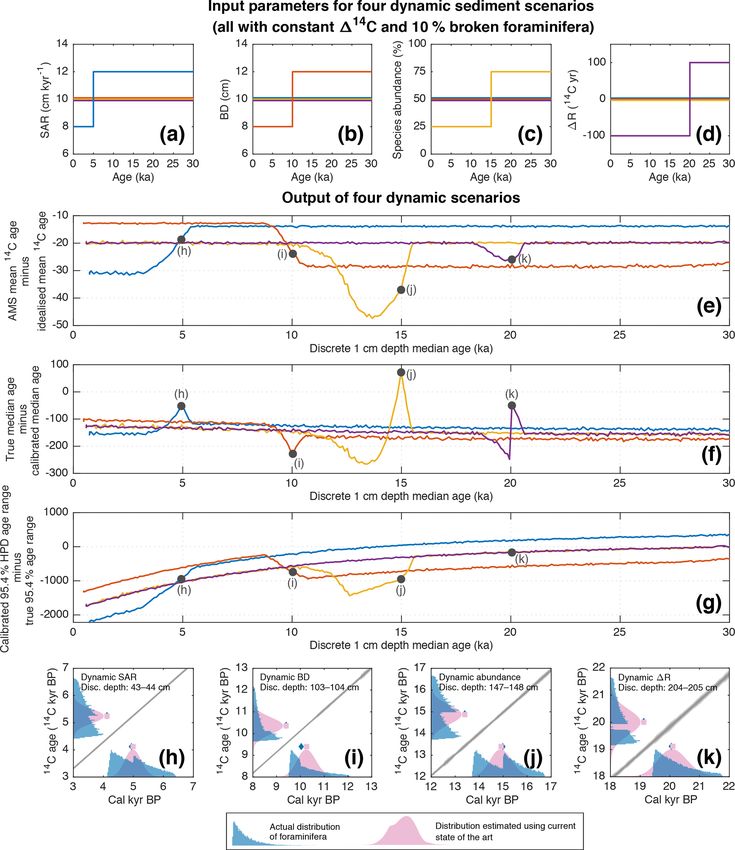
The multiple sediment archive scenarios carried out in Sect. 3 The influence of the various dynamic parameters upon
all involved best-case input parameters with constant SAR. the 14 C measurement and calibration processes, as outlined
In Fig. 5, we carry out four scenarios to investigate the in Fig. 5, represent further sources of age–depth bias in
influence of stepwise changes in the following four input addition to the large biases caused by dynamic 114 C history
parameters: (1) SAR, (2) BD, (3) species abundance and previously outlined in Sect. 3. Furthermore, as has been
(4) reservoir age (1R). In each of the four scenarios, detailed in previous studies, changes in abundance and
one of the aforementioned input parameters is varied at bioturbation depth can in themselves also cause additional
a certain time, while the other three are kept constant general age–depth artefacts, no matter what geochronologi-
(Fig. 5a–d). In this way, the influence of one of the cal method is being used (independent of the 14 C method)
dynamic input parameters can be independently judged. (Bard, 2001; Löwemark and Grootes, 2004; Löwemark et
To further ensure the ability to independently judge the al., 2008; Lougheed, 2020). Such effects can be seen in
dynamic sediment input parameters, in these scenarios we age–depth artefacts also visible in the true median age for the
do not employ a dynamic 114 C history using Marine13 dynamic BD scenario (Fig. S12) and the dynamic abundance
but instead assign 14 C activities to foraminifera using a scenario (Fig. S13). Such artefacts occur in addition to the
constant 114 C history (with an added constant 400-year artefacts related to the 14 C measurement and calibration
reservoir age). This constant 114 C history is assigned as processes, as outlined in this study.
detailed in the methods section (Sect. 2.1). For the calibration Researchers should be aware that periods of long-term
process, we also constructed a calibration curve with the climate change can cause many input parameters to change
same aforementioned constant 114 C (also with an added in concert. For example, the last deglaciation in the North
constant 400-year reservoir age), whereby the confidence Atlantic is known to be characterised by highly dynamic
interval sizes of Marine13 are copied for incorporating a 114 C (Stuiver et al., 1986; Reimer et al., 2013), dynamic
realistic calibration uncertainty. The scenario with dynamic reservoir age (Austin et al., 1995; Waelbroeck et al., 2001;
1R (Fig. 5d) is simulated on the foraminifera by additionally Butzin et al., 2020) and dynamic foraminiferal abundance
subtracting (1R = −100) or adding (1R = +100) to or (Ruddiman and McIntyre, 1981). It is possible that all of
from the 14 C age of simulated foraminifera younger or older, these parameters can combine at once to produce very large
respectively, than 20 ka. During the simulated picking and age–depth artefacts, which could lead to spurious interpre-
calibration processes, it is assumed that the researcher is tations regarding the relationship between, for example, the
aware of the change in 1R, and, during calibration, they last deglaciation and the perceived magnitude of associated
apply a 1R of −100 to all discrete depths shallower than SAR change.
204 cm and a 1R of +100 to all discrete depths deeper than
204 cm.
The simulations using dynamic parameter inputs demon- 5 Conclusion
strate that temporal changes in any of the four main input
parameters (SAR, BD, species abundance, 1R) can result This study demonstrates the possibility of the current
in the generation of 14 C-induced age–depth artefacts in the 14 C measurement and calibration method, as it is applied
discrete-depth domain, due to the median calibrated age to multi-specimen samples within palaeoceanography, to
dynamically deviating from the true median age downcore produce age–depth artefacts, even in the case of best-case
(Fig. 5f). We also note that the changes in the input sediment archives where SAR, BD, species abundance
parameters can cause the 14 C measurement and calibration and reservoir age are all constant. We find that even
processes to generate artefacts in the over- or underesti- high-SAR sediment archives (40 and 60 cm kyr−1 ) are
Geochronology, 2, 17–31, 2020 www.geochronology.net/2/17/2020/B. C. Lougheed et al.: Re-evaluating 14 C dating accuracy in deep-sea sediment archives 27 Figure 5. Four dynamic input scenarios (each with a unique colour) with constant 114 C, each involving dynamic input for (a) SAR, (b) BD, (c) species abundance and (d) reservoir age (1R). A constant broken foraminifera percentage of 10 % is applied in all cases. (e) For each scenario, the resulting discrete-depth offset between mean AMS (i.e. laboratory) conventional 14 C age and the idealised mean 14 C age. (f) For each scenario, the discrete-depth offset between the true median age and the calibrated median age (i.e. that derived from the 14 C measurement and calibration process). (g) For each scenario, the difference between the calibrated highest posterior density (HPD) 95.4 % age range (i.e. that derived from the 14 C measurement and calibration process) and the true 95.4 % age range of the sediment. (h, i, j, k) A visualisation of 14 C calibration skill for select discrete-depth samples from various scenarios indicated on the figure panels. The blue histograms represent the actual single-foraminifera simulation output: on the x axis the true age distribution of the single foraminifera (with the blue diamond corresponding to the median true age) and on the y axis the corresponding true 14 C age distribution of the single foraminifera (with the blue diamond corresponding to the mean 14 C age of all individual foraminifera). All histograms are binned to 30-year or 30 14 C yr bin widths. The pink distributions represent the current state of the art in 14 C dating. The pink normal distribution on the y axis represents an AMS 14 C determination carried out on the single specimens, where the pink square corresponds to its mean. The pink probability distribution on the x axis represents the calibrated age PDF arising from the calibration of the aforementioned AMS 14 C determination using a custom-made calibration curve with constant 114 C (see Sect. 4) and MatCal (Lougheed and Obrochta, 2016), where the pink square represents the median calibrated age. Also shown, for reference, are the calibration curve 1σ (dark grey) and 2σ (light grey) confidence intervals. www.geochronology.net/2/17/2020/ Geochronology, 2, 17–31, 2020
28                                B. C. Lougheed et al.: Re-evaluating 14 C dating accuracy in deep-sea sediment archives

susceptible to the generation of age–depth artefacts during       δ 18 O, δ 13 O and 14 C on a single foraminifer of suitable size
the 14 C measurement and calibration processes. Additional        (Lougheed et al., 2018), thereby allowing for the extraction
age–depth artefacts can be generated in the case of real-world    of both age and palaeoclimate data from single foraminifera
sediment archives where the aforementioned SAR, BD,               in a manner that is independent of the sediment depth and
species abundance and reservoir age processes are inherently      bioturbation aspects of deep-sea sediment archives.
dynamic. Researchers should be aware, therefore, of the
possible existence of such artefacts when interpreting deep-
sea sediment geochronologies developed using 14 C methods         Data availability. Model runs generated by SEAMUS for this
applied to multi-specimen samples. Key to understanding the       publication can be downloaded from the Zenodo repository at
possible existence of such artefacts is a good quantification     https://doi.org/10.5281/zenodo.3735134 (Lougheed et al., 2020).
of the possible magnitude of temporal change in both
foraminiferal abundance and preservation conditions, as
well as awareness of the possibility of changes in local          Supplement. The supplement related to this article is available
14 C activity due to the influence of dynamic 114 C and           online at: https://doi.org/10.5194/gchron-2-17-2020-supplement.
reservoir age. It may also be necessary to revisit existing
studies and re-evaluate the magnitude of changes in deep-sea
                                                                  Author contributions. BCL carried out the model runs, with
sediment SAR inferred from 14 C-based geochronologies,            scenarios conceived with input from BM. BCL wrote the article
especially close to periods of dynamic 114 C and/or dynamic       with input from the co-authors.
foraminiferal abundance. These 14 C-specific artefacts should
be considered in addition to previously highlighted general
age–depth artefacts that can occur in sedimentary records         Competing interests. The authors declare that they have no
(Bard, 2001; Löwemark and Grootes, 2004; Löwemark et              conflict of interest.
al., 2008; Lougheed, 2020). One should also consider that
paired analysis of multi-specimen samples for both 14 C and
another proxy could lead to a signal offset between the two       Acknowledgements. The Swedish National Infrastructure for
proxies due to the 14 C method, as currently applied within       Computing (SNIC) at the Uppsala Multidisciplinary Center for
palaeoceanography, being prone to the generation of the           Advanced Computational Science (UPPMAX) provided computing
types of age artefacts outlined in this study.                    resources. Two anonymous referees and editor Irka Hajdas are
                                                                  thanked for their contribution to the online discussion forum. Their
                                                                  input helped to significantly improve the article.
6    Outlook and future research
                                                                  Financial support. This work was funded by Swedish Research
We demonstrate that the failure to take into account
                                                                  Council (Vetenskapsrådet – VR) starting grant number 2018-04992
the effect of bioturbation upon the (14 C) age distribution       awarded to Bryan C. Lougheed. Brett Metcalfe was supported by
of foraminifera in multi-specimen samples sourced from            a Laboratoire d’excellence (LabEx) of the Institut Pierre Simon
deep-sea archives can lead to spurious age interpretations,       Laplace (LabEx L-IPSL), funded by the French Agence Nationale
especially during the 14 C calibration process. We propose,       de la Recherche (grant no. ANR-10-LABX-0018). Andrew M. Dol-
therefore, that the 14 C calibration process for deep-sea         man was supported by the German Federal Ministry of Education
sediment archives could be improved in future studies             and Research (BMBF) as a Research for Sustainability initiative
through the development of a new 14 C calibration method          (FONA) through the PalMod project (FKZ: 01LP1509C). Ludvig
including bioturbation a priori, seeing that no information       Löwemark acknowledges support from the Ministry of Science and
regarding bioturbation is included in the current palaeo-         Technology (06-2116-M-002-021 to Ludvig Löwemark,) and the
ceanographic state of the art. This new approach would            Featured Areas Research Center Program within the framework of
                                                                  the Higher Education Sprout Project by the Ministry of Education
involve constructing a representative distribution for 14 C age
                                                                  (MOE) of Taiwan.
that includes a priori information regarding the approximate
SAR and BD of the sediment archive, while also taking
into account some basic information regarding possible            Review statement. This paper was edited by Irka Hajdas and
temporal changes in species abundance and 1R. Such a              reviewed by two anonymous referees.
future development would go some way to providing more
realistic uncertainties (i.e. 95.4 % age range) to 14 C-derived
age–depth geochronologies in deep-sea sediment archives.          References
   Finally, we note that increased automation and cost-
effectiveness in 14 C analysis of ultra-small carbonate sam-      Abbott, P. M., Griggs, A. J., Bourne, A. J., and Davies, S. M.:
ples (Ruff et al., 2010; Lougheed et al., 2012; Wacker et           Tracing marine cryptotephras in the North Atlantic during the
al., 2013a, b) can allow for the parallel measurement of            last glacial period: Protocols for identification, characterisation

Geochronology, 2, 17–31, 2020                                                               www.geochronology.net/2/17/2020/
B. C. Lougheed et al.: Re-evaluating 14 C dating accuracy in deep-sea sediment archives 29 and evaluating depositional controls, Mar. Geol., 401, 81–97, Craig, H.: The Natural Distribution of Radiocarbon https://doi.org/10.1016/j.margeo.2018.04.008, 2018. and the Exchange Time of Carbon Dioxide Arrhenius, G.: Geological record on the ocean floor, in: Oceanogra- Between Atmosphere and Sea, Tellus, 9, 1–17, phy, Am. Assoc. Advan. Sci Washington, DC, 129–148, 1961. https://doi.org/10.1111/j.2153-3490.1957.tb01848.x, 1957. Austin, W. E. N., Bard, E., Hunt, J. B., Kroon, D., and Peacock, Damon, P. E., Lerman, J. C., and Long, A.: Temporal J. D.: The 14 C Age of the Icelandic Vedde Ash: Implications for Fluctuations of Atmospheric 14 C: Causal Factors and Younger Dryas Marine Reservoir Age Corrections, Radiocarbon, Implications, Annu. Rev. Earth Pl. Sc., 6, 457–494, 37, 53–62, https://doi.org/10.1017/S0033822200014788, 1995. https://doi.org/10.1146/annurev.ea.06.050178.002325, 1978. Bard, E.: Paleoceanographic implications of the difference in de Vries, H.: Variation in concentration of radiocarbon with deep-sea sediment mixing between large and fine particles, time and location on Earth, Proceedings of the Koninklijke Paleoceanography, 16, 235–239, 2001. Nederlandse Akademie van Wetenschappen B, 61, 94–108, Bard, E., Arnold, M., Duprat, J., Moyes, J., and Duplessy, J. C.: 1958. Reconstruction of the last deglaciation: Deconvolved records of Dolman, A. M. and Laepple, T.: Sedproxy: a forward model for δ 18 O profiles, micropaleontological variations and accelerator sediment-archived climate proxies, Clim. Past, 14, 1851–1868, mass spectrometric 14 C dating, Clim. Dynam., 1, 101–112, 1987. https://doi.org/10.5194/cp-14-1851-2018, 2018. Barker, S., Broecker, W., Clark, E., and Hajdas, I.: Ra- Emiliani, C. and Milliman, J. D.: Deep-sea sediments and diocarbon age offsets of foraminifera resulting from dif- their geological record, Earth-Sci. Rev., 1, 105–132, ferential dissolution and fragmentation within the sedi- https://doi.org/10.1016/0012-8252(66)90002-X, 1966. mentary bioturbated zone, Paleoceanography, 22, PA2205, Ericson, D. B., Broecker, W. S., Kulp, J. L., and Wollin, G.: Late- https://doi.org/10.1029/2006PA001354, 2007. Pleistocene Climates and Deep-Sea Sediments, Science, 124, Berger, W. H.: Planktonic foraminifera: selective solution and the 385–389, https://doi.org/10.1126/science.124.3218.385, 1956. lysocline, Mar. Geol., 8, 111–138, 1970. Erlenkeuser, H.: 14 C age and vertical mixing of deep-sea Berger, W. H. and Heath, G. R.: Vertical mixing in pelagic sediments, Earth Planet. Sc. Lett., 47, 319–326, sediments, J. Marine Res., 26, 134–143, 1968. https://doi.org/10.1016/0012-821X(80)90018-7, 1980. Berger, W. H. and Johnson, R. F.: On the thickness and the 14 C age Guillou, H., Singer, B. S., Laj, C., Kissel, C., Scaillet, S., of the mixed layer in deep-sea carbonates, Earth Planet. Sc. Lett., and Jicha, B. R.: On the age of the Laschamp geo- 41, 223–227, 1978. magnetic excursion, Earth Planet. Sc. Lett., 227, 331–343, Berger, W. H. and Killingley, J. S.: Box cores from the https://doi.org/10.1016/j.epsl.2004.09.018, 2004. equatorial Pacific: 14 C sedimentation rates and benthic mix- Guinasso, N. L. and Schink, D. R.: Quantitative estimates of ing, Mar. Geol., 45, 93–125, https://doi.org/10.1016/0025- biological mixing rates in abyssal sediments, J. Geophys. 3227(82)90182-7, 1982. Res., 80, 3032–3043, https://doi.org/10.1029/JC080i021p03032, Boltovskoy, E.: On the destruction of foraminiferal tests (laboratory 1975. experiments), Révue de Micropaléontologie, 34, 12–25, 1991. Keigwin, L. D. and Guilderson, T. P.: Bioturbation arti- Boltovskoy, E. and Totah, V.: Preservation index and preservation facts in zero-age sediments, Paleoceanography, 24, PA4212, potential of some foraminiferal species, J. Foramin. Res., 22, https://doi.org/10.1029/2008PA001727, 2009. 267–273, https://doi.org/10.2113/gsjfr.22.3.267, 1992. Laj, C., Guillou, H., and Kissel, C.: Dynamics of the earth magnetic Boudreau, B. P.: Mean mixed depth of sediments: The field in the 10–75 kyr period comprising the Laschamp and Mono wherefore and the why, Limnol. Oceanogr., 43, 524–526, Lake excursions: New results from the French Chaîne des Puys https://doi.org/10.4319/lo.1998.43.3.0524, 1998. in a global perspective, Earth Planet. Sc. Lett., 387, 184–197, Bramlette, M. and Bradley, W.: Geology and biology of North https://doi.org/10.1016/j.epsl.2013.11.031, 2014. Atlantic deep-sea cores. Part 1. Lithology and geologic interpre- Le, J. and Shackleton, N. J.: Carbonate Dissolution Fluctuations in tations, Prof. Pap. U.S. Geol. Surv., 196 A, 1–34, 1942. the Western Equatorial Pacific During the Late Quaternary, Pa- Bramlette, M. N.: Pelagic sediments, in: Oceanography: Invited leoceanography, 7, 21–42, https://doi.org/10.1029/91PA02854, lectures presented at the International Oceanographic Congress 1992. held in New York, 31 August–12 September 1959, edited Lougheed, B. C.: SEAMUS (v1.20): a 114 C-enabled, single- by: Sears, M., Am. Assoc. Advan. Sci Washington, DC, 67, specimen sediment accumulation simulator, Geosci. Model Dev., 345–366, https://doi.org/10.5962/bhl.title.34806, 1961. 13, 155–168, https://doi.org/10.5194/gmd-13-155-2020, 2020. Broecker, W., Bond, G., Klas, M., Clark, E., and McManus, J.: Lougheed, B. C. and Obrochta, S. P.: MatCal: Open Source Origin of the northern Atlantic’s Heinrich events, Clim. Dynam., Bayesian 14 C Age Calibration in Matlab, Journal of Open Re- 6, 265–273, https://doi.org/10.1007/BF00193540, 1992. search Software, 4, e42, https://doi.org/10.5334/jors.130, 2016. Butzin, M., Heaton, T. J., Köhler, P., and Lohmann, G.: A short Lougheed, B. C., Snowball, I., Moros, M., Kabel, K., Muscheler, note on marine reservoir age simulations used in IntCal20, R., Virtasalo, J. J., and Wacker, L.: Using an independent Radiocarbon, https://doi.org/10.1017/RDC.2020.9, online first, geochronology based on palaeomagnetic secular variation (PSV) 2020. and atmospheric Pb deposition to date Baltic Sea sediments and Cheng, H., Edwards, R. L., Southon, J., Matsumoto, K., Feinberg, infer 14 C reservoir age, Quaternary Sci. Rev., 42, 43–58, 2012. J. M., Sinha, A., Zhou, W., Li, H., Li, X., Xu, Y., Chen, S., Tan, Lougheed, B. C., Metcalfe, B., Ninnemann, U. S., and Wacker, M., Wang, Q., Wang, Y., and Ning, Y.: Atmospheric 14 C/12 C L.: Moving beyond the age–depth model paradigm in deep-sea changes during the last glacial period from Hulu Cave, Science, palaeoclimate archives: dual radiocarbon and stable isotope 362, 1293–1297, https://doi.org/10.1029/2006PA001354, 2018. www.geochronology.net/2/17/2020/ Geochronology, 2, 17–31, 2020
You can also read


