TORTILLAS ON THE ROASTER SUMMARY REPORT - CENTRAL AMERICAN MAIZE-BEAN SYSTEMS AND THE CHANGING CLIMATE - Catholic Relief Services
←
→
Page content transcription
If your browser does not render page correctly, please read the page content below
TORTILLAS ON
THE ROASTER

                 e va l u a t i o n
SUMMARY REPORT
CENTRAL
AMERICAN
MAIZE-BEAN
SYSTEMS AND
THE CHANGING
CLIMATE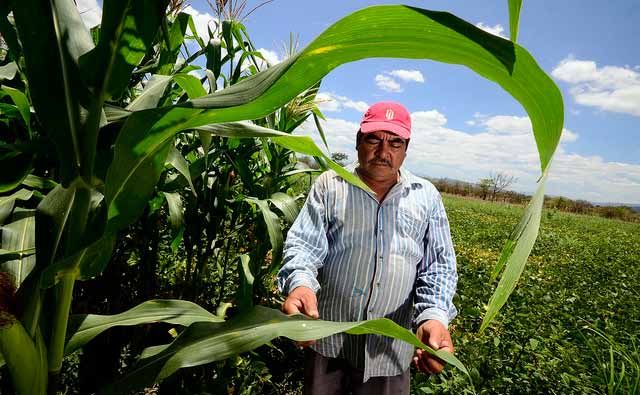
TORTILLAS
                                                                                        ON THE
                                                                                        ROASTER
                                                                                        SUMMARY
                                                                                        REPORT
                                                                                        CENTRAL AMERICAN
                                                                                        MAIZE-BEAN SYSTEMS AND
Copyright © 2012 Catholic Relief Services
ISBN-13: 978-1-61492-053-3                                                              THE CHANGING CLIMATE
ISBN-10: 1-61492-053-2

For any commercial reproduction, please obtain permission from pqpublications@crs.org
or write to
Catholic Relief Services
228 West Lexington Street
Baltimore, MD 21201-3413 USA

Authors of full report:
Anton Eitzinger, CIAT
Kai Sonder, CIMMIT
Axel Schmidt, CRS Consultant

Editing of report summary:
Kathi Hagan

Cover photo:
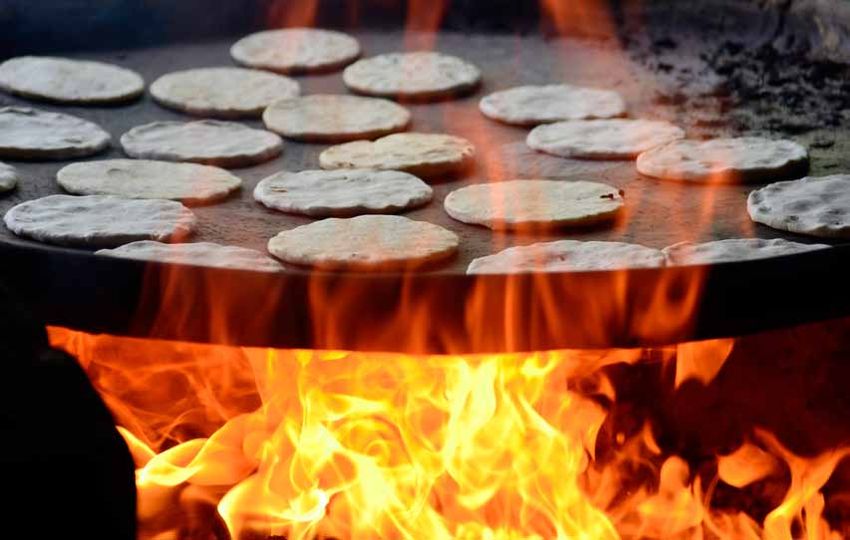
Maize tortillas cook on a pan at a roadside cafe in El Salvador, Neil Palmer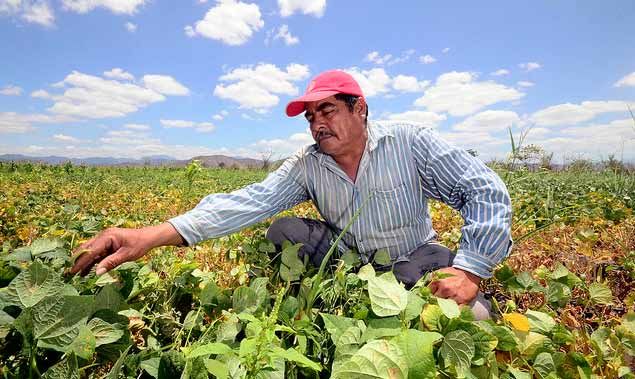
TABLE OF CONTENTS
Foreword . . . . . . . . . . . . . . . . . . . . . . . . . . . . . . . . . . . . . . . . . . . . . . . . . . . . . . . iii
Forew0rd
Executive Summary . . . . . . . . . . . . . . . . . . . . . . . . . . . . . . . . . . . . . . . . . . . . . . iv Our Foundation has been working in Latin America for over 10 years, with over $100 million
invested in the region as a whole, and more than $75 million in Central America alone. The
1 Maize and Beans are the Most Important Food Crops for Central America . . . 2 majority of that investment has been focused on efforts to provide a more food secure future
2 Maize/Bean Smallholder Farmers Face Ongoing and “New” Challenges . . . . . 2 for the most vulnerable rural populations in the region.
Sidebar Maize/Bean Production Systems in Central America . . . . . . . . . . . 3 When we started, we funded many “traditional” development projects. These were projects that
might improve the lives of the individuals participating, and perhaps their family members, but
3 Maize/bean Smallholder Farmers Need Specific Information to Understand
in most cases did not provide opportunities that could be taken to scale – and too often they
and Adapt to Climate Change . . . . . . . . . . . . . . . . . . . . . . . . . . . . . . . . . . . . . . 4 failed to provide exit strategies. In the last several years we have taken a different approach
4 Purpose and Objectives of the Study: Provide Detailed, Actionable and focused in areas that could have a broader impact, leading to changes in policy to bring
Information for Decision Makers . . . . . . . . . . . . . . . . . . . . . . . . . . . . . . . 4 permanent and substantive change to scale.
5 Methods . . . . . . . . . . . . . . . . . . . . . . . . . . . . . . . . . . . . . . . . . . . . . . . . . . . . . 6 We funded Tortillas on the Roaster because the information it reveals is critical to
6 Results: The Effects of Climate Change on Maize/Bean Production in the understanding how this region can achieve long-term food security in the face of extreme
challenges. Climate change raises the vulnerability and resiliency stakes for the more than one
CA-4` . . . . . . . . . . . . . . . . . . . . . . . . . . . . . . . . . . . . . . . . . . . . . . . . . . . . . . . . . . . 9
million subsistence farmers in Central America who depend upon maize and bean production
7 Strategic Recommendations for Adaptation Strategies . . . . . . . . . . . . . . . . . 17 for their survival. Until this report, it was impossible to understand the specific implications of
climate change and what it will mean for the kinds of crops that can be grown and under
8 Summary and Policy Recommendations . . . . . . . . . . . . . . . . . . . . . . . . . . . . . 21 what conditions.
9 References . . . . . . . . . . . . . . . . . . . . . . . . . . . . . . . . . . . . . . . . . . . . . . . . . . . . . . 24
I have met with hundreds of farmers in the course of my many trips to the region over the past
several decades; they already understand climate change is affecting their livelihoods, they just
Figures need help getting the information and learning new techniques to mitigate its effects. We hope
Figure 1: Typical rainfall pattern in Central America . . . . . . . . . . . . . . . . . . . . . . . . iv the stark predictions presented in this report will be a wake-up call to all—farmers, extension
Figure 2: Temperature and precipitation changes predicted to occur by the agents, governments, aid organizations—that we need to take a fundamentally different
2020s . . . . . . . . . . . . . . . . . . . . . . . . . . . . . . . . . . . . . . . . . . . . . . . . . . . 10 approach to farming.
Figure 3: Predicted locations of climate impact areas, in four countries in Central
That’s why our Foundation promotes biologically-based conservation practices that improve soil
America, for bean production. . . . . . . . . . . . . . . . . . . . . . . . . . . . . . . . . 12 quality and water use, while mitigating soil erosion and nutrient run-off. We can’t completely
Figure 4: Predicted differences in maize yields for 2020s under bad and good stop the effects of climate change but we can significantly reduce its impact on farming by
soil scenarios . . . . . . . . . . . . . . . . . . . . . . . . . . . . . . . . . . . . . . . . . . . . . 13 adopting these improved practices, which I use on my own farms in the U.S. and South Africa.
Figure 5: Predicted losses in maize production, in four countries in Central
Food security is a choice, not for those who are hungry but for those who are in a position
America, for the near-term scenario (2020s), by volume and value. . 16 to solve the problem with the right solutions. I hope Tortillas on the Roaster can inform
Figure 6: Predicted losses in bean production, in four countries in Central those solutions.
America, for the near-term scenario (2020s), by volume and value. . 16
Tables
Table 1: Predicted changes in maize production, in four countries in Central
America, for two time periods, by soil quality. . . . . . . . . . . . . . . . . . . . 14 Howard G. Buffett
Table 2: Classes of vulnerability, and the respective strategy objectives. . . . . . . 20 President
The Howard G. Buffett Foundation
ii iii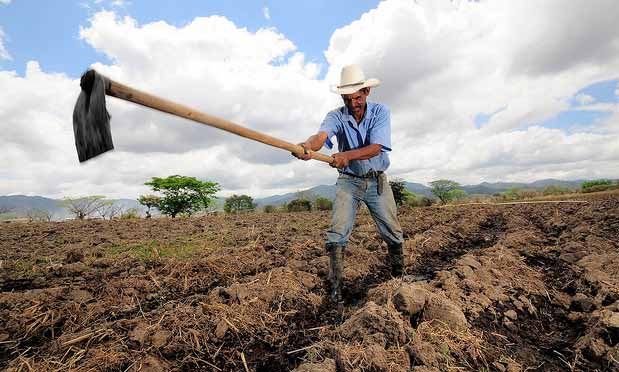
Executive
                                                                                     primarily because of the compounding effect of widespread soil degradation.
                                                                                     Smallholder farmers located on poor soils will see greater losses than those on
                                                                                     good soils. For example, in El Salvador, where land degradation is most severe,

Summary
                                                                                     losses in maize production could be as high as 32% in areas with poor soils and
                                                                                     as low as 1% in areas with good soils by the 2020s. Bean production will also
                                                                                     decline because higher nighttime temperatures will impede flowering. Projected
                                                                                     reductions in bean production are as high as 25% in all four countries.
Climate change is occurring at an accelerated rate and its impacts are being
acutely felt in Central America, one of the world’s most vulnerable regions.         Maps produced by TOR identify three classes of climate impact areas: areas
Agriculture is highly sensitive to the temperature and precipitation changes         where it will be impossible to continue growing maize/beans (Hot Spots); areas
associated with climate change, and smallholder farmers in Central America           where it is possible to continue with maize/bean cultivation if adaptation
are already experiencing the impacts, first hand. Until now, climate change          strategies are implemented and action is taken now (Adaptation Areas); and
projections for Central America have been general, covering wide geographic          areas that are not currently cultivated but which become attractive to smallholder
areas. Given the heterogeneity of the climate, landscapes, and agricultural          farmers due to changing climate conditions (Pressure Areas), many of which are
systems in the region, it is hard to use general trends for decision making at the   high-elevation forests, wetlands, and other sensitive ecosystems.
farm or landscape scales. As a result, smallholder farmers and other decision
                                                                                     The results of the study fill a critical gap in our knowledge of the impacts of
makers have been slow to adapt adequately to the threats of climate change.
                                                                                     climate change on maize/bean production in Central America. With this new
They know that climate change is occurring, but they do not have enough
                                                                                     information, stakeholders can now shift from a position of uncertainty to a
detailed information to act on it.
                                                                                     position of risk management. The study shows there is reason for optimism: if
To fill this gap, CRS,1 CIAT,2 and CIMMYT3 carried out the Tortillas on the          action is taken now, the most severe impacts can be managed.
Roaster study (TOR). Funded by the Howard G. Buffett Foundation, the study
                                                                                     The technical strategies for adaptation are well known. TOR provides
provides detailed, actionable information for specific areas in four Central
                                                                                     recommendations about which adaptation strategies are most appropriate
American countries: El Salvador, Guatemala, Honduras, and Nicaragua (CA-4).
                                                                                     for specific areas. Among the critical areas for investment are soil and water
TOR provides detailed climate projections at a resolution of 5 km2 or higher
                                                                                     management; education and training to build agronomy, soil management and
across all four countries for two distinct time frames—the near term (2020s) and
                                                                                     water management skills; protection of forests, wetlands, and other sensitive
the mid term (2050s). It predicts the potential impacts that climate change will
                                                                                     ecosystems and understanding the appropriate role for plant genetics. The key
have on the production of maize and beans, the two most important food crops
                                                                                     is to strategically focus investments for smallholder maize/bean farmers, and to
in Central America. The study measures impacts in terms of changes in maize/
                                                                                     tailor the investments to unique conditions.
bean production and related economic value. Important among the outcomes
are maps that illustrate how different geographic areas within the CA-4 will         What is needed now is political commitment and long-term investment in
be affected. Finally, recommendations are made for climate change adaption           agricultural production in Central America. Governments urgently need to
strategies tailored to specific geographic areas.                                    invest in education and training to build institutional and human capacity,
                                                                                     and to rebuild extension services that re-emphasize basic agronomy, soil, and
TOR applied state-of-the-art climate models and GIS tools and combined these
                                                                                     water management. Because more than 80% of Central America’s maize and
with field-based agronomic research and detailed socioeconomic analyses at the
                                                                                     beans are grown on rainfed land, agriculture investments should be targeted
household level in selected communities in each of the four countries.
                                                                                     to smallholder farmers in these areas. Production, which is low now, could be
There is an urgent need for maize/bean smallholder farmers to deal with the          increased—even in the face of climate change—through improved agronomic
impacts of climate change. The study finds that the impacts of climate change on     practices and water management. National and local governments, together with
maize/bean production systems are significant, and they could be felt as soon as     communities and civil society, will need to work to protect forests, wetlands, and
the next decade.                                                                     other sensitive ecosystems from encroachment and unsustainable agricultural
                                                                                     practices. Research priorities should include breeding new varieties for heat and
The TOR model projects that mean temperatures will rise by 1°C by the period         drought stress, as a critical part of an integrated adaptation strategy, although
2010 to 2039 (2020s), and by 2°C by the period 2040 to 2069 (2050s).                 we need to be wary of over-relying on this strategy.
Minimum and maximum daily temperatures will rise, and water deficits will
increase due to less precipitation and higher evapotranspiration rates.              1 Catholic Relief Services
                                                                                     2 International Center for Tropical Agriculture
The modeling shows that maize production will decline severely in the long term,
                                                                                     3 International Center for Improvement of Maize and Wheat

                                         iv                                                                                            1
1    M a i z e a n d B e a n s a r e t h e M o s t Im p o r ta n t F o o d                           M a i z e / B e a n P r o d u c t i o n S y s t e m s i n C e n t r a l Am e r i c a
     C r o p s f o r C e n t r a l Am e r i c a
                                                                                                     The maize/bean production system in Central America has evolved as a relay
In the Central American countries of El Salvador, Guatemala, Honduras,                               intercropping system to match the climatic conditions and agro-ecology of the region.
and Nicaragua—here referred to as the CA-4 countries—more than 1 million
smallholder farm families depend on the cultivation of maize4 and/or beans5                          Central America, generally, has a bimodal rainfall pattern. There is a 6-month dry
for their subsistence. The maize/bean production system, which dates back to                         season from December to April (Figure 1), followed by the wet season (May to
the pre-Columbian period, is the foundation of the Central American diet and                         November), which is interrupted by a short dry period (July to August).
is integral to the regional culture. The annual consumption is as much as 170
                                                                                                     The year’s first rainy season takes place from May to July. The first planting season—
kg/person of maize, and 25 kg/person of beans (CEPAL 2005). It is the most
                                                                                                     called primera—occurs at this time. Maize is primarily planted in this first planting
important agricultural production system in the region.
                                                                                                     season, and it is harvested in September/October.

The production system in the CA-4 comprises 2.4 million ha—1.8 million ha of                         Pimera is followed by a short dry spell from July to August. The short dry spell
maize and around 600,000 ha of beans—with an overall output of 3 million                             following the primera is called the canicula.
t/year of maize and 475,000 t/year of beans. The annual gross values of
maize/bean production are greater than US$700 million and US$400 million,                            After the canicula comes a second rainy season, called postrera, which lasts from
respectively (IICA 2007). Nicaragua produces more than 30% of the regional                           early September to November. Beans are inter-panted amongst the mature corn.In
harvest and exports to neighbor countries.                                                           most areas a second crop of maize may also be planted during the postrera. Beans
                                                                                                     are harvested at the end of the postrera.
Maize/bean cultivation is conducted mostly by smallholder families on farms
                                                                                                     In some more humid areas a third planting season—apante—is possible. Planting
averaging 3.5 ha. Productivity is low by global standards, averaging 1.5 t/ha for
                                                                                                     occurs in December/January, and harvesting takes place in February/March. Maize or
maize and 0.7 t/ha for beans. Smallholders invest over 120 million working days
                                                                                                     beans, or both, are grown in apante.
per season in producing maize/beans.
                                                                                                     The timing and severity of the canicula is perhaps the most serious climate risk
                                                                                                     factor to smallholder farmers, and is a major factor for smallholder farmers’ cropping
2 M a i z e / B e a n Sm a l l h o l d e r Fa r m e r s Fac e
                                                                                                     decisions (Magaña et al. 1999). When the canicula is very dry, starts early, or extends
	O n g o i n g a n d “ N e w ” C h a l l e n g e s
                                                                                                     longer than usual, it threatens crops in both the primera and postrera seasons. Maize
Climate change is intensifying the existing challenges of growing maize/bean                         planted in primera can become stressed by an early onset of the dry period. Beans
production in Central America.                                                                       planted at the normal time in postrera can be stressed by the reduced availability of
                                                                                                     moisture during the initial growth period; or, bean planting could be delayed until the
Most smallholder farms are located on sloping terrain, using traditional slash-                      end of the extended canicula, thus shortening the bean-growing season.
and-burn methods. For example, in Honduras, 80% of farms are found on slopes.
Soils are shallow, fragile, and soil degradation is becoming a major constraint for
production.6                                                                                                          Typical rainfall pattern in Central America (mm)
                                                                                                          300
For smallholders dependent on agriculture for their livelihoods, degradation
                                                                                                                                                                 Postrera
of natural resources and low maize/bean production are intimately related to                              250
major determinants of poverty, including: geographic isolation; lack of access to                                                 Primera
services and infrastructure, credit, and input and output markets; low education                          200
levels; and dependency on family labor. Labor migration within countries and the
region, or to the United States, is common. And, within this already precarious                           150

scenario, the food security of millions of people is often at risk because
                                                                                                          100

                                                                                                           50
4 Corn.                                                                                                                                             canicula
5 The Phaseolus vulgaris bean is a small, dark red, Mesoamerican bean, native to Central America.           0
6 Oldeman et al. reported in 1991 that 75% of all agricultural land in CA-4 countries is degraded.              jan   feb   mar     apr     may   jun   jul    aug   sep    oct   nov   dec
  Lands have been further degraded since then, but there has not been a comprehensive survey for
  20 years.

                                                2                                                                                                   3
smallholders are highly vulnerable to climate variability, including droughts and
severe storms.

3 M a i z e / b e a n Sm a l l h o l d e r Fa r m e r s N e e d
	S p e c i f i c I n f o r m at i o n t o U n d e r s ta n d a n d
	A da p t t o C l i m at e C h a n g e
There is an urgent need by CA-4 smallholder farmers and decision makers, both
nationally and regionally, for detailed information about where and how to focus
activities for climate change adaptation and mitigation of the most important
agricultural production system in Central America—maize/beans.
                                                                                       A farmer in Honduras takes a break from digging irrigation channels in Alauca, Honduras
The added impacts of climate change, in the form of higher temperatures and
less precipitation, will significantly affect crop viability or prevent production
altogether. Therefore strategies for protecting the future of maize/bean
production in the CA-4 must be implemented promptly. While the technologies for
adaptation are, for the most part, already known, what is missing is the ability to
know exactly where to apply the technologies strategically.

In order to adapt to climate change, maize/bean smallholders in the CA-4 will
have to know what type of climate-related changes to expect, how these changes
are likely to affect yields, and when and where changes will occur. Adaptation is
possible only if predictions of global climate impacts are known at local levels, so
that smallholders know what to adapt to.

Sufficiently detailed information about the extent of climate change and its
effects in specific areas is needed so that actors can focus their decisions,
policy, coordination, and interventions. However, the current outputs of climate
prediction models are too coarse to allow effective decision making and strategy       Farmer Juan Gonzalez checks his irrigated dry season bean crop in Jamastran, Honduras
implementation at the smallholder farm level.

4 	P u r p o s e a n d Ob j e c t i v e s o f t h e S t u dy: P r ov i d e
 	D e ta i l e d , Ac t i o n a b l e I n f o r m at i o n f o r
 	D e c i s i o n M a k e r s
This study was carried out to provide specific and actionable information
about the projected impacts of climate change of maize/beans, and to provide
smallholder farmers with recommendations for adaptation. There is a gap
between knowing that the impacts of climate change are imminent, and knowing
that mitigation and adaptation strategies should be applied—but not knowing
when and where to apply them. This study was undertaken to predict and analyze
expected climate change impacts on maize/bean production at the smallholder
farm level in El Salvador, Guatemala, Honduras, and Nicaragua.

With funding from the Howard G. Buffett Foundation (HGBF), Catholic Relief
Services collaborated with the International Center for Tropical Agriculture (CIAT)
and the International Center for Improvement of Maize and Wheat (CIMMYT) to
                                                                                       Maize farmer Luis Cortés in his farm in Jamastran, Honduras
                                                                                                                                                                    All photos by Neil Palmer

                                         4                                                                                  5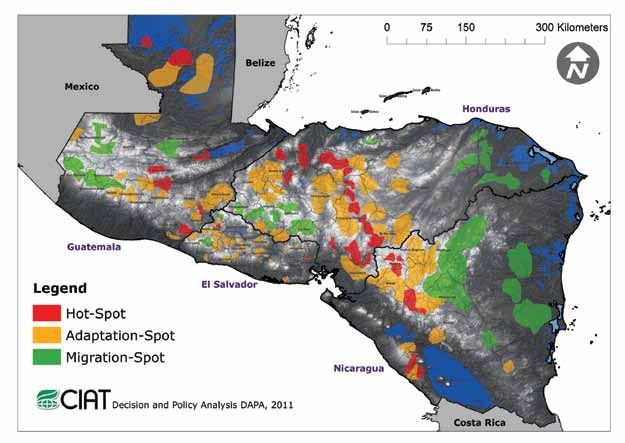
conduct the study from March 2011 to April 2012. The study became familiarly                            Climate projections were run for two time frames.
known as Tortillas on the Roaster (TOR), alluding to the cultural significance of
maize/beans to Central Americans, as well as to climate change.                                         The first is a near-term scenario covering 2010 to 2039. This paper uses the
                                                                                                        shorthand term “2020s” to refer to the average for this period.

4.1	Objectives                                                                                          The second time frame is a mid-term scenario covering 2040 to 2069. In this
    1. Use existing global and regional climate models to create outputs that are                       paper the shorthand term “2050s” is used to refer to the average for this period.
       specific to local scales (ranging from 1 to 5 km2) across the CA-4 countries.
                                                                                                        Once the detailed climate projections were obtained, we clustered the results
    2. Predict how climate change will affect the production of maize/beans in                          based on the outcomes of 19 bioclimatic variables, all of which were related
       the CA-4 countries.                                                                              to temperature (minimum/maximum) and precipitation. The results of this
                                                                                                        bioclimatic analysis were then overlaid on the Köppen climate classification map
    3. Predict how the effects of climate change on maize/bean production in the
                                                                                                        (Köppen 1936, Peel et al. 2007), which divides Central America into three main
       CA-4 countries will affect smallholder farmers economically.
                                                                                                        climatic zones.10
    4. Identify and map, at a local scale, areas related to maize/bean production
       that will be affected by climate change, and classify these areas.                               Our study did not include estimates of the frequency of extreme weather
                                                                                                        events such as hurricanes. Honduras, Nicaragua, and El Salvador are all top-
    5. Identify and describe strategies that are most appropriate for specific                          ranking countries at risk of severe natural disaster according to the latest
       geographic areas and socioeconomic conditions of smallholders.                                   Climate Risk Index 2011 (Harmeling 2010). Although recent publications
                                                                                                        indicate “that greenhouse warming will cause the globally averaged intensity of
5    Methods                                                                                            tropical cyclones to shift towards stronger storms” (Knutson et al. 2010), more
                                                                                                        information about the relationships between climate change and the frequency,
5.1	Providing climate projections for the CA-4, at the local scale                                      intensity, and pattern of tropical cyclones is needed so that such data can be
                                                                                                        included in the modeling.
Historical climate data for Central America were derived from WorldClim’s
database.7 WorldClim uses a combination of data from weather stations and
interpolated data to provide estimates of temperature and precipitation at a high                       5.2	Predicting the effects of climate change on maize/bean
resolution (30 arc-second resolution, or about 1 km2).                                                  production in CA-4
                                                                                                        Next we made predictions of future maize/bean production. We used known
To generate climate projections for the CA-4, we applied 19 different global
                                                                                                        physiological characteristics of maize/bean varieties, and their responses to
circulating models (GCMs).8 The resolution of currently available GCMs ranges
                                                                                                        heat and drought stress, to determine the effects of our climate projections on
from 300 to 1000 km2 at the global level, and from 50 to 60 km2 at the regional
                                                                                                        the crop performance of maize/beans. The main parameters analyzed were
level. These scales are too large for analyzing impacts at the smallholder level.
                                                                                                        temperature (minimum/maximum), rainfall, and soil quality.
To downscale projections to the local scale—i.e., to achieve a resolution of 5
                                                                                                        The tools used to predict maize/bean crop performance included:
km2 or better—researchers used a combination of WorldClim (which was cross-
referenced with locally available climate data), and the delta method, which is                             • FAO’s Ecocrop database11 which is a spatial model that uses a range of
a common tool that improves the resolution of GCMs by using a combination                                     environmental parameters to define a crop suitability index with a range of
of climate data and mathematical interpolation.9 The results of these climate                                 0 to 100. These results were calibrated for the CA-4 countries.12
projections were validated during field visits to 12 sites across four countries.
                                                                                                            • Decision Support for Agrotechnology Transfer (DSSAT).13 DSSAT is a well-
                                                                                                              tested tool for predicting crop performance. DSSAT requires the soil-water
                                                                                                              characteristics and genetic coefficients of each crop cultivar; relevant
7 See www.worldclim.org.                                                                                      agronomic inputs such as fertilizer and irrigation; plus daily maximum and
8 In the literature, the abbreviation GCM is used to refer to “general circulating models” as well as
                                                                                                              minimum temperatures, rainfall, and solar radiation.
  “global climate models”. In this paper, GCM refers to “general circulating models”. GCMs are
  complex mathematical models that are key components for simulating climate and projecting
                                                                                                        9 For background on the delta method see Bader et al. 2008 and Jarvis and Ramirez 2010.
  climate change. The Intergovernmental Panel on Climate Change (IPCC) Fourth Assessment Report
  used 21 GCMs. We used 19 of these GCMs to make our projections for the CA-4.                          10 See Section 3 of the full-length report for details on the clustering methodology.

                                                  6                                                                                                        7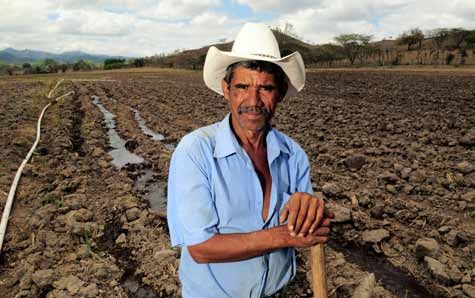
The DSSAT tool requires daily weather information, but our climate modeling           The household vulnerability index is composed of three composite indices
methods above provided only monthly data. The availability of daily weather data      including: the level of exposure of the maize/bean cropping system to changes
is very limited for CA-4 countries. To fill this gap, we used MarkSim,14 a weather-   caused by climate change, the level of sensitivity of the household to the
simulation model that uses 9200 weather stations in tropical and subtropical          change in maize/bean production, and the resilience or adaptive capacity of the
areas of the world and mathematical interpolation to generate maximum and             household. During these surveys, we also held focus-group discussions in all four
minimum temperatures, rainfall, and solar radiation data.15                           countries. Through these discussions we were able to validate our identification
                                                                                      of crop production areas and the importance of maize/bean production at these
About 10 new bean varieties recognized for drought tolerance were field tested        locations.
as part of this study, and their data were added to the database used for the crop
performance models.
                                                                                      5.4     Mapping the climate impact areas in the CA-4
We simplified soil quality estimates by dividing soils into two broad categories:     We used the results of climate modeling, the predicted effects on crop
silts were used as a proxy for good soil, and sandy soils were used as a proxy        performance and aggregate yields, and the analyses of household vulnerability
for degraded (poor) soil. The poor soil scenario (low fertility, low water-holding    to produce detailed GIS maps that illustrate how specific geographic areas will be
capacity) is representative of current trends in soil degradation for Central         affected by climate change. The areas of impact were determined to fit into three
America. The good soil scenario (higher fertility, more organic matter, good water-   classes, which are described in section 6.3.
retention capacity) assumes better soil management. Soil degradation, which is
characterized by nutrient depletion and loss of organic matter, is closely related
with water limitations in two ways: degradation reduces water availability for        6 	R e s u lt s : T h e Eff e c t s o f C l i m at e C h a n g e o n
crops by reducing rainfall infiltration, and it reduces plant water uptake due to        Maize/Bean Production in the CA-4
weak roots (Rockström 2007).
                                                                                      6.1     Climate projections at the local scale
Data on pests and diseases are scarce and the underlying interactions are not
                                                                                      We successfully downscaled the GCMs to higher resolutions—at least 5 km2, and
yet fully understood, so this factor was dropped from the study.
                                                                                      to 1 km2 in some instances. These resolutions are significant improvements over
                                                                                      existing ones. These downscaled models allowed us to generate future climate
5.3	Predicting how the effects of climate change on maize/bean                        scenarios for the four countries included in the study—El Salvador, Guatemala,
production in CA-4 will impact smallholder farmers economically:                      Honduras, and Nicaragua—in terms of a near-term time frame (2020s) and a
household vulnerability to climate change                                             mid-term time frame (2050s).

Socioeconomic analyses were carried out on two levels.
                                                                                      6.2	Projected effects of climate change on maize/bean
First, we gathered socioeconomic information from smallholder farmers in              production
12 communities across the four study countries. The information we collected
                                                                                      Temperature: There will be an increase in annual mean temperatures (around
included main agriculture activities and trends, main sources of food and
                                                                                      +1°C by the 2020s and +2°C by the 2050s). Minimum and maximum daily
income, an analysis of household and community capital (assets), and a general
                                                                                      temperatures will be higher. There will be an increased water deficit due to less
perception of future communal strengths and threats.
                                                                                      precipitation and higher evapotranspiration rates.

Second, based on the initial socioeconomic information gathered and the results
                                                                                      Rainfall: Precipitation will continue to be minimal during the usual 6-month
of the climate and crop modeling, we designed and carried out a detailed survey
                                                                                      dry period (November/December to April), and may become even drier in some
that involved 120 smallholder households in each country. The survey tool was
                                                                                      areas. There is a tendency towards a small reduction in precipitation in the
designed primarily to determine a vulnerability index score for each household.
                                                                                      month of May for most areas.

11 See http://ecocrop.fao.org/ecocrop/srv/en/home.                                    As an example, Figure 2 illustrates the projected changes in precipitation and
12 See Section 3 of the full-length report for details.                               temperature for one area in eastern Honduras, for the near-term scenario
13 See http://dssat.net/.                                                             (2020s). For this particular area we predict no significant change in precipitation
14 See http://gisweb.ciat.cgiar.org/marksim/.                                         in the month of May. For the month of June, when maize is in an early and
                                                                                      critical development phase, we predict less rainfall than the historic average.
15 See Section 3 of the full-length report for details.

                                                    8                                                                          9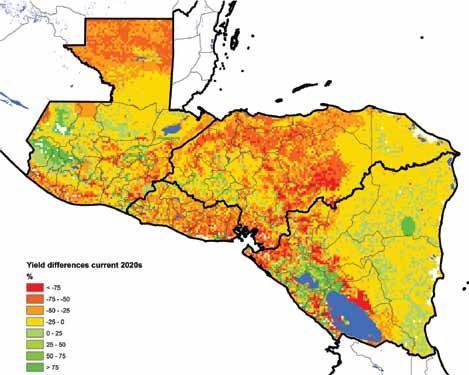
The canicula (mid-summer dry spell that usually occurs in July and August), will 6.3 Maps of the climate change impact areas
be drier than it currently is and it will extend into September. The severity of the
We produced maps for the CA-4 countries that illustrate the specific geographic
canicula in eastern Honduras will threaten maize that is planted in primera, and
areas related to maize/bean production that will be affected by climate change.
the prolonged canicula may make conditions unfavorable for the establishment
The areas that will incur impacts, called climate impact areas, fall into the
and development of the postrera bean crop, which is normally planted in early
following three classifications:
September.
• Hot Spot. An area where it will be difficult or impossible to grow maize/
beans in the future. Smallholder farmers will need to transition out of
maize/beans.
(mm) Precipitation Temperature (°C)
160 36 Current precipitation • Adaptation Area. An area where it is possible for smallholder farmers
34
32
2020 precipitation adapt and continue to produce maize/beans if certain actions are taken
140 2020 maximum temperature
30 now. Adaptation strategies would be focused on how to continue producing
28 Current maximum temperature
120 26 2020 mean temperature
maize/beans.
24 Current mean temperature
100 22 • Pressure Area: An area that is not currently cultivated but where changing
2020 minimum temperature
20
80 18 Current minimum temperature climate conditions will make an area more attractive for conversion to
16 cultivation. Many of these areas are sensitive ecosystems, such as forests
60 = = - - = - - - - = + = 14
12
These results are based on the 2020
(2010-2039) and 2050 (2040-2069) and wetlands. These areas were included in the analyses and on the maps
40 10 climate compared with the 1960-2000
climate (worldClim). Future climate
(e.g., Figure 3) in order to illustrate the need to protect these areas from
8
6 data is derived from 19 GCM models encroachment or degradation.
20 from the 4th (2007) IPCC assessment,
4
run under the A2 scenario (business
0
2 as usual). For further information The map in Figure 3 shows the locations of the three classes of climate impact
0 please visit the following websites:
JAN FEB MAR APR MAY JUN JUL AUG SEP OCT NOV DEZ http://www.ipcc-data.org areas in the CA-4 countries: locations where beans should/can no longer be
http://gisweb.ciat.cgiar.org/GCMPage grown (Hot Spots, in red), locations where production systems need to be
modified/adapted in order for production to continue (Adaptation Spots, in
Figure 2 Temperature and precipitation changes predicted to occur by the 2020s (2010 to 2039), for
one area in eastern Honduras. yellow), and locations where beans could, at least theoretically, be grown in the
future (Pressure Areas, in green).
Most of the impacts to bean cultivation will occur in the 2020s, which is in the
For the second planting season, postrera, this community will receive less near-term scenario. This is because the predicted annual mean temperature
precipitation than the historic average during the month of September, which is increase of +1°C, in combination with higher minimum temperatures (night
when beans are normally planted. temperatures) will cause growing conditions to exceed the plants’ physiological
tolerances. Beans especially are affected because higher night temperatures
The increases in the daily minimum, mean, and maximum temperatures will impair their reproductive capacity and thus their ability to produce beans, i.e.,
exacerbate water deficits: higher temperatures cause higher evapotranspiration their yield potential.
rates of plants, triggering greater extraction of soil moisture by roots and
thus leading to soil water deficits that will worsen the plants’ heat stress. Dry
conditions have substantial negative effects on biomass production and on the
reproductive stages of both maize and bean plants.
Beans are particularly sensitive to high temperatures. When nighttime
temperatures remain above 18°C, flowering is limited, thus significantly reducing
bean yields.
During the months of October and November there is a risk of increased rainfall
and flooding in eastern Honduras. In recent decades, severe storms have
increased in frequency, often damaging agriculture and infrastructure.
10 11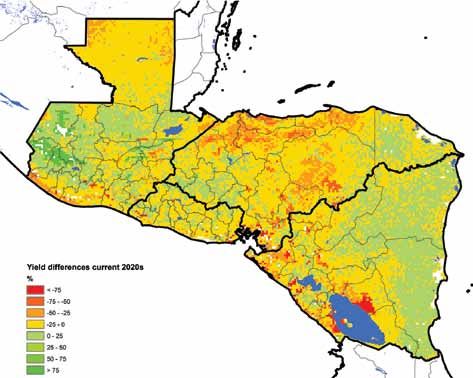
Figure 4a. Predicted differences in maize yields for 2020s under bad soil scenarios

Figure 3. Predicted locations of climate impact areas, in four countries in Central America, for bean
production in the 2020s.

6.4	Soil quality is a main determinant of effects of climate
change on maize production
The DSSAT crop model revealed that the water-retention capacity of soil and soil
fertility will significantly influence crop production, especially that of maize. This is
critical for Central American countries, given that more than 75% of agricultural
land has degraded soils (Oldeman et al. 1991).

Losses in maize production will be considerably greater for smallholder farmers
located on poor soils than for those located on good soils (Table 1). For example,
in El Salvador, climate change will cause a losses of about 30% in maize
production on poor soils, but virtually no loss on good soils. Figure 4 illustrates
the differences in yield reduction due to soil quality for the near-term scenarios
and indicates the respective climate impact areas.

                                                                                                        Figure 4b. Predicted differences in maize yields for 2020s under good soil scenarios.

                                                   12                                                                                                    13
Table 1. Predicted changes in maize production, in four countries in Central DSSAT, but beans did not show such dramatic results as maize.
America, for two time periods, by soil quality.
Poor soils Good soils 6.5 Projected impacts on bean production
The impacts of climate change on bean production are also significant, with
Country 2020s 2050 2020s 2050s reductions predicted to be up to 25% of the CA-4’s total production volume
(% change) (% change) (% change) (% change) by 2050. Honduras will be the most affected country, with reductions in
bean production expected to be 15% by 2020, followed by El Salvador at 8%,
El Salvador –32.2 –33.5 –1.1 –1.8 Nicaragua at 6%, and Guatemala at 4%.
Guatemala –10.8 –11.0 0.5 0.4
6.6 Economic effects
Honduras –29.5 –29.8 –11.7 –11.7 Our conservative predictions indicate that reductions in maize and bean
production will lead to economic losses for the region of about US$125 million
Nicaragua –11.0 –11.3 –3.3 –4.0 per year, or 30% of current values, at or before the end of the 2020s (Figures 5
and 6). Note that these are rough estimates based on linear assumptions and do
An additional reason for greater differences in maize yield losses by soil scenario not take into account yield and price variability across time and regions.
in El Salvador is that this country has very few remaining Pressure Areas (see
section 6.3). In general, production losses for maize are much larger than for beans. This is
true even when price differences tend to smooth the respective losses. Honduras
In all four countries, the negative impacts on maize production under the poor and El Salvador have the largest maize production losses. For beans, Guatemala
soils scenario are expressed at the country level. Honduras is worst affected is the only country with relatively low predicted potential losses, but these
(Table 1); losses in maize production will be almost 30% in poor soils for the low losses would occur only if smallholder farmers took the environmentally
2020s and the 2050s, while losses in good soils will still reach 11.7% for both unsustainable approach of converting higher elevation forests into cultivated
time frames. Second-most negatively affected for the scenario predictions is El land.
Salvador, with slightly over 30% losses on degraded soils but minor losses on
good soils. Nicaragua shows 11% losses for the poor soil scenario, but lower For El Salvador, high potential losses in maize yields and the projected high
losses for the good soil scenario at 3.3% for the 2020s and 4% for the 2050s. price for maize are the main factors influencing high economic losses. However,
Finally, Guatemala stands out with relatively low overall losses in production, at changes in the variability of maize production over time and across jurisdictions
10.8% for the poor soil scenario for the 2020s and 11% for the 2050s, but with a are not a problem in El Salvador. In contrast, Nicaragua is predicted to have
very slight increase in production under the good soil scenario overall. low changes in average production value but increases in production variability.
Honduras is predicted to have the worst economic impact, with both high losses
These results take into account the potential for “annexing” land that is currently in average production and a substantial increase in variability of production
not suitable for maize/beans, but will become more suitable with the changing across growing seasons. Guatemala is predicted to experience small changes in
climate. We classified these lands as Pressure Areas. In many cases, these both average production and variability. Overall, the potential effects of climate
Pressure Areas are high-elevation (cool) forests, wetlands, and other sensitive change on maize/bean production in Guatemala will be less than in the other
ecosystems. The potential for Pressure Areas to be annexed into cultivation is a three countries.
serious threat to natural resources and ecosystems in the region. In El Salvador,
most land that can be cultivated is already cultivated, i.e., there is very little 6.7 Smallholder farmers are highly vulnerable to climate change
land that can still be converted. In the other three countries, Pressure Areas are
more abundant, which, at least in theory, smallholder farmers could annex. The The vulnerability analyses reaffirmed the field observations we made through
positive yield changes in Guatemala reflect the substantial amount of remaining the focus groups and surveys in selected hot spots and adaptation areas. In all
mountainous forest cover in Guatemala that could be shifted to crop production, four countries, rural households have low adaptive capacity to climate change,
if environmental effects were ignored. Note: this study is not recommending as indicated by low physical, natural, and financial assets, and by limited human
conversion of forests or other sensitive ecosystems to annual crops. and social capital. Consequently, most of the CA-4 region can be classified as
particularly vulnerable to climate change, with El Salvador showing the highest
The relationship between soil quality and bean production was also detected in
14 15levels of vulnerability, followed by Honduras and Guatemala with medium levels
Maize production loss. Quantity (t) & value (000 us$)
and Nicaragua with a low level of vulnerability. This classification is somewhat
160,000 arbitrary because we found high variability within the three classes of climate
140,000 136,088
impact areas (Hot Spots, Adaptation Areas, and Pressure Areas—see section
6.3). Nevertheless the analysis provided valuable insights into smallholder farm
120,000 119,201
assets (natural, physical, financial, human, and social), which are essential to
100,000 developing location/farm-specific adaptation strategies.
80,000
The maps produced from this study provide a range of stakeholders, including
60,000 smallholder farmers, government decision makers, development agencies,
44,532
40,000 39,431 38,769
and the donor community, with information that will reduce the uncertainty of
33,950
knowing how and where climate change is impacting smallholder farmers in
20,000 the CA-4, and will guide the implementation of interventions. The maps indicate
10,333 8,096
0 location and degree of predicted impacts so that countries can set priorities for
Nicaragua Honduras El Salvador Guatemala policy, regulation, extension activities, adaptation, mitigation, and preparedness.
This will allow actors from smallholder farm families to local authorities, and
Maize production losses at 2020 (t)
from donors to international agencies, to manage specific climate change risks in
Estimated value of maize production losses at 2020 (Thousands us$)
specific places.
Figure 5. Predicted losses in maize production, in four countries in Central America, for the near-term
scenario (2020s), by volume and value.
7 S t r at e g i c R e c o mm e n dat i o n s f o r A da p tat i o n
S t r at e g i e s
The final objective of TOR was to identify and describe strategies that are
most appropriate for specific geographic areas and socioeconomic conditions
10,000 of smallholders. This section presents the five principal types of adaptation
strategies identified by the study, and then provides a framework for
9,000 8,895 recommendations tailored to specific conditions.
Production loss quantity (t) & value (000 us$)
8,000
7,142
7,000
6,465
7.1 Five principal types of adaptation strategies
6,192 6,177
6,000 Over the course of the study, five principal lines of adaptation strategies
5,228
emerged for implementation at the smallholder level, including: sustainable
5,000
intensification, diversification, expansion of assets, increasing off-farm income,
4,000 and diversification out of agriculture as a livelihood strategy.
3,000
Sustainable intensification and diversification both aim to increase soil fertility
2,000 and water productivity, which are the two key elements for on-farm adaptation. All
1,000 736
five of these strategies require serious investments in human capital (skills and
526
knowledge).
0
Nicaragua Honduras El Salvador Guatemala
7.1.1 Sustainable intensification
Beans production losses at 2020 (t)
Estimated value of beans production losses at 2020 (Thousands us$) Sustainable intensification strategies are aimed at increasing crop productivity
while preserving natural resources (land and water) in productive systems (eco-
Figure 6. Predicted losses in bean production, in four countries in Central America, for the near-term efficiency).
scenario (2020s), by volume and value.
The cornerstone of adapting to climate change is for smallholder farmers to
16 17maximize the efficiency of natural resource use. While agriculture is a victim of 7.1.3 Expand human and social capital/assets
climate change impacts, it is also a contributor, so sustainable intensification
As reported in the sections above, adaptive capacity for smallholders in almost
of production systems can increase productivity while simultaneously reducing
all study sites was low. This highlights the need to focus on building human and
greenhouse gas emissions. A series of strategies and management options for
social capital as an adaptation strategy, which underlies all other strategies.
eco-efficient intensification of agriculture already exist, while others need to be
Information, knowledge, education, and social organization are important
adapted to local conditions. A central element for eco-efficient and sustainable
driving factors for successful implementation of all strategies for climate change
intensification is to increase the efficient use of rainwater. Increasing the efficient
adaptation.
use of rainwater is intimately connected to plant water availability, evaporation
(from soils), transpiration, soil moisture, and plant water uptake capacity; these
in turn are strongly linked to soil management, water harvesting, and plant 7.1.4 Increase off-farm income, and diversify out of agriculture as a
nutrient management. These are the basic elements of agronomy; therefore it livelihood strategy
is critical that extension services, research, and university training re-emphasize
Strategies to increase off-farm income increase the importance of income
basic agronomy.
sources from more-secure off-farm activities. Traditionally many Central American
smallholders generate off-farm income as day labor—during coffee harvest,
In Central America, farmers are expanding the agricultural frontier through
in processing facilities, or in maquiladoras (e.g. textiles for North American
advances into more humid areas, such as the Atlantic coast in Honduras and
markets). These are predominately dry season activities associated with internal
Nicaragua. This is causing widespread deforestation, land degradation, social
migration. Remittances are also an important source of off-farm income, which
conflicts, migration, and increased greenhouse gas emissions. “Expanding”
can help to develop new livelihood strategies when invested in value-generating
access to land could be done better through “climate smart” strategies. For
economic activities.
example, there could be opportunities in the apante areas for converting
deforested and degraded grazing lands into croplands and applying sustainable
Strategies to diversify out of agriculture mean that households will no longer
intensification to reverse land degradation. But this kind of strategy requires
depend on agriculture as the source of income and consumption. Diversifying out
serious investments in knowledge, skills, and social organization (i.e., human
of agriculture requires training and education, particularly for young people, to
and social capital)—see below.
succeed in other sectors. This has important implications for governments and
the private sector in creating the conditions for education and job creation.
7.1.2 Diversification
Strategies that diversify the production system lead to increases in the quantity 7.2 Targeting strategies based on climate change impacts and
and types of foods grown on land, and to more income from agriculture. adaptive capacity
Diversification should aim to keep vegetation over soils for as many months
Identifying strategies that are most appropriate for specific geographic areas
as possible to protect soils against erosion. Diversification can also maximize
and socioeconomic conditions of smallholders proved to be complicated given
water productivity. Multi-story diversification—through agroforestry—can also
the heterogeneity of how climate change would impact each location and the
increase soil water infiltration and is a key strategy for maximizing rainfall (water)
capacity of each smallholder to adapt to these changes. For example, climatic
productivity and reducing water stress.
conditions vary considerably, soil quality is highly variable, and the mix of
household assets (capital), and therefore their adaptive capacity, is also variable.
While livestock and grazing systems were not explicitly studied in TOR, the
The challenge for TOR was to provide assessments and recommendations that
topic emerged in the analysis for two reasons. First, grazing is often blamed for
were meaningful at the farm or landscape level, while being more generally
natural resource degradation in CA-countries, particularly soil degradation on
useful as decision-making tools across many different scenarios.
sloping lands, and second, smallholder farmers are turning to livestock grazing
as an alternative when soils are too degraded for cultivation. There is likely to
To do this, we classified the vulnerability of smallholder farmers based on
be more grazing pressure with climate change. Therefore, the role of improved
the two main vulnerability indicators—impact and adaptive capacity. Each of
grazing practices and forages to mitigate, and adapt to, climate change is an
these two indicators can be scored as high, medium, and low. Based on these
important opportunity (Peters et al. 2000, Shelton et al. 2005). Peters et al.
scores, we determined a composite vulnerability class, ranked high, medium,
(2012, in preparation) identified opportunities in forage-based systems that are
or low. TOR then proposes a different set of objectives for adaptation strategies
economically sustainable and socially equitable with the least possible ecological
corresponding to each vulnerability class.
footprint.
There are three basic strategic objectives: seek off-farm income; reduce the
18 19impact of climate change through sustainable agriculture, or increase assets TOR presents three general types of vulnerability structures, and matches those
(capital) to increase the smallholders’ adaptive capacity. Table 2 summarizes to results of the climate models and socio-economic surveys in each community.
these results. Below, we describe the three general vulnerability structures:
Table 2. Classes of vulnerability, and the respective strategy objectives. 1. Where the impact of climate change is high, but the adaptive capacity
is low, the vulnerability class is scored high. In this case the general
Adaptive Vulnerability recommendation for smallholders is to seek income from non-agricultural
Impact capacity class Objectives of the strategy activities and changing from maize/bean production to other livelihood
High Low High Increase income originating from outside activities.
the household.
– Actions aimed primarily at a change 2. Where the impact of climate change is high, and the adaptive capacity is
of activities (maize/bean) as sources of also high, the composite vulnerability class is medium. In this case, the
livelihoods, including migration to non- strategic objective for adaptation is to reduce the impact of climate change
agricultural activities. on-farm through sustainable intensification and diversification (these will
High Medium High Increase income originating from outside be defined in the next section).
the household.
– Actions aimed primarily at a change of
3. Where the impact of climate change is low, and the adaptive capacity is
activities (maize/bean) and Expansion.
also low, the composite vulnerability class is medium. In this case, the
– Activities aimed at increasing the
household capital endowment.
objective should be to expand the assets (or capital) of smallholders,
i.e., to increase their adaptive capacity, and to practice sustainable
Medium Low High Sustainable intensification.
intensification on farm.
– Actions aimed mainly at reducing the
impacts of the consequences of climate
change. Expansion. The results from TOR indicate that almost all smallholders have low or medium
– Activities aimed at increasing the adaptive capacity, therefore a strategy to increase smallholder assets (i.e., to
household capital endowment. increase adaptive capacity) is common to all communities surveyed in all four
High High Medium Sustainable intensification. countries, while a strategy to reduce the impacts of climate change on livelihoods
– Actions aimed mainly at reducing the is crucial, particularly in El Salvador.
impacts of the consequences of climate
change. Diversification. Note, these strategy objectives should not be taken as absolute
Medium Medium Medium Sustainable intensification. recommendations. Rather, they are intended to be guides, or starting points for
– Actions aimed mainly at reducing discussion with stakeholders (smallholder farmers and their communities) in
the impacts of the consequences of order to analyze results and design more specific strategies.
climate change and/or at increasing
the household capital endowment.
Diversification. 8 S u mm a ry a n d P o l i c y R e c o mm e n dat i o n s
Low Low Medium Expansion. The information generated, the tools developed, and the strategies outlined in
– Activities aimed at increasing the this study have the potential to create more resilient maize/bean production
household capital endowment.
systems, while increasing the capacity of smallholder farmers to adapt to climate
Medium High Low Sustainable intensification. change in the CA-4 countries of El Salvador, Guatemala, Honduras,
– Actions aimed mainly at reducing the
and Nicaragua.
impact of the consequences of climate
change. Diversification.
The results of our project show that through the application of cutting-edge
Low Medium Low Expansion.
climate and crop modeling, uncertainty about the impacts of climate change on
– Activities aimed at increasing the
Central American maize/bean production systems and about how to respond can
household capital. endowment
be alleviated. We successfully downscaled climate models to a useful resolution
Low High Low Any type of strategy is fine.
(5 km2); quantified the impacts on maize/bean production and analyzed their
socioeconomic consequences; identified specific climate impact areas; assessed
20 21household vulnerability to climate change; and presented principal adaptation in these areas. Production, which is low now, could be increased—even in the
strategies. Despite shortfalls in quantity and quality of available input data, face of climate change—through improved agronomic practices and water
we produced high-quality predictions about the influence of changing climate management. National and local governments, working with communities and
conditions on the production of maize/beans in El Salvador, Guatemala, civil society, will need to work together to protect forests and, wetlands, and
Honduras, and Nicaragua. other sensitive ecosystems from encroachment and unsustainable agricultural
practices. Research priorities should include breeding new varieties for heat and
The findings of the present study enable donors, development organizations, and drought stress, although we need to be wary of over-relying on this strategy.
decision makers at local, national, and regional levels to take appropriate action
in the right locations and provide a policy and research framework for successful
implementation of adaptation strategies in the rural sector. The tools and 8.1.2 Better data management
methodologies created for this study can also be applied to contexts Improve Data Collection and Management: Governments also need to invest
beyond CA-4. in their capacity to monitor climate change by collecting and sharing geo-
referenced: (a) daily climate data, (b) yield data for maize and beans, and
(c) updated detailed soils maps.
8.1 Recommendations
There is an urgent need for maize/bean smallholder farmers to deal with the Crop Yields and Economic Data: Inconsistent or missing data made it difficult to
impacts of climate change. Given the magnitude of changes predicted in the provide model outputs at a 1-km resolution in most areas of CA-4. In particular,
near-term scenario (2010 to 2039), climate change adaptation interventions long-term yield and economic data (statistics) at the required level of resolution
must begin to take place now, without further delay. The study finds that the are not available. To better quantify impacts on maize/bean systems and their
impacts of climate change on maize/bean production systems are significant, effects on socioeconomic factors, and to perform advanced economic analyses,
and they will be felt as soon as the next decade. much more and better local-scale economic data and harvest data are needed.
The results of the study fill a critical gap in our knowledge of the impacts of Climate Data: Climate data, particularly in Honduras and El Salvador, need
climate change on maize/bean production in Central America. With this new improvement. The general lack of simple recording and management of key
information, stakeholders can now shift from a position of uncertainty to a weather data at local and national levels impeded, and will continue to impede,
position of risk management. The study shows there is reason for optimism: if the ability to carry out highly detailed data analyses, predictions, and simulation
action is taken now, the most severe impacts can be managed. scenarios. Georeferenced data collection should be the standard—not the
exception—in all public and private agriculture and natural resource programs.
8.1.1 Technical interventions Soils: There has not been a comprehensive soil mapping of the CA-4 for more
The technical strategies for adaptation are well known. TOR provides than 20 years and this is urgently needed in order to better understand the
recommendations on what adaptation strategies are most appropriate for changing conditions and the strategies that are required for climate change
specific areas. adaptation in each location. Based on the demonstrated importance of soil
characteristics for climate adaptation and mitigation, there is a urgent need
Among the critical areas for investment are soil and water management; for georeferenced soil data throughout CA-4. While the variability in soil
education and training to build agronomy, soil, and water management characteristics in hillsides in Central America is particularly challenging,
skills; protection for forests, wetlands, and other sensitive ecosystems; and new remote sensing methodologies tested can contribute to the data gap at
understanding the appropriate role for plant genetics. The key is to strategically local levels.
focus investments for smallholder maize/bean farmers, and to tailor the
investments to unique conditions.
What is needed now is political commitment and investment in agricultural
production in Central America. Governments urgently need to invest in education
and training to build institutional and human capacity, and to rebuild extension
services that re-emphasize basic agronomy, soil, and water management.
Because more than 80% of Central America’s maize and beans are grown on
rainfed land, agriculture investments should be targeted to smallholder farmers
22 23You can also read


