An Integrated Approach for Identifying Molecular Subtypes in Human Colon Cancer Using Gene Expression Data - MDPI
←
→
Page content transcription
If your browser does not render page correctly, please read the page content below
G C A T
T A C G
G C A T
           genes
Article
An Integrated Approach for Identifying Molecular
Subtypes in Human Colon Cancer Using Gene
Expression Data
Wen-Hui Wang 1,2,3 ID , Ting-Yan Xie 1,2 , Guang-Lei Xie 1,2 , Zhong-Lu Ren 4,5
and Jin-Ming Li 1,2, * ID
 1   State Key Laboratory of Organ Failure Research, Division of Nephrology, Southern Medical University,
     Guangzhou 510515, China; thineeyes@163.com (W.-H.W.); bobanne@163.com (T.-Y.X.);
     xgl343@smu.edu.cn (G.-L.X.)
 2   Department of Bioinformatics, School of Basic Medical Sciences, Southern Medical University,
     Guangzhou 510515, China
 3   Network Information Center, The Sixth Affiliated Hospital of Sun Yat-Sen University,
     Guangzhou 510655, China
 4   Center for Systems Medical Genetics, Department of Obstetrics & Gynecology Nanfang Hospital,
     Southern Medical University, Guangzhou 510515, China; renzhonglu@smu.edu.cn
 5   Laboratory of Systems Neuroscience, Institute of Mental Health Southern Medical University,
     Southern Medical University, Guangzhou 510515, China
 *   Correspondence: jmli@smu.edu.cn; Tel.: +86-20-6164-8279

 Received: 22 May 2018; Accepted: 27 July 2018; Published: 2 August 2018

 Abstract: Identifying molecular subtypes of colorectal cancer (CRC) may allow for more rational,
 patient-specific treatment. Various studies have identified molecular subtypes for CRC using gene
 expression data, but they are inconsistent and further research is necessary. From a methodological
 point of view, a progressive approach is needed to identify molecular subtypes in human colon
 cancer using gene expression data. We propose an approach to identify the molecular subtypes
 of colon cancer that integrates denoising by the Bayesian robust principal component analysis
 (BRPCA) algorithm, hierarchical clustering by the directed bubble hierarchical tree (DBHT) algorithm,
 and feature gene selection by an improved differential evolution based feature selection method
 (DEFSW ) algorithm. In this approach, the normal samples being completely and exclusively clustered
 into one class is considered to be the standard of reasonable clustering subtypes, and the feature
 selection pays attention to imbalances of samples among subtypes. With this approach, we identified
 the molecular subtypes of colon cancer on the mRNA gene expression dataset of 153 colon cancer
 samples and 19 normal control samples of the Cancer Genome Atlas (TCGA) project. The colon cancer
 was clustered into 7 subtypes with 44 feature genes. Our approach could identify finer subtypes
 of colon cancer with fewer feature genes than the other two recent studies and exhibits a generic
 methodology that might be applied to identify the subtypes of other cancers.

 Keywords: subtypes of cancer; colon cancer; Bayesian robust principal component; hierarchical
 clustering; feature selection

1. Introduction
     Identifying the molecular subtypes of colorectal cancer (CRC) may allow for more rational,
patient-specific treatment in the future. Various studies have been done to predict molecular subtypes
for CRC based on gene expression data. Fearon and Vogelstein utilized four different genomic and
epigenomic instabilities to identify four subtypes of CRC: chromosome instability (CIN), microsatellite

Genes 2018, 9, 397; doi:10.3390/genes9080397                                     www.mdpi.com/journal/genes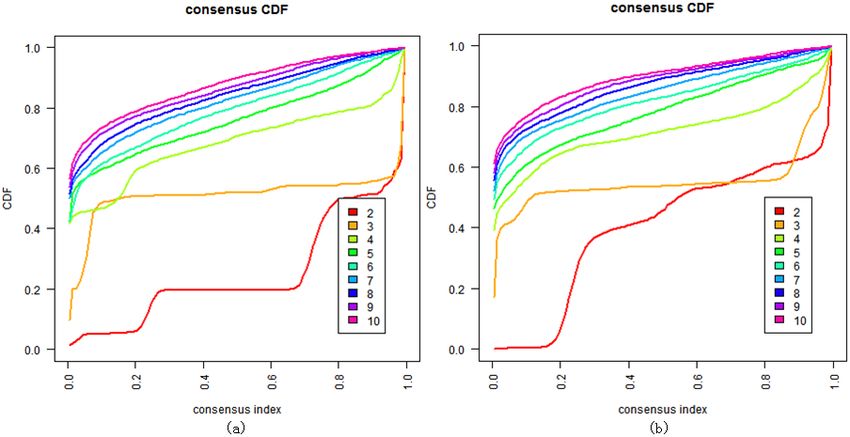
Genes 2018, 9, 397                                                                                2 of 13

instability (MSI), CpG island methylator phenotype (CIMP), and DNA global hypomethylation [1].
Using consensus clustering based on self-organizing maps, nearest centroid classifier, and hierarchical
clustering, Muzny et al. showed that CRC has MSI/CIMP, CIN, and invasive subtypes with
1020 signature genes (340 genes per class) at the gene expression level [2]. The Colorectal Cancer
Subtyping Consortium found our consensus molecular subtypes (CMSs) among six independent
classification systems [3]. However, there remained 13% “mixed or indeterminate” samples that had
heterogeneous patterns of CMS mixtures but did not constitute a fifth subtype [4]. Ren et al. utilized
consensus clustering based on K-means to identify the ECL1 and ECL2 subtypes of colon cancer and
further classify the ECL1 into three subclasses [5]. These subtypes of CRC found in previous studies
appear to be inconsistent, and further research is necessary. From a methodological point of view,
a progressive approach is needed to identify the finer subtypes.
      One popular approach to identifying cancer subtypes is clustering the gene expression data of
patient samples, as expression data can give a comprehensive snapshot of transcription activities
for whole genomes [6]. Because of the intrinsic noise of the gene expression data generated using
microarray or high-throughput sequencing technology, it is desirable to remove noise before clustering.
The usual method is to project gene expressions onto a small number of principal components (PCs)
by principal component analysis (PCA), since the first few principal components can usually capture
most of the variations in gene expressions, whereas the rest of the PCs are often assumed to capture
only the residual noise. However, choosing the proper number of PCs remains an open problem [7].
Recently, a new method for matrix recovery, Bayesian robust PCA (BRPCA), was introduced in the
field of image processing [8]. It decomposes an observed matrix into low-rank, sparse, and noise
components. The gene expression data all lie near some low-dimensional subspaces, so it is natural to
treat those genes of nondifferential expression as approximately low rank and those with differential
expression as sparse perturbation signals [9]. With the noise and smooth low-rank signals filtered
by expression profiling, the sparse components are undoubtedly the perfect signals for identifying
the subtypes by clustering similar samples. The usual clustering method is unsupervised clustering,
which avoids defining the number of subtypes. Song et al. proposed hierarchical information clustering
by means of topologically embedded graphs (named DBHT for short), which does not need any
parameters and outperformed some of the state-of-the-art cluster analysis techniques with the best
parameter settings, such as Kmeans++, spectral clustering via normalized cut on k-nearest neighbor
graph (kNN-Spectral), self-organizing map (SOM), and Q-cut [10]. DBHT is a graph-theoretic approach
to extracting clusters and hierarchies in complex datasets in an unsupervised and deterministic manner,
without the use of any prior information. For gene expression data, this method provides both the
intracluster hierarchy, which describes the way clusters are composed, and the intercluster hierarchy,
which describes how clusters gather together. On one side, clustering the samples into subtypes
is done on the premise that the samples are cancer samples; on the other side, the BRPCA needs
to tune its hyperparameter settings. Therefore, we draw in the concept of “reference object” from
classical physics. Before doing the BRPCA analysis, we add some normal samples as the reference
objects. Only when the normal samples are correctly clustered together do we consider the clustering
reasonable in identifying the subtypes. After identifying the subtypes, getting the marker genes is a
very important task. The DBHT algorithm can also be used to extract significantly differentiating gene
groups among subtypes to select the feature genes for sample classification. However, it is not suitable
for large-scale genomic data due to several drawbacks [11]. In our previous study, we used consensus
clustering to identify subtypes of colon cancer and got 256 feature genes [4]. Hundreds of feature
genes distinctly hamper the translation to clinical practice. Therefore, more efficient and effective
methods should be developed to select the feature genes that discriminate the subgroups at the top
level. Recently, several new algorithms for feature selection have been proposed [12–20]. Our study
suggests that the methods based on differential evolution (DE) in [17,18] can achieve remarkably
good results compared with other well-known feature selection methods. Al-Ani et al. proposed
the differential evolution based feature selection method (DEFSW ) method [18], which not only is
Genes 2018, 9, 397 3 of 13
able to select feature subsets with a predefined cardinality (which is its main functionality), but also
can discover the optimal feature subset size. A wrapper classifier is needed in the DEFSW algorithm.
In view of the usual imbalance of samples among subtypes, we use the naive Bayes (NB) classifier with
empirical prior probabilities and weight accuracy to evaluate classification ability. The empirical prior
probabilities estimate the prior probabilities from the relative frequencies of the classes in training,
which can lessen the influence of the imbalance of samples. Weight accuracy is a special assessment
measurement for classification of imbalance samples.
In this study, we integrated these state-of-the-art techniques of denoising, clustering, and feature
selection to identify molecular subtypes in human colon cancer using gene expression data.
Our integrated approach incorporates denoising by the BRPCA, hierarchical clustering by the DBHT,
and selecting feature genes by DEFSW . We applied this approach to the Cancer Genome Atlas
(TCGA, http://cancergenome.nih.gov/) mRNA gene expression dataset of colon cancer and identified
7 subtypes with 44 feature genes. The results deliver finer subtyping with fewer feature genes than in
the other two recent studies.
2. Materials and Methods
2.1. Dataset
The microarray mRNA gene expression dataset we used to identify the subtypes of colon cancer is
from TCGA. It includes 153 cancers samples, which have been used by Muzny et al. [2] and Ren et al. [4]
for the same purpose, and 19 control normal samples. We used the level 3 dataset from TCGA, and this
was downloaded by the R package “RTCGA” [21].
2.2. Method Overview
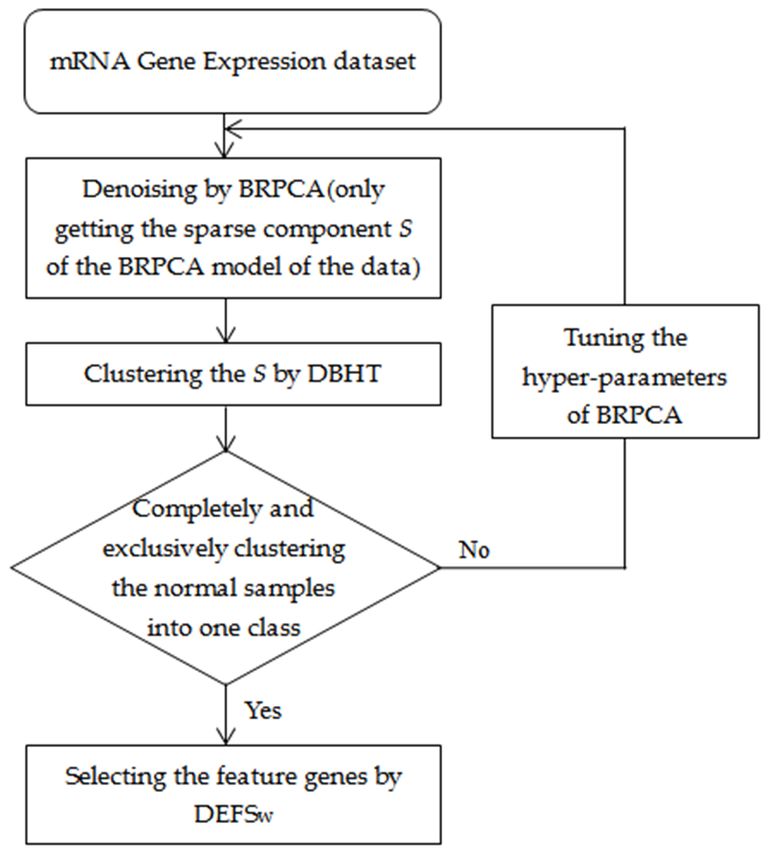
We first applied the BRPCA to denoise the gene expression data by getting the sparse component
but removing the low-rank and noise components, and then we used the DBHT to cluster the sparse
components in the BRPCA. The normal samples completely and exclusively clustered into one
class were considered as the standard of reasonable clustering. If the standard was not reached,
we continually tuned the setting of the hyperparameters of the BRPCA until the clustering was up
to the standard. Finally, we used the DEFSW to select the feature genes for the clusters. A summary
of our approach is shown in Figure 1. The BRPCA, DBHT and DEFSw algorithms were developed
in MATLAB (MathWorks, Natick, MA, USA), and all the related source codes for implementing our
approach are available in the Supplementary file 2 with a brief README.
2.2.1. Bayesian Robust Principal Component Analysis
In the BRPCA model [8], the observed data matrix Y ∈ RP× N is the superposition of 3 parts:
low-rank component L ∈ RP× N , sparse component S ∈ RP× N , and noise term E ∈ RP× N ,
Y = L+S+E (1)
where P is the number of genes, and N is the number of samples. Furthermore,
L = D ( ZΛ)W, S = B ◦ X (2)
where Λ ∈ RK ×K is a diagonal matrix, X ∈ RP× N , and ◦ denotes the pointwise product. The diagonal
matrix Z has binary entries along the diagonal, zkk ∈ {0, 1} for k = 1, . . . K and the binary matrix
B ∈ {0, 1} P× N is sparse. The integer K defines the largest possible rank that may be inferred for L.
The BRPCA model assumed:
1
dk ∼N 0, IP , k = 1, . . . K, D = [d1 , . . . dK ] (3)
PThe microarray mRNA gene expression dataset we used to identify the subtypes of colon
cancer is from TCGA. It includes 153 cancers samples, which have been used by Muzny et al. [2] and
Ren et al. [4] for the same purpose, and 19 control normal samples. We used the level 3 dataset from
TCGA, and this was downloaded by the R package “RTCGA” [21].
Genes 2018, 9, 397 4 of 13
2.2. Method Overview
We first applied the w BRPCA
n ∼N 0, to1 denoise
IK , n = the 1, . . . gene
N, W expression
= [w1 , . . . w N ]data by getting the (4) sparse
K
component but removing the low‐rank and noise components, and then we used the DBHT to
−1
kk ∼N (0, τ ),in
cluster the sparseλcomponents k =the1, · BRPCA.
· · K, τ ∼ Gamma The normal Λ = diagcompletely
( a0 , b0 ),samples [λ1 , . . . λk ] and exclusively
(5)
clustered into one class werezkkconsidered
∼ Bernoullias ( pkthe
), pstandard of reasonable clustering. If the standard (6) was
k ∼ Beta( α0 , β 0 ), k = 1, · · · K
not reached, we continually tuned the setting of the hyperparameters of the BRPCA until the
P
bi ∼ ∏ Bernoulli
clustering was up to the standard. Finally,(πwe used the DEFSW to select the feature genes (7)
pi ), i = 1, . . . N,B = [ b1 , . . . b N ]
for the
clusters. A summary of our approach is shown in Figure 1. The BRPCA, DBHT and DEFSw
p = 1
algorithms were developed
x N ∼ N (0,inν−MATLAB
1
IN ), n = 1,(MathWorks,
. . . N, ν ∼ Gamma Natick,
(c0 , dMA, USA), and all the related (8)
0 ), X = [ x1 , . . . x N ]
source
codes for implementing our approach are available in the Supplementary file 2 with a brief
e pn ∼ N (0, γn−1 ), p = 1, . . . P, γn ∼ Gamma(e0 , f 0 ) (9)
README.
Figure 1. Summary
Figure 1. Summaryof our integrative
of our integrativeapproach.
approach. BRPCA: Bayesianrobust
BRPCA: Bayesian robust principal
principal component
component analysis;
analysis;
DBHT: directed
DBHT: bubble
directed hierarchical
bubble tree;
hierarchical DEFSw:
tree; differential
DEFSw: evolution
differential evolutionbased
basedfeature
featureselection.
selection.
In our study, the observed data matrix Y ∈ RP× N was gene expression profiling of colon cancer
with P = 17, 814 genes and N = 172 samples (153 cancer samples and 19 normal samples). Each column
is a gene expression profile and each row is the gene expression data in every sample. Different from
image processing, which the BRPCA was originally used for [8], our data matrix Y consists of 2 types
of columns, tumor samples and normal samples, and most genes across 2 types of samples should
share some common characteristics. Therefore, we assume the appearance of the sparse component
across sample (column) satisfies a Markov property, i.e.,
(
Beta(α H , β H ) if [0.5b p,i + 0.25(b p,i−1 + b p,i+1 )] ≥ 0.5
π pi ∼ (10)
Beta(α L , β L ) if [0.5b p,i + 0.25(b p,i−1 + b p,i+1 )] < 0.5
where p = 1, . . . P, i = 2, . . . N − 1.
For i = 1, N, we may use sample 2 and sample N − 1 twice, respectively, since sample 1 has no
left neighbor and sample N has no right neighbor. Specifically, a gene with high expression in the left
and right neighbors of a sample should have a high probability of expressing highly in this sample;
hence the sparsity of a sample depends on its neighbors.Genes 2018, 9, 397 5 of 13
Since the density function at one layer is conjugate to the density function at the layer above it,
the posterior density function is easily computed via Markov chain Monte Carlo (MCMC) implemented
using a Gibbs sampler. The details for calculation of the BRPCA algorithm are described in algorithm 1
in Ding et al. [8].
2.2.2. Hierarchical Information Clustering by Means of Topologically Embedded Graphs
The directed bubble hierarchical tree (DBHT) [10] algorithm is used to extract cluster structure
and detect hierarchical organization in complex datasets. This approach is based on the properties
of topologically embedded graphs built from a similarity measure. The general idea of the DBHT is
to use the topological structure of a planar maximally filtered graph (PMFG) [22] to investigate the
properties of the datasets. PMFG is a triangulation of a topological sphere. It has been shown that
PMFG graphs are efficient filtering tools, with topological properties associated with the properties of
the underlying system [22,23]. This makes the PMFG a desirable tool to extract clusters and hierarchies
from complex datasets.
In our study, a sample is a vertex and the Pearson’s correlation coefficient matrix is used as the
similarity matrix of the vertexes.
p
∑ ( xi − x )(yi − y)
r = q i =1 (11)
p 2 2
∑ i =1 ( y i − x ) ( y i − y )
The dissimilarity matrix of the vertexes we used is:
q
d= 2 × (1 − r ) (12)
Based on the similarity and dissimilarity matrix of samples, the DBHT constructs the PMFG to
perform clustering and get hierarchies of samples. The details for the DBHT algorithm are described
in Song et al. [10].
2.2.3. Differential Evolution Based Feature Selection Method
To identify the subtypes using gene expression profiling, feature selection can be used to reduce
the high-dimensionality of huge amounts of otherwise meaningless data. Khushaba and Al-Ani et al.
proposed a powerful feature selection method that utilizes the differential evolution (DE) float number
optimizer in the combinatorial optimization problem of feature selection, named DEFSO [17], followed
by an improved version, DEFSW [18]. In the DEFSO , the desired feature subset size is predefined by
the user, while in the DEFSW , the optimal feature subset size can be discovered automatically only by
setting an upper limit. In the two algorithms, a wrapper classifier such as K nearest neighbor (KNN),
support vector machine (SVM), or naive Bayes (NB) classifier is needed. The wrapper classifier and an
assessment measurement such as classification accuracy are used together to evaluate the classification
ability of features.
In our study, some subtypes have a small number of samples and others have a lot, i.e., there
are imbalances of samples among subtypes. Therefore, a wrapper classifier and an assessment
measurement that can cope with the class imbalance have to be used to avoid the “larger subtypes
win.” Meanwhile, for the DE algorithm, the computation cost is generally huge because of its iterative
evolution, so a fast and simple classifier is desired. Not only can the NB classifier be trained
very efficiently under the condition of a small amount of training data and take only linear time,
but its empirical prior probabilities can lessen the influence of the imbalance of samples. To assess
classification ability, we used weight accuracy instead of the usual classification accuracy. The weight
accuracy of classification is defined by Draminski et al. [20] as:Genes 2018, 9, 397 6 of 13
1 c nii
c i∑
wAcc = (13)
n
=1 i1
+ n i2 + · · · nic
where c is the number of classes, and nij denotes the number of samples in the class i classified as
those from class j. The wAcc considers sizes of classes in such a way as to prevent undue influence of
a majority class on the performance index, and can more effectively assess the ability to classify the
selected feature genes in the imbalanced data. The DEFSW algorithm and its parameter setting that we
used Genes
are listed
2018, 9, in Figure
x FOR PEER 2.
REVIEW 6 of 13
Figure 2. The DEFSW algorithm and its parameter setting in our study.
Figure 2. The DEFSW algorithm and its parameter setting in our study.
3. Results
3. Results
We first used the BRPCA to denoise. In the BRPCA model, we set the largest possible rank as
Wek first
30 used and thetheBRPCA to denoise.
model In the BRPCA
hyperparameters model,
were we setspecified
finally the largestaspossible rank as
follows:
k = 30 6
a0 b0 c0 d0 e0 f0 10 , 0 1 / K , 0 ( K 1) / K , and H 0.01P, H 0.99 P d0 =
and the model hyperparameters were finally specified as follows: a 0 = b0 = c 0 =
e0 = f 0 = 10−6 , α0 = 1/K, β 0 = (K − 1)/K, and α H = 0.01P, β H = 0.99P α L = 0.99P, 6 β L = 0.01P.
L 0.99P, L 0.01P . The initial values of the main arguments − 6 were set as 10 , n 1 .
The initial values of the main arguments were set as ν = 10 , γn = 1. For MCMC-based Bayesian
For MCMC‐based
the number ofBayesian
burn-in inference,
iterations the
Nburnnumber of burn‐in iterations N in were and collection
inference, −in and collection iterations Nburn collect set as 200 and
iterations N collect
100, respectively. Thenwere set as 200the
we applied and 100, respectively.
DBHT to the sparse Then we applied
component the DBHT
S and to the
obtained sparse
eight sample
clusters (see Figure
component S and
3), in whicheight
obtained the normal samples(see
sample clusters were completely
Figure 3), in whichandtheexclusively
normal samplesclustered
were into
completely
one cluster and and
mostexclusively clustered samples
of the MSI/CIMP into one were
cluster and most
divided intoofthree
the MSI/CIMP
subtypes and samples
some were
parts of
divided into three subtypes and some parts of the “invasive” samples were clustered
the “invasive” samples were clustered together. The confusion matrix [24] of the two kinds of subtypes together. The
confusion
is shown matrix
in Table [24] row
1. Each of theoftwo kinds ofrepresents
the matrix subtypes is theshown
samplesin Table 1. Each row
in a predicted of the
class matrix
by the method
represents the samples in a predicted class by the method of Muzny et al. [2], while each column
of Muzny et al. [2], while each column represents the samples in a predicted class by our method.
represents the samples in a predicted class by our method. We also compared the subtypes
We also compared the subtypes predicted by our method and Ren’s method. The confusion matrix of
predicted by our method and Ren’s method. The confusion matrix of the two methods is shown in
Table 2. It shows that the subtypes ECL1 and ECL2 identified by Ren can be further subdivided by
our method.Genes 2018, 9, 397 7 of 13
the two methods is shown in Table 2. It shows that the subtypes ECL1 and ECL2 identified by Ren can
be further subdivided by our method.
Genes 2018, 9, x FOR PEER REVIEW 7 of 13
Table 1. Confusion matrix of subtypes identified by our approach and subtypes identified by
Table 1.etConfusion
Muzny matrix
al. [2]. MSI: of subtypes identified
microsatellite instability;byCIMP:
our approach and subtypes
CpG island identified
methylator by Muzny
phenotype; CIN:
et al. [2]. MSI: microsatellite
chromosomal instability. instability; CIMP: CpG island methylator phenotype; CIN:
chromosomal instability.
Subtype S1 S2 S3 S4 S5 S6 S7
Subtype S1 S2 S3 S4 S5 S6 S7
MSI/CIMP
MSI/CIMP1 1 3 3 2 2 22 19
19 9 9 22 22
CIN 24 13 14 2 0 0 2
CIN 15 24 1 13 8 14 112
Invasive 01 00 2 1
Invasive 0 15 1 1 2 8 011
Unknown 10 00 1 0
Unknown 0 1 2 0 0 0 0
Table 2. Confusion matrix of subtypes identified by our approach and subtypes identified by Ren et al. [4].
Table 2. Confusion matrix of subtypes identified by our approach and subtypes identified by Ren et al. [4].
Subtype S1 S2 S3 S4 S5 S6 S7
Subtype S1 S2 S3 S4 S5 S6 S7
ECL1 40 40 1717 26
ECL1 26 14
14 3 3 0 0 10 10
ECL2 0 1 0 1 17 9 15
ECL2 0 1 0 1 17 9 15
Figure 3. Sample cluster structure from directed bubble hierarchical tree (DBHT) analysis of the sparse
Figure 3. Sample cluster structure from directed bubble hierarchical tree (DBHT) analysis of the
component in the BRPCA (Bayesian robust principal component analysis) model for the 153 colon
sparse component in the BRPCA (Bayesian robust principal component analysis) model for the
cancer samples and 19 normal samples downloaded from the Cancer Genome Atlas (TCGA). The
153 colon cancer samples and 19 normal samples downloaded from the Cancer Genome Atlas (TCGA).
labels inside the symbols correspond to the different subtypes identified by Muzny et al. [2]. MSI:
The labels inside the symbols correspond to the different subtypes identified by Muzny et al. [2].
microsatellite instability; CIMP: CpG island methylator phenotype; CIN: chromosomal instability.
MSI: microsatellite instability; CIMP: CpG island methylator phenotype; CIN: chromosomal instability.
We also tried to directly cluster the mRNA gene expression dataset using DBHT without
We also(Figure
denoising tried to4).
directly cluster the
It suggested thatmRNA gene
directly expression
clustering bydataset
DBHT usingcouldDBHT
not get without denoising
any meaningful
(Figure 4). It suggested
result; even the normalthat directly
samples clustering
could not beby DBHT could
clustered not single
into one get anyclass.
meaningful
We alsoresult; even the
did consensus
normal samples could not be clustered into one single class. We also did consensus
hierarchical clustering [25] in the same way as that described in Ren et al. [4], and the result (Figure hierarchical
clustering [25] that
5a) suggested in the same
the way as
samples thatclustered
were described in two
into Ren clusters
et al. [4],(normal
and theandresult (Figure
cancer 5a) suggested
samples) or three
that the samples were clustered into two clusters (normal and cancer samples)
clusters (normal cluster, and ECL1 and ECL2 subtypes identified by Ren et al.). Using the same or three clusters (normal
cluster,
consensusandclustering
ECL1 andmethod,
ECL2 subtypes
we also identified by Ren et al.).
clustered component S Using
of thethe same consensus
samples in the BRPCA clustering
model,
method, also clustered component S
and the result (Figure 5b) suggested that consensus clustering could not get finer clusters 5b)
we of the samples in the BRPCA model, and the result (Figure for
suggested that consensus clustering could not get finer clusters for component
component S than the DBHT algorithm. All these suggested that the combination of BRPCA and S than the DBHT
algorithm.
DBHT could Allnotthese suggested
only correctlythat the the
cluster combination of BRPCA
normal samples, but and
alsoDBHT
clustercould not only
the cancer correctly
samples into
cluster the normal samples, but also cluster the cancer samples into finer subtypes.
finer subtypes.Genes 2018, 9, 397 8 of 13
Genes 2018, 9, x FOR PEER REVIEW 8 of 13
Genes 2018, 9, x FOR PEER REVIEW 8 of 13
Figure 4.4. Sample
Sample clusterstructure
structure directlyclustered
clustered using directed bubble hierarchical tree (DBHT)
Figure Sample cluster
cluster structuredirectly
directly clusteredusing
usingdirected bubble
directed bubblehierarchical treetree
hierarchical (DBHT) for
(DBHT)
for
the the
samesame data
datadata in Figure
in Figure 3. Labels
3. Labels and
andand symbols
symbols are
are are also
alsoalso the
the the
same same as Figure
as Figure 3. 3.3.
for the same in Figure 3. Labels symbols same as Figure
Figure 5. Clustering by the consensus clustering algorithm when K = 2 to 10. (a) Cluster consensus values
Figure 5.
Figure 5. Clustering
Clusteringbybythe consensus
the consensus clustering algorithm
clustering when
algorithm K = 2Kto=10.
when 2 to(a)10.
Cluster consensus
(a) Cluster values
consensus
and consensus cumulative distribution function (CDF) on the mRNA genes expression dataset; (b) cluster
and consensus cumulative distribution function (CDF) on the mRNA genes expression dataset;
values and consensus cumulative distribution function (CDF) on the mRNA genes expression dataset; (b) cluster
consensus values and consensus CDF on component S of the mRNA gene expression dataset.
consensus
(b) cluster values andvalues
consensus consensus
and CDF on component
consensus S of the mRNA
CDF on component S of thegene
mRNA expression dataset. dataset.
gene expression
We then selected the feature genes for the identified subtypes by the DEFSw algorithm.
We then selected the feature genes for the identified subtypes by the DEFSw algorithm.
We
Considering thenthat
selected the feature
the latent premisegenes for the identified
of identifying subtypes subtypes
is that thebysamples
the DEFS algorithm.
arewfrom cancer
Considering that the latent premise of identifying subtypes is that the samples are from cancer
Considering that the latent premise of identifying subtypes is that the
patients, we expected that the selected feature genes could not only identify cancer subtypes,samples are from cancer
but
patients, we expected that the selected feature genes could not only identify cancer subtypes, but
patients, we expected that the selected feature genes could not only identify
also discriminate between tumor and normal samples, i.e., we expected to select out the feature cancer subtypes, but also
also discriminate between tumor and normal samples, i.e., we expected to select out the feature
discriminate
genes that could between tumor and
discriminate all normal samples,
eight sample i.e., we
clusters. It expected to select
was rational out the
to select the feature
feature genes
genes
genes that could discriminate all eight sample clusters. It was rational to select the feature genes
that
fromcould discriminate expressed
the differentially all eight sample clusters.ofIttumor
genes (DEGs) was rational to select
vs. normal the feature
samples. genes from
We obtained 5897
from the differentially expressed genes (DEGs) of tumor vs. normal samples. We obtained 5897
the differentially expressed genes (DEGs) of tumor vs. normal samples.
DEGs by t‐test (BH‐correction, p value < 0.05) and fold change cutoff 1.5, and then selected theWe obtained 5897 DEGs
DEGs by t‐test (BH‐correction, p value < 0.05) and fold change cutoff 1.5, and then selected the
by t-testgenes
feature from these pDEGs
(BH-correction, valueusing
< 0.05)
theand
DEFSfold change cutoff
W algorithm 1.5, and
described then selected
in Figure 2. We setthe thefeature
upper
feature genes from these DEGs using the DEFSW algorithm described in Figure 2. We set the upper
genes
limit offrom theseofDEGs
the size featureusing
genesthefromDEFS
100Wtoalgorithm
20, and for described
each upperin Figure 2. DEFS
limit, the We set the upper could
w algorithm limit
limit of the size of feature genes from 100 to 20, and for each upper limit, the DEFSw algorithm could
of the size of feature genes from 100 to 20, and for each upper limit, the DEFS
deliver an optimal size of feature genes. We then determined our final size of feature genes to be thatw algorithm could
deliver an optimal size of feature genes. We then determined our final size of feature genes to be that
deliver
which gavean optimal size ofaverage
the maximal featureweight
genes.accuracy
We thenofdetermined our final
the eight sample size of
clusters. Infeature
this way,genes to be
we ended
which gave the maximal average weight accuracy of the eight sample clusters. In this way, we ended
that which
up with 44 gave
featurethegenes:
maximal average
THBS2, NOX4, weight accuracy
KIAA1199, of the CCDC19,
SLC16A4, eight sample clusters.
ZNRF3, GOLT1A, In this way,
HYAL3,
up with 44 feature genes: THBS2, NOX4, KIAA1199, SLC16A4, CCDC19, ZNRF3, GOLT1A, HYAL3,
C15orf26, KIFC1, TIPIN, CTNNAL1, CALU, TAF1A, MCM2, MSH6, FLAD1, GCG, SCRG1, PTGER2,
C15orf26, KIFC1, TIPIN, CTNNAL1, CALU, TAF1A, MCM2, MSH6, FLAD1, GCG, SCRG1, PTGER2,
TIMD4, MUC1, PLOD2, LIMS2, ADH1B, PTN, PTPN7, AQP1, PSD3, CRAT, ATOH8, CGN, C6orf204,
TIMD4, MUC1, PLOD2, LIMS2, ADH1B, PTN, PTPN7, AQP1, PSD3, CRAT, ATOH8, CGN, C6orf204,Genes 2018, 9, 397 9 of 13
we ended up with 44 feature genes: THBS2, NOX4, KIAA1199, SLC16A4, CCDC19, ZNRF3, GOLT1A,
HYAL3, C15orf26, KIFC1, TIPIN, CTNNAL1, CALU, TAF1A, MCM2, MSH6, FLAD1, GCG, SCRG1,
PTGER2, TIMD4, MUC1, PLOD2, LIMS2, ADH1B, PTN, PTPN7, AQP1, PSD3, CRAT, ATOH8, CGN,
C6orf204, FTHP1, KCNMB1, LIG4, PPFIBP2, PPP2CB, ALAS2, ZZEF1, ATXN7, GRLF1, FAM102A,
and C1orf152. Among them, MSH6 is known to be related to CRC, and is located in the Kyoto
Encyclopedia of Genes and Genomes (KEGG) pathway of CRC [26]; THBS2 is a potential prognostic
biomarker in CRC [27] and can be used as an early diagnosis biomarkers of CRC [28]; Overexpression
of NOX4 predicts poor prognosis and promotes tumor progression in human CRC [29], and NOX4
plays a role in PhIP-induced colon carcinogenesis, especially during the early stages before tumor
onset [30], and moreover NOX4 is highly predictive of relapse in stage II left-side colon cancer [31];
KIAA1199 in human colorectal tumors (benign and malignant) is markedly higher than that in the
normal colonic mucosa [32,33] and its overexpression promotes CRC cell migration and invasion [34],
and could be used as a prognostic factor and novel therapeutic target for CRC [35]; Furthermore
KIAA1199 plays a critical role in maintaining an aggressive phenotype of tumor cells, and suppression
of KIAA1199-related motilities of tumor cells contributes to reduced tumor metastasis in CRC [36];
MCM2 is correlated with the cell proliferation state in colon cancer [37] and is more sensitive than Ki-67
in identifying colorectal mucosal proliferation [38]; MUC1 is aberrantly overexpressed in human colon
cancers and is associated with invasion, metastases and a poor prognosis [39,40]; ZNRF3 is important
in serrated tumorigenesis and has identified a potential therapeutic strategy for CRC subtype [41];
LIG4 may represent a new epigenetic marker for CRC independent of known markers [42]; ADH1B
displays decreased expression during progression from adenoma to early and more advanced stage
of colorectal carcinomas [43]. In contrast, Muzny et al. [2] did not select the feature genes for the
identified subtypes, and Ren et al. [4] detected 256 genes as the marker genes of the ECL1 and ECL2
subtypes by Prediction Analysis of Microarrays (PAM) [44].
We used the same NB classifier to validate the classification ability of these feature genes. We did
10%, 20%, and 30% cross-validation (CV) with 1000 repeats. The mean classification accuracy,
the mean weight accuracy of classification, and the mean classification accuracy for each class of
the 1000 CVs are listed in Table 3. S1–S8 denotes the clusters 1–8 and S8 is the cluster of normal
samples. The classification accuracy Acc depends on the number of samples correctly classified and is
evaluated by the formula:
t
Acc = (14)
n
where t is the number of samples correctly classified and n is the total number of samples.
Table 3. Overall mean accuracy, overall mean weight accuracy, and mean accuracy for each class by
1000 times of cross-validation using the naive Bayes (NB) algorithm on the feature gene sets.
Cross Weight
Accuracy Class 1 Class 2 Class 3 Class 4 Class 5 Class 6 Class 7 Class 8
Validation Accuracy
(%) (%) (%) (%) (%) (%) (%) (%) (%)
(%) (%)
10 82.71 84.98 75.70 82.50 91.17 88.50 81.83 90.50 70.67 99.00
20 81.76 82.58 76.72 74.75 78.30 72.25 90.35 83.00 86.17 99.08
30 81.12 81.90 75.90 78.23 76.50 71.40 87.86 82.83 82.50 100.00
4. Discussion
To identify cancer subtypes based on gene expression data, the proposed approach innovatively
integrated state-of-art denoising, clustering, and feature selection algorithms. In BRPCA, the low-rank
component of gene expression data may be the same as the background of an image and the noise
component simulates unknown and nonstationary noise, whereas the sparse component may be
the same as the foreground and is the key information for clustering. The DBHT is intrinsically a
correlation-based clustering method. Through building the PMFG, the method does not need any
prior tuning and provides both intracluster hierarchy, which describes the way clusters are composed,Genes 2018, 9, 397 10 of 13
and intercluster hierarchy, which describes how clusters gather together. To assess whether the
clustering is meaningful, we draw in the concept of “reference object” from classical physics. If the
reference objects, the normal samples, are correctly clustered together, we consider the clustering as
reasonable; otherwise, we need to tune the parameters in the BRPCA. Tuning the parameters means
adjusting the degree of details of component S. The DEFSw algorithm can discover the optimal feature
subset size. Considering the unstable stochastic search, we repeated the DEFSw algorithm multiple
times with different upper limits of the feature size and selected the feature genes from the DEGs.
This may be helpful for selecting out the optimal size of feature genes and getting higher accuracy for
discriminating tumor and normal samples. Overall, the proposed approach can identify finer subtypes
of colon cancer with fewer feature genes than the other two recent studies and exhibits a generic
methodology for identifying cancer subtypes based on gene expression data by common processes.
Inter-tumor diversity of CRC complicates the prediction of disease and treatment outcomes.
Subtypes of colorectal cancer identified by classifying gene expression profiles with defined
prognostic markers would predict individual patient outcomes more precisely and therefore
provide valuable guidance on appropriate therapeutic intervention [45]. It is proposed that
CRC subtyping may advance precision diagnostics, treatment, and guide rational drug design.
Numerous methods have been attempted to achieve this goal using gene expression datasets [2,4].
In a recent study by Bramsen et al. [46], subtyping strategy was used to CRC transcription
profiles for identifying molecular-subtype-specific biomarkers which could contribute to improved
patient prognostication. Moreover, other directions have also been taken to find the colorectal
subtypes based on pathway profiles, morphological characteristics, clinical and molecular features.
Different subtype classifications have been established in recent studies based on three identified
molecular pathways: CIN (chromosomal instability), MSI-H (microsatellite instability-high),
and CIMP [2,3,47–49]. However, there are disagreements among these classifications. There have
been many attempts to find consensus in classification of CRC subtypes, and such efforts are essential
for revealing prognostic and predictive factors for patient outcomes and to guide treatments [45].
However, no universal subclassification has been agreed upon because of the difficulties and the cost
of experimental verification. CRC subtyping consortium (CRCSC) proposed four transcriptional CMSs,
which are associated with distinct histopathological features. However, this remains to be further
documented, and consensus molecular subtyping is still not in a stage to guide clinical decisions [45].
The reliable molecular subtyping approaches are still needed to unveil clinical potentials.
Supplementary Materials: The following are available online at http://www.mdpi.com/2073-4425/9/8/397/s1,
Supplementary File 1: The level 3 mRNA gene expression datasets of 153 colon cancers samples and 19 control
normal samples. Supplementary File 2: The MATLAB source codes to implement our approach.
Author Contributions: W.-H.W. carried out the study and wrote the manuscript. T.-Y.X. contributed to the
annotation and interpretation of the identified feature genes and the subtypes. G.-L.X. implemented parts of the
computing tools and the statistics. Z.-L.R. participated in the design of the study. J.-M.L. conceived of the study,
participated in its design and coordination, and helped to draft the manuscript. All authors read and approved
the final manuscript.
Funding: This study was supported by the National Natural Science Foundation of China (grant No. 31371290)
and the Department of Education of Guangdong Province (YCJ [2011] 430). The work was partially funded by a
grant from the Frontier and Key Technology Innovation Project of Guangdong Province (No. 2014B010118003)
and grants from the Science and Technology Planning Project of Guangdong Province (No. 2015B010129008).
Conflicts of Interest: The authors declare no conflicts of interest.
References
1. Fearon, E.R.; Vogelstein, B. A genetic model for colorectal tumorigenesis. Cell 1990, 61, 759–767. [CrossRef]
2. Muzny, D.M.; Bainbridge, M.N.; Chang, K.; Dinh, H.H.; Drummond, J.A.; Fowler, G.; Kovar, C.L.; Lewis, L.R.;
Morgan, M.B.; Newsham, I.F.; et al. Comprehensive molecular characterization of human colon and rectal
cancer. Nature 2012, 487, 330–337.Genes 2018, 9, 397 11 of 13
3. Guinney, J.; Dienstmann, R.; Wang, X.; De Reyniès, A.; Schlicker, A.; Soneson, C.; Marisa, L.; Roepman, P.;
Nyamundanda, G.; Angelino, P.; et al. The Consensus Molecular Subtypes of Colorectal Cancer. Nat. Med.
2015, 21, 1350–1362. [CrossRef] [PubMed]
4. Ren, Z.L.; Wang, W.H.; Li, J.M. Identifying molecular subtypes in human colon cancer using gene expression
and DNA methylation microarray data. Int. J. Oncol. 2016, 48, 690–702. [CrossRef] [PubMed]
5. Yiu, A.J.; Yiu, C.Y. Biomarkers in Colorectal Cancer. Anticancer Res. 2016, 36, 1093–1102. [PubMed]
6. Jung, S. In-silico interaction-resolution pathway activity quantification and application to identifying cancer
subtypes. BMC Med. Inform. Decis. Mak. 2016, 16, 55. [CrossRef] [PubMed]
7. Ma, S.; Dai, Y. Principal component analysis based methods in bioinformatics studies. Brief. Bioinform. 2011,
12, 714–722. [CrossRef] [PubMed]
8. Ding, X.; He, L.; Carin, L. Bayesian robust principal component analysis. IEEE Trans. Image Process. 2011, 20,
3419–3430. [CrossRef] [PubMed]
9. Liu, J.X.; Wang, Y.T.; Zheng, C.H.; Sha, W.; Mi, J.X.; Xu, Y. Robust PCA based method for discovering
differentially expressed genes. BMC Bioinform. 2013, 14, S3. [CrossRef] [PubMed]
10. Song, W.M.; Di Matteo, T.; Aste, T. Hierarchical information clustering by means of topologically embedded
graphs. PLoS ONE 2012, 7, e31929. [CrossRef] [PubMed]
11. Song, W.M.; Zhang, B. Multiscale Embedded Gene Co-expression Network Analysis. PLoS Comput. Biol.
2015, 11, e1004574. [CrossRef] [PubMed]
12. Nguyen, M.H.; Fernando, D.L.T. Optimal feature selection for support vector machines. Pattern Recognit.
2010, 43, 584–591. [CrossRef]
13. Vedaldi, A.; Zisserman, A. Efficient additive kernels via explicit feature maps. IEEE Trans. Pattern Anal.
Mach. Intell. 2012, 34, 480–492. [CrossRef] [PubMed]
14. Luukka, P. Feature selection using fuzzy entropy measures with similarity classifier. Expert. Syst. Appl. 2011,
38, 4600–4607. [CrossRef]
15. Yu, L.; Han, Y.; Berens, M.E. Stable gene selection from microarray data via sample weighting.
IEEE/ACM TCBB 2012, 9, 262–272. [PubMed]
16. Nguyen, X.V.; Chan, J.; Romano, S.; Bailey, J. Effective Global Approaches for Mutual Information Based
Feature Selection. In Proceedings of the 20th ACM SIGKDD Conference on Knowledge Discovery and Data
Mining (KDD’14), New York, NY, USA, 24–27 August 2014; pp. 512–521.
17. Khushaba, R.N.; Al-Ani, A.; Al-Jumaily, A. Feature subset selection using differential evolution and a
statistical repair mechanism. Expert Syst. Appl. 2011, 38, 11515–11526. [CrossRef]
18. Al-Ani, A.; Alsukker, A.; Khushaba, R.N. Feature subset selection using differential evolution and a wheel
based search strategy. Swarm Evolut. Comput. 2013, 9, 15–26. [CrossRef]
19. Paul, S.; Das, S. Simultaneous feature selection and weighting—An evolutionary multi-objective optimization
approach. Pattern Recognit. Lett. 2015, 65, 51–59. [CrossRef]
20. Draminski, M.; Rada-Iglesias, A.; Enroth, S.; Wadelius, C.; Koronacki, J.; Komorowski, J. Monte Carlo feature
selection for supervised classification. Bioinformatics 2008, 24, 110–117. [CrossRef] [PubMed]
21. Kosinski, M.; Biecek, P. RTCGA: The Cancer Genome Atlas Data Integration. R Package Version 1.2.5. 2016.
Available online: https://rtcga.github.io/RTCGA (accessed on 12 December 2016).
22. Tumminello, M.; Aste, T.; Di Matteo, T.; Mantegna, R.N. A tool for filtering information in complex systems.
Proc. Natl. Acad. Sci. USA 2005, 102, 10421–10426. [CrossRef] [PubMed]
23. Matteo, T.D.; Pozzi, F.; Aste, T. The use of dynamical networks to detect the hierarchical organization of
financial market sectors. Eur. Phys. J. B 2010, 73, 3–11. [CrossRef]
24. Powers, D.M.W. Evaluation: From Precision, Recall and F-Measure to ROC, Informedness, Markedness &
Correlation. J. Mach. Learn. Technol. 2011, 2, 37–63.
25. Monti, S.; Tamayo, P.; Mesirov, J.; Golub, T. Consensus Clustering: A resampling-based method for class
discovery and visualization of gene expression microarray data. Mach. Learn. 2003, 52, 91–118. [CrossRef]
26. Kanehisa, M.; Goto, S.; Furumichi, M.; Tanabe, M.; Hirakawa, M. KEGG for representation and analysis
of molecular networks involving diseases and drugs. Nucleic Acids Res. 2010, 38, D355–D360. [CrossRef]
[PubMed]
27. Wang, X.; Zhang, L.; Li, H.; Sun, W.; Zhang, H.; Lai, M. THBS2 is a Potential Prognostic Biomarker in
Colorectal Cancer. Sci. Rep. 2016, 6, 33366. [CrossRef] [PubMed]Genes 2018, 9, 397 12 of 13
28. Fei, W.; Chen, L.; Chen, J.; Shi, Q.; Zhang, L.; Liu, S.; Li, L.; Zheng, L.; Hu, X. RBP4 and THBS2 are serum
biomarkers for diagnosis of colorectal cancer. Oncotarget 2017, 8, 92254–92264. [CrossRef] [PubMed]
29. Lin, X.L.; Yang, L.; Fu, S.W.; Lin, W.F.; Gao, Y.J.; Chen, H.Y.; Ge, Z.Z. Overexpression of NOX4 predicts poor
prognosis and promotes tumor progression in human colorectal cancer. Oncotarget 2017, 8, 33586–33600.
[CrossRef] [PubMed]
30. Wang, R.; Dashwood, W.M.; Nian, H.; Löhr, C.V.; Fischer, K.A.; Tsuchiya, N.; Nakagama, H.; Ashktorab, H.;
Dashwood, R.H. NADPH oxidase overexpression in human colon cancers and rat colon tumors induced by
2-amino-1-methyl-6-phenylimidazo[4,5-b]pyridine (PhIP). Int. J. Cancer 2011, 128, 2581–2590. [CrossRef]
[PubMed]
31. Bauer, K.M.; Watts, T.N.; Buechler, S.; Hummon, A.B. Proteomic and Functional Investigation of the Colon
Cancer Relapse-Associated Genes NOX4 and ITGA3. J. Proteome Res. 2014, 13, 4910–4918. [CrossRef]
[PubMed]
32. Sabates-Bellver, J.; Van der Flier, L.G.; de Palo, M.; Cattaneo, E.; Maake, C.; Rehrauer, H.; Laczko, E.;
Kurowski, M.A.; Bujnicki, J.M.; Menigatti, M.; et al. Transcriptome profile of human colorectal adenomas.
Mol. Cancer Res. 2007, 5, 1263–1275. [CrossRef] [PubMed]
33. Di Pietro, M.; Sabates Bellver, J.; Menigatti, M.; Bannwart, F.; Schnider, A.; Russell, A.; Truninger, K.; Jiricny, J.;
Marra, G. Defective DNA mismatch repair determines a characteristic transcriptional profile in proximal
colon cancers. Gastroenterology 2005, 129, 1047–1059. [CrossRef] [PubMed]
34. Sun, J.; Hu, J.; Wang, G.; Yang, Z.; Zhao, C.; Zhang, X.; Wang, J. LncRNA TUG1 promoted KIAA1199
expression via miR-600 to accelerate cell metastasis and epithelial-mesenchymal transition in colorectal
cancer. J. Exp. Clin. Cancer Res. 2018, 37, 106. [CrossRef] [PubMed]
35. Xu, J.; Liu, Y.; Wang, X.; Huang, J.; Zhu, H.; Hu, Z.; Wang, D. Association between KIAA1199 overexpression
and tumor invasion, TNM stage, and poor prognosis in colorectal cancer. Int. J. Clin. Exp. Pathol. 2015, 8,
2909–2918. [PubMed]
36. Zhang, D.; Zhao, L.; Shen, Q.; Lv, Q.; Jin, M.; Ma, H.; Nie, X.; Zheng, X.; Huang, S.; Zhou, P.; et al.
Down-regulation of KIAA1199/CEMIP by miR-216a suppresses tumor invasion and metastasis in colorectal
cancer. Int. J. Cancer 2017, 140, 2298–2309. [CrossRef] [PubMed]
37. Giaginis, C.; Georgiadou, M.; Dimakopoulou, K.; Tsourouflis, G.; Gatzidou, E.; Kouraklis, G.; Theocharis, S.
Clinical significance of MCM-2 and MCM-5 expression in colon cancer: Association with clinicopathological
parameters and tumor proliferative capacity. Dig. Dis. Sci. 2009, 54, 282–291. [CrossRef] [PubMed]
38. Hanna-Morris, A.; Badvie, S.; Cohen, P.; McCullough, T.; Andreyev, H.J.; Allen-Mersh, T.G. Minichromosome
maintenance protein 2 (MCM2) is a stronger discriminator of increased proliferation in mucosa adjacent to
colorectal cancer than Ki-67. J. Clin. Pathol. 2009, 62, 325–330. [CrossRef] [PubMed]
39. Byrd, J.C.; Bresalier, R.S. Mucins and mucin binding proteins in colorectal cancer. Cancer Metastasis Rev. 2004,
23, 77–99. [CrossRef] [PubMed]
40. Nakamori, S.; Ota, D.M.; Cleary, K.R.; Shirotani, K.; Irimura, T. MUC1 mucin expression as a marker of
progression and metastasis of human colorectal carcinoma. Gastroenterology 1994, 106, 353–361. [CrossRef]
41. Bond, C.E.; Mckeone, D.M.; Kalimutho, M.; Bettington, M.L.; Pearson, S.A.; Dumenil, T.D.; Wockner, L.F.;
Burge, M.; Leggett, B.A.; Whitehall, V.L. RNF43 and ZNRF3 are commonly altered in serrated pathway
colorectal tumorigenesis. Oncotarget 2016, 7, 70589–70600. [CrossRef] [PubMed]
42. Kuhmann, C.; Li, C.; Kloor, M.; Salou, M.; Weigel, C.; Schmidt, C.R.; Ng, L.W.; Tsui, W.W.; Leung, S.Y.;
Yuen, S.T.; et al. Altered regulation of DNA ligase IV activity by aberrant promoter DNA methylation and
gene amplification in colorectal cancer. Hum. Mol. Genet. 2014, 23, 2043–2054. [CrossRef] [PubMed]
43. Kropotova, E.S.; Zinovieva, O.L.; Zyryanova, A.F.; Dybovaya, V.I.; Prasolov, V.S.; Beresten, S.F.; Oparina, N.Y.;
Mashkova, T.D. Altered Expression of Multiple Genes Involved in Retinoic Acid Biosynthesis in Human
Colorectal Cancer. Pathol. Oncol. Res. 2014, 20, 707–717. [CrossRef] [PubMed]
44. Tibshirani, R.; Hastie, T.; Narasimhan, B.; Chu, G. Diagnosis of Multiple Cancer Types by Shrunken Centroids
of Gene Expression. Proc. Natl. Acad. Sci. USA 2002, 99, 6567–6572. [CrossRef] [PubMed]
45. Bramsen, J.B.; Rasmussen, M.H.; Ongen, H.; Mattesen, T.B.; Ørntoft, M.W.; Árnadóttir, S.S.; Sandoval, J.;
Laguna, T.; Vang, S.; Øster, B.; et al. Molecular-Subtype-Specific Biomarkers Improve Prediction of Prognosis
in Colorectal Cancer. Cell Rep. 2017, 19, 1268–1280. [CrossRef] [PubMed]
46. Sun, W.J. Molecular subtypes of colorectal cancer: Evaluation of outcomes and treatment. Oncol. Transl. Med.
2016, 2, 145–149.Genes 2018, 9, 397 13 of 13
47. Hoadley, K.A.; Yau, C.; Wolf, D.M.; Cherniack, A.D.; Tamborero, D.; Ng, S.; Leiserson, M.D.M.; Niu, B.;
McLellan, M.D.; Uzunangelov, V.; et al. Multiplatform analysis of 12 cancer types reveals molecular
classification within and across tissues of origin. Cell 2014, 158, 929–944. [CrossRef] [PubMed]
48. Roepman, P.; Schlicker, A.; Tabernero, J.; Majewski, I.; Tian, S.; Moreno, V.; Snel, M.H.; Chresta, C.M.;
Rosenberg, R.; Nitsche, U.; et al. Colorectal cancer intrinsic subtypes predict chemotherapy benefit, deficient
mismatch repair and epithelial-to-mesenchymal transition. Int. J. Cancer 2014, 134, 552–562. [CrossRef]
[PubMed]
49. Sadanandam, A.; Lyssiotis, C.A.; Homicsko, K.; Collisson, E.A.; Gibb, W.J.; Wullschleger, S.; Ostos, L.C.;
Lannon, W.A.; Grotzinger, C.; Del Rio, M.; et al. A colorectal cancer classification system that associates
cellular phenotype and responses to therapy. Nat. Med. 2013, 19, 619–625. [CrossRef] [PubMed]
© 2018 by the authors. Licensee MDPI, Basel, Switzerland. This article is an open access
article distributed under the terms and conditions of the Creative Commons Attribution
(CC BY) license (http://creativecommons.org/licenses/by/4.0/).You can also read


