HOW TO SELECT THE RIGHT IOT PLATFORM - CONSIDERATIONS BEYOND CONNECTIVITY - SECURITY, FLEXIBILITY, AND DATA INTELLIGENCE
←
→
Page content transcription
If your browser does not render page correctly, please read the page content below
WHITE PAPER

How To Select the Right IoT Platform
Considerations Beyond Connectivity —
Security, Flexibility, and Data Intelligence

© 2014 Ayla Networks, Inc.                     www.aylanetworks.com
WHITE PAPER       Ho w t o S e l e c t t h e R i g h t I o T P l at fo rm

Contents

     Page 3   Opening

     Page 4   Part I: 7 Steps to Security for the Internet of Things

              1. End-to-end security mechanisms

              2. End-to-end data encryption

              3. Access and authorization control

              4. Activity auditing

              5. Hardened cloud infrastructure

              6. Equal protection across multiple protocols

              7. Education

     Page 5   Part II: The Internet of Things and the Great Unknown

     Page 6   Part III: Putting the Smarts in IoT

     Page 7   About Ayla Networks

     Page 9   Appendix A: Summary of Key IoT Platform Requirements

                                                                                                                    2
WHITE PAPER Ho w t o S e l e c t t h e R i g h t I o T P l at fo rm
Opening
Although it has been with us in some form and under different names for many years, the Internet of
Things (IoT) is suddenly the thing. The ability to connect, communicate with, and remotely manage an
incalculable number of networked, automated devices via the Internet is becoming pervasive, from the
commercial kitchen to the residential basement room to the arm of the fitness buff.
If you’re reading this white paper, you probably have an interest in adding Internet connectivity, mobile
application control, and likely also some “smarts” to your product or device, and so it all can be controlled
and monitored by a smartphone or tablet. Let’s make an assumption that you already believe that
working with an IoT Platform provider will accelerate your time to market and increase your ability to
deliver a world-class connected product, versus trying to do it all in-house. But what’s most important to
consider when evaluating and selecting an IoT Platform?
The ease and simplicity of getting basic networking to work on your prototype, getting it to talk to a
cloud and your mobile app are essential and a critical first step. But what else must you think about and
consider, so that this new era of IoT doesn’t come biting you back later, like an angry junkyard dog.
This white paper focuses on three critical considerations when choosing an IoT platform, specifically what
to evaluate in a platform architecture so that your needs are met today, and more importantly, are going
to be met in the future as you expand your family and functionality of smart-connected products. The key
platform architectural attributes are: (I) Security, (II) Flexibility and (III) Data Intelligence.
This white paper will elaborate on each of these considerations, and close with an introduction to the IoT
platform from Ayla Networks, the end-to-end solution that leading manufacturers are choosing to deliver
world-class IoT products. Finally, an appendix is included at the end with a table of specific features to
look for as you evaluate the best IoT platform for your needs.
White papers can often be dry, and we tried to write this paper a bit differently. The prose is somewhat
informal, written more like the way we’d write a blog post. In this way, we hope you find it more
interesting to read. Tell us what you think – email us at wewantyourcomments@aylanetworks.com –
we’d love to hear from you.
3WHITE PAPER Ho w t o S e l e c t t h e R i g h t I o T P l at fo rm
Part I:
7 Steps to Security for the Internet of Things 1. End-to-end security mechanisms
Mobile apps and connected devices must be authenticated
The Internet of Things (IoT) is starting to appear everywhere in
separately. Both the mobile app and the end user’s credentials
many shapes and forms. But security is one of the hurdles that
must pass authorization. The identity of the connected device
could trip up the growth of the IoT. Following security principles
is best maintained in hardware. That is, the device’s credentials
used in enterprise computing can help clear that hurdle.
can be burned into its connectivity module at the factory, so
Think of the IoT’s breadth for a moment. Already there are it’s not exposed to anyone. This dramatically raises the bar
more connected devices than people on the planet, according for spoofing. Someone would have to steal your device, your
to Norio Nakajima, an executive vice president at Murata. By mobile app, and your password.
2020, there will be 50 billion connected devices, outnumbering
2. End-to-end data encryption
people by more than 6 to 1.
Standard-based encryption from device to mobile app is
Many of these devices will be controllable over the Internet, arguably one of the best deterrents of data theft. Many services
and they will increasingly be responsible for collecting and encrypt data once it gets to their datacenter, but in many ways
transmitting sensitive information. Today consumers might own data is more vulnerable when it’s in transit. The challenge with
a FitBit that collects information on their exercise routine. In a doing this from end to end is making all the authentication and
few years, those same people might have an Internet-enabled key management happen without user configuration, so the
insulin pump that continually delivers data to their doctor. In the data encrypts automatically.
wrong hands, data from home management systems could be
used to assess your whereabouts. Likewise, businesses could 3. Access and authorization control
be vulnerable when they connect things like HVAC, irrigation, This means giving different user types different levels of data
and commercial appliances. access. Consumers might let their utility link to their thermostat
to turn down the AC on peak power days. But the utility would
Hackers often scan for poor or misconfigured security on
be able to using the data for power consumption analysis only.
networks, and IoT environments will likely be no different. This
Or maybe consumers would give retailers limited access to
was the case in the early days of Wi-Fi Internet connectivity,
monitor their AC for proactive maintenance and repair.
when weak security on access points and wardriving prevailed
until education and configurations improved. The IoT could be 4. Activity auditing
vulnerable. By design, it’s always connected to the Internet.
IoT device manufacturers and service providers need to keep log
Therefore, it must have strong security built in.
records so that any breaches can be traced back to the source.
But that’s only half the problem. Security also has to be really Auditing data is also an important way to identify patterns that
simple to implement. Otherwise, people won’t use it. They will can pinpoint problems before they happen. Additionally, it’s a
blame the manufacturers and service providers instead. If we way to rate vendors. If businesses could compare the security
don’t iron out how to make strong security goof-proof, a very practices of vendors in an open and honest way, cloud providers
public breach could result. and IoT service providers would have a huge incentive to invest
in security.
It’s nearly impossible to make any Internet application platform
100% impenetrable from attack, but implementing the best- 5. Hardened cloud infrastructure
practices of enterprise-class security can thwart all but the Hosting data in the cloud can be far more secure than keeping
most persevering hacker with malicious intent. it at home or in a company-run datacenter. Cloud providers
can invest more money and personnel in strengthening their
What does enterprise-class security really mean in the case of
operations against attack. But you still see hackers gaining
an IoT cloud-based platform? Here are seven key principles.
entry into well-known organizations. How do you know security
4WHITE PAPER Ho w t o S e l e c t t h e R i g h t I o T P l at fo rm
best-practices are followed? ISO 27001 is a security certification For product engineers and marketers, unpredictability is an
standard that specifies security management best-practices occupational hazard. Tablets might be a rip-roaring success
and comprehensive security controls for datacenters and other today, but they flopped in 2002 when Microsoft lined up nearly
environments. For example, Amazon Web Services (AWS) is every major manufacturer to release them. You also have the
compliant with ISO 27001. unanticipated success stories like Twitter and Facebook. Wi-
Fi analysts questioned whether consumers would use public
6. Equal protection across multiple protocols
hotspots. FitBit and Nest helped create and popularize two
Devices will communicate over WiFi, cellular, ZigBee, Bluetooth, (connected) product categories -- wearable health monitors
and other wireless (and wired) protocols. Security has to be and smart thermostats -- by incorporating design aesthetics
equally strong across all of them, regardless of whether the and intuitive experience that hit the right pitch with customers.
mobile app is talking to a connected device over the Internet
or locally (e.g. at home, on the same WiFi network as the The Internet of Things market is amplifying but still in the
connected device). early stages of adoption. We are just starting to visualize what
connected products can do to improve industrial productivity,
7. Education create world-class customer experiences, and drive new
Vendors have to be ready to teach consumers and buyers -- understandings between manufacturers and their customer
through easy-to-read web pages or through their customer behaviors. What’s behind the next corner is really anyone’s
service desk -- why security is important and why they need guess.
to think about it. Sadly, human error is still one of the biggest
Engineers developing the next generation of connected
cybersecurity vulnerabilities.
products need to design for flexibility, so they can quickly
Together these measures will significantly increase the security adapt to how the uses for their products will evolve and grow.
for the Internet of Things. But the IoT will be at risk if end users Marketing doesn’t have a crystal ball, and it cannot really know
believe the added steps required for strong security outweigh what features are wanted in the future.
the value. Automated, push-button functionality absolutely can
Designing in flexibility is easier said than done. It’s often
be done, but it is very difficult to develop well, and it requires an
expensive, and many manufacturers arent willing to add the
engineering team with deep experience. Most manufacturers
insurance costs of accommodating TBD new features. This
won’t be able to hire world-class security teams. The cost and
often results in products with rigid designs that can’t evolve to
complexity will far outweigh the benefits for appliance makers
meet the customer’s unanticipated needs, or those that require
or light equipment manufacturers. Instead, they should look for
forklift upgrades to do so.
partners that can provide it for them.
What does this all mean for a development team tasked with
Make no mistake. The IoT is coming. But so are the hackers.
designing and supporting world-class connected products?
Here’s a partial list of flexibility-increasing architectural
Part II:
considerations that will increase the adaptability of connected
The Internet of Things & the Great Unknown
products.
What will the next killer app be for the Internet of
1. Design for networking agnosticism: What’s in a
Things? We have no idea.
thing? If it’s going to be part of the Internet of Things, it
In fact, we don’t think anyone has a clear idea yet. This is an probably has some sort of system architecture featuring
entirely new market, and if the history of technology is any a microcontroller unit (MCU). Most things don’t have any
guide, consumers and even business buyers will behave in operating system -- just a simple MCU and a few sensors.
unpredictable ways. Digital Equipment CEO Ken Olsen didn’t Manufacturers should be able to connect almost any MCU-
think anyone would ever want a computer in their home. Bob based system to the Internet without being redesigned just
“Father of Ethernet” Metcalfe predicted the Internet would to add networking and security. This is accomplished by
suffer a mind-boggling collapse in 1997. removing the burden of networking stacks from the host
5WHITE PAPER Ho w t o S e l e c t t h e R i g h t I o T P l at fo rm
MCU and providing a very thin bit of code that can easily be way to make different products work better together. This
ported to the host MCU. If networking stacks are completely is a great goal, but it’s very difficult when marketing doesn’t
removed from the host MCU (e.g., if they pre-exist on the know what products are coming next, so it doesn’t know
comms chips/modules), then a simple driver is all that’s how products might interact. A configurable cloud-based
required to connect to the Internet. This also provides great rules engine solves this challenge, providing the ability to
future proofing; next year’s product may use a different modify a product’s characteristics and behavior after it
MCU. With this approach, that’s no problem. Marketing can has been in the field, making it work with new products
choose any new features it wants, and engineering can that are being launched. By putting the rules engine in the
deliver it using the most appropriate components. cloud and making it highly configurable, manufacturers can
much more rapidly enable a network effect among their
2. Design for data agnosticism: OK, so I’m recycling
products.
terminology, but my point is similar. Just as there could be
nearly any type of MCU-based architecture in a thing, there 5. Open APIs: Integrations of other enterprise application
could also be just about any type of data. And you can be or cloud platforms may not be a requirement today, but
sure that, even across some product line, the data is going they will surely be in the future. Integrations may be
to change each year with enhancements and new iterations. unidirectional (e.g., inbound from weather.com or outbound
Any solution that somehow requires a crystal ball for what to saleforce.com) or bidirectional (e.g., to/from a specialized
sort of data will be leveraged (including what you name that analytical engine or separate IoT cloud platforms). Either
data) will result in significant downstream redevelopment. way, cloud-centric platforms provide the foundation for an
A better solution includes integrated databases in the open interface approach.
backend with no preset data schema. Marketing and
Adapting quickly in the Internet of Things will be greatly
engineering teams should be free to decide what they want
facilitated by outsourcing the thorny problems like security,
devices to do and what sort of data they should collect.
data management, and networking. Trusted providers of IoT
When they need to change the product, there should be
application-enablement platforms, meanwhile, will spend a lot
no major engineering burden and no major customization.
of their time and energy crafting highly flexible and scalable
The manufacturers that do this best will easily out-innovate
solutions that can be dropped into myriad designs without a
competition and get new products to market faster.
hitch. That’s very cost effective, too.
3. Built-in feedback loops: This is really the home run of IoT
Plan to be adaptable in a new market in an unpredictable world.
design. Imagine easily getting products to market with any
Look to partners who can help get you there faster. Trial and
architecture or data set, as well as being able to learn on the
error will be the norm.
fly as those products are used in the field. The world’s pre-
mier companies -- Amazon, Apple, Google -- already do this And that is something we can predict with complete confidence.
by selling Internet services and connected products. They
leverage their platforms to know which features customers Part III:
like and which ones they don’t. They use built-in feedback Putting the Smarts in the IoT
loops to design products their customers love. This will also
be critical for manufacturers seeking to build IoT products. We watched The Wizard of Oz in 3-D at a company outing last
Those that can gather data, learn from their products, and week, and we can’t get the tune out of our head from when
adapt quickly to change them to suit their customers will Dorothy first meets the Scarecrow, and he sings, “If I only had
be the winners. Doing this involves a complex integration of a brain.” We think much of the Internet of Things now under
devices, databases, and business intelligence and analytics development may end up lamenting the same tune.
tools, but it will be crucial for responsiveness and success.
The IoT has become a catchall phrase. Smart cars, smart
4. Configurable cloud-based rules engines: The Internet home gadgets, smart wearables, and more -- all end up with
of Things is truly enabled when devices can interact with the “smart” moniker. But the brains in the Internet of Things
other devices. Moreover, marketing is always looking for a are more than being tied to the Internet and connecting to an
6WHITE PAPER Ho w t o S e l e c t t h e R i g h t I o T P l at fo rm
ecosystem of other devices. It’s more than a remote monitor for 3. Data processing and analytics services: An IoT platform
your smartphone or tablet. It’s really all about data intelligence. really starts to multiply value when it includes services to
process the collected data and turn it to usable information.
For the Internet at large, the real value has been the capability
At the foundation are the capabilities to create and control
to provide significant new value in the way to collect, manage,
event triggers in a highly customizable fashion. Finally,
and make sense of all the data we create. For the IoT, of course,
there are data analytics modules for business intelligence
the data will come from the things, and perhaps also from
-- e.g., reports and dashboards that the marketing, product
users in the form of metadata. Think of the user cases, such
strategy, and service support teams each will want to
as gathering data from blood pressure cuffs and weight scales
consume.
for the chronically ill and aging and then identifying patterns
to predict deteriorating health. We will save billions alone in 4. Role-based data access control: Manufacturers need
healthcare from the ability to collect, analyze, and respond to to be able to define various user profiles, each with fully
health data from connected devices. customizable control of what data for which the user has
read and/or write access and then to classify each user ID
In another use case, imagine consumer products that help
to a defined profile.
manufacturers learn which features are most popular and how
their products are faring in the field. By leveraging the data, 5. Data scalability: This may be the least sexy part of the data
manufacturers will be get higher-quality products to market intelligence potential of the IoT, but it’s a critical prerequisite
quicker with the set of capabilities that their customers really to making it all work. Again, the manufacturer will need
love. good tools to manage the warehouse of data as the data set
grows, e.g., culling and archiving data over the long term.
Finally, consider the broad set of commercial products sold.
Much of this should be customizable and automated.
They typically have complex channels to get to market, and
the various channel participants can have different access A manufacturer can try to assemble a breadth of development
data privileges. There are several categories of data intelligence expertise and build a platform with all these data intelligence
functions to consider, and they are best managed through functions in-house. But building all this will require hiring and
a secure portal for the manufacturer’s operations team to retaining significant expertise and paying an ongoing cost: lots
administer. of money and lots of risk. The alternatives are to be like Google
and buy a company that can do it for you (got $3.2 billion
1. Flexible data definition tools: The platform needs to
burning a hole in your pocket?) or to go about it the smartest
include intuitive tools for the manufacturer to customize
way and select an off-the-shelf IoT platform from a company
the definition for what data to collect for a given device and
that does only that.
how it is to be collected (e.g., how often, how much). It also
needs to be easy to set up and define new types of devices. Any other way to compete would be, well, not so smart.
There should be no limit on what types of devices can be
defined. Manufacturers should have to work with only one About Ayla Networks
platform for all the connected devices they will launch. Ayla Networks provides the leading application-enablement
platform as a service (PaaS) for the Internet of Things. It is a
2. Data virtualization and non-SQL database: The system
comprehensive software solution that transforms everyday
for organizing the device data for retention also has to be
products into intelligent, interactive products quickly, easily,
very flexible. While accommodating most any data definition
and economically. The Ayla IoT Platform combines innovative
of a device, the platform needs to adapt quickly to the fact
software and networking technologies with cloud-based
that device data definitions will change (expand) often, and
platforms and digital information services, and supports best-
that each device will have many different data definitions
in-class hardware from leading component vendors. Our
out in the field. As a result, the inherent rigidity of an
streamlined approach allows manufacturers to integrate
SQL database -- and the development lag to change SQL
Ayla connectivity into products without substantial design
database schemas -- is overcome.
modifications or changes to existing business models, and in a
way that consumers will understand and appreciate.
7WHITE PAPER Ho w t o S e l e c t t h e R i g h t I o T P l at fo rm
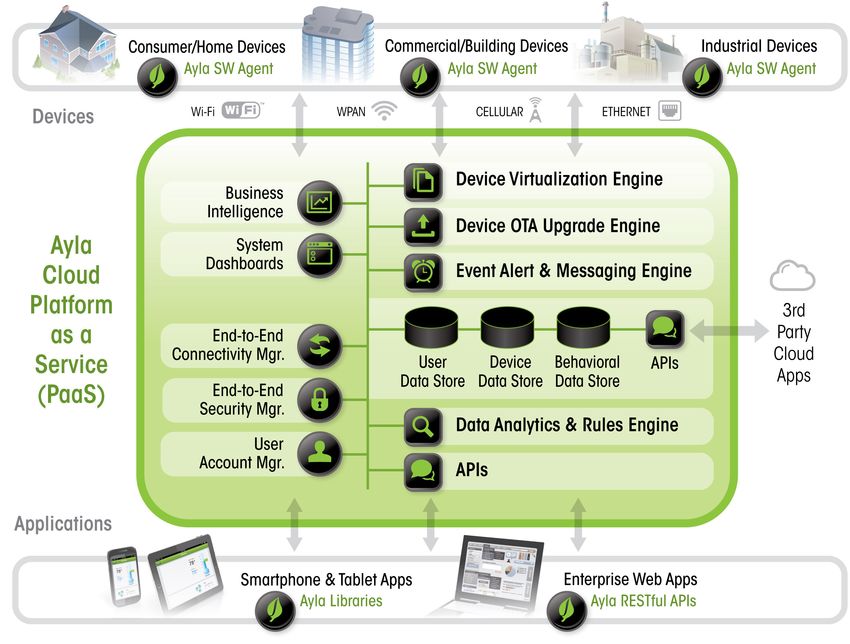
Figure 1: End-to-End Architecture of the Ayla IoT Platform
Figure 1 shows the end-to-end architecture of the Ayla IoT • Ayla Cloud Services
Platform. The end-to-end solution encompasses software The heart of the Ayla IoT Platform, the cloud services provide
agents on the connected device, a suite of software services secure connectivity between devices and apps, virtually
in the cloud, and extensive software libraries for the leading manages an unlimited number of device templates in the field,
mobile operating systems – enabling manufacturers to processes all data pushed and pulled to devices, and provide
easily, securely, and cost effectively build Internet-connected an extensive toolset portal for manufacturers to securely
devices with amazing customer experiences that can scale. manage their customers’ products anywhere.
This single platform can be easily leveraged across a family
• Ayla Applications Libraries
of different IoT products.
Libraries contain all the necessary APIs for creating mobile
The Ayla IoT Platform is Composed of: apps to control Ayla-enabled devices with a smartphone or
• Ayla Embedded Agents tablet in a secure manner. Supports both iOS and Android
Agents incorporate a fully-optimized networking and devices.
security stack to connect devices to the Ayla Cloud
The Ayla IoT Platform robustly supports all of the architectural
Services easily. Agents are pre-burned into leading
capabilities and key requirements outlined in this white paper.
communications modules and chips, making it practically
Please refer to the Appendix A below for a tabular description of
plug-n-play.
these capability requirements and a summary of Ayla’s support.
8WHITE PAPER Ho w t o S e l e c t t h e R i g h t I o T P l at fo rm
Appendix A
Summary of Key IoT Platform Requirements
Key Functional Considerations When Evaluating IoT Platforms The Ayla IoT Platform
SECURITY
1. End-to-end security mechanisms Yes, multi-level authentication
2. End-to-end data encryption Yes, TLS/SSL on all links
3. Flexible & configurable access and authorization control Yes, role/time based
4. Activity logging for audits Yes , within OEMportal toolset
5. Hardened cloud infrastructure Yes, compliant to ISO27001
6. Equal protection across multiple communication protocols Yes
FLEXIBILITY
1. Designed for networking agnosticism Yes
2. Designed for data agnosticism Yes
3. Built-in feedback loops Yes, data analytics within cloud
4. Configurable cloud-based rules engines Yes, within cloud
5. Open APIs Yes, to apps, to other clouds
DATA REQUIREMENTS
1. Flexible data definition tools Yes, within OEMportal toolset
2. Data virtualization and non-SQL database Yes, abstraction layer in cloud
3. Data processing and analytics services Yes
4. Flexible & configurable role-based data access control Yes, role/time based
5. Data scalability Yes, very high
9You can also read


