Privacy Measures for The Big Data Show - Version 0.7 28th August 2020 - Civic Digits
←
→
Page content transcription
If your browser does not render page correctly, please read the page content below
Privacy Measures for
 The Big Data Show
      Version 0.7 28th August 2020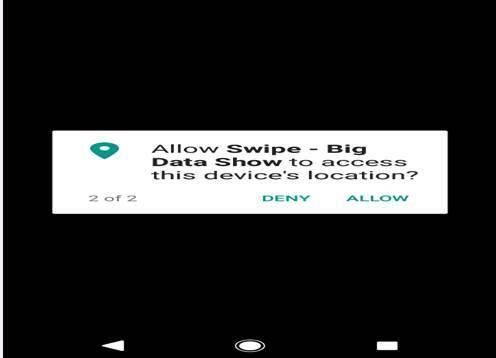
v0.7
28th August 2020

Contents

1.     Introduction                                                           2
2.     Organisational Structures                                              3
     2.1.   TBDS Ethics Committee and Education Steering Committee            3
     2.2.   Civic Digits Team                                                 4
     2.3.       Two Tails                                                     4
3.     Stakeholders                                                           4
     3.1.   Internal Stakeholders                                             4
       Co-Producers                                                           4
       Partners                                                               4
     3.2.   External Stakeholders                                             4
4.     Policy                                                                 5
     4.1.   Child Protection                                                  5
     4.2.   Privacy Statement                                                 5
     4.3.   Terms of Service for the app                                      5
     4.4.   IP and Licensing                                                  5
     4.5.   Project Evaluation                                                6
       Quantitative evaluation.                                               6
       Qualitative evaluation                                                 6
     4.6.   Social Media                                                      6
     4.7.   Customer Relationships     Management (CRM) of Data for schools   6
5.     Functionality and Data Handling of the app                             7
     5.1.   System Data Flow                                                  7
     5.2.   App Permissions                                                   7
     5.3.   App Data Collection                                               9

                                                                              1
v0.7
28th August 2020
1. Introduction
Due to the Covid-19 pandemic the plans for The Big Data Show were cancelled in March
2020 This document is an update to v.05 which was written for the live show. It describes
the project as it is now online.
This document has been prepared and approved by the Ethics Committee, taking on advice
and guidance from key partners including Police Scotland. It presents the privacy and data
protection measures adopted by The Big Data Show (TBDS).
TBDS will be delivered through a website https://thebigdatashow.online (“the website”) this
has been developed and designed by Foxdog studio and will also involve the use of a
smartphone app (“the app”), called Super Swipe. This is being designed and implemented
with the help of Two Tails Studio, a specialist in games and software
development. Documents outline the security measures for the app and the website are
attached to this document in the appendix.
Up to 30 shows will be presented in Perth, Glasgow, Edinburgh through the website and
app. In-school workshops will be delivered to each participating school when it is safe to do
so.
The producers of TBDS aim to improve the data literacy and cyber resilience of pupils who
take part in the project and particularly to inspire young women and people of colour to
consider careers in digital technologies.
Outcomes for: children, teachers, education system, government, Civic Digits
2v0.7
28th August 2020
Short-term outcomes Medium-term Long-term
(immediate): outcomes (eg after outcomes (after a
six months): year):
Awareness of cyber
issues is raised Cyber awareness is This approach is
raised common and
Ethical hacking growing in
careers are better Children have Scotland’s schools
understood progressed onto
further cyber- Children are on the
Learners achieve related/digital or path to further
SCQF credit STEM learning cyber/digital/STEM
opportunities as a learning
Teachers feel result of TBDS
supported to deliver The model has run
curriculum Interest in successfully outwith
cyber/digital/STEM Scotland
Curriculum delivery is careers is increased
recognised as being We have concrete
creatively enhanced A model of creative evidence of an
delivery of STEM increase in learning
Funders’ requirement learning is available, and achievement
are fulfilled with evaluation and aspiration from
the children in this
Teachers have area
explored more
opportunities to We have evidence
bring creative of increased
digital/STEM learning capacity in schools
into the curriculum and between
(eg cross- schools and other
departmentally organisations to
within the school) deliver curriculum in
a creative way.
Scotland’s
progressive approach
in creatively teaching
cyber/digital
awareness is
recognised
This risk assessment has been written by Dr Clare Duffy, Artistic Director of Civic Digits with
Rupert Goodwins, co-writer of The Big Data Show and Creative Technology Officer of Civic
Digits
3v0.7
28th August 2020
This is a dynamic document and will be reassessed on at least a bi-annual basis.
2. Organisational Structures
2.1. TBDS Ethics Committee and Education Steering Committee
Ethics Committee
Person Affiliation Role
(EK) Prof. Ewan Klein (Chair) University of Edinburgh Use, interpretation and
social embedding of
different forms of data
advisor
(NC) Dr. Natalie Coull Abertay University Ethical Hacking Skills
Advisor
(LP) Dr. Lynn Parker Abertay University Games development advisor
(DS) Daniel Sellers Scottish Government: Cyber Resilience Learning
and Skills Policy Adviser
(FO’B) Freda O’Byrne Independent Artist Co-
founder Prewired Theatre In Education
advisor
(AL) Allan Lindsay Young Scot Participation and Co- design
(RM) Rachel McKay Director
Co-design manager
Education Steering Committee
The Education Steering committee are convened to help us achieve our long term aim to
embed TBDS into the education fabric of Scotland and the UK and to advise on the
educational outcomes of the project. They are
Caroline Donald (Chair) Head of learning and Engagement Edinburgh International
Festival
Kirsty McFaul, Senior Officer for Digital Education Scotland
Scot Hunter Internet Safety Officer Education Scotland
Debbie Bentley Drama Teacher Firhill School Edinburgh
2.2. Civic Digits Team
Person Role
4v0.7
28th August 2020
(CD) Clare Duffy Creative Director Civic Digits
(SG) Suzy Glass Executive Producer
(RG) Rupert Goodwins Creative Technical Officer
(RJB) Robyn Jancovitch- Project Manager
Brown
2.3. Two Tails
Director David Mitchell: Delivery of the app for use in live performance and workshops.
3. Stakeholders
3.1. Internal Stakeholders
Co-Producers
● Civic Digits C.I.C
● Perth Theatre
● Unlimited Theatre
Partners
● Edinburgh International Festival (Creative Learning),
● The Citizens’ Theatre (Glasgow, Creative Learning)
● The Lyceum Theatre, (Edinburgh)
● TBDS Ethics Committee (Details given above)
● The Educational Steering Committee (Details given above)
3.2. External Stakeholders
● Schools: 30 across Edinburgh, Glasgow and Perth.
● Education Scotland
● Funders: Creative Scotland, Scottish Government. Cyber Resilience Unit, Digital Xtra,
Garfield Weston
● Creative Informatics. The University Edinburgh.
● Business sponsors: Skyscanner
● Advisers: police, press contacts,
● Ciara Mitchell ScotlandIS: Head of Cyber
4. Policy
4.1. Child Protection
Clare Duffy is a registered STEM Ambassadors and therefore has an up to date PVG
Disclosure. Other members of the creative team such as actors, co-writers and other
creatives do not require PVG disclosure for accompanied, one off visits to schools.
4.2. Privacy Statement
Civic Digits has a Privacy Statement which conforms with the requirements of GDPR. Civic
Digits will hold data about teachers, schools and public audience members who consent to it
but will not share any of this personal data with any third parties without consent.
Civic Digits will share anonymised data about audience and participant numbers, age
groups, and geographical location of performances for research and evaluation purposes,
for example with funding bodies such as Creative Scotland and with academic institutions.
5v0.7
28th August 2020
The privacy statement is available on a website before the workshops begin. ‘Plain
language’ Privacy Statements will also be given out to audiences at the end of each show to
make it clear that no personal data has been seen or collected by Civic Digits though the
process of delivering the show.
4.3. Terms of Service for the app
Civic Digits have written a statement of Terms of Service for using the app, with the
guidance and final approval of the Ethics Committee. The aim of the Terms of Service is to
replicate as much as possible the typical experience of a user downloading and using an app
from Google Play or the Apple App Store. We also want to use this document to show how
the language and form of these terms can be very hard to understand by including absurd
and/or silly statements. These absurd statements will be referred to in the workshop and
there will be further suggestions of ways to explore them as part of our challenge to the
users to think critically about their relationship with the makers of apps.
4.4. IP and Licensing
The intellectual property for the app is shared equally between Civic Digits C.I.C and RG.
Civic Digits C.I.C and RG propose to release any source code for the app that does not
already fall under previous licences under the GPL4 Licence. This source code will either be
available via the website or by email request.
Confidentiality
All participants will be informally asked to agree not to disclose the way this project and
performance works. Much of the delight and magic of the experience is based on testing
what the participants do in a typical online situation. Alerting the audience to ‘the game’
would genuinely spoil the experience. However, we will not require participants to sign a
non-disclosure agreement.
4.5. Project Evaluation
Quantitative evaluation.
The project will offer 30 pupils per school the opportunity to achieve the SCQF-credit
rated award certificates. This data will be managed by the participating schools. Civic Digits
will have a code that relates to a school register and will have no access to pupils’ personal
data.
This ‘Introduction to Digital Citizenship’ course will involve participation in 2 workshops and
will also require outside of direct contact with Civic Digits the sharing of creative work using
data with the rest of the school and gathering feedback.
Qualitative evaluation
The production team delivering the shows will create a ‘show report’ for every show in the
tour. This will reflect the whole team’s assessment of how the participants responded to
each element of the workshops. This will not include any personal data from participants.
The workshop leaders will assess and award the SCQF certificates in the second workshop
and will record details about how learners experienced the project.
6v0.7
28th August 2020
4.6. Social Media
TBDS has a Twitter account, namely @bigdatashowtime. It is likely that Civic Digits and
TBDS will create a variety of social media profiles in the future. Social media platforms sell,
use and/or share data which can identify individuals and threaten their privacy and security
for financial and potentially other reasons. Civic Digits’ aim is that the work we do will
contribute to the debate about the role and responsibility of us as citizens and the
organisations who offer these platforms to know about how they use (personal) data and
how that affects privacy and security online and offline.
4.7. Customer Relationships Management (CRM) of Data for schools
Civic Digits will keep a CRM-style database of the schools and teachers it has contact with to
maintain communication throughout the project. In some cases, this will include personal
telephone numbers for teachers. Consent to hold this data will be requested with booking
instructions.
5. Functionality and Data Handling of the app
5.1. System Data Flow
An overview of the data flow is shown in
the accompanying diagram. In this
diagram, the app described elsewhere in
this document is referred to as “the Phone
App”.
The Control App does not ever interact
directly with the Phone App, but sends
data to the Server. The Server stores this
data in a database. During a TBDS
performance, the Phone App connects
regularly with the Control Application to
"ask" it what scene it should be displaying,
whether it should be playing a sound effect
or triggering any other "magic tricks". The
app also sends a game score to the server and receives a high score table back, when the
phone is known to the servier by a long, random key that exists only for the duration of the
show and for this single purpose: nothing else about the phone or its user is known to the
server software. Data extracted from the database by the Server is sent to the Phone App as
a text object (JSON).
RG as CTO wrote a security design specification. In the appendix to this document Two Tails
have answered each point of this specification. RG will also have eyes on the code for the
app.
5.2. App Permissions
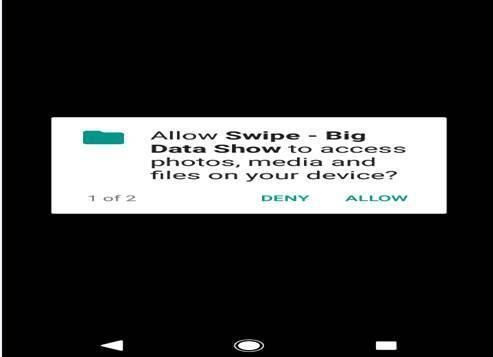
The app will ask the user to allow access to data such as GPS. However, the app will not in
fact be able to collect this data either, in the core code or via Android data access
7v0.7
28th August 2020
permissions as the functionality required to collect this data will not be programmed into
the app. According to the Android documentation,1 these are permissions
to access sensitive user data (such as contacts and SMS), as well as certain system
features (such as camera and internet). Depending on the feature, the
[Android] system might grant the permission automatically or might
prompt the user to approve the request.
We consider it unethical to allow our app to have the functionality to request data access in
this way, since if there was a malicious act on the phone, the data could be exploited.
When first downloaded, the app asks for permissions to access storage and network
connections.
1
https://developer.android.com/guide/topics/permissions/overview
8v0.7
28th August 2020
This is a standard for Apple and Google Play and beyond our ability to change. However, our
app will not access these areas. If we made this clear before the show we believe this would
destroy the potential learning impact of the experience. For this reason we will distribute a
simple and ‘Plain English’ Privacy policy/declaration to all pupils after the show.
9v0.7
28th August 2020
5.3. App Data Collection
No user data is transferred from the user’s phone via the app except a single high score
figure known by a long, random, temporary key shared between the phone app and the
server. . The only information that will be recorded from the user in the app is their GPS
location. This data will be stored locally (within the user app file structure on the user's
phone) and never leaves the phone. This GPS data will be deleted as soon as it has been
used in the show.
For players of SUPER SWIPE who do not attend the show, the app will be updated at the end
of each tour. Every update or re-installation automatically deletes previously collected data.
All analytic data recording has been disabled for the app itself. Some analytic data may be
recorded by the Operating System (Android or iOS) or by the devices themselves (for
example the Apple App Store may record when the application was downloaded) but this is
standard for all phone apps, is outside of our control and is GDPR compliant.
There will be a competition at the start of the show to find ‘The Swipe Champion’. This will
be announced by a message sent to the highest scorer and will not require any personal
data to be seen or collected.
5.4 Live looking over the shoulder of other audience members
There is the risk that an audience member can see data ‘over the shoulder’ of a class mate
when the GPS data of the user is presented to them in the form of a map of where the user
was when they played SWIPE. The map is specifically designed to show the user where they
10v0.7
28th August 2020
were, but to make it difficult for a glance to reveal very much information. Each point on the
map is visited for only a few seconds and there are no place identifies such as street names
or organisations addresses (for example an LGBT youth club). The resolution of the map is
not particularly fine grained, each view of the map representing approximately 0.25 km.
11v0.6
26th August 2020
Privacy Risk Register
Note: Risks are ranked on a 1—5 scale. Exposure is an estimate of the combined effect of
Impact and Likelihood.
Options for avoiding or mitigating t
Risk description Inherent Privacy Risk
Impact Likelihood Exposure
Reputational risk to Civic Digits Ensure demonstrable adherence with data protec
if there is a perceived risk (e.g.,
Mild (2) Mild (2) Mild (2)
via press or social media) of Ask a highly qualified ethics committee to suppor
privacy invasion. think through all of the risks.
Spoof versions of the app are Ensure clear branding and make it as fool proof a
installed on the Apple and/or participants to only download the correct app
Android app stores and allow
malicious code to be installed Low (1) Low (1) Low (1) On a par with any other app in the ecosystem. It i
on users’ phones. impact as a spoof app could do anything it liked, b
no more risk here than do other apps.
Faulty implementation of the Server is protected by strong passwords, and is o
app allows personal data to be accessible to authorised members of the team.
transferred to the system
Server. TBDS does not collect any personal data on the p
Low (1) Low (1) Low (1) GPS tracking. The architecture of the system, the
server and the functionality of the back-end syste
store any data of any kind during operation, so it'
pathway which could malfunction - there is no pa
Insecurities with and on the The server is a standard regularly patched currently
server allow third parties to instance hosted on AWS and managed by a reputa
tamper with the Server routines Low (1) Low (1) Low (1) with whitelisted 2FA admin access to the hosting s
to send malicious payloads to to the instance itself.
the user app.
Insecure data transfer between No user data is transferred between the server an
user app and Server is breached and there is no pathway for malicious data onto t
and malicious payloads are risk that an unknown vulnerability in the app cou
transferred to the user’s phone. custom-designed attack, but that's true for all app
Mild (2) Mild (2) Mild (2) expected audience for the app is small, compared
the audience is mostly school children with little e
impact. It is considered unlikely that it would repa
required to attack it.
Malicious code on user’s phone The only private data stored is recent GPS trackin
is able to access private data exploit in any harmful fashion for our audience, a
stored on the app’s local file Low (1) Low (1) Low (1) little motivation to any malicious attacker to inve
store. extracting it.
Malicious software on one user's phone attacking Mild Mild (2) Mild (2) All phone traffic to and from
another phone connected to the server (2) and server inputs are bounds
see each other’s traffic, and th
successful malicious attack th
the server is considered low d
12v0.6
26th August 2020
the installation and the use of
precautions. Server instances
with current patches.
Appendix
A: Security measures for the App “Super Swipe” and
its control system
1. All communications controlled or specified by TBDS are encrypted. This includes
game-server, control_app-server, and game-mapping_service.
All communication between app, server and control app uses HTTPS/TLS encryption.
2. All communications protocols between game-server and control_app-server are
explicitly documented by Two Tails and disclosed to TBDS. These include which APIs
are being used, data structures, message sizes, timing, and transaction descriptions.
3. API documentation can be found here:
https://docs.google.com/document/d/1QIQdy5dTq8VXjrN5dxCu2k9t605LcUISY5p1S
h3LPXs/edit
4. APIs implement suitable security practices to ensure user access is restricted where
necessary, for example, e.g by using API keys.
Write endpoints (POST/PUT/PATCH) used by the control app require a valid API key
to access. Requires with an invalid API key are rejected.. API keys are managed by a
server admin. API keys are only valid for a certain period of time before
automatically expiring. Expired API keys cannot be reused.
13v0.6
26th August 2020
5. Geo mapping service API and throughput requirements
Mapbox free tier is available for up to 25,000 monthly active users, which gives
plenty of room for TBDS. https://www.mapbox.com/pricing/
6. Overall network traffic per user, average and peak, and an indication of server
CPU/memory requirements for 1.5K users.
Outside the show, the app makes no requests to the server. During a show, on
average the app makes a request to the server every 5 seconds. This request is
typically around 800 bytes including request and response.
Therefore over a 10 minute period, one user would typically use around 93.75KB of
bandwidth (includes in and out). 1.5k users would use 137.32MB.
The server software itself is very lightweight, making use of a single PHP instance and
a MySQL database. A small virtual hosted server with 2G of RAM and a standard CPU
configuration will be more than capable of handling the requirements for the show.
7. All data structure handling is bounds-checked and explicit handling provided for
malformed or out-of-bounds messages. Any malformed requests to the server are
rejected.
8. Control app, game authentication, DOS attack mitigation
DOS protection is difficult as there is no single easy solution and a proper solution
requires an experienced server administrator to put in place and monitor.
9. All code for the app, control app and server is hosted securely on Bitbucket and
access is granted to members of Civic Digits.
B. The Big Data Show Website Security and Privacy
17th Jul 2020
! The server is a virtual machine provided by Linode running Arch Linux. Only the
directors of Foxdog have access to the Linode account and their passwords are
stored by Lastpass.
! The virtual machine is dedicated to the site and is not used for any other purpose.
14v0.6
26th August 2020
! Access to the server is restricted to SSH with key-based authentication. Password
authentication and root login are disabled.
! Administrative access on the server is protected by sudo with password
authentications.
! The server is updated weekly to apply security and stability fixes.
! All communication with the server is protected by TLS. Our certificate is provided by
Letsencrypt and the web server’s TLS layer is configured by certbot.
! Streaming to the server is protected by a password, which is only shared with the
operator.
! The remote control interface is protected by a password, which is only shared with
the operator.
! The website’s admin panel is password protected by Meteor’s authentication
system. The password is only shared with operators of the site.
! An audit of client-server communication points was conducted to ensure each has
the appropriate authentication checks. No modifying (e.g., changing show name)
operation can be performed without authentication.
! For non-administrative use of the site, no identifying information is stored on the
client or server.
! All information entered by administrators (show names, portraits, etc.) should be
considered public and contain no identifying information.
! Removing a show also removes all uploaded images associated with that show.
15You can also read


