Nuclear Data Sensitivity Study for the EBR-II Fast Reactor Benchmark Using SCALE with ENDF/B-VII.1 and - ENDF/B-VIII.0
←
→
Page content transcription
If your browser does not render page correctly, please read the page content below
Article
Nuclear Data Sensitivity Study for the EBR-II Fast Reactor
Benchmark Using SCALE with ENDF/B-VII.1 and
ENDF/B-VIII.0 †
Friederike Bostelmann * , Germina Ilas                      and William A. Wieselquist

                                         Oak Ridge National Laboratory, P.O. Box 2008, Bldg. 5700, Oak Ridge, TN 37831-6170, USA; ilasg@ornl.gov (G.I.);
                                         wieselquiswa@ornl.gov (W.A.W.)
                                         * Correspondence: bostelmannf@ornl.gov
                                         † This manuscript has been authored by UT-Battelle, LLC, under contract DE-AC05-00OR22725 with the US
                                           Department of Energy (DOE). The US government retains and the publisher, by accepting the article for
                                           publication, acknowledges that the US government retains a nonexclusive, paid-up, irrevocable, worldwide
                                           license to publish or reproduce the published form of this manuscript, or allow others to do so, for US
                                           government purposes. DOE will provide public access to these results of federally sponsored research in
                                           accordance with the DOE Public Access Plan (https://energy.gov/downloads/doe-public-access-plan).

                                         Abstract: The EBR-II benchmark, which was recently included in the International Handbook of
                                         Evaluated Reactor Physics Benchmark Experiments, served as a basis for assessing the performance
                                         of the SCALE code system for fast reactor analyses. A reference SCALE model was developed
                                         based on the benchmark specifications. Great agreement was observed between the eigenvalue
                                         calculated with this SCALE model and the benchmark eigenvalue. To identify potential gaps and

                                  uncertainties of nuclear data for the simulation of various quantities of interest in fast spectrum
Citation: Bostelmann, F.; Ilas, G.;
                                         systems, sensitivity and uncertainty analyses were performed for the eigenvalue, reactivity effects,
Wieselquist, W.A. Nuclear Data           and the radial power profile of EBR-II using the two most recent ENDF/B nuclear data library
Sensitivity Study for the EBR-II Fast    releases. While the nominal results are consistent between the calculations with the different libraries,
Reactor Benchmark Using SCALE            the uncertainties due to nuclear data vary significantly. The major driver of observed uncertainties
with ENDF/B-VII.1 and                    is the uncertainty of the 235 U (n,γ) reaction. Since the uncertainty of this reaction is significantly
ENDF/B-VIII.0. J. Nucl. Eng. 2021, 2,    reduced in the ENDF/B-VIII.0 library compared to ENDF/B-VII.1, the obtained output uncertainties
345–367. https://doi.org/10.3390/        tend to be smaller in ENDF/B-VIII.0 calculations, although the decrease is partially compensated by
jne2040028
                                         increased uncertainties in 235 U fission and ν.

Academic Editor: Dan Gabriel Cacuci
                                         Keywords: EBR-II; SCALE; criticality; uncertainty analysis; sensitivity analysis

Received: 27 August 2021
Accepted: 23 September 2021
Published: 30 September 2021
                                         1. Introduction
Publisher’s Note: MDPI stays neutral           Sodium-cooled fast reactors (SFRs) are one of several promising advanced reactor
with regard to jurisdictional claims     concepts being considered for commercialization and have received renewed attention
in published maps and institutional      from industry and research institutions. Paramount to the guaranteed safety of reactor
affiliations.                            plant operations is a sound physical understanding of the systems involved, achieved
                                         largely through computational analyses. To build confidence in computational analyses,
                                         the simulation software must be validated through comparison with experiments. But, as
                                         is true for many advanced reactor concepts, experimental data for SFRs are limited; data
Copyright: © 2021 by the authors.
                                         from the Experimental Breeder Reactor II (EBR-II) provides one of these limited data sets.
Licensee MDPI, Basel, Switzerland.             The EBR-II was operated from 1964 through 1994 by Argonne National Laboratory on
This article is an open access article   a site which now belongs to Idaho National Laboratory (INL). The reactor had a maximum
distributed under the terms and          heat output of 62.5 MWth. Although initially designed to breed more fuel than it consumed,
conditions of the Creative Commons       EBR-II was later reconfigured to operate as an irradiation facility, becoming a testbed for a
Attribution (CC BY) license (https://    variety of fuels and structural materials. The evaluation of EBR-II run 138B, a test within
creativecommons.org/licenses/by/         the Shutdown Heat Removal Tests series conducted on 3 April 1986, was recently included
4.0/).

J. Nucl. Eng. 2021, 2, 345–367. https://doi.org/10.3390/jne2040028                                               https://www.mdpi.com/journal/jne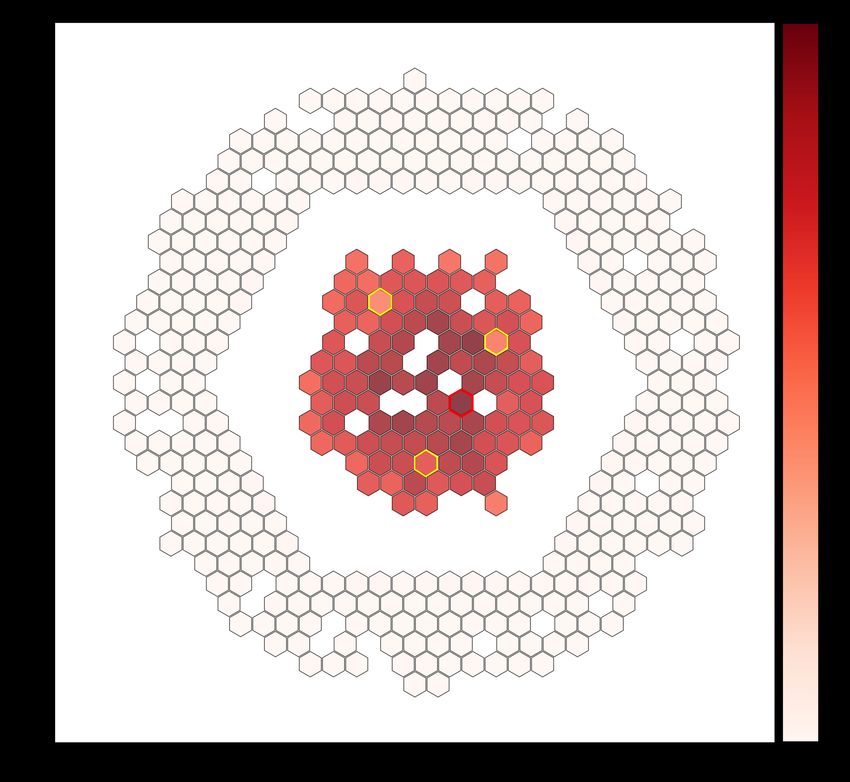
J. Nucl. Eng. 2021, 2                                                                                               346

                        in the 2018 Edition of the International Handbook of Evaluated Reactor Physics Benchmark
                        Experiments (IRPhEP handbook) [1].
                              Although the measured data provided in this benchmark are limited to the eigenvalue,
                        the availability of the benchmark model specifications offers a basis for further performance
                        assessments of computational methods and data using realistic geometrical and material
                        specifications for investigations of other key metrics beyond eigenvalue. They also
                        provide the basis for code-to-code comparisons across institutions based on one thoroughly
                        reviewed data set.
                              Various computational analyses of the EBR-II have been performed for different areas
                        of interest, but only limited studies focused on neutronics analysis (e.g., [2–5]). Furthermore,
                        at the time of this writing, only the EBR-II IRPhEP benchmark authors have published
                        computational analyses based on the new IRPhEP benchmark specifications [1,6,7]. While
                        these analyses cover uncertainty and sensitivity analyses with respect to several modeling
                        parameters such as geometric dimensions and material compositions, they do not cover an
                        analysis of the impact of uncertainties in nuclear data on the calculated results.
                              The uncertainties of important quantities due to nuclear data uncertainties in SFR
                        analyses can be significantly larger than those of thermal systems. This is due to the
                        large uncertainties in relevant cross sections over the high energy range. The eigenvalue
                        uncertainty for SFRs can be 2–3 times greater than for light water reactors (LWRs), depending
                        on the libraries used. For example, a reactivity uncertainty for a typical SFR with mixed
                        uranium-transuranic fuel was found in the range 1–1.5% when using ENDF/B-VII.1 data.
                        The uncertainties of important reactivity coefficients such as the sodium void coefficient
                        was found as high as 5%. The major contributor to the uncertainty of many reactivity
                        coefficients in these systems is 238 U inelastic scattering due to its large uncertainty in the
                        fast energy range. Other relevant contributors to reactivity coefficients uncertainties, are
                        the scattering reactions of 23 Na as the coolant and 56 Fe as the major component in structural
                        materials [8].
                              For SFRs with enriched 235 U such as the EBR-II, it is noted that the 235 U cross section
                        data are well known in the thermal energy range due to extensive history of measurements
                        and evaluations targeting traditional LWRs. However, in the fast energy range, the neutron
                        capture cross section of 235 U shows a large uncertainty of over 30% in the ENDF/B-VII.1
                        releases. Due to the importance for reactivity, this large uncertainty can have a significant
                        impact on the reactivity uncertainty. A significant reduction in reactivity uncertainty is
                        expected when using ENDF/B-VIII.0 data because of the significantly reduced uncertainty
                        for this reaction in the recent library release.
                              The evaluated nuclear data libraries are undergoing continuous modifications based
                        on additional measurements or improved evaluations, and new revisions are being released
                        on a regular basis. Updates of relevant cross sections and uncertainties between the
                        ENDF/B-VII.1 and ENDF/B-VIII.0 releases, including 56 Fe, 238 U, and 239 Pu, can impact
                        reactivity results. For example, reactivity differences of up to 200 pcm were observed in
                        previous studies as a result of updates in 238 U data [9,10].
                              This paper presents the computational analysis of the EBR-II based on the IRPhEP
                        benchmark specifications using SCALE, a widely used computational tool set for criticality
                        safety, reactor physics, shielding, and sensitivity and uncertainty analysis [11]. Although
                        SCALE has been thoroughly tested and validated for light water reactor (LWR) criticality,
                        fewer non-LWR systems are part of SCALE’s criticality safety validation suite [12]. Testing
                        and validation for application to non-LWR systems is ongoing. Recent activities with
                        respect to SCALE’s SFR applications include nuclear data performance assessments for
                        fast-spectrum systems [8–10,13] and cross section processing development [14]. Current
                        modeling efforts concern several non-LWR systems for the validation of SCALE and the
                        support of several application activities, including severe accident analysis and nuclear
                        data performance assessment.
                              The purpose of this article is (1) to assess the performance of the SCALE code system
                        for fast reactor analysis by comparing calculated results with measurements, (2) to perform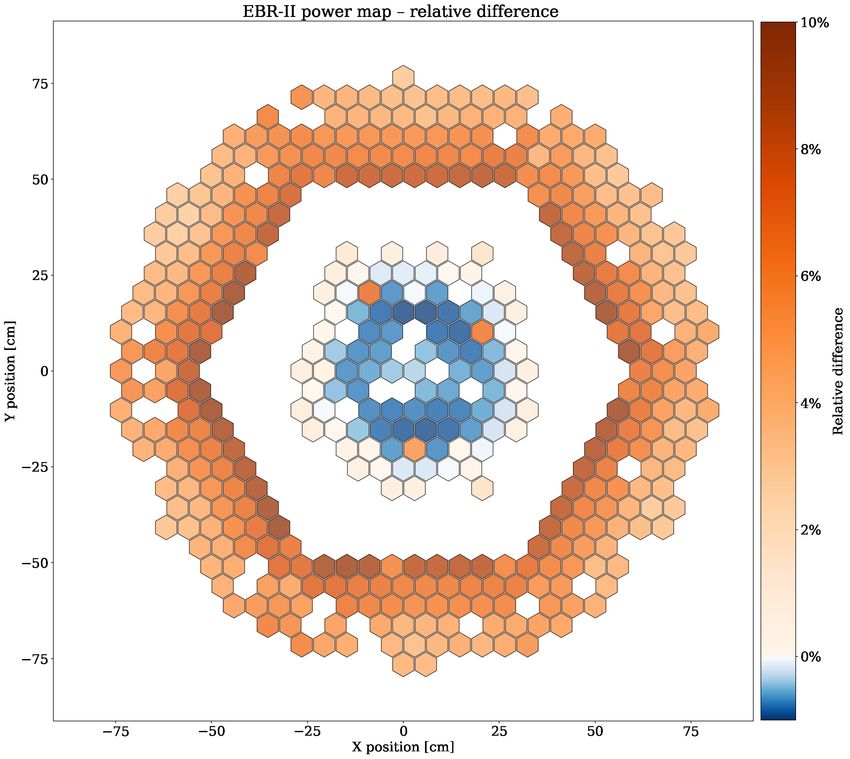
J. Nucl. Eng. 2021, 2                                                                                              347

                        code-to-code comparisons based on previously published results, and (3) to increase
                        awareness of existing gaps in nuclear data and uncertainties for the simulation of quantities
                        of interest for fast-spectrum systems.
                             Eigenvalue results obtained with SCALE’s Monte Carlo code KENO-VI using Evaluated
                        Nuclear Data File (ENDF)/B-VII.1 and VIII.0 nuclear data library evaluations are compared
                        to the benchmark eigenvalue and calculated results published by the benchmark’s authors,
                        obtained with the Monte Carlo N-Particle Transport Code (MCNP) and ENDF/B-VII.0 data.
                        The benchmark’s authors performed extensive studies to assess the impact of uncertainties
                        in various modeling parameters—such as material densities and geometric dimensions
                        on the eigenvalue—to determine the benchmark eigenvalue uncertainty. However, these
                        studies did not include uncertainty resulting from nuclear data on the calculated eigenvalue.
                        This type of information can be used to help identify the causes of observed differences
                        between calculated and experimental eigenvalue results. The study presented in this
                        work is closing this gap by analyzing the impact of nuclear data uncertainties on the
                        calculated eigenvalue uncertainty; the major drivers to the obtained uncertainty are also
                        being investigated. This type of information is also essential for assessing the impact of data
                        differences between different ENDF/B evaluations and for providing recommendations for
                        further nuclear data measurements to reduce important data uncertainties. The analyses
                        presented here go beyond the eigenvalue calculation to include reactivity coefficients and
                        radial power distribution in an attempt to reveal additional relevant nuclear data impacting
                        other operations and safety key metrics.

                        2. EBR-II
                            Table 1 presents an overview of the key characteristics of the EBR-II benchmark [1].
                        A summary of these characteristics, for which a detailed description is available in the
                        IRPhEP benchmark, is provided here for completeness.

                        Table 1. Key characteristics of EBR-II [1].

                        Description                                                    Value
                        Reactor power                                                  62.5 MWth
                        Fuel material                                                  high enriched uranium metal
                        Coolant material                                               sodium
                        Major structural material                                      steel
                        Temperature of all materials (K)                               616
                        Number of fuel assemblies in the core:
                           Full worth                                                  70
                           Half worth                                                  13
                        Number of fuel pins per assembly                               91
                        Number of depleted uranium blanket assemblies                  330
                        Assembly pitch (cm)                                            6.8877
                        Outer fuel radius (cm)                                         0.1651
                        Outer cladding radius (cm)                                     0.2210
                        Inner cladding radius (cm)                                     0.1905
                        Fuel pin pitch (cm)                                            0.566
                        Active core height (cm)                                        34.6075

                             The EBR-II core consisted of 637 hexagonal assemblies divided into three regions:
                        the core, an inner blanket, and an outer blanket (Figure 1). The core region consisted of
                        driver (full worth and half worth) assemblies, experimental/instrumentation assemblies,
                        dummy assemblies, and movable assemblies that were used for reactivity control. The
                        safety and control assemblies contained a fuel region and an absorber region. The core
                        was surrounded by an inner blanket of stainless-steel reflector assemblies. The outer
                        blanket region consisted almost entirely of depleted uranium assemblies for breeding
                        and reflection.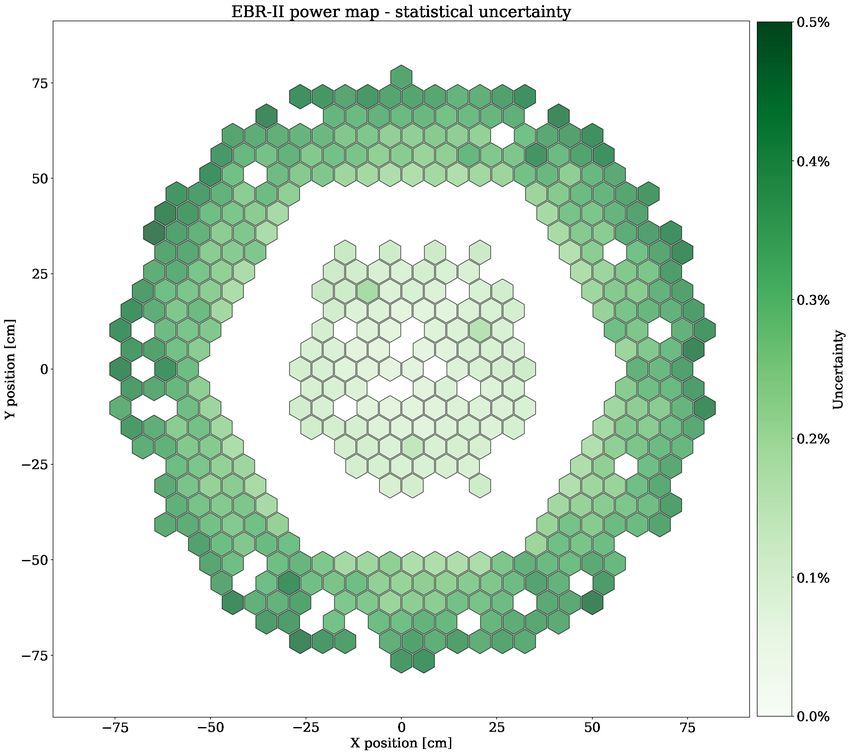
J. Nucl. Eng. 2021, 2                                                                                                   348

                        Figure 1. EBR-II Run 138B core configuration [1].

                             The driver fuel assemblies contained a hexagonal lattice of 91 fuel rods (Figures 2 and 3).
                        Each fuel rod consisted of enriched uranium metal surrounded by a stainless-steel cladding.
                        A wire was wrapped helically up the length of each fuel rod. Due to the complexity
                        of modeling a toroid, the benchmark specifications suggest modeling a single cylinder
                        corresponding to the wire wrap. The specifications also suggest that the regions above
                        and below the fuel area—the upper extension, lower extension, and lower adapter—be
                        simplified as homogenized regions of stainless steel and sodium. All materials in the
                        EBR-II benchmark are assumed to be at a temperature of 343 ◦ C.

                        Figure 2. EBR-II driver rod [1]. The driver rod consisted of three fuel slugs (B, C, D), sodium bond
                        (E), and gas plenum (F).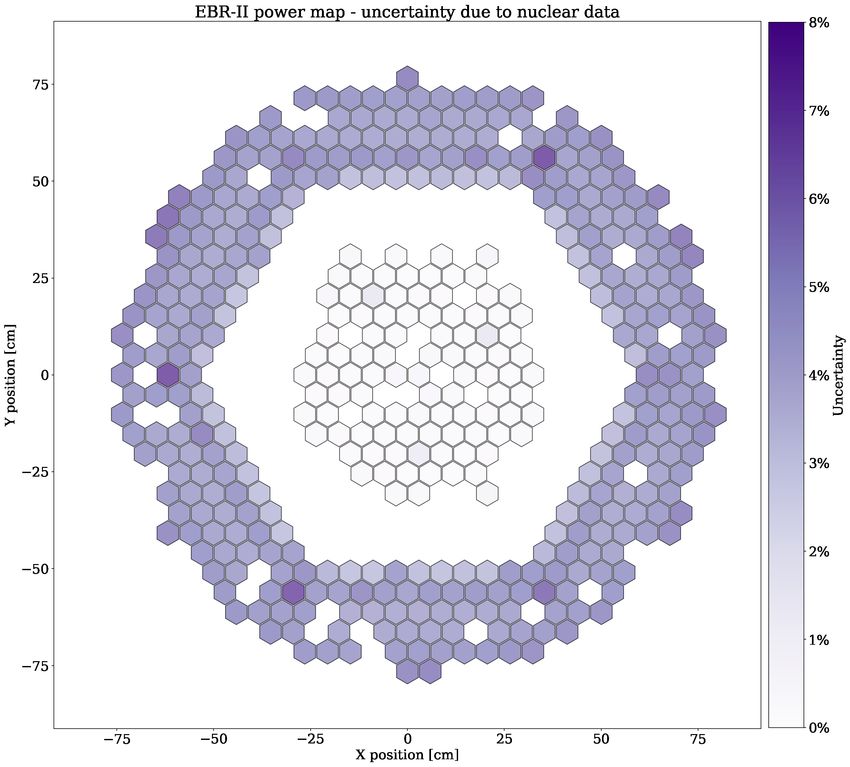
J. Nucl. Eng. 2021, 2                                                                                            349

                             The IRPhEP handbook provides an experimental eigenvalue, along with the
                        corresponding experimental uncertainty. The results of a criticality calculation with MCNP
                        using ENDF/VII.0 data based on the benchmark model are also provided. No other
                        calculations of this particular EBR-II benchmark have been found in the open literature.

                        Figure 3. EBR-II driver assembly [1].

                        3. Applied Computational Methods and Data
                             The results of all calculations presented in this article were obtained using the SCALE
                        code system [11]. SCALE provides a comprehensive, verified and validated, user-friendly
                        tool set for criticality safety, reactor and lattice physics, radiation shielding, spent fuel
                        and radioactive source term characterization, and sensitivity and uncertainty analysis.
                        From the existing modules for different application spaces, the three-dimensional (3D) 3d
                        Monte Carlo neutron transport code KENO-VI and the sensitivity and uncertainty analysis
                        sequences TSUNAMI and Sampler were applied in the work. The applied methods and
                        tools are further described in the subsections below.
                             A three-dimensional (3D) SCALE model of the EBR-II was developed based on the
                        benchmark specifications in the IRPhEP handbook [1]. Figures 4 and 5 show visualisations
                        of the full core model, and Figure 6 shows an image of a half-worth driver assembly.
                             This SCALE model was used as a basis for performing nominal, sensitivity, and
                        uncertainty analyses for the following quantities of interest:
                        1.   eigenvalue (keff ),
                        2.   Control rod (CR) worth: reactivity difference with all control assemblies out vs. all
                             control assemblies in,
                        3.   Sodium void worth: reactivity difference between the nominal model (1) and a model
                             with all sodium removed,
                        4.   Radial power profile.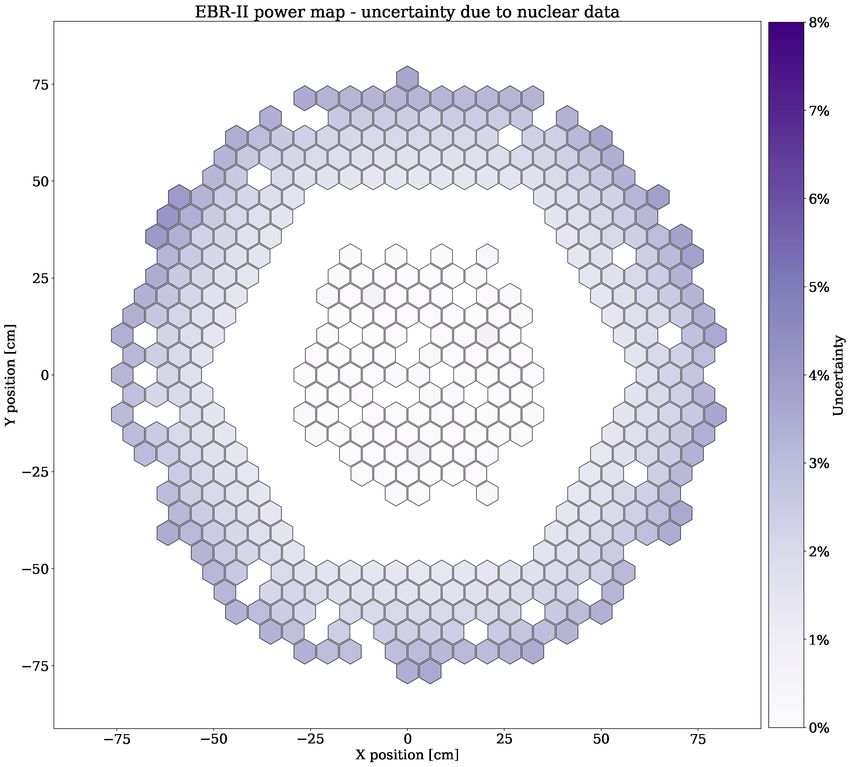
J. Nucl. Eng. 2021, 2                                                                                                     350

                        Figure 4. SCALE full core model of the EBR-II. The inner driver core region (driver fuel in red,
                        bond sodium in yellow, gas plenum in blue) is surrounded by a steel reflector (gray), which is
                        surrounded by the blanket assemblies (purple). The green region shows absorber material in one of
                        the control assemblies.

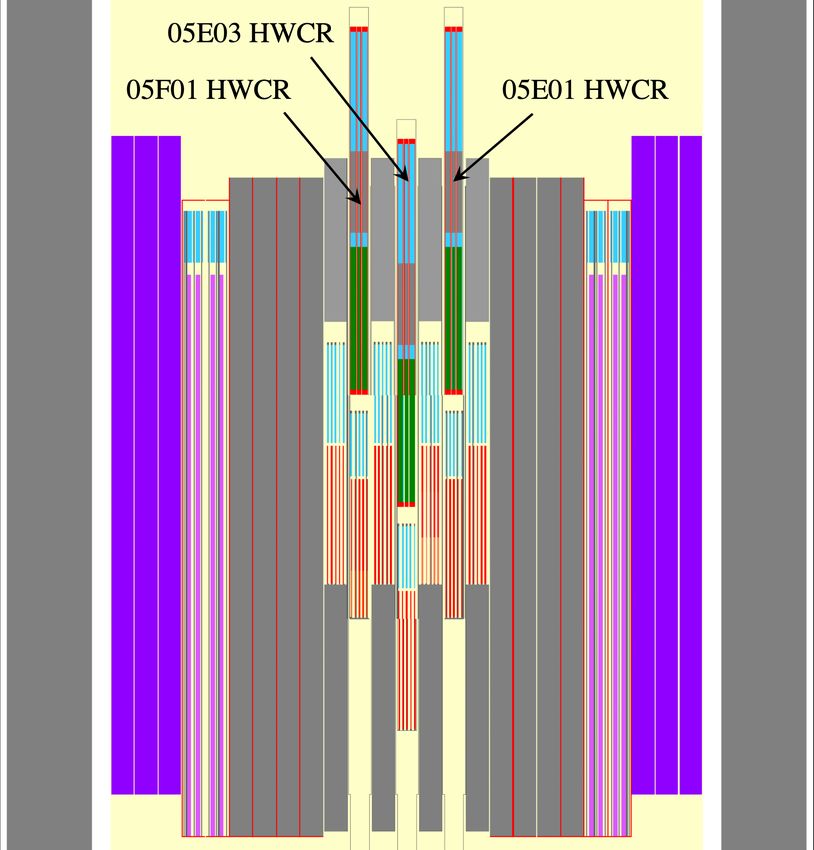
                        Figure 5. Axial view of the EBR-II SCALE full core model, highlighting the different insertion heights
                        of three half worth control rod (HWCR) assemblies.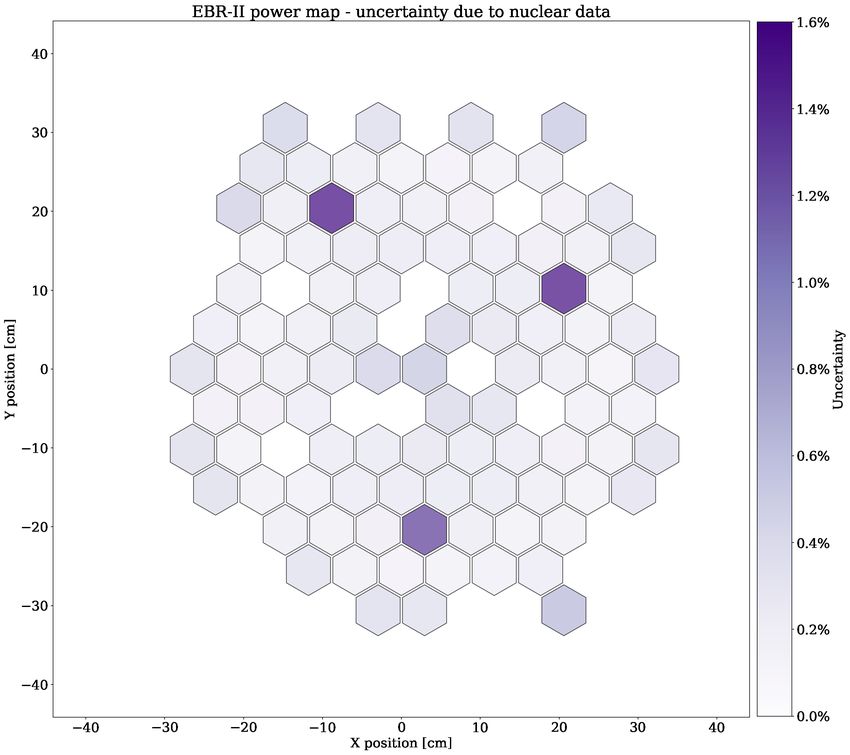
J. Nucl. Eng. 2021, 2                                                                                                  351

                        Figure 6. SCALE half-worth driver assembly model of the EBR-II. The fuel (red) is located in every
                        second rod, and the other rods (gray) are solid steel cylinders. Bond sodium in the fuel rods is
                        displayed in yellow, and the gas plenum is shown in blue.

                        3.1. Neutron Transport
                             The nominal criticality calculations presented in this work were performed with
                        SCAlE’s Monte Carlo code KENO-VI in continuous-energy (CE) mode. For the sensitivity
                        and uncertainty analyses discussed in the following sections, KENO-VI was applied in
                        either CE or in multigroup (MG) mode. The assembly powers were determined by applying
                        KENO-VI in MG mode as part of the TRITON sequence for depletion analysis. TRITON
                        provides a list of specific powers for all materials, determined from the energy released in
                        the materials through fission and capture. By considering that each fuel assembly is using
                        a unique fuel material, the power in each assembly was calculated using the specific power
                        and the heavy metal mass of the fuel in the particular assembly.

                        3.2. Sensitivity Analysis
                             Sensitivity analyses were performed for the eigenvalue and the reactivity effects with
                        the perturbation theory-based approach implemented in SCALE’s TSUNAMI code [15,16].
                        The CE version of TSUNAMI, in particular the contributon-linked eigenvalue sensitivity
                        /uncertainty estimation via track length importance characterization (CLUTCH) method [17]
                        were applied. TSUNAMI calculates sensitivity coefficients for all nuclides included in the
                        model of interest with all reactions in all energy groups [18,19].
                             The application of CLUTCH requires appropriate settings to be determined to calculate
                        the average importance generated per fission neutron emitted (F*) in a spatial grid. Because
                        of the fast neutron flux spectrum in the EBR-II reactor and the consequential small local
                        flux gradients, a relatively coarse spatial grid was applied in the driver fuel region with
                        pitches of 6.5, 6.83 and 4.34 cm in x, y, and z-directions, respectively. Outside the driver
                        core (radially and axially), an even coarser grid was applied to cover fuel in the control
                        rod assemblies and the fuel in the outer reflector ring. Ten latent generations were applied
                        in the calculation of F* during the simulation of the inactive neutron cycles (see [17] for
                        detailed explanations on latent generations). In 600 active and 200 inactive cycles, 200,000
                        neutron histories were calculated per cycle. A large number of inactive cycles was necessary
                        to sufficiently converge F*, and a large number of active cycles improved the convergence
                        of the energy-dependent sensitivities. Using the settings described, the calculation took
                        886.65 CPU-hours on a computing cluster with 2.30 GHz Intel Xeon CPUs.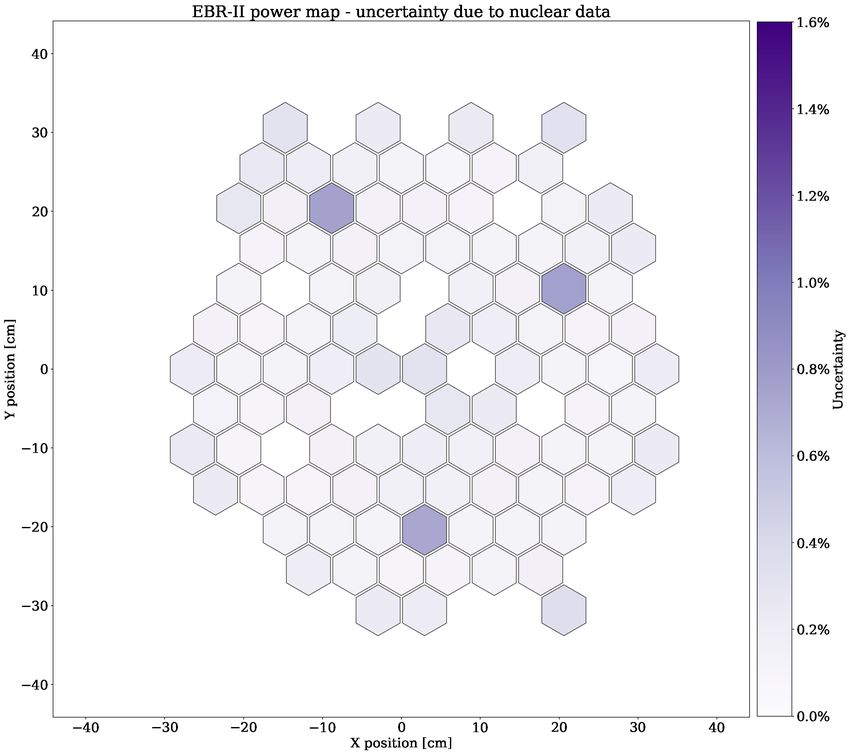
J. Nucl. Eng. 2021, 2                                                                                               352

                             Direct perturbation calculations were performed in conjunction with all CE TSUNAMI
                        calculations to confirm the largest obtained (nuclide-integrated) sensitivities and thereby
                        the adequacy of the chosen settings.
                             TSUNAMI was applied to calculate sensitivities of the eigenvalue. For reactivity
                        differences such as temperature feedback and control rod worth, SCALE’s module TSAR [20]
                        was used to combine the sensitivity coefficients obtained from TSUNAMI calculations at
                        two different states for determining sensitivity coefficients for the reactivity difference.

                        3.3. Uncertainty Analysis
                            Uncertainty analyses were performed through linear perturbation theory and the
                        random sampling approach.

                        3.3.1. Linear Perturbation Theory
                             The nuclear data uncertainties are given in energy-dependent covariance matrices
                        for each nuclide reaction and for correlations between different nuclide reactions. The
                        multiplication of these covariance matrices with the corresponding sensitivity coefficients
                        determined with TSUNAMI in the so-called sandwich formula leads to the total output
                        variance [15,16]. In addition to the total output uncertainty, TSUNAMI provides a list of
                        the individual contributions of all relevant covariance matrices so that the top contributors
                        to the output uncertainty can be identified.

                        3.3.2. Random Sampling Approach
                             Since TSUNAMI does not permit the direct calculation of sensitivity coefficients for
                        power, the random sampling approach as implemented in SCALE’s Sampler sequence [21]
                        was used to study uncertainties resulting from nuclear data of the radial power profile.
                        To identify the top contributing nuclide reactions to the output uncertainty, Sampler
                        calculates the sensitivity index R2 [8] of all reactions of all nuclides relevant for the model.
                        On a level from 0 to 1, R2 provides a measure of the importance of an individual nuclear
                        reaction to the observed output uncertainty.
                             In this work, Sampler was used in combination with KENO-VI in MG mode using
                        SCALE’s 302-group fast reactor library to study uncertainties of the EBR-II radial power
                        profile. A sample size of 500 was used. Each calculation was run using 200,000 neutrons
                        per cycle in 200 active and 50 inactive cycles.
                             To estimate the bias in the power distribution resulting from the MG approximations,
                        a CE calculation was run for comparison using the same neutron settings. The CE
                        transport calculation took ∼80.9 CPU-hours, and the MG transport calculation only took
                        23.1 CPU-hours on a computing cluster with 2.90 GHz Intel Xeon CPUs. In both cases, the
                        loading and preparation of cross sections (in the case of MG, additionally the self-shielding
                        calculation), as well as the processing of the geometry, took a significant amount of time
                        because of the large number of materials (887) and cells (1131 units) in the model.

                        3.4. Applied Nuclear Data
                             As part of the TSUNAMI and Sampler calculations, the KENO-VI neutron transport
                        calculations were performed using the ENDF/B-VII.1 and ENDF/B-VIII.0 CE cross section
                        libraries [22,23]. For the uncertainty quantification, TSUNAMI applied the 56-group
                        ENDF/B-VII.1–based and the 56-group ENDF/B-VIII.0–based covariance libraries. Sampler
                        calculations were performed using perturbation factors that were generated based on these
                        two covariance libraries. More details on these libraries can be found in the SCALE
                        manual [11].
                             All analyses were performed using codes and nuclear data libraries from a pre-release
                        version of SCALE 6.3. Relevant nominal data and uncertainties for analysis of the EBR-II
                        are compared between the different ENDF/B versions in Appendix A.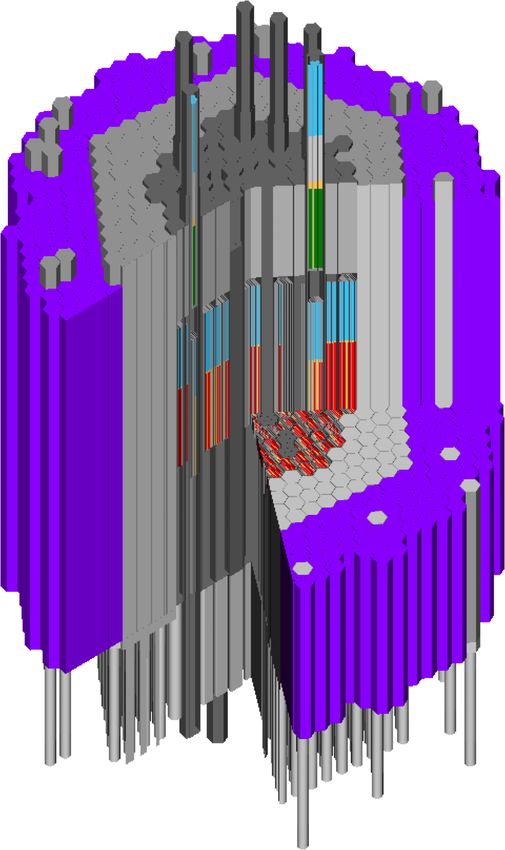
J. Nucl. Eng. 2021, 2                                                                                                       353

                        4. Results
                             To support the discussion of results, Figure 7 presents the energy-dependent flux
                        distribution as seen in different regions of the core. The flux was obtained by overlaying a
                        3D mesh on the core geometry so that each mesh cell contains one fuel element in the x-y
                        direction. The displayed fluxes present the normalized flux per unit lethargy in individual
                        fuel elements at different radial locations.

                        Figure 7. Normalized neutron flux in a 302-group representation at the core axial mid line, at different
                        radial positions determined with KENO-CE.

                             It is interesting to note that the initial plan was to investigate the Doppler reactivity of
                        the EBR-II’s fuel, but only a small reactivity difference of less than 100 pcm was obtained,
                        even when the fuel temperature increased from 616 to 1800 K. Because of the hard neutron
                        flux spectrum in the EBR-II, Doppler broadening in the resonance range with increasing
                        temperature only has a minor effect on the reactivity. With such a small reactivity difference,
                        sensitivities of this quantity cannot be determined with sufficient statistical convergence.
                        Therefore, the analysis was omitted in this study. Choi et al. determined EBR-II’s fuel
                        Doppler reactivity as −0.04268$ when doubling the fuel temperature [24]; given an effective
                        delayed neutron fraction between 200 and 700 pcm, −0.04268$ corresponds to a reactivity
                        between 8 and 30 pcm, thus confirming the small Doppler reactivity.

                        4.1. Nominal Results
                             Table 2 compares the keff results obtained with KENO-CE to the experimental benchmark
                        value and the reported MCNP calculation. The (1σ) benchmark uncertainty is given as
                        618 pcm and includes uncertainties in the geometry and material data. The driver fuel mass
                        and the 235 U concentration are the main contributors to this uncertainty. The benchmark
                        uncertainty assessment considered the initial mass uncertainty and the depletion analysis
                        effect since the discussed EBR-II configuration contains fuel assemblies at varying degrees
                        of burnup [1]. Considering this uncertainty, very good agreement is observed between all
                        calculated results.
                             A direct comparison between the reported MCNP result and the KENO result with
                        ENDF/B-VII.0 data [25] could not be performed because of an issue with the generation of
                        probability tables for SCALE’s CE libraries that was recently fixed. SCALE’s ENDF/B-VII.1
                        and ENDF/B-VIII.0 libraries were updated, but the ENDF/B-VII.0 library was not updated
                        since it will no longer be included in the next SCALE releases. The correction of the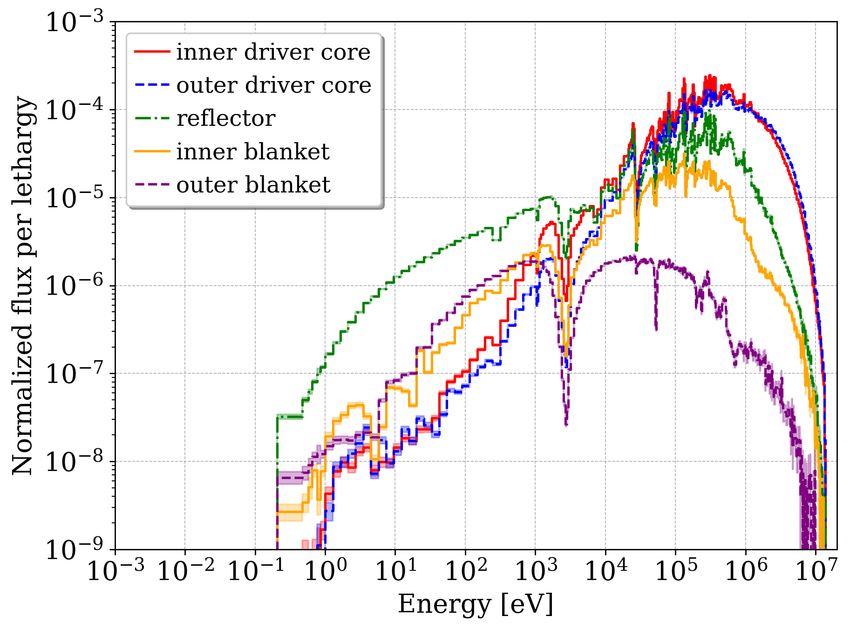
J. Nucl. Eng. 2021, 2                                                                                                        354

                        probability tables has been found to impact reactivity calculations of fast spectrum systems
                        that include irradiated fuel [14].
                              However, the benchmark specification provided the MCNP input. Therefore, it was
                        possible to re-run MCNP calculation with this input using both the ENDF/B-VII.0 and
                        ENDF/B-VII.1 libraries. The eigenvalue decreased by ∼400 pcm when using ENDF/B-VII.1
                        compared to ENDF/B-VII.0. The Oak Ridge National Laboratory (ORNL) MCNP ENDF/
                        B-VII.1 result and the KENO ENDF/B-VII.1 result show a difference of ∼250 pcm; after
                        the provided MCNP model was studied in more detail, it was concluded that this small
                        difference is caused by slight geometric inconsistencies between the models. The cause
                        of the difference between the reported MCNP result and ORNL’s MCNP result when
                        both were using ENDF/B-VII.0 data is unknown. Possible causes of differences could be
                        updates in MCNP and differences in the applied nuclear data files (ORNL used the data
                        files provided with MCNP, but it is not known which data files the benchmark team used).
                              Table 3 compares the nominal quantities of interest based on the different ENDF/B
                        libraries as obtained with KENO-CE. The differences between the ENDF/B-VIII.1 and
                        ENDF/B-VII.1 results are negligible.

                        Table 2. KENO-CE EBR-II keff results compared to the benchmark value and the MCNP-CE results.

                        Case                         Library                         keff              Benchmark ∆k [pcm]
                                                     ENDF/B-VII.1            1.00703 ± 0.00016               −224 ± 618
                        SCALE/KENO
                                                     ENDF/B-VIII.0           1.00704 ± 0.00019               −223 ± 618
                                                     ENDF/B-VII.0            1.01371 ± 0.00017                444 ± 618
                        MCNP 6.1 (ORNL *)
                                                     ENDF/B-VII.1            1.00952 ± 0.00020                25 ± 618
                        MCNP 6.1.1 [1]               ENDF/B-VII.0            1.01169 ± 0.00005                242 ± 618
                         Benchmark [1]                                       1.00927 ± 0.00618                   (ref)
                        * ORNL calculations using the MCNP model provided in the IRPhEP benchmark specifications [1].

                        Table 3. Nominal values of quantities of interest determined with KENO-CE.

                        Quantity                         ENDF/B-VII.1                   ENDF/B-VIII.0                   ∆ρ [pcm]
                        keff                          1.00703 ± 0.00016               1.00704 ± 0.00019                   1 ± 25
                        CR worth [pcm]                        4728 ± 26                       4728 ± 25                   0 ± 36
                        Na void [pcm]                       −4651 ± 18                      −4681 ± 29                  −29 ± 34

                             Figure 8 shows the normalized radial power distribution of the EBR-II. The power
                        was obtained for all materials containing fuel. Empty spaces indicate assemblies that
                        do not contain fuel, such as the dummy assemblies and certain experimental assemblies
                        in the inner driver core. Figure 8 clearly shows the contrast between the high power in
                        the inner core with driver fuel assemblies vs. the low power in the outer blanket. The
                        power was normalized to yield an average assembly power of 1.0 in the inner driver
                        core, and the displayed power in the outer blanket core was adjusted accordingly. The
                        minimum and maximum values of the inner core are 0.653 and 1.297, respectively, when
                        using ENDF/B-VII.1. The minimum and maximum values are 0.597 and 1.282, respectively,
                        when using ENDF/B-VIII.0. The minimum and maximum values of the outer blanket are
                        0.003 and 0.031, respectively, when using ENDF/B-VII.1. The minimum and maximum
                        values are 0.003 and 0.030, respectively, when using ENDF/B-VIII.0.
                             Figure 8 highlights the assembly with the highest power—a half worth driver assembly—
                        with a red hexagon. The assemblies highlighted with a yellow hexagon are three of
                        the high worth control rod (HWCR) assemblies. These control assemblies show a smaller
                        power than other assemblies—in particular compared to other HWCR assemblies—because
                        they are partially inserted into the active region of the core such that their fuel rods are
                        pushed outside and contribute less power (see Figure 5 for the insertion of one of these
                        control assemblies).
J. Nucl. Eng. 2021, 2 355
Figure 8. KENO-MG radial power distribution (axially integrated assembly powers) using
ENDF/B-VII.1 data. High power is visible in the central driver core region, whereas only very
low power is observed in the outer blanket region. The power was normalized to yield an average
inner driver assembly power of 1.
Figure 9 shows the statistical error of the KENO-MG power distribution calculation.
The statistical error was determined by calculating the standard deviation of a set of
calculations with different random seems. The statistical error of the inner driver fuel
assemblies varies between 0.08% and 0.22%. Due to smaller neutron flux in the outer core,
the statistical error of the blanket assemblies is slightly larger with values between 0.19%
and 0.48%. The statistical error in the three partially inserted HWCR assemblies in the
inner driver core is slightly higher than the error of the neighboring assemblies. The fuel
of these assemblies is located below the main active region and therefore experiences a
smaller neutron flux than the main region which leads to a slightly larger statistical error.
In general, these small statistical errors confirm the adequacy of the chosen settings for the
Monte Carlo calculations.
A small bias of the power distribution is expected to be caused by using KENO in MG
mode instead of CE mode. A small MG bias below 5% was previously observed for two
different SFR designs and was attributed to the missing consideration of leakage effects
during the cross section self-shielding calculation [8]. Figure 10 shows the relative difference
of the KENO-MG power distribution to KENO-CE. The KENO-MG result overestimates
the KENO-CE result in the outer blanket region by 2.93–9.58%. The difference in the central
driver core varies between an underestimation of −0.95% and an overestimation of 6.85%.
This type of geometric MG bias will not be sensitive to nuclear data variations and thus
will be a near-constant component in every sample calculation. Therefore, the MG bias will
not greatly affect the relative power uncertainty estimation.J. Nucl. Eng. 2021, 2 356
Figure 9. KENO-MG statistical uncertainty of the axially integrated assembly powers using
ENDF/B-VII.1 data.
Figure 10. Relative difference between the KENO-MG and KENO-CE calculation of the axially
integrated assembly powers using ENDF/B-VII.1 data. Note the different range for the positive and
negative parts of the color map.
4.2. Sensitivity Analysis
Table 4 presents the comparison between the TSUNAMI and direct perturbation
calculations. The keff sensitivities were confirmed for six energy-integrated sensitivity
coefficients. Due to the large number of materials in the model and the consequentialJ. Nucl. Eng. 2021, 2 357
spread of material-dependent sensitivities, only four sensitivities were found to be greater
than 0.01. In addition to these four sensitivities, the top sensitivities in the absorber and
in the fuel were also investigated despite their small values. In general, good agreement
was observed between the sensitivities obtained with TSUNAMI and calculated with
direct perturbation, with differences of less than 2 statistical standard deviations σ of
the sensitivity differences. The largest sensitivity difference was observed for 56 Fe in the
driver assemblies due to the large contribution of the scattering reaction sensitivity to the
total sensitivity of this nuclide, which is generally more difficult to convergence. The 10 B
sensitivity shows a similar difference due to the small sensitivity and therefore similar
challenges with statistical convergence. Based on these results, the parameter settings for
the TSUNAMI-CLUTCH calculation were considered adequate.
Table 4. keff sensitivities obtained using direct perturbation compared to corresponding TSUNAMI results using
ENDF/B-VII.1 data.
TSUNAMI Direct Perturbation
Material Nuclide ∆S (%) ∆S (σ )
Sensitivity Sensitivity R2
Coolant 23 Na 0.0449 ± 0.0007 0.0453 ± 0.0015 0.9944 −1.0% 0.28
Reflector 56 Fe 0.0349 ± 0.0017 0.0369 ± 0.0005 0.9977 −5.5% 1.13
Steel in driver assemblies 56 Fe 0.0192 ± 0.0008 0.0188 ± 0.0005 0.9958 1.7% 0.35
Reflector 52 Cr 0.0154 ± 0.0003 0.0152 ± 0.0005 0.9973 1.5% 0.36
Absorber B4 C 10 B −0.0095 ± 0.0001 −0.0090 ± 0.0005 0.9279 5.4% 0.93
Fuel (assembly position 03C01) 235 U 0.0033 ± 0.0001 0.0034 ± 0.0005 0.9266 −2.3% 0.15
Tables 5–7 list the top integrated sensitivities of the different quantities of interest
as determined with CE TSUNAMI. Each of these sensitivity coefficients represents the
sensitivity of a specific quantity of interest to a single specific reaction and can be used to
understand relevant sensitivities for a given quantity of interest. Because the sensitivities
obtained from the ENDF/B-VII.1 and ENDF/B-VIII.0 are very similar, only the results
obtained with ENDF/B-VII.1 are displayed here.
As expected for fresh uranium fuel, the largest sensitivities are found for 235 U and
238 U. Scattering reactions and the radiative capture (n,γ) reaction of 56 Fe, 52 Cr, and 58 Ni
play a significant role, since these isotopes are the major parts of the cladding materials.
The control rod worth is very sensitive to the the 10 B (n,α), because boron is the absorbing
material in the control rods. The sodium void reactivity is naturally very sensitive to the
elastic and inelastic scattering of 23 Na.
Table 5. EBR-II: top keff sensitivities (top 10 positive and top 10 negative mixture-, region- and energy-integrated sensitivities,
determined with TSUNAMI-CE using ENDF/B-VII.1 data).
Nuclide Reaction Sensitivity (Increasing keff ) Nuclide Reaction Sensitivity (Decreasing keff )
235 U ν 9.537e-01 ± 5.591e-05 235 U n,γ −8.695e-02 ± 3.010e-05
235 U fission 5.486e-01 ± 1.086e-04 238 U n,γ −3.966e-02 ± 2.076e-05
56 Fe elastic 6.762e-02 ± 2.669e-03 56 Fe n,γ −1.685e-02 ± 1.265e-05
23 Na elastic 5.407e-02 ± 1.208e-03 10 B n,α −9.555e-03 ± 1.340e-05
52 Cr elastic 3.480e-02 ± 6.083e-04 58 Ni n,γ −5.420e-03 ± 3.072e-06
238 U ν 3.469e-02 ± 5.355e-05 52 Cr n,γ −3.634e-03 ± 4.483e-06
238 U fission 2.210e-02 ± 5.359e-05 58 Ni n,p −2.952e-03 ± 1.940e-06
58 Ni elastic 1.837e-02 ± 6.585e-04 55 Mn n,γ −2.717e-03 ± 2.584e-06
238 U elastic 1.653e-02 ± 5.665e-04 54 Fe n,γ −2.176e-03 ± 1.330e-06
56 Fe n,n’ 1.309e-02 ± 1.491e-04 53 Cr n,γ −2.135e-03 ± 1.919e-06J. Nucl. Eng. 2021, 2 358
Table 6. EBR-II: top control rod worth sensitivities (reactivity difference between all controls fully inserted and all controls fully
withdrawn *, ∆ρ = 4728 ± 25 pcm; top 10 positive and top 10 negative mixture-, region- and energy-integrated sensitivities, determined
with TSUNAMI-CE using ENDF/B-VII.1 data).
Nuclide Reaction Sensitivity (Increasing ∆ρ) Nuclide Reaction Sensitivity (Reducing ∆ρ)
10 B n,α 4.262e-01 ± 4.564e-04 235 U ν −9.493e-01 ± 1.680e-03
235 U n,γ 5.357e-02 ± 8.876e-04 235 U fission −9.320e-01 ± 3.148e-03
56 Fe n,γ 5.356e-02 ± 3.804e-04 56 Fe elastic −9.565e-02 ± 8.242e-02
238 U n,γ 3.144e-02 ± 6.463e-04 52 Cr elastic −3.683e-02 ± 1.718e-02
235 U n,n’ 2.857e-02 ± 3.657e-03 58 Ni elastic −3.680e-02 ± 2.229e-02
238 U n,n’ 2.204e-02 ± 4.350e-03 238 U elastic −3.379e-02 ± 1.720e-02
55 Mn n,γ 1.442e-02 ± 9.126e-05 238 U fission −2.808e-02 ± 1.532e-03
58 Ni n,γ 1.321e-02 ± 7.568e-05 11 B elastic −2.653e-02 ± 2.908e-03
52 Cr n,γ 1.102e-02 ± 1.262e-04 238 U ν −2.603e-02 ± 1.519e-03
53 Cr n,γ 8.054e-03 ± 5.581e-05 239 Pu ν −2.314e-02 ± 7.302e-04
* EBR-II’s control assemblies include fuel and therefore cause a positive reactivity when fully inserted.
Table 7. EBR-II: top sodium void worth sensitivities (all sodium removed, ∆ρ = −4681 ± 29 pcm; top 10 positive and top 10
negative mixture-, region- and energy-integrated sensitivities, determined with TSUNAMI-CE using ENDF/B-VII.1 data).
Nuclide Reaction Sensitivity (Reducing Negative ∆ρ) Nuclide Reaction Sensitivity (Increasing Negative ∆ρ)
235 U fission 9.829e-01 ± 2.171e-03 23 Na elastic −7.047e-01 ± 2.672e-02
235 U ν 8.492e-01 ± 1.241e-03 23 Na n,n’ −6.572e-02 ± 2.099e-03
56 Fe elastic 2.336e-01 ± 6.374e-02 56 Fe n,γ −1.655e-02 ± 2.909e-04
238 U ν 1.143e-01 ± 1.106e-03 238 U n,γ −9.823e-03 ± 4.789e-04
235 U n,γ 1.128e-01 ± 6.320e-04 58 Ni n,p −9.340e-03 ± 4.690e-05
52 Cr elastic 9.926e-02 ± 1.268e-02 58 Ni n,γ −4.537e-03 ± 5.656e-05
238 U elastic 8.745e-02 ± 1.279e-02 54 Fe n,p −3.900e-03 ± 2.127e-05
238 U fission 8.563e-02 ± 1.108e-03 52 Cr n,γ −3.288e-03 ± 9.066e-05
58 Ni elastic 8.351e-02 ± 1.781e-02 54 Fe n,γ −2.901e-03 ± 2.811e-05
54 Fe elastic 5.294e-02 ± 8.601e-03 60 Ni n,γ −1.665e-03 ± 2.070e-05
4.3. Uncertainty Analysis
Table 8 compares the output uncertainties obtained with TSUNAMI-CE. The causes of
the observed differences can be explained when comparing the individual contributions of
the top contributing nuclear reactions (covariance matrices of the individual reactions) to
the uncertainties presented for each individual quantity of interest in Figure 11.
The keff uncertainty was calculated as ∼2% when using ENDF/B-VII.1 data, but the
uncertainty is significantly smaller with ∼1% when using ENDF/B-VIII.0 data. The major
contributor to this uncertainty in the ENDF/B-VII.1 calculations is 235 U (n,γ). Although
235 U is relevant for the analysis of light-water reactor concepts using low-enriched uranium
fuel, the (n,γ) reaction is usually not observed as a top contributor to output uncertainties:
the top contributor is usually the neutron multiplicity ν [26]. Figure A6 shows that 235 U
(n,γ) has an uncertainty above 30% in the fast energy range. Given the fast energy spectrum
of the EBR-II, this uncertainty becomes the major driver of the keff uncertainty. Naturally,
the decrease of this uncertainty in ENDF/B-VIII.0 leads to the significant decrease of the
keff uncertainty. It should be noted that the importance of this reaction is relevant for EBR-II
because the fuel is enriched uranium. Other SFR concepts using mixed uranium-transuranic
fuel—with a large fraction of plutonium—show other top contributors, which are mainly
reactions of 238 U and 239 U, while 235 U (n,γ) does not appear at all [8].J. Nucl. Eng. 2021, 2 359
Figure 11. Contributions to the output uncertainties (as obtained with TSUNAMI-CE in ∆R/R,
R: response).
Although the individual contribution of 235 U (n,γ) is also significantly decreased
for the control rod worth and sodium void worth in ENDF/B-VIII.0, the effect on the
overall uncertainty is smaller because (1) it is partially compensated through increased
uncertainties of other reactions, and (2) other reactions show major contributions to the
total uncertainty.
In the case of the control rod worth, the increased contributions of 235 U fission and ν
(Figures A5 and A7) compensate for the decreased contributions of, for example, 235 U (n,γ)
and and 56 Fe (n,γ) (Figure A4).
The major contributor to the sodium void worth uncertainty is elastic scattering of
23 Na (Figure A1). The impact of the reduced contribution from 235 U (n,γ) is therefore
smaller than for keff .
Table 8. Uncertainties determined with TSUNAMI-CE.
VIII.0
Quantity ENDF/B-VII.1 ENDF/B-VIII.0 VII.1 −1
keff 2.16% 1.01% −53.0%
CR worth 1.18% 1.26% 6.8%
Na void 5.15% 4.21% −18.3%
The uncertainty of the EBR-II’s radial power distribution as determined with Sampler
/KENO-MG is displayed in Figures 12 and 13. The uncertainty of the power in the outer
blanket assemblies is larger than the power uncertainty of the inner driver assemblies
(Table 9). The ENDF/B-VII.1 calculation yields larger uncertainties as compared to those
obtained using the ENDF/B-VIII.0 calculation.J. Nucl. Eng. 2021, 2 360
Figure 12. Sampler/KENO-MG uncertainty of axially integrated assembly powers using
ENDF/B-VII.1 data: whole core (top) and inner driver core (bottom). Note the different ranges of
the color map for the two images.
The uncertainties of the peak assembly power as determined with ENDF/B-VII.1
and ENDF/B-VIII.0 are 0.343 and 0.335%, respectively. Figure 14 shows that the most
significant contributor to the peak power uncertainty was found to be 23 Na elastic scattering
(Figure A1). As for other quantities of interest of the EBR-II, the (n,γ) uncertainty of 235 U
(Figure A6) provides a significant contribution to the power uncertainty. This contribution
is no longer identified in the ENDF/B-VIII.0 calculation due to the decrease of this
uncertainty in this library. In contrast, the ENDF/B-VIII.0 calculation shows a significantJ. Nucl. Eng. 2021, 2 361
contribution of the 235 U and 239 Pu fission uncertainties caused by the increased uncertainty
of these reactions in ENDF/B-VIII.0 (Figures A5 and A8). The contribution of the 23 Na (n,γ)
uncertainty is increased in the ENDF/B-VIII.0 calculation as compared to the ENDF/B-VII.1
calculation. This is not caused by an increase of the uncertainty in the latest ENDF/B release
(Figure A2 shows that the uncertainty did not change between the latest two ENDF/B
releases), but rather, it is caused by an increased relevance of this reaction resulting due to
the smaller relevance of other cross section uncertainties.
The uncertainties of the partially inserted HWCR assemblies are larger than all other
assembly power uncertainties. The largest uncertainty is obtained in the HWCR assembly
at position 05E03 with 1.496% and 0.976% in the ENDF/B-VII.1 and ENDF/B-VIII.0
calculation, respectively. The top contributors to the HWCR assembly power uncertainty
(Figure 14) are similar to contributors to the peak assembly power uncertainty, identifying
elastic scattering with 23 Na as most important contributor. Additionally, due to location of
the fuel in the HWCR assemblies below the main active region, scattering with the structure
below the core, in particular elastic scattering with 56 Fe, becomes more important.
Table 9. Power uncertainties determined with Sampler/KENO-MG.
Quantity ENDF/B-VII.1 ENDF/B-VIII.0
Power uncertainty in outer blanket zone 3.293–7.049% 1.739–5.255%
Power uncertainty in inner driver zone 0.147–1.496% 0.128–0.976%
Radial peak power uncertainty 0.343% 0.335%
Figure 13. Cont.J. Nucl. Eng. 2021, 2 362
Figure 13. Sampler/KENO-MG uncertainty of axially integrated assembly powers using
ENDF/B-VIII.0 data: whole core (top) and inner driver core (bottom). Note the different ranges of
the color map for the two images.
Figure 14. Sampler/KENO-MG top contributor to the peak power uncertainty and to the 05E03
HWCR assembly power uncertainty in terms of R2 .
5. Conclusions
This article presents an assessment of SCALE for application to fast reactor system
analyses. The SFR SCALE model used in this study was developed based on the EBR-II
benchmark specifications that were recently included in the IRPhEP handbook. The SCALE-
calculated eigenvalue was found to be in close agreement with both the measurement and the
MCNP benchmark calculation. This analysis provides another data point in demonstrating
SCALE’s excellent performance for fast spectrum systems.
To increase awareness of gaps and uncertainties of nuclear data for the simulation of
various quantities of interest in fast spectrum systems, sensitivity and uncertainty analyses
were performed for the eigenvalue, as well as reactivity effects and the radial power profile,
using the two most recent ENDF/B nuclear data libraries.J. Nucl. Eng. 2021, 2 363
The sensitivity analyses provided information about nuclear data for which a change
in the data could cause a significant change in the calculated metric of interest. It was
found that reactivity in the EBR-II is significantly affected by fission, (n,γ), ν, and scattering
cross sections for 235 U and 238 U, as well as scattering cross sections for nuclides in coolant
and structural materials.
The results of the uncertainty analyses—in particular the ranking of contributions
to the output uncertainties—can be used to guide future measurement and evaluation
efforts to reduce the significant nuclear data uncertainties, thereby significantly reducing
the overall observed uncertainties. Due to the fast neutron flux spectrum in the EBR-II,
it was found that the large reactivity uncertainties of 1–5% are mainly caused by large
uncertainties for the 235 U (n,γ) reaction in the fast energy range. For the control rod worth,
the uncertainty of the 56 Fe (n,γ) reaction and inelastic scattering of 235 U and 238 U also
contribute significantly to the overall output uncertainty.
While the nominal results are consistent between the calculations with the different
libraries, the uncertainties due to nuclear data vary significantly. Since the uncertainty
of the major driver of the observed uncertainties—235 U (n,γ)—is significantly reduced in
the ENDF/B-VIII.0 nuclear data library as compared to ENDF/B-VII.0 and ENDF/B-VII.1
libraries, the uncertainties determined for the investigated output uncertainties tend to be
smaller in ENDF/B-VIII.0 calculations, although the decrease is partially compensated for
by increased uncertainties of 235 U fission and ν.
Results from the present study build the foundation for future assessments using the
developed SCALE model. This model will be used for continued validation of SCALE, for
continued testing of SCALE’s nuclear data libraries, and for generation of source terms to
support severe accident analysis.
Author Contributions: Conceptualization, F.B.; methodology, F.B.; software, F.B.; validation, F.B.;
formal analysis, F.B.; investigation, F.B.; resources, G.I., W.A.W.; data curation, F.B.; writing—original
draft preparation, F.B.; writing—review and editing, F.B., G.I., W.A.W.; visualization, F.B.; supervision,
G.I., W.A.W.; project administration, G.I., W.A.W.; funding acquisition, G.I., W.A.W. All authors have
read and agreed to the published version of the manuscript.
Funding: This research was funded by the US Nuclear Regulatory Commission under contract IAA
31310019N0009 for nuclear data assessment for advanced reactors.
Institutional Review Board Statement: Not applicable.
Informed Consent Statement: Not applicable.
Data Availability Statement: The data presented in this study are available on request from the
corresponding author.
Acknowledgments: Support for this work was provided by the US Nuclear Regulatory Commission
(NRC).
Conflicts of Interest: The authors declare no conflict of interest. The funders had no role in the design
of the study; in the collection, analyses, or interpretation of data; in the writing of the manuscript, or
in the decision to publish the results.
Abbreviations
The following abbreviations are used in this manuscript:
CE continuous-energy
contributon-linked eigenvalue sensitivity/uncertainty estimation via
CLUTCH
track length importance characterization
CR control rod
DOE Department of Energy
EBR-II Experimental Breeder Reactor II
ENDF/B Evaluated Nuclear Data File/B
HWCR high worth control rodJ. Nucl. Eng. 2021, 2 364
IFP iterated fission probability
INL Idaho National Laboratory
IRPhEP International Reactor Physics Experiment Evaluation Project
JENDL Japanese Evaluated Nuclear Data Library
LWR light water reactor
MCNP Monte Carlo N-Particle Transport Code
MG multigroup
ORNL Oak Ridge National Laboratory
SFR sodium-cooled fast reactor
Appendix A. Comparison of Relevant Nominal Data and Uncertainties between the
Different ENDF/B Versions
Figure A1. 23 Na elastic scattering nominal data and uncertainty.
Figure A2. 23 Na (n,γ) nominal data and uncertainty.J. Nucl. Eng. 2021, 2 365
Figure A3. 56 Fe elastic scattering nominal data and uncertainty.
Figure A4. 56 Fe (n,γ) nominal data and uncertainty.
Figure A5. 235 U fission nominal data and uncertainty.J. Nucl. Eng. 2021, 2 366
Figure A6. 235 U (n,γ) nominal data and uncertainty.
Figure A7. 235 U ν nominal data and uncertainty.
Figure A8. 239 Pu fission nominal data and uncertainty.
References
1. Lum, E.S.; Pope, C.L.; Stewart, R.; Byambadorj, B.; Beaulieu, Q. Evaluation of Run 138B at Experimental Breeder Reactor II, a Prototypic
Liquid Metal Reactor; Technical Report EBR2-LMFR-RESR-001, CRIT, NEA/NSC/DOC(2006)1; Organisation for Economic
Co-operation and Development/Nuclear Energy Agency: Paris, France, 2018.
2. Balestra, P.; Parisi, C.; Alfonsi, A. EBR-II Static Neutronic Calculations by PHISICS / MCNP6 Codes. In Proceedings of the
Transactions of the American Nuclear Society, New Orleans, LA, USA, 12–16 June 2016; Volume 114.J. Nucl. Eng. 2021, 2 367
3. IAEA. Benchmark Analysis of EBR-II Shutdown Heat Removal Tests; Technical Report IAEA-TECDOC-1819; International Atomic
Energy Agency: Vienna, Austria, 2017.
4. van Rooijen, W. Analysis of the EBR-II SHRT-45R Neutronics Benchmark with ERANOS-2.0. In Proceedings of the Fast Reactors
and Related Fuel Cycles: Next Generation Nuclear Systems for Sustainable Development FR17, Yekaterinburg, Russia, 26–29
June 2017; p. IAEA–CN245–159.
5. Lyu, S.; Lu, D.; Sui, D. Neutronics benchmark analysis of the EBR-II SHRT-45R with SAC-3D. Nucl. Eng. Design 2020, 364, 110679.
[CrossRef]
6. Lum, E.S.; Pope, C. Experimental Breeder Reactor II Reactor Physics Benchmark Evaluation. In Proceedings of the Transactions
of the American Nuclear Society, Orlando, FL, USA, 11–15 November 2018; Volume 119.
7. Stewart, R.; Lum, E.; Pope, C. Design of an experimental breeder reactor run 138B reactor physics benchmark evaluation
management application. J. Nucl. Sci. Technol. 2020, 57, 323–334. [CrossRef]
8. Bostelmann, F. Systematic Sensitivity and Uncertainty Analysis of Sodium-Cooled Fast Reactor Systems. Ph.D. Thesis, École
Polytechnique Fédérale de Lausanne, Lausanne, Switzerland, 2020.
9. Bostelmann, F.; Holcomb, A.M.; Clarity, J.B.; Marshall, W.J.; Sobes, V.; Rearden, B.T. Nuclear Data Performance Assessment for
Advanced Reactors; Technical Report ORNL/TM-2018/1033; Oak Ridge National Laboratory: Oak Ridge, TN, USA, 2019.
10. Bostelmann, F.; Holcomb, A.M.; Marshall, W.J.; Sobes, V.; Rearden, B.T. Impact of the ENDF/B-VIII.0 Library on Advanced
Reactor Simulations. In Proceedings of the Transactions of the American Nuclear Society, Washington, DC, USA, 17–21 November
2019; Volume 121.
11. Wieselquist, W.A.; Lefebvre, R.A.; Jessee, M.A. SCALE Code System, Version 6.2.4; Technical Report ORNL/TM-2005/39; Oak
Ridge National Laboratory: Oak Ridge, TN, USA, 2020.
12. Saylor, E.M.; Marshall, W.J.; Clarity, J.B.; Clifton, Z.J.; Rearden, B.T. Criticality Safety Validation of SCALE 6.2.2; Technical Report
ORNL/TM-2018/884; Oak Ridge National Laboratory: Oak Ridge, TN, USA, 2018.
13. Kim, K.S.; Bostelmann, F.; Holcomb, A.M.; Ilas, G.; Wieselquist, W.A. Verification of the ENDF/B-VII.1 and VIII.0 AMPX
1597-group libraries for advanced reactor analysis. In Proceedings of the M&C 2019, Portland, OR, USA, 25–29 August 2019.
14. Kim, K.S.; Williams, M.L.; Holcomb, A.M.; Wiarda, D.; Jeon, B.K.; Yang, W.S. The SCALE/AMPX multigroup cross section
processing for fast reactor analysis. Ann. Nucl. Energy 2019, 132, 161–171. [CrossRef]
15. Rearden, B.T.; Williams, M.L.; Jessee, M.A.; Mueller, D.E.; Wiarda, D.A. Sensitivity and uncertainty analysis capabilities and data
in SCALE. Nucl. Technol. 2011, 174, 236–288. [CrossRef]
16. Broadhead, B.L.; Rearden, B.T.; Hopper, C.M.; Wagschal, J.J.; Parks, C.V. Sensitivity- and Uncertainty-Based Criticality Safety
Validation Techniques. Nucl. Sci. Eng. 2004, 146, 340–366. [CrossRef]
17. Perfetti, C.M.; Rearden, B.T.; Martin, W.R. SCALE Continuous-Energy Eigenvalue Sensitivity Coefficient Calculations. Nucl. Sci.
Eng. 2016, 182, 332–353. [CrossRef]
18. Williams, M.L. Perturbation Theory for Nuclear Reactor Analysis. In Handbook of Nuclear Reactors Calculations, Volume III; Ronen,
Y., Ed.; CRC Press: Boca Raton, FL, USA, 1986; pp. 63–188.
19. Williams, M.L.; Broadhead, B.L.; Parks, C.V. Eigenvalue Sensitivity Theory for Resonance-Shielded Cross Sections. Nucl. Sci. Eng.
2001, 138, 177–191. [CrossRef]
20. Williams, M.L. Sensitivity and Uncertainty Analysis for Eigenvalue-Difference Responses. Nucl. Sci. Eng. 2007, 155, 18–36.
[CrossRef]
21. Williams, M.L.; Ilas, G.; Jessee, M.A.; Rearden, B.T.; Wiarda, D.; Zwermann, W.; Gallner, L.; Klein, M.; Krzykacz-Hausmann, B.;
Pautz, A. A statistical sampling method for uncertainty analysis with SCALE and XSUSA. Nucl. Technol. 2013, 183, 515–526.
[CrossRef]
22. Chadwick, M.B.; Herman, M.; Obložinský, P.; Dunn, M.E.; Danon, Y.; Kahler, A.C.; Smith, D.L.; Pritychenko, B.; Arbanas, G.;
Arcilla, R.; et al. ENDF/B-VII.1 Nuclear Data for Science and Technology: Cross Sections, Covariances, Fission Product Yields
and Decay Data. Nucl. Data Sheets 2011, 112, 2887–2996. [CrossRef]
23. Brown, D.; Chadwick, M.; Capote, R.; Kahler, A.; Trkov, A.; Herman, M.; Sonzogni, A.; Danon, Y.; Carlson, A.; Dunn, M.; et al.
ENDF/B-VIII.0: The 8th Major Release of the Nuclear Reaction Data Library with CIELO-Project Cross Sections, New Standards
and Thermal Scattering Data. Nucl. Data Sheets 2018, 148, 1–142. [CrossRef]
24. Choi, C.; Ha, K.S. Assessment calculation of MARS-LMR using EBR-II SHRT-45R. Nucl. Eng. Design 2016, 307, 10–29. [CrossRef]
25. Chadwick, M.; Obložinský, P.; Herman, M.; Greene, N.; McKnight, R.; Smith, D.; Young, P.; MacFarlane, R.; Hale, G.; Frankle, S.;
et al. ENDF/B-VII.0: Next Generation Evaluated Nuclear Data Library for Nuclear Science and Technology. Nucl. Data Sheets
2006, 107, 2931–3060. [CrossRef]
26. Rochman, D.; Leray, O.; Hursin, M.; Ferroukhi, H.; Vasiliev, A.; Aures, A.; Bostelmann, F.; Zwermann, W.; Cabellos, O.; Diez, C.; et al.
Nuclear Data Uncertainties for Typical LWR Fuel Assemblies and a Simple Reactor Core. Nucl. Data Sheets 2017, 139, 1–76.
[CrossRef]You can also read


