Painting Pairs: Art History and Technical Study 2019-2020 - Mirra Berridge & Damiët Schneeweisz Unknown Artist, 16th century Spanish Panel ...
←
→
Page content transcription
If your browser does not render page correctly, please read the page content below
Painting Pairs: Art History and Technical Study
                   2019-2020

           Mirra Berridge & Damiët Schneeweisz

         Unknown Artist, 16th century Spanish Panel
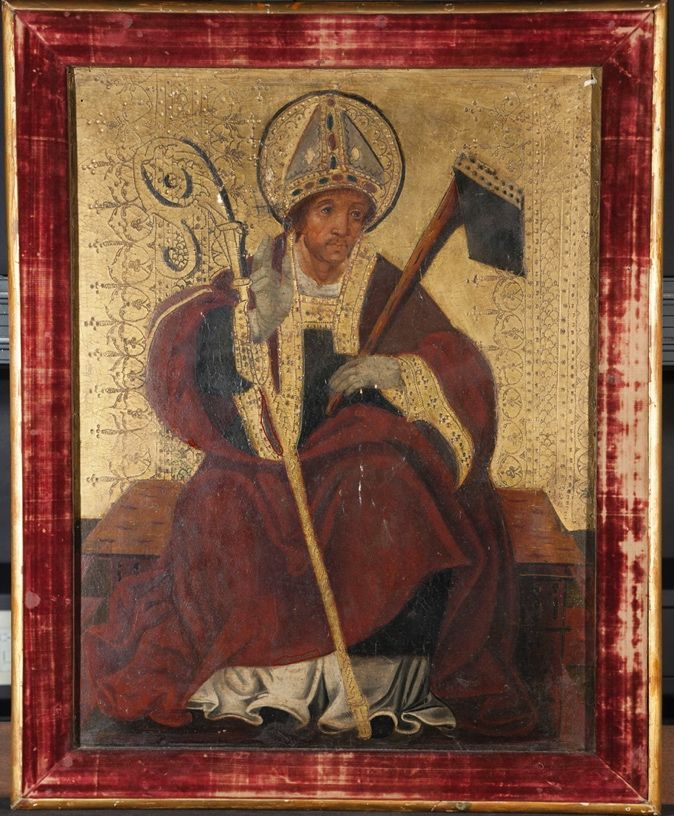
                        Saint Blaise
                      Private owner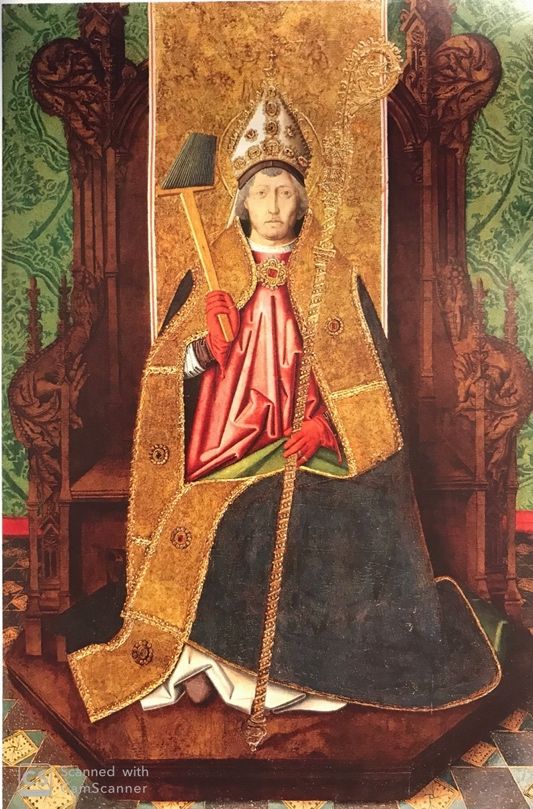
‘Blaise (Blasius) is like blandus, bland, or is formed from bela, meaning habit or disposition,
and syor, small; for the saint was bland through the sweetness of his discourse, virtuous by
habit, and small by the humility of his way of life.’

Jacobus de Voragine, The Golden Legend

                                                                                                  2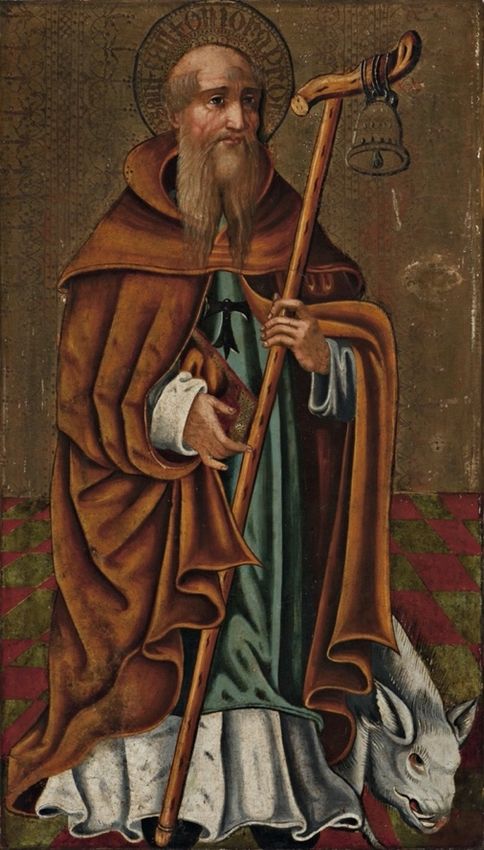
Contents

Introduction to the Project and Acknowledgments                      4

Introduction to the Painting                                         5

Subject History: Saint Blaise and Altarpieces                        8

Materials and Technique: Panel Construction and Ground Preperation   13

Materials and Technique: Underdrawing and Paint Layers               18

Conclusion and Possibilities for Further Research                    24

List of Illustrations                                                25

Bibliography                                                         26

Appendices                                                           29

                                                                         3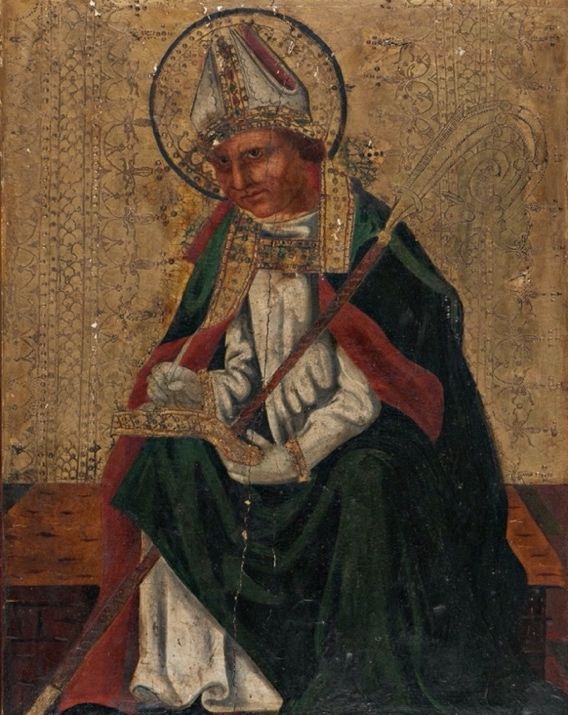
Introduction to the Project and Acknowledgments

This is the final report of a collaborative research project that we conducted as part
of Painting Pairs: Art History and Technical Study at the Courtauld Institute of Art.
The initiative is supported by the Department of Conservation and Technology, The
Courtauld Gallery and the Research Forum.
       As part of this project, we were introduced to a sixteenth-century Spanish
panel painting of Saint Blaise that is part of a private collection. Using a combination
of art historical and technical examination, we sought to better understand the
painting and its story while restoring fragile parts of the work to their original
condition. Though sadly our investigation was interrupted abruptly by the COVID-19
pandemic, we were still able to summarise our findings, working hypotheses and
concerns in the following report. They propose how the panel might have been
made, what it was used for, and how it travelled. We also hope to show its potential
relevance to existing and future scholarship on medieval to early modern Spanish
panel paintings.
       This research project would not have been possible without the help and
guidance of a number of people. Thank you to Pia Gottschaller, Aviva Burnstock,
and Pippa Balch, whose support and critical eye strengthened the following analysis.
We would like to thank the owner of Saint Blaise for his trust, time and bold ideas,
and all those whose helpful questions during our presentation at the Research
Forum challenged and expanded our thinking. We would also like to offer special
thanks to the archives and institutions instrumental in this research: the Courtauld,
the Warburg Institute and the Wellcome Collection for their archival materials and
efforts to make those available to us online as we suddenly found ourselves confined
to our homes and computers. Working on Saint Blaise, known for being a healer of
illnesses, brought a symbolic sense of pertinence to our project during this difficult
period. We hope this report offers the opportunity for bright, new ideas to emerge for
art historians and conservators alike.

                                                                                         4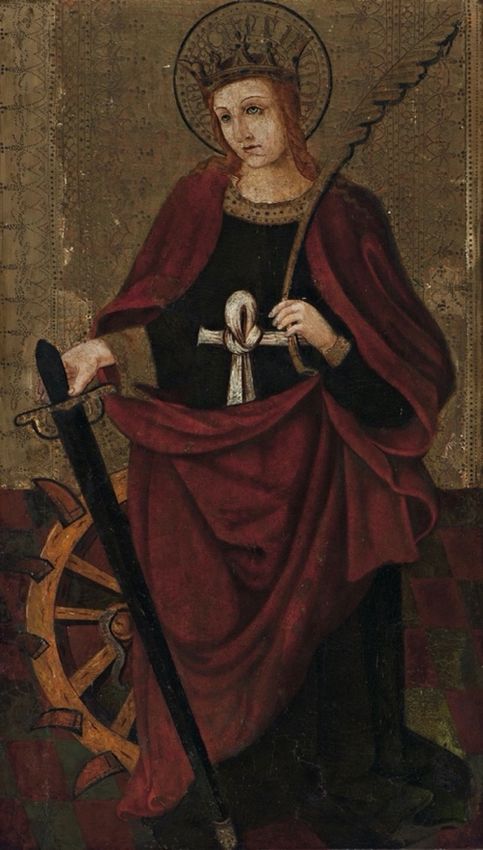
Introduction to the Painting

                       Unknown Artist, Saint Blaise, c. 16th Century
  Figure 1. Front with frame                     Figure 2. Back with frame

This work was painted in oil on a wooden panel that measures 62 by 48 cm. It
depicts the Catholic saint and martyr known as Saint Blaise. Saint Blaise is
celebrated for his miraculous treatment of people and wild animals as a physician
and bishop in the region of Sebastea in modern-day Armenia. In this jewel-like panel,
he is dressed in elaborate red and green vestments and can be seen gesturing up to
the sky with his right hand, his crozier fixed in his right elbow, while holding a large
wooden and metal instrument—an iron comb made from wood and metal—in his
other hand. He is seated on a subtly decorated wooden bench; his head tilted slightly
to accommodate a soft, tranquil gaze. The delicate and skilfully painted facial
features show wrinkled cheeks, a pouty lip and glistening blue-green eyes that are
replicated in the stones on the bishop’s mitre. The figure of the saint is placed in front
of a gilded background, parts of which were decorated with punchwork. The
punchwork’s uneven spacing makes it look rather lopsided and it is of a rougher
quality than the intricately painted facial features. When we first saw the painting, we
were immediately intrigued by these subtle contradictions.

                                                                                           5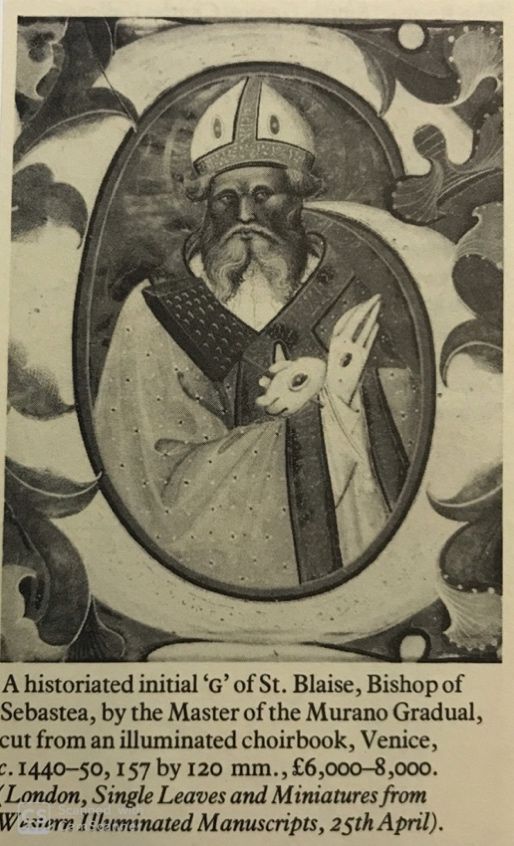
The Spanish auction house Balclis, based in Barcelona, identified the work as
a Catalan School 16th century painting in 2017, prior to its sale to the current owner.1
It is unclear exactly how the auction house made this attribution, presumably on
stylistic grounds, and no historical or technical analysis has been published.
Therefore, our initial research questions where: where was this painting made, for
what purpose, and what might be said about the journey it has undertaken since
then? How did these aspects affect its current appearance? Over the past few
months, we have worked to improve the physical appearance and historical
knowledge of the painting through a combination of conservation treatment and
historical research. As a result, we are able to state that in our view the above
attribution and date are correct, and that the painting was probably originally part of a
larger altarpiece.
                                                            The only initial clue for the
                                                            provenance of the painting is a
                                                            20th century paper label from a
                                                            Spanish conservator on the back
                                                            of the panel (fig. 3). The label,
                                                            translated from Spanish into
                                                            English, reads: ‘Restorer of the
                                                            Royal Monastery of Poblet,’ who
                                                            seems to specialise in the
                                                            treatment of paintings on ‘linen,
    Figure 3. Detail of the label on the back               copper and retables.’2 Previous
                                                            conservation work on the panel
may have been done by this restorer though more information about this label would
need to be gathered to ascertain the extent of work that was done by them.3 The
monastery of Poplet, since 1991 a UNESCO World Heritage site, was founded in
1151 by Cistercian monks from France. It is located in the province of Catalonia at

1
  We were unable to contact the auction house due to the on-going COVID-19 pandemic. Previous
attempts to contact the auction house for more information on the work by the owner of the panel did
not result in more useful information.
2
  Translation by the authors. Original Spanish label: ‘Restaurador del Real Monasterio de Poblet;
Lienzoz Cobres Retablos; Torrente de las flores, 72, 1.°, 3. ° = Tel. 279317 = Barcelona’.
3
  Through the treatment of this panel, extensive retouching and overpaint was found as well as a
locally applied varnish that only covered the painted sections of the painting. Conservation treatment
is still underway.

                                                                                                         6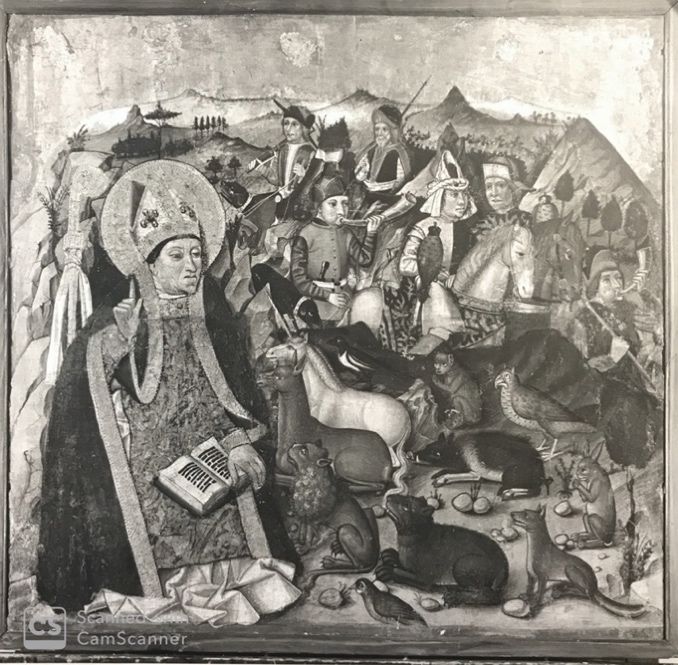
the foot of the Prades mountains and is mostly associated with Saint Benedict and
Saint Bernard.4 The monastery was abandoned in 1835 and subject to numerous
plunderings in the nineteenth century until Italian monks returned in 1940, when a
substantial restoration project began to return the place to its original state. Our
painting may have been acquired possibly as part of an altarpiece by the monastery
at this time. There is no discernible date on the conservation label, nor any indication
of the identity of the restorer.5 Was the conservator exclusively associated with the
monastery or did they also work for public institutions and private collectors? Can we
date the conservator’s work to before or after the monastery’s renewal in 1940?
Understanding the painting’s relationship to the monestary, if there is one at all, will
remain an important question for further research into the panel that we were not
able to study in depth.

4
  For the official website of Monasterio de Santa María de Poblet, see: http://www.poblet.cat/
(accessed on 20/04/2020).
5
  There are a number of archives associated with the monastery that we were unable to access which
may be a useful avenue for further research: for example the library of the monastery, the Montserrat
Tarradellas I Macia Archive and the Casa Ducal de Medinacelli Archive.

                                                                                                   7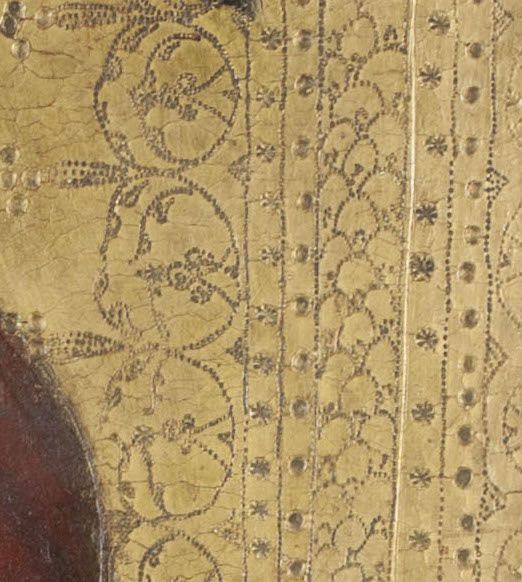
Subject History: Saint Blaise and Altarpieces

Our research was initially concerned with the curious, blocked appearance of the
iron comb that appeared distinct from most other depictions of Saint Blaise.
However, the typical spikey ends had only been obscured by a layer of dirt and wax-
like residue that has been removed during the ongoing conservation treatment. The
iron comb that became visible during technical examination can be clearly attributed
to Saint Blaise. This comb, paired with the halo and general religious iconography of
the work, would have allowed a sixteenth-century audience to read the painting as a
devotional image of Saint Blaise.
       Saint Blaise was one of the most popular medieval saints, known for his
miraculous healing treatments as a physician and a bishop. He became a martyr
through his death by iron combs and is often depicted in his bishop’s mitre holding a
crozier (figs. 4 to 7). Other typical attributes are burning candles or depictions of
scenes of his life (for example, him tending to animals outside a cave-like structure,
fig. 4). Known as San Blas in Spain, San Biagio in Italy, and São Brás in Portugal
and across the Lusophone Atlantic, the saint was particularly popular in Southern
Europe, and the Spanish-ruled regions beyond.

 Figure 4. Saint Blaise found by hunters in his         Figure 5. Saint Blaise, Illuminated
 cave, Spanish 15th century, oil on panel, 54 x         choir book, Venice, c. 1440-50
 58 cm.

                                                                                              8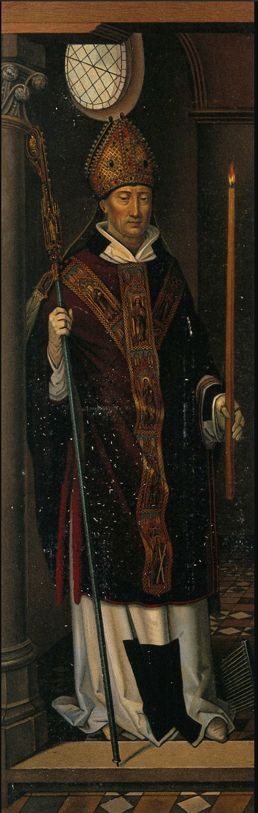
Figure 6. Saint Blaise, Martin Beruat, c.1469-                 Figure 7. Saint Blaise, Hans Memling,
1497, oil, gold and stucco on panel, 136.5 x                   oil on panel c. 1491
97 cm.

        The Golden Legend, one of the most widely read books of the medieval
period and cited from at the beginning of this report, was compiled in 1260 by
Jacobus de Voragine and includes a passage on Saint Blaise that influenced many
medieval representations.6 In this text, Saint Blaise is portrayed as a gentle healer
who, aside from his miraculous actions, was ennobled by his loyalty to Christ and
rejection of non-Christian gods. For this, he is murdered by molten lead and iron
combs. Prior to his death, Blaise ‘prayed to the Lord that anyone who besought his
intercession when suffering from throat trouble or any other illness should be heard
and healed immediately.’7 In fact, the saint’s relationship to illnesses of the throat
goes back to the medical texts of Aëtius of Amida, a Byzantine Greek physician.8
The attribute of an iron comb—an instrument that bears a distinctive visual
resemblance to wool carding combs—signals that he is also the patron saint of wool
combers.9

6
  Jacobus de Voragine, The Golden Legend: Readings on the Saints, translated by William Granger
Ryan (Princeton and Oxford: Princeton University Press, 1993), 151-154.
7
  Voragine, The Golden Legend, 153.
8
  Another notable source are the medieval Acts of Saint Blaise. The Wellcome Collection has devoted
special attention to Saint Blaise as a healer. See for example: Julia Nurse, ‘St Blaise the Throat
Healer,’ in From The Collections, URL: http://blog.wellcomelibrary.org/2016/04/st-blaise-the-throat-
blesser/ (accessed 15 May 2020).
9
  Britannica Academic, ‘St Blaise’, 10 February 2018 (accessed 15 May, 2020).

                                                                                                  9
Representations of Saint Blaise in Spain, both in scenes from his life and as a
saintly figure, remained popular throughout the medieval period and into the
sixteenth century. Depictions of Saint Blaise with an iron comb can be found in
multiple altarpieces in Spain, including one executed by the Master of the Paheria in
the parochial church of Algayon and the St Laurence altar in the church of Nuestra
Senora de los Milagros in Agreda.10 Other Spanish images of Saint Blaise, for
example by Martín Bernat and Juan de Juanes, also show similar punchwork,
colouring, and attributes.11
In fact, we think that our panel was probably not meant for individual display,
but was part of an altarpiece that typically included a number of saints. Such an
earlier context is suggested by what might be remnants of crossbars and joints in the
panel. More importantly, the face of the saint also shows a remarkable similarity to a
number of other pictures sold by Balclis, the same Spanish auction house where
Saint Blaise was acquired. These other figures are Saint Augustine, Saint Catherine
of Alexandria, and Saint Anthony the Abbot (figs. 8 - 10). The panel of Saint
Augustine has similar dimensions to that of Saint Blaise at 63.5 by 50 cm, while the
supports of Saint Catherine and Saint Anthony are both 86.5 by 49.5 cm in size.
Moreover, we know that Saint Augustine was sold in the same sale as Saint Blaise
(although to a different owner), while Saint Catherine and Saint Anthony were
auctioned off at a different time. The four paintings are stylistically very similar in
composition, painting style and punchwork. Note, for example, the decorated
wooden benches in Saint Blaise and Saint Augustine—a motif repeated in the saints’
attributes—the comparable colour schemes, the painting style of details like the
draperies, revealing a characteristic block-like application in the folds, and of the
facial features.12 The punchwork on all four paintings was created with distinctive
three tool marks in the same patterned shapes (figs. 11 to 14).
In other words, Saint Blaise was perhaps part of a much larger altarpiece that
also included Saint Augustine, Catherine and Anthony, perhaps as side panels, less
likely as predella panels. As has happened to other altarpieces, sometimes the
10
This is based on research cited in Elizabeth Lewis’ thesis by Hans Aurenhammer; no dates were
given. Elizabeth Lewis, ‘The Iconography of St Blaise,’ PhD Dissertation submitted to the Graduate
School of Georgetown University, 1976: 152-153. See also M. M. Banks, ‘St. Blaise’s Comb’, Folklore
45, no. 1 (1934): 77-78.
11
Authors’ research. See accompanying images for examples.
12
For the latter, see, for example the V-like shape in the cheeks and the wrinkles around the mouth,
indicating the hand of a particular artist.
10individual panels were separated, for a variety of reasons: during a shift from public
to private devotion; for financial reasons; as anti-Catholic acts during the
Reformation; or during monastery raids in the secularisation.
Figure 8. Saint Anthony the Abbot, Figure 9. Saint Catherine of Alexandria,
Catalan School, 16th Century, Oil and gold Catalan School, 16th Century, Oil and gold
leaf on panel, 86.5 x 49.5 cm. leaf on panel, 86.5 x 49.5 cm.
Figure 10. Saint Augustine, Catalan
School, 16th Century, Oil and gold leaf on
panel
11Figure 11. Detail of punchwork in Saint Figure 12. Detail of punchwork in Saint
Blaise Augustine
Figure 13. Detail of punchwork in Saint Figure 14. Detail of punchwork in Saint
Catherine of Alexandria Anthony the Abbot
12Materials and Technique: Panel Construction and Ground
Preparation
Technical examination indicates that the construction and preparation of this panel
are consistent with what is known about Spanish panel preparation in the sixteenth
century. This hypothesis is supported by an x-radiograph taken of the panel (fig. 15)
and visual observations made under magnification.
Spanish techniques for wooden panels were unique in Western Europe, as
painting conservator Zahira Véliz expertly laid out in her essay.13 Their varied
practices were informed by the cultural diversity of the country, including Islamic
culture, Italian traditions and the Northern Gothic techniques, as well as by the
materials native to the hot and dry region.14 By the sixteenth century, panels were
often constructed in one or multiple workshops, and ‘separate contracts for painting
and carpentry [and sub-contracting carpentry] were also frequent.’15 Such contracts
ensured quality control both to the painter and the client. In fact, multiple complex
contracts with detailed agreements concerning everything from the type of wood to
the subject matter were common.16 Because subcontracting was so frequent, panels
like Saint Blaise could travel through various hands before arriving at their intended
space of display.
The wooden material sourced for the panel can offer a good indication of its
place of origin. Materials that were available locally were preferred: thuja, a type of
cedar, was popular in the south of Spain, pine was used in Castile and Aragon,
poplar in Catalonia, and, although less frequently, walnut and Spanish oak were
sourced for Castilian paintings.17 However, due to the political relationship between
Spain and the Low Countries, a connection exploited by various artists and
13
Zahira Véliz, ‘Wooden Panels and Their Preparation for Painting from the Middle Ages to the
Seventeenth Century in Spain,’ in History of Panel Making Techniques, part two, 136-149.
14
Ibid., 136. See also: Michele Bacci, ‘Devotional Panels as Sites of Intercultural Exchange,’
Domestic Devotions in Early Modern Italy, edited by Maya Corri, Marco Faini, and Alessia Meneghin
(Leiden: Brill, 2019), 272-292; Ainhoa Rodríguez-López, Narayan Khandekar, Glenn Gates and
Richard Newman, ‘Materials and Techniques of a Spanish Renaissance Panel Painting,’ Studies in
Conservation 52, no. 2 (2007): 81-100; Zahira Véliz, Artists’ Techniques in Golden Age Spain
(Cambridge: Cambridge University Press, 1987).
15
Véliz, ‘Wooden Panels and Their Preparation for Painting from the Middle Ages to the Seventeenth
Century in Spain,’ 137.
16
Ibid, p.137.
17
Ibid., 137-9; Judith Sobré, Behind the Altar Table: The Development of the Painted Retable in
Spain, 1350-1500 (Columbia: University of Missouri Press, 1989); Susie Nash, Late Medieval Panel
Paintings: Materials, Methods, Meanings (London: Sam Fogg, 2011).
13merchants, imported panels were also used for Spanish paintings from the mid-
sixteenth century onwards.18 Art historian Susie Nash has referred to Spain as ‘a
melting pot, attracting high-quality artists from across Europe, its trade routes, ruling
families and geography connecting it closely to both the Netherlands and Italy.’19
Netherlandish panels were often made of Baltic oak, which was imported to Spain in
certain cases, while France mostly used walnut and Germany spruce.20
Unfortunately, dendrochronology on our panel has not been conducted, so the type
of wood remains undetermined, but the above list indicates that the vast variety of
types of wood in Spain used in that period would not have allowed us to make such
a regional attribution.
When a panel consisted of
multiple boards, they were cut,
sawn and then joined with butt
joins, dowelled joins, butterfly lap
joins or plain lap joins and often
reinforced by crossbars fixed with
nails hammered in from the front of
the panel for added stability.21
Single boards for smaller panels
that had crossbars affixed to the
back, in the same manner as in the
case of larger panels, were usual
for an altarpiece. The x-ray of Saint
Blaise shows that the panel is made
Figure 15. X-radiograph of Saint Blaise, Before
of a single board with no crossbars
Treatment (fig. 15). The curved band on the
right hand side shows extensive woodworm channels that have been filled. There is
no join visible differentiating this area to the rest of the panel which may indicate that
the board was cut into the sap wood of the tree.22
18
For a comprehensive reading of this relationship, see, for example: Jonathan Brown, Painting In
Spain: 1500-1700 (New Haven: Yale University Press, 1998).
19
Nash, Late Medieval Panel Paintings, 7.
20
Susie Nash, Northern Renaissance Art (Oxford: Oxford University Press, 2009), 57-58.
21
Véliz, ‘Wooden Panels and Their Preparation for Painting from the Middle Ages to the Seventeenth
Century in Spain,’ 139. The different joins appear to be typical for Spain, though not exclusively.
22
Sap wood is the softest part of the tree and much more susceptible to woodworm damage.
14Six small, circular white areas can be seen in the x-ray at the top and bottom
of the panel. These areas of density are consistant with six slightly raised areas on
the face of the painting, visible in normal light. These areas show the presence of six
nails, of which the cut down tips of three can be viewed from the back. This suggests
that crossbars were once attached to the back of the single board panel. The
crossbars were secured by six nails that were hammered in from the front, proposing
the hypothesis that the panel was made as part of a Spanish altarpiece. At some
point, though, that altarpiece must have been disassembled—the crossbars were
taken off and the nails were cut down. The image at that point became an individual
panel, although it is likely that it remained in the same collection as the other images.
The likelihood that the images somehow remained together, or were separated at a
late stage in their history, stems from the fact that they were all sold around the
same time by the same auction house in Barcelona, though to different owners.
A thick layer of canvas or vegetable fibres and gesso was sometimes added
to Spanish panels: linen was popular for the front, hemp fibres for the back.23 Véliz
noted that while such organic reinforcements may be found across Europe, ‘these
materials are most abundant in the preparation of Spanish panels.’24 This method is
also mentioned in a number of contemporary sources, further confirming its
widespread popularity in sixteenth-century Spain.25 Indeed, the back of this panel
does have a strip of of fibrous material down the centre, approximately 14cm wide
and 30 cm long—though it is worth noting that this may be an addition by the
Spanish conservator.26 The x-ray shows dark and whispy lines, that do not relate to
these fibres, but are visible over the entire panel (figs. 16 and 17). The x-ray cannot
tell us at which level of the construction the fibres are present. In a loss of the gilding,
fibres encased in glue in the ground layer can be seen, suggesting that this layer is
on the front of the panel as part of the preparation layers (figs. 18 and 19).27
23
Véliz, ‘Wooden Panels and Their Preparation for Painting from the Middle Ages to the Seventeenth
Century in Spain,’ 140.
24
Ibid.
25
See for example Francisco Pacheco, El Arte de la Pintura, edited by F.J. Sánchez Cantón (Madrid:
Imprenta y Editorial Maestre, 1965 (1638).
26
Former Spanish conservators used similar methods of conservation as the original construction.
27
Technical examination still needs to be conducted on the fibres to determine what type of fibre was
used.
15Figure 16. Detail of X-radiograph Figure 17. Detail of X-radiograph
from top left corner showing fibrous from top right corner showing
material fibrous material
Figure 18. photomicrograph from an Figure 19. photomicrograph from an
area of loss in the gilding showing fibres area of loss in the gilding showing fibres
in the ground layer in the ground layer
For the ground, Spanish artists in the
sixteenth century used chalk or gypsum,
a white mixture made with calcium
carbonate (usually called gesso) or
calcium sulphate, respectively: the former
appears to have been more popular in
Castile, the latter in Valencia and
Andalusia.28 In paint cross-sections, a
Figure 20. Sample A, cross section taken gypsum-containing ground can appear
from a loss in the browned copper green area
underneath the proper left hand of Saint striated, whereas chalk particles are
Blaise shaped like cocoliths.29 The ground layer
28
Véliz, ‘Wooden Panels and Their Preparation for Painting from the Middle Ages to the Seventeenth
Century in Spain,’ 142.
29
S. Santos Gómez, M. San Andrés Moya, J.L. Baldonedo Ródriguez, and O. Conje Sastre.
‘Contribution to te study of grounds fro panel painting of te Spanish school in the fifteenth and
sixteenth centuries’, in Painting Tecniques History, Materials and Studio Practice, ed. Ashok Roy and
Perry Smith (Contributions to the Dublin Congress 7-11 September 1998), pp. 115-120
16of St Blaise appears to contain striated particles, yet further technical analysis needs
to be done to confirm the components (fig. 20).30
Ultimately, the preparation of the structure and ground layers of Spanish
panels has several distinctive attributes. The materials and techniques used for the
painted surface of Saint Blaise offer a number of indications that the panel was made
in the sixteenth century though it is impossible to definitively state that it was made in
Spain. Our initial findings concerning the construction of the panel made for Saint
Blaise would suggest that this panel was in fact made in Spain in the sixteenth
century, though no specific region within the country can be identified.
30
EDX analysis needs to be done on the samples.
17Materials and Technique: Underdrawing and Paint Layers
The materials and techniques used for painting the image are also consistent with
those used in sixteenth-century Spain. However, these methods were not exclusively
used in Spain at this time but also in the Low Countries. Spanish underdrawings are
in some ways different from the detailed and elaborate underdrawings that graced
paintings in the Low Countries: Spanish painters appear to have preferred rough,
bold lines to guide the formation of the image. In Saint Blaise, traces of an
underdrawing can be observed in the nose and at the bottom of the bishop’s robe in
one area of shadow in the OSIRIS IR image (figs. 21 to 24).
Figure 21. OSIRIS infrared reflectogram Figure 22. Infrared image taken with an
adjusted IR camera: Canon D600
The fluid quality of the drawing suggests that a brush and carbon-containing ink were
used. Incised lines, visible around the figure and within the garments that separate
the painted area and the gilded area, were used in the preparation and planning of
the composition. Although the IR images only show minimal underdrawing, this does
not allow the conclusion that more of the drawing is not present. It could have been
made with a non-IR absorbing material like red chalk or iron gall ink or might be
covered by paint that blocks the IR radiation.
18Figure 23. Detail taken from the OSIRIS Figure 24. Detail taken from the OSIRIS
image image
As already mentioned above, the panel seems to have been prepeared with a
gypsum-based ground followed by a
priming layer.31 XRF analysis revealed
peaks for calcium and lead throughout the
painting suggesting that the thin priming
layer is potentially comprised of lead
Figure 25. Sample A taken from loss in the white.32 The cross-sections reveal that in
browned copper green area underneath the
some areas the priming is mixed with
proper left hand
black particles.
The priming layers in the samples
taken from the red sleeve and the green
area (showing as almost black in the
natural light image) underneath the left
hand reveal a varied number of black
Figure 26. Sample E taken from a loss in an
area of vermilion and red glazed robe particles. In the sample from the sleeve
31
S. Santos Gómez, M. San Andrés Moya, J.L. Baldonedo Ródriguez, and O. Conje Sastre.
‘Contribution to te study of grounds fro panel painting of te Spanish school in the fifteenth and
sixteenth centuries’, in Painting Tecniques History, Materials and Studio Practice, ed. Ashok Roy and
Perry Smith (Contributions to the Dublin Congress 7-11 September 1998), pp. 115-120
32
XRF: X-Ray fluorescence. The peaks for lead and sulphur overlap in the readings taken from XRF
thus making it impossible to detect sulphur which would be present if the ground was made from
calcium sulphate. Further testing with SEM-EDX needs to be done to further characterise these
layers.
19only one particle of black can be seen; whereas in the sample from the dark area, a
significantly larger number of black particles is present. This suggests that different
undertones were applied in the preparation stage. The OSIRIS IR image further
supports this hypothesis: there is an observable difference in absorption in the two
areas. The red robe is significantly lighter than the green areas (right inner sleeve,
chest, carding comb and undergarment) suggesting that a carbon containing layer is
present in the priming layer in these these green areas (fig. 25).
Finally a thin paint layer was applied. XRF analysis of an area in the red robe
revealed peaks for mercury (Hg), a characteristic element of vermilion (Appendix 1).
The cross-section and photomicrograph
shows that this area consists of a layer of
vermilion with a darker transparent red glaze
on top (figs. 26 and 27). XRF analysis
showed further that the green paint layers
(right inner sleeve, chest, carding comb and
undergarment) contain copper, suggesting
the presence of a copper containing green
Figure 27. Photomicrograph, area of
vermilion and red glazed robe such as Verdigris or Emerald green (figs. 28 -
31). The dark appearance of these areas might be due to the darkening of copper
and/or the binder, a common phenomenon.
Figure 28. Photomicrograph, browned Figure 29. Photomicrograph, browned
copper green area in proper right sleeve copper green area in centre of robe
20Figure 30. Photomicrograph, browned Figure 31. Photomicrograph, browned
copper green area in the carding comb copper green at the bottom of the robe
XRF analysis detected copper and lead in the hands (Appendix 1). In the
photomicrographs irregularly shaped blue particles, characterisitic for azurite, are
visible; suggesting that they were painted using lead white mixed with azurite (figs.
32 and 33). The face was painted using a mixture of vermilion, lead white and iron
oxide pigments (XRF indicated the presence of mercury, lead and iron). Paint from
the iris of the figure’s left eye probably also contains azurite, added to make the eye
appear slightly cooler to the viewer (fig. 34). A red and green glaze were applied
directly onto the gilding to create the effect of lustre, to imitate the sparkle of jewels
of the mitre. Unfortunately, most of the green and red areas in the mitre have been
covered by overpaint, with the original glaze only visible along the edges of the
‘jewels’ (fig. 35).
Figure 32. Photomicrograph, area in Figure 33. Photomicrograph, area in
proper right hand proper left hand
21Figure 34. Photomicrograph, iris of proper Figure 35. Photomicrograph, red
left eye ‘jewel’ in mitre showing overpaint
The punching in the glided area was made with three different tools to create
various patterns (figs. 36 and 37). Not all of the tool marks made with probably the
same punch look the same, suggesting a difference in how much pressure was
applied on the tool. There are incised lines along the left-hand side of the painting to
lay out the pattern, although not all of the motifs made with the tools follow these
lines. The punchwork outlining the shape of the crozier is made with only one of the
three tools, then a black painted reinforcement was applied along the outline. The
punchwork appears to merge with the patterns created in the background possibly
making it illegible suggesting why a black painted reinforcement was applied. The
pattern on the right hand side is an identical mirror image of the left side, however
the far side of the pattern on the right is not there or not visible due to the obstruction
of the frame. The general appearance of the punchwork is rather clumsy.
Figure 36. Photomicrograph, type 1 and Figure 37. Photomicrograph, type 3 tool
type 2 tool marks mark
From the construction of the panel, the materials and techniques employed for
both the gilded and the painted areas, coupled with the knowledge that during Spain
at this time certain phases of the construction process were outsourced, we can
begin to see that more than one hand was responsible for the end result. Though it is
not clear at which point in the making of the panel support it may have entered the
22painter’s workshop, we can surmise that the gilded area and the painted area were
dealt with separately: the delicacy of the paint application, and the care with which it
has been handled and manipulated, stands in stark contrast to the rough nature of
the punchwork. The incised lines separating the gilding from the painting would
further suggest that two hands—at the very least—were responsible for the painting.
The lines were created to indicate where the gilding needed to be placed. There are
areas of paint that overlap with the gilding deliberately, like the jewels in the mitre,
and some areas that don’t, for example in the left sleeve where the paint extends
over the gilding unintentionally. This suggests that the gilding was done first and then
the painting was completed. The punchwork appears to have been applied at the
end as some of the punchwork sits on top of the painted area.
23Conclusion and Possibilities for Further Research
Our research and technical examination have given us a provisional indication of
when, where, and how the panel was made: it is an oil painting on panel of Saint
Blaise, stylistically and technologically in keeping with Spanish traditions of the
sixteenth century. We have not identified the type of wood used for the painting,
which might further help to pinpoint even the exact province. But technical
investigation revealed much about the process of constructing the panel support and
the application of the painted surface, providing us with a deeper understanding of
Spanish workshop practices in the sixteenth century.
Future research would of course benefit from a comprehensive analysis into
all four paintings of the potentially same altarpiece. However, stylistic comparisons
alone cannot definitively ascribe these images to the same altarpiece. If they were
once paired in some way, questions regarding the choice of saints and their
importance to a sixteenth-century Spanish audience could offer greater knowledge of
both the images’ meaning and the church they may have been displayed in. In
addition, investigation into the label on the back of the painting may help piece
together the mystery of the painting’s journey over the last 400 years. Unfortunately,
a number of research avenues became unavailable to us because of the COVID-19
pandemic, and as such, many questions remain. Yet the close visual, technical and
historical examination that we conducted over the past few months has revealed a
glimpse into a particular period and time, and we hope that our report will inspire
future research.
24List of Illustrations Figure 18. photomicrograph from an
area of loss in the gilding showing
Introduction to the Object fibres in the ground layer
Figure 1. Front with frame Figure 19. photomicrograph from an
Figure 2. Back with frame area of loss in the gilding showing
Figure 3. Detail of the label on the fibres in the ground layer
back Figure 20. Sample A, cross section
taken from a loss in the browned
Subject History: Saint Blaise and copper green area underneath the
Altarpieces proper left hand of Saint Blaise
Figure 4. Saint Blaise found by
hunters in his cave, Spanish 15th Materials and Technique:
century, oil on panel, 54 x 58 cm. Underdrawing and Paint Layers
Figure 5. Saint Blaise, Illuminated Figure 21. OSIRIS infrared
choir book, Venice, c. 1440-50 reflectogram
Figure 22. Infrared image taken with
Figure 6. Saint Blaise, Martin Beruat,
an adjusted IR camera: Canon D600
c.1469-1497, oil, gold and stucco on
Figure 23. Detail taken from the
panel, 136.5 x 97 cm.
OSIRIS image
Figure 7. Saint Blaise, Hans Memling, Figure 24. Detail taken from the
oil on panel c. 1491 OSIRIS image
Figure 8. Saint Anthony the Abbot, Figure 25. Sample A taken from loss
Catalan School, 16th Century, Oil and in the browned copper green area
gold leaf on panel, 86.5 x 49.5 cm. underneath the proper left hand
Figure 9. Saint Catherine of Figure 26. Sample E taken from a loss
Alexandria, Catalan School, 16th in an area of vermilion and red glazed
Century, Oil and gold leaf on panel, robe
86.5 x 49.5 cm. Figure 27. Photomicrograph, area of
Figure 10. Saint Augustine, Catalan vermilion and red glazed robe
School, 16th Century, Oil and gold leaf Figure 28. Photomicrograph, browned
on panel copper green area in proper right
Figure 11. Detail of punchwork in sleeve
Saint Blaise Figure 29. Photomicrograph, browned
Figure 12. Detail of punchwork in copper green area in centre of robe
Saint Augustine Figure 30. Photomicrograph, browned
Figure 13. Detail of punchwork in copper green area in the carding comb
Saint Catherine of Alexandria Figure 31. Photomicrograph, browned
Figure 14. Detail of punchwork in copper green at the bottom of the robe
Saint Anthony the Abbot Figure 32. Photomicrograph, area in
proper right hand
Materials and Technique: Panel Figure 33. Photomicrograph, area in
Construction and Ground Preperation proper left hand
Figure 15. X-radiograph of Saint Figure 34. Photomicrograph, iris of
Blaise, Before Treatment proper left eye
Figure 16. Detail of X-radiograph from Figure 35. Photomicrograph, red
top left corner showing fibrous ‘jewel’ in mitre showing overpaint
Figure 17. Detail of X-radiograph from Figure 36. Photomicrograph, type 1
top right corner showing and type 2 tool marks
Figure 37. Photomicrograph, type 3
tool mark
25Bibliography
Aurenhammer, Hans. Lexikon der Christlichen Ikonographie Vol. I: Alpha und
Omega, Christus und die vierundzwanzig Altesten. Vienna: Verlag Brüder
Hollinek, 1959-1967.
Bacci, Michele. ‘Devotional Panels as Sites of Intercultural Exchange.’ In Domestic
Devotions in Early Modern Italy. Edited by Maya Corri, Marco Faini, and
Alessia Meneghin. Leiden: Brill, 2019.
Banks, M.M. ‘St. Blaise’s Comb.’ Folklore 45, no. 1 (1934): 77-78. URL:
https://www.jstor.org/stable/1255762.
Baring-Gould, S. Lives of the Saints, Vol. II. London: John Hodges, 1872.
Brown, Jonathan. Painting In Spain: 1500-1700. New Haven: Yale University Press,
1998.
Britannica Academic, Encyclopaedia Britannica. ‘St Blaise’. 10 February 2018. URL:
https://academic-eb-
com.ezproxy.leidenuniv.nl:2443/levels/collegiate/article/St-Blaise/15579.
Accessed 15 May 2020.
Durham, M.E. ‘St Blaise. Blasius. Biagie.’ Folklore 45, no. 2 (1934): 163. URL:
https://www.jstor.org/stable/1256076.
Hodge, Sam., Marchant, Roy., and Spring Marika. ‘The consrtction of a large
Castilian retable: a study of techniques and workshop practices’, in Painting
Tecniques History, Materials and Studio Practice, ed. Ashok Roy and Perry
Smith (Contributions to the Dublin Congress 7-11 September 1998), pp. 70-76
Lewis, Elizabeth. ‘The Iconography of St Blaise.’ PhD Dissertation Submitted to the
Graduate School of Georgetown University, 1976.
26Nash, Susie. Northern Renaissance Art. Oxford: Oxford University Press, 2009.
Nash, Susie. Late Medieval Panel Paintings: Materials, Methods, Meanings. London:
Sam Fogg, 2011.
Nurse, Julia. ‘St Blaise the Throat Healer.’ In From The Collections, The Wellcome
Collection Online. URL: http://blog.wellcomelibrary.org/2016/04/st-blaise-the-
throat-blesser/. Accessed 15 May 2020.
Pacheco, Francisco. El Arte de la Pintura. Edited by F.J. Sánchez Cantón. Madrid:
Imprenta y Editorial Maestre, 1965 (1638).
Rodríguez-López, Ainhoa, Narayan Khandekar, Glenn Gates and Richard Newman.
‘Materials and Techniques of a Spanish Renaissance Panel Painting.’ Studies
in Conservation 52, no. 2 (2007): 81-100.
S. Santos Gómez, M. San Andrés Moya, J.L. Baldonedo Ródriguez, and O. Conje
Sastre. ‘Contribution to te study of grounds fro panel painting of te Spanish
school in the fifteenth and sixteenth centuries’, in Painting Tecniques History,
Materials and Studio Practice, ed. Ashok Roy and Perry Smith (Contributions
to the Dublin Congress 7-11 September 1998), pp. 115-120
Sobré, Judith. Behind the Altar Table: The Development of the Painted Retable in
Spain, 1350-1500. Columbia: University of Missouri Press, 1989.
Véliz, Zahira. Artists’ Techniques in Golden Age Spain. Cambridge: Cambridge
University Press, 1987.
Véliz, Zahira. ‘Wooden Panels and Their Preparation for Painting from the Middle
Ages to the Seventeenth Century in Spain.’ In The Structural Conservation of
Panel Paintings: History of Panel Making Techniques, part two. Edited by
Kathleen Dardes and Andrea Rothe. Los Angeles: Getty Publications, 1998.
27de Voragine, Jacobus. The Golden Legend: Readings on the Saints. Translated by
William Granger Ryan. Princeton and Oxford: Princeton University Press,
1993.
28Appendices
Appendix I: XRF analysis
Area Elements present Inference about Pigments
present
Highlight in red robe S, Ca, Fe, Hg, Pb vermillion, lead white, iron
oxide, calcium (possibly
gypsum)
Dark chest area Ca, Fe, Cu, Pb lead white, iron oxide,
copper green, calcium
(possibly gypsum)
Dark area in proper right Ca, Fe, Cu, Pb lead white, iron oxide,
sleeve copper green, calcium
(possibly gypsum)
Dark area in carding Ca, Fe, Cu, Pb lead white, iron oxide,
comb copper green, calcium
(possibly gypsum)
Dark area in the lower Ca, Fe, Cu, Pb lead white, iron oxide,
robe copper green, calcium
(possibly gypsum)
Proper right palm Ca, Fe, Cu, Pb lead white, iron oxide,
azurite, calcium (possibly
gypsum)
Proper left hand Ca, Fe, Cu, Pb lead white, iron oxide,
azurite, calcium (possibly
gypsum)
Proper left eye Ca, Fe, Cu, Pb lead white, iron oxide,
azurite, calcium (possibly
gypsum)
Right cheek Ca, Fe, Cu, Hg, Pb vermillion, lead white, iron
oxide, calcium (possibly
gypsum)
Proper right wrist Ca, Fe, Cu, Pb lead white, iron oxide,
azurite, calcium (possibly
gypsum)
Lowlight in white robe Ca, Fe, Pb lead white, iron oxide,
calcium (possibly
gypsum)
Yellow highlight in proper Ca, Fe, Hg, Pb vermilion, lead white, iron
left bench oxide, calcium (possibly
gypsum)
29You can also read


