Main Street's workers, families, and small businesses are now suffering as Wall Street prospers from policies to fight the coronavirus recession
←
→
Page content transcription
If your browser does not render page correctly, please read the page content below
equitablegrowth.org

                                                                                                                     shutterstock.com
  ISSUE BRIEF: Tax & Macroeconomics

Main Street’s workers, families, and small
businesses are now suffering as Wall
Street prospers from policies to fight the
coronavirus recession
September 2020         By Amanda Fischer

Overview
In San Antonio, 10,000 cars lined up to get bags of       the disease caused by the novel coronavirus, as of
groceries from a local food bank, waiting hours in        early September.4
the heat for help.1 In New Orleans, advocates chained
themselves together outside of the city courthouse        But while these economic and health crises unfold in
to prevent landlords from finalizing evictions.2 In New   cities and towns across the country, a slice of the U.S.
York City, more than one-third of small businesses        economy continues to thrive, insulated from upheaval,
may be closed forever.3 And across the United States,     or even benefitting from it. The S&P 500—an index
more than 190,000 lives have been lost to COVID-19,       of 500 major publicly traded companies in the United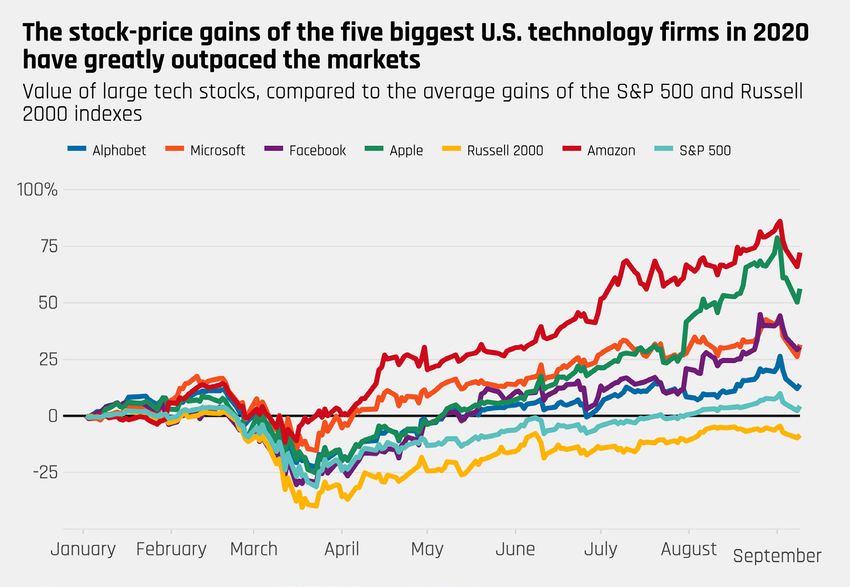
Main Street’s workers, families, and small businesses are now suffering as Wall Street prospers from policies to fight the coronavirus recession   2

States and a benchmark for gauging the health of the U.S. corporate sector—is up
more than 5 percent in 2020, as of September 9. The index has not only fully recov-
ered to its pre-pandemic level but, in fact, has hovered around the all-time high.5

Leading the way is Apple Inc., which saw its market capitalization double in just 2
years and was the first company in U.S. history to be valued at $2 trillion.6 Bond
issuances by U.S. companies—the way most medium- to large-sized firms fund
themselves, by issuing debt—have also soared to an all-time high in the second
quarter of 2020.7 This occurred after the U.S. bond market hit a prior high of
debt-raising in the previous quarter.8 Companies issuing both the most credit-wor-
thy investment-grade bonds and those issuing less credit-worthy “high yield” or
“junk” grade bonds have been able to raise money fairly cheaply to get through
the cash crunch caused by declining revenue during the coronavirus pandemic and
ensuing recession.9

How did the fates of working people—facing death, hunger, displacement, and job-
lessness—and small businesses facing permanent closure become so disconnect-
ed from the fates of large corporations? Why isn’t the abundance channeled via
U.S. financial markets to those at the top of the wealth and income ladders in the
United States translating to security for most individuals and families? The answer
is evident most immediately in the policy choices made during the coronavirus
recession but also in policies enacted in the decades before the U.S. economy hit
this particular shock.

This issue brief details what’s happening today on Main Street among our nation’s
workers, their families, and our small businesses. It then explains why much of Wall
Street remains insulated from the economic suffering happening across the Main
Streets of our nation, and how policy decisions made over the past 40 years have
produced these outcomes by design. It concludes with some key lessons about
why policymakers not acting aggressively and consistently during and after the
Great Recession of 2007–2009 harmed Main Street in many prolonged ways—les-
sons that, in 2020, seemed to have been learned, based on policymakers’ initial
actions at the onset of the coronavirus recession but which increasingly fade as
the fates of Wall Street and Main Street diverge.

To avoid another prolonged recession and tepid economic recovery, policymakers
need to realize that Main Street needs to come first. Those policy tools are avail-
able and tested. They need to be deployed.
Main Street’s workers, families, and small businesses are now suffering as Wall Street prospers from policies to fight the coronavirus recession   3

Individuals, families, and small businesses
are on the edge

Individuals, families, and small businesses are on the edge of a cratering economy.
The unemployment rate was 8.4 percent, as of August 2020, higher than at many
points during the Great Recession of 2007–2009.10 While overall unemployment
numbers have improved from their peak earlier this year, there’s been a surge in
the number of permanent job losses, as temporary layoffs transition to lasting
cuts.11 Food insecurity is rising, especially in households with children.12 Thirty
million to 40 million people may be at risk of looming evictions, marking the most
severe housing crisis in modern U.S. history.13 Small businesses everywhere are
shuttering, and many of them may be closed for good.14 Public health data indicate
that growing numbers of people are experiencing mental health challenges such
as depression, anxiety, substance abuse, and suicidal ideation.15 And all of these
trends, like COVID-19 itself, disproportionately harm people of color, especially
Black, Indigenous, and Latinx individuals and families.

The good news is that this suffering is not inevitable. Policymakers have the tools to
support individuals and families and to prevent a wider macroeconomic downturn
if they choose to do so. In fact, actions taken by lawmakers in the spring and early
summer as the pandemic spread across the country reduced the harm faced by most
workers and their families and at least some small business owners. But that protec-
tion began to wane beginning at the end of July as various coronavirus aid programs
expired. The renewed harm now facing many workers, their families, and small busi-
nesses will become more and more permanent if policymakers don’t act again soon.

 Researchers at the Center on Poverty and Social Policy at Columbia University
find that the Coronavirus Aid, Relief, and Economic Security, or CARES, Act, kept
12 million people out of poverty.16 Other research from former Equitable Growth
Steering Committee member and Harvard University researcher Raj Chetty, leading
the Opportunity Insights team, produced research showing that the “recovery
rebates” (also known as direct payments) provided to individuals and families
alongside enhanced Unemployment Insurance helped households in the poorest
ZIP codes maintain necessary spending.17

The same is true for housing stability. ProPublica, the investigative news organi-
zation, reviewed filings in local court records in more than a dozen states over
the course of months, finding that evictions dropped substantially in properties
covered by the CARES Act’s federal eviction moratorium.18 All of these findings,
however, are either largely expired or greatly diminished. Most of the one-time,
Main Street’s workers, families, and small businesses are now suffering as Wall Street prospers from policies to fight the coronavirus recession   4

direct relief $1,200 checks were spent many months ago, enhanced unemployment
benefits ran out at the end of July 2020, and significant uncertainty surrounds the
continuation of a federal eviction moratorium.19

Then, there are small businesses, which sustain half of private-sector jobs in the
country. The Washington Center for Equitable Growth previously documented
both the successes and challenges of earlier federal policy interventions, namely
the $670 billion Paycheck Protection Program.20 While that program proved to be
an effective lifeline for some firms in need of a boost to get through the worst of
the mandatory, pandemic-induded lockdowns, it was less successful in helping the
hardest-hit firms in the areas with the most cases of the coronavirus and the most
concentrated caseloads of COVID-19.21

Challenges with the Paycheck Protection Program largely centered around issues
with its program design, namely the rules around eligible uses of funds, condi-
tions for loan forgiveness, and the intermediation of funding to these businesses
through financial institutions.22 Equitable Growth documented how policymakers
might fix those flaws, but the future of the Paycheck Protection Program is uncer-
tain. As of August 8, 2020, the ability of the program to accept new applications ex-
pired, with more than $130 billion unspent and not available to eligible businesses.23

In summary, data show that we can prevent suffering when we give individuals,
families, and small businesses the direct support they need to survive the coro-
navirus recession. Policymakers provided substantial relief in the CARES Act, but
that help ran out. Yet what persists in its absence is the rescue money available for
financial markets, as well as pre-existing advantages in our economy for certain
large firms. Because our financial infrastructure is designed to quickly stabilize the
corporate sector—even without further action from Congress—what’s happening
on Wall Street looks a lot different from what’s happening for many workers.

Much of Wall Street is winning
When we say Wall Street is thriving, it’s important to identify precisely which slice
of U.S. businesses is doing well in this moment. A good way to judge medium- to
large-sized corporations’ health is through two measures. The first is to look at
how their stocks are trading. The second is to see whether corporations have been
able to borrow money and at what rate of interest. Corporations also raise money
by taking out loans from banks or nonbank financial firms, with small businesses
relying more on that type of funding. This issue brief will delve into those credit
markets, but only minimally.24
Main Street’s workers, families, and small businesses are now suffering as Wall Street prospers from policies to fight the coronavirus recession 5
Broadly, the two major U.S. stock markets, the New York Stock Exchange and
NASDAQ, are performing extraordinarily well because a handful of powerful tech-
nology companies are profiting handsomely due to the nature of the coronavirus
recession, which plays to their strengths, and because of historically lax antitrust
enforcement that enables them to further boost their profits at the expense of
other firms, workers, and consumers. Meanwhile, the U.S. bond market is perform-
ing well more broadly for all firms. This is due, in large part, to rescue programs
designed by the Federal Reserve under authority provided in the CARES Act.
So, let’s turn to each of these Wall Street financial markets in turn.
The U.S. stock market
Stocks represent equity, or an ownership interest, in a company. Fundamentally,
stock prices are determined by investors’ confidence in the future earnings of a
firm (calculated by combining the risk-free rate earned on holding government
debt, plus the risk premium associated with owning the stock). Stocks are also a
relatively risky form of investment, as stockholders are the first to bear losses and
the last in line to get paid if a company fails. In good times, stockholders are com-
pensated by dividends issued by the company or through appreciation of the stock
price, which is realized if the investor sells shares of stock.
So, how have the stock markets been performing during the coronavirus reces-
sion? While the S&P 500 index, which measures the 500 largest companies on
both U.S. stock markets, is up more than 5 percent in 2020 as of September 9,
those gains have been driven by only a handful of companies that control a signifi-
cant share of all stocks traded on the markets.25
Those top companies are concentrated in the technology sector. Consider the
roughly $27 trillion in total market capitalization of all companies in the S&P 500.26
Of the value of all outstanding shares:
Apple Inc. boasts a $2 trillion market value.27
Amazon.com Inc. and Microsoft Corp. each represent around $1.7 trillion in
value.28
Alphabet Inc., the parent company of Google, represents just more than $1
trillion in value.29
Facebook Inc. represents more than $800 billion in value.30Main Street’s workers, families, and small businesses are now suffering as Wall Street prospers from policies to fight the coronavirus recession 6
In total, the market capitalization of these five giants is more than one-fifth the val-
ue of the total market capitalization of the 500 largest firms trading on U.S. equity
markets. (See Figure 1.)
Figure 1
...the market
capitalization of these
five giants is more than
one-fifth the value
of the total market
capitalization of the 500
largest firms trading on
U.S. equity markets.
Source: Compust, Goldman Sachs Global
Investment Research.
More broadly, total market capitalization for all publicly traded firms is concentrat-
ed in the S&P 500, with those 500 companies representing more than 75 percent
of the value of all equities traded on U.S. stock exchanges.31 This level of concentra-
tion in market capitalization among a small number of companies is at historically
above-average levels and is at the highest level it has been in about 40 years.32 The
previous time it even approached this level was during the dot-com boom more
than two decades ago, though even then, the top five stocks only represented
around 16 percent of the S&P 500’s total value.33
These technology companies’ stock-price gains in 2020—particularly since the
coronavirus and its recession hit—are outsized, too. The stocks of these five firms
are registering astronomical returns while the median stock in the S&P 500 index
declined by 4 percent as of August 28.34
Technology companies dominate the stock market among large companies. And,
in turn, the stock market indexes of large companies are outpacing indexes backed
by the stocks of smaller firms. The Russell 2000, an index that tracks small-cap U.S.
firms, is down around 8.4 percent since the start of 2020, as of September 9.35
A visualization of the returns of Amazon, Alphabet, Apple, Microsoft, and FacebookMain Street’s workers, families, and small businesses are now suffering as Wall Street prospers from policies to fight the coronavirus recession 7
stocks, versus the returns of the overall S&P 500 and Russell 2000 indexes, is
instructive. (See Figure 2.)
Figure 2
...the stock market
indexes of large
companies are outpacing
indexes backed by the
stocks of smaller firms.
Source: Yahoo Finance.
If stock prices reflect investors’ belief in the future health of a company, then
technology firms are right to inspire significant confidence during the coronavirus
recession. With many people trapped at home, reluctant to go outside, and in-
creasingly working from their houses if they are able to do so, the business models
of technology companies are uniquely suited for this moment.
Take the changing nature of shopping. A survey by consulting firm McKinsey taken
between July 30, 2020 and August 2, 2020 finds that consumers’ use of online
channels for purchases surged during the pandemic, with 59 percent growth in
online grocery purchases, 45 percent growth in online over-the-counter medicine
purchases, and 18 percent growth in online consumer electronics purchases, to
name just three examples.36 McKinsey finds that across purchase categories, there
has been a 15 percent to 45 percent growth in online sales, with similar levels of
growth in the percentage of consumers who plan to make all purchases online.37
Across channels, new modes of product delivery, such as curbside pickup and
home delivery, rose sharply.38
This trend benefitted Amazon the most. The company registered 40 percent
growth in earnings in the second quarter of 2020, compared to a year earlier.39 In
fact, the company’s second quarter earnings this year “managed to blow away ele-
vated [investor] expectations,” according to the stock market website The MotleyMain Street’s workers, families, and small businesses are now suffering as Wall Street prospers from policies to fight the coronavirus recession 8
Fool.40 And Amazon continues to expand in ways that draw sharp contrast with the
decline in brick-and-mortar retail sales and the companies engaged in traditional
retail sales. News articles recently reported that Amazon is looking to convert
vacant mall department stores into distribution centers, with Amazon’s growing
reach coming alongside the recent bankruptcies of retailers, including J.C. Penney
Company, Inc., Sears Holdings, Marcus Corp (the parent company of Neiman Mar-
cus), J.Crew Group, Inc., and Ann Taylor’s parent company, Ascena Retail Group.41
The surge in working from home, rather than the office, has also benefited tech-
nology companies, which provide services such as cloud computing needed for
telework. A survey of more than 300 chief financial officers and finance leaders
by research firm Gartner Inc. finds that nearly three-quarters of companies plan
to shift at least 5 percent of their previously on-site workforce to remote work
permanently.42 Another study by consulting company Global Workplace Analytic
estimates that when the pandemic is over, 30 percent of the entire workforce will
work from home at least a couple times a week.43 In contrast, before the pandemic,
U.S. Census Bureau data released in 2018 found that 5.3 percent of workers typical-
ly worked at home.44
But it’s not just COVID-19 causing technology companies’ dominance. A second
factor to consider is how U.S. competition policy favors Big Tech. As the Washing-
ton Center for Equitable Growth’s Director of Competition Policy Michael Kades
noted in a recent post, weak antitrust laws and conservative courts using unsound
economic theories continually expose U.S. markets to corporate abuses of market
power, which boost large corporations’ profits and dominance at the expense of
competitors, workers, and consumers.45
In a recent hearing of the U.S. House Committee on the Judiciary featuring the
chief executive officers of Amazon, Apple, Google, and Facebook, Kades notes
how policymakers focused on the ways in which these technology companies have
suppressed competition through harmful exclusionary conduct.46 Those practices,
according to Kades, “allow dominant companies to stifle actual and potential rivals,
preventing competition on the merits and allowing incumbents to obtain or exploit
market power.”47
Kades notes that in the hearing, policymakers cited several examples of these
practices, including:
Facebook cutting off online entertainment community Vine’s access to
Facebook because it was a potential competitor
Amazon pricing its proprietary products and services below cost to
drive out competitorsMain Street’s workers, families, and small businesses are now suffering as Wall Street prospers from policies to fight the coronavirus recession 9 Apple discriminating against apps that compete with Apple products Google preferencing its own content over that of its competitors48 Kades notes that new legislation is needed to give enforcement agencies and the courts the ability to shift the balance in U.S. antitrust law.49 The U.S. bond market In addition to funding themselves with shares, firms also fund themselves with bonds, or securities issued by a firm paying a pre-established rate of return, either fixed or variable, for a set period of time. Bondholders’ investments are usually backed by collateral owned by the firm, and bondholders receive priority com- pared to stockholders if a company fails and its assets are liquidated. Like stocks, bonds are widely traded among investors and can be grouped into in- dexes composed of a variety of bonds that can also be traded. Unlike stocks, bond returns do not change based on swings in the value of the firm. Note that compa- nies can also fund themselves with other types of debt such as loans from banks or nonbank financial firms, including private equity companies, which this issue brief will touch on briefly later. The bond market, unlike the stock markets, is performing solidly for all types of companies, even during the coronavirus recession.50 All told, companies, as of mid-August, have issued $1.9 trillion in bonds in 2020—a record amount, with healthy issuance for both investment-grade and speculative-grade companies.51 Companies have needed to raise additional money to help cover revenue shortfalls caused by a dip in demand during the pandemic. Other companies are issuing new debt because of the historically low cost of financing, driven by Federal Reserve interventions in the market, described later in this issue brief. Among investment-grade companies, bond issuance totaled $1.3 trillion, hitting a yearly record just 8 months into the year 2020.52 Big companies such as Alphabet and Apple borrowed billions of dollars in recent weeks to lock in the low cost of debt financing.53 Indeed, mid-August 2020 was a record week for investment-grade bond issuances. (See Figure 3 on next page.) Riskier firms have been able to issue bonds as well. Issuance by high-yield companies set a record in the second quarter of 202054 and topped a new record for the “typ- ically slow August,” breaking records not seen since 2012.55 Firms adversely affected by the pandemic—among them aerospace manufacturer Boeing Inc. and Carnival Corp., the cruise line—were able to issue debt to fund themselves when previously,
Main Street’s workers, families, and small businesses are now suffering as Wall Street prospers from policies to fight the coronavirus recession 10

                                                                                                                    Figure 3

                                                                                                                    Among investment-grade
                                                                                                                    companies, bond issuance
                                                                                                                    totaled $1.3 trillion,
                                                                                                                    hitting a yearly record
                                                                                                                    just 8 months into the
                                                                                                                    year 2020.
                                                                                                                    Source: Skyler Rossi, “U.S. High-Grade
                                                                                                                    Bond Sales Set Record, Reach $1.346
                                                                                                                    Trillion” Bloomberg, August 17, 2020,
                                                                                                                    available at https://www.bloomberg.
                                                                                                                    com/news/articles/2020-08-17/u-s-high-
                                                                                                                    grade-sales-topple-record-reach-1-342-
                                                                                                                    trillion?sref=hXddXOju.

both firms had sought higher-cost loans from nonbank financial firms such as hedge
funds.56 In total, yields on high-yield companies’ bonds are at record lows after briefly
spiking in March 2020, meaning investors are requiring historically small levels of
returns in exchange for purchasing company debt.57 (See Figure 4.)

                                                                                                                    Figure 4

                                                                                                                    ...yields on high-yield
                                                                                                                    companies’ bonds are at
                                                                                                                    record lows after briefly
                                                                                                                    spiking in March 2020.
                                                                                                                    Source: Paula Seligson and Gowri Gurumurthy,
                                                                                                                    “U.S. Junk Bond Market Sets Record-Low
                                                                                                                    Coupon in Relentless Rally,” Bloomberg,
                                                                                                                    August 10, 2020, available at https://www.
                                                                                                                    bloomberg.com/news/articles/2020-08-10/u-s-
                                                                                                                    junk-bond-market-sets-record-low-coupon-in-
                                                                                                                    relentless-rally?sref=hXddXOju.

How did the bond market become so robust for the full spectrum of firms issuing
debt? This story is about interventions by the Federal Reserve.
Main Street’s workers, families, and small businesses are now suffering as Wall Street prospers from policies to fight the coronavirus recession 11 The U.S. bond market seized up in March, when the coronavirus recession began and as a growing consensus developed in U.S. financial markets that the United States would experience a prolonged recession due to the ongoing and failed public health response to the coronavirus pandemic.58 But the Federal Reserve’s mere announcement at the end of that month—saying the central bank would undertake a number of accommodative measures to boost the economy, includ- ing buying bonds and exchange traded funds, or ETFs, backed by bonds using funds appropriated under the CARES Act—caused markets to rebound and gain confidence.59 Indeed, Federal Reserve Chair Jerome Powell noted at the end of March that the central bank is “not going to run out of ammunition,” and financial markets responded with confidence.60 Specifically, the central bank set up two facilities, announced in March but opera- tionalized starting in May, for the purpose of supporting corporate credit markets. The first facility, the Primary Market Corporate Credit Facility, which is opera- tional but has not yet made any purchases, is designed to purchase debt directly from the issuing companies.61 The second facility allows the Fed to purchase both individual bonds and ETFs backed by corporate bonds on the secondary market via the Secondary Market Corporate Credit Facility.62 In total, both programs have the authority to purchase up to $750 billion in assets.63 The Fed, using its lender- of-last-resort authority to leverage money appropriated by Congress, which stands in a first-loss position relative to the central bank, has $75 billion in congressional appropriations to withstand any losses on its balance sheets.64 As of August 10, 2020, the Secondary Market Corporate Credit Facility has just more than $12 billion worth of holdings, around $8.7 billion of which is in the form of ETFs and $3.5 billion of which is in the form of individual bonds purchased on the secondary market.65 The purchases by the Fed include bonds, or ETFs backed by bonds, issued by firms that were rated as investment grade on March 22, 2020, whether they have kept that rating or have been subject to certain downgrades since that date (companies in the latter category are known as “fallen angels”).66 Among individual bond purchases, the Fed’s activity has been concentrated among blue chip companies, or large, well-established firms with household names.67 Individual bond purchases have comprised all of the Fed’s activity since the end of July.68 Generally, the Fed’s purchase activity has slowed in recent months com- pared to early on in the pandemic response, but it still remains active.69 The Fed helped companies that are riskier bets too, through the purchase of ETFs, which began in May 2020 but has generally slowed in the months since.70 Early pur- chases of ETFs by the Fed coincided with private buyers flooding the market, with the Fed’s purchases making investors feel more comfortable with the risks associ- ated with companies with riskier profiles and higher debt.71 Though the Fed owned
Main Street’s workers, families, and small businesses are now suffering as Wall Street prospers from policies to fight the coronavirus recession 12 only 3 percent of total assets in the ETFs in which it purchased shares at the end of June, the Fed accounted for more than half of new cash inflows into some ETFs, giving it an outsized ownership share of some funds and putting pressure upward on prices and driving down yields.72 Notably, the Fed and other banking regulators sounded the alarm on high-yield corporate debt just before the pandemic.73 But today, 54 percent of the Fed’s cor- porate debt portfolio is composed of bonds on the cusp of junk bond territory,74 easing investors’ comfort and causing them to expand purchases notwithstanding increasing default rates and ratings downgrades.75 The size of the Fed’s total bond market interventions, at $12 billion,76 is relatively small (by way of comparison, Alphabet alone issued $10 billion in debt earlier this month).77 Still, the effects of the Fed’s actions on financial markets are profound. Fed reassurances to the bond market demonstrate that it will do whatever is nec- essary to stabilize corporate credit markets, and the $750 billion pledge of avail- able funding for the Primary Market Corporate Credit Facility, alongside continuing purchases by its SMCCF window, gives confidence that the Fed has deep pockets to execute on its promises. Observers differ on their perception of the wisdom of the Fed’s actions, with some calling it “decisive action” to “[avert] a worst-case scenario”78 and others saying the Fed is “addicted to propping up markets even without a need.”79 But all agree that the bond market was buoyed by Federal Reserve interventions. Why isn’t the boom on Wall Street trickling down? The stock market and the bond market are humming along amid the unprecedent- ed coronavirus recession. But one central question that flows from these trends is to what extent the boom in stocks and bonds is helping people on Main Street by: Preventing layoffs Boosting individuals’ investment incomes Producing knock-on effects for small businesses Helping state and local governments cope with declining revenues
Main Street’s workers, families, and small businesses are now suffering as Wall Street prospers from policies to fight the coronavirus recession 13

The short answer is that it is too soon to tell, but let’s examine each of these
questions individually. The details may well indicate the emergence of trends in
the coming weeks and months akin to what happened during and after the Great
Recession of 2007–2009, which produced prolonged suffering for Main Street.

U.S. financial market gains are not preventing many layoffs

The stock market boom doesn’t mean much for most workers’ jobs. First, only
around 17 percent of workers are employed at an S&P 500 firm.80 In contrast,
nearly half the U.S. workforce is employed by small businesses.81 The vast majority
of small businesses don’t issue stock.

For those who are employed at companies that issue shares, stock prices could
be correlated with job growth—investors may feel confident in a company when
they see it innovating or investing in workers to grow the business. But sometimes,
investors actually penalize companies for investing in workers. American Airlines
Group, for example, was downgraded by analysts when it gave raises to pilots and
flight attendants.82 And Chipotle Mexican Grill, Inc. experienced a 3 percent decline
in its stock price when analysts determined it couldn’t trim its workforce costs.83

Importantly, the companies whose stocks are surging the most during the corona-
virus recession don’t employ that many people. Big technology companies, while
large employers in an absolute sense, don’t have that many workers compared to
their share of the stock markets’ total value. While they represent around a fourth
of the total market capitalization of S&P 500 firms, they represent only 5 percent of
the index’s total workforce. As a recent Bloomberg news report notes, 20 years ago,
companies with the same market share employed 10 percent of the S&P 500’s total
workforce.84 These companies are also more likely to use gig workers or independent
contractors, who don’t have the security of permanent employees.85 Good examples
are Amazon using independent contractors to do “last mile” deliveries with their
own cars,86 or Google and Facebook using independent contractors to screen their
platform for inappropriate content that violates the company’s guidelines.87

In fact, research suggests that companies with a higher level of “intangible assets”
(such as intellectual property and brand recognition) per employee are far outpacing
stock gains compared to companies with fewer intangible assets per employee.88
Part of this is driven by the unique nature of the coronavirus recession and the surge
in the value of technology intermediation. But again, it’s also an outgrowth of anti-
trust policies that allowed prolific mergers and acquisitions in the technology sector.

The Fed’s support for bond markets could hypothetically support workers at com-
panies that need to issue debt. After all, if a company can’t raise money, they can’t
Main Street’s workers, families, and small businesses are now suffering as Wall Street prospers from policies to fight the coronavirus recession 14

meet payroll. It is hard to causally determine whether any Fed actions are respon-
sible for any positive indicators in labor markets, but, as economist William Spriggs
of the AFL-CIO notes, one counterfactual (the Fed not acting at all) is unlikely to
have produced better results for workers. Spriggs notes, “so you want [the Fed] to
let all the companies go bankrupt? And then which jobs do you think will be left?”

In short, boosting teetering companies, while imperfect, may be better than the
alternative.89

However, it is important to note that the Fed didn’t face a binary choice to do every-
thing for corporate credit markets without precondition or do nothing at all. In fact,
the CARES Act did include discretionary authority for the Fed to require corpora-
tions receiving rescue aid to retain jobs, maintain collective bargaining agreements,
prohibit dividends and stock buybacks, and limit executive compensation,90 yet the
Fed used several legal maneuvers to sidestep those conditions on aid.91 Two exam-
ples of how the Fed’s financial market activities are decoupled from worker pro-
tections can be instructive. For example, the Fed purchased corporate debt issued
by ExxonMobil Corp.92 Meanwhile, the company is separately preparing for job cuts
and ending their employer match for their remaining employees’ 401(k) retirement
plans.93 The Fed also bought the corporate debt of Tyson Foods, Inc.,94 while the
company has allowed a massive outbreak of COVID-19 in its meatpacking facilities.95

Finally, some contend that the Fed’s bond market actions are just delaying the devil
coming due for many teetering firms and therefore won’t have a long-term posi-
tive effect on jobs. Indeed, the Federal Reserve Bank of New York recently noted
a growth in firms whose expense payments exceed their cash flow.96 These firms
are colloquially known as zombie companies.97 The New York Fed’s research finds
that around 25 percent of all public firms (except agriculture) had expense pay-
ments that exceeded cash flow, along with more than a third of companies in the
entertainment/hospitality/food, mining/oil, and retail industries.98 The Fed’s bond
purchases could serve to prop up companies that otherwise would have stumbled
or failed, including those that were precarious long before the pandemic, such as
many oil and gas firms.99

Investment income doesn’t matter much for most Americans

The Fed’s actions also are unlikely to boost returns for most low- to moderate-in-
come people in the United States. While about half of Americans own some
amount of stock (either directly or through investment vehicles such as 401(k)
plans), the value of all stock ownership is concentrated, with the top 1 percent of
households by wealth owning more than half the value of all outstanding shares.100
Main Street’s workers, families, and small businesses are now suffering as Wall Street prospers from policies to fight the coronavirus recession 15

As for corporate bonds, individual ownership, especially among moderate-income
households, is extremely limited in the United States. Low- and moderate-income
people do have exposure to the bond market through insurance companies, mutu-
al funds, or pension funds that own such bonds.101

Small businesses continue to struggle

The Fed’s actions also are unlikely to do much for small businesses, aside from po-
tential salutary macroeconomic effects of its actions for the U.S. economy gener-
ally. Small businesses typically don’t issue stocks or bonds, so they’re not helped by
the Fed’s interventions in those markets. Low interest rates, under typical econom-
ic conditions, should enable some small firms to borrow more cheaply from com-
mercial bank lenders. But, as described more below, bank lending is retrenching as
financial institutions become more risk-averse during the pandemic.

The Fed did create a separate program to facilitate direct lending to mid-sized
businesses, known as the Main Street Lending Facility.102 The program was de-
signed to encourage financial institutions to lend to mid-sized companies with up
to 15,000 employees and $5 billion in revenue by having the Federal Reserve pur-
chase 85 percent to 95 percent of those underlying loans.103 Despite a $600 billion
available pot of funding, the Fed has only committed or settled $252 million across
32 loans, with another 55 loans worth $604 million under review.104

This Fed program is floundering due to the complex rules of the Fed’s Main Street
Lending Facility, alongside the already substantial debt load among mid-sized busi-
nesses and the reliance of the Fed program on the participation of private-sector
lenders.105 Indeed, the sluggish start of the Main Street Lending Facility mirrors a
general downturn in available credit for small- and mid-sized companies that rely
on bank and nonbank loans for funding, despite low interest rates.

As noted in a recent Bloomberg article, “banks are tightening conditions on loans
to smaller firms at a pace not seen since the financial crisis, while many direct lend-
ers that have traditionally focused on the middle market are pulling back or turning
to bigger deals instead.”106 This is despite claims from some that recent relaxation
of post-Great Recession banking regulations would increase the provision of credit
for nonfinancial businesses.107 Nonbank lenders are likewise tightening lending as
they address increasing defaults and are targeting bigger deals.108

In short, the coronavirus recession and the policy response has produced a lopsid-
ed trend in corporate credit markets—with small firms that rely on lending in-
creasingly finding it difficult to get credit while high-yield firms with access to bond
markets enjoying falling yields.109 (See Figure 5 on next page.)
Main Street’s workers, families, and small businesses are now suffering as Wall Street prospers from policies to fight the coronavirus recession 16

                                                                                                                    Figure 5

                                                                                                                    ...the coronavirus
                                                                                                                    recession and the
                                                                                                                    policy response has
                                                                                                                    produced a lopsided
                                                                                                                    trend in corporate credit
                                                                                                                    markets—with small
                                                                                                                    firms that rely on lending
                                                                                                                    increasingly finding it
                                                                                                                    difficult to get credit while
                                                                                                                    high-yield firms with
                                                                                                                    access to bond markets
                                                                                                                    enjoying falling yields.
State and local government financing is dire
                                                                                                                    Note: 3Q BBB yield as of August 11, 2020.

How are the Federal Reserve’s bond market interventions affecting the health of                                     Source: Paula Seligson and Gowri Gurumurthy,
state and local government finances and, therefore, the workers of these public-sec-                                “U.S. Junk Bond Market Sets Record-Low
                                                                                                                    Coupon in Relentless Rally,” Bloomberg,
tor employers? The Fed, in April, established a Municipal Lending Facility to buy up                                August 10, 2020, available at https://www.
                                                                                                                    bloomberg.com/news/articles/2020-08-10/u-s-
to $500 billion in bonds issued by certain qualifying counties and cities so that they                              junk-bond-market-sets-record-low-coupon-in-
could use the proceeds to pay for necessary expenses related to, or declines in reve-                               relentless-rally?sref=hXddXOju.

nue because of, COVID-19.110 But only two bonds have been purchased by the Fed so
far. One was issued by the state of Illinois, for $1.2 billion.111 The other was issued by
the state of New York Metropolitan Transit Authority, for $451 million.112

The discrepancy between the Fed’s municipal and corporate bond buying program
rules is instructive. The Fed imposes more stringent requirements on municipal
borrowers than on corporate ones. A municipality rated A3 by a credit rating agen-
cy (a medium-grade rating that signifies the weakest borrowers within the cohort
of strong borrowers) could borrow for a maximum of 3 years at around a 2.2 per-
cent interest rate, while a similarly situated bond issued by an A3-rated corporation
would pay just 1 percent.113

What’s more, municipalities can borrow for a maximum of 3 years, but corpora-
tions will be able to borrow for 4 years to 5 years—giving them more time to repay
debts.114 Companies that issue bonds directly to the Fed via the Primary Market
Corporate Credit Facility can have repayment timelines of up to 4 years, while the
Fed’s program to buy bonds in the secondary market through its Secondary Mar-
ket Corporate Credit Facility is allowing maturities of up to 5 years.115
Main Street’s workers, families, and small businesses are now suffering as Wall Street prospers from policies to fight the coronavirus recession 17 Similar to the situation with corporate bonds, municipal bonds were stressed at the onset of COVID-19, and then, the market stabilized upon the Fed announcing its interventions, which included both the creation of the state and local bond purchase facility and other actions.116 But the Fed’s terms for municipal bond pur- chases are generally more punitive than those for corporations, meaning that the program may only be attractive for lower-rated municipalities that would other- wise have trouble borrowing at low cost in the market. Tellingly, only two municipal bond issuers have found the Fed’s terms attractive, with issuances totaling $1.65 billion, compared to more than $12 billion in Fed-supported corporate bond issu- ances, which support a range of investment-grade and high-yield firms. Given the large declines in state and local revenues, combined with a lack of emer- gency federal support for state and local government bearing the increased costs of fighting the pandemic, public-sector job losses and services cuts are all but certain to continue because most states cannot run budget deficits. States and localities have already cut about 6 percent of their workforces as of mid-August 2020, and most estimates anticipate further job cuts absent a stabilization of the pandemic, added support from Congress, or a loosening of borrowing terms by the Federal Reserve.117 Conclusion The coronavirus economic crisis need not produce deep and sustained harm for individuals and families in the United States if policymakers learn the lessons of the past. During the Great Recession, Congress failed to provide support commensu- rate with the scale of the crisis, and we saw the consequences.118 Wall Street was quickly stabilized and returned to profitability, with the fourth quarter of 2009 being the last quarter in which the banking sector posted losses.119 But individuals, families, and small businesses did not fare as well. It took until 2017 for median household income to get back to pre-crisis levels.120 The Great Reces- sion saw more than a third of workers unemployed for 27 weeks or more.121 These sustained periods of joblessness led to poorer health, shorter life expectancies, and worse academic performance for children.122 The eviction crisis during and after the Great Recession produced heightened levels of stress, health crises, ad- diction, child abuse, and myriad other negative family outcomes.123 The apex of the previous global financial crisis, 2009, marked the year when business deaths most strongly outpaced business births, and for 3 months that year, new business creation reached its lowest point since the U.S. Bureau of Labor Statistics began collecting the information.124 And, perhaps most troublingly, one
Main Street’s workers, families, and small businesses are now suffering as Wall Street prospers from policies to fight the coronavirus recession 18

study from the U.S. Centers for Disease Control and Prevention found that suicides
doubled in the years just before and after the Great Recession, spurred by severe
housing stress, including evictions and foreclosures.125

Today, Wall Street is recovering even faster than during and after the Great
Recession. Meanwhile, the coronavirus recession may be on track to deliver even
worse economic conditions for workers, their families, and small businesses.
Absent further action from policymakers, our nation may replicate the alarming
consequences of the Great Recession. And this is not even taking into account the
human tragedies brought on by the coronavirus pandemic and COVID-19 deaths
and lingering sicknesses.

Policymakers have the evidence and tools to ensure a strong recovery. Direct finan-
cial aid to individuals and families works. Programs such as extended Unemployment
Insurance, increased food benefits through the Supplemental Nutirition Assistance
Program, and aid to states for Medicaid should be scaled up commensurate with
economic indicators—and not scaled down until indicators show it’s safe to do so.
Congress also needs to provide more financial aid to state and local governments.

Then, there are the reforms needed to ensure continuing financial aid to Wall
Street is accompanied by concomitant obligations to help workers and their
families, and support credit to small businesses. Policymakers should design more
resilient “plumbing” to make rescues of families and small businesses as friction-
less as Federal Reserve financial market interventions.126

Beyond the immediate response to the pandemic, the Washington Center for
Equitable Growth provides a roadmap for the structural solutions needed to rebal-
ance the economy over the long term, including restoring antitrust enforcement,
boosting wages, and empowering workers.127 The United States walked into the
coronavirus pandemic with severe underlying fragilities. To ensure a sustainable
recovery will require bold action now, as well as addressing these weaknesses with
structural policy changes.

—Amanda Fischer is the Policy Director at the Washington Center
for Equitable Growth.
Main Street’s workers, families, and small businesses are now suffering as Wall Street prospers from policies to fight the coronavirus recession 19

Endnotes
1		 Sam Van Pykeren, “Food Bank Lines Across            12		 Ben Eisen, “How’s the Coronavirus Economy?
    America,” Mother Jones, April 13, 2020, available        Great or Awful, Depending on Whom You
    at https://www.motherjones.com/food/2020/04/             Ask,” The Wall Street Journal, September 2,
    these-photos-show-the-staggering-food-bank-              2020, available at https://www.wsj.com/articles/
    lines-across-america/.                                   hows-the-coronavirus-economy-great-or-awful-
                                                             depending-on-whom-you-ask-11599039003.
2		 Chris Granger, “Photos: Renters Block New
    Orleans Courthouse to Protest Rising Evictions      13		 Emily Benfer and others, “The COVID-19
    During Coronavirus,” The Times-Picayune, July            Eviction Crisis: An Estimated 30-40 Million
    30, 2020, available at https://www.nola.com/             People in America Are At Risk” (Washington:
    multimedia/photos/collection_20c3ed8c-d288-              The Aspen Institute, 2020), available at https://
    11ea-85cf-2b21a79e5ab9.html#3.                           www.aspeninstitute.org/blog-posts/the-covid-
                                                             19-eviction-crisis-an-estimated-30-40-million-
3		 Matthew Haag, “One-Third of New York’s Small             people-in-america-are-at-risk/.
    Businesses May Be Gone Forever,” The New York
    Times, August 5, 2020, available at https://www.    14		 Ann Saphir, “U.S. Small Businesses Face Mass
    nytimes.com/2020/08/03/nyregion/nyc-small-               Closures Without More Pandemic Aid,” Reuters,
    businesses-closing-coronavirus.html.                     July 29, 2020, available at https://www.reuters.
                                                             com/article/us-health-coronavirus-usa-smallbiz-
4		 “United States COVID-19 Cases and                        insig/u-s-small-businesses-face-mass-closures-
    Deaths by State,” available at https://                  without-more-pandemic-aid-idUSKCN24U1MM.
    covid.cdc.gov/covid-data-tracker/?CDC_
    AA_refVal=https%3A%2F%2Fwww.cdc.                    15		 Mark E. Czeisler, “Mental Health, Substance
    gov%2Fcoronavirus%2F2019-ncov%2Fcases-                   Use, and Suicidal Ideation During the COVID-19
    updates%2Fcases-in-us.html#cases (last accessed          Pandemic – United States, June 24-30, 2020”
    September 14, 2020).                                     (Washington: U.S. Centers for Disease Control
                                                             and Prevention, 2020), available at https://
5		 “S&P 500 Index,” as of September 2, 2020,                www.cdc.gov/mmwr/volumes/69/wr/mm6932a1.
    available at https://www.marketwatch.com/                htm#suggestedcitation.
    investing/index/spx.
                                                        16		 Zachary Parolin, Megan A. Curran, and
6		 Jessica Bursztynsky, “Apple Becomes First U.S.           Christopher Wimer, “The CARES Act and
    Company to Reach $2 Trillion Market Cap,”                Poverty in the COVID-19 Crisis” (New York:
    CNBC, August 19, 2020, available at https://www.         Center on Poverty and Social Policy at Columbia
    cnbc.com/2020/08/19/apple-reaches-2-trillion-            University Poverty & Social Policy Brief, 2020),
    market-cap.html#:~:text=Apple%20hit%20a%20               available at https://static1.squarespace.com/
    market%20cap%20of%20%242%20trillion%20                   static/5743308460b5e922a25a6dc7/t/5eefa3463
    Wednesday%2C%20doubling,barrier%20just%20                153d0544b7f08b4/1592763209062/Forecasting-
    before%2011%20a.m.                                       Poverty-Estimates-COVID19-CARES-Act-
7		 Nick W. Kraemer and others, “Credit Trends:              CPSP-2020.pdf.
    Global Financing Conditions: Bond Issuance Is       17		 Raj Chetty and others, “How Did COVID-19
    Expected to Finish 2020 Up 6% After A Strong             and Stabilization Policies Affect Spending and
    Second Quarter,” S&P Global Market Intelligence,         Employment? A New Real-Time Economic
    July 27, 2020, available at https://www.spglobal.        Tracker Based on Private Sector Data”
    com/ratings/en/research/articles/200727-credit-          (Cambridge, MA: Opportunity Insights, 2020),
    trends-global-financing-conditions-bond-                 available at https://opportunityinsights.org/wp-
    issuance-is-expected-to-finish-2020-up-6-after-a-        content/uploads/2020/05/tracker_paper.pdf.
    strong-sec-11584612.
                                                        18		 Jeff Ernsthausen and Ellis Simani, “The Eviction
8		 Ibid.                                                    Ban Worked, But It’s Almost Over. Some
9		 Ibid.                                                    Landlords Are Getting Ready,” ProPublica, July
                                                             24, 2020, available at https://www.propublica.org/
10 U.S. Bureau of Labor Statistics, “The Employment          article/the-eviction-ban-worked-but-its-almost-
   Situation – August 2020,” Press release,                  over-some-landlords-are-getting-ready.
   September 4, 2020, available at https://www.bls.
   gov/news.release/pdf/empsit.pdf.                     19		 Michael Garvey and Claudia Sahm, “Get
                                                             More Money Immediately to U.S. Families
11		 Brian Chappatta, “Permanent Job Losses Pose             and Help Them Out of the Coronavirus
     Trouble for Economic Recovery,” Bloomberg,              Recession” (Washington: Washington Center
     September 4, 2020, available at https://finance.        for Equitable Growth, 2020), available at
     yahoo.com/news/permanent-job-losses-pose-               https://equitablegrowth.org/get-more-money-
     trouble-150223643.html.
Main Street’s workers, families, and small businesses are now suffering as Wall Street prospers from policies to fight the coronavirus recession 20
immediately-to-u-s-families-and-help-them-out- accessed September 14, 2020). Total market
of-the-coronavirus-recession/. capitalization of all U.S. companies is $35 trillion,
$27 trillion of which is represented in the S&P
20 Amanda Fischer, “Did the Paycheck Protection 500.
Program Work for Small Businesses Across
the United States?” (Washington: Washington 32 Ben Marks and Brett Angel, “The S&P 500 Has
Center for Equitable Growth, 2020), available at Never Been More Top Heavy,” Minneapolis Star
https://equitablegrowth.org/did-the-paycheck- Tribune, August 15, 2020, available at https://www.
protection-program-work-for-small-businesses- startribune.com/the-s-p-500-has-never-been-
across-the-united-states/. more-top-heavy/572106152/.
21 Ibid. 33 Ibid.
22 Ibid. 34 Lawrence Delevingne, “U.S. Big Tech Dominates
Stock Market After Monster Rally, Leaving
23 Jeanne Sahadi, “Many Small Business Investors on Edge,” Reuters, August 28, 2020,
Owners Worry a Second Shutdown Would available at https://www.reuters.com/article/
be Devastating,” CNN Business, July 4, 2020, us-usa-markets-faangs-analysis/u-s-big-tech-
available at https://www.cnn.com/2020/06/30/ dominates-stock-market-after-monster-rally-
success/small-business-ppp-loan-coronavirus- leaving-investors-on-edge-idUSKBN25O0FV.
shutdown-what-now/index.html.
35 “Russell 2000 index year-to-date returns,”
24 Federal Deposit Insurance Corporation, as of September 3, 2020, available at https://
“Leveraged Lending and Corporate Borrowing: www.marketwatch.com/investing/index/rut (last
Increased Reliance on Capital Markets, with accessed September 14, 2020).
Important Bank Links” (2019), available at https://
www.fdic.gov/bank/analytical/quarterly/2019- 36 McKinsey & Company, “Survey: U.S. Consumer
vol13-4/fdic-v13n4-3q2019-article2.pdf. Sentiment During the Coronavirus Crisis” (2020),
Specifically, according to the report, from 1990 available https://www.mckinsey.com/business-
to 2017, debt securities increased their share of functions/marketing-and-sales/our-insights/
corporate borrowing from 48 percent to around survey-us-consumer-sentiment-during-the-
69 percent, with the remaining borrowing taking coronavirus-crisis.
the form of bank and nonbank loans. Corporate
37 Ibid.
borrowers account for a much smaller share than
smaller, noncorporate businesses such as sole 38 Ibid.
proprietorships and partnerships that rely more
heavily on banks to fund themselves because 39 Jeffrey Dastin and Akanksha Rana, “Amazon
they do not issue stocks or bonds. Posts Biggest Profit Ever At Height of Pandemic
in U.S.,” Reuters, July 30, 2020, available at https://
25 “S&P 500 Index,” as of September 2, 2020. www.reuters.com/article/us-amazon-com-results/
amazon-posts-biggest-profit-ever-at-height-of-
26 “S&P 500 Market Cap: 27.05 USD for Jul 2020,”
pandemic-in-u-s-idUSKCN24V3HL.
available at https://ycharts.com/indicators/
sp_500_market_cap. 40 Daniel Sparks, “Is Amazon Stock a Buy Right
Now?” Motley Fool, August 11, 2020, available
27 “Apple Market Cap: 2.225T USD for Sept 2020,”
at https://www.fool.com/investing/2020/08/11/is-
available at https://ycharts.com/companies/AAPL/
amazon-stock-a-buy-right-now.aspx.
market_cap.
41 Esther Fung and Sebastian Herrera, “Amazon and
28 “Amazon Market Cap: 1.756T USD for Sept 2020,”
Mall Operator Look at Turning Sears, J.C. Penney
available at https://ycharts.com/companies/
Stores Into Fulfillment Centers,” The Wall Street
AMZN/market_cap; “Microsoft Market Cap: 1.735T
Journal, August 9, 2020, available at https://
for Sept 2020,” available at https://ycharts.com/
www.wsj.com/articles/amazon-and-giant-mall-
companies/MSFT/market_cap.
operator-look-at-turning-sears-j-c-penney-stores-
29 “Alphabet Market Cap: 1.143T for Sept 2020,” into-fulfillment-centers-11596992863.
available at https://ycharts.com/companies/
42 Gartner Inc., “Gartner CFO Survey Reveals 74
GOOG/market_cap.
Percent Intend to Shift Some Employees to
30 “Facebook Market Cap: 843.71B for Sept 2020,” Remote Work Permanently,” Press release, April
available at https://ycharts.com/companies/FB/ 3, 2020, available at https://www.gartner.com/en/
market_cap. newsroom/press-releases/2020-04-03-gartner-
cfo-surey-reveals-74-percent-of-organizations-
31 “Total Value of of U.S. Stock Market, June 30, to-shift-some-employees-to-remote-work-
2020,” available at https://siblisresearch.com/data/ permanently2.
us-stock-market-value/#:~:text=The%20total%20
market%20capitalization%20of,about%20 43 Rani Molla, “Office Work Will Never Be the
OTC%20markets%20from%20here.) (last Same,” Vox, May 21, 2020, available at https://Main Street’s workers, families, and small businesses are now suffering as Wall Street prospers from policies to fight the coronavirus recession 21
www.vox.com/recode/2020/5/21/21234242/ to Finish 2020 Up 6% After A Strong Second
coronavirus-covid-19-remote-work-from-home- Quarter.”
office-reopening.
55 Cezary Podkul, “Fed Stimulus Is
44 U.S. Census Bureau, “Selected Economic Resuscitating the High-Yield Bond Market,”
Characteristics: American Community Survey” The Wall Street Journal, August 14, 2020,
(2018), available at https://data.census.gov/ available at https://www.wsj.com/articles/fed-
cedsci/table?q=commute&tid=ACSDP1Y2018. stimulus-is-resuscitating-the-high-yield-bond-
DP03&hidePreview=false. market-11597438798.
45 Michael Kades, “Hearing with Tech CEOs 56 Steven Pearlstein, “The Fed is Addicted to
Sets Stage for New Legislation to Tackle Propping Up the Markets, Even Without a
Anticompetitive Conduct By Dominant Firms Need,” The Washington Post, June 17, 2020,
in U.S. Economy” (Washington: Washington available at https://www.washingtonpost.com/
Center for Equitable Growth, 2020), available at business/2020/06/17/fed-is-addicted-propping-up-
https://equitablegrowth.org/hearing-with-tech- market-whether-it-needs-help-or-not/.
ceos-sets-stage-for-new-legislation-to-tackle-
57 Paula Seligson and Gowri Gurumurthy, “U.S.
anticompetitive-conduct-by-dominant-firms-in-
Junk Bond Market Sets Record-Low Coupon
the-u-s-economy/.
in Relentless Rally,” Bloomberg, August 10,
46 Ibid. 2020, available at https://www.bloomberg.
com/news/articles/2020-08-10/u-s-junk-bond-
47 Ibid. market-sets-record-low-coupon-in-relentless-
48 Ibid. rally?sref=hXddX0ju.
49 Ibid. 58 Kraemer and others, “Credit Trends: Global
Financing Conditions: Bond Issuance Is Expected
50 Kraemer and others, “Credit Trends: Global to Finish 2020 Up 6% After A Strong Second
Financing Conditions: Bond Issuance Is Expected Quarter.”
to Finish 2020 Up 6% After A Strong Second
Quarter.” 59 Ibid.
51 Sally Bakewell, “Much of America Is Shut Out of 60 Jeff Cox, “Powell on Whether the Fed Has
the Greatest Borrowing Binge Ever,” Bloomberg, Enough Firepower: ‘We’re Not Going to Run Out
August 13, 2020, available at https://www. of Ammunition,’” CNBC, March 26, 2020, available
bloomberg.com/news/articles/2020-08-13/a-2- at https://www.cnbc.com/2020/03/26/fed-chair-
trillion-credit-boom-leaves-america-s-smaller- jerome-powell-on-when-to-restart-the-economy-
firms-behind?sref=hXddX0ju. we-would-tend-to-listen-to-the-experts.html.
52 Skyler Rossi, “U.S. High-Grade Bond Sales Set 61 Board of Governors of the Federal Reserve
Record, Reach $1.346 Trillion,” Bloomberg, August System, “Primary Market Corporate Credit
17, 2020, available at https://www.bloomberg. Facility” (2020), available at https://www.
com/news/articles/2020-08-17/u-s-high- federalreserve.gov/monetarypolicy/pmccf.htm.
grade-bond-sales-topple-record-reach-1-342- 62 Board of Governors of the Federal Reserve
trillion?sref=hXddX0ju. System, “Secondary Market Corporate Credit
53 Alexandra Scaggs, “Apple Is Paying 2.6 Facility” (2020), available at https://www.
Percent to Borrow for 40 Years in a Record federalreserve.gov/monetarypolicy/smccf.htm.
Week for Bonds,” Barron’s, August 14, 2020, 63 Ibid.
available at https://www.barrons.com/articles/
apple-is-the-latest-to-tap-bond-markets-in-a- 64 Ibid.
record-setting-week-51597344992; Kate Duguid,
65 Board of Governors of the Federal Reserve
“Google Owner Alphabet Issues Record $10
System, “Periodic Report: Update on Outstanding
Billion Bond at Lowest-Ever Prices,” Reuters,
Lending Facilities Authorized by the Board
August 3, 2020, available at https://www.reuters.
under Section 13(3) of the Federal Reserve Act,
com/article/us-alphabet-bonds/google-owner-
August 8, 2020” (2020), available at https://www.
alphabet-issues-record-10-billion-bond-at-lowest-
federalreserve.gov/publications/files/nonlf-noelf-
ever-price-idUSKCN24Z2PC#:~:text=Google%20
pdcf-mmlf-cpff-pmccf-smccf-talf-mlf-ppplf-
owner%20Alphabet%20issues%20
msnelf-mself-msplf-8-10-20.pdf#page=4.
record%20%2410%20billion%20bond%20
at%20lowest%2Dever%20price,-Kate%20 66 Board of Governors of the Federal Reserve
Duguid&text=NEW%20YORK%20(Reuters)%20 System, “Secondary Market Corporate Credit
%2D%20Alphabet,lowest%2Dever%20cost%20 Facility.”
of%20financing.
67 Jeff Cox, “The Fed Bought More Blue-Chip
54 Kraemer and others, “Credit Trends: Global and Junk Bonds, and Has Started Making
Financing Conditions: Bond Issuance Is ExpectedYou can also read


