Lab on a Chip - RSC Publishing

Page created by Christian Williamson
 
CONTINUE READING
Lab on a Chip - RSC Publishing
Volume 22
                                                                                      Number 2
                                                                                      21 January 2022
                                                                                      Pages 203–414

Lab on a Chip
Devices and applications at the micro- and nanoscale
rsc.li/loc

                                ISSN 1473-0197

                                PAPER
                                Johannes Dornhof and Andreas Weltin et al.
                                Microfluidic organ-on-chip system for multi-analyte
                                monitoring of metabolites in 3D cell cultures
Lab on a Chip - RSC Publishing
Lab on a Chip
                                                                                                                                                                                                                           View Article Online
                                                                                                      PAPER                                                                                                                 View Journal | View Issue

                                                                                                                                            Microfluidic organ-on-chip system for multi-
            This article is licensed under a Creative Commons Attribution 3.0 Unported Licence.

                                                                                                                                            analyte monitoring of metabolites in 3D cell
Open Access Article. Published on 01 December 2021. Downloaded on 2/27/2022 6:25:08 PM.

                                                                                                  Cite this: Lab Chip, 2022, 22, 225
                                                                                                                                            cultures†
                                                                                                                                            Johannes Dornhof, a Jochen Kieninger, a Harshini Muralidharan,b
                                                                                                                                            Jochen Maurer,b Gerald A. Urbana and Andreas Weltin *a

                                                                                                                                            Three-dimensional cell cultures using patient-derived stem cells are essential in vitro models for a more
                                                                                                                                            efficient and individualized cancer therapy. Currently, culture conditions and metabolite concentrations,
                                                                                                                                            especially hypoxia, are often not accessible continuously and in situ within microphysiological systems.
                                                                                                                                            However, understanding and standardizing the cellular microenvironment are the key to successful in vitro
                                                                                                                                            models. We developed a microfluidic organ-on-chip platform for matrix-based, heterogeneous 3D cultures
                                                                                                                                            with fully integrated electrochemical chemo- and biosensor arrays for the energy metabolites oxygen,
                                                                                                                                            lactate, and glucose. Advanced microstructures allow straightforward cell matrix integration with standard
                                                                                                                                            laboratory equipment, compartmentalization, and microfluidic access. Single, patient-derived, triple-
                                                                                                                                            negative breast cancer stem cells develop into tumour organoids in a heterogeneous spheroid culture on-
                                                                                                                                            chip. Our system allows unprecedented control of culture conditions, including hypoxia, and simultaneous
                                                                                                                                            verification by integrated sensors. Beyond previous works, our results demonstrate precise and
                                                                                                                                            reproducible on-chip multi-analyte metabolite monitoring under dynamic conditions from a matrix-based
                                                                                                                                            culture over more than one week. Responses to alterations in culture conditions and cancer drug
                                                                                                  Received 3rd August 2021,                 exposure, such as metabolite consumption and production rates, could be accessed quantitatively and in
                                                                                                  Accepted 3rd November 2021
                                                                                                                                            real-time, in contrast to endpoint analyses. Our approach highlights the importance of continuous, in situ
                                                                                                  DOI: 10.1039/d1lc00689d
                                                                                                                                            metabolite monitoring in 3D cell cultures regarding the standardization and control of culture conditions,
                                                                                                                                            and drug screening in cancer research. Overall, the results underline the potential of microsensors in
                                                                                                  rsc.li/loc                                organ-on-chip systems for successful application, e.g. in personalized medicine.

                                                                                                  1. Introduction                                                                     the use of patient-derived stem cells that recapitulate the
                                                                                                                                                                                      original patient's tumour from a single stem cell level
                                                                                                  Three dimensional (3D) cell cultures have become essential                          onwards promises truly individualized medicine.1,2 Such
                                                                                                  in vitro models, e.g. in cancer research and drug development.                      models are of particular importance in the development of
                                                                                                  Microfluidic organ-on-chip platforms allow patterning and                           new and personalized medications, as they offer the
                                                                                                  compartmentalization of 3D cultures to study responses to                           possibility for fast, cost-effective and parallelized testing of
                                                                                                  stimuli such as drug exposure at minimal volumes, control of                        potential drug candidates in vitro, without negative side
                                                                                                  culture conditions, and cellular interactions. Integrated                           effects for the patient and with the perspective to also reduce
                                                                                                  microsensors for real-time monitoring of both culture                               animal experiments. The triple-negative breast cancer stem
                                                                                                  conditions and cell metabolism promise unprecedented                                cell (BCSC) model used in this study consists of isolated cells
                                                                                                  insight into these complex in vitro models. In cancer research,                     from individual patients after undergoing chemotherapy.3
                                                                                                                                                                                      Focus on such stem cells is essential because they drive
                                                                                                                                                                                      metastasis and are therapy resistant, meaning traditional
                                                                                                  a
                                                                                                    Laboratory for Sensors, IMTEK – Department of Microsystems Engineering,
                                                                                                  University of Freiburg, Georges-Köhler-Allee 103, 79110 Freiburg, Germany.
                                                                                                                                                                                      treatments may not be effective. In current practice, in order
                                                                                                  E-mail: weltin@imtek.de; Tel: +49 761 203-7263                                      to test e.g. the efficacy of a chemotherapeutic drug, cells are
                                                                                                  b
                                                                                                    Molecular Gynecology, Clinic for Gynecology and Obstetrics, University Hospital   cultured in microtiter plates, then exposed to the
                                                                                                  RWTH Aachen, Pauwelsstraße 30, 52074 Aachen, Germany                                chemotherapeutic agent, and then cultured again while cell
                                                                                                  † Electronic supplementary information (ESI) available: Describing the
                                                                                                                                                                                      viability is tracked by e.g. spheroid growth or staining
                                                                                                  computational modelling of mass transport. Video S1: filling of cell
                                                                                                  compartment with standard laboratory pipette. Video S2: microscopic view of
                                                                                                                                                                                      methods. In some cases, cells are transplanted into mice as
                                                                                                  microstructure-guided filling of cell compartment with Matrigel. See DOI:           xenografts in order to recapitulate the original tumour. Such
                                                                                                  10.1039/d1lc00689d                                                                  procedures are time and resource consuming, aside from the

                                                                                                  This journal is © The Royal Society of Chemistry 2022                                                              Lab Chip, 2022, 22, 225–239 | 225
Lab on a Chip - RSC Publishing
View Article Online

                                                                                                  Paper                                                                                                                Lab on a Chip

                                                                                                  ethical concerns of animal models. It would therefore be           for many different parameters such as oxygen,17–27
                                                                                                  beneficial to perform some of these analyses on-chip. One          superoxide,28        nitric     oxide    (NO),29  pH,20,25,27,30–32
                                                                                                  central aspect is hypoxia as the cells are typically cultured in   transepithelial         electrical     resistance   (TEER),33–36
                                                                                                                                                                              19,23,31,37          19,31,37
                                                                                                  hypoxia incubators, although it is not often clear which exact     lactate,              glucose          and other biochemically
                                                                                                  oxygen concentration occurs within the 3D matrix. In a stop/       relevant substances were developed and used for examination
                                                                                                  flow regimen within an organ-on-chip system, e.g. oxygen           of static and dynamic 2D and 3D in vitro models. Optical
                                                                                                  consumption as a quantitative measure for cell viability can       sensors measure variations in optical properties, e.g.
                                                                                                  be determined within minutes from a small cell number in a         luminescence of sensing layer, caused by analyte
                                                                                                  minimal volume. Besides continuous and online tracking of          concentration changes. Their limitations include their
            This article is licensed under a Creative Commons Attribution 3.0 Unported Licence.

                                                                                                  metabolic parameters, microfluidic systems allow an                undefined zero-point, integration capability into full-wafer
Open Access Article. Published on 01 December 2021. Downloaded on 2/27/2022 6:25:08 PM.

                                                                                                  advanced level of control of culture conditions including in       fabrication processes and inherent non-linear transfer
                                                                                                  situ verification thereof.                                         function, which restricts them from use at low
                                                                                                      Along with the extensive effort put into improvement of        concentrations. Deposition of microelectrodes by means of
                                                                                                  in vitro models in order to make them resemble the in vivo         thin-film technology established in microfabrication, on the
                                                                                                  situation as closely as possible, it became evident that           other hand, enables the integration of sensor arrays with a
                                                                                                  traditional 2D cultures consisting of adherent cell                high spatial resolution within a miniaturized environment.
                                                                                                  monolayers can replicate the complex reality within the            Besides rather basic electrical sensors for impedance
                                                                                                  human body only to a limited extent. It has been shown that        measurement to assess barrier properties of adherent cells,
                                                                                                  cells of the same type behave fundamentally different              this approach allows the integration of electrochemical
                                                                                                  depending on how they are cultured.4 Within a 2D culture,          sensors for measurement of a variety of different dissolved
                                                                                                  cell interactions occur only laterally across the cell             species at micromolar concentrations and second-by-second
                                                                                                  membranes and through signalling molecules that spread             temporal resolution. Their successful integration into both
                                                                                                  within the comparably large volume of cell culture medium.         static17,24,25,38 and dynamic31 2D cell culture, as well as
                                                                                                  Within static 3D cultures, however, cells are embedded             hanging droplet systems,37 has already been demonstrated.
                                                                                                  within an artificial extracellular matrix (ECM) and develop        Bavli et al. showed luminescence-based oxygen sensor beads
                                                                                                  into spherical structures called spheroids, in which cell–cell     integrated into multiple spheroids in a bioreactor, together
                                                                                                  interactions and concentration gradients of metabolites and        with external downstream electrochemical glucose and
                                                                                                  waste products are found as under physiological                    lactate biosensors. Misun et al. integrated glucose and lactate
                                                                                                  conditions.5,6 Furthermore, 3D models were equipped with           biosensors in their hanging droplet system to measure single
                                                                                                  medium supply channels for active7,8 or passive9,10 perfusion      spheroid metabolism in situ over hours. Both approaches
                                                                                                  in order to mimic the dynamic situation and concentration          include isolated spheroids in an open or gas-permeable
                                                                                                  gradients within living tissue even better. In such                system environment. Microsensor integration into platforms
                                                                                                  microfluidic platforms, the ECM is partitioned from medium         for dynamic, matrix-based cultivation of cells in 3D, on the
                                                                                                  channels by means of photolithographic ECM patterning or           other hand, is rather challenging. Compartments for reliable
                                                                                                  specific barrier structures, manufactured in a wide range of       cell-laden gel integration have to be formed. Dynamic,
                                                                                                  dimensions and shapes.10–14 Trietsch et al. introduced their       reliable and efficient fluidic access has to be provided to
                                                                                                  concept of stratified cell culture, in which ECM-gels are          supply the cells with medium, and meaningful measurement
                                                                                                  separated from fluid channels by microstructured                   signals have to be extracted from the heterogeneous culture
                                                                                                  phaseguides in a microtiter plate format.10 ECM-free               by integrated sensors or via microfluidics.
                                                                                                  spheroid generation approaches have been elaborated, based             In this work, we introduce a transparent, state-of-the-art
                                                                                                  on the agglomeration of cells, rather than their formation         organ-on-chip platform for matrix-based organoid cultivation
                                                                                                  from single cells, within round-bottom ultralow attachment         from single cells with integrated highly sensitive and long-
                                                                                                  plates,      spinning      bioreactors,   hanging      droplets,   term stable electrochemical microsensors for real-time
                                                                                                  microengineered traps, magnetic levitation and fluidically         measurement of oxygen, lactate and glucose. Cell cultivation
                                                                                                  generated droplets.15 Such approaches accelerate spheroid          is performed within culture compartments enclosing the
                                                                                                  formation, but, self-assembly of cells into patient-specific       ECM, separated by structured microchannels to enable
                                                                                                  tumour organoids cannot be studied in more detail under            medium perfusion, introduction of external stimuli and
                                                                                                  these accelerated conditions.                                      different microfluidic operation modes. The presented
                                                                                                      Characterization of the cell state has traditionally been      technology links microsensors with compartmentalized cell
                                                                                                  dominated by optical methods such as staining, combined            culture, allowing culture conditions, including hypoxia, to be
                                                                                                  with microscopy and endpoint analysis. In recent years, it         specifically adjusted and monitored. Besides optical
                                                                                                  has been shown, that the monitoring of metabolic                   inspection of spheroid development, the transparent
                                                                                                  parameters and culture conditions by means of embedded             platform enables determination of cellular oxygen and
                                                                                                  sensors can provide many benefits in terms of information          glucose consumption as well as lactate production with
                                                                                                  content and quality of drug screening experiments, as well as      stable sensors over a relevant period of more than one week.
                                                                                                  fundamental metabolic characteristics of tissues.16 Sensors        To underline the utility of such a technology for drug-

                                                                                                  226 | Lab Chip, 2022, 22, 225–239                                                 This journal is © The Royal Society of Chemistry 2022
Lab on a Chip - RSC Publishing
View Article Online

                                                                                                  Lab on a Chip                                                                                                                                       Paper

                                                                                                  screening experiments during personalized therapy, patient-                    covered with an insulation stack of 800 nm silicon nitride
                                                                                                  derived triple-negative breast cancer stem cells (BCSC1) are                   and 200 nm silicon oxide. Reactive ion etching (RIE) through
                                                                                                  used as a clinically relevant cell model and exposed to drugs                  the previously patterned AZ 1518 (Clariant, Switzerland)
                                                                                                  and hypoxia. Besides drug screening and toxicity studies,                      positive resist mask was used to open the insulation and the
                                                                                                  organ-on-chip systems with integrated electrochemical                          titanium layer in regions on the wafer where contact pads
                                                                                                  sensors, as introduced in the following, can contribute to                     and electrodes are located.
                                                                                                  standardization of in vitro models and to more fundamental                         The fluidic walls, barrier structures and electrode rims of
                                                                                                  research on cellular metabolism and interactions between co-                   the platform were formed using the permanent negative
                                                                                                  cultures.                                                                      epoxy resist SU-8 3000 as structural material (Fig. 1c and d).
            This article is licensed under a Creative Commons Attribution 3.0 Unported Licence.

                                                                                                                                                                                 The complex structures were created by 365 nm UV light
Open Access Article. Published on 01 December 2021. Downloaded on 2/27/2022 6:25:08 PM.

                                                                                                  2. Methods                                                                     exposure of multiple SU-8 layers through two different
                                                                                                                                                                                 chrome masks. A first 40 μm thick layer of SU-8 3025 was
                                                                                                  2.1. Chip fabrication                                                          spin-coated, soft-baked and exposed to 360 mJ cm−2 UV light
                                                                                                  Fabrication of the organ-on-chip system began on wafer-level                   to generate circular structures around sensor and reference
                                                                                                  with a 500 μm thick, 4-inch Pyrex borosilicate glass wafer                     electrodes, as well as the continuous part of the barrier
                                                                                                  (Fig. 1c). First, the wafer was coated with a 500 nm silicon                   structures. A post exposure bake step was followed by spin-
                                                                                                  nitride insulating layer using plasma enhanced physical                        coating of three consecutive layers of SU-8 3050 at 80 μm
                                                                                                  vapour deposition (PECVD). The image reversal resist AZ                        thickness each. In between each layer deposition, a soft bake
                                                                                                  5214E (Clariant, Switzerland) was spin-coated to a thickness                   was conducted for 5 min at 65 °C and 25 min at 95 °C. The
                                                                                                  of 1.4 μm and patterned by UV light with the mask aligner                      temperature was ramped at 2 °C min−1 in all baking steps in
                                                                                                  MA6B (Süss MicroTec, Germany) using a chromium mask.                           order to avoid thermal stress-induced delamination of the
                                                                                                  Subsequently, 50 nm titanium as adhesion promoter, 100 nm                      already cross-linked structures of the first SU-8 layer. After
                                                                                                  platinum as electrode material and 20 nm titanium as                           coating the wafer with all layers, the SU-8 stack with a total
                                                                                                  capping layer were evaporated and structured in a lift-off                     thickness of 280 μm was exposed through a second chrome
                                                                                                  process. In a further PECVD step, the wafer surface was                        mask with 990 mJ cm−2 UV light and post exposure baked at

                                                                                                  Fig. 1 System design, configuration and microfabrication. (a) Top-view illustration of the sensor glass chip comprising two cell compartments for matrix-
                                                                                                  based spheroid cultivation with three adjacent microchannels for medium supply and fluidic control of culture conditions. Electrochemical microsensors
                                                                                                  for oxygen, lactate and glucose are integrated for continuous metabolic monitoring. (b) Photographs of an assembled device filled with coloured hydrogel
                                                                                                  and with attached PMMA-cover. Electrical sensor read-out is done by means of a custom-made printed circuit board. Phase-contrast micrograph shows
                                                                                                  breast cancer stem cell (BCSC1) spheroids within a spheroid compartment after five days of culture. (c) Schematic cross-sectional view, including materials
                                                                                                  and technologies used. (d) SEM-micrograph of patterned SU-8 structures composing the fluidic structures. Barrier structures allow leakage-free filling of
                                                                                                  extracellular matrix hydrogels. The photograph shows gel-filled cell compartments.

                                                                                                  This journal is © The Royal Society of Chemistry 2022                                                               Lab Chip, 2022, 22, 225–239 | 227
Lab on a Chip - RSC Publishing
View Article Online

                                                                                                  Paper                                                                                                                 Lab on a Chip

                                                                                                  65 °C for 5 h. This step patterns the fluidic walls as well as      same approach was used to seal the electrical connections
                                                                                                  the triangular shaped barrier structures. Development in            between glass chip and PCB (Fig. 1b).
                                                                                                  1-methoxy-2-propanol acetate (Sigma-Aldrich, USA) for 75 min           The     multi-channel       potentiostat     MultiPalmSens4
                                                                                                  on an orbital shaker revealed the cross-linked structures by        (Palmsens, The Netherlands) was used in all electrochemical
                                                                                                  dissolving unexposed SU-8, which were finally hard baked for        measurements in a 3-electrode setup using on-chip reference
                                                                                                  3 h at 150 °C.                                                      and counter electrodes. Oxygen sensor operation was
                                                                                                                                                                      performed at an acquisition rate of 10 Hz using the following
                                                                                                  2.2. Sensor electrode modification                                  three-step chronoamperometric protocol: (1) 0.7 VAg/AgCl for 2
                                                                                                                                                                      s, (2) −0.4 VAg/AgCl for 2 s, (3) −0.3 VAg/AgCl for 6 s. Each
            This article is licensed under a Creative Commons Attribution 3.0 Unported Licence.

                                                                                                  Silver/silver chloride reference electrodes were fabricated by
                                                                                                                                                                      measurement cycle was ended at open circuit conditions,
Open Access Article. Published on 01 December 2021. Downloaded on 2/27/2022 6:25:08 PM.

                                                                                                  electroplating of a 10 μm thick silver layer at −16 mA cm−2
                                                                                                                                                                      whose duration defined the time between two oxygen
                                                                                                  for 10 min in Arguna S solution (Umicore Galvanotechnik,
                                                                                                                                                                      concentration readings and lasted 50 s or 110 s, depending
                                                                                                  Germany). This layer was then partially converted to silver
                                                                                                                                                                      on the experiment. Biosensors were operated at a constant
                                                                                                  chloride in 0.1 M KCl solution at 1.6 mA cm−2 for 20 min.
                                                                                                                                                                      potential of 0.5 VAg/AgCl and an acquisition rate of 2 Hz.
                                                                                                  The last fabrication step on wafer-level was the deposition of
                                                                                                  a permselective membrane onto the biosensor electrodes.
                                                                                                  Therefore, m-polyIJphenylenediamine) was deposited by                2.4. Cell culture
                                                                                                  electropolymerization during cyclic voltammetry using a 3
                                                                                                                                                                      The fluorescent-labelled breast cancer stem cell line 1 (BCSC1
                                                                                                  mM m-phenylenediamine (Sigma-Aldrich, USA) solution.
                                                                                                                                                                      eGFP) was utilized for all cell-related experiments. Passage
                                                                                                  Wafer dicing separated the 20 chips per wafer. Electrical
                                                                                                                                                                      30–40 cells were cultured in a 2D environment in mammary
                                                                                                  connection to the system was ensured by flip-chip bonding to
                                                                                                                                                                      stem cell (MSC) medium with 2% Matrigel (Corning, USA) at
                                                                                                  a printed circuit board with the electrically conductive
                                                                                                                                                                      37 °C inside a hypoxia box (Billups-Rothenberg, USA) and low
                                                                                                  adhesive Polytec EC 242 (Polytec PT, Germany) and curing at
                                                                                                                                                                      oxygen conditions (3% O2, 5% CO2, 92% N2). The cell culture
                                                                                                  100 °C for 20 min. Since all subsequent fabrication steps
                                                                                                                                                                      medium consisted of mammary epithelial basal medium
                                                                                                  were carried out at room temperature, electrodes could now
                                                                                                                                                                      (Lonza Group, Switzerland) and was supplemented with 2%
                                                                                                  be further equipped with hydrogels, which partly contain
                                                                                                                                                                      B27 (Gibco-BRL, USA), 1% amphotericin B (Sigma Aldrich,
                                                                                                  temperature-sensitive enzymes.
                                                                                                                                                                      USA), 1% penicillin/streptomycin (Sigma-Aldrich, USA), 20 ng
                                                                                                      Oxygen sensor electrodes were modified through
                                                                                                                                                                      ml−1 epidermal growth factor (PeproTech, USA), 4 μg ml−1
                                                                                                  deposition of a diffusion-limiting membrane by manual
                                                                                                                                                                      heparin (Sigma-Aldrich, USA), 20 ng ml−1 fibroblast growth
                                                                                                  dispensing and subsequent UV-curing of polyIJ2-hydroxyethyl
                                                                                                                                                                      factor (PeproTech, USA), 35 μg ml−1 gentamicin (Gibco, USA)
                                                                                                  methacrylate) (pHEMA). The pHEMA precursor solution
                                                                                                                                                                      and 500 nM rho kinase inhibitor H-1152 (Calbiochem, USA).
                                                                                                  consisted of 28% HEMA, 26% pHEMA, 42% ethylene glycol,
                                                                                                                                                                      Cells were split as soon as the confluence reached 70%.
                                                                                                  3% triethylene glycol dimethacrylate (TEGDMA) and 1%
                                                                                                                                                                          In order to isolate single cells from the 2D cell culture,
                                                                                                  Irgacure 651 in water. Circular SU-8 rims around the
                                                                                                                                                                      cells were incubated with accutase (Life Technologies, USA)
                                                                                                  electrodes define the volume and protect the membrane
                                                                                                                                                                      for 20 min at 37 °C. After cell counting, the desired cell
                                                                                                  during microfluidic operation. Platinum counter electrodes
                                                                                                                                                                      number was suspended in 25% MSC medium and 75%
                                                                                                  were left untreated. For biosensor fabrication, pHEMA with
                                                                                                                                                                      Matrigel on ice. A volume of 3.5 μl of the suspension was
                                                                                                  entrapped lactate oxidase (Sekisui Chemical, Japan) or
                                                                                                                                                                      filled into each cell compartment through the gel loading
                                                                                                  glucose oxidase (BBI Solutions, UK) was dispensed onto the
                                                                                                                                                                      ports using a 10 μl pipette and pre-cooled tips. The cell-laden
                                                                                                  previously applied electropolymer membrane. If an increase
                                                                                                                                                                      chip was incubated at 37 °C for additional 30 min to let the
                                                                                                  of the linear range of the sensor was necessary, an additional
                                                                                                                                                                      Matrigel solidify. The polyimide tape HB830 (Hi-Bond Tapes,
                                                                                                  diffusion-limiting pHEMA membrane without embedded
                                                                                                                                                                      UK) was used in order to seal all ports in a gas-tight manner
                                                                                                  enzymes was applied. Blank electrodes consisted of exactly
                                                                                                                                                                      on the top side of the platform which are not connected
                                                                                                  the same configuration but without lactate oxidase or glucose
                                                                                                                                                                      during microfluidic operation. Drug exposure experiments
                                                                                                  oxidase in the first pHEMA membrane.
                                                                                                                                                                      were performed using doxorubicin hydrochloride (Actavis,
                                                                                                                                                                      USA) and antimycin A (Sigma Aldrich, USA).
                                                                                                  2.3. Device assembly and electrical read-out
                                                                                                  The final fabrication step was the permanent attachment of a
                                                                                                  computer      numerical      control   (CNC)    milled      poly-   2.5. Microfluidic measurements
                                                                                                  IJmethylmethacrylate) (PMMA) cover (2 mm thickness) to the           Demonstration of fluidic compartment separation was
                                                                                                  fluidic unit (Fig. 1b and c). The cover contained all fluidic in-   performed with spheroid compartments containing 0.5%
                                                                                                  and outlet ports and was placed manually on the fluidic walls       agarose (Sigma-Aldrich, USA). Depending on the scenario,
                                                                                                  using a stereo microscope. Both components of the system            either pure phosphate-buffered saline (PBS) or PBS with 100
                                                                                                  were attached by underfilling of the biocompatible epoxy-           μM H2O2 (Perhydrol, Merck, Germany) was perfused at 2 μl
                                                                                                  based adhesive Epo-Tek 302-3M (Epoxy Technology, USA)               min−1 through the respective channel by means of two
                                                                                                  and subsequent curing at room temperature for 24 h. The             precision syringe pumps (PHD 2000 Infusion/Withdraw,

                                                                                                  228 | Lab Chip, 2022, 22, 225–239                                                  This journal is © The Royal Society of Chemistry 2022
Lab on a Chip - RSC Publishing
View Article Online

                                                                                                  Lab on a Chip                                                                                                               Paper

                                                                                                  Harvard Apparatus, USA and Cavro XL 3000, Tecan Group,            microstructure-guided gel integration allows the embedment
                                                                                                  Switzerland).                                                     of artificial extracellular matrices (ECM) commonly used for
                                                                                                      Throughout      all   cell-based   and     sensor-related     in vitro cell cultivation44 into the closed platform, such as
                                                                                                  measurements, the programmable syringe pump Cavro XL              Matrigel, but also agarose or polyethylene glycol (PEG).
                                                                                                  3000 was used. Pump protocols were implemented with the           Within these compartments, single cells of mono- or co-
                                                                                                  software bioMON 4 (Jobst Technologies, Germany).                  cultures develop into organoids with heterogeneous 3D
                                                                                                      Oxygen calibration was performed in PBS at 37 °C and          structures during microfluidic operation, while cell culture
                                                                                                  Matrigel-filled spheroid compartments. The electrolyte            medium        is   supplied    via    adjacent  microchannels
                                                                                                  reservoir was purged with a mixture of air and nitrogen using     (Fig. 1a and b). The same channels permit the targeted
            This article is licensed under a Creative Commons Attribution 3.0 Unported Licence.

                                                                                                  the gas mixing station GMix41 (Hitec-Zang, Germany).              control of culture conditions, insertion of external stimuli
Open Access Article. Published on 01 December 2021. Downloaded on 2/27/2022 6:25:08 PM.

                                                                                                  Biosensors were calibrated before and after an experiment         such as drugs or hypoxia, and a fluidic separation of culture
                                                                                                  using aliquots of MSC medium containing different                 compartments for investigation of cell–cell interactions. In
                                                                                                  concentrations of sodium L-lactate (Sigma-Aldrich, USA) and       contrast to open systems such as hanging droplet platforms
                                                                                                  D-(+)-glucose-monohydrate (Honeywell Fluka, USA).                 or systems made of PDMS, an accurate control of the
                                                                                                      After platform seeding with the desired cell density, the     dissolved gas composition and the ability to measure cellular
                                                                                                  system was placed in an oven at 37 °C and electrically            respiration rates is enabled by the gas-tight sealing of the
                                                                                                  connected to the potentiostat. Unless otherwise stated, the       culturing milieu. Electrochemical microsensors, directly
                                                                                                  inlet of the middle channel was connected to a reservoir          integrated into the culture environment, monitor both
                                                                                                  filled with 15 ml MSC medium via microfluidic tubing. An          culture conditions and cellular metabolism. The metabolic
                                                                                                  atmosphere consisting of 95% air and 5% CO2 supplied by           parameters oxygen, lactate and glucose are measured
                                                                                                  the gas mixing station was created within the reservoir. A        continuously in a stop/flow perfusion concept for renewal of
                                                                                                  syringe pump was connected to the same channel's outlet in        the medium without exposing cells to flow-induced shear
                                                                                                  order to aspirate the cell culture medium in stop/flow (2 μl      stress. Additionally, the design also allows passive pumping
                                                                                                  min−1) cycles. The inverted microscope Nikon Eclipse              schemes, e.g. by gravity.
                                                                                                  TE2000-U (Nikon, Japan) was used to acquire phase-contrast           The fluidic unit of the system is disposed on a 16.2 × 10.6
                                                                                                  and fluorescence images.                                          mm2 Pyrex borosilicate glass chip using microfabrication
                                                                                                                                                                    processes and consists of two 1.4 μl cell compartments
                                                                                                  2.6. Computational modelling of mass transport                    surrounded by three 500 μm wide microchannels (Fig. 1a).
                                                                                                  We performed computational modelling of the mass                  Within the platform, electrochemical microsensors are
                                                                                                  transport in the microfluidic organ-on-chip system using          integrated into the bottom of the glass chip. Three
                                                                                                  finite element analysis with COMSOL Multiphysics 4.2              amperometric oxygen sensor electrodes (Ø 200 μm) are
                                                                                                  (COMSOL, USA). The physics interface “Transport of Diluted        located in each of the three channels in close vicinity of the
                                                                                                  Species” bearing Fick's law was chosen under the assumption       compartments. In another design variation, oxygen sensors
                                                                                                  of diffusion limited mass transport within the two-               are additionally located in the spheroid compartments'
                                                                                                  dimensional model. No further interaction of the molecule         bottom in order to access pericellular oxygen levels. Three
                                                                                                  with the hydrogel was assumed. Concentration changes              enzyme-based biosensor electrodes for glucose, lactate and
                                                                                                  within the supply channel were implemented with a                 the blank signal are present downstream the middle channel.
                                                                                                  transition time of 20 s. Hydrogen peroxide and doxorubicin,       Biosensors are located just outside the cell culture area so
                                                                                                  with diffusion coefficients in water modelled as 2 × 10⁻⁹ m2      that the occurring reactions do not influence the cells, but
                                                                                                  s−1 (ref. 39, 40) and 0.58 × 10⁻⁹ m2 s−1,41 respectively, were    close enough that undiluted low-volume medium can be
                                                                                                  used as representative substances for small and larger            measured. Additionally, the biosensor technology allows the
                                                                                                  molecules. Diffusion coefficients for the substances in           potential detection of additional molecules such as pyruvate,
                                                                                                  75% Matrigel in the cell chambers are not available in the        glutamate45 or superoxide28 by changing the embedded
                                                                                                  literature. Based on our own measurements, we estimated           enzyme. Each microchannel has a downstream rectangular-
                                                                                                  the diffusion coefficients in 75% Matrigel to be 25% lower        shaped counter (0.35 mm2) and circular silver/silver chloride
                                                                                                  than in water, which is in good agreement with the                (Ag/AgCl) reference electrode in order to measure the analytes
                                                                                                  literature42 for 100% Matrigel. Additional analyses for various   in a 3-electrode setup. Biosensor and reference electrodes
                                                                                                  diffusion coefficients, chip locations and diffusion times can    have a diameter of 300 μm.
                                                                                                  be found in the ESI.†                                                Based on previous studies of Bohl et al.46 and Rubehn
                                                                                                                                                                    et al.,47 a multi-layer photo-lithography process was
                                                                                                  3. System concept and design                                      elaborated to pattern the structures which form the fluidic
                                                                                                                                                                    unit from permanent epoxy photoresist (SU-8). The interface
                                                                                                  The presented microsystem is designed for three-                  between compartment and microchannel, which is defined
                                                                                                  dimensional, matrix-based cell cultivation and sensor-            by barrier structures that guide leakage-free filling of the
                                                                                                  assisted characterization of the metabolic microenvironment.      liquid cell/matrix suspension, ensures diffusion of dissolved
                                                                                                  Preliminary results were introduced earlier.43 Simple,            molecules into and out of the compartments during culture.

                                                                                                  This journal is © The Royal Society of Chemistry 2022                                           Lab Chip, 2022, 22, 225–239 | 229
Lab on a Chip - RSC Publishing
View Article Online

                                                                                                  Paper                                                                                                                            Lab on a Chip

                                                                                                  Barrier structures are composed of a 40 μm high step with                      Single cells suspended in an ice-cold Matrigel/medium
                                                                                                  superimposed equilateral triangles of 100 μm edge length                    mixture are introduced with a standard laboratory 10 μl
                                                                                                  and 200 μm spacing (Fig. 1d). The height of the triangles                   pipette via cell-loading inlet ports on the topside of the
                                                                                                  extends up to the entire height (280 μm) of the inner volume                platform (see Movie S1†). The guidance of the barrier
                                                                                                  of the platform, which can be adjusted with a high precision                structures provides leakage-free fluid propagation through
                                                                                                  and reproducibility by means of the multi-layer fabrication                 the spheroid compartments (Movie S2†) with a
                                                                                                  process. In combination with the flat step, the integrity of                homogeneous cell distribution. The modular arrangement
                                                                                                  the introduced gel is not affected by fluidic operation for                 of compartments and channels permits upscaling if
                                                                                                  more than one week. The top part of the platform is formed                  additional cultures are to be studied. An internal volume of
            This article is licensed under a Creative Commons Attribution 3.0 Unported Licence.

                                                                                                  by a milled PMMA cover including all fluidic ports and is                   below 10 μl allows rapid changes of substance
Open Access Article. Published on 01 December 2021. Downloaded on 2/27/2022 6:25:08 PM.

                                                                                                  hermetically bonded to the fluidic unit (Fig. 1c). The design               concentrations and reactions to external stimuli, using
                                                                                                  is such that all fluidic structures could be included in the                small amounts of fluids. Culture conditions during drug
                                                                                                  cover alone, e.g. as an injection moulded part, for more                    screening experiments can thus be changed dynamically
                                                                                                  efficient fabrication.                                                      within short time intervals.

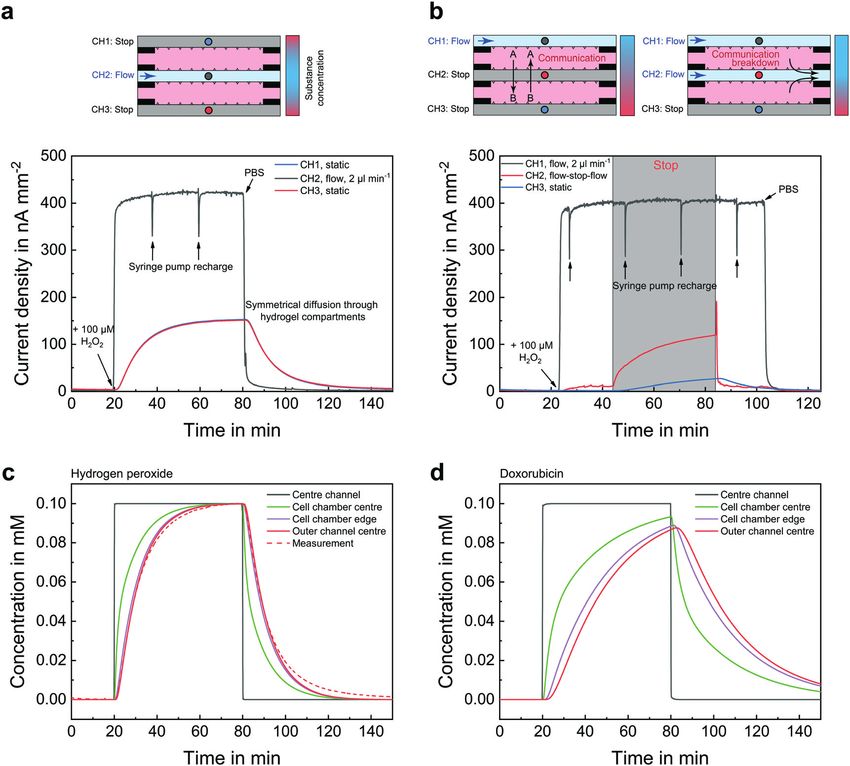
                                                                                                  Fig. 2 Mass transport control study. H2O2 in PBS was used as test substance and measured with microsensors located in the centre of each
                                                                                                  microchannel. (a) Liquid perfusion is exclusively performed within the middle channel leading to identical microenvironments inside both spheroid
                                                                                                  compartments, reflected by the overlapping sensor signals. (b) Second operation mode in which a constant flow is applied to an outer channel. If
                                                                                                  perfusion within the middle channel is stopped, concentration gradients form across both compartments permitting communication of different
                                                                                                  cell types. Application of a flow to the same channel interrupts the communication by fluidic separation. (c) Computational modelling of mass
                                                                                                  transport for hydrogen peroxide (Dliq = 2.50 × 10⁻⁹ m2 s−1, Dgel = 1.875 × 10⁻⁹ m2 s−1) diffusion from the centre channel into the cell chamber. The
                                                                                                  measurement results fit the modelled behaviour very well, confirming that the sensor signals follow the underlying principles, and that mass
                                                                                                  transport is dominated by diffusion. (d) Computational modelling of the mass transport of a larger molecule, the cancer drug doxorubicin (Dliq =
                                                                                                  0.58 × 10⁻⁹ m2 s−1, Dgel = 4.35 × 10⁻¹⁰ m2 s−1) into the cell chamber.

                                                                                                  230 | Lab Chip, 2022, 22, 225–239                                                           This journal is © The Royal Society of Chemistry 2022
Lab on a Chip - RSC Publishing
View Article Online

                                                                                                  Lab on a Chip                                                                                                                Paper

                                                                                                  4. Results                                                        channel, where liquid flow prevented further diffusion into
                                                                                                  4.1. Mass transport and microfluidic compartmentalization         compartment B. By stopping the flow in the middle channel,
                                                                                                                                                                    the H2O2 entered the static channel through compartment B,
                                                                                                  The chip layout allows generation of different                    as indicated by the increase of the sensor signal within this
                                                                                                  microenvironments in both spheroid compartments, as well          channel. Re-establishment of the flow resulted in a removal
                                                                                                  as control of the communication between the embedded cells        of H2O2 from compartment B and re-isolation of both
                                                                                                  by directing fluid flow to specific channels. To illustrate the   compartments. Hereby, we show the successful manipulation
                                                                                                  system's capabilities, Fig. 2 shows two possible operation        of mass transport and thus culture conditions by
                                                                                                  modes together with electrochemical measurements under            compartmentalization and microfluidics.
            This article is licensed under a Creative Commons Attribution 3.0 Unported Licence.

                                                                                                  microfluidic operation, in which each mode was performed             Computational study. Fig. 2c shows the simulated mass
Open Access Article. Published on 01 December 2021. Downloaded on 2/27/2022 6:25:08 PM.

                                                                                                  in sequence. Hydrogen peroxide (H2O2) in phosphate                transport of a small molecule, e.g. hydrogen peroxide,
                                                                                                  buffered saline (PBS), which occurs as a reactive species and     recapitulating the experiment in Fig. 2a. As expected, there is
                                                                                                  behaves similarly to oxygen in terms of diffusion, was used       an almost immediate concentration change in the centre
                                                                                                  as test substance for these diffusion analyses.                   channel and an increasingly slower change, the larger the
                                                                                                      Experimental study. Fig. 2a shows the first operation         distance to the centre channel becomes. The dashed line
                                                                                                  mode in which the two outer channels are kept static, while       shows the normalized experimental data from Fig. 2a for the
                                                                                                  the middle channel is perfused. This leads to equal               hydrogen peroxide measurement in the outer channel. It can
                                                                                                  substance distribution into both spheroid compartments due        be observed that the experimental data follow the simulated
                                                                                                  to the axial symmetry of the chip. Depending on the               curve very closely. The main qualitative difference is observed
                                                                                                  diffusivity of the individual solute within the used hydrogel,    in the higher signal at the end during the removal of the
                                                                                                  concentration gradients develop from the centre to the outer      substance, which can be explained by an ongoing release of
                                                                                                  walls of the chip. This was demonstrated with an                  substance from the dead ends of the fluid channels that were
                                                                                                  electrochemical measurement, in which all sensors showed a        not modelled. The degree of quantitative match between
                                                                                                  signal close to zero at the beginning, since no oxidizable        experiment and simulation lies in the accuracy of the used
                                                                                                  substance was present in PBS. As soon as H2O2 entered the         diffusion coefficients. Data for different combinations of
                                                                                                  platform via the middle channel, the sensor located within it     diffusion coefficients and the influence on diffusion times
                                                                                                  showed a rise in signal which was dependent on the analyte        are found in the ESI.† Overall, it can be shown that our
                                                                                                  concentration and the flow rate. With a lag of around 70 s,       sensor data follow the underlying physical principles, which
                                                                                                  the sensors near the outer walls of the chip showed an            are dominated by diffusion within the cell compartments,
                                                                                                  increase in signal current, as H2O2 molecules diffused            and reflect the expected mass-transport situation very well,
                                                                                                  through the hydrogel containing compartments leading to a         both qualitatively and quantitatively. Furthermore, it was
                                                                                                  rise in concentration. Thereby, the courses and final values      shown that in situ sensors can provide valuable information
                                                                                                  of both sensor signals were similar, indicating a symmetrical     by verifying parameters used in computational models, such
                                                                                                  substance distribution within the chip and a highly               as the diffusion coefficient, which is extremely challenging to
                                                                                                  reproducible sensor performance. After pure PBS was               measure but has strong influence on the mass transport.
                                                                                                  perfused again in the middle channel, it took 30 min                 Fig. 2d shows the same situation as Fig. 2c, just for a
                                                                                                  (t90%–10%) until the hydrogels released all H2O2. Sensor          much slower diffusing substance, such as the drug
                                                                                                  signals increased and decreased according to t (−1/2) matching    doxorubicin. As expected, a much slower concentration
                                                                                                  the one-dimensional analytical solution of Fick's second          change can be observed. Overall, it can be assumed that
                                                                                                  law.48 Hereby, we show how integrated sensor measurements         concentrations of small molecules such as oxygen are fully
                                                                                                  can enable the assessment of mass transport in organ-on-          exchanged in the cell compartments within a typical flow
                                                                                                  chip devices.                                                     phase of 30 min. For matrix-based 3D cell culture systems, it
                                                                                                      Fig. 2b shows the case where the supply of nutrients and      should be considered that diffusion is comparably slow if
                                                                                                  oxygen is ensured via one outer channel, while the other two      there is no forced mass transport, e.g. by flow, and diffusion
                                                                                                  channels are kept static without flow. Thus, concentration        times even in highly permeable ECM gels are in the range of
                                                                                                  gradients range over the entire width of the chip. In addition,   minutes to hours depending on the molecule size. Further
                                                                                                  communication between the compartments can then take              details regarding system geometry, diffusion coefficients and
                                                                                                  place by diffusion of signalling molecules through the static     diffusion times are found in the ESI.†
                                                                                                  middle channel. Applying a flow to this channel leads to an
                                                                                                  interruption of the communication and isolates both
                                                                                                  compartments fluidically. The application of the middle           4.2. Oxygen sensor characterization
                                                                                                  channel for such fluidic separation was validated by a            The applied amperometric oxygen sensor principle relies on
                                                                                                  measurement with H2O2, which can be seen as a signalling          the electrochemical reduction of oxygen at the platinum
                                                                                                  molecule equivalent with a comparatively high diffusivity due     surface. Concentration changes are therefore determined by
                                                                                                  to its smaller size. After adding H2O2 to the outer channel, it   measuring the mass transport change to the electrode. For
                                                                                                  diffused through compartment A and reached the middle             this purpose, an optimized chronoamperometric protocol17

                                                                                                  This journal is © The Royal Society of Chemistry 2022                                            Lab Chip, 2022, 22, 225–239 | 231
View Article Online

                                                                                                  Paper                                                                                                                           Lab on a Chip
            This article is licensed under a Creative Commons Attribution 3.0 Unported Licence.
Open Access Article. Published on 01 December 2021. Downloaded on 2/27/2022 6:25:08 PM.

                                                                                                  Fig. 3 Oxygen sensor and gas-tightness characterization. Medium flow was applied to the middle channel at 10 μl min−1. Both outer channels
                                                                                                  were kept static. (a) Sensor response for the chronoamperometric oxygen measurement protocol in air-saturated and nitrogen-flushed PBS. The
                                                                                                  mean current density of the last second is taken for data evaluation. (b) Oxygen sensor calibration before and after long-term measurement in
                                                                                                  MSC medium. Error bars are s.d. (c) Transient oxygen calibration. (d) Gas-tightness verification by lowering the oxygen concentration via fluidics
                                                                                                  and subsequent stopping of the perfusion. Dissolved oxygen concentration remains in hypoxic regime within the spheroid compartment even after
                                                                                                  3 h without active supply of oxygen-free electrolyte.

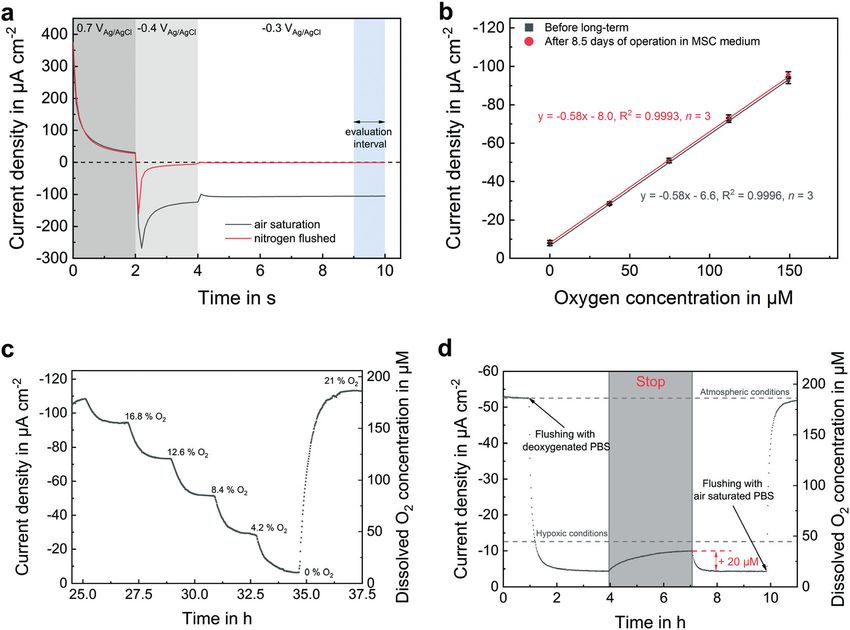
                                                                                                  was applied (Fig. 3a), which is based on the unique                        Fig. 3b. Sensitivity did not change after more than 8 days of
                                                                                                  characteristic features of platinum electrochemistry. Initially,           continuous operation. These results underline the stable
                                                                                                  platinum oxide is formed at an anodic potential. The formed                electrochemical protocol and the protection of the electrodes
                                                                                                  oxide layer is reduced in the following step by lowering the               by the membranes, which successfully prevent electrode
                                                                                                  potential to a cathodic region. As a result, a bare platinum               fouling and attachment of blocking substances. Additionally,
                                                                                                  surface is present at the electrode–electrolyte interface, which           sensitivity can be adjusted by the membrane thickness. In
                                                                                                  acts as a catalyst for the oxygen reduction reaction. In a last            the shown example, the sensitivity was −0.58 μA cm−2 μM−1
                                                                                                  upward step by 100 mV to achieve faster sensor stabilization,              with a relative error of 0.8% ± 0.4% before and 1.2% ± 0.4%
                                                                                                  the actual oxygen measurement takes place. A typical current               after long-term measurement (n = 6 × 3, based on 6 different
                                                                                                  response is shown in Fig. 3a for oxygen concentrations at                  concentration values in 3 independent calibration runs) with
                                                                                                  atmospheric and anoxic conditions. Oxygen-free conditions                  respect to the measurement range. All electrodes showed a
                                                                                                  result in a sensor output close to zero allowing one-point                 detection limit below 1 μM (based on 3 σ of the blank). Low
                                                                                                  calibration. An approximately 20 μm thick pHEMA-based                      standard deviations of the measurement points indicate a
                                                                                                  diffusion limitation membrane is dispensed into the SU-8                   highly     reproducible    measurement     of   the   oxygen
                                                                                                  polymer rims surrounding the sensor electrodes (Fig. 1c) in                concentration within the platform.
                                                                                                  order to obtain a defined diffusion profile above the
                                                                                                  electrode and thereby increase the stability of the sensor
                                                                                                  response.                                                                  4.3. Gas tightness
                                                                                                     By cyclic formation and removal of the oxide layer, the                 In many microfluidic systems for culturing and monitoring
                                                                                                  electrode is permanently cleaned during the measurement.                   spheroid cultures that are made of gas-permeable materials
                                                                                                  This leads to a remarkably high long-term stability of the                 (such as PDMS) or open systems (such as hanging droplets),
                                                                                                  sensor without measurable drift over one week, even within                 the gas composition in the cell culture medium is regulated
                                                                                                  protein-containing cell culture medium, as demonstrated in                 by gas exchange with the incubator environment. This is a

                                                                                                  232 | Lab Chip, 2022, 22, 225–239                                                          This journal is © The Royal Society of Chemistry 2022
View Article Online

                                                                                                  Lab on a Chip                                                                                                                       Paper

                                                                                                  convenient approach, however unlike the in vivo situation, if
                                                                                                  a constant and reproducible oxygen concentration is desired
                                                                                                  for all tissue types in the system, especially if several systems
                                                                                                  are used in parallel for a high throughput evaluation. We
                                                                                                  intentionally used gas-impermeable materials to have a
                                                                                                  targeted control of the gas composition through external
                                                                                                  gassing of the medium in reservoirs outside the microsystem.
                                                                                                  In addition, this enables the determination of cellular
                                                                                                  respiration rates, since the controlled influx of new medium
            This article is licensed under a Creative Commons Attribution 3.0 Unported Licence.

                                                                                                  is the only source of oxygen molecules.
Open Access Article. Published on 01 December 2021. Downloaded on 2/27/2022 6:25:08 PM.

                                                                                                      The ability of the system to maintain hypoxic conditions
                                                                                                  within a spheroid compartment was verified with an
                                                                                                  experiment (Fig. 3d) in which the oxygen concentration was
                                                                                                  first lowered to below 15 μM by perfusing oxygen-free
                                                                                                  electrolyte. Upon stopping the flow for 3 h, oxygen has
                                                                                                  increased to a final concentration of 35 μM, remaining in
                                                                                                  hypoxic regime. Most likely, this slight increase is caused by
                                                                                                  oxygen dissolution from microbubbles which remain after
                                                                                                  the sealing of inlet and outlet ports, rather than by oxygen
                                                                                                  diffusion through the compartment surrounding materials.
                                                                                                  However, in practical operation during cell culture, typical
                                                                                                  stop phases do not last longer than 30 min, which leads to a
                                                                                                  maximum oxygen concentration increase by 10 μM, if there is
                                                                                                  no cellular oxygen consumption.

                                                                                                  4.4. Formation of breast cancer stem cell spheroids
                                                                                                  The cell model used in this work consists of triple-negative
                                                                                                  breast cancer stem cells, more specifically of the breast
                                                                                                  cancer stem cell line 1 (BCSC1), one of five extensively
                                                                                                  characterized BCSC lines isolated from primary invasive
                                                                                                  tumours of individual patients.3,49,50 BCSCs are of particular
                                                                                                  interest in the development of personalized chemotherapy
                                                                                                  approaches for triple-negative breast cancer patients, as they
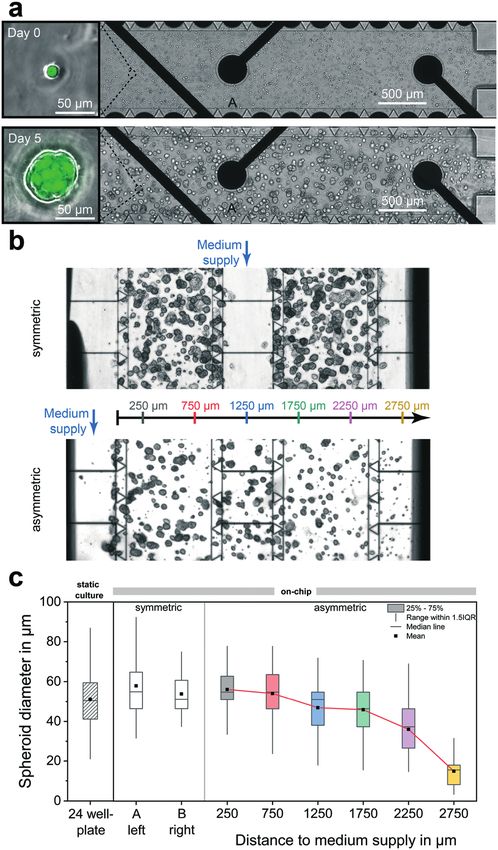
                                                                                                                                                                      Fig. 4 On-chip tumour spheroid formation. (a) Phase-contrast
                                                                                                  are considered to be responsible for both cancer metastasis         micrographs of single breast cancer stem cells (BCSC1) embedded in
                                                                                                  and therapy resistance.51                                           75% Matrigel right after seeding and gelation at a seeding density of 2
                                                                                                     Fig. 4a shows the development of single BCSC1 cells into         × 106 cells ml−1. During dynamic supply with cell culture medium over
                                                                                                  spheroids with a mean diameter of approximately 50 μm               days, spheroids develop within compartments. Scale bar, 500 μm.
                                                                                                                                                                      Inserts show micrograph overlays (phase-contrast and green
                                                                                                  after four days of culture under dynamic fluidic operation in
                                                                                                                                                                      fluorescence) of a single cell and a spheroid. Scale bars, 50 μm. (b)
                                                                                                  which cell culture medium was perfused through the middle           Phase-contrast micrographs showing spheroids on day 5 of culture
                                                                                                  channel of the chip. By variation of different seeding              which have grown under two different medium supply situations.
                                                                                                  densities, an optimum was found between 0.5 × 10⁶ and 2 ×           Seeding densities: 1.5 × 10⁶ cells ml−1 (top) 0.5 × 10⁶ cells ml−1
                                                                                                  106 cells per ml, resulting in a total cell number of 3500 to       (bottom). (c) Comparison of spheroid diameter distribution for static
                                                                                                                                                                      conditions within a traditional well-plate (seeding density: 1.5 × 10⁶
                                                                                                  15 000 cells per platform. In this range, there were enough
                                                                                                                                                                      cells ml−1) and for both dynamic situations on-chip (n ≥ 58).
                                                                                                  cells for a sufficiently high measurement signal and at the
                                                                                                  same time no lack of nutrients occurred, and enough room
                                                                                                  for growth remained over a time span of at least five days.
                                                                                                  Due to the axial symmetry along the central channel, the            distribution varies more widely compared to methods
                                                                                                  same concentration gradients develop in both cell chambers,         where individual spheroids are formed from aggregation
                                                                                                  as confirmed in Fig. 2a. Thus, spheroids in compartment A           of a defined number of cells using microfluidic structures
                                                                                                  and B experience the same culture conditions during growth          and techniques.52 In order to study spheroids with a
                                                                                                  and do not differ in size or amount (Fig. 4b and c).                uniform size distribution or larger diameter for higher
                                                                                                  Furthermore, on-chip grown spheroids have the same                  metabolic activity instead of the development from single
                                                                                                  morphology and size distribution as within a standard well-         cells, spheroids can be grown outside the platform, sorted
                                                                                                  plate format (Fig. 4c). Typical for cultures in which spheroids     by a cell strainer with defined mesh size and transferred
                                                                                                  develop from ECM-embedded single cells, the spheroid size           into the platform.

                                                                                                  This journal is © The Royal Society of Chemistry 2022                                                 Lab Chip, 2022, 22, 225–239 | 233
View Article Online

                                                                                                  Paper                                                                                                                   Lab on a Chip

                                                                                                     The lower micrograph of Fig. 4b shows an example where
                                                                                                  the whole inner volume of the platform was filled with cell-
                                                                                                  laden Matrigel, with the exception of one outer channel
                                                                                                  which was used for medium perfusion. This asymmetric
                                                                                                  supply with fresh medium results in substance gradients
                                                                                                  across the entire width of the platform, as demonstrated in
                                                                                                  Fig. 2b. Previous studies demonstrated for adherent cell
                                                                                                  monolayers53 and matrix-embedded cancer cells54 that such
                                                                                                  gradients lead to nutrient-dependent metabolic profiles and
            This article is licensed under a Creative Commons Attribution 3.0 Unported Licence.

                                                                                                  cell viability. Consequently, spheroids developing closer to
Open Access Article. Published on 01 December 2021. Downloaded on 2/27/2022 6:25:08 PM.

                                                                                                  the supply were exposed to more favourable growth
                                                                                                  conditions than cells growing more distant, as reflected in
                                                                                                  their structure. This is also evident from the spheroid
                                                                                                  diameter (see Fig. 4c), which was significantly smaller when
                                                                                                  the spheroids were located more than 1.75 mm from the
                                                                                                  supply channel. Since in all experiments we observed that
                                                                                                  BCSC1 spheroids grew largely independent of the oxygen
                                                                                                  concentration, we speculate that other factors such as the
                                                                                                  accumulation of waste products leads to inhibition of
                                                                                                  spheroid growth. These findings underline the importance of
                                                                                                  selecting appropriate scaling of cell culture environments,
                                                                                                  considering the diffusion properties of nutrients and cellular
                                                                                                  waste products within the used ECM, and verifying culture
                                                                                                  conditions in situ with integrated sensors.

                                                                                                  4.5. Measurement of cellular oxygen consumption
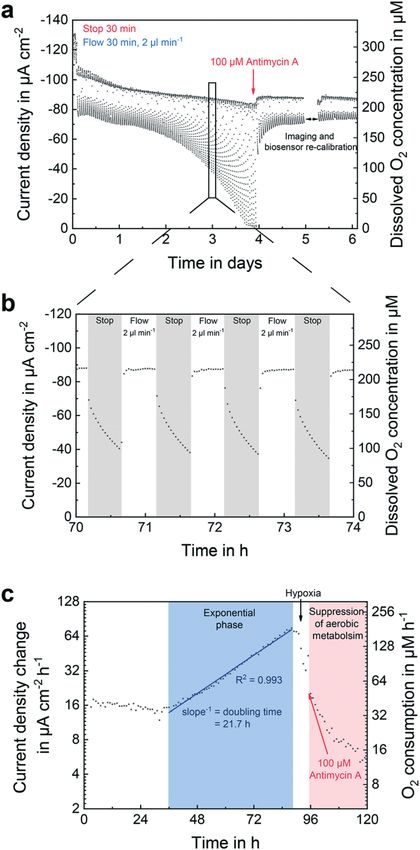
                                                                                                  Fig. 5 shows the signal of an oxygen sensor located in the
                                                                                                  centre of the perfusion channel, in between of both cell
                                                                                                  compartments. During growth, the culture medium was
                                                                                                  aspirated through the platform in stop/flow cycles with each
                                                                                                  phase lasting for 30 min. In the stop phases, active supply of
                                                                                                  medium with atmospheric oxygen concentration was
                                                                                                  stopped. The change in oxygen concentration within the chip
                                                                                                  was then solely caused by the cells and showed a steady
                                                                                                  decrease over time (Fig. 5b). Oxygen sensor consumption
                                                                                                  during a stop phase was only 0.3% with respect to the overall
                                                                                                  oxygen content within the chip and can therefore be
                                                                                                  neglected. During flow phases, cells were re-supplied with
                                                                                                  oxygen-rich medium, which passed over the sensor at 2 μl
                                                                                                  min−1, bringing its signal back to baseline. Since the signal is   Fig. 5 In-line oxygen monitoring. Oxygen monitoring in the central
                                                                                                                                                                     perfusion channel during the formation of breast cancer stem cell
                                                                                                  superimposed by a flow-dependent offset, the sensor showed
                                                                                                                                                                     (BCSC1) spheroids at a seeding density of 2 × 10⁶ cells ml−1. MSC cell
                                                                                                  a higher oxygen concentration than the expected 188.7 μM at        culture medium was perfused in stop/flow cycles. Oxygen
                                                                                                  atmospheric conditions (19.9% O2, 5% CO2). The gap in the          concentration was measured every 2 minutes. (a) Oxygen
                                                                                                  oxygen measurement after addition of the drug resulted from        measurement over 6 days during spheroid formation including
                                                                                                  electrical disconnection of the system from the potentiostat       exposure to the metabolism altering drug antimycin A. (b) Section over
                                                                                                                                                                     4 hours on day 3 of the same measurement. Each measurement point
                                                                                                  to characterize the state of the cells under the microscope
                                                                                                                                                                     represents the oxygen concentration at the given time. (c) Oxygen
                                                                                                  and subsequent recalibration of the biosensors.                    consumption over time, whereby the slopes of the linear fits of the last
                                                                                                     Over time, the oxygen demand of the cells increased, due        5 concentration values of each stop phase were taken for data
                                                                                                  to proliferation and exponential growth of the cell number         evaluation.
                                                                                                  within the forming spheroids. This is also reflected in the
                                                                                                  decrease of oxygen concentration during the stop phases in
                                                                                                  the course of culture time (Fig. 5a). After 3.75 days, all         the sensor output at anoxic conditions during calibration
                                                                                                  available oxygen molecules were metabolized during the stop        (Fig. 3a). Oxygen consumption increased with a doubling
                                                                                                  phases, as indicated by a sensor current of −1.2 μA cm−2,          time of 21.7 h (Fig. 5c). After 4 days of culture, 100 μM
                                                                                                  which represents 1.5% of atmospheric conditions matching           antimycin A was added to the cell culture medium leading to

                                                                                                  234 | Lab Chip, 2022, 22, 225–239                                                  This journal is © The Royal Society of Chemistry 2022
View Article Online

                                                                                                  Lab on a Chip                                                                                                                    Paper

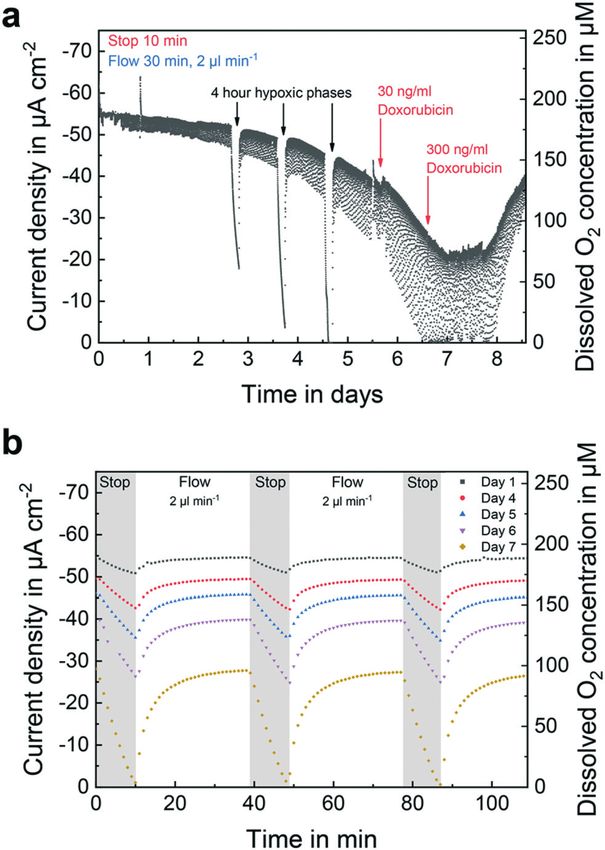
                                                                                                  an abrupt rise in oxygen concentration to atmospheric                  phases. During the first three days of culture, flow phases re-
                                                                                                  conditions. As antimycin A inhibits mitochondrial electron             established conditions at 19.9% oxygen. Afterwards, this
                                                                                                  transfer,55 the aerobic cell metabolism was suppressed, as             baseline was no longer reached due to the high oxygen
                                                                                                  shown by the drastic decrease in oxygen consumption. A                 uptake by the cells, as shown in Fig. 6b, where stop/flow
                                                                                                  cellular response to the drug occurred within a 1 hour stop/           sections at the end of the respective day are summarized.
                                                                                                  flow cycle (Fig. 5a). By integration of oxygen sensors into the        This observation underlines the importance of positioning
                                                                                                  perfusion channel of such dynamic cell culture systems, the            sensors for oxygen monitoring within the cell embedding
                                                                                                  oxygen concentration of the inflowing medium can be                    ECM to access the realistic culture microenvironment
                                                                                                  monitored. At the same time, oxygen consumption rates can              experienced by the cells even during active medium
            This article is licensed under a Creative Commons Attribution 3.0 Unported Licence.

                                                                                                  be determined very accurately and used for revealing drug-             perfusion.
Open Access Article. Published on 01 December 2021. Downloaded on 2/27/2022 6:25:08 PM.

                                                                                                  induced effects on the respiratory metabolism.                             During spheroid development, three experimental phases
                                                                                                                                                                         were included, in which the supply with fresh medium was
                                                                                                                                                                         interrupted for 4 h (Fig. 6a) in order to mimic acute cyclic
                                                                                                  4.6. Pericellular monitoring and exposure to doxorubicin               hypoxia as seen in real tumours during accelerated growth
                                                                                                  While the previous example covered the oxygen concentration            compared to healthy tissue.56 After each phase, the oxygen
                                                                                                  change within the medium supply channel of the system,                 concentration returned to values as before stopping the flow,
                                                                                                  Fig. 6a shows a long-term oxygen measurement in the centre             and the cellular oxygen consumption did not change. Since
                                                                                                  of a spheroid compartment in close vicinity to the spheroids.          the oxygen consumption was also not affected, it is shown
                                                                                                  By integration into the cell compartment, the sensor's signal          that BCSC1 cells have an adapted metabolism and tolerate
                                                                                                  is not flow-dependent and indicates the actual oxygen                  hypoxia well, whereas oxygen consumption does not depend
                                                                                                  concentration experienced by the cells even during flow                on the overall oxygen concentration.
                                                                                                                                                                             On the sixth day of culture (Fig. 6a), 30 ng ml−1 of the
                                                                                                                                                                         chemotherapeutic drug doxorubicin, frequently used for the
                                                                                                                                                                         treatment of breast cancer and based on the intercalation
                                                                                                                                                                         into the DNA,57 was added to the cell culture medium. At this
                                                                                                                                                                         critical concentration, BCSC1 cells show a significantly
                                                                                                                                                                         inhibited cell proliferation when cultivated in 2D.49 In
                                                                                                                                                                         contrast, the BCSC1 spheroids showed no change in
                                                                                                                                                                         metabolism even more than 24 h post drug exposure. After
                                                                                                                                                                         increasing that concentration by a factor of 10, the oxygen
                                                                                                                                                                         concentration course changed to higher values. As verified by
                                                                                                                                                                         microscopy the cells began to die, whereby the oxygen
                                                                                                                                                                         concentration within the compartment successively began to
                                                                                                                                                                         rise. Comparing the onset of action on oxygen uptake for
                                                                                                                                                                         antimycin A (Fig. 5a) and doxorubicin (Fig. 6a) indicates, that
                                                                                                                                                                         antimycin A induces a drug response much faster reflecting
                                                                                                                                                                         the differences in the mechanisms of action. Such
                                                                                                                                                                         acquisition of additional information on pharmacodynamics
                                                                                                                                                                         highlights the fundamental benefit of sensor-based
                                                                                                                                                                         pericellular metabolic monitoring. In comparison to a
                                                                                                                                                                         traditional experiment where cells are exposed to a drug, re-
                                                                                                                                                                         seeded and proliferation is monitored over days, our method
                                                                                                                                                                         allows real-time, online and quantitative access to cell
                                                                                                                                                                         metabolism.

                                                                                                                                                                         4.7. Glucose and lactate monitoring
                                                                                                                                                                         Biosensors are based on the equimolar conversion of glucose
                                                                                                                                                                         or lactate into H2O2 inside the pHEMA-based hydrogel, which
                                                                                                                                                                         is immobilized on the electrodes and entraps the enzymes
                                                                                                                                                                         glucose oxidase or lactate oxidase, respectively. The
                                                                                                  Fig. 6 Long-term oxygen monitoring. (a) Pericellular oxygen            concentration of the analyte is then determined by the
                                                                                                  monitoring within a spheroid compartment at a seeding density of 1.5
                                                                                                                                                                         current density for the oxidation of the formed H2O2 at a
                                                                                                  × 106 cells ml−1. Oxygen concentration was measured every minute.
                                                                                                  During measurement, cells were exposed to three hypoxic phases and
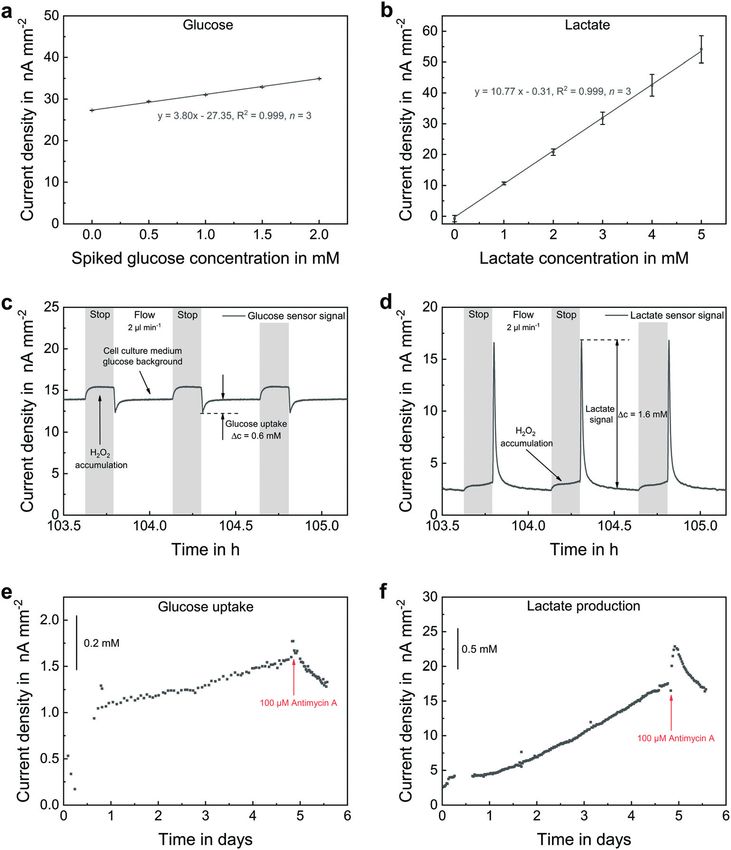
                                                                                                                                                                         potential of 0.5 VAg/AgCl. Sensor calibration for glucose and
                                                                                                  two exposures to different concentrations of doxorubicin. (b) Course   lactate sensors are shown in Fig. 7a and b, respectively.
                                                                                                  of the oxygen concentration at the respective day of culture.          During measurement, a blank-signal was recorded by an

                                                                                                  This journal is © The Royal Society of Chemistry 2022                                                Lab Chip, 2022, 22, 225–239 | 235
View Article Online

                                                                                                  Paper                                                                                                                                Lab on a Chip
            This article is licensed under a Creative Commons Attribution 3.0 Unported Licence.
Open Access Article. Published on 01 December 2021. Downloaded on 2/27/2022 6:25:08 PM.

                                                                                                  Fig. 7 Biosensor characterization and long-term measurements. (a) Spiked glucose biosensor calibration before and after operation within long-
                                                                                                  term culture. Error bars are s.d. (b) Lactate biosensor calibration before and after operation within long-term culture. Error bars are s.d. (c) Glucose
                                                                                                  and (d) lactate signal simultaneously recorded during microfluidic operation (stop 10 min/flow 30 min). (e) Glucose uptake and (f) lactate
                                                                                                  production during long-term culture and their change upon addition of 100 μM antimycin A.

                                                                                                  electrode without embedded enzyme, in order to subtract                       secretion, both analytes were always present and converted
                                                                                                  unspecific background signals. The developed biosensors                       by the enzyme membranes. This resulted in a H2O2
                                                                                                  showed a highly linear, reversible and selective behaviour                    accumulation over the sensor electrodes and a signal increase
                                                                                                  within the physiological range. The limit of detection was 7.6                during stop phases. Biosensors were placed outside the cell
                                                                                                  μM (±3.7 μM, n = 3) in case of glucose and 6.1 μM (±4.2 μM,                   compartments downstream the microchannel in order to
                                                                                                  n = 3) for lactate sensors. Sensitivity, limit of detection and               prevent H2O2 diffusion into the inner volume of the platform.
                                                                                                  linear range can be adjusted for the desired application by                   At the beginning of a flow phase, the consumed medium was
                                                                                                  varying the height of the diffusion-limiting membrane within                  removed from the culture volume and passed over the sensor.
                                                                                                  the membrane stack. An individual calibration was                             As glucose was metabolized by the cells, a signal drop relative
                                                                                                  performed prior and after each experiment. Drift correction                   to the background was detected, and its uptake was
                                                                                                  was performed under the assumption of linear sensitivity                      quantified by subtraction of both signal values. In case of
                                                                                                  decay for long-term measurement evaluation.                                   lactate, a distinct signal peak appeared at the initiation of
                                                                                                     Fig. 7c and d shows typical biosensor signals during                       perfusion. Both glucose consumption and lactate secretion
                                                                                                  spheroid cultivation. Due to the high glucose background                      increased with rising cell density and decreased again after
                                                                                                  concentration in MSC medium and the cellular lactate                          the addition of a lethal dose of antimycin A. Compared to the

                                                                                                  236 | Lab Chip, 2022, 22, 225–239                                                              This journal is © The Royal Society of Chemistry 2022
You can also read