Secure Email Gateway (SEG) V2 - VMware Workspace ONE UEM - VMware Docs
←
→
Page content transcription
If your browser does not render page correctly, please read the page content below
Secure Email Gateway
(SEG) V2
VMware Workspace ONE UEM
Secure Email Gateway (SEG) V2

You can find the most up-to-date technical documentation on the VMware website at:

https://docs.vmware.com/

VMware, Inc.
3401 Hillview Ave.
Palo Alto, CA 94304
www.vmware.com

               ©
Copyright          2021 VMware, Inc. All rights reserved. Copyright and trademark information.

VMware, Inc.                                                                                     2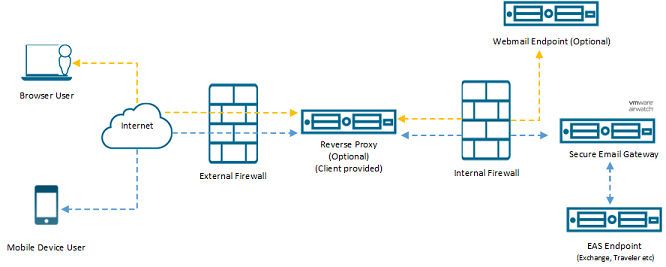
Contents

     1 Introduction to the Secure Email Gateway (V2) 4

     2 Configure the SEG V2 9

     3 Install the Secure Email Gateway (V2) 37

     4 Additional Configuration on SEG V2 45

     5 SEG Migration (Classic) 52

     6 Email Management    57

VMware, Inc.                                             3
Introduction to the Secure Email
Gateway (V2) 1
The Workspace ONE UEM powered by AirWatch Secure Email Gateway V2 (SEG V2) helps to
protect your mail infrastructure and enables VMware AirWatch Mobile Email Management (MEM)
functionalities. Install the SEG along with your existing email server to relay all ActiveSync email
traffic to Workspace ONE UEM-enrolled devices.
Based on the settings you define in the Workspace ONE UEM console, the SEG filters all
communication requests from individual devices that connect to SEG.
Note This guide contains information about the SEG V2. The SEG Classic software is being
discontinued and end of life has been announced. The Classic Secure Email Gateway (SEG)
installer will reach End of General Support on May 5, 2019. On December 24, 2018, the Classic
SEG installer will be removed from the Resources portal. After May 5, 2019, VMware cannot
guarantee full support for Classic SEG. For more information about the End-of-Life terms, see
https://kb.vmware.com/s/article/2960293.
Note To read about the Classic SEG information, see the VMware AirWatch Secure Email
Gateway 1811 guide at https://docs.vmware.com/en/VMware-Workspace-ONE-UEM/1811/WS1-
Secure-Email-Gateway/GUID-AWT-SEG-CLASSIC-REQS.html.
Requirements for the Secure Email Gateway (V2)
To successfully deploy the SEG, you must meet the UEM console requirements, hardware
requirements, software requirements, and network recommendations.
UEM Console Requirements
n All currently supported UEM console versions. See the Workspace ONE UEM console release
and End of General Support Matrix document for more details on the currently supported
versions.
n REST API must be enabled for the Organization Group.
Prerequisite: Enable REST API
To configure the REST API URL for your Workspace ONE UEM environment:
1 Navigate to Groups & Settings > All Settings > System > Advanced > API > REST API.
VMware, Inc. 4Secure Email Gateway (SEG) V2
2 The Workspace ONE UEM gets the API certificate from the REST API URL, that is, on the site
URLs page located at Groups & Settings > All Settings > System > Advanced > Site URL. For
SaaS deployments,the API URL must be in the asXX.awmdm.com format.
You can configure the SEG V2 at a container organization group that inherits the
REST API settings from a customer type organization group.
Hardware Requirements
A SEG V2 server can be either a virtual (preferred) or physical server.
Note the following when deploying SEG V2:
n An Intel processor is required. CPU Cores should each be 2.0 GHz or higher.
n The minimum requirements for a single SEG server are 2 CPU cores and 4 GB RAM.
n When installing the SEG servers in a load balanced configuration, sizing requirements can be
viewed as cumulative. For example, a SEG environment requiring 4 CPU Cores and 8 GB RAM
can be supported by either:
n One single SEG server with 4 CPU cores and 8 GB RAM.
n Two load-balanced SEG servers, each with 2 CPU cores and 4 GB RAM.
n 5 GB disk space needed per SEG and dependent software. This does not include system
monitoring tools or additional server applications.
Software Requirements
n Windows Server 2008 R2
n Windows Server 2012
n Windows Server 2012 R2
n Windows Server 2016
n Windows Server 2019
Networking Requirements
The SEG uses the following default ports:
Source
Component Destination Component Protocol Port Description
Devices (from SEG HTTPS 443 Devices request mail from SEG
Internet and Wi-
Fi)
Console Server SEG HTTPS 443 Console makes administrative
commands to SEG
VMware, Inc. 5Secure Email Gateway (SEG) V2
Source
Component Destination Component Protocol Port Description
SEG Workspace ONE UEM HTTP or 80 or 443 SEG retrieves the configuration and
REST API (Device HTTPS general compliance policy information
Services (DS) or Console
Server (CN) server)
SEG Internal hostname or TCP 5701 and If SEG Clustering is used, then SEG
IP of all other 41232 communication to shared policy cache
SEG servers across other SEGs for updates and
replication.
SEG localhost HTTP 44444 Admin accesses the SEG server status
and diagnostic information from the
localhost machine.
Device Services SEG HTTPS 443 Enrollment events and real-time
compliance communicates to SEG.
SEG Exchange HTTP or 80 or 443 Verify the following URL is accessible
HTTPS from the browser on the SEG server and
prompts for the credentials. http(s)://
/Microsoft-
Server-ActiveSync
The SEG V2 requires that TLS 1.1 or 1.2 is supported on the client's email server, preferably TLS
1.2. It is recommended that the client follow the guidelines of the email system and the OS
manufacturer.
Recommendations
Requirement Notes
Remote access to Windows Servers available to Workspace ONE UEM and Set up the Remote Desktop Connection
administrator rights Manager for multiple server
management. You can download the
installer from the Microsoft download
center.
Installation of Notepad++ (Recommended) This application makes it easier to parse
through the log files.
Ensure Exchange ActiveSync is enabled for a test account
Ensure you have remote access to the servers where Workspace ONE UEM
is installed. Typically, Workspace ONE UEM consultants perform installations
remotely over a web meeting or screen share. Some customers also provide
Workspace ONE UEM with VPN credentials to directly access the
environment as well.
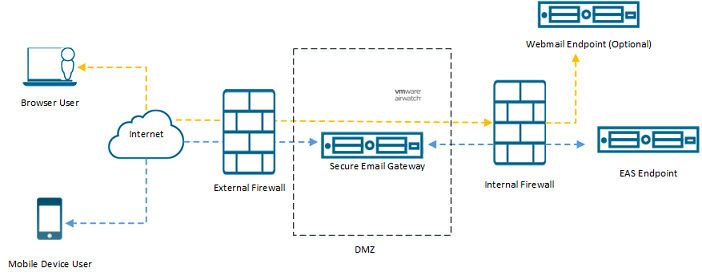
VMware, Inc. 6Secure Email Gateway (SEG) V2 The Secure Email Gateway Architecture Deploy the SEG to enable the policy creation that determines how end-users access mail on their devices. It is optimal to install the Secure Email Gateway (SEG) in a Demilitarized Zone (DMZ) or behind a reverse proxy server. The SEG is an on-premises component that you install as part of your organization's network. The SEG Proxy model requires an Exchange ActiveSync infrastructure like Microsoft Exchange, IBM Notes Traveler, or G Suite. For more information on SEG, contact Workspace ONE Support. Note Workspace ONE UEM only supports the versions of third-party email servers currently supported by the email server provider. When the provider deprecates a server version, Workspace ONE UEM no longer supports integration with that version. SEG Setup with Exchange ActiveSync Workspace ONE UEM best practices support this configuration. The SEG is placed in the DMZ for routing mobile email traffic. Note VMware recommends configuring the SEG with Exchange ActiveSync to route mobile email traffic. Exchange ActiveSync SEG Using Optional Reverse Proxy Configuration The reverse proxy configuration uses an optional reverse proxy to direct the mobile device traffic to the SEG Proxy while routing browser traffic directly to the webmail endpoints. Use the following network configuration to set up the reverse proxy to communicate between devices and the SEG using the Exchange ActiveSync (EAS) protocol. VMware, Inc. 7
Secure Email Gateway (SEG) V2

Recommendations for Reverse Proxy Configuration
Exchange ActiveSync is a stateless protocol, and persistence is not explicitly required by
Microsoft. The best load-balancing method might vary from different implementations. Use the
following information to meet the recommended load-balancing requirements efficiently.

n   IP-based affinity: Configure IP-based affinity if you are using Certificate authentication and
    there is no proxy or other component in front of the load-balancer that changes the source IP
    from the original device.

n   Authentication Header Cookie based Affinity: If you are using Basic authentication,
    especially if there is a proxy or other network component that changes the source IP from
    the original device.

VMware, Inc.                                                                                     8
Configure the SEG V2
2
The following topics describes the information related to configuration of SEG V2.
To implement the SEG (V2) for your email architecture, first configure the settings on the UEM
console. After you configure the settings, you can download the SEG installer from the
Workspace ONE resource portal.
1 In the UEM console, navigate to Email > Settings and select Configure. The ADD wizard
displays.
2 In the Platform tab of the wizard:
a Select Proxy as the Deployment Model.
b Select the Email Type (Exchange, IBM Notes, or Google).
c If you selected Exchange as the email type, then select the appropriate exchange version
from the drop-down menu. Click Next. Example of email servers is Exchange, IBM Notes,
or Google.
3 Configure the basic settings in the Deployment tab of the wizard and then select Next.
Setting Description
Friendly Name Enter a friendly name for the SEG deployment. This
name gets displayed on the MEM dashboard.
External URL and Port Enter the URL and port number for the incoming mail
traffic to SEG.
Listener Port The SEG listens for device the communication through
this port. The default port number is 443. If SSL is
enabled for SEG, the SSL certificate is bound to this port.
Terminate SSL on SEG Enable this option if you want the SSL certificate to be
sent from the SEG instead of offloading on a web
application firewall. Upload a .pfx or .p12 certificate file
including the root and intermediate certificates.
Upload Locally Select to upload the SSL certificate locally during
installation.
VMware, Inc. 9Secure Email Gateway (SEG) V2
Setting Description
SEG Server SSL Certificate Select Upload to add the certificate that binds to the
listening port. The SSL certificate can be automatically
installed instead of providing it locally. An SSL certificate
in the .pfx format with a full certificate chain and private
key included must be uploaded. See, the Upload the SSL
Certificate after Renewal section in the Chapter 3 Install
the Secure Email Gateway (V2) topic to understand the
methods to upload the SSL certificate after renewal.
Email Server URL and Port Enter the email server URL and port number in the form
https://email server url:email server port. The SEG uses
the following URL for proxying email requests to the
email server. If using Exchange Online, enter the https://
outlook.office365.com URL.
Ignore SSL Errors between SEG and email server Select Enable to ignore the Secure Socket Layer (SSL)
certificate errors between the email server and the SEG
server.
Ignore SSL Errors between SEG and AirWatch server Select Enable to ignore Secure Socket Layer (SSL)
certificate errors between the Workspace ONE UEM
server and the SEG server.
Establish a strong SSL trust between the Workspace
ONE UEM and the SEG server using valid certificates.
Allow email flow if no policies are present on SEG Select Enable to allow the email traffic if SEG is unable to
load the device policies from the Workspace ONE UEM
API. By default, the SEG blocks all email requests if no
policies are locally present on the SEG.
Note A list of all the device records with the
corresponding compliance status is provided. SEG does
not calculate the compliance of a given device by itself,
instead uses the data received from the Workspace ONE
UEM console.
Enable Clustering Select Enable to enable clustering of multiple SEG
servers.
When clustering is enabled, policy updates are
distributed to all SEGs in the cluster. The SEGs
communicate with each other through the SEG clustering
port.
SEG Cluster Hosts Add the IPs or hostnames of each server in the SEG
cluster.
SEG Cluster Distributed Cache Port Enter the port number for SEG to communicate to the
distributed cache.
SEG Clustering Port Enter the port number for SEG to communicate to the
other SEGs in the cluster. Enable clustering to have
multiple SEG servers operating as a cluster.
4 Select Next in the Profile tab of the wizard. If necessary, assign an email profile to the MEM
configuration. Select Next in the Profile tab of the wizard.
VMware, Inc. 10Secure Email Gateway (SEG) V2
5 On the Summary tab, review the configuration that you have just created. Select Finish to
save the settings.
6 Download the SEG installer from the Workspace ONE resource portal.
7 Configure any additional settings for your SEG using the Advanced option.
Setting Description
Use Default Settings The Use Default Settings check box is enabled by
default. To modify the advanced settings, you must
uncheck this box.
Enable Real-time Compliance Sync Enable this option to send the compliance information
to the SEG in real-time. Without this, individual changes
to the device policies are refreshed per the delta sync
interval.
Required transactions The Required transactions cannot be disabled.
Optional transactions Enable or disable the optional transactions such as Get
attachment, Search, Move Items, and so on. The
following are the Exchange Active Sync (EAS)
transactions that the SEG reports to the console and
are displayed on the Email List View in the Last
Command column.
Diagnostic Set the number and frequency of transactions for a
device when the test mode is enabled.
Sizing Set the frequency of SEG and API server interaction.
Skip Attachment & Hyperlink transformations for S/ Enable to exempt the encryption of attachments and
MIME signed emails transformation of hyperlinks through SEG for emails
that are signed with S/MIME certificates.
Enable S/MIME repository lookup Enable automatic lookup of the S/MIME certificate
managed in a hosted LDAP directory. Enter the
following values to configure the lookup.
n LDAP URL - Specify the URL of the LDAP server
hosting the S/MIME certificates. For example,
LDAP://certs.soandso.local/o=dept,c=company.
n Authentication Type - Specify the authentication
type used by the LDAP server. Anonymous and
Basic authentication are supported. If Basic
authentication is selected, you must enter the
username and password.
n Certificate Attribute - The public key attribute used
on the LDAP server to specify the S/MIME
certificate. For example, userCertificate;binary.
You must restart SEG service after enabling this
feature.
Custom Gateway Settings The SEG custom gateway settings are available as a
key-value pair on the Workspace ONE UEM console.
The commonly used properties are seeded on the
Workspace ONE UEM console. For more information on
the SEG supported key value pairs.
VMware, Inc. 11Secure Email Gateway (SEG) V2
Setting Description
Block Attachments Used to control the default action when SEG is unable
to communicate with the Workspace ONE UEM or
when the local policy set is empty.
Default Message for Blocked Attachments Configure the message that is displayed to end users
when SEG blocks attachments.
Configuring for High Availability and Disaster Recovery
SEG can be configured in high availability and disaster recovery environments with both
clustering and non-clustering server configurations. The high availability and disaster recovery
setups are independent of the cluster configuration.
Use a load balancer to achieve the desired high availability and disaster recovery configuration.
The same public host name must be used for the SEG servers across the data centers to ensure
that the users need not reauthenticate when a SEG server failover occurs.
The following are the benefits of using SEG in a clustering and non-clustering server
environments:
n Non-clustered server configuration:
n Each SEG is updated independently.
n Failover can be performed at the load balancer.
n Clustered server configuration:
n Each data center must have its own MEM configuration and an external URL to update the
MEM configuration's cluster.
Note The external URL need not match the URL used by devices to access email, instead
the UEM console uses the external URL to send policy updates to the appropriate cluster
configuration.
n Internal IP addresses or hostnames are applicable for clustering rather than public IP
addresses only.
n Device EAS profiles must use a third URL that can be failed-over between data centers.
SEG Custom Gateway Settings
The SEG v2 configurations are controlled at an individual node level. The custom gateway setting
feature centralizes the configuration on the Workspace ONE UEM Console as part of the MEM
configuration itself.
Prerequisites
The following table lists the requirements for the SEG custom settings feature:
VMware, Inc. 12Secure Email Gateway (SEG) V2
Minimum SEG and UAG Supported
Platform Version Workspace ONE UEM Console
Windows 2.17.0 20.10
UAG UAG 2009 (SEG 2.17.0) 20.10
Configure SEG Custom Gateway Settings
The SEG custom settings are available as key-value pairs on the Workspace ONE UEM console.
The commonly used properties are seeded on the Workspace ONE UEM Console. To configure
the custom settings, perform the following steps:
1 Log in to the Workspace ONE UEM console.
2 Navigate to the Email > Email Settings.
3 Configure the Email Settings for SEG.
4 Configure the additional settings for SEG using the Advanced option.
5 Navigate to the Custom Gateway Settings, click ADD ROW, and enter the supported
configuration as the key-value pair:
n Key: Enter the property or setting name.
n Type: Enter the type of value such as string, integer, and so on.
n Value: Enter the property or custom value.
6 Click Save.
Apply the Custom Gateway Settings on the SEG Service
During an installation or upgrade, if the custom settings are provided on the Workspace ONE
UEM console, then the SEG service starts with the applied custom settings
If the custom settings are added or updated on the Workspace ONE UEM console when the SEG
service is running, then a refreshSettings notification is triggered for SEG. The SEG fetches the
latest custom gateway settings. A few of the custom settings are applied immediately, whereas
the other custom settings might require you to restart the SEG service.
Supported Configuration for the Custom Gateway Settings
The following section lists all the supported SEG properties or settings for the custom settings
feature.
Note The properties or settings are grouped based on feature or functionality. The custom
settings can be added on the Workspace ONE UEM console in any order.
VMware, Inc. 13Secure Email Gateway (SEG) V2
JVM Arguments or System Settings
The JVM arguments or system settings property keys start with -D. If the property value is
modified, SEG updates the custom system settings in the segServiceWrapper.conf (for
Windows) or seg-jvm-args.conf (for UAG). If the system setting is updated when the SEG service
is running, then the SEG triggers a service restart.
You can configure the seg.custom.settings.service.restart.code=0 property in the application-
override.properties file to disable the automatic restart of the SEG service.
Apply System Setting
Configuration Key Described Value type Default value at Run Time
- Comma-separated String MD5, RC4, TLSv1, If the modified value is
Djdk.tls.disabledAlgorit list of TLS algorithms, TLSv1.1, SSLv2Hello, detected, restart
hms ciphers, and versions SSLv3, DSA, DESede, automatically.
to be disabled. DES, 3DES,
DES40_CBC,
RC4_40,
MD5withRSA, DH,
3DES_EDE_CBC,
DHE, DH keySize <
1024, EC keySize <
224
- Customize the Integer 2048 If the modified value is
Djdk.tls.ephemeralDHK strength of the detected, restart
eySize ephemeral DH key automatically.
size used internally
during the TLS or
DTLS handshake. The
system property
does not impact the
DH key sizes in the
ServerKeyExchange
messages for
exportable cipher
suites.
The following DH key
sizes are impacted,
the DHE_RSA,
DHE_DSS, and
DH_anon-based
cipher suites in the
JSSE Oracle provider.
For more
information, see
Customizing Size of
Ephemeral Diffie-
Hellman Keys.
VMware, Inc. 14Secure Email Gateway (SEG) V2
Apply System Setting
Configuration Key Described Value type Default value at Run Time
-Dsyslog.enabled Flag to enable the Boolean TRUE - For the UAG If the modified value is
syslog configuration deployment detected, restart
for SEG. FALSE - For the automatically.
Windows
deployment
-Dsyslog.host Host address of the String localhost If the modified value is
syslog server. detected, restart
The host address automatically.
value can be
configured with any
remote syslog server
hostname or IP
address that listens
over UDP.
If syslog to the
remote server is
configured with the
TCP or TLS, then
point to a local host
syslog listener that
can retransmit using
the required protocol
over the wire.
The in-built UAG
syslog configuration
can function as the
local retransmitter.
- Specify the Kerberos Time in the 23:59:59 If the modified value is
Dkerberos.process.rec process recycle time, hh24:mm:ss format detected, restart
ycle.time when enabled. automatically.
Process recycling can
be enabled using the
property -
Denable.kerberos.pr
ocess.recycle.
-Xmx Maximum java heap Long If the system If the modified value is
memory for the property is not detected, restart
service in Mebibytes configured, automatically.
(MiB). dynamically
For example, 8 GiB of identified during the
RAM can be SEG service
configured as 8192. installation based on
the system
configuration.
-Dsyslog.facility Syslog facility as String USER If the modified value is
defined by the detected, restart
Syslog server. automatically.
VMware, Inc. 15Secure Email Gateway (SEG) V2
Apply System Setting
Configuration Key Described Value type Default value at Run Time
-Dsyslog.port Syslog listener port Integer 514 If the modified value is
that the SEG points detected, restart
to. automatically.
- SEG can be Boolean FALSE If the modified value is
Denable.kerberos.proc configured to recycle detected, restart
ess.recycle the native Kerberos automatically.
client processes
when the Kerberos
based authentication
is enabled.
VMware, Inc. 16Secure Email Gateway (SEG) V2
Support for EWS
Apply System Setting
Configuration Key Description Value type Default value at Run Time
enable.boxer.ens.ews. Flag to enable SEG to Boolean FALSE Restart the SEG
proxy listen for the EWS service.
traffic and proxy the
same to the
configured Exchange
EWS endpoint.
By default, SEG
proxies the EWS
requests to the email
server host
configured as part of
the MEM
configuration.
However, a different
host can be
configured using the
ews.email.server.hos
t.and.port property.
ews.email.server.host. If the email server URL No user action No user action
and.port hostname for the required. required.
EWS is different than
the EAS, then use
this property to
configure the EWS
email server
hostname.
When the host name
for the EWS
connection is used
from the
ews.email.server.hos
t.and.port property,
all the other HTTP
connection
parameters remain
the same, similar to
the EAS parameters.
If the host is using a
self-signed
certificate,
corresponding
trusted certificate
must be added to
SEG separately.
VMware, Inc. 17Secure Email Gateway (SEG) V2
Apply System Setting
Configuration Key Description Value type Default value at Run Time
EWS proxy can be
enabled using flag
enable.boxer.ens.ew
s.proxy.
http.response.status.c HTTP response code Integer 503 No user action
ode.for.connection.ter for the EWS request required.
minated.with.ews when a connection
error occurs between
the SEG and the
Exchange.
Certificate-based Authentication
Apply System Setting
Configuration Key Description Value type Default value at Run Time
proxy.email.request.on Flag to enable the Boolean TRUE No user action
.kerberos.error proxy request to the required.
email server, in case,
an error occurs when
generating the KCD
token.
response.status.code. HTTP response code Integer 503 No user action
on.kerberos.error.for.n for commands, other required.
on.ping than PING and
OPTIONS, when the
Kerberos token
generation results
fail.
response.status.code. If the Integer 200 No user action
on.kerberos.error.for.p proxy.email.request. required.
ing on.kerberos.error
property is set to
false, then the
response.status.cod
e.on.kerberos.error.f
or.ping is the HTTP
status code returned
during a Kerberos
error for the PING
command request.
response.status.code. HTTP response code Integer 401 No user action
on.kerberos.error.for.o for the OPTIONS required.
ptions.method command when the
Kerberos token
generation results
fail.
VMware, Inc. 18Secure Email Gateway (SEG) V2
Apply System Setting
Configuration Key Description Value type Default value at Run Time
response.status.code. HTTP response code Integer 401 No user action
on.certificate.validatio when the certificate required.
n.fail authentication is
enabled and if SEG
the client certificate
validation fails.
If the flag
force.client.cert.for.s
sl.handshake is
enabled, the request
with the missing or
invalid certificate
might be rejected
during the SSL
handshake.
enable.upn.lookup.fro Flag to enable the Boolean FALSE No user action
m.subject.cn UPN (used for required.
Kerberos
authentication)
lookup from Subject,
and Common Name
when the UPN is not
present in the SAN
type extension of the
client certificate.
generate.krb5.config.a Flag to generate the Boolean TRUE Restart the SEG
t.service.restart KRB configuration file service.
(krb5.ini in Windows
or krb5.conf in UAG)
when restarting the
SEG service.
kerberos.service.max. Number of KCD client Integer 10 Restart the SEG
processes.size processes that SEG service.
spawns.
kerberos.thread.pool.si Number of threads Integer 5 Restart the SEG
ze.per.service used per KCD client service.
process.
kerberos.service.healt Frequency of polling Integer 5 Restart the SEG
h.check.frequency.in.s by SEG for each KCD service.
econds client process.
kerberos.enable.perfor Flag to enable time Boolean TRUE Restart the SEG
mance.metrics.logging statistics for the service.
Kerberos token
handling.
VMware, Inc. 19Secure Email Gateway (SEG) V2
Apply System Setting
Configuration Key Description Value type Default value at Run Time
kerberos.process.kill.m The maximum wait Integer 60 Restart the SEG
ax.wait.time.in.seconds time for a process to service.
shut down, when you
attempt to stop the
native process.
kerberos.process.max. Maximum time in Integer 120 Restart the SEG
time.to.recover.in.seco seconds permitted service.
nds for a process to be in
any status
(NOT_STARTED,
STARTING,
FAILED_TO_START,
or BUSY) other than
AVAILABLE. To
recover processes in
an unexpected
situation and ensure
a safer execution.
kerberos.backpressure Maximum size of the Integer 2500 Restart the SEG
.queue.max.size backpressure queue service.
to obtain the
Kerberos token. If the
backpressure queue
is full, further
requests are ignored.
kerberos.backpressure Duration in seconds Integer 20 Restart the SEG
.queue.max.wait.in.sec for which a request service.
onds waits in a
backpressure queue
for the Kerberos
token generation
before being
stopped.
enable.cert.revocation. Flag to enable the Boolean FALSE Restart the SEG
validation certificate revocation service.
check using the CRL.
The flag is used only
when the CBA is
enabled.
VMware, Inc. 20Secure Email Gateway (SEG) V2
Apply System Setting
Configuration Key Description Value type Default value at Run Time
fail.hard.on.crl.downlo Flag to prevent SEG Boolean TRUE Restart the SEG
ad.failure.during.server from starting if SEG is service.
.startup unable to fetch the
CRLs at start.
The option is
applicable only when
any CRL distribution
URL is configured
using the
remote.crl.distributi
on.http.uris key.
remote.crl.fetch.interv Interval in minutes for Long (the value type 1440 (24 hours) Restart the SEG
al.in.minutes a periodic timer that is integer) service.
attempts to update
SEG with the latest
CRL data.
remote.crl.distribution. List of HTTP URLs of String NA No user action
http.uris CRL Distribution required.
Points (CDP). Use the
value when SEG is
configured to accept
the client certificates,
either by enabling
the Require Client
Certificate flag or the
Kerberos based
authentication.
Applicable only if
enable.cert.revocati
on.validation value is
set to true.
kerberos.linux.named. Delay in milliseconds Long 50 Restart the SEG
pipe.connect.delay.mill before the SEG Java service.
is process attempts to
listen to the named
pipes that are started
by the Kerberos
client native
processes. This delay
is to ensure smooth
recovery of crashed
Kerberos client
processes. This
property is applicable
only for SEG on UAG.
Since: UAG 21.03
VMware, Inc. 21Secure Email Gateway (SEG) V2
Certificate-Mapping LDAP Lookup
Apply System Setting
Configuration Key Description Value type Default value at Run Time
cert.mapping.ldap.ena The flag indicates if Boolean FALSE Restart the SEG
bled the certificate- service.
mapping feature is
enabled for SEG.
If the KCD
authentication is
disabled in the email
configuration, ignore
the setting and
consider as false.
cert.mapping.ldap.host The remote LDAP String NA Restart the SEG
host information in a service.
proper URL format.
cert.mapping.ldap.auth The authentication Integer 0 (simple Restart the SEG
Type type used with the authentication) service.
LDAP server for the
certificate-mapping
feature.
cert.mapping.ldap.user The LDAP user for String NA Restart the SEG
authenticating the service.
LDAP query.
SEG uses the same
service account
credentials
configured as part of
the Kerberos
authentication
settings.
However for the
LDAP query, the user
name must be
provided in the
Distinguished Name
(DN) format.
cert.mapping.ldap.attr List of LDAP lookup String NA Restart the SEG
s attributes used for service.
certificate-mapping
feature.
VMware, Inc. 22Secure Email Gateway (SEG) V2
Apply System Setting
Configuration Key Description Value type Default value at Run Time
cert.mapping.ldap.serv Distinguished name String NA Restart the SEG
er.base of the base domain service.
configured for
running the LDAP
query. The query
fetches the matching
results from the
domain.
By default, the query
refers to the rootDSE
of the LDAP setup.
The field can be
empty for the
userCertificate and
userPrincipalName
attributes indexed
and replicated to the
global catalog.
cert.mapping.ignore.ld Flag to ignore any Boolean FALSE Restart the SEG
ap.ssl.errors SSL errors when service.
contacting LDAP
server for the
certificate-mapping
lookup.
cert.mapping.max.que Maximum number of Integer 25 Restart the SEG
ry.executor.pools LDAP services service.
created to allow the
maximum concurrent
LDAP queries.
cert.mapping.ldap.con LDAP connect Integer 3000 Restart the SEG
nect.timeout.millis timeout in service.
milliseconds for
certificate-mapping.
cert.mapping.ldap.rea LDAP read timeout in Integer 3000 Restart the SEG
d.timeout.millis milliseconds for service.
certificate-mapping.
cert.mapping.ldap.serv LDAP (executor) Integer 3 Restart the SEG
ice.pool.size service thread pool service.
size.
cert.mapping.backpres Maximum size of Integer 1000 Restart the SEG
sure.queue.size requests that are service.
allowed in back
pressure queue,
waiting for the LDAP
service for
certificate-mapping
lookup.
VMware, Inc. 23Secure Email Gateway (SEG) V2
Apply System Setting
Configuration Key Description Value type Default value at Run Time
cert.mapping.backpres Maximum time a Integer 60 Restart the SEG
sure.max.ttl.in.seconds request can stay in service.
back pressure queue
waiting for the LDAP
service to be
available.
cert.mapping.wait.dela Fixed delay waiting Integer 500 No user action
y.for.concurrent.query. for a request when required.
millis another request for
the same UPN is in
progress for getting
certificate mapping.
SEG Policy and Cache
Apply System Setting
Configuration Key Description Value Type Default Value at Run Time
bulk.update.completio The timeout value in Integer 600 No user action
n.threshold.in.seconds seconds to complete required.
bulk policy update
flow. If the bulk
policy update does
not complete within
this duration, the bulk
policy update is
marked as failure.
Since: SEG 2.20.0,
UAG 21.06
policy.data.not.ready.r HTTP response code Integer 503 No user action
esponse.code to be returned to the required.
device if SEG is yet
to receive all the
policy data just after
start, and the
configuration
prohibits email
communication until
policy data is ready.
ignore.duplicate.recor Flag to ignore Boolean TRUE No user action
ds.during.policy.updat duplicate records required.
e returned from an API,
and compare the size
of a policy in the SEG
cache with the size
for only Unique IDs.
policy.update.eventbu Event bus timeout Long 30000 No user action
s.timeout.buffer.millis used during a policy required.
update.
VMware, Inc. 24Secure Email Gateway (SEG) V2
Apply System Setting
Configuration Key Description Value Type Default Value at Run Time
disable.api.policy.coun Maximum time in Boolean FALSE No user action
t.match.during.policy.u seconds that SEG required.
pdate waits for the cache
to be asynchronously
updated with the
new policy records
during a bulk policy
update.
policy.async.cache.up Maximum time in Integer 900 Restart the SEG
date.completion.thresh seconds that SEG service.
old.seconds waits for the cache
to be asynchronously
updated with new
policy records during
a bulk policy update.
cache.index.validation. Timeout duration in Integer 30000 No user action
eventbus.timeout.millis milliseconds for required.
validating the cache
index on all the
nodes after a bulk
policy update.
If failed, SEG retries
before finally
reverting the
changes.
cache.index.swap.wait. Wait delay in Long 60000 No user action
time.in.millis milliseconds before required.
swapping active and
passive cache
indexes after the
latest policy from API
is updated on the
passive cache.
cache.index.validation. Number of retry Integer 3 No user action
max.retry.count attempts to validate required.
that the cache
indexes are updated
in all the nodes, when
clustering is enabled.
VMware, Inc. 25Secure Email Gateway (SEG) V2
Apply System Setting
Configuration Key Description Value Type Default Value at Run Time
wait.time.in.millis.befor In case the policy Long 30000 No user action
e.passive.cache.cleanu update fails and the required.
p.start SEG is running in a
clustered mode, the
cache indexes in all
the nodes must be
updated to be in
sync. The
wait.time.in.millis.be
fore.passive.cache.cl
eanup.start, is the
time in milliseconds
for which the SEG
waits before cleaning
the passive cache, so
that all the nodes
have sufficient time
to swap the passive
and active indexes, if
necessary.
cache.async.update.st Interval in Long 10000 No user action
atus.check.timer.interv milliseconds for a required.
al.millis periodic timer that
validates async
policy data update in
cache.
full.bulk.update.interva Integer 1440 (24 hours) Restart the SEG
l.in.minutes (only when service.
the delta is enabled)
validate.resource.uri.in. Interval in minutes for Boolean TRUE No user action
jwt.auth a periodic full bulk required.
policy update, when
the delta sync is
enabled.
jwt.allowed-clock- Flag to enable Integer 30 No user action
skew-in-seconds validation of resource required.
URL in the JWT
token.
tcpip.discovery.timeou Maximum allowed Integer 5 Restart the SEG
t-seconds skew in JWT service.
timestamp for the
token to be
successfully
authenticated.
hazelcast.operation.cal Timeout for Hazel Long 60000
l.timeout.millis cast cache read or
write operation.
VMware, Inc. 26Secure Email Gateway (SEG) V2
Content Transformation
Apply System Setting
Configuration Key Description Value Type Default Value at Run Time
disable.transformation. Flag to disable the Boolean TRUE No user action
on.inline.unknown.atta attachment required.
chment.bytes transformation if the
MIME type cannot be
identified.
disable.transformation. Flag to ignore the Boolean TRUE No user action
on.inline.unknown.atta transformation on required.
chment.tag the inline attachment
tags that do not have
a file extension or
MIME type to be
processed correctly.
enable.request.transfo Flag to enable the Boolean FALSE No user action
rmation.by.default content required.
transformation on
the request flow.
If any of the
transformation types
are enabled and the
value is FALSE, the
request
transformation
occurs. When the
value is TRUE,
request
transformation
always occurs.
Enable the flag when
the content the
transformation is
enabled and the
attachments are
encrypted or
hyperlinks are
transformed. The
content
transformation is
disabled, but the
outgoing emails are
decrypted
attachments and
original hyperlinks.
VMware, Inc. 27Secure Email Gateway (SEG) V2
HTTP Request or Response
Apply System Setting
Configuration Key Description Value type Default value at Run Time
email.server.request.ti HTTP request Integer 1200000 No user action
meout.millis timeout from SEG to required.
the email server in
milliseconds for the
email traffic.
Since: SEG 2.20.0,
UAG 21.06
keep.http.client.conne Flag to keep a socket Boolean True No user action
ction.alive connection to the required.
email server and the
API server alive to
reuse the same
connection for any
subsequent request.
Since: SEG 2.20.0,
UAG 21.06
keep.email.server.clien Flag to keep a socket Boolean True No user action
t.connection.alive connection to the required.
email server alive, to
reuse the same
connection for any
subsequent request.
Note This key is
supported until SEG
version 2.19.0 and
UAG version 21.03.1.
For SEG version
2.20.0 and UAG
version 21.06, use
key
keep.http.client.con
nection.alive.
api.server.connect.tim HTTP connection Integer 15000 No user action
eout.millis timeout from SEG to required.
the API server in
milliseconds.
email.server.connect.ti HTTP connection Long 15000 No user action
meout.millis timeout from SEG to required.
the email server in
milliseconds.
VMware, Inc. 28Secure Email Gateway (SEG) V2
Apply System Setting
Configuration Key Description Value type Default value at Run Time
force.client.cert.for.ssl. In the MEM Boolean FALSE No user action
handshake configuration, when required.
the Require Client
Certificate is enabled
in the Advanced
Settings option,
setting the flag to
TRUE forces the SSL
handshake to fail.
Due to the absence
of a client certificate
and the request not
reaching the
application layer, the
SSL handshake fails.
If the flag is set to
FALSE, the request
reaches the
application layer
before failing due to
the lack of the client
certificate.
http.client.max.idle.tim Maximum idle Integer 3600 No user action
eout.seconds timeout in seconds required.
after which any
connection is closed
to release the system
resources.
http.response.status.c HTTP response code Integer 503 No user action
ode.for.non.ping.on.co for the requests required.
nnection.closed.failure other than the PING
command when the
connection between
the SEG and the
email server closes
unexpectedly.
You can use this
option only if the flag
return.http.response
.status.for.non.ping.
on.connection.close
d.failure is enabled.
http.response.status.c HTTP response code Integer 200 No user action
ode.for.ping.on.connec for the PING required.
tion.closed.failure command requests
when the connection
between the SEG
and email server
closes unexpectedly.
VMware, Inc. 29Secure Email Gateway (SEG) V2
Apply System Setting
Configuration Key Description Value type Default value at Run Time
http.server.max.idle.ti Idle time in seconds Integer 3600 No user action
meout.seconds after which an required.
inbound connection
to the SEG server is
closed.
max.http.buffer.chunk. Maximum HTTP Integer 8192 (that is, 8 KB) No user action
size chunk size. required.
max.initial.line.length Maximum length of Integer 4096 (that is, 4 KB) No user action
the initial line of the required.
HTTP requests
ending or originating
at SEG.
return.http.response.st Flag to decide if the Integer TRUE No user action
atus.for.non.ping.on.co SEG responds to the required.
nnection.closed.failure device in case a
connection error
occurs between SEG
and the email server
when serving a non-
PING command.
When enabled, the
http.response.status
.code.for.non.ping.o
n.connection.closed.
failure property
determines the
response code.
Few email clients
might show some
error when the
connection to SEG is
abruptly closed.
SMIME Certificate Lookup
Apply System Setting
Configuration Key Description Value type Default value at Run Time
smime.lookup.ldap.con LDAP connection Integer 3000 No user action
nect.timeout.millis timeout in required.
milliseconds for the
SMIME certificate
lookup.
smime.lookup.ldap.rea LDAP read timeout in Integer 3000 No user action
d.timeout.millis milliseconds for the required.
SMIME certificate
lookup.
VMware, Inc. 30Secure Email Gateway (SEG) V2
Apply System Setting
Configuration Key Description Value type Default value at Run Time
smime.lookup.ldap.ser Base path of the String NA No user action
ver.base LDAP server that the required.
SEG uses for the
SMIME lookup.
smime.lookup.ignore.ld Flag to ignore any Boolean FALSE No user action
ap.ssl.errors SSL errors when required.
contacting the LDAP
server for the SMIME
lookup.
Custom Response Headers
Apply System Setting
Configuration Key Description Value Type Default Value at Run Time
resp-header.Strict- The STS header with String Max- No user action
Transport-Security the preconfigured age=31536000;includ required.
default value is eSubDomains
overridden and a
new SEG value is
used.
resp-header.X- New header with a String NA No user action
Custom-Header specified value is required.
included for
subsequent
responses.
KCD Client Configuration
Apply System Setting
Configuration Key Description Value Type Default Value at Run Time
kerb-conf.log_level System log level for Integer 2 No user action
the kcdclient pipe required.
processes that the
SEG spawns.
0 - Off
1 - Error
2 - Warning
3 - Info
4 - Debug
kerb- Flag to indicate if a Integer 1 No user action
conf.log_file_append process restart must required.
append logs or
discard old logs and
truncate a file.
0 - Do not append
1 - Append
VMware, Inc. 31Secure Email Gateway (SEG) V2
Apply System Setting
Configuration Key Description Value Type Default Value at Run Time
kerb- Maximum number of Integer 1 No user action
conf.log_file_backup_ backup log files to be required.
count created when the
maximum file size is
reached.
kerb-conf.log_file_size Maximum file size of Integer 10 No user action
a Kerberos process required.
log file in MB.
kerb- Time taken in Integer 30 No user action
conf.refresh_config_in seconds to refresh required.
terval the settings and to
load any updated
configuration from a
file.
krb5- The properties are NA NA No user action
conf. updated in the krb5- required.
base.conf file.
SEG Statistics, Monitoring, and Troubleshooting
Apply System Setting
Configuration Key Description Value Type Default Value at Run Time
custom.response.text.f Custom text to be String OK No user action
or.root.and.health.api sent as a response required.
when the root path
of the SEG V2 is
accessed.
If
hide.seg.info.on.heal
th.monitor.response
is set to true, the text
is also used in the
response body of the
health monitoring
endpoints (/health
and /lb-health).
Since: SEG 2.20.0,
UAG 21.06
log.device.delta.sync.p Flag to enable the Boolean FALSE No user action
ayload.in.debug.mode delta sync payload. required.
VMware, Inc. 32Secure Email Gateway (SEG) V2
Apply System Setting
Configuration Key Description Value Type Default Value at Run Time
api.server.connectivity. When SEG verifies Integer 5000 No user action
diagnostic.timeout.milli the connectivity to required.
s the API server to
capture the
diagnostic
information, specify
the HTTP connection
timeout in
milliseconds.
email.server.connectivi When SEG verifies Integer 5000 No user action
ty.diagnostic.timeout. the connectivity to required.
millis the Email server to
capture diagnostic
information, specify
the HTTP connection
timeout in
milliseconds.
high.cpu.monitoring.en Flag to enable the Boolean FALSE No user action
abled CPU usage required.
monitoring and to
generate thread
dumps beyond a
threshold limit.
Configure the
threshold limit using
the
cpu.monitor.trigger.t
hreshold.percentage
property.
log.http.server.networ Flag to enable the Boolean FALSE No user action
k.activity SEG HTTP server required.
network activity.
enable.seg.metrics.coll Flag to enable the Boolean TRUE No user action
ection SEG metrics required.
collection. When the
flag is enabled with
the UEIP flag on the
Workspace ONE
UEM console, SEG
reports the
diagnostic
information to the
VMware Analytics
Cloud (VAC).
VMware, Inc. 33Secure Email Gateway (SEG) V2
Apply System Setting
Configuration Key Description Value Type Default Value at Run Time
log.active.sync.payloa Flag to enable String FALSE No user action
d.in.debug.mode logging active required.
synchronization
payload in active-
sync-payload-
reporting.log
Since: SEG 2.18.0,
UAG 20.12
.
hide.seg.info.on.health. Flag to disable SEG Boolean False No user action
monitor.response version and build required.
information in the
health monitoring
endpoints (/health
and /lb-health).
Since: SEG 2.19.0,
UAG 21.03
SEG Logging
Apply System Setting
Configuration Key Description Value Type Default Value at Run Time
logger.app The SEG application String Error No user action
logs are applicable required.
for the app.log and
the ews-proxy.log
files.
Since: SEG 2.18.0,
UAG 20.12
logger.transactional The transaction String Debug No user action
summary logs are required.
applicable for the
http-transaction.log,
kerberos-
transaction.log and
the ews-
transaction.log
transaction log files.
The default log level
is Debug and you
need not change
unless you want to
disable the
transactional logging.
Since: SEG 2.18.0,
UAG 20.12
VMware, Inc. 34Secure Email Gateway (SEG) V2
Apply System Setting
Configuration Key Description Value Type Default Value at Run Time
logger.policy.cache The policy update String Info No user action
and SEG cache logs required.
are applicable for the
policy-update.log
and cache.log files.
Since: SEG 2.18.0,
UAG 20.12
logger.kerberos.servic The Kerberos service String Error No user action
e.manager manager log is required.
applicable for the
kerberos-service-
manager.log file.
Since: SEG 2.18.0,
UAG 20.12
logger.cert.auth The certificate-based String Error No user action
authentication log is required.
applicable for the
cert-auth.log file.
Since: SEG 2.18.0,
UAG 20.12
logger.compliance Transaction for String Error No user action
blocked devices due required.
to non-compliance.
This is applicable for
the non-compliant-
devices.log log file.
Since: SEG 2.18.0,
UAG 20.12
logger.content.transfo Email content String Error No user action
rmation transformation such required.
as hyperlink and
attachment
transform. This is
applicable for the
content-
transform.log file.
Since: SEG 2.18.0,
UAG 20.12
VMware, Inc. 35Secure Email Gateway (SEG) V2
SEG Targeted Content Logging
SEG targeted content logging is enabled to troubleshoot content transformation related issues.
When you enable content logging, SEG starts writing email content (before and after
transformation) in the /tmp/content-logs folder.
Note Enable content logging only for troubleshooting and remove the property keys from
custom settings after troubleshooting. You must consent the customer before you enable
content logging.
Apply System Setting
Configuration Key Description Value Type Default Value at Run Time
content.logging.target. Enable content Boolean False No user action
all logging for all users required.
and devices.
Since: SEG 2.18.0,
UAG 20.12
content.logging.target. Enable content String NA No user action
users logging for targeted required.
users.
Comma separated
list. For example,
user1, user2, and so
on.
Since: SEG 2.18.0,
UAG 20.12
content.logging.target. Enable content String NA No user action
easdeviceids logging for targeted required.
EAS device IDs.
Comma separated
list. For example
device1, device2. and
so on.
Since: SEG 2.18.0,
UAG 20.12
VMware, Inc. 36Install the Secure Email Gateway
(V2) 3
Install the Secure Email Gateway (SEG) to relay all email traffic to Workspace ONE UEM-enrolled
devices.
1 Run the installer as an administrator. In the AirWatch Secure Email Gateway - InstallShield
Wizard window. Click Next.
2 Accept the End User License Agreement.
3 Click Next to install the SEG to the default folder C:\AirWatch\ or click Change to choose a
different folder.
4 Click Yes to install the JRE.
5 Enter the AirWatch API Information and click Next.
Note The credentials used for accessing the API are only used for the initial setup and
cannot be used again.
Settings Description Description
HTTPS Select the check box if the protocol for the Workspace
ONE UEM API server is https.
API Server Hostname Enter the hostname of your Workspace ONE UEM API
server.This is required to fetch the SEG configuration
from the UEM console.
Admin Username Enter the user name of a Workspace ONE UEM Admin
user account.
Admin Password Enter the password for the Admin Username.
MEM Config GUID Enter the unique ID of your Mobile Email Management
(MEM) configuration.This is shown on the MEM
Configuration page on the UEM console.
VMware, Inc. 37Secure Email Gateway (SEG) V2
6 If an outbound proxy is required for the communication from the SEG to the API server then
select the Outbound proxy? check box and enter the proxy settings details as described in
the table. Click Next.
Settings Description
HTTPS Select the check box if the protocol for the proxy is
https.
Proxy Host The address of the proxy host.
Proxy Port The proxy port number.
Username Username for proxy authentication.
Password Password for the proxy username provided.
Note These fields are available once you select the
Does the proxy require authentication credentails?
7 Optional: Click Browse to upload the SSL Certificate, enter the Certificate Password and then
click Next.
Note You can skip this step if the SSL certificate is already uploaded
8 Click Install to begin the installation. The InstallShield Wizard takes a few minutes to install the
SEG.
9 Click Finish to exit the AirWatch Secure Email Gateway - InstallShield Wizard.
The SEG V2 Admin Page
On the Windows deployment of SEG v2, you can access the Admin page at https://
localhost:44444/seg/admin. If SSL is not enabled for SEG, use http.
After you install the SEG, you can perform the following tasks from the SEG Admin page:
n Change logging levels for the different SEG processes
n Call diagnostics endpoints
n View health and statistics information
Note For SEG on UAG, the SEG Health and Diagnostic information is available under the Edge
Service Session Statistics section of the UAG Admin UI. For more information about SEG Health
and Diagnostic, see the Monitoring the SEG Health and Diagnostics section in the Deploying and
Configuring VMware Unified Access Gateway guide.
VMware, Inc. 38Secure Email Gateway (SEG) V2
Logging
The information related to the SEG processes is recorded in different log files. The level of
logging determines the amount of information that is logged for a particular log file. The duration
specifies how long an elevated logging level persists before reverting to the default level of the
log.
The SEG generates the following logs:
Log Name Description of the Log Contents
Application logs The SEG application logs are applicable for the app.log and the ews-proxy.log files.
Transaction Summary The transaction summary logs are applicable for the http-transaction.log, kerberos-
transaction.log and the ews-transaction.log transaction log files. The default log level is
Debug and you need not change unless you want to disable the transactional logging.
Policy Updates and Cache The policy update and SEG cache logs are applicable for the policy-update.log and
cache.log files.
Kerberos Service Manager The Kerberos service manager log is applicable for the kerberos-service-manager.log
file.
Certificate Authentication The certificate-based authentication log is applicable for the cert-auth.log file.
Device Transactions Transaction for blocked devices due to non-compliance. This is applicable for the non-
(Blocked) compliant-devices.log log file.
Content Transformation Email content transformation such as hyperlink and attachment transform. This is
applicable for the content-transform.log file.
Diagnostics
On the Diagnostics page you can view the diagnostic information for the SEG and invoke
diagnostic endpoints to see other SEG-related information such as the SEG configuration
settings, look up the policies in the SEG cache, and download records related to specific policy
types.
To use these endpoints, enter the API endpoints as shown in the following table into the REST
API URI field on the diagnostic page and click the GET button. Information related to the endpoint
is either displayed in the text area on the diagnostics page or a .csv file of the information is
downloaded.
API Endpoint Description
/diagnostic Returns SEG diagnostic information.
By default, the SEG diagnostic information is displayed on the diagnostics
page.
/policy/segconfig Returns the SEG configuration settings.
VMware, Inc. 39Secure Email Gateway (SEG) V2
/policy//
/cache// Download records related to policy types including devices, accounts,
managed attachments, unmanaged attachments, and 451 redirect mappings.
The following table contains policy types and their respective lookup keys you use to view these
policies in the SEG cache. Replace the and the in the API
endpoint, /policy//.
PoIicy Type Policy Lookup Key Description
segconfig No lookup key Look up the SEG configuration settings.
required
generalaccess No lookup key Look up the general access policy.
required
device EAS Device Look up the device policy by providing the EAS Device Identifier as
Identifier the lookup key.
For example, /policy/device/SMKG1KBHQ53H39TFTNQQ10JDES
account User name Look up the account policy by providing user name as the lookup
key.
easdevicetype EAS device type Look up the EAS device type policy by providing EAS device type
as the lookup key.
mailclient Mail Client Look up the mail client policy by providing mail client as the lookup
key.
You must have all characters in the encoded URL form.
For example, /policy/mailclient/Apple-
iPhone5C3%2F1405.526000002
hyperlink No lookup key Look up the hyperlink policy.
required
Encryptionkeydatapayload AirWatch Device Look up the encryption key data payload by providing the
ID Workspace ONE UEM Device ID as the lookup key.
Configure the External Configuration File
In certain scenarios, you might want to override the default values provided in the
application.properties file. Using the SEG V2, you can manually override the values in the
application.properties file using an external configuration file, instead of modifying the
application.properties file.
Before you begin:
VMware, Inc. 40Secure Email Gateway (SEG) V2
In addition to the configuration received from the Workspace ONE UEM console, the SEG V2
uses certain values from the local configuration file at SEGDir/config/application.properties.
During a SEG V2 upgrade, the values in the older application.properties file are discarded and
the external configuration file retains any overridden values when the new version of SEG is
installed. In case, any values need to be modified, update the external configuration file. During a
SEG upgrade this helps to retain the customer overridden configuration values.
Note For SEG version 2.17.0 or later, with the Workspace ONE UEM console version 20.10 and
later, you must use the SEG key-value pair settings instead of the external configuration file. To
understand the SEG key-value pair settings, see the SEG Custom Gateway Settings topic.
About this task:
The following procedure describes the steps to configure the external configurations file.
Note The file or folder names used in this procedure are for your reference only. You can
choose any file or folder names as per your choice.
1 Create a folder in the server machine where SEG V2 is installed, and create a subdirectory
where the override file is located.
Results: For example, create a subdirectory with name config-override under the SEG
installation directory C:\AirWatch\SEG\.
2 Browse to the newly created folder and create a properties file.
Results: For example, if the file name is seg-application-override.properties, full path of
the file might be C:\AirWatch\SEG\config-override\seg-application-
override.properties.
3 Navigate to Control Panel > System and Security > System.
4 Click the Advanced System Settings link on the left-side panel, and then click Environment
Variables.
5 Create a system variable. Add the additional.spring.config.location value for the
Variable name and provide the full path of the file created in Step 2 as Variable value.
6 Save the newly created file and click OK. As per the example in Step 2, the value of the
system variable is C:\AirWatch\SEG\config-override\seg-application-override.properties.
7 Open the properties file created in Step 2 in any text editor, add the property key-value pairs
that you want to override and save the file. Any changes to this file take effect only after the
SEG service is restarted.
8 Restart the SEG service and check if SEG is using the overridden values from the external
configuration file.
What to do next:
After restarting SEG, the overridden values from the external configuration file is used. Verify
that the functional behavior of SEG is as per the overridden values.
VMware, Inc. 41You can also read


