State of Green Finance in the UAE - The first national survey on contributions of financial institutions to Green Economy - UNEP FI
←
→
Page content transcription
If your browser does not render page correctly, please read the page content below

UAE Green Agenda 2015-2030

State of Green Finance in the UAE
      The first national survey on contributions of
        financial institutions to Green Economy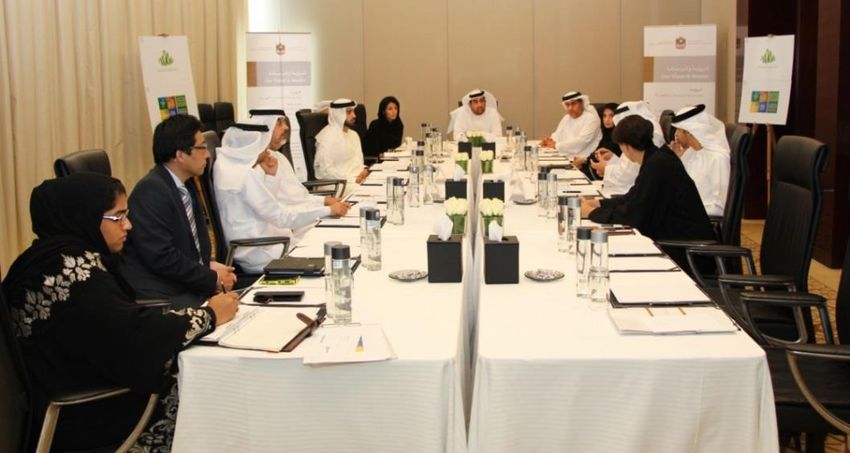
Table of contents
1. Background ………………………………… 3           4. Driving force ……….............……..... 11
1.1 UAE Green Agenda                    4.1 Attitudes to sustainability
1.2 Advancing green finance under       4.2 Influences of environmental
     the UAE Green Agenda                    factors
                                        4.3 Rationale for green finance
2. Survey outline …………….………...……. 5     4.4 Prospect in Islamic finance
2.1 Purpose of the report
2.2 Profiles of survey respondents      5. Challenges ………………..........……… 15
2.3 Defining green finance              5.1 Barriers to introducing green
                                             finance
3. Current practices …………………….….. 8     5.2 Policies for scaling up green
3.1 Existing green finance products          finance
     and services
3.2 Investment in green projects        6. Way forward ……………………………. 17
3.3 Materialized and non-materialized   6.1 Key findings of the survey
     benefits                           6.2 Action points for financial
                                            institutions
                                        6.3 Recommended steps for
                                            mainstreaming green finance
1.1 UAE Green Agenda 2015-2030

                                                                                                                                                                   1 Background
In January 2015, the Cabinet of the United Arab        bin      Fahad,     Minister    of
Emirates issued a decision to implement                Environment and Water, and its
the UAE Green Agenda 2015-2030. The Green              members consist of high-level
Agenda resulted from concerted efforts of the          representatives from five federal
federal and local authorities to concretize the UAE    ministries (Energy, Public Works,
Green Growth Strategy. The Strategy was launched       Economy, Finance and Foreign
by His Highness Sheikh Mohammed bin Rashid Al          Affairs) and all seven emirates of
Maktoum, Vice-President and Prime Minister of the      the UAE [Picture].
UAE and Ruler of Dubai, in January 2012. It aims to
                                                       A committee for each of the five
put forward the country’s ambition to become a
                                                       strategic objectives has been
global hub and a successful model for the low-
                                                       established by September 2015,
carbon green economy so as to enhance the
                                                       which     will  formulate      and                    Second meeting of the Emirates Green Development
competitiveness and sustainability of its
                                                       implement concrete activities.                                  Council (September 2015) and EGDC logo
development and preserve its environment for
future generations.                                    Among the five committees, the Committee on          market creation for the emerging environmental
                                                       Knowledge-based Economic Diversification, which is   goods and services (EGS) sector, while increasing
Through the subsequent extensive stakeholder           coordinated by the Ministry of Economy, was          the green credentials of existing sectors by
consultation process, the Green Agenda was             appointed to implement the Green Diversification     enhancing resource and energy efficiency.
developed as an overarching framework to               Program (1.2).
implement the strategy, consisting of five strategic                                                        This program is further broken down into three sub-
objectives and twelve main programs, which are         This program aims to provide a comprehensive         programs aiming to: i) draw a strategic roadmap and
further broken down into 31 sub-programs [Figure       solution for promoting the economic activities of    set targets for greening the existing industries and
1]. In June 2015, the Emirates Green Development       “green industries” to help shift the UAE economy     nurturing promising clean technologies and the             3
Council (EGDC) was formed to coordinate and            beyond hydrocarbon resources. In combination with    nascent EGS sector (1.2.1); ii) provide practical
oversee the implementation and ensure effective        the National Green Innovation Program (1.1) to be    support for enabling businesses and entrepreneurs
collaboration between federal and local authorities    conducted under the same committee, where            to take greening actions (1.2.2); and iii) stimulate
as well as stakeholders, in line with the UAE Vision   technological contents and new business models       the financial sector to invest in green projects and
2021. The Council is chaired by H. E. Dr. Rashid       will be advanced, this program would focus on        businesses (1.2.3) [Figure 2].
1.2 Advancing green finance under the UAE Green Agenda
1 Background

               Figure 1. Structure of the UAE Green Agenda 2015-2030                                                         Figure 2. Structure of the Green Diversification Program

               The macroeconomic scenarios examined in the             taking green actions, most of the pioneering green     stimulate the country’s financial sector towards
               development of the Green Agenda require the             projects in the UAE have been led and funded by        investment in green projects and innovating green
               investment of 1-2% of gross domestic product            government, and limited private-sector finance and     finance products and services. This includes the
    4          (GDP) in greening the economy for the next 15                                                                  development of domestic green finance models and
                                                                       investment has been considered as the major
               years. To raise a massive level of investment,          challenge to materialize economic opportunities and    products, for example, energy performance contract
               attracting private-sector financing and investment is   job creation for green economy.                        (EPC), public finance initiative (PFI) and green sukuk
               ultimately a decisive factor. Despite the wide                                                                 (Islamic bond). This scheme would include capacity
               availability of green technology solutions and the      The UAE Green Agenda’s Green Finance and               building, match-making between entrepreneurs and
               willingness of both government and citizens for         Investment Support Scheme (1.2.3) aims to              potential funders/lenders, and policy support.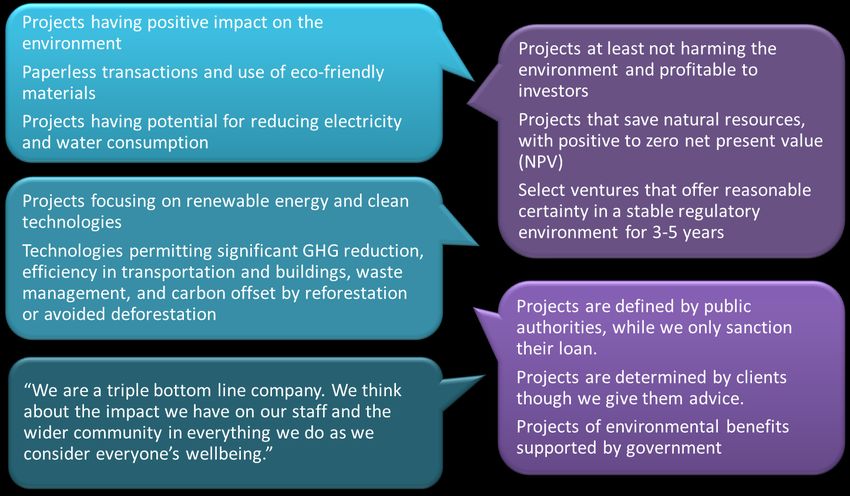
2.1 Purpose of the report

                                                                                                                                                                                 2 Survey outline
The Ministry of Environment and Water (MoEW)
                                                       Survey questions (abridged)                                  Q8: Which type(s) of green finance products/services is
will host the Global Roundtable of the United                                                                       your institution planning to introduce in the UAE in the
Nations Environment Programme Finance                  Section 1: Details of you and your institution               near future?
Initiative (UNEP FI) in the fourth quarter of 2016,    Country of headquarters                                      Q9: How many projects and how much has your
                                                       Type of institution                                          institution invested in green projects through the above
under the patronage of His Highness Sheikh             Geographical coverage of operations                          products/services offered in the UAE? [Total; Sectoral]
Hamdan bin Mohammed bin Rashid Al Maktoum,             Total assets/portfolio assets/gross premiums written         Q10: What are the criteria of defining green projects
Crown Prince of Dubai. In preparation for this high-   [Global; UAE]                                                and making decisions to invest in those projects?
level global gathering, the need for a                 Is the institution regulated by the UAE authorities?
                                                                                                                    Section 4: Challenges & expectations of green finance
                                                       Does your institution offer any Islamic financial products
comprehensive overview of green finance practices                                                                   Q11: What are the reasons for adopting (or planning to
                                                       and services?
in the country was recognized. Such an overview                                                                     adopt) green finance practices?
                                                       Section 2: General engagement in green finance               Q12: Roughly, what is the success rate of the green
was also deemed necessary as a baseline for            Q1: To what extent are environmental issues affecting        projects/companies that your institution has already
attracting attention of the financial sector to the    your institution’s business risks?                           invested in?
UAE Green Agenda.                                      Q2: Which environmental issues and policies are largely      Q13: How much has your institution benefitted from the
                                                       (positively or negatively) affecting or going to affect      implementation of green finance practices through cost
Against this backdrop, an online questionnaire         your business?                                               savings, additional revenues, increased share values,
                                                       Q3: Does your institution incorporate environmental          etc.? Please provide by a rough estimate of monetized
survey was jointly developed by MoEW, the Central      and social sustainability elements in its vision and         values or a share in total profits benefits. What types of
Bank of the UAE and UNEP FI, consisting of 4           strategy?                                                    benefits?
sections and 17 questions [Box]. It was circulated     Q4: Are environmental, social and governance (ESG)           Q14: What are the main barriers/challenges for
                                                       factors integrated into your institution’s business          implementing green finance practices in your
among 455 financial institutions operating in the
                                                       decision-making processes?                                   institution?
country during the summer of 2015, in cooperation      Q5: Does your institution regularly publish any non-         Q15: Do you think that in five years there will be more
with the Central Bank, the Insurance Authority, the    financial reports?                                           emphasis on environmental, social and governance
Securities and Commodities Authority (SCA) and         Q6: Is your institution a signatory or member of the         (ESG) issue in the UAE financial sector than today?
                                                       global initiatives related to sustainable                    Q16: Do you think that the rise of Islamic finance                5
the Dubai Financial Services Authority (DFSA).         development and green finance?                               provides more opportunities to develop green finance
                                                       Section 3: Current status on green finance                   products and services and to invest in green projects?
This report aims to provide an overview of the UAE
                                                       Q7: Which type(s) of green finance products/services         Q17: What type of support or facilitation from the
financial sector’s readiness, current practices and                                                                 government is most required to grow green finance
                                                       does your institution currently offer in the UAE and
challenges in green finance, based on the analysis     outside the UAE?                                             practices in the UAE?
and extracts of the survey responses.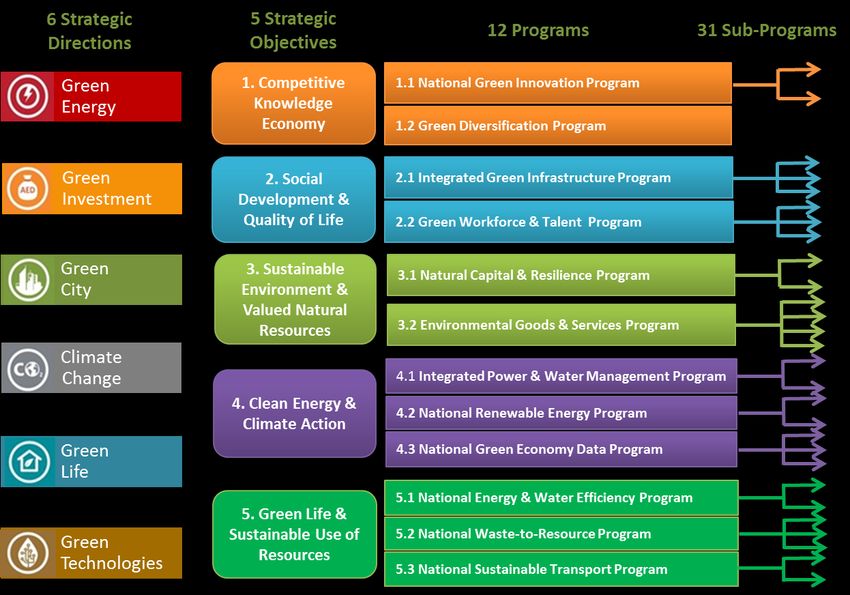
2.2 Profiles of survey respondents
2 Survey outline

                                                                                                                           No. of respondents
                                                                        0           5               10             15   20        25       30
                                                                                                                                                insurance [Figure 3]. Notably, 28 out of the 48
                                                                                                                                                banks operating in the UAE (58.3%) responded.
                                                    Commercial bank                                                                      28     Three-quarters (74.7%) of the respondents are
                               Financial and monetary intermediary                                             13                               under regulation of the Central Bank, 31.6% under
                                                                                                                                                SCA, and 19.0% under the Insurance Authority.
                                      Financial investment company                                            12
                                                                                                                                                The aggregated domestic assets of the 79
                                     Property and liability insurance                                    10
                                                                                                                                                respondent      institutions     (technically called
                                                    Finance company                             8                                               “portfolio assets” in investment firms and “gross
                   Life assurance and operations of fund formation                          7                                                   premiums written” in insurance companies)
                                                                                                                                                amounting to AED 2.915 trillion (USD 787 billion),
                                                    Investment bank                     6                                                       which exceeds the total gross assets of UAE banks
                        Sovereign wealth fund/Government-owned                      4                                                           (AED 2.431 trillion = USD 656 billion as of August
                                                                                                                                                2015). Thus, it is considered that this survey can
                                                    Takaful insurance           3
                                                                                                                                                represent a reasonably good sample of the entire
                                                       ESCO/Yield Co            3                                                               UAE financial sector’s activities.

                    Figure 3. Types of respondent institutions (multiple answers)

                   By the deadline, 79 institutions replied back                more prominent (40.5% were established in 2000
                                                                                                                                                                         a
                                                                                                                                                       The survey illustrates
                   (response rate: 17.4%). Among them, 60 (75.9%)               or later) among the respondents, older institutions                    good overview and
                                                                                established earlier than 1980 also constitute nearly
                   locate their headquarters in the UAE and 7 (8.9%)
                   in other Gulf Cooperation Council (GCC) countries            one-third (31.6%).                                                     baseline of the UAE
    6
                   (Bahrain, Kuwait, Oman, Qatar and Saudi Arabia).             Over one-third (35.4%) of the respondents are                          financial sector as it covers
                   45 institutions (57.0%) operate only within the              occupied by commercial banks, followed by
                   country, while most of the rest also cover GCC
                                                                                                                                                       the majority of local
                                                                                financial and monetary intermediary (mostly
                   (35.4%) as well as diverse regions around the                money exchange and transfer agencies), financial                       assets.
                   world. Whereas relatively new establishments are             investment company, and property and liability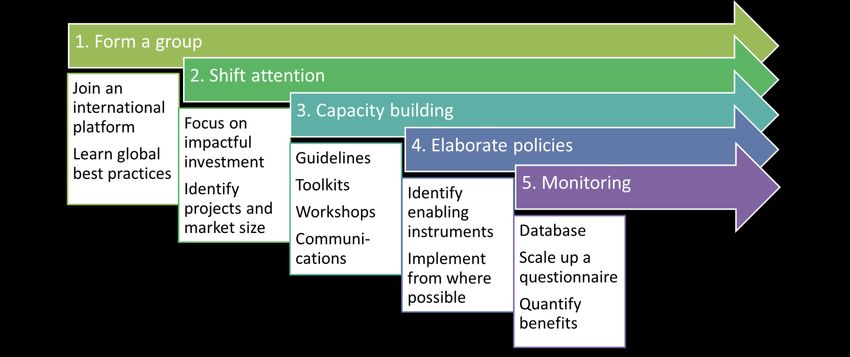
2.3 Defining green finance

                                                                                                                                                                         2 Survey outline
Since no universal definition of green or sustainable
finance exists to date, the questionnaire generally
referred it to as “any of the financial institution’s
practices supporting and facilitating sustainable
development – whether it is for projects,
businesses, industry, organizations, or general
events and campaigns”.

The actual identification of such practices was thus
left to the respondents so as to understand and
bridge gaps between government and the private
sector in the efforts towards a green economy.

The respondents did not come up with any
common definition or standards but provided
diverse criteria from general environmental

        There is no universal
        approach to green
        finance as it is defined                                                                Figure 4. Respondent institutions’ criteria of defining green finance
                                                                                                          and making decisions to invest in green projects (excerpts)
        by general positivity,                                                                                                                                                7
                                                        benefits to specific technologies or impact              defined by government or clients, reflecting the fact
        specific technologies,                          reduction measures, whilst others emphasized to          that most of such projects are currently arranged by
        profitability or others’                        take into account the balance between economic           the public sector and the role of financial
                                                        and environmental benefits [Figure 4]. Interestingly,    institutions tends to be limited to arranging loans
        evaluation.                                     a few passively replied that green projects are          for the contractors.
3.1 Existing green finance products and services
3 Current practices

                                                              0                  10            20               30 No. of respondents
                                                                                                                                                            and credit cards made from plant-based or recycled
                                      Green transactions                                                         38%                                        plastics material – are overwhelmingly the most
                                                                                                                                        Figure 7.           popular form of green finance. Overall, 16 types of
                                   Green project finance                    8%                                                          Consideration of
                                                                                                                                                            products and services have been adopted by at
                                                                       5%        Figure 5. Provision of green                           introducing new
                          Energy performance contracts                                                                                                      least one institution to date. Meanwhile, the
                                                                                 finance products/services in                           green finance
                                          Green accounts           4%            the UAE among respondent                               products/services   products, which are supposed to make more
                                                                                 institutions                                           in the UAE          substantive impact for enabling a green economy
                                         Green auto loan          3%                                                Planning
                                                                                                                                                            including green project finance, green loans and
                                    Green personal loans                                                            No future                               green bonds, seem to be still at an early stage of
                                                                                                                    plan                                    adoption [Figure 6, with highlights of impactful
                                      Green bonds/sukuk                                                                                           41%
                                                                                                    48%                                                     products].
                                            Private equity                       52%                        Have a               59%
                                                                                                            product(s)
                                     Green building loans         1%
                                                                                                            No product
                                                                                                                                                                   38 institutions already
                                     Green micro-finance
                                                                                                                                                                   offer green finance
                                        Green credit lines
                                                                                            The survey asked whether and which green finance
                                                                                            products and services the respondent institutions
                                                                                                                                                                   products, but most
                                                 SRI funds
                                                                                            provide in the UAE. Nearly half (38 institutions)                      impactful products are not
                                       Impact investment
                                                                                            already provide a green finance product or service
                                Energy savings insurance                                    to date [Figure 5].
                                                                                                                                                                   yet widely adopted.
     8                8            DBFO/BOOT contracts
                                                                                            Among the 28 types of products and services which               Meanwhile, only 32 institutions (40.5%) answered
                                    Risk-sharing facilities                                 the questionnaire listed to help the respondents                that they are planning to introduce additional
                                                                                            answer, “green transactions” in a way to save                   products and services in green finance in the near
                          Figure 6. Types of green finance products/services
                          provided in the UAE by respondent institutions                    material and energy use – e.g. paperless                        future, which were fewer than those who already
                          (multiple answers)                                                statements, online and mobile banking, and debit                have at least one product or service [Figure 7].
3.2 Investment in green projects

                                                                                                                                                             3 Current practices
To date, the total amount of green
                                                                 Invested
investment is estimated to exceed
                                                                 Not invested
AED 80 billion (USD 22 billion)                           23%                          33%                               18 institutions from the
including the nuclear energy
projects ongoing in the Western
                                                                                                                         banking and investment
Region of Abu Dhabi. Nearly a                  77%                                                        67%            sectors have invested in
quarter of the respondents (18                                              UAE
institutions) from the banking and                                          Overseas
                                                                                                                         green projects. Half of
investment sectors have invested in       Figure 8. Investment
                                          in green projects by
                                                                                                                         the domestic investment
                                                                                       Figure 9. Share of domestic and
green projects from their assets          respondent                                   overseas investment in green      went to the water &
[Figure 8]. Two-thirds of this green      institutions                                 projects made by respondent
investment went to 75 domestic                                                         institutions                      electricity sector.
projects, which amounts to 0.27% of                                                                 1%
                                                                 4%                    2%
the domestic gross product (GDP) in 2014. The rest
were invested in 27 overseas projects [Figure 9].
                                                                  14%                                                       Figure 10. Respondent
More green investment should also have been
                                                                                                                            institutions’ green investment
made where this survey could not capture.
                                                                                                                            by sector
                                                                                                    50%
Counting only the investment in which sector                                                                                   Water & Electricity
breakdowns were provided, half of the domestic                                                                                 Transport
                                                                            29%
green investment went to the water and electricity                                                                             Oil & Gas                           9
sector such as efficiency and renewable energy                                                                                 Construction
projects. The transport and logistics sector                                                                                   Other sectors
received 29%, followed by oil and gas (14%) and                                                                                Conservation
buildings and construction (4%) [Figure 10].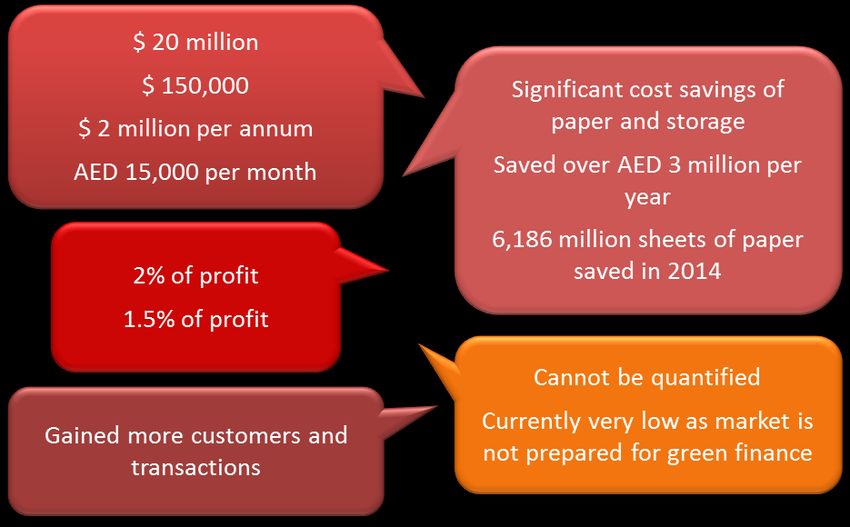
3.3 Materialized and non-materialized benefits
3 Current practices

                      The survey included an open-ended question about           Figure 11.
                      a rough estimate of the benefits that the                  Respondent
                      respondent institutions have gained from the               institutions’
                                                                                 estimated benefits
                      implementation of green finance practices, for             from green finance
                      example through cost savings, additional revenues          practices (excerpts)
                      and increased share values. The answers were
                      diverse – starting from negligible to as much as
                      USD 20 million and 2% of total profits, while others

                           Benefits and
                           success rate of green
                           finance are varied, but
                                                                             No. of respondents
                           leading institutions benefit                      7                                                                       Figure 12. Perceived success rate of green
                                                                                                            33%
                           as much as 2%            of their                 6
                                                                                                                                                     projects invested by respondent institutions
                                                                                                                           28%
                           profit.                                           5
                                                                                         22%
                                                                                                                                                         The survey also asked the success
                                                                             4
                                                                                                                                                         rate of green projects in which the
                                                                                                                                          17%            respondent     institutions    have
                      answered by the amount of paper and energy             3
 10                                                                                                                                                      invested, although the definition
                      saved by green measures [Figure 11].
                                                                             2                                                                           and degree of success is inevitably
                      If the entire UAE banking sector gained 2% of total    1                                                                           subjective. The rates were equally
                      profits from green finance, the total benefits would                                                                               spread from very highly successful
                                                                             0
                      amount to AED 780 million (USD 210 million) a                Very high (>75%)     High (50-75%)   Moderate (25-   Low (
4.1 Attitudes to sustainability
4 Driving force
What is the driving force behind the management [Figure 13]. 25 institutions (31.6%)
Figure 13. Integration of ESG increasing number of UAE financial regularly publish their non-financial performance –
factors in respondent institutions’
18% institutions introducing green environmental, sustainability, or corporate social
decision-making processes
finance products and services or responsibility (CSR) reports as stand-alone or
30%
investing in green projects? The integrate into annual financial reports [Figure 14].
Yes, systematically survey generally shows that their
positive attitudes to sustainability
Yes, above a threshold
have already been well nurtured. 25 Nearly a third of
Yes, for specific sectors institutions (31.6%) replied that
34% 1% respondents already
17% No, but planning they already incorporate
No, no plan
environmental and social integrate
sustainability elements into their
overall visions or strategies, and
sustainability and
additional 33 institutions (41.8%) regularly publish non-
1% are planning to do so in the near
Environmental report
future. financial reports.
Sustainability/CSR report 13%
Such attitudes are clearly
Integrated report Albeit still a minority, 12 institutions (15.2%) take
demonstrated by the systematic
integration of sustainability into part in one or more of leading global initiatives that
No, but planning 45%
18% their regular operations and promote green finance and accountability such as
No, no plan Carbon Disclosure Project (CDP), Global Reporting
procedures. 24 institutions (30.4%)
replied that they systematically Initiative (GRI), UNEP FI and UN Global Compact. 11
integrate environmental, social and Also there are a few signatories of the Equator
governance (ESG) factors into their Principles, UN Principles for Responsible
Figure 14. Publication of non- 23%
financial reports by business decision-making processes Investment, UNEP FI Principles for Sustainable
respondent institutions such as due diligence, investment Insurance, and UN Sustainable Stock Exchange
analysis, risk assessment and Initiative.4.2 Influences of environmental factors
4 Driving force
No. of respondents
0 5 10 15 20 25
Despite that many institutions showed positive 30 35
attitudes to sustainability, environmental factors Climage change & extreme weather events
have not been felt as material risk to their own 41%
business yet. Only 19.0% answered that the impact Energy security
38%
of environmental issues is “very high” or “high”, Environmental standards & certificates
whereas 36.7% answered “low” and 21.5% even 32%
said “little” impact on their business [Figure 15]. Environmental charges & subsidies
23%
With regard to specific issues and policies, 40.5% Food safety & security
20%
replied climate change and extreme weather Pollution - air, soil and water
events would be affecting or going to affect their
Water scarcity & management
Natural resource depletion & biodiversity loss
9% 18%
21% Environmental liabilities
14% Figure 16. Environmental
10%
Environmental disclosure requirements issues/policies affecting or
13% going to affect respondent
institutions (multiple answers)
23%
Environmental risks business. The second most affecting issue is energy
have not yet been felt by security (38.0%), followed by government policies
such as environmental standards and certificates
37%
12 the majority, while (31.6%) and charges and subsidies (22.8%). Those
climate change and institutions seem to be less concerned with
domestic environmental issues such as pollutions,
Very high High Medium Low Little
energy are the two water scarcity and biodiversity loss, and potential
Figure 15. Influence of environmental factors in liabilities for causing negative impact to the
business risks of respondent institutions
major concerns. environment [Figure 16].4.3 Rationale for green finance
4 Driving force
0 5 No. of respondents
10 15 20 25 30 35 Figure 18. Prospect
40
of rise in ESG
CSR 8% factors in the UAE
46% financial sector
Cost savings and efficiency
44% 20%
Reputation and brand
Yes
38%
Competitive advantage No
29% 1%
Profitability Not sure
71%
25% No answer
Diversification of products
19%
Stakeholder relations
Risk management
Policy incentives and pressures
16% CSR, cost and
Industry trend
reputation motivate
13%
Access to capital
green finance as 71%
11%
Employee motivation
Figure 17. Reasons of respondent institutions for expect more emphasis in
10% adopting or planning to adopt
green finance (multiple answers) ESG in 5 years.
Corporate social responsibility (CSR) came to the institutions seem to consider that green finance As a future prospect of green finance, the large 13
top of the reasons for adopting or planning to makes business sense, as cost savings and majority of institutions (70.9%) agree that
adopt green finance practices among the efficiency was chosen as the second most popular environmental, social and governance (ESG) issues
respondent institutions (45.6%), while reputation reason (44.3%), and competitive advantage (29.1%) will be even more emphasized in the country’s
and brand (38.0%) was also among the most and profitability (25.3%) were also considered financial sector in next five years than today [Figure
impactful factors. At the same time, many highly important [Figure 17]. 18].4.4 Prospect in Islamic finance
4 Driving force
Whilst interest in Islamic finance is rapidly growing Figure 20. Prospect
not only in the Arab region but across the world, 47% of institutions offer 8% in Islamic finance
to be applied for
Islamic banks have been thriving in the UAE in the
last few years. The Central Bank of the UAE has Islamic finance green investment
in the UAE
issued an Islamic banking license to eight banks to
date, whose assets increased by 14.4% a year
products, while the 47%
between the second quarter of 2014 and that of view on the prospect in 43% Yes
2015. During the same period, their share in total
banking assets increased from 17.4% to 18.4%, and
applying it for green No
Not sure
their financing increased to reach AED 290 billion finance is mixed. No answer
(USD 78.3 billion), 21.7% of the domestic credit 2%
from 19.5% a year before. No. of respondents
0 5 10 15 20 25 30 35 40 45 The survey identifies far more institutions than the
licensed Islamic banks – 37 institutions (46.8%) –
Islamic banking 24%
provide a range of Islamic finance products. 24.1%
Sukuk 19% have Islamic banking, 19.0% arrange sukuks (Islamic
bonds), 17.7% offer Shariah investment funds, and
Shariah investment funds 18% 8.9% have takaful (Islamic insurance) and/or re-
Takaful-retakaful takaful (Islamic re-insurance) [Figure 19].
9%
Shariah-based commodity trade platform 5% In relation to green finance, 46.8% consider that the
rise of Islamic finance will provide more
14 Shariah indices 4% opportunities to develop green finance products
and services or to invest in green projects. On the
Islamic micro-finance 3% other hand, a substantial number of institutions
No offer 53% (43.0%) also answered that they were not sure
about such a prospect, as the view over Islamic
Figure 19. Islamic finance products offered by respondent institutions (multiple answers) finance seems to be divided [Figure 20].5.1 Barriers to introducing green finance
5 Challenges
No. of respondents
The practices of green finance are still at an 0 5 10 15 20 25
embryonic stage among UAE institutions, as they
Enforcement is not adequate 29%
face diverse barriers and challenges to starting it up
and integrating it into their regular operations. The Sector risk is high 24%
survey questioned most significant barriers and
Payback period is too long 22%
challenges, among of them include macroeconomic
situations, generic conditions surrounding green Profitable projects are lacking 20%
finance, transactional issues and public support.
Case is unclear 18%
The highest number of institutions (29.1%) pointed Figure 21. Barriers
out that the lack of adequate enforcement of Data is not available and challenges to
policies and regulations has caused a difficulty in MRV is not standardized 16% implementing green
introducing green finance in the UAE. Their proper finance among
Technology risk is high 14% respondent
implementation is critical to give clear incentives
institutions (multiple
for industry to take greener actions and invest in Counterparty risk is high 13%
answers)
greener solutions by penalizing non-compliers and
Client confidence in low 11%
raising the bar on standards continuously.
Transaction cost is too high
This was followed by the factors more directly
impacting their bottom line, including high risk of 10%
Lack of policy
Economic outlook is unfavourable
green sectors (24.1%), long payback period and
Price outlook is not favourable
enforcement, high
lack of long-term finance (21.5%), lack of
profitability (20.3%) and unclarity in benefits Policies are not favourable 8%
risk and low return
15
(17.7%). Lack of data (17.7%) and standard are among the most
Knowledge is lacking 5%
methodology for measurement, reporting and
verification (MRV) (16.5%) were also considered as Policies are unstable 4% common barriers to
important barriers, since it affects decision-making
such as due diligence and risk assessment [Figure Leadership is lacking 1% introducing green finance.
21].5.2 Policies for scaling up green finance
5 Challenges
To conclude the survey, its final question asked country. Practical, direct support came to the top of requested improved policy coherence and
what type of support or facilitation from answers such as guidelines and on green finance coordination in government (40.5%) as well as the
government is most required to scale up and (43.0%) and grants, subsidies, loans and interest establishment of national targets and roadmaps to
accelerate grow green finance practices in the discounts (40.5%). Many respondents also disseminate green finance (36.7%).
43%
No. of respondents
35 41%
37% Figure 22. Types of support Guidelines, policy
30 33% or facilitation from the
government required by coherence and
32%
25
respondent institutions to
practice green finance
financial support
(multiple answers)
are among the support
20
most required to
18% 16% 15%
15
14% 13% advance green
11%
10 10%
9%
finance.
6%
5 These were followed by awareness raising and
information dissemination (32.9%) and the
0 establishment of governmental green funds and
bonds (31.6%). In contrast, only a small number of
16 institutions showed interest in government
intervention through market mechanisms, or
“getting prices right” policies, such as fiscal policy,
purchasing agreements and feed-in-tariffs (FITs),
and tradable permits (e.g. carbon credits) [Figure
22].6.1 Key findings of the survey
6 Way forward
The findings from the survey are summarized as incorporate sustainability
follows: elements into their visions and
strategies, and the similar
Current practices of green finance
number already integrate ESG
Nearly half of the respondent institutions factors in their decision-making
already provide a green finance product or processes systematically.
service, while 41% are planning to introduce
new products/services in the near future. The respondents see climate
change affecting or going to
Nearly a quarter of the respondent institutions affect their business the most,
from the banking and investment sectors have along with energy security and
invested in green projects (including 75 domestic government policies.
projects) from their assets. At least 0.27% of
GDP was invested in domestic green projects. For many financial institutions,
green finance makes business
Benefits from green finance sense as cost savings, First national roundtable on green finance (May 2015)
Some institutions are already realizing competitive advantage and
substantial benefits from green finance through profitability – along with CSR and reputation – significant barriers to introducing green finance
cost savings, additional revenues and increased are raised as main reasons for adopting or in the UAE. High risk level of green sectors, long
share values. The most profitable cases reach as planning to adopt green finance. payback period and lack of profitability are also
much as USD 20 million and 2% of total profits. among the challenges faced by financial
An increasing number of institutions provide a
institutions.
If the entire UAE banking sector gained 2% of range of Islamic finance products and services,
total profits from green finance, the total while the views over the prospect for applying Practical, direct support such as guidelines and 17
benefits would amount to AED 780 million (USD them to green finance are mixed. subsidies is the most sought-after support from
210 million) a year. government to promote green finance, followed
Challenges and policies to overcome by awareness raising and green funds. In contrast,
Drivers of green finance Lack of adequate enforcement of policies and fiscal policy, feed-in tariffs and tradable permits
Nearly a third of the respondent institutions regulations was recognized as the most are less popular measures.6.2 Action points for financial institutions
6 Way forward
In a world where the global population is Why is sustainability relevant to the CEO and the Board of your institution?
approaching 9 billion, all of whom with basic needs
to be met, where natural resources are rarefied, Risks of Inaction Opportunities
and where climate disruptions are mounting, Loss of business opportunities through a failure to adapt New business opportunities arise from a
“business as usual” is no longer sufficient. to changing market realities new understanding of the market and
Higher overall risk exposure through a failure to changing world context.
The world has changed, markets are changing fast
understand the materiality of environmental and social
and a new approach to finance is needed to adapt
risks Stronger, more resilient institution thanks
and to keep up with the pace of change. Banks, for
Potential pressure or disengagement of investors to proper understanding and management
example, are at a historic tipping point when of sustainability issues
prioritizing sustainable investment choices
continuing to grow, as a business has become
closely interconnected with the fulfilment of Lack of preparedness for regulatory and policy
Better rated and valued company
broader goals such as social and environmental adjustments
sustainability [Box]. Risks to reputation, credibility and image of the
Improved reputation, credibility and
company through a failure to respond to stakeholder
recognition of the brand
expectations.
A new approach
Source: UNEP FI
to finance is needed
What can financial institutions do?
as business has become Foster a new corporate culture: Actively
Demonstrate vision: Ensure that environmental communicate and advocate within the
interconnected with the and social sustainability issues are directly organization to show top-level buy-in, and invest
18 fulfilment of embedded into your organization’s vision. in developing staff awareness and expertise.
sustainability Establish adequate governance: Accountability Be transparent: Promote clear and transparent
goals. on sustainability issues needs to be established
at the highest levels of the organization, within
communication on your organization’s approach
and progress in adapting to and incorporating to
the Executive Committee and/or the Board. sustainability issues.6.3 Recommended steps for mainstreaming green finance in the UAE
6 Way forward
or technologies in order to help advocate more
impactful green investment and engage more
institutions. (This could be presented at the
UNEP FI Global Roundtable in 2016.)
Step 3: Capacity building and awareness raising
Guidelines, technical toolkits and communication
materials may be developed to help disseminate
the notion and practices of green finance, while
workshops and events may be organized for
Figure 23. A proposed different target audience.
roadmap for
mainstreaming green Step 4: Elaborate enabling policies
finance in the UAE
Identify practical policy measures that enable
It is clearly needed to accelerate the dissemination scaling up green finance practices based on
Step 1: Form a national group on green finance
and elevate the practices of green, sustainable multi-stakeholder consultation, and introduce
finance in the UAE so as to realize the level of A multi-stakeholder group consisting of financial and implement from where government can
investment and scale of projects required for institutions, green businesses and project afford.
economic diversification through fostering green developers, and government authorities with a
primary objective to learn from best practices Step 5: Monitor progress
industry and jobs. A nationally coordinated,
through UNEP FI, exchange knowledge, and Set a mechanism to estimate the green finance
strategic implementation plan may well be
identify innovative ways to overcome barriers. market and benefits and monitor financial sector
developed and put into force under the framework 19
of the UAE Green Agenda (Sub-Program 1.2.3: Step 2: Shift attention to impactful projects and initiatives by setting up database, scaling up the
Green Finance and Investment Support Scheme). products questionnaire survey, etc.
Based on the feedback from the survey, such a Conduct a baseline study on the country’s Report the progress through EGDC and the State
strategy may be developed and implemented market potential of green projects and of Green Economy Report, and revise plans and
around the following multiple steps [Figure 23]: investment opportunities according to industries targets regularly.State of Green Finance in the UAE The first national survey on contributions of financial institutions to Green Economy Copyright © United Arab Emirates Ministry of Environment and Water 2015 For further information or for provision of feedback: UAE Ministry of Environment and Water, Green Development Department (Secretariat, Emirates Green Development Council) PO Box 1509, Dubai, United Arab Emirates E-mail: greendevelopment@moew.gov.ae This publication is available for download from www.moew.gov.ae
You can also read


