UK Insurance and Long-Term Savings - The state of the market - Association of British Insurers
←
→
Page content transcription
If your browser does not render page correctly, please read the page content below

Association of British Insurers

     UK Insurance and
     Long-Term Savings
     The state of the market

abi.org.uk

@BritishInsurers
2       UK Insurance and Long-Term Savings: The state of the market

    Contents
    3           Welcome
    4           Introduction
    5           The UK insurance and savings market
    5           Economic context
    9           The UK insurance and savings market
    13          Importance to UK households
    16          General insurance
    16          The total market
    18          Motor
    20          Property
    21          Other lines
    26          Life and long-term savings
    26          Summary
    27          Pensions
    29          Retirement income
    31          Protection
    33          ABI contacts

        abi.org.uk

        @BritishInsurers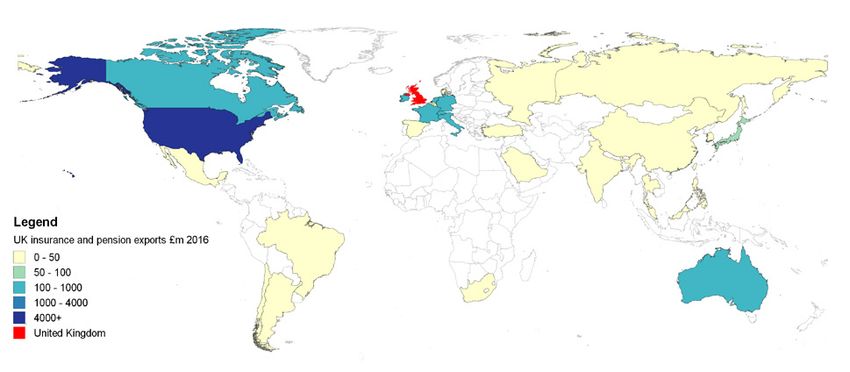
UK Insurance and Long-Term Savings: The state of the market   3

Welcome
Huw Evans
Director General

It is a pleasure to introduce the ABI’s first State of
the Market publication. Having detailed market
data to inform our policy positions and illustrate our
arguments is a must-have in our dealings with ministers,
policymakers, regulators and customers.
Over the last two years, we have fundamentally
modernised our Data & Analytics work under Matt
Cullen’s leadership to produce more timely analysis as
well as raw data. This publication is the next step in using
that analysis to inform debate to the benefit of all.
I hope you find this a stimulating read and a useful reference
point for your work in the months ahead. We hope this is the
first publication of many and that you will continue to let us
know what you need from our Data & Analytics work as we
all navigate this fast-changing world together.

About the ABI
The Association of British Insurers is the voice
of the UK’s world leading insurance and long-
term savings industry.
A productive, inclusive and thriving sector, we
are an industry that provides peace of mind
to households and businesses across the UK
and powers the growth of local and regional
economies by enabling trade, risk taking,
investment and innovation.
4     UK Insurance and Long-Term Savings: The state of the market

    Introduction
    Matt Cullen
    Assistant Director, Head of Strategy, Data & Analytics

    Welcome to our State of the Market report. Building on
    our annual Key Facts summary document, this more
    detailed report uses the ABI’s wide range of data on the
    UK insurance and long-term savings market to paint
    a picture of the key trends affecting our sector, and
    considers the reasons behind them. The ABI statistics
    used are freely available to ABI members on our website
    (www.abi.org.uk), and can be purchased by non-
    members in a range of different subscription packages.
    Over the last two years – the period to which data used
    in this report relates – a wide range of forces have been
    exerted on the UK insurance and long-term savings
    market. Long-term savings firms have continued to adjust
    to a world of auto-enrolment and pension freedoms,
    while general insurers have been stung by the 2017
    reduction of the Ogden discount rate on the one hand,
    but helped by a soft reinsurance market and benign
    weather on the other. Across the industry, companies
    have had to adjust to a new prudential regulation regime
    – Solvency II, have engaged with a wide range of conduct
    regulation issues, and have begun detailed planning
    for Brexit. This is not to mention the broader long-
    term trends impacting firms – the accelerating digital
    revolution, the shifting dynamics of the global economy,
    an ageing population etc.
    While the market has inevitably been affected by all
    of these forces, our industry’s role in society remains
    steadfast. From London to Liverpool, and indeed from
    Lagos to Los Angeles, the UK insurance industry is
    helping families and businesses thrive by managing risk
    and providing long-term security and stability. The ABI’s
    Helping Britain Thrive campaign, launched in 2017, sets
    out the industry’s contribution to UK society – employing
    hundreds of thousands of people, paying billions in taxes
    and, as shown in this report, writing more insurance and
    savings business than ever before.
    We are always keen to engage with industry participants
    and analysts on the state of the market, so please do feel
    free to get in touch with any questions, or suggestions for
    future work.

      abi.org.uk

      @BritishInsurers
UK Insurance and Long-Term Savings: The state of the market 5
Section 1
The UK insurance and savings market
By Daniel Sadler – Manager, Data & Analytics
The UK is one of the most prosperous and developed Figure 2: GDP growth, top five economies by GDP (%), 2016
countries in the world. Residents enjoy a relatively high
1.6%
standard of living compared to the rest of the world; United States
businesses benefit from competitive tax rates, a mature Japan 1.0%
legal system and a well-educated workforce.
China 6.7%
The UK Insurance and Long-Term Savings Industry plays
a significant role in this, helping households safeguard United Kingdom 1.8%
their possessions and manage the risk of adverse life
Germany 1.9%
events, as well as safeguarding savings for their future.
Businesses are better able to manage their risks and
more efficiently deploy their resources with suitable
insurance arrangements in place.
Key industries
Economic context The UK economy is dominated by the services sector,
which comprises 80% of total GDP; the next largest
sector, manufacturing, comprises just 19% of GDP, with
Economic output
the remaining 1% being agriculture5. This structure has
The UK has the fifth largest economy in the world, with been relatively consistent for the UK over the last 25
a Gross Domestic Product (GDP) of just over £1.9 trillion years, with services accounting for 69% of GDP in 1990
in 20161; only Germany, Japan, China and the USA have a and growing to current levels due to the gradual decline
larger output than the UK (see Figure 1). of UK manufacturing (see Figure 3).
Figure 1: World top five economies by GDP (£trillion, Figure 3: Output by main industrial sector in the UK
current prices)2, 2016 (% of GDP, 1990-2016)
%
100
90
United States 13.75 80
70
Japan 3.66
60
50
China 8.29
40
30
United Kingdom 1.94
20
10
Germany 2.57 0
1990
1991
1992
1993
1994
1995
1996
1997
1998
1999
2000
2001
2002
2003
2004
2005
2006
2007
2008
2009
2010
2011
2012
2013
2014
2015
2016
UK GDP has continued to grow over recent periods, Services, value added (% of GDP)
Industry, value added (% of GDP)
despite the long-term fallout from the 2007-08 recession Agriculture, value added (% of GDP)
and the UK’s vote to leave the European Union. UK
annual GDP growth for 2016 was 1.8%3 ; however, this
has since fallen to 1.5% for the twelve months preceding This structural composition is similar to that of the
2017Q34. The 2016 estimate compares favourably to the USA, where the service sector accounts for 79% of GDP;
other largest economies, with both the USA and Japan meanwhile, Germany and China both have a larger
experiencing a lower growth rate than the UK. manufacturing sector in relative terms, with 41% of
output in China from manufacturing industries (See
Figure 4).
1
ONS (2017) “Gross Domestic Product: chained volume measures: Seasonally adjusted £m”,
2
The World Bank (2017) “World Development Indicators: GDP Current US$ & GDP (current LCU)”
3
The World Bank (2017) “World Development Indicators: GDP growth (annual %)”
4
ONS (2017) “Time Series: Gross Domestic Product: q-on-q4 growth rate CVM SA% (PGDP)”
5
The World Bank (2017) “World Development Indicators: Economy Structure”6
Figure 4: Output by main industrial sector, largest five Taxation
world economies (% of GDP, 2015)6
The UK remains one of the most competitive places
% in the world to base a company, with corporation tax
100 rates currently at 19%11 and scheduled to drop to 17%12
80
in 2020. This is lower than any other country in the G7;
corporation tax in the USA is over double that of the UK
60 at 40%, with the next lowest after the UK being Canada
at 26.5%. However, with Brexit looming in 2019, other
40
European jurisdictions, such as Ireland and Liechtenstein
20 with a corporate tax rate of just 12.5%, pose even more
serious competition to the UK than they already do.
0
United Kingdom United States Japan Germany China
Services, value added (% of GDP) Figure 6: Corporate tax, top five insurance markets plus
Industry, value added (% of GDP) Ireland and EU average (%, 2017)
Agriculture, value added (% of GDP)
Population and productivity United States 40
The UK population is currently 65.6 million people7; this Japan 30.86
is significantly smaller than that of the other top five China 25
economies. Relative to GDP, the UK population compares
favourably, with GDP per capita at just over £31,440 per United Kingdom 19
person; Japan’s equivalent sits at £30,307; however, the France 33.33
USA figure is significantly higher at £41,9998.
Ireland 12.5
Despite a relatively high GDP per capita, UK workers
are less productive than their peers in the other largest EU average 21.51
economies. The average UK worker contributed £52,229
to the UK economy in 2016; by comparison, workers in
Germany produced £61,753 a year, and US employees Figure 7: Corporate tax time series for the UK, USA,
produced over £71,254 per year. Ireland and EU average (%, 2003-2017)
Figure 5: GDP per capita and employee productivity (£, 2016) %
45
£ 40
80,000 35
Corporate tax rate
70,000 30
60,000 25
50,000 20
15
40,000
10
30,000
5
20,000
0
2003
2004
2005
2006
2007
2008
2009
2010
2011
2012
2013
2014
2015
2016
2017
10,000
0
United United China Germany Japan World European United States United Kingdom Ireland EU average
Kingdom States Union
GDP Per Capita, PPP current £
The world’s fourth largest insurance market
GDP Per Employee, PPP current £
Employment in the UK, taken as the proportion of the
population at working age and also working, is quite The UK hosts the fourth largest insurance market in the
high compared to other developed countries at 74.2%; world, and the largest in Europe, with a total premium
the average employment level for EU member states is volume in 2016 of just under £225 billion13. The world’s
currently 67.6% and 70% for the USA9. However, the UK largest insurance market is located in the USA, with a
lags well behind the OECD leader – Iceland – with 86.5%. 2016 premium income of £998 billion – roughly four and a
half times the size of the UK market.
Meanwhile, the unemployment rate in the UK has dropped
slightly from 5.4% in 2015 to 4.9% in 201610 - below levels
seen immediately prior to the 2007-8 financial crisis.
6
The World Bank (2017) “World Development Indicators: Economy Structure”
7
ONS (2017) “Article: Overview of the UK population: July 2017”
8
The World Bank (2017) “World Development Indicators: GDP per capita (current US$)”
9
OECD (2017) “Employment situation, second quarter 2017, OECD”
abi.org.uk 10
ONS (2017) “Time series: Unemployment rate (aged 16 and over, seasonally adjusted)”
11
KPMG (2017) “Corporate tax rates table”
@BritishInsurers 12
HM Treasury (2017) “Policy paper, Spring Budget 2017, Published 8 March 2017: 4.3 Business Tax”
13
Swiss Re Sigma 3 (2017)UK Insurance and Long-Term Savings: The state of the market 7
Figure 8: Top Five countries by Total Premium Income Figure 10: Insurance density: premiums per capita by
(£m, 2015 & 2016) business type (£, 2016)16
United 998,102
States 862,600 United States 1273 1808
347,830
Japan
293,497 Japan 2069 685
344,019
PR China 2016 China 140 109
252,862
2015
United 224,515 United Kingdom 2239 761
Kingdom 215,167
France 1644 862
175,389
France
155,715
Life business: £ Non-Life business: £
The UK market grew by just under 4% in real terms from
201514. This is the second largest growth rate in the top
five markets after China at 25% growth (see Figure 9), Figure 11: Insurance penetration: premiums as a % of
and the largest growth rate in the top five EU markets GDP by business type (%, 2016)
by some margin. Note, however, that when including
the impact of depreciation of the pound compared to
overseas currencies over 2016, this change appears France 6.06 3.17
significantly smaller than in some other EU states.
United Kingdom 7.58 2.58
Figure 9: Inflation adjusted growth rate by market top five PR China 2.34 1.81
insurance markets( %, 2016)
Japan 7.15 2.37
25
United States 3.02 4.29
Life business % Non-Life business %
It is worth noting that certain significantly smaller
markets eclipse the UK under the per capita and GDP
equivalent measures; the Cayman Islands reports both
3.7 the highest 2016 premiums per capita at £8975 per
1.3
Japan France person, and the highest insurance penetration figure
United States PR China United Kingdom -0.1 with premiums equivalent to 22.6% of GDP.
-5.1
The world’s largest insurance exporter
Taking account of population and economy size when
comparing the top five insurance markets paints a With such a large insurance market, it is perhaps unsurprising
somewhat different picture. The UK has the second that the UK is a significant exporter of insurance services. In
largest market in the top five relative to its population, fact, the UK is the single largest exporter of insurance and
with premiums per capita in 2016 at just under £3000 per pensions services in the world, exporting just under £15
person, just behind the USA at £3080 per person15 billion17 in 2016; this is more than the combined insurance and
(see Figure 10). The UK insurance market is also very large pensions exports of Asia (£13.4 billion), and significantly more
compared to the overall size of the economy, with UK than the next largest exporter, the USA, which exported just
premium volume equivalent to just over 10% of GDP (see over £13 billion in 2016.
Figure 11).
14
Swiss Re Sigma 3 (2017)
15
Swiss Re Sigma 3 (2017)
16
The World Bank (2016) “GDP per capita (current US$)”
17
WTO (2017) “Trade and tariff data”8 UK Insurance and Long-Term Savings: The state of the market
Figure 12: Top five insurance exporters + Asia (£m, 2016)18
United Kingdom 14,880
United States 13,094
Germany 8,251
Ireland 7,652
France 6,343
Asia 13,414
The UK insurance market also caters for the vast majority
of domestic demand, importing just £149 million of
overseas insurance and pensions business in 2016.
Amongst the top five insurance markets, the UK is the only
country with a positive trade balance (exporting more than
it imports). By comparison, the USA imported just under
£36 billion of insurance and pensions business in 2016.
Figure 13: Top five insurance markets – trade balance
(exports minus imports) (£m, 2016)
-385 France
United Kingdom 14,731
-6,522 China
-2,903 Japan
-22,626 United States
The UK exports insurance and pension services to many
different countries around the world. Its largest export
market by far is the USA, with just under a third (31%)19
of exports heading there in 2015 (see Figure 14). The UK
actually exported more to the US than it did to Europe,
with 28% of exports in 2015 going to EU28 countries.
Figure 14: UK insurance export destinations (£m, 2016)
18
WTO (2017) “WTO-UNCTAD-ITC annual trade in services dataset”
abi.org.uk
19
ONS (2016) “UK Balance of Payments, Pink Book 2016”
@BritishInsurersUK Insurance and Long-Term Savings: The state of the market 9
The UK insurance and savings market Figure 16: UK Insurance Sector - tax contribution
breakdown (%, 2014) 23
Contribution to the UK economy
The UK insurance and long-term savings industry is Employment taxes 26.3%
not only significant on the world stage; it also plays a Insurance premium tax 19.5%
significant role in the prosperity of the UK economy. PAYE on annuities 17.3%
VAT 14.8%
Corporation tax 12.9%
Economic output Tax deducted at source other 4.8%
Other taxes 4.3%
The insurance and pensions sector is a significant
contributor to UK output, adding between £42 and
£45 billion in gross value to the UK economy in 2015.
This includes £34 billion20 from the core insurance and
Insurance and pensions companies account for
pensions sector, as well as approximately £8-11 billion
approximately 3.4% of all corporation tax receipts; they
from a variety of auxiliary professions that support the
also pay a significant amount of VAT (approximately
sector. Insurance and pensions account for roughly a
30% of all taxes borne by the industry). This is a result of
third of output from the Financial Services sector.
insurance products being VAT-exempt, with IPT charged
instead; this therefore precludes insurers from recovering
Figure 15: Growth in GVA for various UK sectors
some of the VAT paid on their own expenses.
(2010=100, 2010-2015)21
%
200 Jobs
180
160
The insurance sector is also a very significant employer,
with approximately 324,100 individuals employed by the
Index (2010 = 100)
140
120
sector in 2016. Just under a third of these employees
100 (105,000) are directly employed by the sector, whilst a
80 further 219,000 are employed in auxiliary services such as
60 claims handling and broking (see Figure 17).
40
20 Figure 17: Employment in the UK insurance industry
0 (%, 2016)24
2010 2011 2012 2013 2014 2015
Finance & Insurance Services auxiliary to financial
services and insurance
Financial service activities
All employment
Insurance & Reinsurance
Taxation
Full Time 84%
The UK insurance industry contributed approximately
£11.8 billion in tax to the Exchequer in 2014 (excluding
324K jobs Part Time 15%
Other (inc. self employed) 2%
Lloyd’s), equivalent to just under 2% of all Government
tax receipts22. This figure includes a variety of taxes borne
by the industry – including Corporation Tax, Business
Rates, etc. – and tax collected by the industry on behalf
of the Government – such as Insurance Premium Tax
(IPT), PAYE on employees and annuitants, and so on.
20
ONS (2016) “UK National Accounts, The Blue Book: 2016”
21
ABI (2017) “Helping Britain Thrive”
22
Source: PWC, Total Tax Contribution of the UK Insurance Industry, 2014
23
PWC (2014) “Total Tax Contribution of the UK insurance industry”
24
ABI (2017) “Helping Britain Thrive”10 UK Insurance and Long-Term Savings: The state of the market
Figure 18: Employment in the insurance industry Figure 19 Regional employment in the insurance industry
(jobs, 2016) (jobs, 2015)
140,000
116,293
120,000
100,000
88,005
80,000 70,195
60,000
40,000 33,526
20,000 14,668
471 943
0
Life Non-life Life Non-life Risk and Insurance Other
Insurance insurance reinsurance reinsurance damage agents activities
evaluation and auxiliary to
brokers insurance
Core insurance industry Auxiliary to insurance
106k jobs 218k jobs
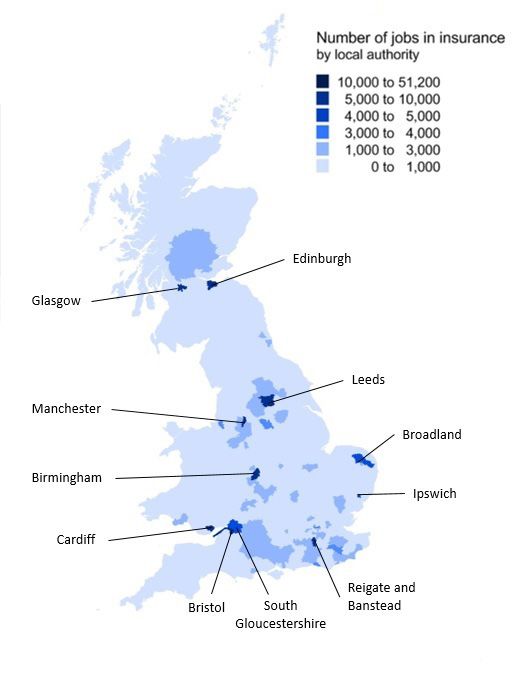
As well as contributing to UK employment as a whole,
insurers also contribute significantly to regional
employment across the whole of the UK. Though the
City of London has the highest regional employment
with 51,000 jobs, there are many other key insurance
employment hotspots including Leeds (18,000 jobs),
Greater Manchester (15,000 jobs) and Bristol (11,000 jobs)
– see Figure 19 for more detail. Overall, around two thirds
of the sector’s employees are based outside London.
Investing in the UK
Insurers also contribute to the economy indirectly, with
investments in Government debt, UK listed corporations
and other assets enabling further output. As of 2016, UK
insurance and pensions companies held a total of £1.7
trillion of investments – equivalent to just under 90% of
UK GDP26. These investments include money managed
on behalf of savers such as pension policyholders,
insurance reserves and long-term investments to fund
pension annuities.
Approximately £156 billion of these investments are
held in UK Government debt – typically gilts of varying
maturities – and a further £244 billion is invested in UK
private sector securities (equities, corporate bonds, etc.)
– see Figure 20.
Investment varies across the sector. General insurance
companies, driven primarily by the need for liquidity
and short-term certainty, tend to invest largely in cash
and ‘Overseas Debentures, Loan Stocks, Preference &
Guaranteed Stocks & Shares’. In comparison, long-term
insurance companies, driven by the needs to both deliver
good returns long-term, and match assets against long-
term liabilities, focus much less on these areas, and more
on traditional equities and property.
25
ABI (2017) “Helping Britain Thrive”19 ONS (2016) “UK Balance of Payments, Pink Book 2016”
abi.org.uk
26
ABI Statistics – Invested Assets
@BritishInsurersUK Insurance and Long-Term Savings: The state of the market 11
Figure 20: Aggregated invested assets (%, 2016)27 Market subsectors
% The UK life sector received just under twice as much
100 premium volume as the non-life sector in 2016, at £147
90 billion in premiums29. The non-life sector meanwhile
80
70
received approximately £77 billion in premiums in 2016 – see
60 Figure 21.
50
40 Figure 21: UK Life and Non-Life premium volume (£m, 2016)
30
20
10
General Long-Term Total Non-Life
Premium Volume 77,374
Business Business Business
UK Public Sector Overseas Public Sector Other
UK Private Sector Overseas Private Sector Life Premium
volume 147,141
A leading UK exporter
One of the secondary impacts of being the world’s The UK Insurance market hosts a large number of
largest exporter of insurance and pensions is a significant companies. Many of these are authorised by UK
contribution to the UK’s balance of payments. The UK regulators to write insurance business, whilst other are
has experienced a consistently negative trade balance authorised in their parent country and ‘passport’ into
for almost 20 years, with Q3 1998 being the last quarter the UK. As of June 2017, there were 605 companies in the
to experience a positive trade balance being. Meanwhile, UK authorised to write motor insurance30; 229 of these
the UK insurance industry has experienced a consistently were authorised in the UK, and 376 passported in from
positive trade balance since at least 1986. an EEA member state. In total 300 UK companies were
authorised to write some form of general insurance
Insurance is a significant exporter compared to other business; see Figure 22 for the full breakdown. It is worth
major industry sectors, both in the services and noting that we do not have data on the number of these
manufacturing sectors. During 2013-15, the UK exported that are actually active.
£11.58 of insurance and pensions services on average
for each £1 that it imported28; by comparison the rest of Figure 22: General Insurance Authorisations (summer 2017)
the UK financial services sector exported just £4.55 on
average for every £1 of imported financial services, and Number of Number of
the UK exported just 70 pence worth of trade in goods for Product UK EEA Total
every £1 imported. companies companies
Motor Insurance 229 376 605
Market overview Accident and Sickness 253 359 612
Fire and damage to property 223 423 646
Marine, aviation and railway
Key companies rolling stock
224 352 576
UK insurers and pension providers are among the General liability 229 399 628
largest companies in the UK. Thirteen of the FTSE100 Credit and suretyship 201 219 420
index of largest UK listed companies are either Other classes 264 458 722
insurance or pension providers, or own large insurance
Total companies 300 624 924
/ pensions subsidiaries. Of these, the combined market
capitalisation of the eight insurance-focussed companies
in the FTSE 100 is substantial – just over £122 billion –
and comprises approximately 6% of the overall value of
the index. In addition to the large listed companies, there
are several large mutual and friendly societies, such as
NFU Mutual, LV= and Royal London.
27
ABI (2017) “Industry data: Invested assets”
28
ONS (2016) “UK Balance of Payments, Pink Book 2016 – Time Series Dataset”
29
Swiss Re Sigma 3 (2017)
30
Bank of England (2017) “Insurance Information – Lists of Insurers”12 UK Insurance and Long-Term Savings: The state of the market
The UK hosts significantly fewer companies that are
authorised to transact life and pensions business,
with 355 companies overall with some sort of life
authorisation – of which 187 passport in from the EEA.
Again, we do not have data on the number of these that
are actually active.
Figure 23: Life Insurance Authorisations
Number of Number of
Product UK EEA Total
companies companies
Life and annuity 115 172 287
Marriage and birth 48 56 104
Linked long-term 142 138 280
Permanent health 94 39 133
Tontines 1 7 8
Capital redemption 47 79 126
Pension fund management 60 40 100
Collective insurance 1 6 7
Social insurance 0 4 4
Total companies 168 187 355
abi.org.uk
@BritishInsurersUK Insurance and Long-Term Savings: The state of the market 13
Importance to UK households Figure 25: UK household disposable incomes
(£median, 2003-2017)
UK households are very diverse, with significant
variations in demographic background, income and
31,000
assets. The insurance and pensions industry provides
29,000
financial security and assistance across the whole
27,000
spectrum of different household types, helping protect
25,000
everything from their possessions to their pensions, and
23,000
many things in-between.
21,000
19,000
Overview of UK households 17,000
15,000
2003/04
2004/05
2005/06
2006/07
2007/08
2008/09
2009/10
2010/11
2011/12
2012/13
2013/14
2014/15
2015/16
2016/17
Size and composition
The UK population reached a new high in 2016, with All households Retired households Non-retired households
65.631 million people living in just over 27 million32
households. The number of households in the UK has
increased by 7% since 2006; this increase has broadly Household expenditure on general insurance
stayed in line with population growth, resulting in the
average household size remaining at 2.4 people over the Households purchase a variety of different types of
past decade33. insurance to meet their needs. Households spent, on
average, £16.30 a week on general insurance in 2016, and
Figure 24: UK Population / household count (millions, a further £21.50 a week on pensions and life assurance
2005-2016)34 products; this equates to approximately £1966 a year, or
around 7% of household disposable income. This is costing
m m households nearly £619 more than in 2012. For comparison,
27.5 67
households spent around £1200 on clothing and footwear
27.0
66
and £1800 on household goods and services in 2016.
65
26.5 64
Motor insurance
Number of Households
63
26.0
Population
62 Motor insurance is the most widely held type of general
25.5
61 insurance product in the UK, with 74%36 of households
25.0 60
purchasing one or more policies in 2016. The median
59
expenditure of these households on motor insurance
24.0
58
was approximately £450/year in 2016; for comparison, the
ABI’s motor premium tracker for 2016 showed an average
24.0 57
premium of £44137. Households spend significantly more
2005
2006
2007
2008
2009
2010
2011
2012
2013
2014
2015
2016
than this on purchasing and maintaining their vehicles;
Number of Households Population on average they spent £1227 purchasing vehicles, and a
The UK, like many countries, has a diverse range of further £1690 operating and maintaining them38.
household types. Over the past decade there has been a
66% rise in the number of multi-family households, and Figure 27: Average UK household motoring expenses
a 7% increase in the number of households with adult (£median, 2016)
children still living at home.
1,227
1,123
Household income
UK household incomes have been slowly increasing
in recent years, following several years of stagnant
567
growth after the recession. The median UK household 450
disposable income in 2015/16 was £26,683, an increase of
just over £560 on the previous year; disposable incomes
have grown on average by just under 3% per year since
2013/14 (Figure 25)35. Retired households have bucked
Motor Maintenance Petrol Purchase
the overall trend somewhat, with steady growth in insurance of vehicles of vehicles
(median)
disposable incomes over the last decade.
31
ONS (2017) “Population estimates”
32
ONS (2017) “Living costs and food survey”
33
ONS (2016) “Statistical bulletin: Families and households in the UK: 2016”
34
ONS (2017) “Population estimates” and “Labour Force Survey”
35
ONS (2017) “Statistical bulletin: Nowcasting household income in the UK: financial year ending 2017”
36
ONS (2017) “Living Costs and food survey”, ABI analysis14 UK Insurance and Long-Term Savings: The state of the market
Home insurance Other insurance expenditure
The average household in the UK had approximately Households spend money on a variety of other types of
£34,900 worth of contents in their primary residence in insurance, protecting not only their property but their
2012-1439; this is approximately 1.4 times as large as the incomes, their health and their future.
annual household disposable income for that period.
In 2016, around 7% of households spent money on travel
This represents a considerable amount of household
insurance – on average around £160 per year – compared
wealth contained in the contents of people’s homes, and
to an average expenditure of £1200 per year on package
many choose to take measures to protect these assets.
holidays. Just over 6% of households reported some
Home contents insurance is the second most widely level of expenditure on private medical insurance in 2016,
held form of insurance amongst households, with 72% with the median average expenditure at just over £528;
having some form of contents insurance expenditure meanwhile, around 22% of households had some sort of
in 2016 40. Of those with contents insurance, the median life insurance coverage, spending on average £336 in 2016.
expenditure was approximately £128 per year; similar
equivalent household expenditures include an average of
£125/year spent on cleaning materials. Households & pensions
Many UK households own their own home, with
64% of households living in their own home (with or Contributing to pensions
without a mortgage) compared to 36% who rent41. A Households need to make provisions for later life to
large proportion of these households purchase home maintain their standard of living, with the state pension
buildings insurance to help cover the risk of losing currently providing just £159.55 a week (or £8,297 per
their home to events such as flooding or fire; indeed, year). In 2015/16 there were approximately 13.4 million
mortgage providers generally require those in the 43% actively contributing members of occupational pension
of households purchasing with a mortgage to protect schemes43 - schemes set up and administered by an
their home. In 2016, approximately 61% of households employer on behalf of their employees – and a further
spent money on home buildings insurance – spending on 8.9 million44 members of personal pension schemes
average £158 per household on obtaining cover. (including group personal pensions, stakeholder
A large proportion of households – 56% - chose to pensions, etc.).
combine their purchase of buildings and contents This represents a considerable increase over the last
insurance, and spent approximately £279 on a combined few years, with the equivalent total in 2010/11 being
policy42. For comparison, the ABI’s household insurance approximately 13.7 million active occupational and
premium tracker recorded an average premium paid personal pensions scheme members combined. This
figure of £307 in 2016. It is also worth noting that, in 2016, increase has largely been driven by the introduction of
households spent significantly more money on furniture - auto-enrolment, which legally requires employers to
£848 - and newspapers and magazines - £280 – than they enrol and contribute towards their employees’ pensions
did on obtaining the peace of mind afforded by home (unless the employee specifically opts out).
insurance.
The average contribution of a scheme member can
Figure 28: Average UK household expenditure on home vary widely between the type of pension. For a Defined
insurance (£median, 2016) Benefit (i.e. final/average salary) style occupational
pension scheme, the 2016 average contribution was
848
the equivalent of between 22.7% and 24.9% of salary,
depending on the valuation basis of the scheme; of this
total, the employee themselves contributed between
5.8% and 7.5% of their salary45.
Looking at Defined Contribution style occupational
schemes paints a radically different picture, with the
279 280 average overall contribution approximately 4.2% - of which
158 1% is contributed by the employee. This will likely increase
127
significantly in 2018, however, with the forthcoming rise in
minimum contributions for auto-enrolment schemes to
Property Property Property Furniture Newspapers 3% from employees and 2% from employers46.
Combined Contents Structure and magazines
37
ABI “Quarterly Motor Premium tracker” 43
ONS (2016) “Occupational Pensions Scheme Survey”
38
ONS (2017) “Living Costs and food survey” 44
HMRC (2017) “Table PEN6: Personal pensions”
39
ONS (2015) “Wealth and Assets Survey: Physical Wealth, Wealth in Great Britain, 2012 to 2014” 45
ONS (2016) “Occupational Pensions Scheme Survey”
40
ONS (2017) “Living Costs and food survey”, ABI analysis 46
The Pensions Regulator “Increases in minimum contributions
41
ONS (2017) “Labour force survey” for automatic enrolment pensions”
42
ONS (2017) “Living Costs and food survey”, ABI analysisUK Insurance and Long-Term Savings: The state of the market 15
Households in retirement Household impact of recent Government
There were 11.8 million people aged 65 and older in the 47
legislation
UK in 2016 – approximately 18% of the population. This
proportion has been steadily growing over the last few
Insurance Premium Tax (IPT)
years, from 16% in 2010. The UK population is ageing.
The IPT rate has increased to 12%, around five times
Figure 29: UK population aged 65+ (%, 2010-2015)48 more than when it was first introduced in 1994 at 2.5%.
The latest increase could add around £50 to the average
% annual household bill51. Those who are likely to see their
18.00
premiums rise the most are young and older drivers, who
17.50 pay more for their motor insurance52.
17.00
Figure 31: Historical IPT rates (%, 1994-2016)53
16.50
%
25
16.00
15.50
20
Mid- Mid- Mid- Mid- Mid- Mid-
2010 2011 2012 2013 2014 2015
Year 15
There were approximately 8.75 million pensioner 10
households in 2016 49; a little over half of these (57%) were
couples, and the remainder were single. 97% of these 5
households received the state pension50, whilst 70% had
0
some form of private pension income. Investment income
1994
1995
1996
1997
1998
1999
2000
2001
2002
2003
2004
2005
2006
2007
2008
2009
2010
2011
2012
2013
2014
2015
2016
was also a popular source of income for pensioner units
in 2016, with 63% in receipt of an average income of £260 Standard rate Higher rate
a year. Additionally, approximately 17% of pensioner The amount of revenue raised from IPT, on a per
households still received income from employment. household basis, stood at £179 in the 2016/17 fiscal
From a value perspective, 43% of their household income year54. The Government received £4.8 billion from
came from benefits (state pension, etc.), with a further Insurance Premium Tax in 2016/17. It is estimated that the
33% received from private and occupational pensions annual costs of IPT per household will increase to more
(see Figure 30 for the full breakdown). than £200 from 201855.
Figure 30: UK pensioner income sources Figure 32: Past and predicted IPT revenue to the
(% of pensioner households, 2016) exchequer (£bn, 1990-2021)
7.00
6.00
Benefit income 43% 5.00
Occupational pension 29%
IPT Revenue, £bn
4.00
Personal pension income 4%
Investment income 8% 3.00
Earnings 16% 2.00
Other income 1%
1.00
0.00
1999-00
2000-01
2001-02
2002-03
2003-04
2004-05
2005-06
2006-07
2007-08
2008-09
2009-10
2010-11
2011-12
2012-13
2013-14
2014-15
2015-16
2016-17
2017-18
2018-19
2019-20
2020-21
47
ONS (2017) “Article: Overview of the UK population: July 2017”
48
ONS (2017) “UK and Regional population estimates 1838-2015”
49
Pensioner household defined as a single individual over state pension age (SPA), or couple with at least one individual over SPA
50
Department for Work and Pensions (2017) “Pensioners’ income series: financial year 2015/16”
51
SMF (2017) “The impact of Insurance Premium Tax on UK households”
52
ABI (2017) “News: news articles: 2017/05: third rise in insurance premium tax in under two years”
53
HM Revenue & Customs (2017) “UK trade info: Tax and duty bulletins: Insurance Premium Tax”
54
SMF (2017) “The impact of Insurance Premium Tax on UK households”
55
SMF (2017) “The impact of Insurance Premium Tax on UK households”16 UK Insurance and Long-Term Savings: The state of the market
SECTION 2
General insurance
By Rachel Pearson – Data & Analytics Adviser (General Insurance)
The total market Figure 34: Total UK GI business by territory of risk (%, 2016)
The UK general insurance market provides support and
certainty to households and businesses within the UK
and abroad, across a wide range of business lines. In
2016, the overall size of the market reached £59 billion,
of which £39 billion related to domestic risks, while UK 66%
£20 billion was focussed overseas. This is, however, EU 17%
Other 10%
only looking at ABI members – when looking to include
Home-Foreign 8%
non-members, including notably business done through
Lloyd’s of London, there was almost £87 billion worth of
business written in the UK in 2016. Going forward in this
document, unless stated otherwise, statistics represent
ABI data providers only.
Delving deeper into the ABI’s data, we clearly see the impact
Figure 33: Total UK gross written premium (£m, 1995-2016) of Solvency II, which came into effect in January 2016.
£m
This caused significant reshuffling, with many insurers
70,000 buying more reinsurance, or consolidating their books
and passing risks from solo entities up to group level.
65,000
With Solvency II in mind, there have also been some
60,000
shifts in the way that the ABI has collected and calculated
55,000 the data, aligning ourselves as much as possible with
50,000
SII reporting, and allowing us to examine the market in
more detail. For example, we are now able to calculate
45,000 underwriting results in terms of earned premiums,
40,000 and look at a more detailed breakdown of insurers’
commission and expenses than ever before. We are also
1995
1996
1997
1998
1999
2000
2001
2002
2003
2004
2005
2006
2007
2008
2009
2010
2011
2012
2013
2014
2015
2016
now taking into consideration changes in provisions for
This represents market growth of £1.5 billion, or 3% on future claim payments within Gross Claims Incurred.
2015, of which almost £2 billion came from foreign risks.
The reinsurance industry stood out in particular in 2016,
Over a third of business written by UK insurers is written
with an increase in the proportion of Gross Written
through either the overseas branches or subsidiaries of
Premiums being ceded to reinsurers to a record 29% of
UK entities, or through Freedom of Services, highlighting
UK business. This record is unsurprising given:
just how significant the international dimension is for
our sector, and how important it is to maintain strong 1. The impact of Solvency II on capital requirements,
trade relations. With the UK having voted to withdraw which has made increased reinsurance protection
from the European Union in June 2016, and triggering more attractive for certain firms;
Article 50 in March 2017, a difficult and complicated
2. The continued softening of a global reinsurance market
set of negotiations has now begun, creating significant
swimming in capital as a result of the rise of Insurance-
uncertainty about the shape of the UK insurance
Linked Securities (ILS) and alternative capital.
industry’s future presence in Europe.
abi.org.uk
@BritishInsurersUK Insurance and Long-Term Savings: The state of the market 17
Figure 35: Proportion of total GWP reinsured (% , 1995-2016) Returning to the direct market, Insurance Premium Tax
has been making headlines recently, having been hiked
% up for the third time in just two years, and doubling since
100 November 2015. The most recent rate increase, from 10%
to 12%, is estimated to cost the average household an
80 extra £47 a year, and has been labelled as a ‘raid on the
responsible’ by the ABI.
60 In February 2017, the Ministry of Justice announced that
the Ogden Discount Rate would change, for the first
time since 2001, from 2.5% to -0.75%. This is the rate
40
used in calculating lump-sum compensation for those
suffering life changing injuries. The announcement sent
20 shockwaves through the industry, with insurers facing an
immediate, sizeable capital hit, followed by significant
0 ongoing increased costs, which will inevitably feed
through into motor and liability premiums. Subsequently,
1995
1996
1997
1998
1999
2000
2001
2002
2003
2004
2005
2006
2007
2008
2009
2010
2011
2012
2013
2014
2015
2016
the Government has announced plans to change the
Reinsurance Ceded (£m) Net Written Premium(£m)
legal basis on which the Discount Rate is set, with the
intention of the rate returning to a level that more
There has also been a significant increase in the number realistically represents the investment behaviour of
of ABI members now reporting for reinsurance, with ABI claimants.
members’ share of the UK reinsurance market more than
doubling since 2015. Figure 37: Total UK GI market underwriting result
(%, 1983-2015)
This year saw insurers paying out more in claims, driven
by the direct market where Gross Claims Incurred grew %
10
by 6% on 2015. However, it was reinsurers that picked
5
up much of the additional bill here, paying out a record
0
share of claims at 34%. Without this, the insurance
-5
market could have been telling a very different story.
-10
This also demonstrates a shift in the balance of the
-15
market, with reinsurers’ share of claims higher than the
-20
proportion of premiums ceded to reinsurance for the first
-25
time since 2005, as shown in Figure 36.
-30
-35
Figure 36: Proportion of business reinsured against
1983
1985
1987
1989
1991
1993
1995
1997
1999
2001
2003
2005
2007
2009
2011
2013
2015
proportion of claims incurred paid by reinsurers
(% , 1999-2016)
%
50
40
30
20
10
0
1999
2000
2001
2002
2003
2004
2005
2006
2007
2008
2009
2010
2011
2012
2013
2014
2015
2016
Reinsurance Ceded Reinsurance’ Share18 UK Insurance and Long-Term Savings: The state of the market
Motor Figure 39: Average UK premium for private car (including IPT)
(£, 2012Q1-2017Q3)
After the first year of underwriting profit in 21 years in
2015, the UK insurance market made a loss of £194m
£
in 2016, with a Combined Operating Ratio of 102.3%. 600
This was very much expected however, with rising
claims costs – particularly relating to repair bills and the 500
weakening of the pound - putting significant pressures
on the market. The losses were contained within the 400
domestic market, with commercial motor insurance
making an underwriting profit for the second year in a 300
row. The size of the market has been growing steadily,
with Gross Written Premiums for comprehensive private 200
car policies growing 12% from 2015 to £12 billion. There
has also been steady growth in volume in recent years, 100
with over 27m policies written in 2016.
0
Figure 38: UK direct motor GWP (£m) and underwriting
2012 Q1
2012 Q2
2012 Q3
2012 Q4
2013 Q1
2013 Q2
2013 Q3
2013 Q4
2014 Q1
2014 Q2
2014 Q3
2014 Q4
2015 Q1
2015 Q2
2015 Q3
2015 Q4
2016 Q1
2016 Q2
2016 Q3
2016 Q4
2017 Q1
2017 Q2
2017 Q3
result (%, 1995-2016)
£m % With premiums rising rapidly, young drivers were the
16,000 5
unexpected exception to the rule, with the average
14,000 premium for those aged 18-20 falling from £997 in 2015
0
to £973, with telematics encouraging and rewarding safer
12,000
driving. Younger drivers continued to pay comfortably
-5
10,000 the highest premiums however, and claimed significantly
8,000 -10
more frequently than any other age group. The only age
group that had a higher average claim cost than 18-20
6,000
-15 year olds was the over 91s, whose average claim was over
4,000 £5,500, driven up by a few large claims in a very small
-20 pool of drivers.
2,000
Claims costs dominated the motor insurance industry in
– -25
2016, with the domestic claims ratio at its highest level
1995
1996
1997
1998
1999
2000
2001
2002
2003
2004
2005
2006
2007
2008
2009
2010
2011
2012
2013
2014
2015
2016
since the LASPO reforms came into effect in 2012. This
GWP(£m) Underwriting Result (%) is even without the full impact of the Ogden Discount
Rate change coming through, with the Discount Rate
having been adjusted in early 2017, for the first time
since 2001, from 2.5% to -0.75%. Bodily injury claims are
Motor premiums reached a record high at the end of
unsurprisingly the most expensive part of claims costs for
2017 Q3, at £485, £57 higher than the average motor
insurers, with 40% of all private car claims costs paid out
premium at the beginning of 2016. Rising repair costs,
relating to bodily injury claims.
repeated hikes in Insurance Premium Tax, and with the
industry anticipating significantly higher bodily injury
Figure 40: Gross claims paid for private car, split by type
claims costs following the Ogden Discount Rate change in
of claim (%, 2016)
February 2017, all contributed to this trend. In the second
quarter of 2017, the ABI was also able to measure average
premiums month by month, to better understand the
instant impact of increases in IPT. The AA suggested Bodily Injury 41%
that this rise in IPT could increase the number of people Theft 3%
choosing to risk driving uninsured56, at the same time as Property Damage 23%
the Motor Insurers Bureau reported the first rise since Accidental Damage 25%
2004 in the number of claims against uninsured drivers57. Windscreen Only 2%
Replacement Vehicle 5%
Other 1%
56
ABI (2017) “Helping Britain Thrive”19 ONS (2016) “UK Balance of Payments, Pink Book 2016”
abi.org.uk
57
ABI Statistics – Invested Assets
@BritishInsurersUK Insurance and Long-Term Savings: The state of the market 19
In the Queen’s Speech in 2017, the Government Figure 41: Average cost (£) and volume (000’s) of motor
announced that they would tackle escalating whiplash theft claims (1996-2016)
claims in their Civil Liability Bill, following many years of
%
ABI campaigning on the topic. Whiplash type claims have 120 6,000
remained high in recent years, with over 671,000 people
making a whiplash type claim in 2016/201758. Proposed
Average cost of settled theft claim (£)
100 5,000
Number of theft claims settled (000s)
reforms, including increasing the small claims track (SCT)
limit to £5,000, seek to tackle the growing compensation 80 4,000
culture, while still ensuring that genuinely injured
claimants receive the care and compensation they need. 60 3,000
While the use of Advanced Driver Assistance Systems 40 2,000
(ADAS) is growing, with the industry fully supporting
the development of autonomous driving, replacing and 20 1,000
repairing cars with such sophisticated technology proves
0 0
more complex, and naturally more expensive59. Rising
1996
1997
1998
1999
2000
2001
2002
2003
2004
2005
2006
2007
2008
2009
2010
2011
2012
2013
2014
2015
2016
vehicle repair costs are proving increasingly problematic
for insurers, with increasingly expensive spare parts
being required, and the weakening of the pound forcing
up import costs. Brexit is also expected to exacerbate the
situation, with the SMMT warning that a poor deal, or no
deal would add further pressure on import, and therefore
repair costs60.
Theft has also been on the rise, with the number of
theft claims reaching its highest levels since early 2013,
although nowhere near the heights of the 1990s and
early 2000s. The cost of these claims has also been rising,
with the average theft claim costing 15% more in just 18
months. The police have been reporting a similar trend,
with a 19% rise since April 2015 in the number of thefts
of motor vehicles61. As the number of cars on the market
with keyless entry systems grows, thieves are increasingly
intercepting these signals to hack into and steal the car.
With thieves targeting these higher-end cars, this will
undoubtedly be a driver of the increasing average cost
of theft.
58
Department for Work and Pensions’ Compensation Recovery Unit (CRU)
59
http://news.thatcham.org/pressreleases/repair-focus-2017-thatcham-research-calls-for-new-
thinking-and-approaches-to-halt-spiralling-cost-of-repair-2002192
60
https://www.smmt.co.uk/2017/07/government-urged-put-automotive-heart-brexit-agenda-uk-
motorists-face-10-increase-servicing-costs/
61
https://www.ons.gov.uk/peoplepopulationandcommunity/crimeandjustice/bulletins/
crimeinenglandandwales/yearendingmar201720 UK Insurance and Long-Term Savings: The state of the market
Property The aftermath of Storm Desmond, Eva and Frank
formed the greatest hurdle for property insurers in
There was a collective sigh of relief at the end of 2016, as
2016, as insurers were left with the significant costs and
insurers welcomed a year of benign weather. As the UK
challenges caused by the floods, with an estimated
began to recover from the effects of Storms Desmond,
15,000 claims costing around £1.3 billion. With flooding
Eva and Frank at the end of 2015, insurers’ results also
becoming a growing risk for families across Britain,
began to pick back up, with a Combined Operating Ratio
the launch of Flood Re in April 2016, after years of
of 89.3 (the lowest since 2004), and Direct Gross Written
development by the ABI and wider industry, has helped
Premiums growing by 4% to £10.4 billion.
to keep home insurance accessible and affordable for
those living in high flood risk areas.
Figure 42: UK direct property gross written premium
(£m , 1995-2016)
Figure 44: UK Gross property claims incurred per quarter
£m (£m, 2004-2017)
12,000
£m
10,000 3,000
8,000 2,500
6,000 2,000
4,000 1,500
2,000 1,000
- 500
1995
1996
1997
1998
1999
2000
2001
2002
2003
2004
2005
2006
2007
2008
2009
2010
2011
2012
2013
2014
2015
2016
0
2004
2005
2006
2007
2008
2009
2010
2011
2012
2013
2014
2015
2016
2017
Figure 43: UK property underwriting result (% , 1983-2015) Domestic Commercial
%
25 With more water than ever now running through families’
20
homes, and the increased tendency to hide plumbing
15
10 away out of sight and out of mind, there has been an
5 increase in both the volume and cost of Escape of Water
0 claims, with claims costs increasing 50% in the last three
-5 years. The weakening of the pound, which has been
-10
-15
driving up repair costs, and a shift from copper to plastic
-20 pipes are thought to have been contributing to the rise in
-25 volume and costs of claims in recent years. This has now
-30 become a point of focus for the industry, with insurers
1983
1985
1987
1989
1991
1993
1995
1997
1999
2001
2003
2005
2007
2009
2011
2013
2015
looking to better understand and combat this rapidly
rising peril.
Looking more closely at the domestic market, average
premiums for combined buildings and contents Although burglaries are estimated to be down 72% since
insurance fell through 2016, and reached a record 199562, with households doing more to protect and
low at the beginning of 2017 at just £297, with benign prevent, the total cost of individual theft claims started
weather, cheap reinsurance, and high competition to rise again at the beginning of 2017, reaching £96m for
keeping premiums low. The continuing penetration domestic theft in Q1 – the highest level since the end
of aggregators will also be contributing to the overall of 2012. With households holding increasing numbers
fall in prices, with 20% of Gross Written Premiums now of gadgets and expensive goods, the average cost of
written through price comparison sites. Premiums picked domestic theft claims hit a peak at the beginning of 2017,
up slightly in the second and third quarters of 2017, as more than doubling in just 10 years.
Insurance Premium Tax was increased for the third time
in just two years to 12%.
abi.org.uk
https://www.ons.gov.uk/peoplepopulationandcommunity/crimeandjustice/
62
@BritishInsurers bulletins/crimeinenglandandwales/yearendingdec2016UK Insurance and Long-Term Savings: The state of the market 21
As the 350th anniversary of the Great Fire of London Liability (including cyber insurance)
came around in September 2016, the ABI called for a
Reinsurance protection saved the day for liability
review of fire regulations, paying particular attention
insurers, who saw record underwriting profits of £312m
to the need for sprinklers in buildings with vulnerable
in 2016. With gross claims rising, reinsurers paid out
occupants, including schools and care homes, as well as
over 50% of claims following a significant shift towards
warehouses over 2,000m2. Fire is by far the most costly
reinsurance in 2015. This, combined with significant
peril for commercial property insurers, with over 50%
reserve releases throughout the market, drove the
of the total claims paid out for fire & explosions. Similar
underwriting profit in an environment that otherwise
to theft claims, while the volume of fire-related claims is
surely would have led to underwriting losses.
decreasing, the impact of this is cancelled out by the cost
of these claims increasing rapidly, with the average fire
Figure 45: UK liability underwriting result (% , 1983-2015)
claim costing almost three times more than claims ten
years ago.
%
Following the catastrophic Grenfell Tower fire in June 20
2017, insurers worked closely on the ground with those 10
affected by the fire, and will continue to offer help and 0
support moving forward. There is now a countrywide -10
effort to review and amend building regulations, with a -20
public inquiry investigating what happened at Grenfell -30
Tower, and a forward looking Independent Review
-40
of Building Regulations and Fire Safety for fire safety,
-50
which the ABI has submitted a response to, advocating
for wide-ranging improvements to the building control -60
1983
1985
1987
1989
1991
1993
1995
1997
1999
2001
2003
2005
2007
2009
2011
2013
2015
system, and clarity on the roles and responsibilities of
those involved.
In October 2017, the ABI launched ‘The Insurance GWP fell slightly in 2016, down to below £4 billion, with
Experiments’ – a series of short, accessible animations some of the business that used to be included under
helping consumers better understand their insurance. the ‘liability’ umbrella splitting out under the other
With property insurers accepting over 80% of claims Solvency II classes of insurance. Within Liability, Public
made in 2015 and 2016, the ABI is initially focusing on and Products Liability was the largest line at 40% of
property insurance, as the complex nature of add-ons GWP, while also making the least profit at just £23m, with
and limits can appear daunting to consumers, with this product recalls at an all-time high.
confusion ultimately leading to underinsurance. Employers’ liability had the lowest Combined Operating
Ratio, at just 78, driven by a particularly low claims
ratio, as reinsurers’ share of claims came to almost 60%.
Changes in the Ogden Discount Rate will undoubtedly
have an effect on the liability market, with insurers
accounting for significant cost increases on high value
claims. Even taking into consideration the expected
revision of the calculation of the Discount Rate, there will
still have been an overall reduction in the rate, driving up
the pay-outs of large claims.
The ABI, for the first time, is able to estimate the size of
the UK cyber insurance market, at around £20m in 2016.
This is however, likely to be just the tip of the iceberg,
with much of cyber insurance expected to be written
through Lloyd’s of London. Following the ‘Wannacry’
crisis in May 2017, cyber insurance has been gaining more
profile as part of the toolkit for businesses in managing
cyber risk, and this should contribute to sustained
growth over the coming years.
58
Department for Work and Pensions’ Compensation Recovery Unit (CRU)
59
http://news.thatcham.org/pressreleases/repair-focus-2017-thatcham-research-calls-for-new-
thinking-and-approaches-to-halt-spiralling-cost-of-repair-2002192
60
https://www.smmt.co.uk/2017/07/government-urged-put-automotive-heart-brexit-agenda-uk-
motorists-face-10-increase-servicing-costs/
61
https://www.ons.gov.uk/peoplepopulationandcommunity/crimeandjustice/bulletins/
crimeinenglandandwales/yearendingmar2017You can also read


