Tephrostratigraphy and Magma Evolution Based on Combined Zircon Trace Element and U-Pb Age Data: Fingerprinting Miocene Silicic Pyroclastic Rocks ...
←
→
Page content transcription
If your browser does not render page correctly, please read the page content below
ORIGINAL RESEARCH
                                                                                                                                         published: 25 February 2021
                                                                                                                                      doi: 10.3389/feart.2021.615768

                                            Tephrostratigraphy and Magma
                                            Evolution Based on Combined Zircon
                                            Trace Element and U-Pb Age Data:
                                            Fingerprinting Miocene Silicic
                                            Pyroclastic Rocks in the Pannonian
                                            Basin
                                            Réka Lukács 1,2*, Marcel Guillong 3, Olivier Bachmann 3, László Fodor 4,5 and
                                            Szabolcs Harangi 1,2
                                            1
                                              MTA-ELTE Volcanology Research Group, Budapest, Hungary, 2Department of Petrology and Geochemistry, Eötvös Loránd
                                            University (ELTE), Budapest, Hungary, 3Institute of Geochemistry and Petrology, Department of Earth Sciences, ETH Zürich,
                                            Zürich, Switzerland, 4MTA-ELTE Geological, Geophysical and Space Science Research Group, Budapest, Hungary,
                                            5
                                              Department of Physical and Applied Geology, Eötvös Loránd University (ELTE), Budapest, Hungary

                           Edited by:
                                            We present a novel approach to use zircon as a correlation tool as well as a monitor for
                        Adelina Geyer,
    Instituto De Ciencias De La Tierra      magma reservoir processes in silicic volcanic systems. Fingerprinting eruption products
         Jaume Almera (ICTJA), Spain        based on trace element content and U-Pb dates of zircon offers a promising, previously
                      Reviewed by:          underestimated tephra correlation perspective, particularly in cases where the main
                   Maxim Portnyagin,
 Geomar Helmholtz Center for Ocean
                                            minerals and glass are altered. Using LA-ICP-MS analyses, a rapid and cost-effective
             Research Kiel, Germany         method, this study presents U-Pb dates and trace element concentration data of more
               Leonid Danyushevsky,
                                            than 950 zircon crystals from scattered occurrences of early to mid-Miocene silicic
    University of Tasmania, Australia
                                            ignimbrites in the northern Pannonian Basin, eastern-central Europe. This magmatic
                 *Correspondence:
                       Réka Lukács          phase produced >4000 km3 of erupted material, which provide unique stratigraphic
          rekaharangi@caesar.elte.hu        marker horizons in central and southern Europe. The newly determined zircon U-Pb
                                            eruption ages for the distal pyroclastic deposits are between 17.5 and 14.3 Ma,
                    Specialty section:
         This article was submitted to
                                            comparable with the previously published ages of the main eruptive events.
                          Volcanology,      Multivariate discriminant analysis of selected trace element concentrations in zircon
               a section of the journal
                                            proved to be useful to distinguish the main volcanic units and to correlate the
            Frontiers in Earth Science
                                            previously ambiguously categorized pyroclastic deposits with them. Using the zircon
        Received: 09 October 2020
        Accepted: 25 January 2021           trace element content together with published glass data from crystal-poor ignimbrites, we
       Published: 25 February 2021          determined the zircon/melt partition coefficients. The obtained values of the distinct
                              Citation:     eruption units are very similar and comparable to published data for silicic volcanic
 Lukács R, Guillong M, Bachmann O,
        Fodor L and Harangi S (2021)
                                            systems. This suggests that zircon/melt partition coefficients in calc-alkaline dacitic to
      Tephrostratigraphy and Magma          rhyolitic systems are not significantly influenced by the melt composition at >70 wt% SiO2
Evolution Based on Combined Zircon
                                            at near solidus temperature. The partition coefficients and zircon trace element data were
  Trace Element and U-Pb Age Data:
         Fingerprinting Miocene Silicic     used to calculate the equilibrium melt composition, which characterizes the eruption
              Pyroclastic Rocks in the      products even where glass is thoroughly altered or missing. Hence, our results provide
                      Pannonian Basin.
           Front. Earth Sci. 9:615768.
                                            important proxies for tephrostratigraphy in addition to yielding insights into the complex
     doi: 10.3389/feart.2021.615768         processes of silicic magma reservoirs.

Frontiers in Earth Science | www.frontiersin.org                                  1                                        February 2021 | Volume 9 | Article 615768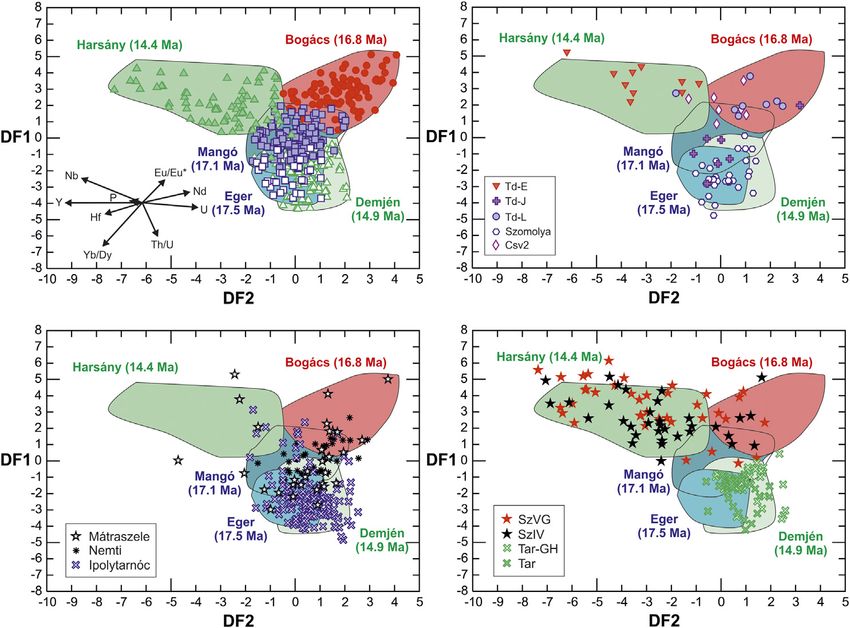
Lukács et al.                                                                                                                                               Zircon Fingerprinting

                                             Keywords: zircon trace element, LA-ICP-MS, Bükkalja volcanic field, Miocene, U-Pb age, zircon/melt partition
                                             coefficient, magma conditions, tephrostratigraphy

1 INTRODUCTION                                                                              Schaltegger, 2003; Grimes et al., 2015). Therefore, this mineral
                                                                                            can yield a time-stamped record of the magma types and it can be
Eruptions of large volume silicic magma are usually accompanied                             a key-mineral in correlating eruption products (Aydar et al.,
with caldera collapse, pyroclastic flows (ignimbrites) traveling up                          2012) even in case of strong alteration.
to 100 km distance and pyroclastic falls dispersed over 100’s of                                The Pannonian Basin (eastern-central Europe; Figure 1)
kilometre away from the source (e.g., de Silva, 1989; de Silva and                          produced among the largest silicic volcanic eruptions in
Francis, 1989; Wilson et al., 1995; Wörner et al., 2000; Ellis et al.,                      Europe for the last 20 Myr (Lukács et al., 2018a). Volcanic ash
2012; Lipman and Bachmann, 2015; Barker et al., 2020).                                      material was deposited throughout central and southern Europe
Therefore, their volcanic products act as important marker                                  (e.g., Rocholl et al., 2018; Lukács et al., 2018a; Rybár et al., 2019;
beds in stratigraphy, in addition to providing key information                              Sant et al., 2020) and therefore plays an important role in
about the origin of the magmas. In the past, several geochemical                            constraining the regional Paratethys chronostratigraphy in this
tools, such as composition of glass and the main mineral phases                             area (Steininger et al., 1988; Sant et al., 2017). Based on a
have been used to correlate scattered deposits of an eruption                               thorough zircon-based study, Lukács et al. (2018a) could
event (de Silva and Francis, 1989; Shane and Smith, 2000; Pearce                            identify at least five major eruption events from 18.2 Ma to
et al., 2002; Harangi et al., 2005; Pearce et al., 2007; Lowe, 2011;                        14.4 Ma mostly sourced around the southern foreland of the
Aydar et al., 2012; Gisbert and Gimeno, 2016; Lowe et al., 2017;                            Bükk Mts., called Bükkalja Volcanic Field (BVF; Northern
Petrelli et al., 2017). However, syn- and post-eruption alteration                          Hungary, Figure 1). Miocene silicic pyroclastic deposits are
often obscures the original compositional features of pyroclastic                           widespread in the Pannonian Basin although most of them are
deposits. A possible solution to correlate scattered, variable                              buried by young sediments due to post-volcanic subsidence.
altered silicic volcanic deposit is to use zircon chemistry, as                             Nevertheless, there are many scattered occurrences in
zircon is both a common accessory mineral in silicic magmas                                 Northern Hungary, tens of kilometre from the BVF. In this
and it is very resistant to mechanical and chemical erosion. Since                          study, we explore how combined zircon U-Pb dates and trace
U and Th can effectively enter its crystal lattice, it is widely used in                    element content allow fingerprinting the main eruption units of
geochronology to date eruption events as well as to constrain the                           the BVF, and whether such chemical fingerprints of zircons can
timescale of magma storage evolution. Zircon contains significant                            be used to correlate distal deposits lacking precise age data and/or
amount of other trace elements, such as Y, Ti, middle and heavy                             stratigraphic position. We argue that such a zircon-based
rare earth elements and their concentrations depend on the                                  correlation technique could be extended to volcanic ash
nature of the magma as well as the crystallization conditions,                              deposits found in different Paratethys basins of central and
which can then be used for tectonomagmatic provenance studies                               southern Europe, several hundreds of kilometre from the BVF
(Hoskin and Ireland, 2000; Belousova et al., 2002; Hoskin and                               where volcanic glasses are altered and they yield no more

  FIGURE 1 | Occurrences of Miocene silicic pyroclastic rocks in Northern Hungary. Studied samples in the Bükkalja volcanic field presented this paper are denoted
  by numbers (Supplementary Table S1; after Lukács et al., 2018a), whereas other samples used for correlation are shown with sample names
  (IT  Ipolytarnóc; MSZ  Mátraszele; NEMTI  Nemti; SZVG  Szentkút; Tar  Tar; Tar-Gh  Tar Gömör hill; SZIV  Szilvásvárad). Europe is an ESA satellite picture from 2009.

Frontiers in Earth Science | www.frontiersin.org                                        2                                           February 2021 | Volume 9 | Article 615768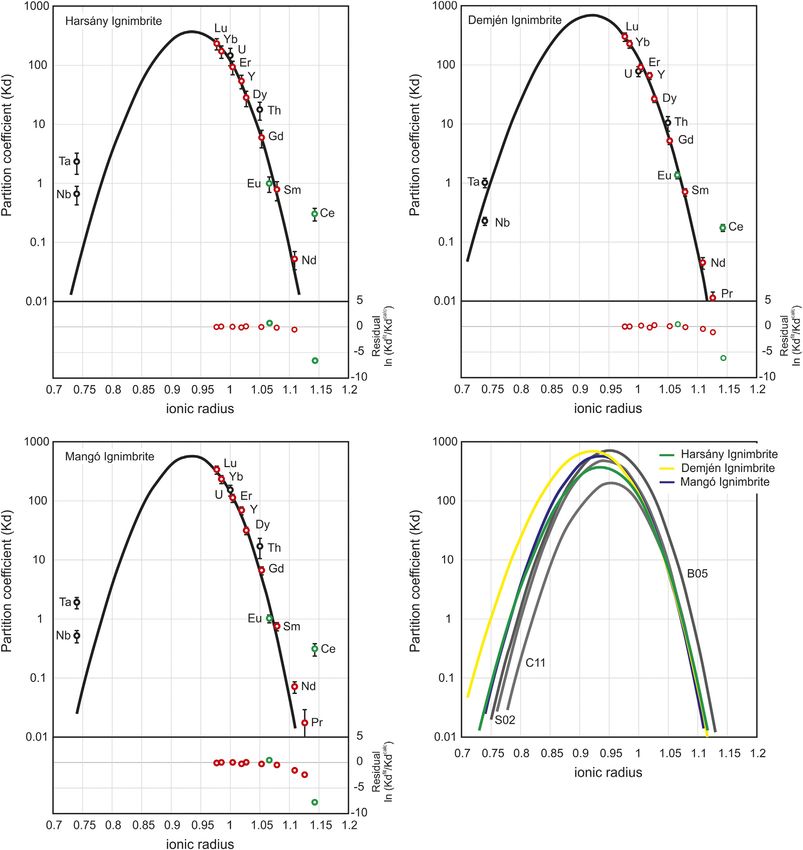
Lukács et al.                                                                                                                      Zircon Fingerprinting

information about the erupted magmas (Lukács et al., 2018a;                    plagioclase and biotite with accessory minerals of zircon,
Rocholl et al., 2018). Zircons are also known to be a useful                   allanite, apatite and ilmenite. The Demjén ignimbrite is
monitor of magma evolution (Miller et al., 2007; Claiborne et al.,             rhyodacitic and a notable feature is the occurrence of
2010; Wotzlaw et al., 2013; Deering et al., 2016; Buret et al., 2017;          amphibole and sporadically clinopyroxene, while quartz is
Szymanowski et al., 2017; Claiborne et al., 2018; Yan et al., 2018;            much restricted compared to the rhyolitic units. The most
Yan et al., 2020) and can be used to unravel the pre-eruption                  complex eruptive product is the Bogács unit (Czuppon et al.,
processes in the crustal reservoirs emplaced in continental crust.             2012), where a gradual compositional and petrological change is
Obtaining reliable mineral-melt distribution coefficients is a key              observed upwards. In contrast to the other eruption units, the
for it as well as to infer the composition of the melt from which              pyroclastic rocks of the Bogács unit are characteristically
those zircons crystallized, particularly when no direct                        crystal-rich (15–40 vol%). Its lower subunit is rhyolitic and
information for the melt phase (e.g., strongly altered glass) is               contains unwelded and welded ignimbrites (with two types of
available. Thus, our aim with this study is to present a novel                 fiamme), whereas the upper subunit is a mixture of various
approach to use zircons as a correlation tool and magma monitor                juvenile clasts (scoria, pumice and hybrid clasts) suggesting
for a large volume silicic volcanic system.                                    pre-eruption mixing and mingling of crystal mushes and melts
                                                                               with dacitic to rhyolitic compositions (Czuppon et al., 2012).
                                                                               Remarkably, the mineral phases and the glasses are usually free
2 GEOLOGICAL SETTING                                                           of syn-eruption or post-eruption alteration in all units
                                                                               (Harangi et al., 2005) and therefore, they preserve the
The Pannonian Basin was formed by major lithospheric                           original compositional features.
extension in the hinterland of the Carpathian-Dinarides                            This study focuses on finding correlation tools using zircon
orogens during the Miocene (Royden et al., 1982; Tari et al.,                  U-Pb dates and trace element contents to constrain the
1999; Horváth et al., 2006; Horváth et al., 2015). The continental             relationship of scattered silicic pyroclastic occurrences in the
rifting was diachronous, started probably already at around                    BVF and in the northern Pannonian Basin (Figure 1). These
28 Ma at the southwestern margin, although the major stage                     pumiceous volcanoclastics were dated previously by K-Ar
occurred during the early Miocene (19–16 Ma) in the western                    technique that yielded ages from 20 to 13 Ma (Hámor et al.,
areas and it took place only at about 10–9 Ma in the central-                  1980; Márton and Pécskay, 1998; Póka et al., 2004; Zelenka et al.,
eastern subbasins (Fodor et al., 1999; Tari et al., 1999; Ustaszewski          2004; Pécskay et al., 2006). They were divided into formal
et al., 2010; Toljić et al., 2013; Horváth et al., 2015; Balázs et al.,       lithostratigraphic units: Gyulakeszi Rhyolite Tuff, 19.6 ±
2016).                                                                         1.4 Ma; Tar Dacite Tuff, 16.4 ± 0.8 Ma and Galgavölgy
    The continental extension was accompanied with widespread                  Rhyolite Tuff, Harsány Rhyolite Tuff, Cserehát Rhyolite Tuff,
volcanism involving eruption of various magmas since the early                 Felnémet Rhyolite Tuff with overlapping ages from 14.6 to 9 Ma
Miocene (Szabó et al., 1992; Harangi, 2001; Seghedi et al., 2004,              (Hámor et al., 1980; Márton and Pécskay, 1998; Gyalog and
Seghedi et al., 2005; Harangi and Lenkey, 2007; Seghedi and                    Budai, 2004; Less et al., 2005).
Downes, 2011; Lukács et al., 2018a; Harangi and Lukács, 2019).
The last eruptions occurred in the Late Pleistocene at the
northern part of the Pannonian Basin (100 ka; Šimon and                       3 SAMPLES AND ANALYTICAL METHODS
Halouzka, 1996; Šimon and Maglay, 2005) and in the
southeastern Carpathians (30 ka; Harangi et al., 2015; Molnár                  More than 950 zircon crystals were analyzed for U-Pb dating in
et al., 2019). This long-lasting volcanism began with an                       combination for trace element content from 30 samples. Samples
ignimbrite flare-up event when more than 4000 km3 silicic                       used in this study are presented in Figure 1, Table 1 and
magma erupted during about 3 Myr (Lukács et al., 2018a).                       Supplementary Table S1 with their stratigraphic position,
Lukács et al. (2018a) distinguished at least five major                         GPS coordinates, lithology and volcanic facies. Geological
eruptions in the BVF (17.5 ± 0.3 Ma Eger ignimbrite, 17.055 ±                  background of the studied localities is given in the
0.024 Ma Mangó ignimbrite, 16.816 ± 0.059 Ma Bogács unit,                      Supplementary Data Sheet S1. The BVF samples represent all
14.880 ± 0.014 Ma Demjén ignimbrite and 14.358 ± 0.015 Ma                      the units identified by Lukács et al. (2018a); Supplementary
Harsány ignimbrite based on pooling of the youngest zircon                     Table S1), while samples out of BVF are from several scattered
population in each unit). These eruptions provided significant                  localities in the northern part of the Pannonian Basin (Figure 1;
volume of erupted material covering extensive areas across the                 Supplementary Table S1).
Pannonian Basin and elsewhere in Europe (e.g., Lukács et al.,                     Zircon crystals of BVF units presented in Lukács et al. (2015),
2018a; Rocholl et al., 2018; Rybár et al., 2019; Sant et al., 2020).           Lukács et al. (2018a) were targeted for trace element analysis. We
These eruption products act as important marker layers in the                  used the same sample aliquots and crystal mounts as Lukács et al.
early to mid-Miocene and could help to constrain the regional                  (2015), Lukács et al. (2018a) measured for zircon U-Pb dating
Paratethys chronostratigraphy used in central Europe.                          (see Supplementary Table S1; Lukács et al., 2018b). In addition,
    The volcanic products of three of the main eruption units                  we performed combined U-Pb dating and trace element analysis
(Eger, Mangó and Harsány) are rhyolitic and contain crystal-poor               for the samples collected in Northern Hungary using the same
pumices (Lukács et al., 2007; Harangi and Lenkey, 2007; Lukács                 methodologies. The list of the studied samples with GPS
et al., 2015; Lukács et al., 2018a). Phenocrysts are quartz,                   coordinates of the localities is presented in Table 1.

Frontiers in Earth Science | www.frontiersin.org                           3                                  February 2021 | Volume 9 | Article 615768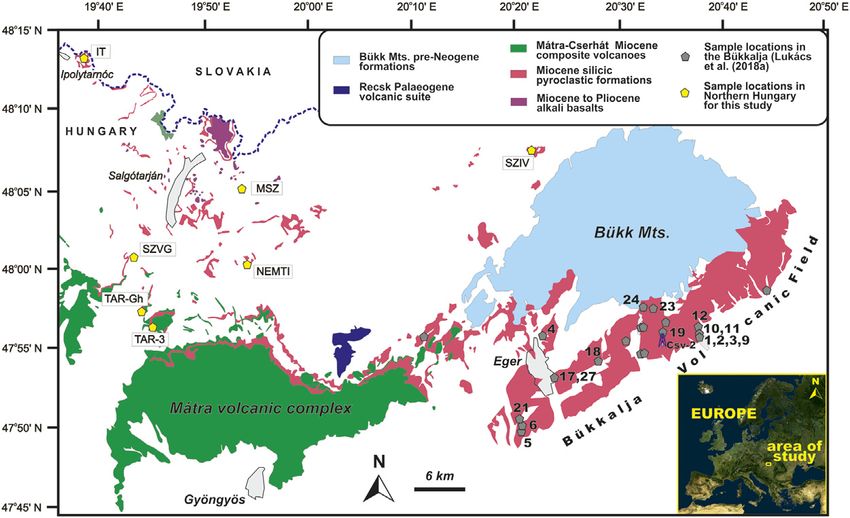
Lukács et al.                                                                                                                                             Zircon Fingerprinting

TABLE 1 | Localities and main features of the studied samples in Northern Hungary.

Sample            Locality, layer      GPS coordinates             Lithology                     Volcanic                      Petrology                        Sample type
name                                                                                              facies

IT-BOR1         Ipolytarnóc, Borókás    48°13′59.64″N,    Gray rhyolite lapilli tuff          Unwelded        Pumice, glass shards (fresh), q, plg, bi, am,     Bulk rock
                valley                  19°40′34.44″E                                         ignimbrite      all, (porphyritic) andesite and sedimentary
                                                                                                              lithic clasts, charcoal and plant fossils
IT-PUB          Ipolytarnóc, Puhako}    48°14′12.07″N,    White rhyolite lapilli tuff         Unwelded        Pumice, glass shards (fresh), q, plg, bi, all,    Bulk rock
                quarry                  19°39′17.17″E                                         ignimbrite      sedimentary lithic clasts
IT-MU2          Ipolytarnóc, Mucsiny    48°13′59.64″N,    White rhyolite lapilli tuff         Unwelded        Pumice, glass shards (fresh), q, plg, bi, am,     Bulk rock
                cave (Slovak            19°40′34.44″E                                         ignimbrite      all, (porphyritic) andesite and sedimentary
                Republic)                                                                                     lithic clasts
IT-KKB1         Ipolytarnóc, below      48°13′57.49″N,    White rhyolite lapilli tuff         Reworked        Pumice, glass shards (fresh), q, plg, bi, all,    Bulk rock
                Keményko  } quarry      19°39′25.70″E                                         unwelded        sedimentary lithic clasts (radiolatite)
                                                                                              ignimbrite
NEMTI           Nemti, Arany hill       47°59′44.64″N,    White rhyolite lapilli tuff         Unwelded        Pumice, glass shards (zeolitized), q, plg, bi,    Bulk rock
                                        19°51′46.08″E                                         ignimbrite      all, andesite lithic clasts
MSZ-1           Mátraszele-Kazár,       48°4′24.48″N,     Greenish white bentonitic           Unwelded        Pumice, glass shards (bentonitic), q, plg,        Bulk rock
                bentonite quarry        19°52′40.31″E     rhyolite lapilli tuff               ignimbrite      bi, all, andesite lithic clasts
TAR-gh-1        Tar, gömör hill         47°57′42.72″N,    White dacite lapilli tuff           Unwelded        Glass (mostly fresh), plg, bi, andesite lithic    Bulk rock
                                         19°45′6.09″E                                         ignimbrite      clasts
TAR-3                      } quarry
                Tar, Fehérko            47°57′9.88″N,     White dacite pumiceous              Unwelded        Pumice, glass (fresh), plg, am, bi, andesite      Pumice
                                        19°45′46.45″E     block-bearing lapilli tuff          ignimbrite      lithic clasts
SZIV            Szilvásvárad            48°7′42.73″N,     White rhyolite lapilli tuff         Reworked        Pumice (mostly fresh), q, plg, bi, opx, am,       Bulk rock
                                        20°23′29.45″E                                         unwelded        all, spicule
                                                                                              ignimbrite
SZVG            Szentkút, Vadász-        48°0′40.03″N,    White accretionary lapilli-         Distal tuff     Pumice, glass shards in pellets (mostly           Accretionary
                gödör                    19°45′13.45″E    bearing tuff in Leitha                              fresh), q, plg, bi, opx, am, all, spicule, bone   pellets
                                                          Limestone Fm                                        fragment

    Zircon U-Pb isotopes and trace element contents were                                    are presented in Supplementary Table S2, the weighted mean age
analyzed by LA-ICP-MS at the ETH Zürich. The laser ablation                                 of the six crystals gives 1.431 ± 0.002 Ma (MSWD  0.63). For the
system was a Resonetics Resolution 155 type which was coupled                               LA-ICP-MS data reduction, we used IOLITE (Paton et al., 2011)
to a Thermo Element XR SF-ICP-MS. We used 30 µm spot size,                                  combined with VizualAge (Petrus and Kamber, 2012) software.
5 Hz repetition rate, 2.0 J/cm2 energy density (fluence) and 20 s                            The Th disequilibrium correction was performed after alpha
(in session for only geochemistry) or 40 s (in sessions for U-Pb                            dose-correction assuming a constant Th/U partition coefficient
dating and chemistry) ablation time after five cleaning pulses and                           ratio of 0.33 ± 0.063 (1 σ; Rubatto and Hermann, 2007) and using
30 s of gas blank acquisition.                                                              the equations of Schärer (1984). Zircon U-Pb dates for the 10
    U-Pb dating of zircons was preferably taken on rim parts of the                         samples in Northern Hungary were not corrected for common Pb
sectioned crystals and for each sample we conducted at least 45                             contents; however, during data reduction, integration intervals
spot analyses on various zircon grains. We performed the                                    were set to exclude the common Pb contaminated signal intervals
analyses in three sessions. Analytical conditions were similar                              and data were filtered according to their discordance ([(207Pb/
to what Lukács et al. (2018b) used and summarized in                                        235
                                                                                                U Age)–(206Pb/238U Age)]/(207Pb/235U Age) < 10%). Average
Supplementary Data Sheet S1. GJ-1 reference zircon (Jackson                                 uncertainty of the individual zircon dates is given as 2 SE and it is
et al., 2004) was used as a primary standard, while Zircon 91500,                           between 1.3 and 2.1% (relative 2 SE).
Plešovice, Temora2, OD-3, AUSZ7-1, AUSZ7-5, AUSZ8-10 were                                      In case of trace element analysis we used NIST610 as primary
measured as validation reference materials (Wiedenbeck et al.,                              reference material and zircon 91500 for quality control, and an
1995; Black et al., 2004; Sláma et al., 2008; Iwano et al., 2013;                           in-house synthetic reference material (Synthetic Zircon Blank) to
Kennedy et al., 2014; von Quadt et al., 2016, respectively). The                            correct the Nb concentrations in some sessions. We analyzed the
average precision of the reference materials (RM) ranged from                               samples in 12 sessions and in case of 9 sessions U-Pb isotopes and
0.8% to 2.4% (2 SE) in case of secondary RM older than 30 Ma,                               trace elements were determined simultaneously (see
while the younger have 6.4–10.1% (2 SE) average precisions                                  Supplementary Table S1). With some variations between
(further details are in Supplementary Table S2). Validation                                 sessions the target elements were Si, Zr, REE, Y, Hf, P, Nb,
reference materials, covering an age interval between                                       Ta, U, Th, Ti (see Supplementary Table S1), and either Al, Rb,
1063.5 Ma and 1.431 Ma, were used to correct the matrix-                                    Ba, Ca, Fe or Al, Sr were measured for monitoring glass, apatite
dependent age offsets following the procedure described in                                  and iron oxide inclusions. Si (15.2 wt% in Zircon) was used as
Sliwinski et al. (2017). The youngest reference material was                                internal standard for data reduction done by IOLITE. Spot
AUSZ8-10 of which six crystals were measured by ID-TIMS                                     compositions that has larger values than the detection limit
method to obtain its reference age value. Analytical conditions                             for Al, Fe, Ca were discarded from the database. Further data
were the same as in von Quadt et al. (2016). Results of the analyses                        filtering was made using the results of Principal Component

Frontiers in Earth Science | www.frontiersin.org                                        4                                       February 2021 | Volume 9 | Article 615768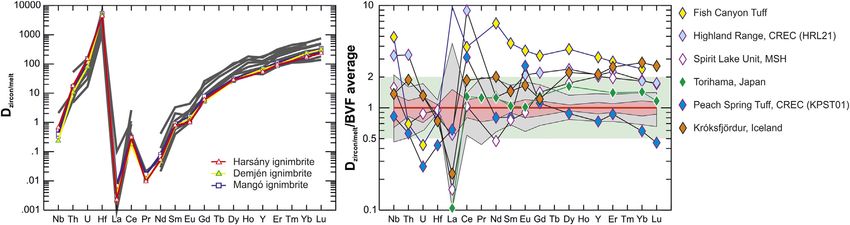
Lukács et al.                                                                                                                                        Zircon Fingerprinting

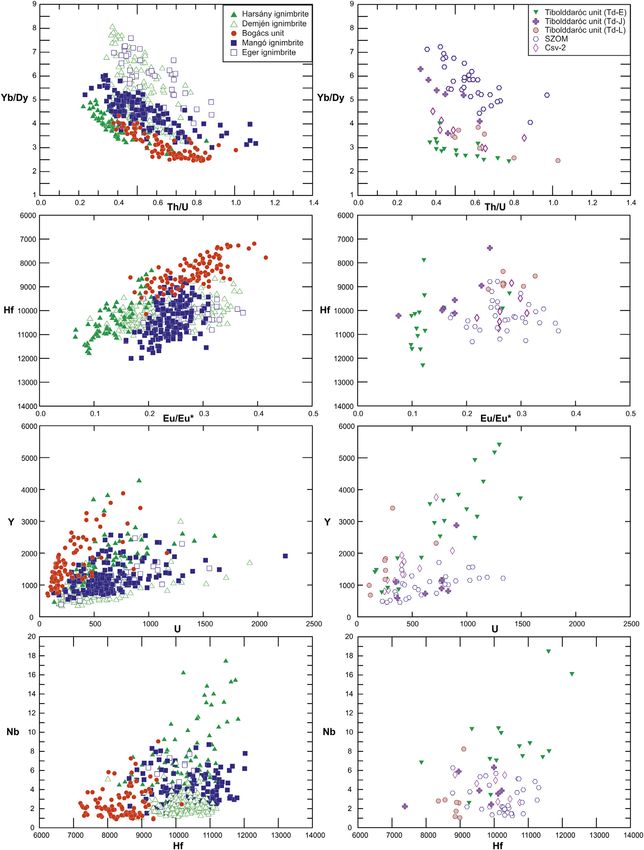
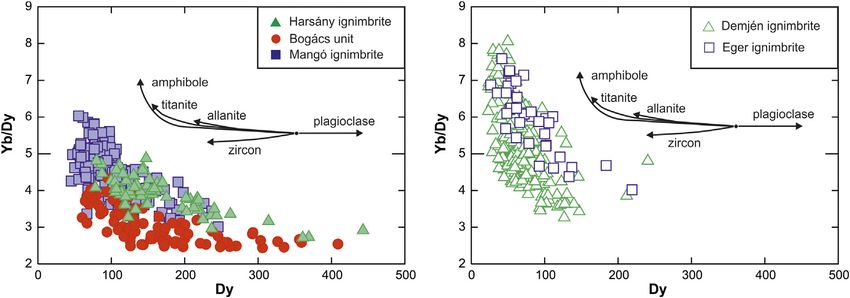
  FIGURE 2 | Zircon trace element variation diagrams for the main BVF eruption units (left panel) and for the scattered distal samples in Northern Hungary (right
  panel).

Analysis (PCA) and data having anomalously high values in Y,                            Statistical analyses were performed by the NCSS 2020 Software
La, HREE, P, Nb, possibly due to incorporation of glass or mineral                      (NCSS, LLC. Kaysville, Utah, United States, ncss.com/software/
inclusion in the analyzed compound volume were also omitted.                            ncss).

Frontiers in Earth Science | www.frontiersin.org                                    5                                          February 2021 | Volume 9 | Article 615768
Lukács et al.                                                                                                                 Zircon Fingerprinting

4 RESULTS                                                                (8000–11200 ppm) range as Mangó and Eger ignimbrite, but a
                                                                         usually lower and restricted variation in Nb (mostly
Lukács et al.                                                                                                                                                        Zircon Fingerprinting

TABLE 2 | Summary of zircon U-Pb dates and determined ages of Miocene ignimbrite samples from distal occurrences in Northern Hungary.

Sample               No.data/conc.                Average                Youngest population            Uncertainty         Number of data           MSWDc        Interpreted age with
name                     Dataa                  uncertainty of                 ageb                                             used                                    external
                                                   dates                                                                                                              uncertaintiesd

                                                     2SEe                          (Ma)f                    (Ma)                                                            (Ma)
SZVG                       58/53                     2.4%                          14.39                    0.06                    40                  1.4              14.4 ± 0.2
TAR-3                      53/47                     2.0%                          14.97                    0.06                    36                  1.4              15.0 ± 0.2
TAR-Gh-1                   53/48                     2.1%                          14.93                    0.07                    27                  1.6              14.9 ± 0.2
IT-BOR1                    55/45                     1.7%                          17.26                    0.08                    20                  1.6              17.3 ± 0.3
IT-MU2                     51/45                     1.7%                          17.44                    0.07                    24                  1.6              17.4 ± 0.3
IT-PUB                     53/47                     1.8%                          17.49                    0.10                    18                  1.6              17.5 ± 0.3
IT-KKB1                    50/41                     1.6%                          17.24                    0.08                    19                  1.7              17.2 ± 0.3
MSZ-1                      66/44                     2.0%                          16.67                    0.11                    13                  1.8              16.7 ± 0.3
NEMTI                      65/56                     1.8%                          17.11                    0.06                    32                  1.4              17.1 ± 0.3
SZIV                       60/52                     1.7%                          14.25                    0.06                    25                  1.5              14.3 ± 0.2
a
  number of age data / number of concordant age data.
b
  calculated from the dataset of each sample that includes the youngest dates (without younger outliers) to older dates until the MSWD of weighted average remains below a threshold value
indicating isochronous age (Wendt and Carl, 1991).
c
  MSWD  Mean Squared Weighted Deviation.
d
  Propagated uncertainty is calculated by quadratic adding of uncertainty of interpreted eruption ages and 1.5% external error of LA-ICP-MS measurements.
e
  2SE  2 standard error.
f
 Ma  million years ago.

sample from MSZ has younger eruption age akin to the Bogács                                      variables and increase the interpretability with minimizing
unit (16.7 Ma; Lukács et al., 2018a).                                                            the information loss. Although they have already widely
   Trace element composition of zircons from pyroclastic deposits                                applied in tephrochronology (e.g., Lowe, 2011 and
in the Northern Hungary was analyzed along with the U-Pb                                         references therein), there are only a few applications in
isotopes (full data are presented in Supplementary Tables S1,                                    zircon studies (e.g., Bell and Harrison, 2013; Barth et al.,
S2). The compositional features overlap those of the BVF main                                    2017). We show here that such techniques could provide a
units (Figure 2) suggesting that they belong to the same volcanism.                              promising perspective in the interpretation of zircon trace
                                                                                                 element data set.
                                                                                                     In the first step, we conducted multivariate mathematical
5 DISCUSSION                                                                                     techniques to characterize the main eruption units defined by
                                                                                                 Lukács et al. (2018a) for the BVF and then, in the second step,
5.1 Correlation of Eruption Units Based on                                                       we explored correlation of distal pyroclastic deposits with the
Zircon Fingerprints                                                                              main units. We applied Principal Component Analysis (PCA) to
5.1.1 Zircon Trace Element Discrimination                                                        describe the variation of the data set and to recognize the outlier
Trace element composition of zircons from different eruption                                     data. This was followed by the application of the Multiple
units shows a wide variety, although certain trace elements and                                  Discriminant Analysis (MDA) to find predictive equations to
trace element ratios have distinct values characteristic of the                                  distinguish successfully the main eruptive units by their zircon
eruption units (Figure 2). The within-unit zircon chemical                                       trace element abundances and trace element ratios. The U/Pb
variation is partly due to the fact that LA-ICP-MS spot analysis                                 ages were not involved in this analysis; therefore, this result
takes a compound volume of several growth zones of the                                           could be used as an independent check how temporally distinct
crystals and forms therefore an average composition of the                                       eruptive events can be differentiated. The MDA can find the best
spot. Although we focused on measuring the outer parts of the                                    solution to separate naturally occurring groups in a data set
crystal grains, age-zoned crystals could yield distinct                                          using discriminant functions, which are linear combinations of
composition. Thus, outlier data occurs, when older domains                                       the variables. The first discriminant function maximizes the
or part of them are incorporated into the measured volume. In                                    differences between groups, while the second, third and so on
addition, tiny glass or mineral inclusions incorporated into the                                 functions have subsequently less ability to do that. Discriminant
measured volume can also modify the trace element                                                scores of each sample are calculated based on the equations
composition. However, they can be recognized and omitted                                         given for the discriminant functions and the score plots give a
from the data set. The distinct compositional characteristics of                                 visual impression of how well the discriminant functions classify
the main eruption units suggest that LA-ICP-MS spot data for                                     the data.
zircons can be used effectively for correlation purposes.                                            We run MDA using zircon compositions from samples of the
Within the trace elements and trace element ratios, we                                           five main eruption units (Eger, Mangó, Bogács, Demjén and
found that P, Y, Nb, Nd, Hf, U and the Th/U, Yb/Dy, Eu/                                          Harsány) and used canonical score plots to check the separation
Eu* ratios have the most discriminating role.                                                    of the compositional groups. We found that the yielded canonical
   Multivariate mathematical techniques offer a powerful                                         scores effectively discriminate these units (and Supplementary
tool to examine datasets with large number of samples and                                        Figure S3 in Supplementary Data Sheet S2). Based on the

Frontiers in Earth Science | www.frontiersin.org                                             7                                              February 2021 | Volume 9 | Article 615768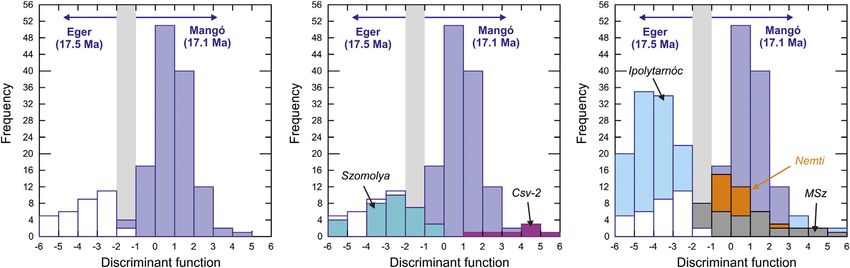
Lukács et al.                                                                                                                                             Zircon Fingerprinting

  FIGURE 3 | Multiple discriminant analysis plot with the two most significant discriminant functions (DF1 and DF2) can effectively distinguish the 5 main eruptive units
  of the BVF (top left panel) based on combination of trace elements and trace element ratios from zircon. This plot is used to correlate zircons from further pyroclastic
  deposits in the BVF (top right panel) and distal occurrences in Northern Hungary to one of the main eruption units (two panels at bottom).

canonical coefficients on the discriminant functions (DF), the
                                                                                          TABLE 3 | Standard canonical coefficients showing the contribution of each
scores of the samples can be calculated as follows:
                                                                                          variable to the separation ability of the five main groups (eruptive units).

DF1  11.441957 + 0.000394 × P − 0.000062 × Y + 0.396326                                  Variable            DF1                DF2                DF3                DF4

           × Nb + 0.211835 × Nd − 0.000523 × Hf − 0.000531 × U                            P                 0.03154           −0.13732           −0.50123             0.54705
                                                                                          Y                -0.03186           -0.78329            0.56603             0.40183
                                Eu                  Th
           + 13.574236 ×            − 7.807679 ×   − 1.518135                         Nb                0.71656           −0.61972           −0.20441            0.37143
                                Eup                 U                                     Nd                0.31323            0.48635           −0.12869            −0.32753
                                                                                          Hf               -0.33426           −0.38320           -0.93266            −0.22473
             Yb                                                                                            −0.13914                              −0.39870            −0.66048
           ×                                                                            U                                    0.56860
             Dy                                                                           Eu/Eu*            0.67678            0.23302           −1.29835            0.14022
                                                                                          Th/U             −0.99165            0.15912            0.02372             0.79169
                                                                                                           −1.26829           −0.40288
 DF2  8.308337 − 0.001715 × P − 0.001515 × Y − 0.342766                                  Yb/Dy                                                   0.73016             0.95524

            × Nb + 0.32891 × Nd − 0.000599 × Hf + 0.002171 × U
                               Eu                  Th                                     DF4  −7.562455 + 0.006832 × P + 0.000777 × Y + 0.205438
            + 4.673717 ×           + 1.252784 ×   − 0.482246
                               Eup                 U                                                 × Nb − 0.221503 × Nd − 0.000351 × Hf − 0.002522 × U
              Yb                                                                                                   Eu                 Th
            ×                                                                                      + 2.812365 ×  p  + 6.233289 ×   + 1.143419
              Dy                                                                                                   Eu                 U
                                                                                                       Yb
DF3  18.180106 − 0.00626 × P + 0.001095 × Y − 0.113057                                              ×
                                                                                                       Dy
           × Nb − 0.087029 × Nd − 0.001458 × Hf − 0.001523 × U
                                Eu                   Th                                   The discriminating ability of each variables on the specific
           − 26.041305 ×          p
                                      + 0.186743 ×   + 0.873998                        discriminant function is expressed by the standard canonical
                                Eu                   U
                                                                                          coefficients. For instance, Nb, Eu/Eu*, Th/U and Yb/Dy ratios
             Yb
           ×                                                                            have the greatest separation ability for the studied zircons as
             Dy                                                                           indicated by the highest coefficient values on the discriminant

Frontiers in Earth Science | www.frontiersin.org                                      8                                          February 2021 | Volume 9 | Article 615768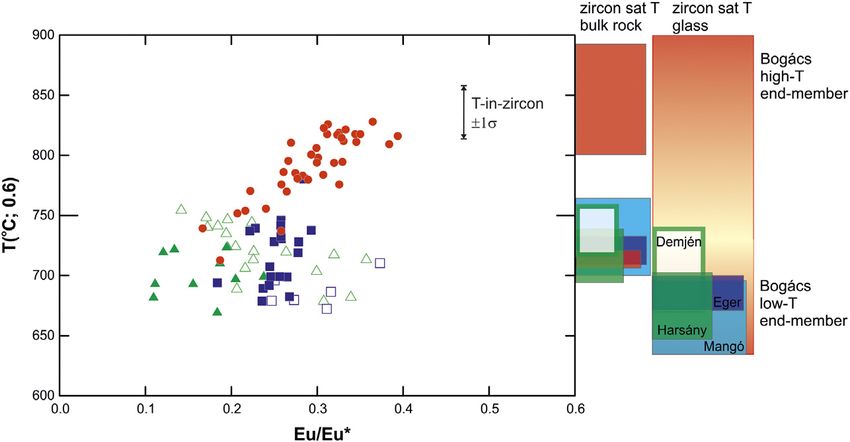
Lukács et al.                                                                                                                                                Zircon Fingerprinting

  FIGURE 4 | Two-group discriminant analysis plot to distinguish the two oldest ignimbrite units: the 17.5 Ma Eger ignimbrite and the 17.1 Ma Mangó ignimbrite can
  be readily distinguished based on combined trace element content and trace element ratios of zircon (left panel). This plot is used to find correlation of further ignimbrites
  in the BVF (middle panel) and distal pyroclastic rocks in Northern Hungary (right panel) with similar ages with one of the two oldest eruptive units.

function1, while Y, Nb and U have the greatest importance in the                            and the Th/U and Yb/Dy ratios have the largest contributions.
second discriminant function (Table 3). Based on the discriminant                           Zircons from the Eger ignimbrite have DF < -2 values, whereas
score1 and score2 values, the five ignimbrite groups defined by their                         zircons from the Mangó ignimbrite unit have typically DF > -1
eruption ages can be readily separated (Figure 3). Zircons from the                         values. In summary, both the multi-group and the 2-group
17.5 Ma Eger and the 14.9 Ma Demjén units show some overlap,                                discriminant plots provide a fast correlation technique based
although they can be distinguished based on the canonical score2 and                        on zircon trace element composition.
score4 (Supplementary Figure S3 in Supplementary Data Sheet S2                                  Having the best discriminant functions for the five already
along with the MDA result statistics).                                                      identified eruption groups in the BVF, the discriminant score
    A particular interest on this analysis is how zircons with broadly                      plots can be used to find the appropriate eruption units for
similar or close ages (e.g., Eger vs. Mangó units and Demjén vs.                            deposits, which cannot be unambiguously classified because of
Harsány units) can be separated based on trace element                                      lack of proper knowledge on the position in the stratigraphic
characteristics. The canonical variate score1 and score2 values                             column or the large uncertainties in geochronological
successfully fulfill this requirement suggesting that such plots can                         data including the zircon U-Pb ages analyzed by LA-ICP-
be effectively used to correlate unknown zircon samples with the                            MS (i.e., ±200–300 ky). For instance, the well-exposed
main eruption units of Bükkalja (Figure 3). Zircons of the 17.5 Ma                          Szomolya ignimbrite (Lukács et al., 2005) is one of the
Eger and the 17.1 Ma Mangó ignimbrite units as well as the 14.4 Ma                          oldest eruption products in the Bükkalja volcanic field, but
Harsány and the 14.9 Ma Demjén ignimbrite units are distinguished                           it is not clear whether it belongs to the Eger or to the Mangó
primarily based on the canonical variate score1 values, whereas the                         ignimbrite unit. Zircon trace element signature in the MDA
zircons of the 16.8 Ma Bogács units are also separated in this plot.                        and 2GDA plots suggests an Eger-affinity (Figures 3, 4). At
Thus, this multivariate mathematical analysis supports the notion                           Tibolddaróc, there is an almost continuous section with
that each eruption unit has a specific geochemical fingerprint and this                       several volcanic eruption beds between the Bogács unit and
is reflected also in the zircon trace element compositions.                                  the Harsány ignimbrite (Lukács et al., 2007, Lukács et al.,
Furthermore, 2-group discrimination analysis (2GDA) can be                                  2015; Biró et al., 2020). The accretionary lapilli-bearing layer
applied to separate more clearly the 17.5 Ma Eger and the                                   (sample Td-L in Lukács et al., 2007; Lukács et al., 2015) just
17.1 Ma Mangó ignimbrite units based on the following                                       above the Bogács unit has zircons, which show a clear affinity
discriminant function (Figure 4):                                                           to the Bogács unit (Figure 3), i.e., this fall unit was part of the
                                                                                            Bogács eruption phase. On the other hand, zircons from the
DF  7.090045 − 0.003431 × P − 0.001151 × Y + 0.621158 × Nb                                 Td-E lapilli tuff have trace element composition akin to the
          + 0.337352 × Nd + 0.00079 × Hf − 0.002234 × U                                     slightly younger Harsány ignimbrite (Figure 3), suggesting
                               Eu                  Th                                       that this belongs to a precursor eruption before the large
          + 10.588279 ×            − 7.943225 ×   − 2.620376                            ignimbrite-forming volcanic event at 14.4 Ma. The 16.2 Ma
                               Eup                 U
                                                                                            Td-J zircons differ from the Bogács unit and has an own,
            Yb                                                                              distinct geochemical signature as does the oldest, 18.2 Ma
          ×
            Dy                                                                              Csv-2 lapilli tuff (Figure 3), i.e. they represent additional
                                                                                            volcanic event apart from the five main ones. Although the
Zircons of the two oldest ignimbrite units can be readily                                   number of analyzed zircon grains from these units is rather
distinguished based on the DF, where the Nb concentration                                   small, it is important to recognize that trace element

Frontiers in Earth Science | www.frontiersin.org                                        9                                            February 2021 | Volume 9 | Article 615768
Lukács et al. Zircon Fingerprinting
fingerprint of zircons from the Csv-2 sample differs from that element composition of zircons suggests that they could derive
of the Eger ignimbrite unit, which is the oldest volcanic from two distinct eruptions: the Ipolytarnóc ignimbrites have
product on the surface within the BVF. zircon trace element affinity to the 17.5 Ma Eger ignimbrite unit,
Correlation of ignimbrite occurrences in the surroundings of whereas the unwelded ignimbrite at Nemti has zircon trace
the BVF was also performed using the multiple and the 2-group element features akin to the slightly younger, 17.1 Ma Mangó
discriminant analysis techniques described above. The results for ignimbrite eruption unit. So far, no older eruption ages (based on
representative cases are shown in Figure 4. The first-order zircon U-Pb chronology) have been obtained for silicic
conclusion is that all except for one of the distal ignimbrite volcanoclastic rocks in this area, thus the general assumption
occurrences can be correlated with one of the five main eruption being the oldest volcanoclastics remains true, but with a younger
units (Lukács et al., 2018a) identified in the BVF. The Ipolytarnóc formation age. Although the zircon U-Pb ages and trace element
ignimbrite has a particular importance because it covers a famous compositions strongly suggest a connection between these
early Miocene fossil footprint sandstone and this site is awarded ignimbrite occurrences, paleomagnetic data seem to yield a
by a European Diploma as a protected area with outstanding different interpretation. Márton and Pécskay (1998) and
geological feature. It was formerly suggested that this volcanic Márton et al. (2007b) used the paleomagnetic declination data
unit could belong to one of the oldest Miocene pyroclastic to distinguish three major eruption events, following the classic
horizons in the Pannonian Basin, but the age has remained three-fold subdivision of volcanoclastics in the northern
controversial (Márton et al., 2007a). Taking only the zircon Pannonian Basin (Hámor et al., 1980). This approach assumes
composition data, the discriminant scores show a clear affinity very similar (identical) rotation values for the coeval volcanic
to the 17.5 Ma Eger ignimbrite unit, the oldest volcanic unit on units and vica versa; similar rotation would mean similar
the surface in the BVF. In contrast, ignimbrites from the nearby formation age. Structurally speaking, this model would induce
area (e.g., Nemti, Mátraszele) can be correlated rather with the homogenous rotation of completely rigid blocks or microplates
slightly younger, 17.1 Ma Mangó ignimbrite unit. Zircons from (Márton and Fodor, 1995). Our results are at odds with this
the SZVG locality in the same area indicate that this volcanic bed model in a few sites; e.g., the ∼30° counterclockwise rotation of
can belong to the youngest, 14.4 Ma Harsány ignimbrite unit, as Ipolytarnóc ignimbrite would imply the same rotation as the
do the slightly reworked ignimbrite occurrences in the northwest 16.8 Ma Bogács unit and therefore a coeval formation (Márton
margin of the Bükk Mts. (e.g., SZIV locality). The thick ignimbrite and Márton, 1996; Márton et al., 2007a), whereas the
at Tar, which was formerly regarded as the type-locality of the 17.1–17.5 Ma eruption units (Mangó and Eger) show larger
Middle dacite tuff horizon, has an unambiguous affinity to the rotation. Further complex studies are needed to dissolve this
14.9 Ma Demjén ignimbrite corroborating the conclusion drawn apparent controversy and the solution may imply heterogeneous
based on trace element signature of the glass shards (Harangi block rotations or local remagnetization.
et al., 2005; Lukács et al., 2018a). In summary, a wide variation of Zircon trace element characteristics of the Mátraszele
volcanic eruption products are exposed in the Northern bentonite do not give clear inference for its origin. The
Pannonian Basin, but zircon fingerprints help to find their youngest zircon age population with the inferred eruption
relations. age of 16.67 Ma is close to the Bogács unit, yet this is not
confirmed by the zircon trace element features. The relatively
5.1.2 Eruption Chronology large compositional variation and different U-Pb dates
Combination of zircon U-Pb dates and trace element could be consistent with the reworking character of the
composition provides a firm tool to correlate scattered bentonite body.
eruption products of large volcanic events. The new zircon The studied pyroclastic rocks in the northern Pannonian Basin
geochronological data, in addition to the trace element confirm a relatively long gap in the silicic volcanism between
characteristics of the distal silicic pyroclastic deposits in the 16.2 Ma and 14.9 Ma, which was already recognized in the
northern Pannonian Basin, help to constrain better their ages Bükkalja volcanic field (Lukács et al., 2018a). One of the
and their relations to the main ignimbrite-forming eruption largest eruptions could have been related to the formation of
events. the Demjén ignimbrite (14.880 ± 0.014 Ma; Lukács et al., 2015;
The ignimbrites at Ipolytarnóc and Nemti were considered to Lukács et al., 2018a). The two ignimbrite occurrences at Tar can
belong uniformly to the oldest eruption unit in the Pannonian be clearly correlated with this eruption as noted already by
Basin, the so-called Gyulakeszi Formation (Hámor et al., 1980; Harangi et al. (2005) based on glass trace element composition
Hámor 1985). K-Ar ages from these sites (Hámor 1985) fall in the and later by Lukács et al. (2018a) based on bulk rock
wide age range of 19.0 to 17.5 Ma characterizes this formation geochemistry. This eruption age is older what Zelenka et al.
although the oldest ages were preferred. However, Pálfy et al. (2004) proposed (13.0–13.9 Ma) and younger what was obtained
(2007) provided ID-TIMS zircon age data for the Ipolytarnóc previously for the TAR-Gh locality (15.9 ± 0.6 Ma) using K-Ar
ignimbrite that was younger (17.42 ± 0.04 Ma) than the formerly dating. Zircon trace element composition of both localities at Tar
postulated age of ∼19.0 Ma. They published also 40Ar/39Ar suggests connection to identical eruption event and a close
plagioclase dates of 17.02 ± 0.14 Ma for Ipolytarnóc and correlation with the Demjén ignimbrite unit in the BVF. These
16.99 ± 0.16 Ma for Nemti. Our new zircon ages support the volcanic products along with the thick pyroclastic sequence at
younger age of the Ipolytarnóc and Nemti ignimbrites Sirok as well as at Demjén (sites 5 and 8 on Figure 1, Lukács et al.,
(17.5–17.2 Ma and 17.1 Ma, respectively). Furthermore, trace 2018a) can define the lithostratigraphic unit of the Tar Dacite
Frontiers in Earth Science | www.frontiersin.org 10 February 2021 | Volume 9 | Article 615768Lukács et al. Zircon Fingerprinting
Tuff, but their age suggests a younger origin than previously Determination of zircon/melt partition coefficients was
determined by K/Ar technique (17–16 Ma, Hámor et al., 1980; performed in a similar way as Claiborne et al. (2018). Zircon
Gyalog and Budai, 2004, Pécskay et al., 2006). Our results trace element data were carefully screened before using them for
presented in this paper strengthen the conclusion of Lukács partition coefficient calculation. Only the outer rim data were
et al. (2018a) that the Demjén ignimbrite eruption event at selected and any outliers possibly reflect mineral or glass
∼14.9 Ma yielded the Tar Dacite Tuff, which is the most inclusions were omitted. We used the average along with the
extensive silicic pyroclastic horizon and a significant standard deviation of the remaining data set to characterize the
stratigraphic marker layer in the Pannonian Basin and zircon trace element composition assumed to be in equilibrium
probably also in Europe. with the host melt represented by the glass data. In each eruption
The Demjén ignimbrite eruption was followed by eruption of a unit, only those samples where trace element content of the
more silicic magma yielding the Harsány ignimbrite at 14.36 Ma glasses was homogeneous were involved. Thus, samples from the
(Lukács et al., 2007; Lukács et al., 2015). Two pyroclastic deposits Bogács unit were not involved, where different juvenile clasts exist
found several 10’s kilometres from one another (SZVG and SZIV) and the zircon-melt relationships are not obvious. On the other
have zircon trace element composition readily showing a strong hand, two compositional types of zircon are recognized in the
affinity to this eruption unit and this is confirmed also by the Demjén unit and this seems to be consistent with the slight
determined zircon eruption ages within uncertainty (14.4 ± compositional difference in the glasses (particularly in the Eu-
0.2 Ma and 14.3 ± 0.2 Ma). This suggests that the Harsány anomaly; Supplementary Figure S6 in Supplementary Data
ignimbrite eruption could have also regional impact even in Sheet S2). Here, only the high Yb/Dy and high Eu/Eu* zircons
far distances as implied by the volcanic ash occurrences with were considered and used along with the glasses showing no or
similar ages in central and southern Italy (Wotzlaw et al., 2014; slight negative Eu-anomaly. These partition coefficients were
Lukács et al., 2018a; Rocholl et al., 2018). Trace element similar to the ones obtained for the other units. In a few cases,
fingerprint of zircons could help to prove this correlation. partition coefficients were calculated also using bulk rock data
(Lukács et al., 2018a) and these gave similar results within
Petrogenetic Implications uncertainty (Supplementary Figure S4 in Supplementary
5.1.3 Zircon/Melt Partition Coefficients Data Sheet S2). The result is presented in Table 4 and shown
Trace element data of zircons can be used for tephra correlation in Figure 5. The quality of the obtained zircon/melt partition
purposes only when compositionally distinct magmas erupted. coefficients was evaluated based on the lattice strain model
Trace element composition of zircons reflects the magma (Blundy and Wood, 1994; Blundy and Wood, 2003a; Blundy
composition as well as the crystallization condition in the and Wood, 2003b) using Onuma diagrams (Onuma et al., 1968).
shallow magma reservoir such as the prevailing temperature The calculated zircon/melt partition coefficients (Dzircon/melt)
and redox state. This is particularly true for crystal-poor of the Bükkalja rhyolites have very similar values to published
evolved systems when zircon is a late phase and is in data for dacitic to rhyolitic systems (Figure 5; Sano et al., 2002;
equilibrium with the melt (represented by glass phase in the Bachmann et al., 2005; Colombini et al., 2011; Padilla and Gualda,
erupted material). Knowledge on the mineral/melt distribution or 2016; Claiborne et al., 2018). Remarkably, the same values were
partition coefficients could help to constrain better the chemical obtained within the ±standard deviation range, irrespective of the
evolution of the silicic magma as well as characterizing the eruptive units even though zircon, glass and bulk rock
coexisting melt when no available glass phase exists in the compositions differ significantly in the BVF rocks. This
rock. The partition coefficients are determined experimentally, implies that chemical composition of the Si-rich magmas (at
although natural mineral and glass data from volcanic rocks can SiO2 >70 wt%) does not have major influence on the Dzircon/melt’s.
be used also to calculate these values although with inherently less In general, the partition coefficients show a steady increase from
precision than the former data. Nevertheless, the latter approach the light REE to the heavy REE (Dzircon/melt’s for HREE are >100);
appears to be more promising as pointed out by Claiborne et al. Th, U and Hf are strongly compatible (Dzircon/melt >10), whereas
(2018) and Burnham (2020). Partition coefficients between zircon Nb is slightly incompatible (Dzircon/melt 0.3–0.7). Although we
and melt (glass) were published for dacitic to rhyolitic magmas calculated Dzircon/melt values for La and Pr, we note that these
from various tectonic settings (e.g., Nagasawa, 1970; Mahood and values have to be considered with caution, because both elements
Hildreth, 1983; Fujimaki, 1986; Sano et al., 2002; Bachmann et al., have very low concentration, close to the detection limit for LA-
2005; Colombini et al., 2011; Padilla and Gualda, 2016; Claiborne ICP-MS analysis in zircons. In fact, their partition coefficients
et al., 2018) and these data show a considerable scatter (Figure 5). show considerable variation in the published data sets and also in
The Miocene silicic ignimbrites from the BVF have low crystal our results. Cerium is slightly incompatible (Dzircon/melt 0.2–0.3)
content and contain fresh glass shards and pumices and therefore showing a positive anomaly (Dzircon/meltCe > Dzircon/meltCe*) in the
they provide a good opportunity to determine zircon/melt partition coefficient pattern (Figure 5), whereas Eu has a slight
partition coefficients for calc-alkaline rhyodacitic to rhyolitic negative anomaly similarly to the Mt St Helens data (Claiborne
systems. For such purposes, we used the trace element content et al., 2018). The Th/Uzircon/melt data are fairly similar ranging
of zircons measured at the outer margins of the crystals and from 0.11 to 0.16. There is also a generally good agreement with
combined these data with trace element composition of the glass the partition coefficients of rhyolites, such as from the Highland
phases in the same sample (Harangi et al., 2005) to calculate the Range and the Peach Spring Tuff (Colombini et al., 2011; Padilla
partition coefficients for a set of trace elements. and Gualda, 2016) that were formed during the early stages of
Frontiers in Earth Science | www.frontiersin.org 11 February 2021 | Volume 9 | Article 615768Lukács et al. Zircon Fingerprinting
FIGURE 5 | Zircon-melt partition coefficients for the BVF rhyolites (left panel) compared to a set of published data (gray lines) for silicic volcanic systems: High-K
calc-alkaline rhyolite from Highland Range HRL21 and Peach Spring Tuff (KPST01), Colorado River Extensional Corridor (CREC), western United States (Colombini et al.,
2011), High-K dacite, Fish Canyon Tuff (Bachmann et al., 2005); dacite from Spirit Lake stage, Mount St. Helens (MSH; Claiborne et al., 2018); Torihama dacite pumice,
Kyushu, Japan (Sano et al., 2002) and Króksfjördur calc-alkaline rhyolite from Iceland (Claiborne et al., 2018). Zircon/melt partition coefficients for the BVF rhyolites
(gray field) are normalized to the average values represented with the ±standard deviation range (pink field right panel). They are mostly within the range of ±2-times of the
average values (green field). A set of published partition coefficients are also presented for comparison.
Miocene extension in the southwestern United States, a similar characterize the calc-alkaline dacitic to rhyolitic systems and they
tectonic setting characterized the Pannonian Basin during the are not significantly influenced by the silica content of the melt at
silicic ignimbrite volcanism at the BVF. Furthermore, we got SiO2>70 wt%. In the Onuma plots, the ro(M)3 + values are similar
similar, although generally lower, values as those from the only (0.920–0.935) in all cases that are a little bit lower than what
calc-alkaline rhyolite in Iceland at the 11–12 Ma Króksfjördur Blundy and Wood (2003a) and Burnham and Berry (2012)
(Jónasson et al., 1992; Claiborne et al., 2018; Figure 5). determined based on experimental Dzircon/melt values
Trace element partitioning between a solid phase and a (0.968–1.1018). The EM3+ is also in a fairly similar range
coexisting melt is described by the crystal lattice-strain model (520–793 GPa) consistently with the obtained values by
(Blundy and Wood, 1994; Blundy and Wood, 2003a; Blundy and Claiborne et al. (2018), whereas the Do(M)3 + values range
Wood, 2003b) providing that in equilibrium condition trace from 328 and 575. These values are in the range listed by
element distribution coefficients are strongly dependent on the Burnham and Berry (2012) for natural samples. Ce has a
ionic radius and ionic valence that can be described by a significant positive offset from the best-fit line, whereas Eu has
mathematical expression. This means that isovalent cations a modest negative offset what are due to the coexistence of Ce3+
have a parabola-like function in an ln Dmin/liq vs. Ionic radius and Ce4+, and Eu3+ and Eu2+, respectively. The extent of the
plot, commonly referred as Onuma diagram (Onuma et al., 1968). deviation is dependent on the oxidation state of the magmatic
The parabola-like curves have four freely varying parameters: the system.
maximum Dmin/liq (Do(M)n+), the radius of that site (ro(M)n+), the
apparent Young ‘s Modulus (EMn+) and the temperature, which 5.1.4 Constraints on the Magma Evolution
make it difficult to find the best-fit result. This is also due to the Zircon trace element characteristics reflect closely the
fact that trivalent cations (REE and Y) fall on the right side of the environment under the crystallization took place. Combining
parabola, while there is no strict constrain for the left side due to these data with the U-Pb dating results, important constraints on
the lack of trivalent cations (Dzr/liqSc could help in this, but it is the evolution of the crustal magma reservoirs can be made (e.g.,
usually not determined, because of difficulties to measure Sc in Claiborne et al., 2010; Schmitt et al., 2010; Reid et al., 2011;
zircon, particularly by LA-ICP-MS). In our calculation, we did Klemetti et al., 2011; Wotzlaw et al., 2013; Chamberlain et al.,
not include La, Ce, Eu in the line-fitting and constrained the 2014; Cooper and Kent, 2014; Klemetti and Clynne, 2014; Storm
temperature between 700 and 750°C. The best-fit curves are et al., 2014; Barboni et al., 2016; Reid and Vazquez, 2017;
presented in Figure 6 and the obtained parameters are shown Szymanowski et al., 2017). Zircons from the BVF silicic
in Table 4. In all cases the residuals, i.e., ln (Dmin/liqfit/Dmin/liqcalc) volcanic rocks show distinct trace element compositional
as proposed by Colombini et al. (2011), remained low (close to features (Figure 2) implying different crystallization conditions
zero). in their reservoirs before eruption. Noteworthy, these magma
The best-fit curves with high R2 (>0.92) for the Bükkalja reservoirs existed and evolved partially coeval as shown by their
samples (Figure 6) support the validity of the obtained zircon/ U-Pb spot dates (Lukács et al., 2015; Lukács et al., 2018a; Harangi
melt partition coefficients. The position of the right part of the and Lukács, 2019).
parabola is the same compared to other published data (Figure 6; Zircon Th/U ratio can be used as a proxy for the magma
e.g., Sano et al., 2002; Colombini et al., 2011), only the Fish differentiation, whereas Hf and Ti reflect the thermal history of
Canyon Tuff line (Bachmann et al., 2005) deviates a bit. This the magma during crystallization (Claiborne et al., 2006;
suggests that relatively coherent zircon/melt partition coefficients Claiborne et al., 2010). The Th/U ratio in zircons depends
Frontiers in Earth Science | www.frontiersin.org 12 February 2021 | Volume 9 | Article 615768Lukács et al. Zircon Fingerprinting FIGURE 6 | Onuma diagrams showing the best-fit parabola-like curves on the obtained zircon/melt partition coefficients for the Harsány ignimbrite; Demjén ignimbrite; and Mangó ignimbrite. They have very similar parameters in the equation of the lattice strain model of Blundy and Wood (1994), the values are presented in Table 4. The best-fit curves are compared with those for published data (grey-lines; S02: Sano et al., 2002; B05: Bachmann et al., 2005; C11: Colombini et al., 2011; bottom right panel and general similarities can be recognized, particularly with that of Sano et al. (2002). closely on the chemical composition of the melt from which they getting to be more differentiated, zircon Th/U ratio decreases, crystallize (Belousova et al., 2002; Schmitt et al., 2003; Bindeman although this can be affected also by co-crystallization of other et al., 2006; Reid et al., 2011; Kirkland et al., 2015; Reid and accessory phases, such as allanite. In the studied BVF rocks, the Vazquez, 2017). Both elements are highly compatible to zircons Th/U ratio is in the range between 2 and 5 both in the whole rocks and they usually show substantial variation as crystallization and the glasses (Harangi et al., 2005; Lukács et al., 2018a). In the condition changes (Hoskin and Schaltegger, 2003). As melt is zircons, this ratio is
Lukács et al.                                                                                                                                            Zircon Fingerprinting

TABLE 4 | Calculated zircon/melt partition coefficients with the obtained strain-lattice model parameters for samples of three eruption units in the BVF. The partition
coefficients have very similar values although zircons show distinct trace element characteristics. The average partition coefficients for the BVF silicic volcanic rocks are
also given. Detailed data are presented in Supplementary Table S3.

Unit                Harsány ignimbrite             Demjén ignimbrite                                     Mangó ignimbrite                                       BVF average
Locality                Tiboddaróc                 High Yb/Dy type            Mészhegy           Túrbucka           Eger upper           Pünkösdhegy

Y                        53.80                           65.51                   69.64              53.15               53.39                 52.95                  58.07
Nb                      0.6630                          0.2264                  0.5249             0.3318              0.4167                0.3911                 0.4257
Ba                      0.0002                          0.0002                  0.0001             0.0001              0.0001                0.0001                 0.0002
La                      0.0022                          0.0033                  0.0077             0.0034              0.0068                0.0031                 0.0044
Ce                      0.3043                          0.1739                  0.3148             0.3119              0.3108                0.2625                 0.2797
Pr                      0.0094                          0.0112                  0.0176             0.0169              0.0166                0.0105                 0.0137
Nd                      0.0523                          0.0446                  0.0721             0.0810              0.0676                0.0506                 0.0614
Sm                      0.7878                          0.7017                  0.7613             0.9124              0.7474                0.6926                 0.7672
Eu                      0.9945                          1.3562                  1.0322             1.6139              1.1911                1.0275                 1.2026
Gd                        5.95                            5.10                    6.70               7.88                5.81                  5.31                   6.13
Dy                       28.19                           26.45                   31.77              28.87               27.07                 27.64                  28.33
Er                       93.04                           90.72                  113.56              97.99               99.76                 86.88                  96.99
Yb                        172                             225                     235                159                 206                   165                    194
Lu                        232                             299                     341                262                 266                   272                    279
Hf                       4324                            4730                    4733               4827                4487                  5320                   4737
Ta                        2.33                            1.01                    1.93               1.13                1.40                  1.50                   1.55
Th                       17.68                           10.43                   17.11              14.15               15.37                 16.85                  15.27
U                         146                              78                     154                 86                  94                   117                    113
Onuma plot best fit parameters
   r3+
    o                   0.9358                          0.9200                  0.9340             0.9302              0.9348                0.9274
   E3+
     M (Gpa)            617.58                          556.26                  674.04             573.65              521.16                616.63
   D3+
     o                  372.33                            700                   575.81             464.00              422.97                533.98
   T (oK)                 998                             998                     998                998                998                    998
   T (oC)                 723                             725                     725                725                725                    725
   R2                   0.9963                          0.9946                  0.9920             0.9735              0.9716                0.9800

typical of igneous zircons (Hoskin and Schaltegger, 2003),                                 Bogács unit. On the other hand, there is a negative correlation
although the Highland Range zircons show higher values                                     between Ti and Hf in zircons, supporting the notion that Hf
(Colombini et al., 2011). The corresponding Dzr/melt(Th/U) is                              variation is strongly dependent on crystallization temperature
around 0.14 ± 0.02 consistent with zircons grew from high-                                 (Claiborne et al., 2010). Hf content is typically low in the Bogács
silica rhyolitic melt (Bindeman et al., 2006; Reid and Vazquez,                            unit (
You can also read


