Dynamic Process and Mechanism of the Catastrophic Taihongcun Landslide Triggered by the 2008 Wenchuan Earthquake Based on Field Investigations and ...
←
→
Page content transcription
If your browser does not render page correctly, please read the page content below
ORIGINAL RESEARCH
                                                                                                                                                 published: 02 August 2021
                                                                                                                                            doi: 10.3389/feart.2021.710031

                                            Dynamic Process and Mechanism of
                                            the Catastrophic Taihongcun
                                            Landslide Triggered by the 2008
                                            Wenchuan Earthquake Based on Field
                                            Investigations and Discrete Element
                                            Method Simulations
                                            Xingtao Zhou 1,2, Pengfei Wei 2, Xiaodong Fu 3*, Lihua Li 2 and Xiaohui Xue 4,5
                                            1
                                              School of Civil Engineering and Architecture, Hubei University of Arts and Science, Xiangyang, China, 2Eighth Geological Brigade
                                            of Hubei, Hubei Geological Bureau, Xiangyang, China, 3State Key Laboratory of Geomechanics and Geotechnical Engineering,
                        Edited by:          Institute of Rock and Soil Mechanics, Chinese Academy of Sciences, Wuhan, China, 4Key Laboratory of Advanced Transducers
                    Faming Huang,           and Intelligent Control Systems (Ministry of Education and Shanxi Province), Taiyuan University of Technology, Taiyuan, China,
                                            5
          Nanchang University, China          Shanxi Transportation Technology Research & Development Co., Ltd., Taiyuan, China
                       Reviewed by:
                             Fei Tan,
                                            The Taihongcun landslide, which was a remarkable geological disaster triggered by the
     China University of Geosciences,
                                China       2008 Wenchuan earthquake, had a volume of about 2 × 10⁶ m3 and killed about 23
                           Yuan Wei,        people. Through detailed field investigations, basic information of topography, geological
Shijiazhuang Tiedao University, China
                                            structure and stratigraphy for the landslide were acquired and key kinetic characteristics of
                  *Correspondence:
                        Xiaodong Fu
                                            the landslide were identified. On the basis of filed investigations, 2D numerical models with
                   xdfu@whrsm.ac.cn         discrete element method (DEM) were established to simulate the kinematics and failure
                                            process of the landslide. To ensure the validity of the dynamic calculations, the free-field
                   Specialty section:
                                            boundary condition was developed and introduced intro the DEM models. According to
        This article was submitted to
Environmental Informatics and Remote        filed investigations and DEM simulations, the dynamic processes of the Taihongcun
                              Sensing,      landslide can be divided into four phases: fragmentation, projection motion, scraping,
               a section of the journal
           Frontiers in Earth Science       and granular debris flow and accumulation. In addition, the parameter analysis showed
           Received: 15 May 2021            that the particle bond strength had a significant influence on the runout distance and
           Accepted: 15 July 2021           landslide debris morphology. Finally, the possible mechanism of the Taihongcun landslide
         Published: 02 August 2021
                                            was determined: a rock mass of poor quality provided the lithological basis for this
                              Citation:
                                            landslide formation; a joint set J1 in the back scarp and a weak interlayer of carbonaceous
 Zhou X, Wei P, Fu X, Li L and Xue X
         (2021) Dynamic Process and         slate and shale between the upper sliding mass and the bedrock formed the rupture
      Mechanism of the Catastrophic         boundaries of the upper source area; a strong seismic ground motion was the external
Taihongcun Landslide Triggered by the
2008 Wenchuan Earthquake Based on           excitation that triggered the destructive landslide event; additionally, hypermobility was
     Field Investigations and Discrete      caused by the high elevation and topographical conditions of the landslide.
        Element Method Simulations.
           Front. Earth Sci. 9:710031.      Keywords: Taihongcun landslide, field investigation, discrete element method, dynamic process, formation
     doi: 10.3389/feart.2021.710031         mechanism

Frontiers in Earth Science | www.frontiersin.org                                     1                                             August 2021 | Volume 9 | Article 710031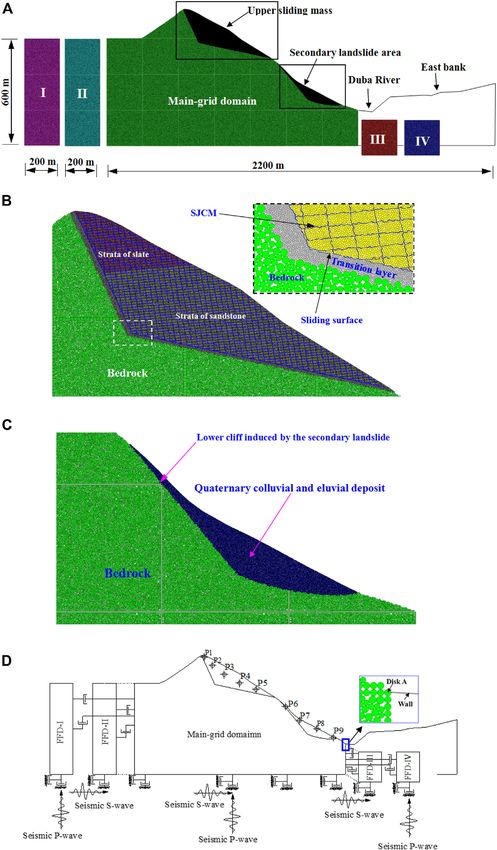
Zhou et al.                                                                                  Dynamic Process and Mechanism Taihongcun Landslide

INTRODUCTION                                                             et al., 2014; Che et al., 2016) and finite difference method
                                                                         (FDM) (Bouckovalas and Papadimitriou, 2005; Bourdeau and
On May 12, 2008, a magnitude Mw 7.9 earthquake occurred in               Havenith, 2008; Zhou et al., 2013). The continuous simulation
the Longmenshan Mountains tectonic zone of Sichuan Province,             methods are based on the assumption of small deformation and
China. The earthquake’s epicenter was located at Yingxiu Town,           displacement; therefore, using this type of approach, it is difficult
Wenchuan County (31.0°N and 103.4°E), and the hypocenter was             to describe large displacements along discontinuities and
at a depth of approximately 19 km. Surface displacements                 rotations of blocks in a jointed rock mass under seismic
produced by the fault rupture reached several meters,                    loading. The second category consists of discontinuum
propagating from the epicenter for approximately 240 km                  methods such as discontinuous deformation analysis (DDA)
along the mountain range (Fan et al., 2018). According to the            (Wu and Chen, 2011; Zhang et al., 2015; Huang et al., 2016;
statistical data provided by the Chinese government, this                Fu et al., 2019) and the discrete element method (DEM). With an
earthquake claimed the lives of more than 87,000 people and              explicit scheme-based force balance solution, the DEM exhibits a
injured approximately 459,000 others (Qi et al., 2010). More than        high computational efficiency in the seismic analysis of large-
60,000 rock avalanches and landslides were triggered by the 2008         scale rock mass engineering. In the DEM, blocks or particles
Wenchuan earthquake (Gorum et al., 2011; Wang et al., 2014),             resulting from different discretizations of the domain of interest
and several hundred landslide dams were formed.                          can lead to different approaches. The most popular block-based
   Landslides triggered by strong earthquakes have always been a         DEMs are the commercialized UDEC and 3DEC for solving two-
popular topic of discussion. The dynamics and failure                    and three-dimensional (2D and 3D) problems; these programs
mechanisms of earthquake-induced landslides are critical to              have been extensively used in seismic response analyses for rock
elucidate for improving hazard prevention and mitigation                 engineering (Kveldsvik et al., 2009; Cui et al., 2016; Song et al.,
measures. Field investigations indicate that the kinematic               2018). The particle-based DEM method introduced by Cundall
processes of earthquake-induced landslides are characterized             and Strack (1979) simulates the mechanical behavior of a material
by high speeds, long runouts, and high mobilities (Wang                  by representing it as an assemblage of discs (2D) and spheres
et al., 2009; Yin et al., 2009; Chigira et al., 2010; Dai et al.,        (3D). The DEM was originally used to investigate granular
2011; Gorum et al., 2011; Tang et al., 2011; Huang et al., 2012;         materials such as soils/sands and was eventually implemented
Zhang and Yin, 2013; Zhang et al., 2016). Considerable kinetic           in a commercial code, i.e., Particle Flow Code (PFC) (Itasca
energy, high toe to rupture surface elevations, elastic energy           Consulting Group Inc., 2008). To solve problems related to a rock
release due to grain fragmentation, and high excessive pore              mass, a bonded particle model (BPM), in which intact rocks are
water pressure generated by undrained loading were                       represented as assemblages of cemented rigid particles, was
underscored as the principal controlling factors for the long            developed (Potyondy and Cundall, 2004), and a smooth joint
travel distance, high speed, and high mobility (Wang et al.,             contact model (SJCM) was proposed to model the joints (Ivars
2009; Chigira et al., 2010; Zhang and Yin, 2013; Wang et al.,            et al., 2011).
2014). It was concluded that the occurrence of an earthquake-                As previously documented, many earthquake-triggered
induced landslide is controlled mainly by seismic, terrain, and          landslides are characterized by flow-like movement, and the
geological factors (Huang et al., 2012). Strong ground motion            sliding material disintegrates into fragments during the high-
generated by the earthquake and topographic amplification of              speed movement, ultimately forming a granular deposit. The
seismic waves due to features of the terrain were emphasized as          particle-based DEM method simulates the geomaterial as
the main triggers of rock avalanches and landslides (Havenith            assemblies of rigid discs (in 2D) or spheres (in 3D) bonded at
et al., 2003; Murphy, 2006; Bourdeau and Havenith, 2008; Yin             their contacts and allows finite displacements, rotations and
et al., 2009; Huang et al., 2012; Zhou et al., 2013).                    separations of the discrete particles. The failure process in the
   Field investigation and numerical simulation are two                  synthetic material can be represented by the breakage of bonds
fundamental techniques for analyzing the dynamics and                    and propagation and coalescence of these microcracks. Therefore,
revealing the possible mechanism of individual landslides                the particle-based DEM is more appropriate than DDA or the
induced by strong earthquakes. Through field investigation,               continuum methods for simulating the dynamic failure process
detailed information about a single landslide can be obtained,           and kinematic characteristics of landslides triggered by
such as its geological and topographical features (Has and Nozaki        earthquakes. Huang et al. (2012), Tang et al. (2013), Zhou et al.
2014; Wang et al., 2014; Zhang et al., 2016; Zhuang et al., 2018).       (2013), Yuan et al. (2014), and Deng et al. (2017) developed 2D DEM
Furthermore, field investigation can provide evidence of the              models to simulate the dynamic process of landslides triggered by
dynamic processes for landslides (Zhang et al., 2011, Zhang              earthquakes and explore their seismic failure mechanism. In their
et al., 2016; Xu et al., 2013). Numerical simulation is an               simulations, the sliding surface and bedrock were represented by wall
important approach for modelling the dynamic process of                  elements, and the seismic ground motion histories were applied to
rock avalanches and exploring the formation mechanism of                 the wall boundaries. One drawback of this approach is that the wall
earthquake-triggered landslides. At present, numerical                   boundaries cannot absorb the scattering waves from the upper
simulation methods for the seismic response analysis of rock             sliding body, and the radiation of waves from the sliding mass
or soil slopes are mainly divided into two categories. The first          into the bedrock cannot be modeled. Therefore, nonreflecting
category is composed of traditional continuum methods,                   boundary conditions instead of wall boundaries are required to
including the finite element method (FEM) (Charatpangoon                  simulate the failure process of earthquake-induced landslides.

Frontiers in Earth Science | www.frontiersin.org                     2                                     August 2021 | Volume 9 | Article 710031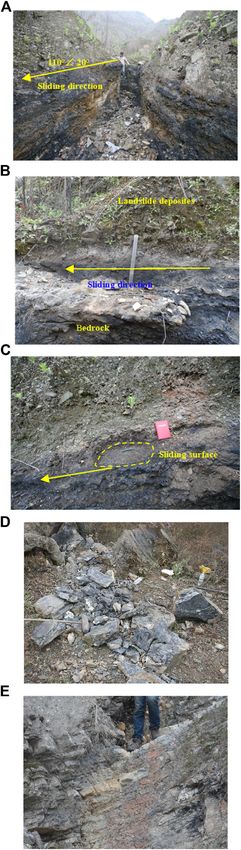
Zhou et al.                                                                                                Dynamic Process and Mechanism Taihongcun Landslide

  FIGURE 1 | Location of the Taihongcun landslide in Beichuan County, Sichuan Province (modified from Dai et al., 2011).

  FIGURE 2 | (A) Pre-sliding image from Google Earth taken on April 2, 2005; (B) Post-sliding image from Google Earth taken on January 22, 2011.

Frontiers in Earth Science | www.frontiersin.org                                3                                         August 2021 | Volume 9 | Article 710031
Zhou et al.                                                                                                    Dynamic Process and Mechanism Taihongcun Landslide

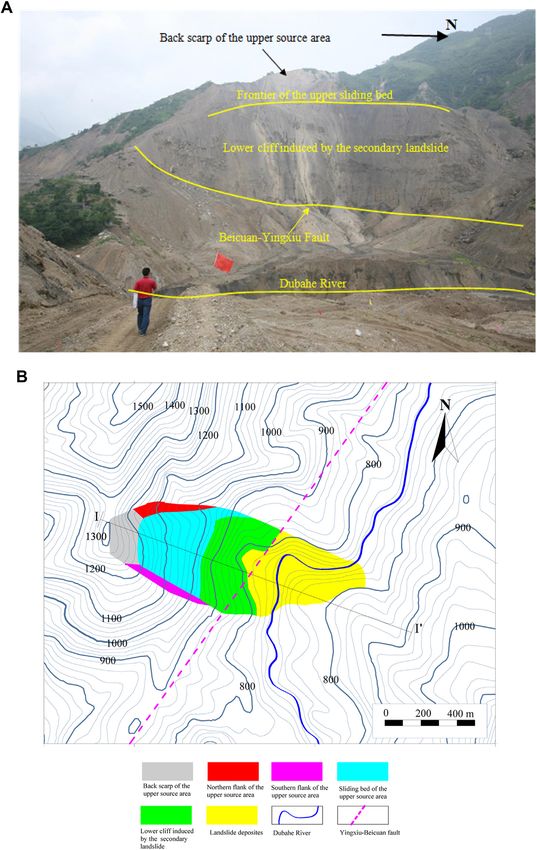
  FIGURE 3 | (A) Photograph of Taihongcun coseismic landslide, which was taken on July 3, 2008 and the landslide dam had already been breached artificially. (B)
  Plane view of the Taihongcun landslide. (C) Geological longitudinal section through the main slding direction I-I′ for the Taihongcun landslide.

Frontiers in Earth Science | www.frontiersin.org                                   4                                           August 2021 | Volume 9 | Article 710031
Zhou et al.                                                                              Dynamic Process and Mechanism Taihongcun Landslide

  FIGURE 3 | (Continued).

   In this study, detailed geological and geomorphological            of Taihong Village, Chenjiaba Town, Beichuan County in
surveys were conducted for the catastrophic Taihongcun                Sichuan Province, China. The landslide, triggered by the
landslide triggered by the 2008 Wenchuan earthquake; this             2008 Wenchuan earthquake, killed approximately 23 people,
landslide is located in Chenjiaba town, Beichuan County,              destroyed one village, and blocked the Duba River. The
Sichuan Province, China. From the detailed field                       Taihongcun landslide lies on the right bank of the Duba
investigation, the main characteristics of the Taihongcun             River, originating from the north-south trending ridge of
landslide were identified. Subsequently, 2D DEM models                 the Shuijingyan mountain (Figure 2B). Due to the long-
were established to simulate the kinematic and failure                term river erosion, the west bank is concave, causing the
processes of the Taihongcun landslide through the PFC2D               slope near the bank to be unstable (Figure 2A). The
code. To ensure the validity of the dynamic calculations, the         geomorphology of the Taihongcun coseismic landslide is
free-field boundary condition was developed and introduced             chair-shaped and can be divided into two parts by the
into the DEM models. The effects of the vertical and horizontal       existence of a notable cliff on the edge of the upper sliding
seismic forces on the dynamic failure process of this landslide       bed (Figure 3A). The upper source area is between 960 and
were considered. Finally, based on field investigations and            1,300 m in elevation, with an estimated volume of 1.5
numerical simulations, we discussed the possible                      million m3, and the original slope was between 20° and 30°
mechanism contributing to this landslide event.                       (Figure 3). The back scarp of the upper source area is 170 m
                                                                      wide, 200 m high and has an average slope of approximately
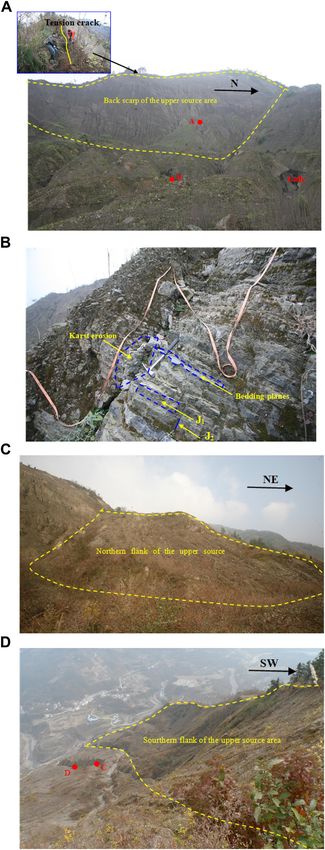
                                                                      70°. The northern flank (Figure 4C) is approximately 79 m
GEOMORPHOLOGICAL AND GEOLOGICAL                                       high and approximately 134 m long, with a strike of 90° and a
SETTINGS                                                              slope of approximately 52°. The southern flank is
                                                                      approximately 42 m high and approximately 200 m long,
The catastrophic Taihongcun landslide occurred on the east-           with a strike of 120° and a slope of approximately 33 °. A flat
facing slope of Shuijingyan Mountain (31°58′25.4″N,                   sliding bed can be seen in the middle of the landslide. This flat
104°35′55.6″E, see Figures 1, 2), which is located northeast          section is covered with landslide deposits with an average

Frontiers in Earth Science | www.frontiersin.org                  5                                   August 2021 | Volume 9 | Article 710031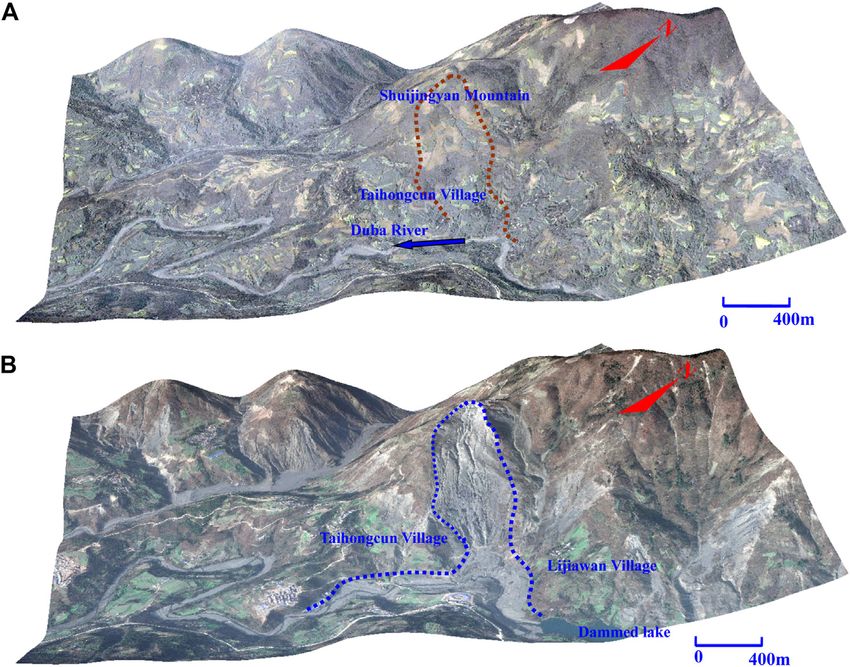
Zhou et al.                                                                                                   Dynamic Process and Mechanism Taihongcun Landslide

  FIGURE 4 | Photographs of different parts of the upper source area,                 FIGURE 5 | Strata in the upper source area. (A) Sliding surface on the
  which are taken on December 3, 2012. (A) Back scarp. (B) Rock mass of the           location spot B shown in Figure 4A. (B) Sliding surface on the location spot C
  lower part of back scarp and the photo location are shown as the red circle A       shown in Figure 4D. (C) Sliding surface on the location spot D shown in Figure 4D.
  in Figure 4A. (C ) Northern flank of the upper source. (D) Sourthern flank            (D) Carbonaceous and siliceous slate of Cambrian Qiujiahe Formation. (E)
  of the upper source area.                                                           Sandstone intercalated with limestone of Cambrian Youfang Formation.

Frontiers in Earth Science | www.frontiersin.org                                  6                                            August 2021 | Volume 9 | Article 710031
Zhou et al.                                                                                     Dynamic Process and Mechanism Taihongcun Landslide

                                                                             thickness of 40 m; the deposits are gray, with moderately
                                                                             weathered slate fragments present at the surface. The lower
                                                                             cliff induced by the secondary landslide is between 780 and
                                                                             960 m in elevation and 400 m in width, with an average slope of
                                                                             approximately 50°. Field investigations show that the Yingxiu-
                                                                             Beicuan fault is located at the toe of the landslide (Figure 3).
                                                                             The floodplain of the Duba River is below the lower cliff, and
                                                                             the depth from the bottom of the river to the bank is 35–41 m.
                                                                             The main sliding direction along line I-I′ in Figure 3B is 110°.
                                                                                 Figure 3C displays the geological longitudinal section through
                                                                             the main slding direction I-I′ for the Taihongcun landslide.
                                                                             According to field investigations, the Taihongcun slope
                                                                             consists of the Cambrian Qiujiahe Formation (Єq), Cambrian
                                                                             Youfang Formation (Єy) and Silurian Hanjiadian Formation
                                                                             (Sh). The Cambrian Qiujiahe Formation is mainly composed
                                                                             of carbonaceous and siliceous slate (Figure 5D); the Cambrian
                                                                             Youfang Formation is composed of extensively jointed sandstone
                                                                             (Figure 5E); and the Silurian Hanjiadian Formation is composed
                                                                             of thin layers of argillaceous slate. The Cambrian Qiujiahe
                                                                             Formation outcrop, in which the slate is strongly weathered, is
                                                                             observed at the top of the back scarp, with a thickness of
                                                                             approximately 96 m. A 0.4 m wide tension crack is found at
                                                                             the top of the back scarp (Figure 4A). The lower part of the back
                                                                             scarp consists of the Cambrian Youfang Formation, in which the
                                                                             sandstone is intercalated with limestone (Figure 4B), with a
                                                                             thickness of approximately 80 m. Karst erosion has developed
                                                                             along the preexisting fissures in the limestone, weakening the
                                                                             stability of the back scarp. The bedding planes of the strata
                                                                             around the back scarp of the slope gently dip away from the
                                                                             slope surface at an angle of approximately 10°. Two dominant and
                                                                             steep joint sets (J1, J2) are widely developed in the back scarp
                                                                             (Figure 4B). Set J1 dips away from the back scarp surface at an
                                                                             angle of approximately 80° and controls the surface deformation
                                                                             of the back scarp.
                                                                                 The displaced material covering the sliding bed of the upper
                                                                             source area is mainly composed of gray slate blocks and
                                                                             fragments, as observed on the surface. The bedrock of the
                                                                             upper source is the extensively jointed sandstone of the
                                                                             Cambrian Youfang Formation (Figure 5E). Several gullies
                                                                             incised into the deposit by rainfall runoff enabled the internal
                                                                             structure of the deposit and sliding surface to be examined and
                                                                             sampled. As shown in Figures 5A–C, according to observations
                                                                             from a gully, a weak interlayer of carbonaceous slate and shale
                                                                             exists between the landslide deposits and the bedrock, with a dip
                                                                             angle ranging from 17° to 23°. The thickness of this layer is
                                                                             approximately 0.2–1.5 m. An obvious sliding surface can be seen
                                                                             between the displaced material and carbonaceous shale (Figures
                                                                             5A–C). Therefore, the carbonaceous shale is the strata on top of
                                                                             which the sliding surface occurred. The lower cliff was
  FIGURE 6 | Deposition area of the Taihongcun landslide. (A) Granular
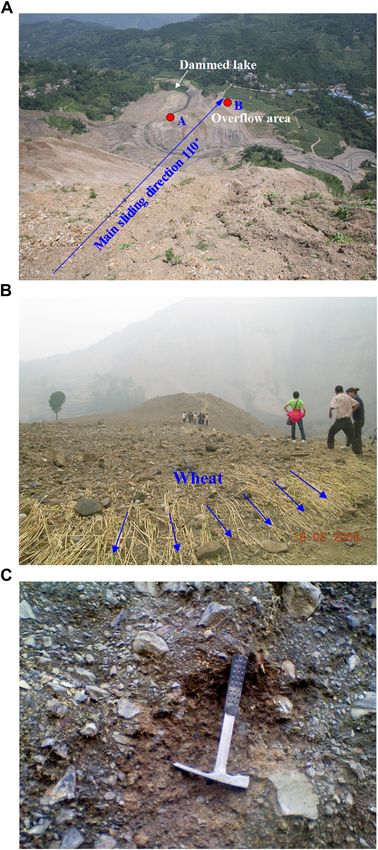
  debris covered the Duba rive and the farmlands (the landslide dam          determined to have formed after the Wenchuan earthquake by
  had already been breached artificially). (B) Air wave blew down the         comparing Figures 2A,B; this area was subsequently covered by
  wheat due to granular debris on the location shown as the red circle       Quaternary colluvial and eluvial deposits with an average
  B in Figure 6A. (C) Compact landslide deposits composed of                 thickness of 70 m. The basement rock of the cliff consists of
  angular fragments on the location shown as the red circle A in
                                                                             the carbonaceous and siliceous slate of the Cambrian Qiujiahe
  Figure 6A.
                                                                             Formation and sandstone of the Cambrian Youfang Formation.

Frontiers in Earth Science | www.frontiersin.org                         7                                   August 2021 | Volume 9 | Article 710031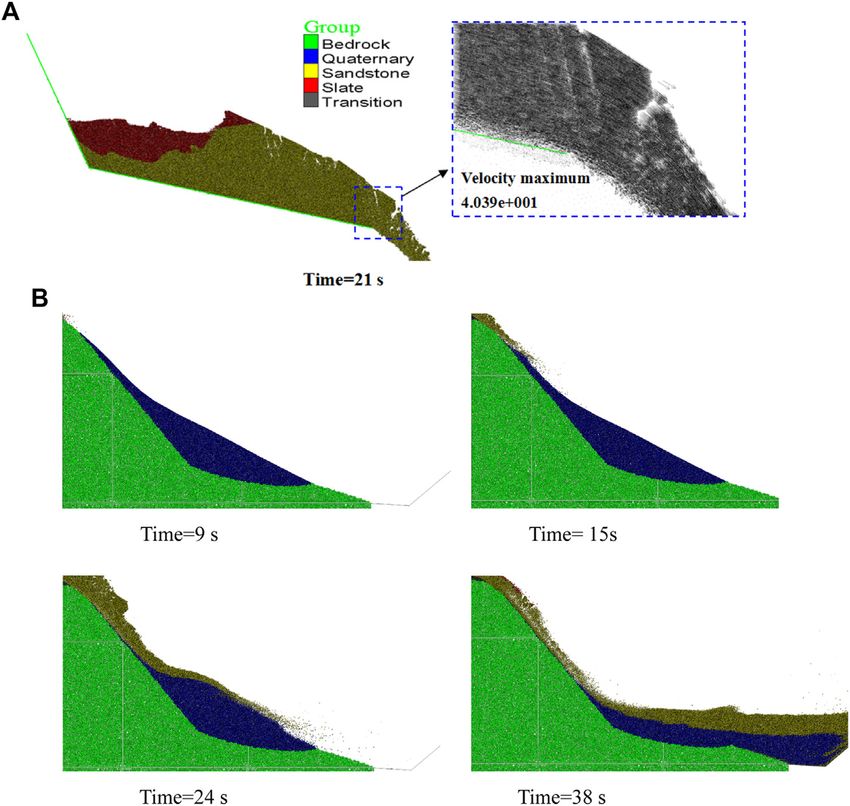
Zhou et al.                                                                                   Dynamic Process and Mechanism Taihongcun Landslide

Based on the field observations, the strata in the shallow part of        the majority of the deposits are subangular to angular. As
the cliff are highly weathered. Due to the long-term strong              shown in Figure 6B, in the front of the deposits on the
tectonic activities of the Yingxiu-Beicuan fault, which lies             opposite bank, wheat stalks were pushed down and arranged
across the foot of the cliff, the rock mass of the entire slope is       in radial lines by the powerful air blast induced by the
fractured and is vulnerable to weathering. Thus, the strength of         displaced material, indicating the high-speed movement of
the slope rock mass is low. The Yingxiu-Beicuan fault is the             the granular debris flow.
interface between the Cambrian strata (in the hanging wall) and
Silurian strata (in the footwall) (Figure 3).
                                                                         DISCRETE ELEMENT METHOD MODELING
KINEMATIC CHARACTERISTICS OF                                             The dynamic processes of landslides under seismic loading
TAIHONGCUN LANDSLIDE                                                     conditions are very complicated. The DEM is well suited for
                                                                         simulating the cracks and subsequent large displacements of
As shown in Figure 3, the study area can be divided into three           catastrophic landslides or rock avalanches and is therefore a
regions: the upper source area, the secondary landslide area,            useful tool for analyzing their complex kinematics and failure
and the debris deposit area. The elevation difference between            mechanisms. In this section, based on the two-dimensional code
the toe and the crest of the slope in the upper source area is           PFC2D, DEM models were used to investigate the kinematical
260 m, and the corresponding horizontal distance is 460 m.               process and failure mechanism of the Taihongcun landslide
The original slope of the upper source area failed due to the            triggered by the 2008 Wenchuan earthquake.
substantial seismic forces. After the landslide initiation in this
area, the source mass detached from the parent rock mass and
slid along the sliding surface at an increasing speed. High-             Free-Field Boundary Condition for Discrete
temperature carbonization observed near the sliding surface              Element Method
indicates that a high-speed shearing effect between the sliding          In a numerical analysis of the seismic response of rock slopes,
body and the sliding surface was produced during the high-               earthquake waves such as plane body waves are usually applied at
speed movement of the displaced mass (Figures 5A–C). The                 the bottom of the model and propagate upward. The boundary
initial velocity was obtained when the upper sliding body slid           conditions at the sides of the model should account for the free-
in front of the toe of the sliding surface and was projected into        field motion that would exist in the absence of a structure, such as
the air. After the failed rock mass was projected into the air           a slope or a tunnel. The free-field boundary algorithm proposed
from the toe of the upper sliding surface, this mass would               by Zienkiewicz et al. (1989) is selected to “enforce” the free-field
exhibit a parabolic airborne course, and the gravitational               motion in such a way that the boundaries retain their
potential energy would be converted into kinetic energy in               nonreflecting properties (i.e., outward waves originating from
the falling stage. The secondary landslide area is characterized         the structure are properly absorbed). In this approach, the lateral
by the cliff below the upper source area. A large elevation              boundaries of the main grid domain are coupled to the free-field
difference of 200 m between the toe of the sliding surface and           domain by viscous dashpots to simulate an absorbing boundary,
the cliff base allowed the airborne rock mass from the upper             and the unbalanced forces from the free-field grid are applied to
source area to acquire considerable momentum and thus to                 the main grid boundary. The free-field grid is solved in parallel
scrape the preexisting deposit overlaying the cliff. The loose           with the main grid. For a lateral boundary of the main grid
deposit material was entrained by the rock debris due to the             domain with its normal in the direction of the x-axis, the free-field
impact and pushed downwards with it.                                     boundary condition for 2D problems can be expressed as follows:
    In the deposit area, the granular debris flow reached the
valley bottom below the 180 m high cliff, blocked the Duba                                                    x − u_ x  + σ x
                                                                                               σ x  −ρcp u_ m      ff      ff
                                                                                                                                                  (1)
River, and climbed the opposite bank of the river                                             τ xy    −ρcs u_ m
                                                                                                                y   −   u_ffy    + τ ffxy        (2)
(Figure 6A). The horizontal travel distance was
approximately 1,200 m, and the vertical fall height was                  where σ x and τ xy are the normal and shear components of the
approximately 550 m. The thickness of landslide deposits                                                                            x and u_ y
                                                                         traction applied to the lateral boundary, respectively; u_ m        m

is affected by terrain. The deposits in the gullies and rivers           are the x and y components of the main grid point velocity at the
are thickest, and the average thickness is approximately 50 m.           lateral boundary; u_ffx and u_ffy are the x and y components of the
Specifically, the deposits are the thickest at the landslide dam,         velocity of the grid point in the free-field domain; and u_ffx and u_ ffx
with a thickness of up to approximately 95 m. The thickness              are the tractions contributed from the free-field grid in the x and y
of the debris flow deposits along the river course is generally           directions.
approximately 30 m, while the thickness at the edge of the                   Eqs 1, 2 are defined based on the continuum condition. To
accumulation area is only 2–5 m. Field investigations show               apply the free-field boundary condition in the DEM models, Eqs
that the deposits are composed mostly of highly fragmented               1, 2 need to be discretized. For regular packing geometries, it may
sandstone and shale; the grain size is in the range of sand,             be possible to develop analytical expressions of the equivalent
gravel, and cobble, with some large boulder-sized blocks                 discrete free-field boundary condition based on Eqs 1, 2. For a
(Figure 6C). The main grain size is gravel and cobble, and               square array of disks (each particle has four neighbors) of unit

Frontiers in Earth Science | www.frontiersin.org                     8                                         August 2021 | Volume 9 | Article 710031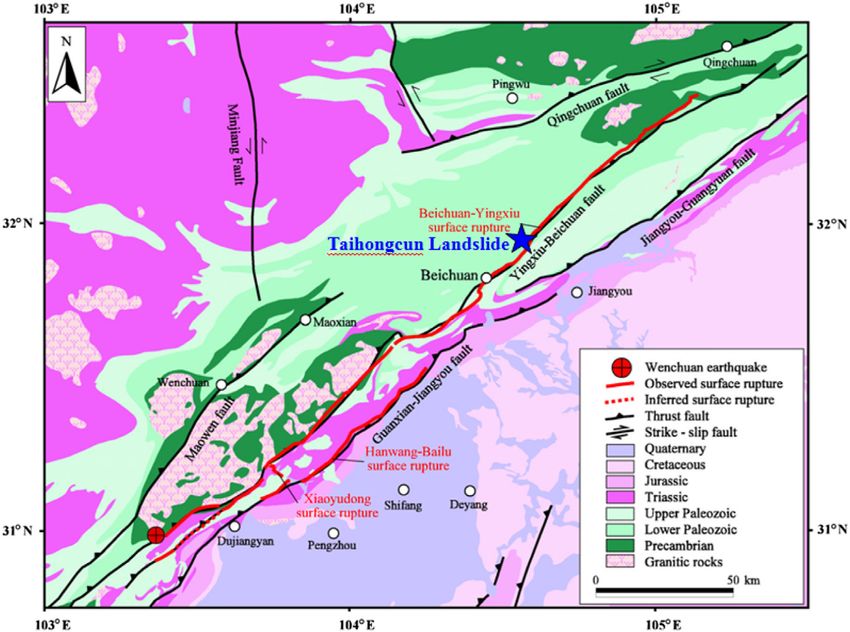
Zhou et al.                                                                                                           Dynamic Process and Mechanism Taihongcun Landslide

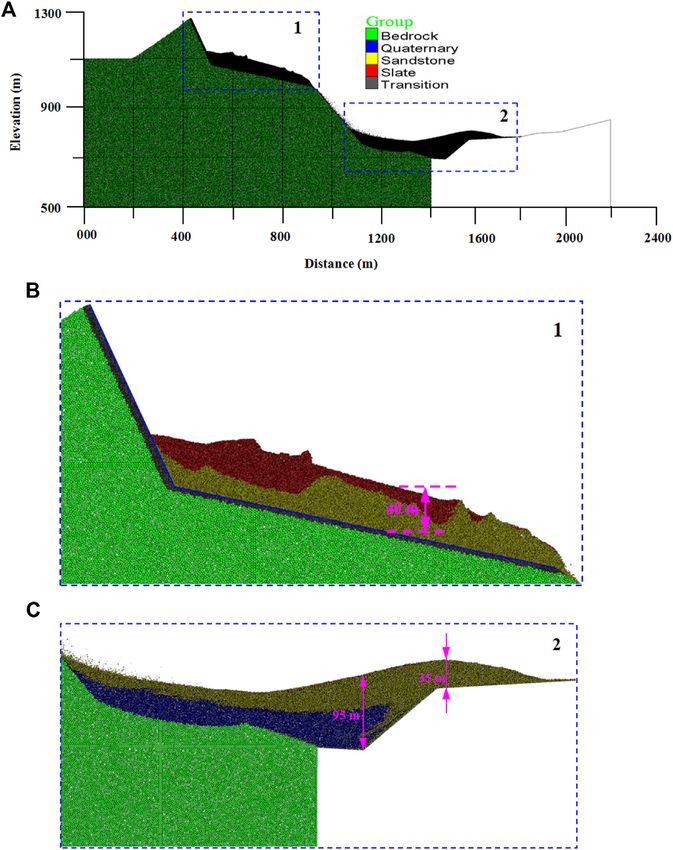
  FIGURE 7 | DEM model of the Taihongcun landslide. (A) Part I is the free-field domain I (FFD-I), part II is the free-field domain II (FFD-II), part III is the free-field domain
  III (FFD-III), and part IV is the free-field domain IV (FFD-IV). (B) Upper sliding mass and bedrock. (C) Secondary landslide area. (D) Dynamic boundary setting and locations
  of monitoring disks for the landslide.

Frontiers in Earth Science | www.frontiersin.org                                        9                                              August 2021 | Volume 9 | Article 710031
Zhou et al.                                                                                                       Dynamic Process and Mechanism Taihongcun Landslide

TABLE 1 | Micro-parameters for different types of material used in the DEM models.

Micro-material parameters                        Strongly weathered sandstone                Fresh sandstone      Strongly weathered slate       Colluvial and eluvial
                                                                                                                                                       deposits

Assembly bulk density (kg/m3)                                             2,400                   2,600                     2,300                       2,200
Minimum radius (Rmin) (m)                                                  0.30                     1.0                      0.30                        0.30
Particle radius ratio (Rmax/Rmin)                                           1.5                     1.5                      1.5                         1.5
Particle contact modulus (Ec) (GPa)                                         8.0                    17.0                       3.5                         0.8
Particle stiffness ratio (kn/ks)                                            1.5                     1.5                       1.5                        2.0
Ball–ball friction coefficient                                               0.5                    0.5                       0.5                         0.5
Parallel bond modulus (E c ) (GPa)                                          8.0                    17.0                       3.5                         0.8
                                 n s
Parallel bond stiffness ratio (k /k )                                       1.5                     1.5                      1.5                         2.0
Parallel-bond normal strength (σ c ) (MPa)                                 12.5                    36.0                       5.0                        0.55
Parallel-bond shear strength (τ s ) (MPa)                                  12.5                    36.0                       5.0                        0.55
Parallel-bond radius multiplier (λ)                                          1                       1                         1                           1

thickness in 2D, the particles in the assemblies have a common                                  seismic ground motion of the wall elements is in accordance
diameter Db. The regular square packing is subjected to an                                      with the movements of disk A (see Figure 7D).
unconfined compression test. The axial stress, kn,SJ , is related
to the axial force, ks,SJ , as follows:                                                          The sliding mass in the upper source area is composed of slate
                                                                                             and sandstone (see Figure 7B). In PFC2D, a joint is identified as a
                                           Fa
                                   σa                                            (3)        contact between particles lying on opposite sides of the joint
                                          Db × 1
                                                                                             plane. Joint plane contacts follow a contact model with properties
Substituting Eq. 3 into Eqs 1, 2, the free-field boundary condition                           that are different from those assigned to particle contacts
for the DEM in 2D is obtained by                                                             elsewhere in the rock mass.
                                                                                                 The most commonly used method for the generation of rock
                                           x − u_ x  + fx
                       fx  −β2p ρcp Db u_m      ff      ff
                                                                                  (4)        joints is to set the bond strengths of the joint plane contacts to low
                       fy    −β2s ρcs Db u_m   −   u_ffy    +   fyff           (5)        values (or zero for the lowest shear strength) (Kulatilake et al.,
                                             y
                                                                                             2001; Wang et al., 2003; Huang et al., 2015). The shortcomings of
where fx and fy are the normal and shear components of the force                             this method are that the surface of a generated joint has an
applied to the particles at the lateral boundaries of the main grid                          inherent microscale roughness that is due to the circular shape
          ff       ff
domain; fx and fy are the forces of a particle in the free-field                              and the nonuniform size and distribution of the particles
domain in the x and y directions; and β2p and β3s are the                                    (Bahaaddini et al., 2015). Therefore, it is difficult for the
nondimensional calibration factors for optimum wave                                          particles to slide along the discontinuities, especially along the
absorption.                                                                                  sliding surface. To solve this problem, the smooth joint contact
                                                                                             model (SJCM) was developed and introduced into PFC to
Numerical Model                                                                              simulate joints on a mesoscopic scale (Ivars et al., 2011). The
Figure 7A shows the 2D DEM model of the Taihongcun                                           SJCM simulates the behavior of an interface regardless of the local
landslide, constructed based on the geological longitudinal                                  particle contact orientations along the interface. The behavior of a
section shown in Figure 3C. The sliding mass in the upper                                    frictional or bonded joint can be modeled by assigning the SJCM
source area can be detailed in Figure 7B, and the secondary                                  to all contacts between particles that lie on opposite sides of a
landslide area in the model is shown in Figure 7C. To capture the                            joint. With this approach, the shear behavior and mechanisms of
main features of the large rock avalanche, the following                                     rock joints under direct shear tests were studied in detail
assumptions were made:                                                                       (Bahaaddini et al., 2013, 2015; Gutiérrez-Ch et al., 2018). In
                                                                                             this study, the J1 joint set, bedding planes, sliding surface and back
1. The sliding mass in the source area is cut by two sets of                                 scarp are modeled with the SJCM (Figure 7B). Thus, the sliding
   discontinuities, including joint set J1 and the bedding planes.                           mass in the upper source area can slide or separate along the
2. Given the radius difference between the bedrock and the                                   sliding surface and back scarp.
   sliding mass, an 8 m thick transition layer is produced                                       The dynamic boundary conditions and monitoring disks for
   between the bedrock and sliding mass (see the enlarged                                    the DEM model are shown in Figure 7D. To absorb outward
   view in the box in Figure 7B).                                                            propagating waves and avoid plane waves propagating upward
3. The rupture surface, including the back scarp and the sliding                             from being distorted at the lateral boundaries of the model, the
   surface, is preset along the interface between the transition                             free-field boundary conditions described in Free-Field Boundary
   layer and sliding mass.                                                                   Condition for Discrete Element Method are applied to the model.
4. The bedrock below the sliding surface is considered                                       To ensure that the free-field domain has the same elastic behavior
   homogeneous.                                                                              as the main grid domain, the microscale properties of the free-
5. To avoid a large computational burden, the bedrock under the                              field domains are the same as those of the bedrock. The free-field
   riverbed and east bank are simulated by wall elements. The                                domain is composed of four soil columns. The soil columns

Frontiers in Earth Science | www.frontiersin.org                                        10                                     August 2021 | Volume 9 | Article 710031
Zhou et al. Dynamic Process and Mechanism Taihongcun Landslide
TABLE 2 | Calibrated parameters for smooth joint contact model (SJCM).
Micro-material parameters Sliding surface Bedding planes and joint set J1
SJCM normal stiffness kn,SJ (MPa/mm) 2.0 6.6
SJCM shear stiffness ks,SJ (MPa/mm) 2.0 6.6
SJCM coefficient of friction μSJ 0.42 0.32
SJCM bond normal strength σ n,SJ (MPa) 0.08 0.04
SJCM bonded system cohesion cSJ (MPa) 0.6 0.5
SJCM bonded system friction angle (°) 42 30
FIGURE 8 | Input horizontal and vertical ground acceleration records after filtering and baseline correction.
FFD-I and FFD-II are located on the left of the main grid domain, uniaxial compressive strength tests are carried out on BPMs to
and the soil columns FFD-III and FFD-IV are located on the calibrate microscopic parameters against the uniaxial
right. Note that only a seismic P-wave is applied on the bottom compressive strength UCS, elastic modulus E and Poisson’s
boundaries of soil columns FFD-I and FFD-IV and that only a ratio v. The derived microscopic parameters of the BPMs for
seismic S-wave is applied on the bottom boundaries of soil the landslide are listed in Table 1. A comparison of the
columns FFD-II and FFD-III, while seismic P- and S-waves macroscopic properties between the BPMs and laboratory
are applied to the bottom boundary of the main grid domain. experiments is conducted. The results from the BPMs are very
When only an S-wave (or a P-wave) is required as input for the close to those from the laboratory experiments.
model, the free-field domain is merely composed of soil columns Numerical direct shear tests under constant normal stress are
FFD-II and FFD-III (or FFD-I and FFD-IV). Viscous boundary employed to determine the strength and stiffness parameters of
conditions are applied to the bottom boundary of the main grid the SJCM interfaces. The SJCM is applied to the contacts between
and free-field domains. particles that lie on opposite sides of the shear plane. To simulate
the direct shear tests, the lower block is kept stationary during the
Model Parameters and Seismic Input tests, and a horizontal velocity V, which is low enough to ensure
PFC2D simulates the intact material as an assembly of circular that the sample remains in quasistatic equilibrium, is applied to
particles bonded at their contacts with the contact bond model or upper walls. The normal stress is applied vertically to the upper
parallel-bond model and is thus referred to as a bonded particle block, and this normal stress is kept constant during the tests by
model (BPM) (Potyondy and Cundall, 2004). The macroscopic using a servo-control mechanism (Itasca Consulting Group Inc.,
mechanical behavior of the synthetic material depends on the 2008). The shear and normal displacements are obtained by
microscopic parameters of the particles and bonds between tracing the horizontal and vertical displacements of the upper
particles. However, the microscopic parameters cannot, in block, respectively, and the shear stress is calculated by dividing
general, be related directly to a set of relevant material the average force reaction on the upper left and lower right walls
properties (Itasca Consulting Group Inc., 2008). In general, by the joint length. The calibrated SJCM parameters for the
the microscopic parameters can be obtained by means of a sliding surface, bedding planes and joint set J1 are listed in
calibration process in which a series of numerical tests are Table 2.
performed to reproduce the desired macroscopic properties Because no strong motion station is present at the landslide
measured in laboratory experiments. In this study, numerical site, records of the Wenchuan earthquake waves from the strong
Frontiers in Earth Science | www.frontiersin.org 11 August 2021 | Volume 9 | Article 710031Zhou et al. Dynamic Process and Mechanism Taihongcun Landslide
are chosen as the seismic loading inputs. The peak ground
accelerations (PGAs) of the original seismic records at the
Qingping station are 824.12 cm/s2 in the east-west direction,
802.7103 cm/s2 in the north-south direction, and 622.91 cm/s2
in the vertical direction. Because the 2D DEM models (Figure 7)
are constructed based on a geological longitudinal section
(Figure 3C), it is necessary to project the horizontal
acceleration records in the east-west and north-south
directions into the main sliding direction of the landslide
using the following equation:
aH aE−W · sin(110°) + aN−S · cos(110°) (6)
where aH is the acceleration in the main sliding direction, aE−W is
the acceleration in the east-west direction, aN−S is the acceleration
in the north-south direction, and 110° is the azimuth of the main
sliding direction.
The ultimate acceleration histories after filtering and baseline
correction are shown in Figure 8. The velocity time-history records
are transformed into force time-history records and applied to the
bottom boundaries of the main grid and free-field domains.
To effectively dissipate the kinetic energy of the assembly
system, numerical damping must be used in the simulations.
Local damping and viscous damping are available in DEM
models to dissipate kinetic energy. Local damping applies a
damping force, with a magnitude proportional to the
unbalanced force, to each particle, while viscous damping adds
normal and shear dashpots at each contact. Local damping is not
applicable for landslide simulation (Deng et al., 2017). Therefore,
viscous damping is used in the simulations. The parameters of
viscous damping can have a significant impact on the results, but
they cannot be explicitly related to any physical mechanism. The
parameters of viscous damping in DEM models can also influence
the grain motion and reflect energy dissipation during collision.
The damping parameters are correlated with the coefficients of
restitution, which can be measured in the laboratory or field. The
results of field restitution coefficient tests conducted by Giani
(1992) are used to define the damping parameters. The values of
the normal and shear damping coefficients are thus set to 0.4 and
0.2, respectively, (Deng et al., 2017).
NUMERICAL SIMULATION RESULTS AND
ANALYSIS
The dynamic process of the Taihongcun rock avalanche can be
classified into four stages: upper sliding mass fragmentation,
projection of the upper displaced mass, scraping of the upper
sliding mass toward the Quaternary colluvial and eluvial deposit,
and granular debris flow and accumulation. Each of the
stages is discussed in detail in Upper Sliding Mass
Fragmentation–Granular Debris Flow and Accumulation. The
numerical parameter of internal bonding strength is the most
FIGURE 9 | Progressive fragmentation of the upper sliding mass during
earthquake. crucial factor influencing landslide transport and deposition in
the DEM model (Zhang et al., 2017). Therefore, the influence of
the parallel-bond strength on the runout distance and deposition
motion station Qingping, which is close to the seismogenic patterns is investigated in Influence of the Bond Strength on the
Yingxiu-Beicuan fault and is 40 km away from the landslide, Runout Distance and Deposition Patterns.
Frontiers in Earth Science | www.frontiersin.org 12 August 2021 | Volume 9 | Article 710031Zhou et al. Dynamic Process and Mechanism Taihongcun Landslide FIGURE 10 | (A) Projectile motion: the toe of the sliding surface projects the upper sliding mass into the air. (B) Scraping action of the upper sliding mass toward the Quaternary colluvial and eluvial deposit covering the lower cliff. Upper Sliding Mass Fragmentation loadings, tensile cracks develop in the rear part of the Figure 9 shows the progressive fragmentation of the upper sliding sliding body, forming a tensile stress concentration zone body under the combined horizontal and vertical seismic (Figures 9E–D). Then, the cracks widened laterally and loadings; the cluster plots indicate fractured blocks (Itasca propagated vertically to the intersection between the scarp Consulting Group Inc., 2008). In the static gravity equilibrium and the sliding surface, generating horizontal and vertical situation (Figure 9A), damage can be observed in the rock displacements. The large elevation difference between the mass near the scarp and sliding surface and on the top part of slope and the slip plane facilitated the rockslide, triggered the slope. Cracks or fissures develop along the bedding planes by the violent quaking. and joint set J1 in the damaged regions, and the rock mass is broken into small blocks. The entire model can be brought to equilibrium under gravity so that the slope is stable before the Projectile Motion of the Upper Displaced earthquake. After the seismic force is applied to the base of the Mass model, the slope is not stable (Figures 9E–H). In the initial Under seismic and gravity forces, the upper sliding mass achieved stage of the Taihongcun rock avalanche, a rock slide occurred, a high initial speed of approximately 40 m/s over a short period as and an obvious settlement is observed near the top of the slope it slid away from the toe of the sliding surface (Figure 10A). when the shear stress at the sliding surface reaches the shear There is sufficient open space in the movement direction of the strength (Figure 9B). The development of cracks or fissures in landslide, allowing the upper sliding mass to run out from the top the rock mass, induced by the shaking and sliding, is observed of the 180 m cliff at a high speed, along a parabolic path (Figures (Figures 9E–H). The high-speed shearing effect between the 9E–G, Figure 10A). After the upper sliding mass was projected sliding body and the sliding bed resulted in fragmentation of into the air, the speed increased rapidly during the vertical drop the rock blocks into small particles (Figures 9B,C). The from the toe of the sliding surface to the valley bottom. The high jointed rock blocks in the slope begin falling and fragment initial velocity, high elevation of the toe of the sliding surface and into smaller sizes as a result of the internal forces exceeding the sufficient open space in the movement direction induced bonding strength (Figures 9E–H). Under strong seismic projectile motion. Frontiers in Earth Science | www.frontiersin.org 13 August 2021 | Volume 9 | Article 710031
Zhou et al.                                                                                                            Dynamic Process and Mechanism Taihongcun Landslide

  FIGURE 11 | Time-history curves of horizontal velocity for monitoring points. (A) Velocities of monitoring points in the upper source area. (B) Velocities of monitoring
  points in the Quaternary colluvial and eluvial deposit.

Scraping of the Upper Sliding Mass                                                           sliding mass (particles 1, 2, and 3) start moving slowly, and their
Figure 10B shows the scraping of the upper sliding mass into the                             movement continues for a short time. However, particles in the
Quaternary colluvial and eluvial deposit on the lower cliff. As the                          front of the upper sliding mass (particles 4 and 5) start moving
gravitational potential energy would be converted into kinetic                               quickly, and their movement continues for a longer period. The
energy in the falling stage, with a substantial kinetic energy, the                          peaks in the recorded velocities in the front of the upper sliding
thrown upper sliding mass collided with and intensely scraped off                            mass (particles 4 and 5) appear later than those in the rear of the
the Quaternary deposit, completely entraining and removing the                               upper sliding mass (particles 1, 2, and 3). The seismic response of
deposits. The bedrock below the Quaternary deposits was                                      the upper sliding mass is most intensive at t  6–50 s, and the
completely exposed after the event, and the lower cliff formed.                              direct cause of the landslide is the earthquake. As illustrated in
The lower part of the landslide was triggered into a secondary                               Figure 11B, monitoring particle 6 in the top of the lower
failure due to the earthquake activity and the effects from the                              Quaternary deposit was displaced by the thrown upper sliding
upper part of the landslide.                                                                 mass at approximately 13 s. The particles in the top of the lower
                                                                                             Quaternary deposit were displaced earlier and farther than those
Granular Debris Flow and Accumulation                                                        in the bottom. Therefore, the velocity peaks of the monitoring
Figure 11 shows the velocity histories of the monitoring particles                           particles decrease from the top of the lower Quaternary deposit to
at different locations in the upper sliding mass and the lower                               the bottom. The speeds of the monitoring particles in the lower
Quaternary deposit (shown in Figure 7D). As shown in                                         Quaternary deposit peaked at approximately 30 s, then gradually
Figure 11A, the maximum velocity of the monitoring particles                                 decreased, and reached zero at approximately 43 s.
is approximately 60 m/s, which was recorded at point 5, and the                                  The upper sliding mass was disintegrated into fragments due to the
peaks of the recorded velocities decrease from the front of the                              strong vibration, intensive collision, and violent scraping action. Then,
upper sliding mass to the rear. Particles in the rear of the upper                           the fragmented geomaterial transformed into granular debris with a

Frontiers in Earth Science | www.frontiersin.org                                        14                                              August 2021 | Volume 9 | Article 710031
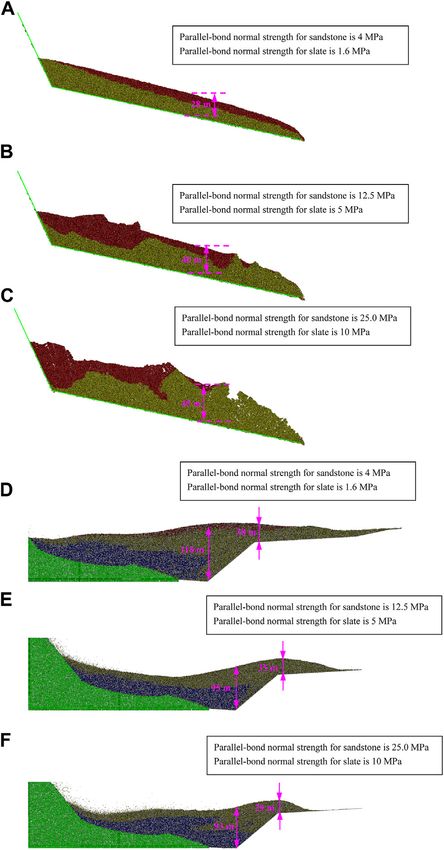
Zhou et al. Dynamic Process and Mechanism Taihongcun Landslide FIGURE 12 | Ultimate landslide deposit accumulation. (A) Entire model. (B) Deposits in the upper source area. (C) Deposits in the valley of the Duba River. rapid, flow-like motion. The lower Quaternary deposit was entrained deposits are covered by sandstone debris. The distance between the due to the rock debris collision on the slope surface. The topography summit of the mountain before the earthquake and the edge of the after sliding is shown in Figure 12A, which indicates that there are two deposit on the opposite bank is approximately 1,200 m in the deposition zones of the Taihongcun landslide: the first is in the upper horizontal direction, and the vertical height from the summit of the source area, where fragmented rock debris accumulates on the sliding mountain to the bottom of the Duba River is approximately 600 m. surface; the second is in the valley of the Duba River. In the first deposition zone (Figure 12B), the average thickness of the deposit is approximately 40 m, which is in accordance with the field observations, Influence of the Bond Strength on the and the deposit can be divided into two layers: an upper layer of slate Runout Distance and Deposition Patterns and a lower layer of sandstone. In the second deposition zone, the Some researchers noted that the basal friction coefficient and granular debris flow reached the valley bottom below the 180 m high the internal bonding strength were the most crucial factors cliff, blocked the Duba River, and climbed over the opposite bank of the influencing landslide transport and deposition in PFC2D river (Figure 12C). The second deposition zone has a maximum models (Tang et al., 2009; Deng et al., 2017; Zhang et al., thickness of approximately 35 m on the opposite bank, and the greatest 2017). The influence of the basal friction coefficient on the height of the landslide dam in the Duba River valley is approximately runout distance and deposition patterns can be understood 95 m. The landslide deposit in the second deposition zone is mainly easily. However, the influence of the internal bonding composed of sandstone and Quaternary deposits. The Quaternary strength on the runout distance and deposition patterns is Frontiers in Earth Science | www.frontiersin.org 15 August 2021 | Volume 9 | Article 710031
Zhou et al.                                                                                                    Dynamic Process and Mechanism Taihongcun Landslide

                                                                                            Case 3. The parallel-bond normal strength for sandstone is
                                                                                         25 MPa, and the parallel-bond normal strength for slate is 10 MPa.
                                                                                            Figures 13A–C shows the final topography of the first
                                                                                         deposition zone for the three cases, and Figures 13D–F shows
                                                                                         the final topography of the second deposition zone for the three
                                                                                         cases. As depicted in Figure 13, the final topography of the deposits
                                                                                         in the simulations indicate that the internal bonding significantly
                                                                                         influences the resultant runout distance and debris flow avalanche
                                                                                         deposit. Figure 13 show that Case 1 results in the minimum
                                                                                         thickness of the first deposition zone, the maximum thickness of
                                                                                         the second deposition zone, and the longest runout distance, while
                                                                                         Case 3 results in the maximum thickness of the first deposition zone,
                                                                                         the minimum thickness of the second deposition zone and the
                                                                                         shortest runout distance. Moreover, the deposits for Case 1 are the
                                                                                         densest of the three cases. The series of simulation results indicates
                                                                                         that a lower bond strength enables the upper sliding mass to more
                                                                                         easily fragment (Figure 13A), while a high bond strength will cause
                                                                                         the main body mass to behave as a rigid block, thus hindering
                                                                                         fragmentation (Figure 13C). With respect to the back analysis of the
                                                                                         runout distance and debris accumulation topography, Case 2
                                                                                         provides the best simulation results for the Taihongcun landslide
                                                                                         dynamics process.

                                                                                         FORMATION MECHANISM ANALYSIS
                                                                                         Based on field investigations and discrete element simulations, we
                                                                                         conclude that the occurrence of the Taihongcun landslide is the
                                                                                         result of a combination of seismic, terrain, and geological factors.
                                                                                         The formation mechanism of the Taihongcun landslide will be
                                                                                         discussed in this section.

                                                                                         Weak Rock in the Slope
                                                                                         Rock mass quality is the basis for the stability of rock slopes.
                                                                                         The strength and deformation modulus of a rock mass with a
                                                                                         good quality are high, which is beneficial to the slope stability,
                                                                                         while that with a poor quality are low, which challenges slope
                                                                                         stability. The rock mass in the study area was of poor quality
                                                                                         due to the shearing and brecciation associated with past fault
                                                                                         movement, rendering the rock slopes prone to failure and
                                                                                         contributing to the high degree of disintegration of the failed
  FIGURE 13 | (A–C) Influence of bonding strength on the landslide
                                                                                         rock mass. The strength of the Cambrian sandstone and slate
  deposit accumulation in the upper source area. (D–F) Influence of bonding               in the upper source area is low, and the rocks are vulnerable to
  strength on the landslide deposit accumulation in the valley of the Duba River.        weathering, leading to fracturing of the upper sliding mass.
                                                                                         The weak rock mass of the slope is the lithological basis for this
                                                                                         landslide formation.
disputed and poorly understood. A series of numerical
simulations that were performed to investigate the runout                                Unfavorable Geological Structure
distance and deposition area of the Taihongcun landslide in                              Based on the field investigations, there exists a group of joints J1, which
relation to internal bond strength are presented in this                                 steeply dip outward, in the residual slope of the upper source area, and
section. Three cases for the parallel-bond normal strength                               the back scarp developed along this joint set. As observed in the
of the particles are used in the numerical simulations:                                  outcrop (Figure 5), a weak interlayer composed of carbonaceous slate
   Case 1. The parallel-bond normal strength for sandstone is                            and shale is present. Under strong ground motion induced by
4 MPa, and the parallel-bond normal strength for slate is 1.6 MPa.                       earthquakes, the slope is easily shears along the weak interlayer,
   Case 2. The parallel-bond normal strength for sandstone is                            and a large-displacement slide can occur. The joint set J1 and the
12.5 MPa, and the parallel-bond normal strength for slate is 5 MPa.                      weak interlayer formed the rupture surfaces of the upper source area.

Frontiers in Earth Science | www.frontiersin.org                                    16                                       August 2021 | Volume 9 | Article 710031
Zhou et al. Dynamic Process and Mechanism Taihongcun Landslide
Strong Seismic Ground Motion According to field investigations and numerical simulations,
The seismic intensity in the study area is more than X (Chinese a possible mechanism of the Taihongcun landslide was
seismic intensity) (Huang and Li 2009), and the seismogenic determined: the rock mass in the study area was of poor
Yingxiu-Beicuan fault passes through the foot of the valley slope. quality and was vulnerable to weathering, which provided the
The original PGA in the area is greater than 600 Gal, a seismic lithological basis for this landslide formation; the joint set J1,
intensity greater than X (Li et al., 2008). Furthermore, the main which steeply dips outward in the residual slope, and the weak
source area is located in the hanging wall of the fault, and the interlayer, which was comprised of carbonaceous slate and
hanging wall effect in the near-fault ground motion (Li et al., shale, formed the rupture boundary of the upper source area;
2008; Huang and Li, 2009) may be obvious in the study area. The the strong seismic ground motion was an external excitation
strong seismic ground motion is an external excitation that that triggered the destructive landslide event; additionally, the
triggers the destructive landslide event. high elevation and topographical conditions provided the bases
for hypermobility.
Notably, the seismogenic Yingxiu-Beicuan fault that ruptured
High Elevation and Topographical during the Wenchuan earthquake lay across the foot of the valley
Conditions slope. The role of oblique-thrust faulting in the initiation of
The vertical distance from the toe of the upper sliding surface to earthquake-induced landslides needs to be quantitatively
the valley bottom is approximately 300 m. Therefore, the upper assessed. However, it is difficult to account for oblique-thrust
sliding mass can gain substantial kinetic energy, transformed faulting in our simulations at present. Therefore, further research
from the gravity potential energy, in the falling stage. There is is needed to consider the effects of oblique thrusting on the
enough transport space downslope to facilitate the projection of initiation of near-fault landslides in such simulations.
the upper sliding mass into the air. Three faces of the Shuijingyan
mountain, where the landslide originated, are free, and the terrain
is steep, high and convex. The topographic amplification effect on DATA AVAILABILITY STATEMENT
seismic waves is strong at or near ridge crests in this kind of
topography, which favors slope failure. The high elevation and The original contributions presented in the study are included in
topographical conditions provided the basis for hypermobility. the article/Supplementary Material, further inquiries can be
directed to the corresponding author.
CONCLUSION
ETHICS STATEMENT
This paper focuses on the dynamic process and formation
mechanism of the catastrophic Taihongcun landslide triggered Written informed consent was obtained from the relevant
by the 2008 Wenchuan earthquake. Through detailed field individuals for the publication of any potentially identifiable
surveys, basic information of the topography, geological images or data included in this article.
structure and stratigraphy for the landslide was acquired, and
key kinetic characteristics of the landslide were identified. Based
on field investigations, 2D DEM models were established to AUTHOR CONTRIBUTIONS
simulate the kinematics and failure process of the landslide.
To ensure the validity of the dynamic calculations, the free- XZ and XF were involved in the final development of the project
field boundary condition was developed and introduced into the and manuscript preparation. XZ and PW wrote the manuscript
DEM models. The modeled scenario had a reasonably good fit to draft. LL and XX analyzed the data. All authors: corrections,
the actual topography, adding credibility to the modeling results. modifications, and final acceptation.
Based on the field investigations and numerical simulations,
the dynamic processes of the Taihongcun landslide was divided
into four phases: upper sliding mass fragmentation, projection of FUNDING
the upper displaced mass, scraping of the upper sliding mass
toward the Quaternary colluvial and eluvial deposit, and granular The study was financially supported by the National Basic Research
debris flow and accumulation. The progressive fragmentation Program of China (no. 2015CB057905), the National Natural
and projectile motion of the upper sliding body under the Science Foundation of China (nos. 51779253, 41672319), and the
combined horizontal and vertical seismic loadings were National Key R&D Program of China (no. 2016YFC0401803).
effectively simulated. The mechanism of the Quaternary
deposit on the lower cliff scraped by the upper sliding mass
was revealed through these simulations. In addition, a parameter ACKNOWLEDGMENTS
analysis showed that the internal bond strength of the particles
had a significant influence on the runout distance and landslide We would like to acknowledge the reviewers and the editors for
debris morphology. their comments and suggestions.
Frontiers in Earth Science | www.frontiersin.org 17 August 2021 | Volume 9 | Article 710031Zhou et al. Dynamic Process and Mechanism Taihongcun Landslide
REFERENCES Huang, D., Cen, D., Ma, G., and Huang, R. (2015). Step-path Failure of Rock Slopes
with Intermittent Joints. Landslides 12 (5), 911–926. doi:10.1007/s10346-014-
0517-6
Bahaaddini, M., Hagan, P. C., Mitra, R., and Hebblewhite, B. K. (2015). Parametric Huang, R., Pei, X., Fan, X., Zhang, W., Li, S., and Li, B. (2012). The Characteristics
Study of Smooth Joint Parameters on the Shear Behaviour of Rock Joints. Rock and Failure Mechanism of the Largest Landslide Triggered by the Wenchuan
Mech. Rock Eng. 48 (3), 923–940. doi:10.1007/s00603-014-0641-6 Earthquake, May 12, 2008, China. Landslides 9 (1), 131–142. doi:10.1007/
Bahaaddini, M., Sharrock, G., and Hebblewhite, B. K. (2013). Numerical Direct s10346-011-0276-6
Shear Tests to Model the Shear Behaviour of Rock Joints. Comput. Geotechnics Huang, R. Q., and Li, W. L. (2009). Analysis of the Geo-Hazards Triggered by the
51 (51), 101–115. doi:10.1016/j.compgeo.2013.02.003 12 May 2008 Wenchuan Earthquake, China. Bull. Eng. Geol. Environ. 68 (3),
Bouckovalas, G. D., and Papadimitriou, A. G. (2005). Numerical Evaluation of 363–371. doi:10.1007/s10064-009-0207-0
Slope Topography Effects on Seismic Ground Motion. Soil Dyn. Earthquake Itasca Consulting Group Inc (2008). Version 4.0. manual. PFC2D/3D.
Eng. 25, 547–558. doi:10.1016/j.soildyn.2004.11.008 Minneapolis (USA).
Bourdeau, C., and Havenith, H. B. (2008). Site Effects Modelling Applied to the Kulatilake, P. H. S. W., Malama, B., and Wang, J. (2001). Physical and Particle Flow
Slope Affected by the Suusamyr Earthquake (Kyrgyzstan, 1992). Eng. Geology Modeling of Jointed Rock Block Behavior under Uniaxial Loading. Int. J. Rock
97 (3), 126–145. doi:10.1016/j.enggeo.2007.12.009 Mech. Mining Sci. 38 (5), 641–657. doi:10.1016/s1365-1609(01)00025-9
Charatpangoon, B., Kiyono, J., Furukawa, A., and Hansapinyo, C. (2014). Dynamic Kveldsvik, V., Kaynia, A. M., Nadim, F., Bhasin, R., Nilsen, B., and Einstein, H. H.
Analysis of Earth Dam Damaged by the 2011 off the Pacific Coast of Tohoku (2009). Dynamic Distinct-Element Analysis of the 800m High Åknes Rock
Earthquake. Soil Dyn. Earthquake Eng. 64 (3), 50–62. doi:10.1016/ Slope. Int. J. Rock Mech. Mining Sci. 46, 686–698. doi:10.1016/
j.soildyn.2014.05.002 j.ijrmms.2008.10.007
Che, A., Yang, H., Wang, B., and Ge, X. (2016). Wave Propagations through Jointed Li, X., Zhou, Z., Yu, H., Wen, R., Lu, D., Huang, M., et al. (2008). Strong Motion
Rock Masses and Their Effects on the Stability of Slopes. Eng. Geology 201, Observations and Recordings from the Great Wenchuan Earthquake. Earthq.
45–56. doi:10.1016/j.enggeo.2015.12.018 Eng. Eng. Vib. 7 (3), 235–246. doi:10.1007/s11803-008-0892-x
Chigira, M., Wu, X. Y., Inokuchi, T., and Wang, G. H. (2010). Landslides Induced Mas Ivars, D., Pierce, M. E., Darcel, C., Reyes-Montes, J., Potyondy, D. O., Paul
by the 2008 Wenchuan Earthquake, Sichuan, China. Geomorphology 118 (3), Young, R., et al. (2011). The Synthetic Rock Mass Approach for Jointed Rock
225–238. doi:10.1016/j.geomorph.2010.01.003 Mass Modelling. Int. J. Rock Mech. Mining Sci. 48 (2), 219–244. doi:10.1016/
Cui, Z., Sheng, Q., and Leng, X. (2016). Control Effect of a Large Geological j.ijrmms.2010.11.014
Discontinuity on the Seismic Response and Stability of Underground Rock Murphy, W. (2006). Landslides from Massive Rock Slope Failure. Netherlands:
Caverns: a Case Study of the Baihetan #1 Surge Chamber. Rock Mech. Rock Eng. Springer. The Role of Topographic Amplification on the Initiation of Rock
49 (6), 2099–2114. doi:10.1007/s00603-015-0908-6 Slopes Failures during Earthquakes.
Cundall, P. A., and Strack, O. D. L. (1979). A Discrete Numerical Model for Potyondy, D. O., and Cundall, P. A. (2004). A Bonded-Particle Model for Rock. Int.
Granular Assemblies. Geothechnique 29 (1), 47–65. J. Rock Mech. Mining Sci. 41 (8), 1329–1364. doi:10.1016/j.ijrmms.2004.09.011
Dai, F. C., Tu, X. B., Xu, C., Gong, Q. M., and Yao, X. (2011). Rock Avalanches Qi, S., Xu, Q., Lan, H. X., Zhang, B., and Liu, J. Y. (2010). Spatial Distribution
Triggered by Oblique-Thrusting during the 12 May 2008 Ms 8.0 Wenchuan Analysis of Landslides Triggered by 2008.5.12 Wenchuan Earthquake, China.
Earthquake, China. Geomorphology 132 (3), 300–318. doi:10.1016/ Eng. Geology 116, 95–108. doi:10.1016/j.enggeo.2010.07.011
j.geomorph.2011.05.016 Song, Z.-C., Zhao, L.-H., Li, L., Zhang, Y., and Tang, G. (2018). Distinct Element
Deng, Q., Gong, L., Zhang, L., Yuan, R., Xue, Y., Geng, X., et al. (2017). Simulating Modelling of a Landslide Triggered by the 5.12 Wenchuan Earthquake: A Case
Dynamic Processes and Hypermobility Mechanisms of the Wenjiagou Rock Study. Geotech Geol. Eng. 36 (4), 2533–2551. doi:10.1007/s10706-018-0481-3
Avalanche Triggered by the 2008 Wenchuan Earthquake Using Discrete Tang, C., Zhu, J., Qi, X., and Ding, J. (2011). Landslides Induced by the Wenchuan
Element Modelling. Bull. Eng. Geol. Environ. 76, 923–936. doi:10.1007/ Earthquake and the Subsequent strong Rainfall Event: A Case Study in the
s10064-016-0914-2 Beichuan Area of China. Eng. Geology 122 (1), 22–33. doi:10.1016/
Fan, X., Juang, C. H., Wasowski, J., Huang, R., Xu, Q., Scaringi, G., et al. (2018). j.enggeo.2011.03.013
What We Have Learned from the 2008 Wenchuan Earthquake and its Tang, C.-L., Hu, J.-C., Lin, M.-L., Angelier, J., Lu, C.-Y., Chan, Y.-C., et al. (2009).
Aftermath: A Decade of Research and Challenges. Eng. Geology 241, 25–32. The Tsaoling Landslide Triggered by the Chi-Chi Earthquake, Taiwan: Insights
doi:10.1016/j.enggeo.2018.05.004 from a Discrete Element Simulation. Eng. Geology 106, 1–19. doi:10.1016/
Fu, X., Sheng, Q., Tang, H., Chen, J., Du, Y., Zhang, Z., et al. (2019). Seismic j.enggeo.2009.02.011
Stability Analysis of a Rock Block Using the Block Theory and Newmark Tang, C.-L., Hu, J.-C., Lin, M.-L., Yuan, R.-M., and Cheng, C.-C. (2013). The
Method. Int. J. Numer. Anal. Methods Geomech. 43, 1392–1409. doi:10.1002/ Mechanism of the 1941 Tsaoling Landslide, Taiwan: Insight from a 2D Discrete Element
nag.2903 Simulation. Environ. Earth Sci. 70 (3), 1005–1019. doi:10.1007/s12665-012-2190-1
Giani, G. P. (1992). Rock Slope Stability Analysis. Rotterdam: Balkema. Wang, C., Tannant, D. D., and Lilly, P. A. (2003). Numerical Analysis of the
Gorum, T., Fan, X. M., Westen, C. J., Huang, R. Q., Xu, Q., Tang, C. A., et al. (2011). Stability of Heavily Jointed Rock Slopes Using PFC2D. Int. J. Rock Mech.
Distribution Pattern of Earthquake-Induced Landslides Triggered by the 12 Mining Sci. 40 (3), 415–424. doi:10.1016/s1365-1609(03)00004-2
May 2008 Wenchuan Earthquake. Geomorphology 133 (3), 152–167. Wang, F., Cheng, Q., Highland, L., Miyajima, M., Wang, H., and Yan, C. (2009).
doi:10.1016/j.geomorph.2010.12.030 Preliminary Investigation of Some Large Landslides Triggered by the 2008
Gutiérrez-Ch, J. G., Senent, S., Melentijevic, S., and Jimenez, R. (2018). Distinct Wenchuan Earthquake, Sichuan Province, China. Landslides 6 (1), 47–54.
Element Method Simulations of Rock-concrete Interfaces under Different doi:10.1007/s10346-009-0141-z
Boundary Conditions. Eng. Geology 240, 123–139. doi:10.1016/ Wang, G., Huang, R., Lourenço, S. D. N., and Kamai, T. (2014). A Large Landslide
j.enggeo.2018.04.017 Triggered by the 2008 Wenchuan (M8.0) Earthquake in Donghekou Area:
Has, B., and Nozaki, T. (2014). Role of Geological Structure in the Occurrence of Phenomena and Mechanisms. Eng. Geology 182, 148–157. doi:10.1016/
Earthquake-Induced Landslides, the Case of the 2007 Mid-niigata Offshore j.enggeo.2014.07.013
Earthquake, Japan. Eng. Geology 182, 25–36. doi:10.1016/j.enggeo.2014.09.006 Wu, J.-H., and Chen, C.-H. (2011). Application of DDA to Simulate Characteristics
Havenith, H.-B., Vanini, M., Jongmans, D., and Faccioli, E. (2003). Initiation of of the Tsaoling Landslide. Comput. Geotechnics 38, 741–750. doi:10.1016/
Earthquake-Induced Slope Failure: Influence of Topographical and Other Site j.compgeo.2011.04.003
Specific Amplification Effects. J. Seismology 7 (3), 397–412. doi:10.1023/a: Xu, W.-J., Xu, Q., and Wang, Y.-J. (2013). The Mechanism of High-Speed Motion
1024534105559 and Damming of the Tangjiashan Landslide. Eng. Geology 157 (6), 8–20.
Huang, D., Song, Y. X., Cen, D. F., and Fu, G. Y. (2016). Numerical Modeling of the doi:10.1016/j.enggeo.2013.01.020
2008 Wenchuan Earthquake-Triggered Daguangbao Landslide Using a Yin, Y., Wang, F., and Sun, P. (2009). Landslide Hazards Triggered by the 2008
Velocity and Displacement Dependent Friction Law. Eng. Geology 215, Wenchuan Earthquake, Sichuan, China. Landslides 6 (2), 139–152. doi:10.1007/
50–68. doi:10.1016/j.enggeo.2016.11.003 s10346-009-0148-5
Frontiers in Earth Science | www.frontiersin.org 18 August 2021 | Volume 9 | Article 710031You can also read


